

Dermatology Lasers Market Summary:
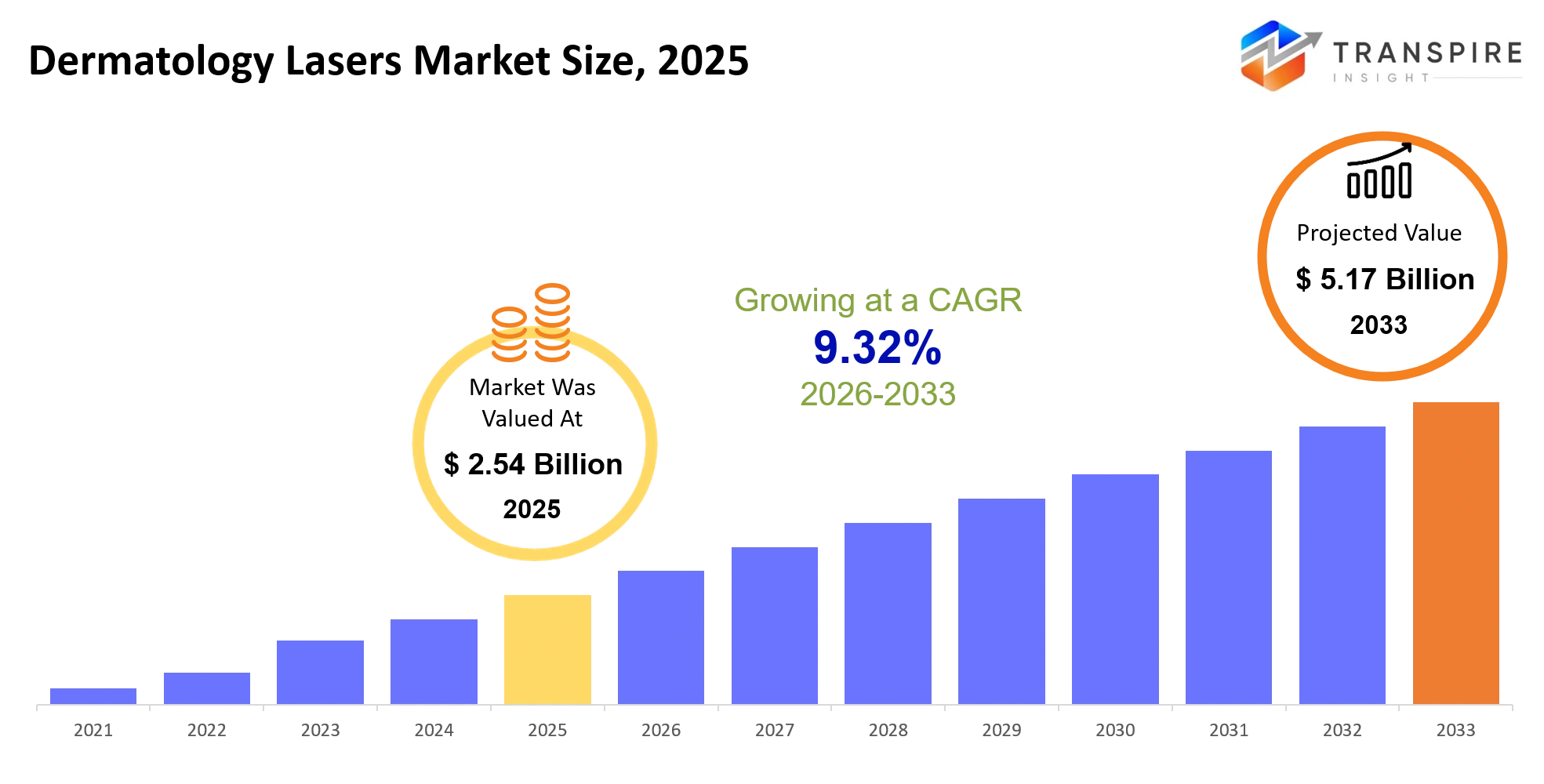
As per Transpire Insight Analysis, the Dermatology Lasers Market size is estimated at USD 2.54 Billion in 2025 and is anticipated to reach USD 15.26 Billion by 2033, growing at a CAGR of 11.82% from 2026 to 2033. This growth has been fueled by the growing demand for minimally invasive treatment of the skin, increased aesthetic treatments, advances in laser technology, and increased availability of dermatology services.
The dermatology lasers market is expected to grow due to the increase in the frequency of use of the laser systems by clinicians for the treatment of the skin, tattoo removal, and hair reduction. Recently, there has been a trend of preference for precision and minimally invasive laser systems, allowing faster recovery and increased comfort level. One of the factors driving the growth of the dermatology lasers market is the increase in the use of ablative and picosecond laser systems due to the constant innovations of the manufacturers and individualisation of the treatment process.
The growth was also driven by the rise in the popularity of aesthetic procedures that boosted the market for dermatology lasers. The market has expanded due to the increase in the number of skin care, cosmetic treatments and dermatology services. As a result, the growth of the procedures has continued to grow steadily and is likely to be sustained in the future due to the purchase of the laser systems by clinics.
Dermatology Lasers Market Size & Forecast:
- Market Size 2025: USD 2.54 Billion
- Expected Market Value (2033): USD 5.17 Billion
- Forecast CAGR (2026–2033): 9.32%
- Leading Region in 2025: North America
- Fastest Growing Region: Asia Pacific
- Key Company Profiles: Candela Medical, Lumenis, Alma Lasers, Cynosure, Cutera, Fotona, El.En., Lutronic, Bausch + Lomb, Sciton, Quanta System, Asclepion Laser Technologies, Aerolase, Zimmer MedizinSysteme, Venus Concept.
Key Market Insights:
The dermatology lasers market is continuously changing due to new developments in technology, growing volumes of aesthetic procedures, and increasing clinical use of sophisticated lasers. Innovations, broadening treatment applications, and patient inclination toward less invasive procedures keep transforming the competitive landscape.
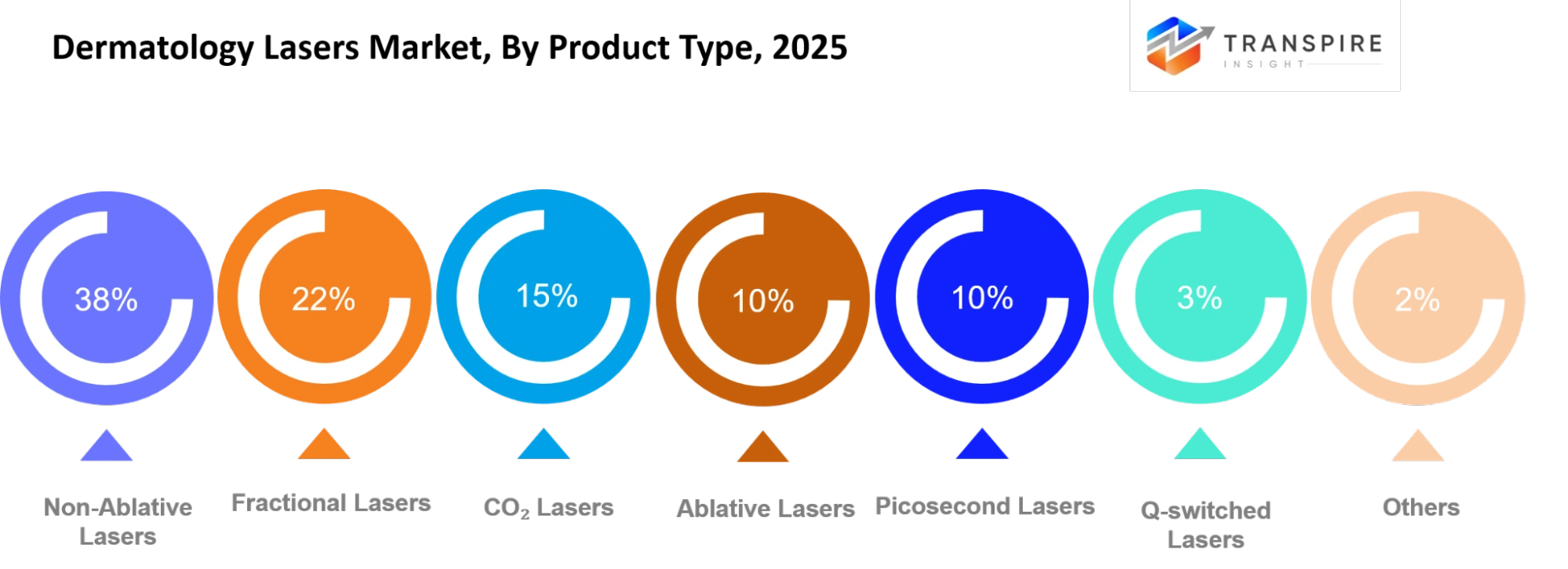
- Non-Ablative Lasers have a market share of 38%, which is due to high demand for therapies that provide highly effective skin rejuvenation without much downtime.
- Fractional Lasers have a market share of 22% since producers are improving their precision and customisation in treatment settings according to skin condition.
- CO₂ Lasers have a 15% share owing to innovations in tissue-targeting technology used for skin resurfacing.
- Picosecond Lasers will grow with a CAGR of 18.3% because of increased application in tattoo removal and treatment of pigmentation problems with shorter recovery time.
- Ablative Lasers make up 10% of the market while still being used in complex cases of skin resurfacing, where deep tissue penetration is needed.
- Q-Switched Lasers have a market share of 3% owing to their application in removing tattoos and treating skin pigmentation problems.
- Manufacturers are creating solutions with AI-supported treatment planning, cooling system intelligence, and energy adjustment.
What are the Key Drivers, Restraints, and Opportunities in the Dermatology Lasers Market?
Drivers
The market for dermatological lasers is mainly boosted by an increasing preference for minimally invasive cosmetic treatments and constant innovations in laser technology. Innovations in the area of non-ablative lasers allow clinics to provide skin rejuvenation, pigmentation treatments, and scar treatments in less time than before. The revival of elective aesthetic procedures post-pandemic and increased spending on appearance among consumers have further fueled equipment sales and treatment numbers. These trends have encouraged vendors to develop multipurpose laser devices.
Restraints
The high prices of dermatology lasers, as well as maintenance costs. Small clinics and healthcare providers experience financial difficulties with using high-quality laser equipment. At the same time, the necessity for specialists, the requirement to comply with regulations, and different insurance issues remain limitations of using laser equipment.
Opportunities
The potential opportunity that exists is through the advancement of AI-enabled laser treatments along with picosecond laser technology. The rapid investment by the healthcare industry in the Asia-Pacific region and elsewhere in the developing world has also created opportunities for players in the market to capitalise on.
What Has the Impact of Artificial Intelligence Been on the Dermatology Lasers Market?
The significance of artificial intelligence in enhancing the effectiveness and precision of dermatological laser therapies has been on the rise recently. The use of AI-based software for the evaluation of skin features and pigmentation, as well as recommendations on the setting of optimal laser therapy parameters depending on a patient's skin type and previous treatment experience, increases consistency and eliminates the necessity for manual calibration. AI can assist the dermatologist in tailoring the treatment plan for various dermatological conditions, including acne scarring, skin pigmentation problems, vascular lesions, and skin rejuvenation.
Another area of clinical benefit provided by predictive analytics is the estimation of treatment responses that can help practitioners individualise treatment plans and avoid extra visits. These benefits are limited by the prohibitive costs involved in integrating software solutions, as well as data privacy regulations and compatibility problems with laser machines. It may prove difficult to deploy the AI technology in smaller clinics as the financial resources are limited, as well as the knowledge to use the AI technology. In March 2025, Researchers from Yale University School of Medicine and Gold Skin Care Centre reported in the Journal of Cosmetic Dermatology about the use of AI systems to automatically set laser treatment parameters according to the features of the skin, enhancing accuracy and safety of cosmetic dermatology treatments.
Key Market Trends:
The dermatology lasers market is currently undergoing a smooth shift towards the usage of precise laser treatments due to technological advances and new patient needs. Companies are working hard to develop smart laser systems, wider applicability, and increased efficiency to increase their market share.
- Clinics have been actively substituting traditional laser systems with non-ablative and fractional systems offering an efficient treatment within a short time frame.
- Multifunctional laser platforms are widely used in dermatology nowadays, which allows performing skin resurfacing, skin pigmentation, scar revision, and hair removal on a single platform.
- The use of AI in the preparation of laser treatments is becoming popular, allowing dermatologists to choose the optimal laser settings for each patient.
- Picosecond laser technology is rapidly growing in popularity due to increasing needs for efficient and fast tattoo removal and pigmentation correction with minimal tissue damage.
- The use of advanced cooling systems and real-time energy measurement systems has become standard for dermatology lasers.
- Premium laser equipment is getting popular in dermatology clinics due to high demand for personalised cosmetic treatments.
Dermatology Lasers Market Segmentation
By Product Type
Non-Ablative Lasers occupy the biggest share with 38% due to their capability to perform effective skin regeneration with a very short recovery period. Their popularity among dermatologists and aesthetics clinics is connected with the rising consumer demand for safe cosmetic procedures. The Fractional Lasers make up 22%, and CO₂ Lasers take 15% in the market as the most commonly applied solutions for skin resurfacing and scar treatment. Ablative Lasers take 10%, and the same is observed for the Picosecond Lasers, but the latter ones show the highest growth rate within the period considered (CAGR 18.3%) due to the excellent efficiency in tattoos and pigmentations removal. Q-switched Lasers make up 3%, and Others – 2%.
By Application
The market growth is mainly driven by the Skin Resurfacing category, which is the highest revenue-generating segment owing to the increasing preference of patients for skin treatments for wrinkles, acne, and ageing skin. Categories like Hair Removal & Pigmentation Treatment have seen high demand in recent times as there is growing awareness among consumers and availability of treatment. Several other applications, including Scar Treatment, Tattoo Removal, Vascular Lesions, and Cosmetic Rejuvenation, will see growth with the advent of the latest laser technology.
By End User
Dermatology Clinics contribute to the highest share due to their unique skills, advanced laser devices, and tailor-made therapy programs. Meanwhile, Hospitals will keep delivering necessary laser treatment, while the rapid growth of Medical Spas can be attributed to aesthetic procedures in an outpatient setting. Other healthcare establishments include Cosmetic Surgery Centres, Ambulatory Surgical Centres, Research Institutes, and others.
By Technology
There are CO₂ Laser, Nd: YAG Laser, Alexandrite Laser, Diode Laser, Er: YAG Laser, IPL Systems, and other technologies. CO₂ and Nd: YAG lasers are popular for their use in different dermatological cases. At the same time, the increasing popularity of Alexandrite and Diode lasers is associated with hair removal and pigmentation therapy. The evolution in energy delivery, cooling and accuracy of treatment encourages healthcare providers to update their current laser devices.
By Distribution Channel
This is driven by Direct Sales, allowing the manufacturers to offer installation, technical support, and clinical education directly to the healthcare professionals. The Medical Device Distributors keep enhancing market access in the regions, especially in the developing countries. Hospital Procurement is a trustworthy procurement channel for larger healthcare organisations, whereas online business-to-business platforms are becoming significant in the process of procurement of products.
What are the Key Use Cases Driving the Dermatology Lasers Market?
Dermatology lasers are used primarily for the purpose of skin resurfacing due to their availability and extensive usage through the Non-Ablative Lasers. They are widely used for treating wrinkles, improving skin texture, treating acne marks, and addressing pigmentation issues, providing faster recovery time than other existing techniques.
Lasers are finding their usage in various other applications such as hair removal, tattoo removal, scar revision, vascular lesions, and skin rejuvenation. Medical spas, dermatology centres, and hospitals are increasingly using these latest technological advancements to offer patient-customised care with better precision and consistent results. Some new application areas that can be seen include the analysis of the skin through the help of AI and planning customised treatment, and using multiple lasers to provide aesthetically pleasing results. It is expected that with the growing popularity of preventive skin care and minimally invasive procedures, these lasers will see more application areas.
|
Report Metrics |
Details |
|
Market size value in 2025 |
USD 2.54 Billion |
|
Market size value in 2026 |
USD 2.77 Billion |
|
Revenue forecast in 2033 |
USD 5.17 Billion |
|
Growth rate |
CAGR of 9.32% from 2026 to 2033 |
|
Base year |
2025 |
|
Historical data |
2021 - 2024 |
|
Forecast period |
2026 - 2033 |
|
Report coverage |
Revenue forecast, competitive landscape, growth factors, and trends |
|
Regional scope |
United States; Canada; Mexico; United Kingdom; Germany; France; Italy; Spain; Denmark; Sweden; Norway; China; Japan; India; Australia; South Korea; Thailand; Brazil; Argentina; South Africa; Saudi Arabia; United Arab Emirates |
|
Key company profiled |
Candela Medical, Lumenis, Alma Lasers, Cynosure, Cutera, Fotona, El.En., Lutronic, Bausch + Lomb, Sciton, Quanta System, Asclepion Laser Technologies, Aerolase, Zimmer MedizinSysteme, Venus Concept. |
|
Customization scope |
Free report customization (country, regional & segment scope). Avail customized purchase options to meet your exact research needs. |
|
Report Segmentation |
By Product Type (Ablative Lasers, Non-Ablative Lasers, Fractional Lasers, Picosecond Lasers, Q-switched Lasers, Pulsed Dye Lasers, CO₂ Lasers, Others); By Application (Skin Resurfacing, Hair Removal, Tattoo Removal, Scar Treatment, Pigmentation Treatment, Vascular Lesions, Cosmetic Rejuvenation, Others); By End User (Hospitals, Dermatology Clinics, Medical Spas, Cosmetic Surgery Centers, Ambulatory Surgical Centers, Research Institutes, Others); By Technology (CO₂ Laser, Nd:YAG Laser, Alexandrite Laser, Diode Laser, Er:YAG Laser, IPL Systems, Others); By Distribution Channel (Direct Sales, Medical Device Distributors, Hospital Procurement, Online B2B Platforms, Others). |
Which Regions are Driving the Dermatology Lasers Market Growth?
North America
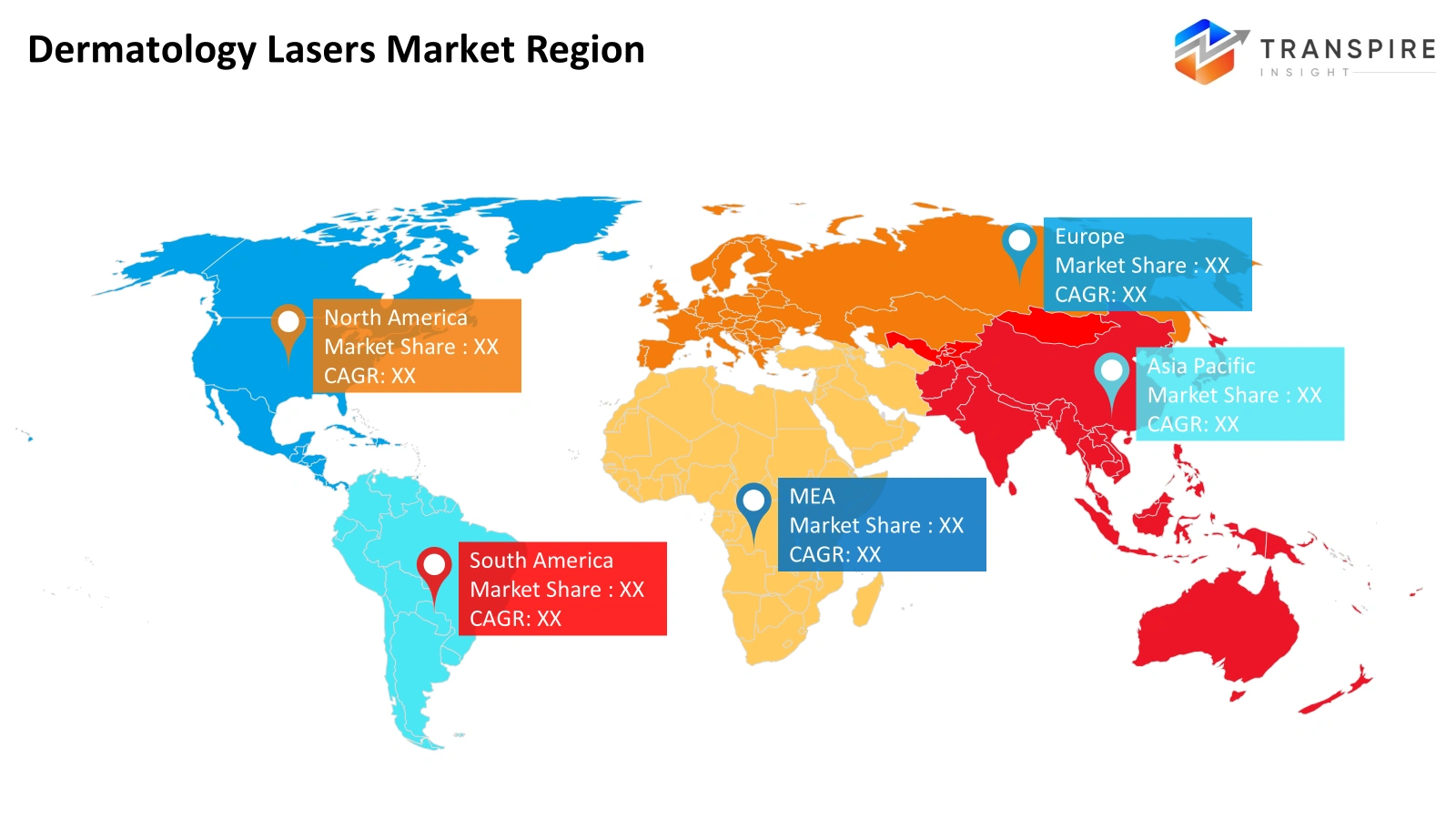
The share of North America in the market of dermatology lasers is the highest – 39%. This is attributed to the developed healthcare system, a large number of dermatology clinic chains in the region, along with advanced laser technologies used in this sphere, the popularity of aesthetic procedures in the region, and the presence of key players of the industry on the regional market. Favourable reimbursement for specific dermatological treatments, as well as high awareness of consumers about cosmetic skin treatments, contribute to the leadership of the region.In April 2025, Fraxel FTX, a next-generation laser skin resurfacing platform from Solta Medical (Bausch Health), was unveiled at the ASLMS 2025 Annual Conference in Orlando, Florida. The device is intended for skin resurfacing, pigmentation therapy, wrinkle reduction, and scar removal to enhance the development of advanced dermatology laser technologies in North America.
Europe
Europe's share in the market is 29%, which makes it a stable m market where there is a constant demand for procedures that use lasers for dermatology. Compared to North America, Europe's growth is driven by the presence of developed public and private healthcare systems, growing popularity of minimally invasive procedures for aesthetic purposes, and stringent requirements for the quality of medical devices. Continuous investment in the modernisation of dermatology clinics and implementation of advanced laser technologies provide stability to the region's market development.In April 2025, Candela Corporation unveiled the Vbeam Pro Laser Platform at the ASLMS 2025 Annual Meeting. This laser platform comprises 595 nm pulsed dye laser and 1064 nm Nd: YAG laser technologies for vascular and dermatologic applications. Commercialisation efforts started in several major European countries after launching this innovative technology into the market.
Asia Pacific
The Asia Pacific region is growing at the fastest pace and holds around 25% of the market share with a projected growth rate of 19.1% CAGR during the forecast period. Urbanisation, higher disposable incomes, increasing medical tourism, and investment in cosmetic healthcare have been some of the factors that have contributed to the growth of the market in recent times. Increasing dermatology clinics and availability of laser treatments in emerging economies have provided growth opportunities in the market. In the coming years, owing to the increasing popularity of aesthetic treatments, the Asia Pacific region would remain a lucrative segment.In March 2025, Candela Corporation announced that its new Glacē Skin Purifying Treatment will be available in the Asia Pacific markets after being unveiled globally at the AAD Annual Meeting 2025. This product launch will support rising demand for advanced aesthetic and dermatology lasers in Asia Pacific.
Who are the Key Players in the Dermatology Lasers Market and how do they Compete?
The competition in the dermatology lasers market around the world is based on innovations, the performance of the product, and the extension of geographical reach. Competing manufacturers seek to innovate laser systems, which provide better accuracy, reduced recovery periods, and flexibility in terms of applications. Competitors also rely on the expansion of the distribution network, research and development, and cooperation with clinics and hospitals specialising in dermatology.
The competitive advantage of the leading companies can be seen through the use of unique technologies and special business approaches. Candela Corporation specialises in the production of premium aesthetic lasers and launches new systems used for skin resurfacing, hair removal, and pigment management, while increasing training for its products. Lumenis specialises in innovation, offering intelligent energy delivery and multi-application laser platforms that enable performing a wider range of dermatological procedures. Cynosure gains a competitive advantage through product development and partnerships.
Dermatology Lasers Market companies
- Candela Medical
- Lumenis
- Alma Lasers
- Cynosure
- Cutera
- Fotona
- El.En.L
- Utronic
- Bausch + Lomb
- Sciton
- Quanta System
- Asclepion Laser Technologies
- Aerolase
- Zimmer MedizinSysteme
- Venus Concept
Recent Development News
In April 2025, Alma Lasers unveiled its new generation of Alma Harmony aesthetic platform with new laser technologies and AI-powered workflow innovations and personalisation solutions for various skin conditions. This product release extended Alma's product line and provided added efficiency to dermatology practitioners.
Source: https://almalasers.com
What Strategic Insights Define the Future of the Dermatology Lasers Market?
The future of the dermatology lasers market is expected to witness more technology-enabled treatment solutions that would have increased precision, efficiency, and effectiveness. The future growth potential of the dermatology lasers market will be driven by increasing adoption of AI-based laser systems, minimally invasive procedures, and increasing investments in dermatology clinics in emerging markets.
hidden threat lies in the growing technology disparity between top-notch healthcare facilities and smaller ones, wherein expensive technology and skilled workforce will pose barriers to adoption in the latter. On the other hand, growing demand for picosecond and non-ablative lasers, and increasing investments in healthcare in the Asia Pacific region offer great potential. The companies need to work towards offering cost-efficient laser platforms and investing in constant innovations to capitalise on emerging demands and sustainable growth in the future.
Key Segmentations are:
By Product Type
- Ablative Lasers
- Non-Ablative Lasers
- Fractional Lasers
- Picosecond Lasers
- Q-switched Lasers
- Pulsed Dye Lasers
- CO₂ Lasers
By Application
- Skin Resurfacing
- Hair Removal
- Tattoo Removal
- Scar Treatment
- Pigmentation Treatment
- Vascular Lesions
- Cosmetic Rejuvenation
By End User
- Hospital
- Dermatology Clinics
- Medical Spas
- Cosmetic Surgery Centers
- Ambulatory Surgical Center
- Research Institute
By Technology
- CO₂ Laser
- Nd:YAG Laser
- Alexandrite Laser
- Diode Laser
- Er:YAG Laser
- IPL Systems
By Distribution Channel
- Direct Sales
- Medical Device Distributors
- Hospital Procurement
- Online B2B Platforms
Regional Outlook
North America
- United States
- Canada
- Mexico
Europe
- Germany
- United Kingdom
- France
- Spain
- Italy
- Rest of Europe
Asia Pacific
- Japan
- China
- Australia & New Zealand
- South Korea
- India
- Rest of Asia Pacific
South America
- Brazil
- Argentina
- Rest of South America
Middle East & Africa
- Saudi Arabia
- United Arab Emirates
- South Africa
- Rest of the Middle East & Africa
Frequently Asked Questions
Find quick answers to common questions.
The dermatology lasers market size was valued at USD 2.54 Billion in 2025 and is poised to reach USD 5.17 Billion by 2033, expanding at a 9.32% CAGR.
Key segments for the dermatology lasers market are By Product Type (Ablative Lasers, Non-Ablative Lasers, Fractional Lasers, Picosecond Lasers, Q-switched Lasers, Pulsed Dye Lasers, CO₂ Lasers, Others); By Application (Skin Resurfacing, Hair Removal, Tattoo Removal, Scar Treatment, Pigmentation Treatment, Vascular Lesions, Cosmetic Rejuvenation, Others); By End User (Hospitals, Dermatology Clinics, Medical Spas, Cosmetic Surgery Centers, Ambulatory Surgical Centers, Research Institutes, Others); By Technology (CO₂ Laser, Nd: YAG Laser, Alexandrite Laser, Diode Laser, Er: YAG Laser, IPL Systems, Others); By Distribution Channel (Direct Sales, Medical Device Distributors, Hospital Procurement, Online B2B Platforms, Others).
Growth is primarily driven by the increase in the incidence of skin problems, the need for minimally invasive beauty treatments, constant developments in laser technology, increased interest in cosmetic procedures, and the development of dermatological clinics around the world.
The market is led by major manufacturers including Candela Medical, Lumenis, Alma Lasers, Cynosure, Cutera, Fotona, El.En., Lutronic, Bausch + Lomb, Sciton, Quanta System, Asclepion Laser Technologies, Aerolase, Zimmer MedizinSysteme, Venus Concept.
The dermatology lasers market in North America represents 39% of the market due to higher usage of lasers, rising demands for aesthetic and skin care treatments, solid medical facilities, and leading dermatological equipment companies.
The commercial areas in the dermatology laser market comprise increasing demand for minimally invasive cosmetic procedures, increased adoption of aesthetic procedures in developing nations, technological developments in lasers, and increased investments in dermatology centres and medical spas.
- Candela Medical
- Lumenis
- Alma Lasers
- Cynosure
- Cutera
- Fotona
- El.En.L
- Utronic
- Bausch + Lomb
- Sciton
- Quanta System
- Asclepion Laser Technologies
- Aerolase
- Zimmer MedizinSysteme
- Venus Concept
About the Authors

Pankaj Ghogare Patil
I am Pankaj Ghogare Patil, a Senior Research Analyst at Transpire Insight, specializing in the Pharmaceutical, Chemicals & Materials, Healthcare IT, and Biotechnology industry. My expertise lies in conducting comprehensive market research, analyzing industry trends, evaluating competitive landscapes, and translating complex data into actionable insights. At Transpire Insight, I closely follow emerging technologies, regulatory developments, and market innovations to create accurate, well-researched, and informative content that helps businesses and professionals make informed decisions. I am committed to producing credible, evidence-based articles that reflect industry best practices while making technical topics accessible and valuable for a broad audience.

Chakradhar Khansole
Chakradhar serves as the Research Director at Transpire Insight, bringing over 8 years of experience in technology, innovation, and strategic market intelligence. He specializes in transforming complex market data into actionable business insights that enable organizations to make informed, growth-oriented decisions. Recognized for his strategic vision and analytical expertise, Chakradhar leads high-impact research initiatives, delivering comprehensive market assessments, competitive intelligence, and forward-looking industry analysis.
Recently Published Reports
-
Apr 2026
AI in Diabetic Retinopathy Market
AI in Diabetic Retinopathy Market Size, Share & Analysis Report By Type (Screening AI Systems, Diagnostic AI Systems, and Predictive AI Models), By Application Segment (Hospitals, Ophthalmology Clinics, Diagnostic Centers, and Research and Development), and Geography (North America, Europe, Asia-Pacific, Middle East and Africa, South and Central America), 2021 - 2031
-
Apr 2026
Psychometric Tests Market
Psychometric Tests Market Size, Share & Analysis Report By Type (Personality Tests, Ability/Aptitude Tests, Skill/Knowledge Tests, and Others), By Application (Talent Acquisition and Talent Management), and Geography (North America, Europe, Asia-Pacific, Middle East and Africa, South and Central America), 2021 – 2031
-
Apr 2026
Rare Biological Sample Collection Market
Rare Biological Sample Collection Market Size, Share & Analysis Report By Type (Isolation Kits & Reagent, Blood Collection Tubes, and Others), By Application (Oncology, Transcriptomics, Pharmacogenomics, and Others), and Geography (North America, Europe, Asia-Pacific, Middle East and Africa, South and Central America), 2021 – 2031
-
Jul 2026
Diabetic Retinopathy Market
Diabetic Retinopathy Market Size, Share & Analysis Report By Type (Proliferative Diabetic Retinopathy, and Diabetic Macular Edema (DME)), By Treatment Type (Anti VEGF Drug, Steroid Implants, Laser Surgeries, and Vitrectomy), and Geography (North America, Europe, Asia-Pacific, Middle East and Africa, South and Central America), 2021 – 2031
Our Clients







