
Global Medical Device Vigilance and Patient Safety Software Market Size & Forecast:
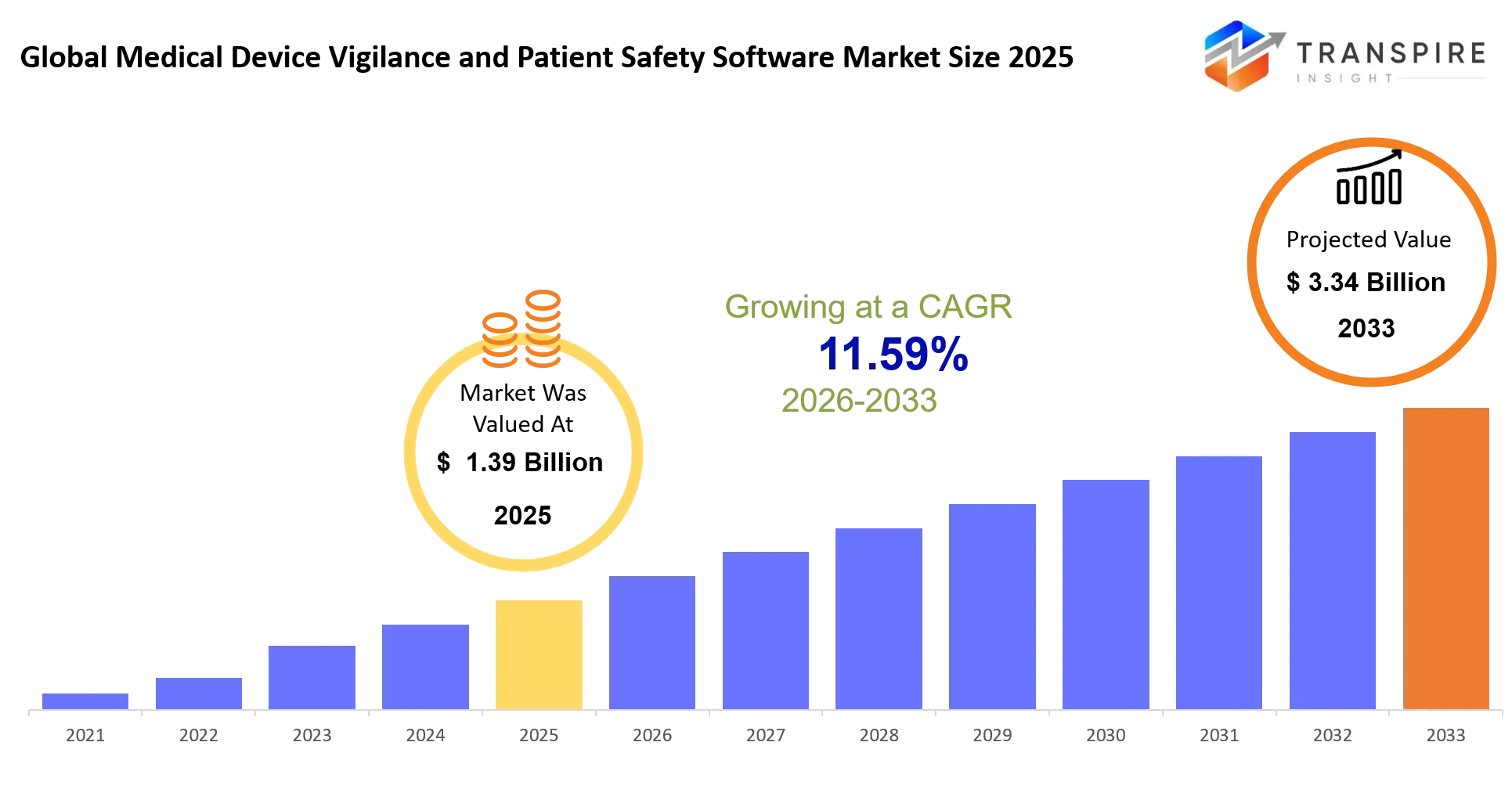
- Global Medical Device Vigilance and Patient Safety Software Market Size 2025: USD 1.39 Billion
- Global Medical Device Vigilance and Patient Safety Software Market Size 2033: USD 3.34 Billion
- Global Medical Device Vigilance and Patient Safety Software Market CAGR: 11.59%
- Global Medical Device Vigilance and Patient Safety Software Market Segments: By Component (Software, Services, Analytics, Reporting Tools, Risk Management, Cloud Platforms, AI Modules, Others); By Deployment (Cloud, On-Premise, Hybrid, SaaS, Private Cloud, Public Cloud, Managed Services, Others); By Application (Adverse Event Reporting, Risk Management, Compliance Management, Quality Management, Signal Detection, Product Recalls, Audit Management, Others); By End User (Hospitals, Medical Device Manufacturers, CROs, Regulatory Authorities, Clinics, Pharma Companies, Laboratories, Others); By Enterprise Size (Large Enterprises, Medium Enterprises, Small Enterprises, Public Organizations, Private Organizations, Global Enterprises, Regional Enterprises, Others).
Global Medical Device Vigilance and Patient Safety Software Market Summary:
As per Transpire Insight Analysis, the Global Medical Device Vigilance and Patient Safety Software Market size is estimated at USD 1.39 billion in 2025 and is anticipated to reach USD 3.34 billion by 2033, growing at a CAGR of 11.59% from 2026 to 2033.
This vital industry sector now enables manufacturers, hospitals, clinicians, and regulatory organisations to monitor, report, and manage medical device complaints, recalls, and adverse events. Vigilance and patient safety software are increasingly relied upon to extract the maximum learning from extensive data sets, in addition to speeding up the reporting process and minimising delays that put patient health at risk. In recent years, there has been a significant migration from paper-driven, disparate vigilance reporting to more sophisticated cloud-based, AI-powered surveillance hubs.
Such solutions help process and report real-time safety information at a global level.
European MDR regulations and new FDA reporting capabilities have already put increasing strain on reporting processes, and recent safety issues associated with all device classes, including implantable devices, infusion and pumps, along with increasingly connected devices, are fueling accelerated demand for proactive surveillance software. The increase in the level of regulatory requirements on an already-burdened system creates sustained and growing demand, as medical device organisations look to improve compliance, efficiencies and patient safety with automation.
Key Global Medical Device Vigilance and Patient Safety Software Market Insights:
The journey of regulatory modernisation and digital safety monitoring is paving the way for the evolution of vigilance software from a compliance tool to a strategic risk-management platform. There is a growing trend to use AI-powered analytics and cloud reporting systems to enhance the efficiency of surveillance and speed up regulatory responses.
- Adverse event reporting software is a 34% share of the market, and vendors are adding automation in case intake and multi-country reporting.
- AI signal detection software is expected to exhibit a growth rate of 18.2% CAGR, with machine-learning algorithms detecting emerging safety patterns at an earlier stage.
- North America accounts for 46% of global revenue, with regulatory reporting infrastructure well developed and a high prevalence of digital quality systems.
- Compliance management solutions account for 15% of application demand as manufacturers adjust to a changing MDR, FDA and global reporting landscape.
- Risk management platforms make up 21% of market activity, while risk-benefit assessment modules are becoming more popular among device manufacturers.
- Vigilance and enterprise quality ecosystems converge in Quality management applications, which make up 11% of deployments.
- The vendors that are integrating predictive analytics into post-market surveillance workflows have a 9% share of the signal detection solutions market.
- More than half of new deployments are cloud-based, which allows for remote audits, real-time collaboration, and a central safety governance centre.
What are the Key Drivers, Restraints, and Opportunities in the Global Medical Device Vigilance and Patient Safety Software Market?
Driver:
The increasing complexity of worldwide medical device regulatory compliance, post-market surveillance, and post-market oversight rules. Concerns from recent device safety issues, plus increasing use of connected medical devices by providers and patients, have driven regulators to increase monitoring activities. Medical device manufacturers, hospitals and CROs will no longer be able to monitor clinical trials with separate siloed methods, as all the data previously siloed in several reports will be consolidated, and an automated system will manage and simplify adverse events reporting, enabling regulatory submissions and making the entire entity ready for audit at all times. In March 2026, the FDA launched its unified Adverse Event Monitoring System (AEMS) platform. This large-scale infrastructure deployment consolidates multiple legacy databases into a singular dashboard to manage electronic adverse event intakes across regulated device categories.
Restraint:
Interoperability with existing legacy hospital, manufacturing and quality management (QM) systems and their specific region and jurisdictional data, standards and reporting infrastructure, which adds difficulty, cost and lead time to implementation. These systemic and structural concerns occur because legacy infrastructure can be expensive to replace, redesign workflow or provide necessary skilled IT support.
Opportunity:
The growth in AI-enabled predictive safety intelligence and the formation of global digital health ecosystems present significant upside potential. Organisations will leverage sophisticated analytics to gain insight into potential device safety hazards well before a problem develops with the devices in the field. Cloud investment, RWE platforms and digital health will serve to fuel additional avenues for expansion and the digital pace in Asia Pacific – particularly where regulatory systems are also advancing rapidly – will create fertile opportunities for providers focused on predictive and automated compliance, along with an elastic cloud infrastructure.
In May 2026, the European Commission implemented mandatory EUDAMED Actor and Device Registration frameworks to anchor its centralised digital health ecosystem. This structural rollout provides an integrated digital clearinghouse that enables device manufacturers and global authorities to share post-market surveillance trends.
What Has the Impact of Artificial Intelligence Been on the Global Medical Device Vigilance and Patient Safety Software Market?
Artificial intelligence has dramatically increased the effectiveness and smarter management of medical device vigilance and patient safety software. In addition, the addition of AI allows automated adverse events intake, case triage, duplication searches, literature monitoring and report submissions, lessening the manual, resource-intensive processes of today's vigilance groups. Language-processing software provides analysis of unstructured complaint information, clinical reports and service data, in order to systematically isolate significant safety information faster and with greater accuracy.
AI applications in predictive analytics are proving highly effective. The combination of predictive algorithms identifies recurring device problems, detects rising adverse events, and creates warnings to prevent a widespread safety issue before it becomes a product recall. This empowers healthcare organisations and manufacturers to transition from the usual reactive approach to problem-solving to a proactive approach. AI improves the accuracy of product reporting, accelerates case resolution, better supports the audit processes, and enables global monitoring in real time. The high cost of implementing the AI system, integration into existing technology, questions over the transparency of the algorithms, and the reliability of data to provide meaningful insights that are supportable by human judgment.
Key Global Medical Device Vigilance and Patient Safety Software Market Trends:
The industry is moving away from reporting events towards predictive patient safety intelligence based on advanced analytics. Organisations are increasingly focusing on a comprehensive quality, compliance and vigilance framework instead of a singular safety application.
- Organizations are turning to cloud-native vigilance platforms in a bid for quicker upgrades and global scalability instead of on-premise systems.
- Signal detection with AI is no longer a novel application, but a common tool for post-market surveillance.
- Manual case processing and submission delays are minimised thanks to enhanced regulatory reporting workflows, which are increasingly automatic.
- There is increasing real-world safety data for connected medical devices, promoting models that monitor safety constantly.
- Enterprise-wide risk visibility is becoming better due to the cross-functional integration of quality management and vigilance systems.
- The importance of digital audit readiness tools is growing, given regulators' increased push for more transparent audit outcome documentation.
- Patient safety issues are being centralised on patient safety dashboards and are being consolidated across various healthcare facilities.
- Predictive recall management is developing, allowing businesses to anticipate trends of product-risk before a wide recall field action.
Global Medical Device Vigilance and Patient Safety Software Market Segmentation
By Component:
Software-dominated segment as companies are investing in unified applications for adverse event reporting, regulatory monitoring and surveillance processes. The services sector is rapidly developing through integration, customization, and managed compliance services, while the growing segment includes cloud solutions, Analytics and reporting, AI services for predictive patient care management, risk management software solutions and safety analytics. Advanced features are enhanced by the rise of AI as a component.
By Deployment:
Cloud-based offerings claim the largest market share due to enhanced real-time communication capabilities, a centralised data store, regulatory automatic updates and safety surveillance across multiple locations. Public cloud and SaaS are experiencing growing momentum while private cloud and hybrid remain the prime choices for enterprises demanding elevated levels of data safety and regulatory compliance. Organisations increasingly opt for more adaptable cloud architecture to assist in worldwide compliance actions.
By Application:
Adverse Event Reporting dominates the market at 34% due to strict post-market surveillance and increasing volumes of reports, with Risk Management following close behind with 21% owing to a growing emphasis on preventive strategies for safety, while Compliance Management is 15% and Quality Management 11% as companies integrate these practices into a unified vigilance system. In the emerging section of Signal Detection (9%), AI-based Signal Detection Platforms have an estimated 18.2% CAGR, making them the rapidly increasing application segment, with product recalls, audit management and other safety applications making up the rest of 10%.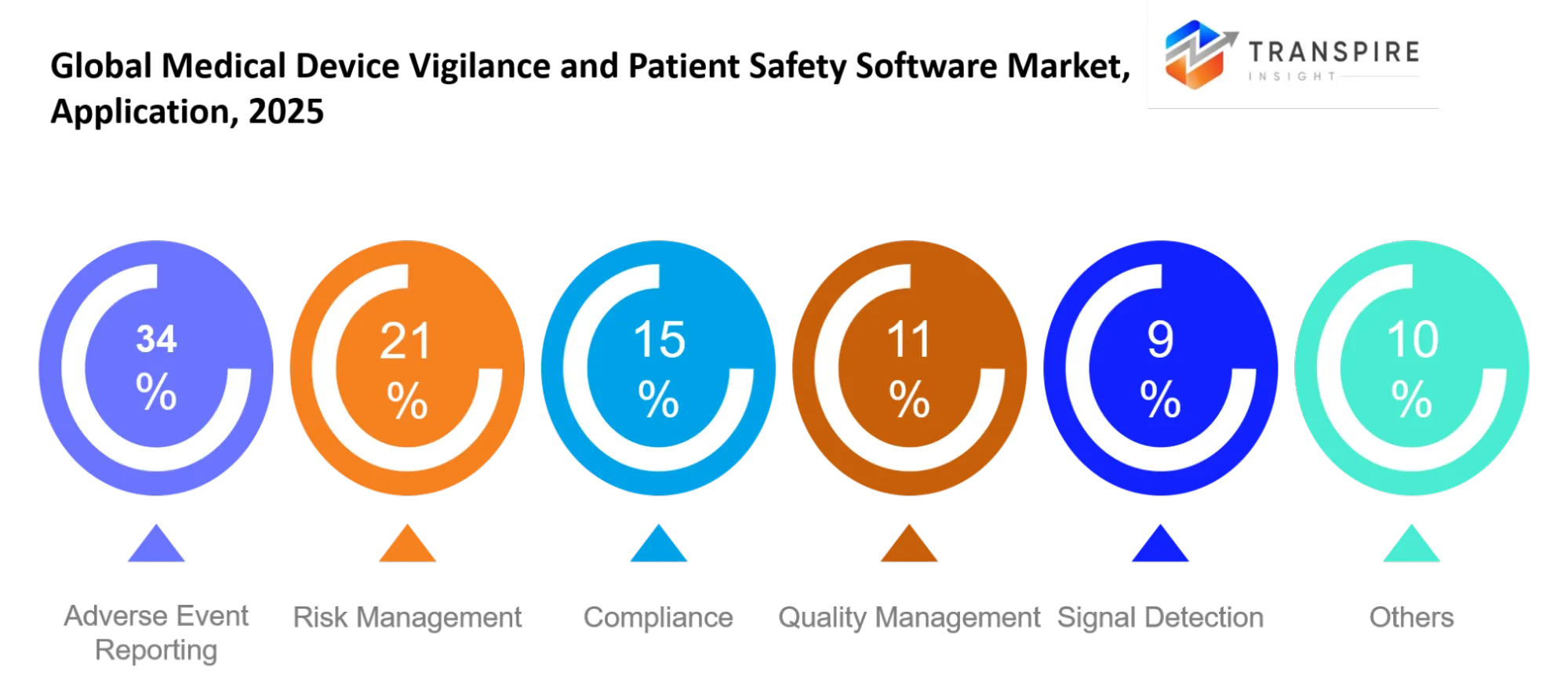
By End-User:
Medical device manufacturers are the largest customers for this technology and service. Health care organizations including hospitals and clinics, CROs, pharmaceutical developers, laboratories and regulatory agencies, are looking at vigilance integrated platforms that are key in supporting increased reporting accuracy, oversight for patient safety, and workflow efficiency.
By Enterprise Size:
Large enterprise businesses have a high impact because of their global regulatory obligations and broad product scope. Companies in medium and small enterprises are increasingly migrating to the cloud to streamline regulatory processes while opting for affordability via subscription. Public and private sectors, regional businesses, and the enterprise’s global leader will all start investing more due to complexity in regulations and the world’s high demands for patient care.
What are the Key Use Cases Driving the Global Medical Device Vigilance and Patient Safety Software Market?
The biggest market is regulatory reporting for adverse events and post-market surveillance, which corresponds with the top segment of the market (34%). Through these kinds of applications, manufacturers and healthcare professionals can register customer complaints and device failures, conduct incident investigations, automate reporting to regulatory agencies and perform compliance documentation.
Other applications for vigilance are enterprise risk management, quality management, auditing preparation and managing recalls of products.
An increasingly popular option to create an overview of safety and compliance information across countries/markets is to build an internal view of compliance by the vigilance information.
New market-growth possibilities include advanced monitoring, which covers advanced analysis and regulatory affairs with the help of data.
|
Report Metrics |
Details |
|
Market size value in 2025 |
USD 1.39 Billion |
|
Market size value in 2026 |
USD 1.55 Billion |
|
Revenue forecast in 2033 |
USD 3.34 Billion |
|
Growth rate |
CAGR of 11.59% from 2026 to 2033 |
|
Base year |
2025 |
|
Historical data |
2021 - 2024 |
|
Forecast period |
2026 - 2033 |
|
Report coverage |
Revenue forecast, competitive landscape, growth factors, and trends |
|
Regional scope |
United States; Canada; Mexico; United Kingdom; Germany; France; Italy; Spain; Denmark; Sweden; Norway; China; Japan; India; Australia; South Korea; Thailand; Brazil; Argentina; South Africa; Saudi Arabia; United Arab Emirates |
|
Key company profiled |
Oracle, SAP, Veeva, IQVIA, ArisGlobal, Sparta Systems, Dassault Systèmes, Ennov, Honeywell, IBM, Siemens Healthineers, Parexel, Accenture, Medidata, AssurX |
|
Customization scope |
Free report customisation (country, regional & segment scope). Avail customised purchase options to meet your exact research needs. |
|
Report Segmentation |
By Component (Software, Services, Analytics, Reporting Tools, Risk Management, Cloud Platforms, AI Modules, Others); By Deployment (Cloud, On-Premise, Hybrid, SaaS, Private Cloud, Public Cloud, Managed Services, Others); By Application (Adverse Event Reporting, Risk Management, Compliance Management, Quality Management, Signal Detection, Product Recalls, Audit Management, Others); By End User (Hospitals, Medical Device Manufacturers, CROs, Regulatory Authorities, Clinics, Pharma Companies, Laboratories, Others); By Enterprise Size (Large Enterprises, Medium Enterprises, Small Enterprises, Public Organizations, Private Organizations, Global Enterprises, Regional Enterprises, Others) |
Which Regions are Driving the Global Medical Device Vigilance and Patient Safety Software Market?
North America holds a significant market share of 46%, which is attributed to a mature regulatory landscape, widespread IT in healthcare, and a high density of device manufacturers. Compliance requirements are high across organisations, so they maintain significant investment in compliance software. Cloud-based software solutions have wide acceptance and facilitate deployment in the region. It is supported by continuous government regulatory policies focusing on increased safety for the patients' monitoring software. In March 2026, Veeva Systems rolled out its updated Veeva Safety Signal application. This cloud-based software launch embeds advanced tracking modules to detect unexpected adverse events during clinical trials and postmarketing phases, delivering robust automated signal tracking to meet high North American compliance standards for patient monitoring systems.
The European market comprises 27% of the total global value and holds the second-largest market share globally. A greater role of market drivers includes regulatory harmonisation and updating and modernizing compliances, as against North America. Regulations under MDR have boosted market trends by creating awareness and the need for advanced vigilance, tracking and traceability systems. The market is gradually gaining stability due to the effective partnership between manufacturers and authorities. In April 2026, IQVIA released Veeva Safety Suite and Vigilance Detect + Extract integrations. This automated software deployment utilises layered natural language processing and generative AI to continuously scan patient interaction data and extract compliant ICH E2B-formatted safety intelligence.
The Asia-Pacific holds about 20% of the total market size in terms of market share and is the fastest-growing region with the fastest growth rate at a CAGR of 19.4%. The Asia Pacific region, which has seen recent adoption of healthcare digitalisation efforts, a rising medical device manufacturing operation, and increasing regulation, is a game-changer. The governments are initiating and undertaking the modernisation of safety in the nation. In light of such progress, substantial opportunities will arise over the coming years for AI and cloud-based surveillance systems. In April 2026, Greenlight Guru launched its Post-Market MedTech Operations Maturity Architecture. This software product rollout introduces dedicated, connected modules for complaint handling, CAPA, and nonconformances, giving rapidly growing Asia-Pacific manufacturers the exact AI-friendly infrastructure required to modernise safety surveillance across regional digitalised networks.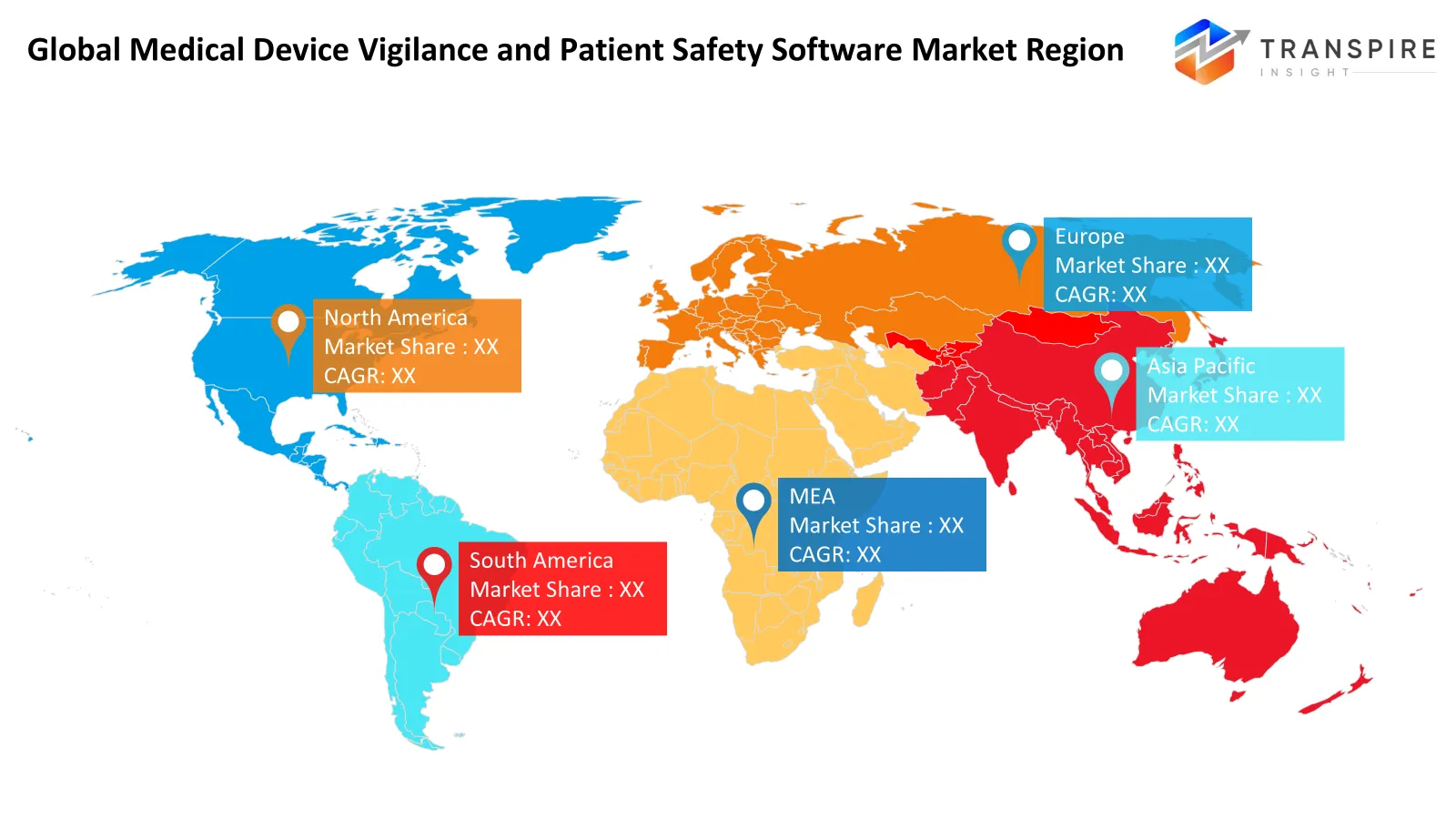
Who are the Key Players in the Global Medical Device Vigilance and Patient Safety Software Market and how do they Compete?
The Global Medical Device Vigilance and Patient Safety Software Market competition is powered by regulatory automation, AI-powered analytics, cloud-based deployment models, and integrations with enterprise-wide quality management software. Solution providers aim to create platforms that enhance monitoring capabilities for patient safety, make operations and monitoring easier and more efficient, reduce the complexities of the regulations while leveraging analytics capabilities for safety. Predictive analytics will act as a key differentiator across solution providers.
Oracle, SAP, IBM and Accenture leverage vast cloud infrastructure and connectivity across enterprises in delivering transformational, business-aligned cloud services, integrating the whole business- to the supply chain from global visibility. Veeva, IQVIA, ArisGlobal and Parexel leverage domain expertise to simplify global, highly regulated reporting and compliance workflows. The specialists include Sparta Systems, AssurX, Ennov and Medidata, who concentrate on robust cloud platforms that empower their customers for quality and safety best practices, with Dassault Systèmes integrating vigilance with Product Lifecycle Management and Honeywell & Siemens Healthineers leveraging IoT technology for connected care. Many companies across the board are focusing on building capabilities for vigilance through AI, cloud upgrades, stronger partnership networks, and richer regulatory content.
Key Players are:
- Oracle
- SAP
- Veeva
- IQVIA
- ArisGlobal
- Sparta Systems
- Dassault Systèmes
- Ennov
- Honeywell
- IBM
- Siemens Healthineers
- Parexel
- Accenture
- Medidata
- AssurX
Recent Development News
- In March 2026, RLDatix completed a full-scale institutional migration of the Children’s Hospital of Orange County onto its cloud-hosted healthcare risk management platform. This deployment replaced fragmented reporting systems with a unified patient safety platform, accelerating safety investigations and improving reporting efficiency.
- In May 2026, Qinecsa rolled out its updated QVW digital suite featuring continuous safety surveillance software specialised for medical devices. This targeted software launch transitions life sciences organisations from traditional, passive complaint handling into an era of proactive, automated signal tracking to manage global post-market surveillance and medical device vigilance data.
What Strategic Insights Define the Future of the Global Medical Device Vigilance and Patient Safety Software Market?
Industry is trending towards a predictive, interoperable safety ecosystem where quality and safety monitoring, regulatory submissions and real-world evidence are coordinated via a central intelligence layer. Organisations that can leverage AI-powered analytics combined with real-time automated reporting have the potential for operational and regulatory upside. Undermining the shift: an increasing reliance on fragmented data sets and AI-generated recommendations without sufficient oversight and standards of quality and transparency poses a unique set of governance challenges. On the upside: an opening to real-time safety intelligence data from connected devices and ongoing post-market surveillance programs opens new doors. Strategy vendors should focus on interoperable cloud platforms, explainable AI solutions, and global regulatory intelligence solutions in the coming months; future market leadership is for the vendors who enable customers to shift away from managing on the reactive and start making predictions.
Key Segmentations are:
By Component
- Software
- Services
- Analytics
- Reporting Tools
- Risk Management
- Cloud Platforms
- AI Modules
- Others
By Deployment
- Cloud
- On-Premise
- Hybrid
- SaaS
- Private Cloud
- Public Cloud
- Managed Services
- Others
By Application
- Adverse Event Reporting
- Risk Management
- Compliance Management
- Quality Management
- Signal Detection
- Product Recalls
- Audit Management
- Others
By End User
- Hospitals
- Medical Device Manufacturers
- CROs
- Regulatory Authorities
- Clinics
- Pharma Companies
- Laboratories
- Others
By Enterprise Size
- Large Enterprises
- Medium Enterprises
- Small Enterprises
- Public Organizations
- Private Organizations
- Global Enterprises
- Regional Enterprises
- Others
Regional Outlook
North America
- United States
- Canada
- Mexico
Europe
- Germany
- United Kingdom
- France
- Spain
- Italy
- Rest of Europe
Asia Pacific
- Japan
- China
- Australia & New Zealand
- South Korea
- India
- Rest of Asia Pacific
South America
- Brazil
- Argentina
- Rest of South America
Middle East & Africa
- Saudi Arabia
- United Arab Emirates
- South Africa
- Rest of the Middle East & Africa
Frequently Asked Questions
Find quick answers to common questions.
The Global Medical Device Vigilance and Patient Safety Software Market size was valued at USD 1.39 Billion in 2025 and is poised to reach USD 3.34 Billion by 2033, expanding at a 11.59% CAGR.
Key segments for the Global Medical Device Vigilance and Patient Safety Software Market are By Component (Software, Services, Analytics, Reporting Tools, Risk Management, Cloud Platforms, AI Modules, Others); By Deployment (Cloud, On-Premise, Hybrid, SaaS, Private Cloud, Public Cloud, Managed Services, Others); By Application (Adverse Event Reporting, Risk Management, Compliance Management, Quality Management, Signal Detection, Product Recalls, Audit Management, Others); By End User (Hospitals, Medical Device Manufacturers, CROs, Regulatory Authorities, Clinics, Pharma Companies, Laboratories, Others); By Enterprise Size (Large Enterprises, Medium Enterprises, Small Enterprises, Public Organizations, Private Organizations, Global Enterprises, Regional Enterprises, Others).
Growth is primarily driven by stricter global medical device regulations, expanding post-market surveillance requirements, AI-powered safety monitoring, and the growing need for automated adverse event reporting and compliance management.
The Global Medical Device Vigilance and Patient Safety Software Market is led by major manufacturers, including Oracle, SAP, Veeva, IQVIA, ArisGlobal, Sparta Systems, Dassault Systèmes, Ennov, Honeywell, IBM, Siemens Healthineers, Parexel, Accenture, Medidata, and AssurX.
North America holds 46% of the global market, supported by advanced healthcare IT infrastructure, stringent FDA regulations, high adoption of cloud-based compliance solutions, and the strong presence of leading medical device manufacturers.
Key Opportunities include AI-based signal detection platforms, cloud-native vigilance solutions, real-world evidence integration, connected medical device monitoring, and expanding healthcare digitisation initiatives across Asia-Pacific markets.
- Oracle
- SAP
- Veeva
- IQVIA
- ArisGlobal
- Sparta Systems
- Dassault Systèmes
- Ennov
- Honeywell
- IBM
- Siemens Healthineers
- Parexel
- Accenture
- Medidata
- AssurX
About the Authors

Mayur Shinde
I am Mayur Shinde, a Senior Research Analyst at Transpire Insight, specializing in the Automotive & Transportation and Information & Communication Technology (ICT) Industry. My work focuses on analyzing emerging market trends, technological advancements, competitive landscapes, and industry developments to deliver accurate, data-driven insights. I am passionate about transforming complex market information into clear, actionable content that helps businesses, professionals, and decision-makers stay informed and make confident strategic decisions.

Chakradhar Khansole
Chakradhar serves as the Research Director at Transpire Insight, bringing over 8 years of experience in technology, innovation, and strategic market intelligence. He specializes in transforming complex market data into actionable business insights that enable organizations to make informed, growth-oriented decisions. Recognized for his strategic vision and analytical expertise, Chakradhar leads high-impact research initiatives, delivering comprehensive market assessments, competitive intelligence, and forward-looking industry analysis.
Recently Published Reports
-
Apr 2026
3D Optical Profiler Market
3D Optical Profiler Market Size, Share & Analysis Report By Type (Desktop 3D Optical Profiler, and Portable 3D Optical Profiler), By Technology (Confocal Technology, and White Light Interference), By End-Use Industry (Manufacturing, Research Institutions, Automotive, Aerospace and Defense, Medical Devices, and Other), and Geography (North America, Europe, Asia-Pacific, Middle East and Africa, South and Central America), 2021 - 2031
-
Apr 2026
Depth Sensor Market
Depth Sensor Market Size, Share & Analysis Report By Type (Infrared Depth Sensors, Time-of-Flight (ToF) Sensors, Stereo Vision Sensors, Structured Light Sensors, Ultrasonic Depth Sensors), By Application (Automotive, Robotics, Gaming, Consumer Electronics, Industrial Automation, Healthcare, Security & Surveillance, Others), By End Users (Automotive Manufacturers, Consumer Electronics Companies, Healthcare Providers, Industrial Companies, Security Agencies, Gaming Companies, Robotics Companies, Others), and Geography (North America, Europe, Asia-Pacific, Middle East and Africa, South and Central America), 2021 – 2031
-
Apr 2026
Digital Manufacturing Market
Digital Manufacturing Market Size, Share & Analysis Report By Component (Hardware, Software, and Services), By Technology (Robotics, 3D Printing, Internet of Things (IoT), and Others), By Application (Automotive and Transportation, Aerospace and Defense, Consumer Electronics, Industrial Machinery, and Others), By Process Type (Computer-Based Designing, Computer-Based Simulation, Computer 3D Visualization, Analytics, and Others), and Geography (North America, Europe, Asia-Pacific, Middle East and Africa, South and Central America), 2021 – 2031
-
Apr 2026
Digital Visa Services Market
Digital Visa Services Market Size, Share & Analysis Report By Type (Individual Travelers, Group Travelers), By Application (Tourism, Business Travel, Others), and Geography (North America, Europe, Asia-Pacific, Middle East and Africa, South and Central America), 2021 – 2031