
Data Centre Networks Market Summary:
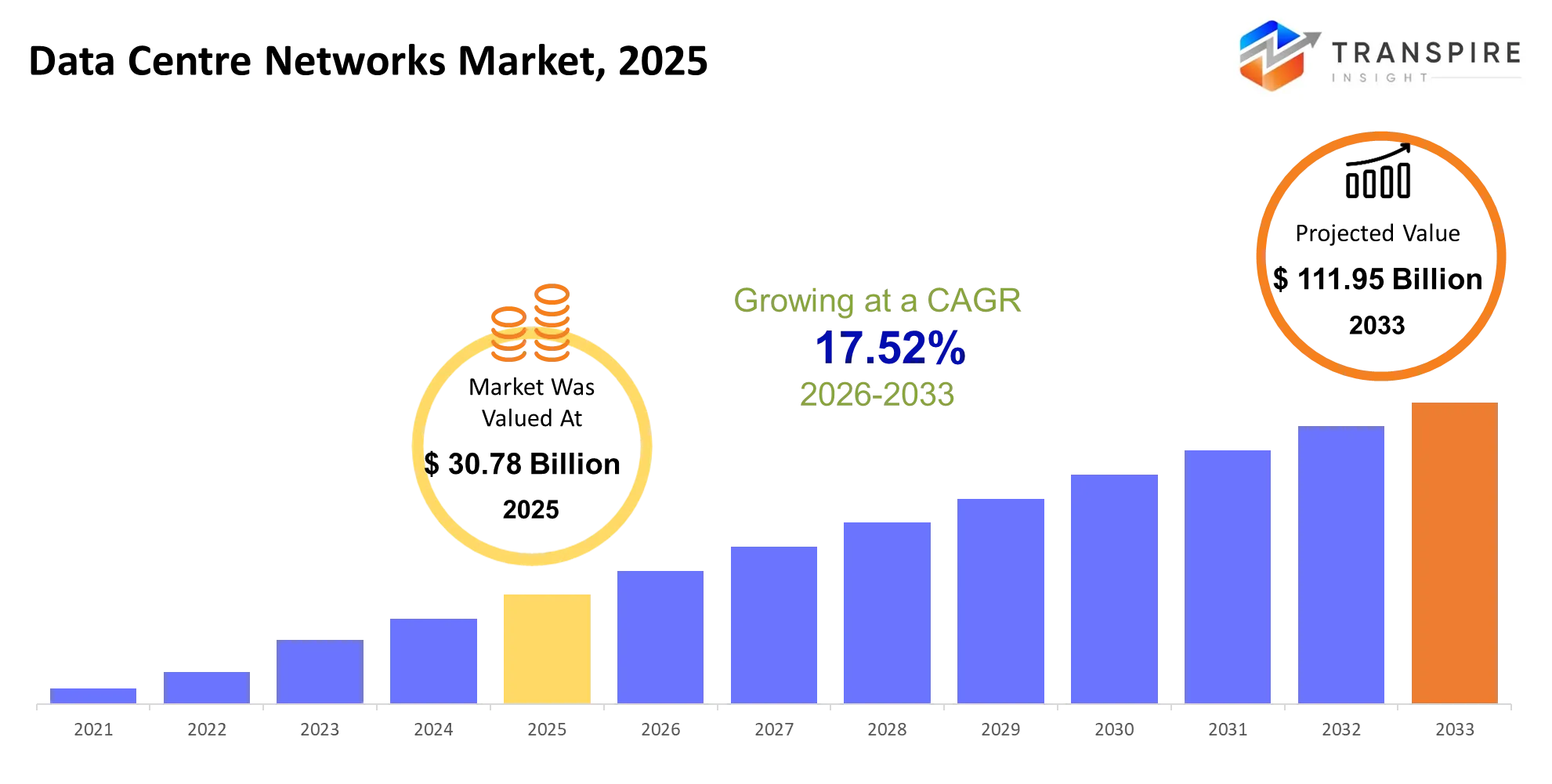
As per the Transpire Insight, The Data Centre Networks Market size is estimated at USD 30.78 billion in 2025 and is anticipated to reach USD 111.95 billion by 2033, growing at a CAGR of 17.52% from 2026 to 2033.
The data centre networks market supplies high-speed routing, switching, optical links, security, and traffic-control infrastructure necessary for sharing cloud apps, enterprise systems, and GPU clusters without bottlenecks. The network design arc in the past three to five years has shifted away from traditional three-tier architecture toward spine-leaf fabric and software-defined control for AI-optimized Ethernet architectures that are driven by real-world requirements for generative-AI training and inference in which thousands of GPUs share data traffic nonstop. Even a few seconds of congestion events can sharply cut traditional accelerators' investment utilization. So, buying has shifted away from port-count-closer to predictable low-latency fabric, 400G/800G, RDMA, and the cramming down of optical interconnects into a data-centre-sizing trend: larger distributed workloads generate east-west traffic flows that reveal oversubscription and latency limits, prompting operators to buy higher-capacity switches, interconnects, optics, telemetry, load balancing, and automated network operation. Sustainability reporting is also having an influence, with EU regulations requiring eligible facilities to report energy-performance metrics.
Data Centre Networks Market Size & Forecast:
- Market Size 2025: USD 30.78 Billion
- Expected Market Value (2033): USD 111.95 Billion
- Forecast CAGR (2026-2033): 17.52%
- Leading Region in 2025: North America
- Fastest Growing Region: Asia-Pacific
- Key Company Profiles: Cisco Systems, NVIDIA, Arista Networks, Juniper Networks, Hewlett Packard Enterprise, Huawei, H3C, Dell Technologies, Broadcom, Intel, VMware, Extreme Networks, Nokia, IBM, Lenovo.
Key Data Centre Networks Market Insights:
Data centre networking is changing from the traditional networking approach of general-purpose connectivity to the AI-fabric approach where congestion control, optical density and automation are the keys to GPU productivity. The key to competitive advantage is going to vendors who deliver high-speed Ethernet, silicon innovation, and software-based assurance over cloud, enterprise, and multi-site environments.
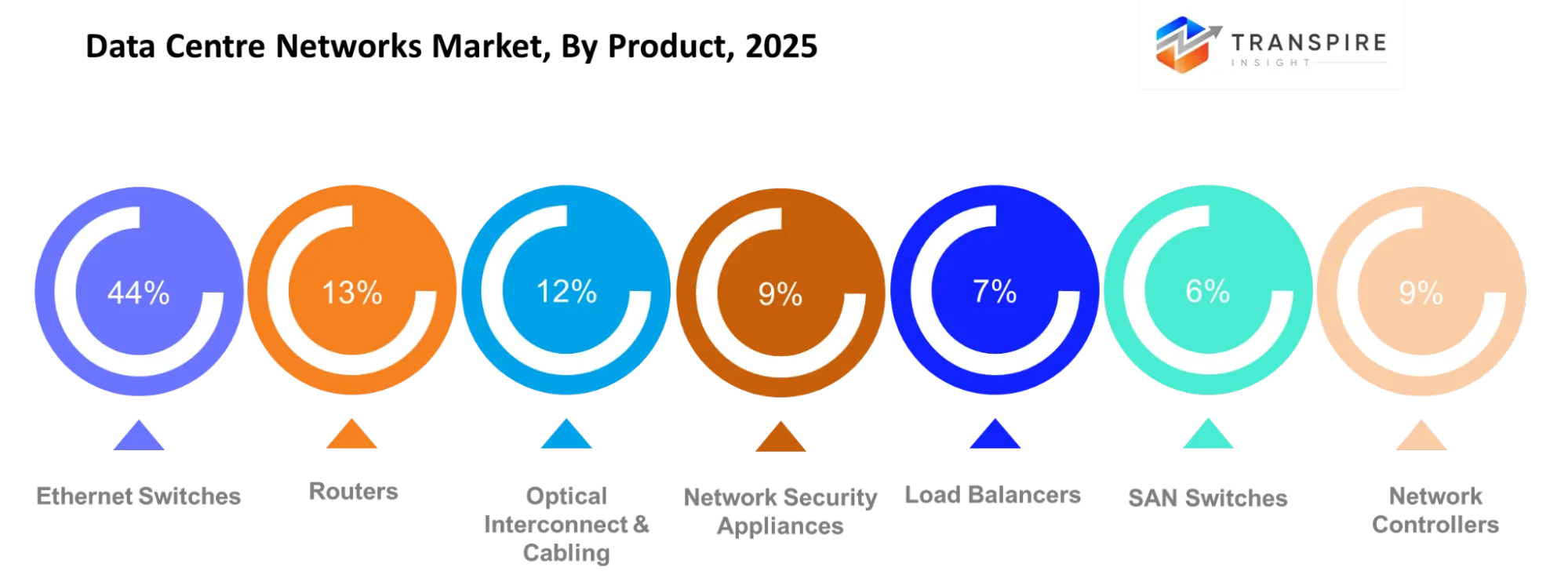
- The product mix is led by 43.82% Ethernet-switch share, with NVIDIA's Spectrum-X connecting switching and DPUs and optics for AI factories.
- Cisco's growth in high-speed AI fabrics and inter-site connectivity keeps routers at 13.00% importance.
- As 800G adoption moves towards 1.6T, 12.00% optical interconnect and cabling are playing a strategic role.
- 9.00% security appliances represent convergence, where Cisco includes security in AI-factory designs.
- 7.00% load balancers are being transformed into software-defined traffic management in distributed inference.
- As architectures continue to evolve, 6.00% SAN switches are still relevant for storage-intensive enterprise workloads.
- The 5th percentile of network controllers are moving toward agentic AIOps, with HPE Marvis automation being a prime example.
- As architectures split, 4.18% of other equipment is helping specialised edge and hybrid deployments.
- With the denser GPU clusters, 100G, 200G and 400G links are increasingly being replaced by 800G fabrics.
What are the Key Drivers, Restraints, and Opportunities in the Data Centre Networks Market?
Driver:
AI infrastructure build-outs are changing the economics of network procurement. Large language model training, real-time inference, cloud-native applications, and distributed storage generate intensive east-west traffic between servers rather than the older north-south traffic pattern. The trigger is the rapid expansion of GPU clusters, where network congestion can leave expensive compute capacity idle. Consequently, hyperscalers and colocation providers are adopting 400G and 800G switching, low-latency RoCE/Ethernet fabrics, high-radix spine layers, and optical links to improve job completion time and GPU utilisation. NVIDIA’s 2025 Spectrum-X photonics announcement illustrates the shift, with configurations reaching 100 Tb/s and 400 Tb/s for large AI fabrics.
Restraint:
Capital intensity remains a structural constraint. Upgrading a network is not limited to replacing switches: it can require new optics, fibre pathways, NICs, cooling capacity, power distribution, network-management software, and skilled engineering teams. Interoperability between proprietary AI fabrics and multi-vendor enterprise environments can further slow deployment. Reliability risk persists because network-related problems remain the largest category of IT service outages, often tied to configuration and change-management failures.
Opportunity:
The next growth pool is power-aware, automated networking for AI workloads distributed across multiple data-centre sites. Co-packaged optics, silicon photonics, intent-based operations, and 1.6T links can raise fabric density while lowering energy used per transmitted bit. NVIDIA states that co-packaged silicon photonics can cut power consumption by 3.5 times versus conventional pluggable transceivers. Europe is especially attractive because facilities with at least 500 kW of installed IT power must report annual energy-performance indicators, making telemetry, efficient optics, and automation commercially important.
What Has the Impact of Artificial Intelligence Been on the Data Centre Networks Market?
AI is turning the data centre network from a static connect layer to an actively optimised compute fabric. AI workloads generate high levels of east-west traffic between the GPUs, memory, storage, and switches, so congestion, latency, and bandwidth are key to training time and inference economics. Network telemetry and machine-learning models can detect anomalous traffic, predict congestion, adjust routing, and automate capacity provisioning before services can degrade in performance. In addition, analytics correlating packet errors, optical module health, temperature, and utilisation can flag potentially failing components.
On the architectural level, AI factories are supporting smarter Ethernet (higher speed), more optical interconnects, and more programmable fabrics; in fact, AMD has identified networking as an architecturally significant factor for AI system throughput by 2026, as the industry shifts from 800G to 1.6T. These new architectures increase utilisation, though their deployment is currently constrained by high-cost optics and switches, integration with legacy management tools, and the difficulty of ensuring automation decisions are correct as cluster-wide traffic moves rapidly.
In June 2026, Arista Networks launched its next-generation Arista 7060XE7 Series portfolio of 1.6-Terabit (1.6T) networking platforms designed to optimise rack-scale AI architectures.
Key Data Centre Networks Market Trends:
AI clusters are making networks a compute utilisation problem, as predictability of network bandwidth is as critical as port capacity. The market is heading toward flatter, software-driven fabrics, and the use of optics, telemetry, and energy management is becoming a key design decision, not add-ons.
- Spine-leaf and Clos fabrics are replacing three-tier networks as traditional client-server application traffic is becoming the majority of east-west application traffic.
- While Ethernet switches account for 43.82% of product revenue, customers are increasingly looking for switches that are more congestion-control, buffer-efficient, and AI-fabric friendly.
- 400G is emerging as a common cloud-fabric speed, and 800G is being increasingly adopted for new AI pods and for high-growth hyperscale deployments.
- 1.6T is coming to early spine and inter-cluster links, driven by the bandwidth needs of very large AI training environments.
- Optical interconnect and cabling demand is growing as copper is reaching limits and dense deployments of GPUs are driving demand for high-bandwidth fibre connectivity.
- Co-packaged optics and silicon photonics are shifting from R&D to AI-factory designs to lower power consumption of interconnects and boost port density.
- Network automation has evolved from rules-based monitoring to AIOps telemetry-based fault prediction, root cause analysis, and safer changes.
- As single data centres face power and capacity constraints, multi-site AI networking is becoming more significant, favouring scale-across architectures.
Data Centre Networks Market Segmentation
Product:
Ethernet Switches lead with 43.82%, reflecting their central role in rack-to-rack and east-west traffic across modern data centres. Routers account for 13.00%, supporting interconnection between facilities and external networks. Optical Interconnect & Cabling holds 12.00% and is expanding as AI clusters require higher-speed links, including 800G and emerging 1.6T connections. Network Security Appliances represent 9.00%, followed by Load Balancers at 7.00%, SAN Switches at 6.00%, Network Controllers at 5.00%, and Others at 4.18%. Optical interconnect also records the highest stated growth rate at 18.32% CAGR, driven by bandwidth, latency, and signal-integrity requirements.
Network Architecture:
Spine-Leaf and Clos designs are gaining importance as data centres handle dense east-west traffic between GPUs, servers, and storage. SDN Overlay architectures add centralised programmability, enabling operators to automate routing and network policies across changing workloads. Three-Tier remains relevant in established enterprise facilities where legacy infrastructure and predictable traffic patterns influence upgrades. Mesh supports resilient interconnection, while Hyper-Scale Custom architectures optimise large AI facilities. Hybrid Architecture and Others address mixed environments requiring flexibility, redundancy, and gradual modernisation.
Deployment:
Hyperscale Cloud and AI Data Centres are reshaping network procurement because accelerator-dense environments require high-bandwidth, low-latency fabrics. Enterprise Data Centres continue supporting business-critical applications, while Colocation facilities provide shared infrastructure for organisations seeking scalable capacity without building entire facilities. Edge/Micro Facilities are expanding where localised processing reduces latency for industrial, telecom, and AI workloads. Private Cloud deployments emphasise control and security, while Government Data Centres prioritise sovereignty. Others address specialised requirements involving resilience, compliance, and distributed computing.
Speed:
100G and 200G continue supporting established data-centre environments, but higher-performance workloads are accelerating migration toward 400G, 800G, and emerging 1.6T connectivity. AI training clusters particularly require faster links to move large datasets between accelerators, storage, and network switches without creating bottlenecks. 25G/50G remain important for server and access-layer connections where extreme bandwidth is unnecessary. 10G continues serving legacy and lower-intensity workloads, while Others accommodate specialised requirements. This progression is increasing demand for advanced optics and high-speed switching platforms.
End User:
IT & Telecom remains a core market because cloud platforms and communications networks require continuously scalable connectivity. BFSI emphasises low latency, transaction reliability, and security, while Retail & E-Commerce require networks capable of handling variable digital traffic. Healthcare prioritises secure data movement and application availability, whereas Government focuses on sovereignty and resilience. Manufacturing increasingly connects operational systems and edge infrastructure, while Media & Entertainment requires high-throughput content processing. Others include specialised workloads where automation, interoperability, and lifecycle efficiency influence network investment.
What are the Key Use Cases Driving the Data Centre Networks Market?
The core use case involves high-speed data movement within AI and cloud data centres. Ethernet Switches, by far the largest category (43.82%), allow traffic to move between accelerators, servers, storage, and gateways, and 800G and, ultimately, 1.6T links are aimed at coordinated workloads.
Growing use cases include cloud interconnection, enterprise virtualisation, cybersecurity inspection, storage networking, financial market trading, healthcare workloads, and media processing. Colocation and hyperscale facilities are turning to programmable spine-leaf or Clos network fabrics to adapt to changing traffic patterns without having to build new networks.
Emerging use cases include distributed AI inferencing, GPU-as-a-service, edge intelligence, and interconnect between distributed facilities. Optical interconnects and automated traffic engineering are providing the lowest latency and most power-efficient options for economic AI.
|
Report Metrics |
Details |
|
Market size value in 2025 |
USD 30.78 Billion |
|
Market size value in 2026 |
USD 36.17 Billion |
|
Revenue forecast in 2033 |
USD 111.95 Billion |
|
Growth rate |
CAGR of 17.52% from 2026 to 2033 |
|
Base year |
2025 |
|
Historical data |
2021 - 2024 |
|
Forecast period |
2026 - 2033 |
|
Report coverage |
Revenue forecast, competitive landscape, growth factors, and trends |
|
Regional scope |
United States; Canada; Mexico; United Kingdom; Germany; France; Italy; Spain; Denmark; Sweden; Norway; China; Japan; India; Australia; South Korea; Thailand; Brazil; Argentina; South Africa; Saudi Arabia; United Arab Emirates |
|
Key companies profiled |
Cisco Systems, NVIDIA, Arista Networks, Juniper Networks, Hewlett Packard Enterprise, Huawei, H3C, Dell Technologies, Broadcom, Intel, VMware, Extreme Networks, Nokia, IBM, Lenovo. |
|
Customization scope |
Free report customisation (country, regional & segment scope). Available customised purchase options to meet your exact research needs. |
|
Report Segmentation |
Product (Ethernet Switches, Routers, Optical Interconnect & Cabling, Network Security Appliances, Load Balancers, SAN Switches, Network Controllers, Others); Network Architecture (Spine-Leaf, Three-Tier, SDN Overlay, Mesh, Clos, Hyper-Scale Custom, Hybrid Architecture, Others); Deployment (Hyperscale Cloud, Enterprise Data Centers, Colocation, Edge/Micro Facilities, Private Cloud, Government Data Centers, AI Data Centers, Others); Speed (100G, 200G, 400G, 800G, 1.6T, 25G/50G, 10G, Others); End User (IT & Telecom, BFSI, Retail & E-Commerce, Healthcare, Government, Manufacturing, Media & Entertainment, Others). |
Which Regions are Driving the Data Centre Networks Market Growth?
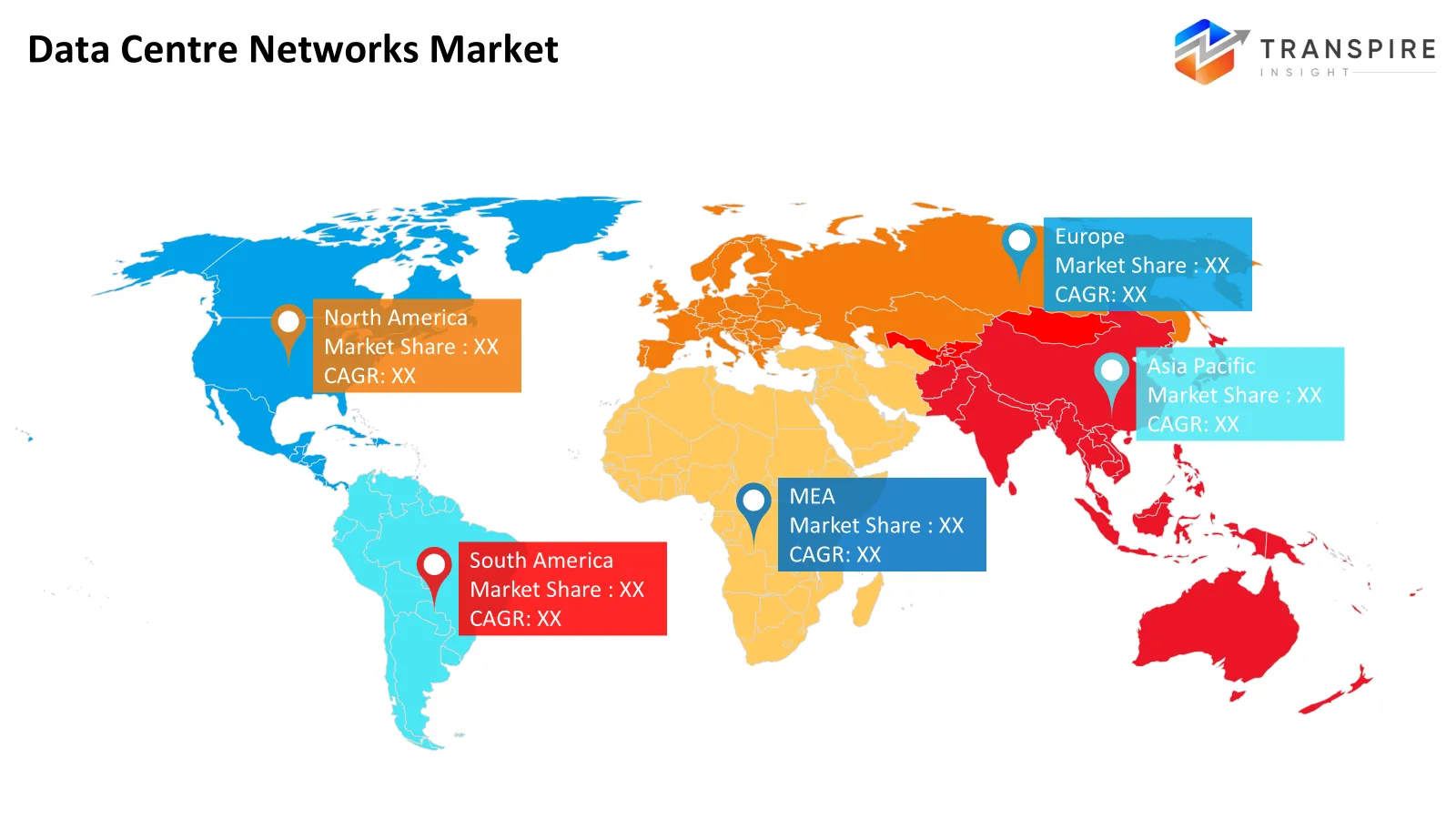
North America accounts for 38.00% of the data centre networks market volume, driven by hyperscaler cloud regions, AI training zones and mature colocation volumes. North America has an edge over other regions due to strong semiconductor, software, cloud and telecom supply chains that enable rapid roll-out of 400G, 800G and automation-enabled fabrics. Large-scale enterprise artificial intelligence deployments drive demand for secure hybrid connectivity rather than siloed on-premises upgrades. The North American procurement model hinges on high-throughput, low-latency fabric designs as network latency erodes the utilisation of expensive GPU infrastructure.
In March 2026, NVIDIA entered into a multi-year strategic agreement to invest $2 billion in Coherent Corp. to expand research, development, and U.S.-based manufacturing of advanced laser and optical networking products.
Europe represents 21.00% of demand and focuses on energy efficiency, data sovereignty and transparency of operations. Operators with installed IT power demand of at least 500 kW must annually report on a set of specific sustainability metrics to the European data-centre database. This promotes demand for investments in telemetry from the network, power-aware design, efficient optical architectures, and software controls that allow operators to demonstrate a compliance position. Stable demand across the regulated sector (BFSI, government, healthcare, industrials) is the backbone of Europe's stable market, but growth of AI infrastructure is less pronounced than in North America.
In September 2026, the European Commission proposed a formalised data centre energy efficiency package. This policy action establishes an A-to-G sustainability labelling system explicitly assessing water usage effectiveness, power usage efficiency, and grid-flexibility capability.
https://ec.europa.eu/commission/presscorner/detail/en/ip_26_1667
Asia-Pacific contributes 30.00% market share and is anticipated to grow at a compound annual growth rate of 16.20%, as per reports by Market Insights Inc. The recent growth in the country is due to hyperscale construction, sovereign-cloud initiatives, a surge in digital services, and the transfer of artificial intelligence capacity to India, Malaysia, Australia, and Southeast Asia. The data-center pipeline expected to be in the Asia-Pacific by 2025 stands at 19.4 gigawatts, with a USD 11.6 billion investment, driven by power availability for sites. The upcoming opportunity is to build high-speed, low-energy networks around new facilities rather than overhauling sites with existing three-tier infrastructure.
In September 2026, a consortium backed by BlackRock and IFM Investors entered exclusive talks to acquire Stack Infrastructure’s Asia Pacific data centre portfolio for up to USD 25 billion. This massive entity-level transaction will allow the investors to expand their footprint across key power-advantaged, AI-ready markets.
Who are the Key Players in the Data Centre Networks Market, and how do they compete?
The market is shifting away from port pricing and towards AI-fabric performance, software automation, optical efficiency, and ecosystem dominance. Cisco, Arista, NVIDIA, HPE, Juniper, Huawei and H3C are competing in switching and routing. Broadcom and Intel are competing over silicon and NIC ecosystems. VMware, IBM, Dell, Lenovo, Extreme Networks and Nokia are competing over hybrid infrastructure, orchestration, edge, enterprise and vertical solutions.
Cisco is using its own Silicon One silicon and Nexus management platforms to deliver AI-scale throughput and policy-based safe operation. NVIDIA is delivering end-to-end optimisation from GPU to network, Spectrum-X Ethernet and photonics for large AI clusters. Arista is focusing on cloud-style EOS software, 800G high-density platforms and automation for hyperscale customers. HPE is adding to its Juniper-powered silica-based Wi-Fi and LAN switch portfolio AI native operation and open Ethernet scale-up networking. Huawei and H3C compete on a low-cost approach with in-country support in China and other developing economies. Dell and Lenovo combine networking with servers and AI infrastructure. Broadcom has merchant switching silicon; Intel has Ethernet adapters and infrastructure acceleration; VMware has virtualised network control. Nokia, IBM and Extreme Networks are into specialised routing, hybrid-cloud integration and cloud-managed enterprise.
Key Players are:
- Cisco Systems
- NVIDIA
- Arista Networks
- Juniper Networks
- Hewlett Packard Enterprise
- Huawei
- H3C
- Dell Technologies
- Broadcom
- Intel
- Vmware
- Extreme Networks
- Nokia
- IBM
- Lenovo
Recent Development News
- In June 2026, Hewlett Packard Enterprise (HPE) launched updated Slingshot 400 switches. The new product rollout introduces advanced capabilities specifically engineered to enable secure, multi-tenant AI research environments across enterprise and public sector data centres. https://telecom.economictimes.indiatimes.com/news/enterprise-services/hpe-unveils-game-changing-self-driving-network-solutions-for-ai-and-data-centers/131905895
- In August 2026, Zayo partnered with Nvidia. This collaborative effort leverages advanced hardware and intelligence to design and construct dedicated high-capacity "AI corridors" across the United States, solving the complex inter-data centre networking requirements needed for distributed superclusters. https://www.zayo.com/newsroom/zayo-teams-with-nvidia-to-scale-critical-network-capacity-for-ai-factories/
- In September 2026, Qualcomm announced a multi-generational collaboration with Amazon covering customised silicon and optical connectivity solutions for next-generation AI data centres. The partnership includes optical interconnect technology supporting bandwidth of up to 1.6T, strengthening high-speed connectivity within Amazon’s data centre networks. https://www.qualcomm.com/news/releases/2026/09/qualcomm-announces-multi-generational-product-collaboration-with
What Strategic Insights Define the Future of the Data Centre Networks Market?
The industry is heading to AI, high-speed fabrics, and consumers, with network infrastructure that's driven by AI clusters rather than server traffic. Infrastructure coupling is an emerging concern, with insufficient power, optics, advanced silicon, or missing sites limiting network buildout despite consumers' predictable requests for higher network capacity. The (potentially) new European energy and water reporting rules imply that resource efficiency will become a routine element of infrastructure planning, not just sustainability metrics. There's an opportunity to deploy 800G/1.6T Ethernet, optical interconnects, AI telemetry, and autonomous remediation in standard infrastructure blueprints for hyperscale, colocation, and sovereign data centres and edge facilities. Hewlett Packard Enterprise's 2026 networking portfolio offers a vision for AI-native, autonomous, self-driving networks. Strategically, vendors should focus on open interoperability, power-conscious networking, and software automation, while strengthening joint go-to-market collaborations with hyperscalers, accelerators, and data centre operators to overcome installation issues and deliver higher utilisation as AI infrastructure becomes more widespread.
Key Segmentations are:
Product
- Ethernet Switches
- Routers
- Optical Interconnect & Cabling
- Network Security Appliances
- Load Balancers
- SAN Switches
- Network Controllers
- Others
Network Architecture
- Spine-Leaf
- Three-Tier
- SDN Overlay
- Mesh
- Clos
- Hyper-Scale Custom
- Hybrid Architecture
- Others
Deployment
- Hyperscale Cloud
- Enterprise Data Centers
- Colocation
- Edge/Micro Facilities
- Private Cloud
- Government Data Centers
- AI Data Centers
- Others
Speed
- 100G
- 200G
- 400G
- 800G
- 1.6T
- 25G/50G
- 10G
- Others
End User
- IT & Telecom
- BFSI
- Retail & E-Commerce
- Healthcare
- Government
- Manufacturing
- Media & Entertainment
- Others
By Regional Analysis
North America
- US
- Canada
- Mexico
Europe
- Germany
- UK
- France
- Italy
- Spain
- Russia
- Rest of Europe
Asia Pacific
- China
- Japan
- India
- South Korea
- Australia
- Rest of Asia Pacific
South America
- Brazil
- Argentina
- Rest of South America
Middle East & Africa
- UAE
- Saudi Arabia
- Qatar
- South Africa
- Rest of the Middle East & Africa
Frequently Asked Questions
Find quick answers to common questions.
The data centre networks market size was valued at USD 30.78 billion in 2025 and is poised to reach USD 111.95 billion by 2033, expanding at a 17.52% CAGR.
Key segments for the data centre networks market are Product (Ethernet Switches, Routers, Optical Interconnect & Cabling, Network Security Appliances, Load Balancers, SAN Switches, Network Controllers, Others); Network Architecture (Spine-Leaf, Three-Tier, SDN Overlay, Mesh, Clos, Hyper-Scale Custom, Hybrid Architecture, Others); Deployment (Hyperscale Cloud, Enterprise Data Centers, Colocation, Edge/Micro Facilities, Private Cloud, Government Data Centers, AI Data Centers, Others); Speed (100G, 200G, 400G, 800G, 1.6T, 25G/50G, 10G, Others); End User (IT & Telecom, BFSI, Retail & E-Commerce, Healthcare, Government, Manufacturing, Media & Entertainment, Others).
Growth is primarily driven by AI data-centre expansion, rising east-west traffic, 800G/1.6T networking adoption, hyperscale cloud investment, high-speed optical interconnects, network automation, and software-defined infrastructure.
The data centre networks market is led by major manufacturers, including Cisco Systems, NVIDIA, Arista Networks, Juniper Networks, Hewlett Packard Enterprise, Huawei, H3C, Dell Technologies, Broadcom, Intel, VMware, Extreme Networks, Nokia, IBM, Lenovo.
North America holds 38.00% of the market, supported by hyperscale cloud infrastructure, AI investments, mature data-centre ecosystems, advanced networking adoption, and strong optical-fiber connectivity.
Opportunities include 800G/1.6T Ethernet, AI-optimized switching, optical interconnects, automated network management, predictive maintenance, energy-efficient networking, edge connectivity, and integrated security solutions.
- Cisco Systems
- NVIDIA
- Arista Networks
- Juniper Networks
- Hewlett Packard Enterprise
- Huawei
- H3C
- Dell Technologies
- Broadcom
- Intel
- Vmware
- Extreme Networks
- Nokia
- IBM
- Lenovo
About the Authors

Mayur Shinde
I am Mayur Shinde, a Senior Research Analyst at Transpire Insight, specializing in the Automotive & Transportation and Information & Communication Technology (ICT) Industry. My work focuses on analyzing emerging market trends, technological advancements, competitive landscapes, and industry developments to deliver accurate, data-driven insights. I am passionate about transforming complex market information into clear, actionable content that helps businesses, professionals, and decision-makers stay informed and make confident strategic decisions.

Chakradhar Khansole
Chakradhar serves as the Research Director at Transpire Insight, bringing over 8 years of experience in technology, innovation, and strategic market intelligence. He specializes in transforming complex market data into actionable business insights that enable organizations to make informed, growth-oriented decisions. Recognized for his strategic vision and analytical expertise, Chakradhar leads high-impact research initiatives, delivering comprehensive market assessments, competitive intelligence, and forward-looking industry analysis.
Recently Published Reports
-
Apr 2026
3D Optical Profiler Market
3D Optical Profiler Market Size, Share & Analysis Report By Type (Desktop 3D Optical Profiler, and Portable 3D Optical Profiler), By Technology (Confocal Technology, and White Light Interference), By End-Use Industry (Manufacturing, Research Institutions, Automotive, Aerospace and Defense, Medical Devices, and Other), and Geography (North America, Europe, Asia-Pacific, Middle East and Africa, South and Central America), 2021 - 2031
-
Apr 2026
Depth Sensor Market
Depth Sensor Market Size, Share & Analysis Report By Type (Infrared Depth Sensors, Time-of-Flight (ToF) Sensors, Stereo Vision Sensors, Structured Light Sensors, Ultrasonic Depth Sensors), By Application (Automotive, Robotics, Gaming, Consumer Electronics, Industrial Automation, Healthcare, Security & Surveillance, Others), By End Users (Automotive Manufacturers, Consumer Electronics Companies, Healthcare Providers, Industrial Companies, Security Agencies, Gaming Companies, Robotics Companies, Others), and Geography (North America, Europe, Asia-Pacific, Middle East and Africa, South and Central America), 2021 – 2031
-
Apr 2026
Digital Manufacturing Market
Digital Manufacturing Market Size, Share & Analysis Report By Component (Hardware, Software, and Services), By Technology (Robotics, 3D Printing, Internet of Things (IoT), and Others), By Application (Automotive and Transportation, Aerospace and Defense, Consumer Electronics, Industrial Machinery, and Others), By Process Type (Computer-Based Designing, Computer-Based Simulation, Computer 3D Visualization, Analytics, and Others), and Geography (North America, Europe, Asia-Pacific, Middle East and Africa, South and Central America), 2021 – 2031
-
Apr 2026
Digital Visa Services Market
Digital Visa Services Market Size, Share & Analysis Report By Type (Individual Travelers, Group Travelers), By Application (Tourism, Business Travel, Others), and Geography (North America, Europe, Asia-Pacific, Middle East and Africa, South and Central America), 2021 – 2031