

Asia Pacific Load Balancer Market Size & Forecast:
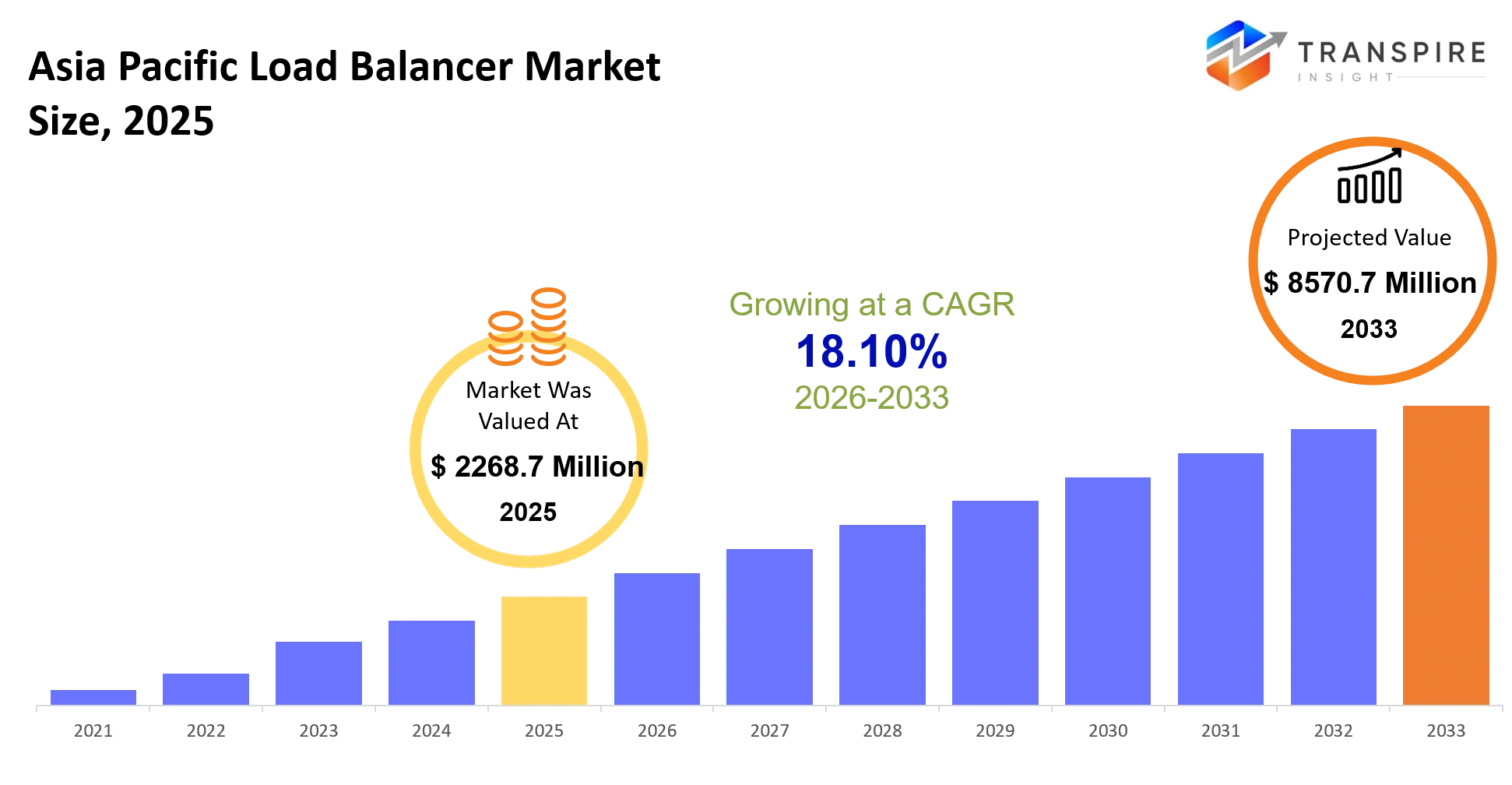
- Asia Pacific Load Balancer Market Size 2025: USD 2268.7 Million
- Asia Pacific Load Balancer Market Size 2033: USD 8570.7 Million
- Asia Pacific Load Balancer Market CAGR:18.10%
- Asia Pacific Load Balancer Market Segments: By Type (Hardware Load Balancers, Software Load Balancers, Cloud Load Balancers, Application Load Balancers, Network Load Balancers, Global Load Balancers, ADC Load Balancers, Others); By Deployment (Cloud, On-Premise, Hybrid, Multi-Cloud, Edge Computing, Others); By Enterprise Size (Large Enterprises, SMEs, Startups, Government Organizations, Others); By End User (IT & Telecom, BFSI, Healthcare, Retail, Government, Manufacturing, Others)
Asia Pacific Load Balancer Market Summary
The Asia Pacific Load Balancer Market was valued at USD 2268.7 Million in 2025. It is forecast to reach USD 8570.7 Million by 2033. That is a CAGR of 18.10% over the period.
The Asia Pacific Load Balancer Market is very important for keeping services available and running smoothly. It does this by spreading network traffic across servers and applications. In terms load balancers help prevent systems from getting too busy, reduce downtime and keep applications performing well for businesses, cloud providers, manufacturers, financial institutions and online shopping platforms.As companies do business online it has become really important to have applications that always work without stopping. This is no longer a nice thing to have, it is something that companies need to operate.
Over the few years the Asia Pacific Load Balancer Market has changed a lot. It used to be that load balancers were mostly hardware-based. Now they are mostly cloud-based and software-defined.
Key Market Insights
- The Asia Pacific Load Balancer Market was mostly controlled by East Asia in 2025. This region had 38 percent of the market. The reason for this is that a lot of money was invested in data centers.
- Southeast Asia is the region that is growing the fastest until 2033. This is because many companies are working on transformation projects. These projects need traffic management solutions.
- In 2025 most new load balancers were based in the cloud. They made up over 55 percent of deployments. This means they were used more than hardware appliances in many companies.
- Application load balancing was the popular type. It had 45 percent of the market. This is because more and more people are using the web and application programming interfaces.
- Global server load balancing is growing fast. This is because many companies are using clouds and spreading their applications across different areas.
- The IT and telecom sector used load balancers the most. They had 30 percent of the market. This is because they are expanding their networks and deploying 5G infrastructure.
- After 2022 the BFSI sector started to use load balancers quickly. This is because financial institutions want their systems to always be available, secure and work well for banking.
- Companies like F5 Networks, Citrix, NGINX and Radware are making their products better. They are adding automation, analytics and application security to their load balancing platforms.
- Amazon Web Services, Microsoft Azure and Google Cloud are also making it easier for companies to use load balancing services. They are reducing the complexity of deployment. Making it easier to scale.
- Between 2023 and 2025 people started to use intelligence to optimize traffic. This helps to use resources, reduce latency and improve the performance of applications, in different environments. The Asia Pacific Load Balancer Market is using this technology to improve the load balancers. The load balancers are becoming more efficient.
What are the Key Drivers, Restraints, and Opportunities in the Asia Pacific Load Balancer Market?
Driver
The main reason the Asia Pacific Load Balancer Market is growing fast is that companies are moving their applications to the cloud and using cloud services. Many companies used to keep all their data and applications in one place. Now they are spread out across public clouds, private clouds and edge locations. This change has made it harder to manage traffic. It is no longer practical to do it manually. Load balancers are now very important in keeping applications running smoothly, reducing delays and supporting services.The growth of banking, e-commerce streaming services and business software has also driven the adoption of load balancers. Each new application adds traffic and requires smart distribution across multiple servers and cloud environments. Companies invest in traffic management tools to prevent downtime and maintain an user experience. This trend directly increases spending on software licenses, managed services and infrastructure in the region.
The use of load balancers is also driven by the need for load balancers to manage traffic. Companies are looking for load balancers that can handle the increased traffic and provide an user experience.
Restraint
The biggest challenge is integrating load balancing platforms with existing legacy systems and modern cloud environments. Many companies still use applications that were not designed for cloud-based systems. Upgrading or reconfiguring these systems requires a lot of investment, specialized expertise and time. This structural challenge is hard to overcome because critical workloads often rely on existing infrastructure.Security and compliance requirements add another layer of difficulty. Companies in sectors like banking, healthcare and government must ensure that traffic management solutions meet standards before deployment. Testing, certification and migration processes can take months or even years. These factors delay modernization initiatives. Reduce the speed at which new load balancers are deployed.
Opportunity
A major opportunity is emerging through AI-driven application delivery and edge computing deployments. Advanced load balancers can use machine learning algorithms to predict traffic spikes, optimize resource allocation and improve application responsiveness in time. Rapid investment in data centers and edge infrastructure is creating conditions for these technologies. Businesses increasingly require processing capabilities to support low-latency applications and digital services.
Another promising opportunity lies in the convergence of load balancers and cybersecurity functions. Enterprises are seeking platforms that combine traffic management, application security and threat mitigation within a solution. This approach simplifies operations. Improves protection, against increasingly sophisticated cyberattacks. Vendors that deliver platforms with automation predictive analytics and security capabilities will be positioned to capture long-term growth opportunities across the load balancer market.
What Has the Impact of Artificial Intelligence Been on the Asia Pacific Load Balancer Market?
Artificial intelligence and new digital technologies are changing load balancing platforms. They are turning them into systems that deliver applications. These systems use intelligence to look at the network and see how applications are working. They also look at how servers are being used and what users are doing. Then they use this information to decide how to route traffic. Big cloud companies and people who deliver applications are now using automation to spread workloads across servers and clouds. This happens without anyone having to do it
This makes things easier to manage. Helps companies keep their services running when a lot of people are using them. Machine learning is being used more and more to make sure applications are running well and to predict what will happen with the infrastructure. These systems look at what happened in the past with traffic. How long it took to get a response. They use this information to guess when there will be a lot of traffic. Then companies can add computing power and prevent servers from getting too busy. This keeps applications running smoothly.Looking at traffic also helps keep companies from cyber attacks. It can find traffic that's not normal and might be an attack. The good things about this system are big. It can keep applications running, make them faster and use resources better. It can also save companies money by not using many resources. Artificial intelligence also helps companies follow rules and respond faster.
There is a problem. It is hard and expensive to add intelligence to old systems. A lot of companies have applications that do not give consistent information. This makes it hard to predict what will happen. Can slow down the process of putting the system in place. This is why some companies are not using intelligence for application delivery even though it has a lot of benefits.
Key Market Trends
- Since 2021 companies have started using software load balancers of hardware appliances. This change helps them grow and set up their infrastructure faster.
- Between 2022 and 2025 more companies started using clouds. This led to a need for balancing server traffic globally across different application environments.
- AI-based traffic optimization became an advantage. It helped vendors manage delays and use resources better in time with AI-powered traffic optimization.
- Companies now prefer platforms that combine load balancing, web firewalls and DDoS protection. They like this better than using networking tools.
- AWS, Microsoft Azure and Google Cloud improved their managed application delivery services. This made things simpler for enterprise customers after 2023.
- More and more workloads are being put into containers starting in 2022. This has increased the use of Kubernetes- load balancing solutions in cloud environments.
- F5 Networks, NGINX and Citrix made their automation capabilities better. This helps companies do manual traffic management and have their applications available more often.
- From 2023 onward investments in edge computing grew rapidly. This created a need for routing traffic locally and delivering applications with low delay.
- Buyers now look at vendors based on security integration automation features and observability features. They consider these in addition to hardware performance.
- After some cyberattacks companies started using zero-trust security more. They began deploying load balancing platforms that can inspect traffic thoroughly.
Asia Pacific Load Balancer Market Segmentation
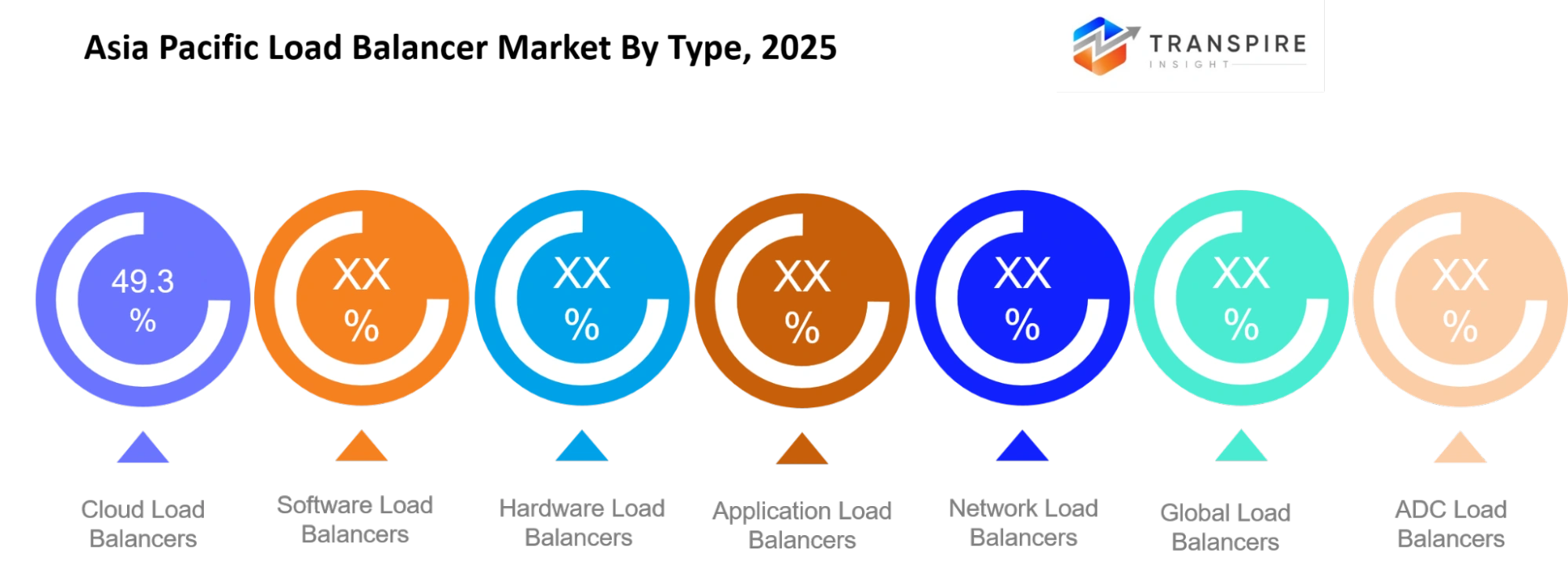
By Type
Load Balancers that are based on hardware will still be used by companies that need good performance and control over their networks for very important applications. These Load Balancers will still be used in places where it's crucial to have consistent and reliable network traffic. Big companies in industries that have a lot of rules will keep using hardware based Load Balancers because they need Load Balancers to work and be reliable. However not as many new companies will start using hardware based Load Balancers as more people start using cloud based Load Balancers.
Software Load Balancers will become more popular as companies start to use affordable ways to deploy Software Load Balancers. Cloud Load Balancers and Application Load Balancers will be used more as companies update the way they deliver applications across locations. These Load Balancers will help companies scale, automate and deploy faster. Network Load Balancers and Global Load Balancers will also get better at managing traffic across regions for companies that use multiple cloud systems and have global digital services.
By Deployment
More and more companies will start using cloud based deployment because they want to be able to scale and reduce the amount of infrastructure they need and deliver applications faster. Cloud based Load Balancers will help companies handle workloads, especially in e-commerce, banking and other enterprise applications. Companies will keep moving their workloads to the cloud to be more agile and reduce costs. This will make the demand for traffic management solutions go up.
Some companies will still use on-premise deployment because they need to have control over their data and follow rules. Hybrid and multi-cloud environments will become more popular as companies try to balance their security, performance and flexibility needs. Edge computing will become more important as companies start to use applications that need to be very responsive and are deployed close to the people using them. This will help with real-time processing. Make applications more responsive.
By Enterprise Size
Big companies will still be the users of Load Balancers because they have IT systems and a lot of application traffic. These companies will keep investing in application delivery systems to make sure their applications are always available secure and working well. Digital transformation programs will make the adoption of Load Balancers even stronger across companies that operate in regions. There will still be a demand for automated solutions.
Sized companies will start to use cloud based Load Balancers more as the costs go down and cloud based Load Balancers become more accessible. These companies will prioritize flexibility, scalability and fast deployment over infrastructure investments. Government organizations will keep investing in digital platforms to support public services. The adoption of Load Balancers will also increase in industries that have a lot of rules and need to be reliable and compliant.
By End User
The IT and Telecom industry will still be the user of Load Balancers because they have networks and need to handle a lot of data traffic. The continuous expansion of services, 5G infrastructure and cloud platforms will make the demand for traffic management systems even stronger. These companies will need to have availability and performance optimization across their networks. They will keep investing in Load Balancers.
The Banking and Financial Services industry will keep adopting Load Balancers because of banking, payment systems and cybersecurity requirements. Healthcare organizations will use Load Balancers more because of telemedicine and digital health platforms that need to work and be stable. Retail and e-commerce companies will rely heavily on Load Balancers to manage traffic spikes and make sure their customers have an experience. Government and manufacturing companies will adopt Load Balancers to improve their reliability and digital service delivery.
What are the Key Use Cases Driving the Asia Pacific Load Balancer Market?
The main thing about the Asia Pacific Load Balancer Market is that it helps with getting the traffic to the right application. This is really important for companies that have applications on the cloud. They need to make sure that these applications are always available, that they do not take long to load and that they work well even when a lot of people are using them at the same time. The Asia Pacific Load Balancer Market is very important for companies in the IT and telecom and BFSI sectors because these companies need to make sure that their digital services are always working well. If these services are not working well the companies can lose money. Their customers can lose trust in them.
There are ways that the Asia Pacific Load Balancer Market is being used. For example it is being used to manage the traffic on websites that sell things online. It is also being used to make sure that transactions are secure when people are banking online. The Asia Pacific Load Balancer Market is also being used by companies and BFSI companies to make sure that their websites can handle a lot of traffic during busy times of the year.. It is being used by healthcare companies to make sure that people can always get the medical information they need.
The Asia Pacific Load Balancer Market is also being used in ways. For example it is being used to help with applications that need to work quickly such as the Internet of Things and smart city platforms. The Asia Pacific Load Balancer Market is also being used by companies that make things and by the government to help with systems that need to be watched in time.. It is being used with artificial intelligence to make sure that the workload is spread out evenly across many clouds, which helps the system work better and makes it last longer.
|
Report Metrics |
Details |
|
Market size value in 2025 |
USD 2268.7 Million |
|
Market size value in 2026 |
USD 2674.8 Million |
|
Revenue forecast in 2033 |
USD 8570.7 Million |
|
Growth rate |
CAGR of 18.10% from 2026 to 2033 |
|
Base year |
2025 |
|
Historical data |
2021 - 2024 |
|
Forecast period |
2026 - 2033 |
|
Report coverage |
Revenue forecast, competitive landscape, growth factors, and trends |
|
Regional scope |
Asia Pacific |
|
Key company profiled |
F5 Networks, Citrix, AWS, Microsoft Azure, Google Cloud, NGINX, HAProxy, Radware, A10 Networks, Fortinet, Kemp, Cisco, IBM, Oracle, Alibaba Cloud |
|
Customization scope |
Free report customization (country, regional & segment scope). Avail customized purchase options to meet your exact research needs. |
|
Report Segmentation |
By Type (Hardware Load Balancers, Software Load Balancers, Cloud Load Balancers, Application Load Balancers, Network Load Balancers, Global Load Balancers, ADC Load Balancers, Others); By Deployment (Cloud, On-Premise, Hybrid, Multi-Cloud, Edge Computing, Others); By Enterprise Size (Large Enterprises, SMEs, Startups, Government Organizations, Others); By End User (IT & Telecom, BFSI, Healthcare, Retail, Government, Manufacturing, Others) |
Which Regions are Driving the Asia Pacific Load Balancer Market Growth?
North America is ahead of the Asia Pacific Load Balancer Market because companies there started using native architectures early on and have a lot of big data centers. The banking, telecom and SaaS industries need their systems to be working all the time so they keep investing in systems to manage their internet traffic. Big cloud providers and companies that help deliver applications are also based there which makes the market more mature. Companies are spending a lot of money on cybersecurity and managing clouds, which helps North America stay ahead in making application delivery more modern.
Europe is a market that is driven by rules and regulations. There are rules about data privacy and how companies can use the cloud. Companies in Europe care a lot about following these rules and making sure their data is safe. They are moving from systems to hybrid cloud systems but they are doing it slowly and carefully. This means there is a demand for load balancing solutions in industries like finance, government and manufacturing.
Southeast Asia is growing fast. This is because companies are quickly building digital infrastructure and moving to the cloud. The government is helping by investing in data centers and digital economy programs. More people are shopping online using technology and streaming videos, which is making internet traffic more complicated. This is an opportunity for companies that sell load balancing solutions that work well with the cloud and edge computing. They can expect to see a lot of growth from 2026 to 2033.
Who are the Key Players in the Asia Pacific Load Balancer Market and How Do They Compete?
The Asia Pacific Load Balancer Market shows a moderately consolidated structure where a small group of global infrastructure and networking vendors compete with rising cloud-native service providers. Competition is shaped mainly by technology capability, especially automation, cloud integration, and application security features rather than pure pricing. Established players continue defending their position by upgrading software-defined offerings, while newer entrants focus on cloud-native and containerized environments. Vendor selection increasingly depends on integration flexibility across multi-cloud and edge infrastructures.
F5 Networks focuses on advanced application delivery and security integration, offering solutions that combine load balancing with application protection features. This approach strengthens its position in enterprise banking and telecom environments where uptime and security are critical. Citrix emphasizes virtualization-driven traffic management, enabling enterprises to optimize application performance across hybrid infrastructures. Its expansion strategy relies on deeper integration with workspace and digital experience platforms.
AWS, Microsoft Azure, and Google Cloud dominate cloud-native load balancing through managed services embedded directly into their ecosystems. Their competitive advantage comes from seamless scalability and global infrastructure reach, reducing operational complexity for enterprises. Radware and Fortinet differentiate through security-first load balancing, integrating threat detection and mitigation into traffic management systems. These companies expand through partnerships with cloud providers and increased deployment in regulated industries across Asia Pacific markets.
Company List
- F5 Networks
- Citrix
- AWS
- Microsoft Azure
- Google Cloud
- NGINX
- HAProxy
- Radware
- A10 Networks
- Fortinet
- Kemp
- Cisco
- IBM
- Oracle
- Alibaba Cloud
Recent Development News
In February 2025, Tencent Cloud expanded its Asia Pacific cloud infrastructure footprint with continued investment in regional data center capacity, including Southeast Asia and Malaysia. This expansion supports higher demand for traffic management, application delivery, and cloud-based load balancing services driven by rapid digitalization.https://en.wikipedia.org
In 2026, industry research highlighted the rise of kernel-level and eBPF-based load balancing architectures designed for microservices environments. These systems improve throughput and reduce latency by shifting traffic distribution into the operating system kernel, significantly enhancing performance for cloud-native applications.https://arxiv.org
What Strategic Insights Define the Future of the Asia Pacific Load Balancer Market?
The Asia Pacific Load Balancer Market is going to change a lot over the 5 to 7 years. It will move towards systems that are fully controlled by software and use Artificial Intelligence (AI) to manage applications. This change will be driven by companies using multiple cloud services, more edge computing nodes being set up and people wanting digital services that work in real-time. This is especially true for banking, telecom and e-commerce businesses.Load balancing will not just be about distributing traffic. It will also be about predicting and managing workloads in a way. Systems will automatically try to make latency, cost and resilience across different infrastructures. Load Balancer systems will play a role in achieving this.
One risk is that companies might become too dependent on cloud ecosystems. If companies put all their workloads under a few big infrastructure providers it could be hard for them to change later. This might limit their flexibility. Slow down innovation for smaller vendors. The Load Balancer Market will have to navigate through this risk.
Asia Pacific Load Balancer Market Report Segmentation
-
By Type
- Hardware Load Balancers
- Software Load Balancers
- Cloud Load Balancers
- Application Load Balancers
- Network Load Balancers
- Global Load Balancers
- ADC Load Balancers
- Others
-
By Deployment
- Cloud
- On-Premise
- Hybrid
- Multi-Cloud
- Edge Computing
- Others
-
By Enterprise Size
- Large Enterprises
- SMEs
- Startups
- Government Organizations
- Others
-
By End User
- IT & Telecom
- BFSI
- Healthcare
- Retail
- Government
- Manufacturing
- Others
Frequently Asked Questions
Find quick answers to common questions.
The expected Asia Pacific Load Balancer Market size for the market will be USD 8570.7 Million in 2033.
Key segments for the Asia Pacific Load Balancer Market are By Type (Hardware Load Balancers, Software Load Balancers, Cloud Load Balancers, Application Load Balancers, Network Load Balancers, Global Load Balancers, ADC Load Balancers, Others); By Deployment (Cloud, On-Premise, Hybrid, Multi-Cloud, Edge Computing, Others); By Enterprise Size (Large Enterprises, SMEs, Startups, Government Organizations, Others); By End User (IT & Telecom, BFSI, Healthcare, Retail, Government, Manufacturing, Others).
Major Asia Pacific Load Balancer Market players are F5 Networks, Citrix, AWS, Microsoft Azure, Google Cloud, NGINX, HAProxy, Radware, A10 Networks, Fortinet, Kemp, Cisco, IBM, Oracle, Alibaba Cloud.
The Asia Pacific Load Balancer Market size is USD 2268.7 Million in 2025.
The Asia Pacific Load Balancer Market CAGR is 18.10% from 2026 to 2033.
- F5 Networks
- Citrix
- AWS
- Microsoft Azure
- Google Cloud
- NGINX
- HAProxy
- Radware
- A10 Networks
- Fortinet
- Kemp
- Cisco
- IBM
- Oracle
- Alibaba Cloud
About the Authors

Mayur Shinde
I am Mayur Shinde, a Senior Research Analyst at Transpire Insight, specializing in the Automotive & Transportation and Information & Communication Technology (ICT) Industry. My work focuses on analyzing emerging market trends, technological advancements, competitive landscapes, and industry developments to deliver accurate, data-driven insights. I am passionate about transforming complex market information into clear, actionable content that helps businesses, professionals, and decision-makers stay informed and make confident strategic decisions.

Chakradhar Khansole
Chakradhar serves as the Research Director at Transpire Insight, bringing over 8 years of experience in technology, innovation, and strategic market intelligence. He specializes in transforming complex market data into actionable business insights that enable organizations to make informed, growth-oriented decisions. Recognized for his strategic vision and analytical expertise, Chakradhar leads high-impact research initiatives, delivering comprehensive market assessments, competitive intelligence, and forward-looking industry analysis.
Recently Published Reports
-
Apr 2026
3D Optical Profiler Market
3D Optical Profiler Market Size, Share & Analysis Report By Type (Desktop 3D Optical Profiler, and Portable 3D Optical Profiler), By Technology (Confocal Technology, and White Light Interference), By End-Use Industry (Manufacturing, Research Institutions, Automotive, Aerospace and Defense, Medical Devices, and Other), and Geography (North America, Europe, Asia-Pacific, Middle East and Africa, South and Central America), 2021 - 2031
-
Apr 2026
Depth Sensor Market
Depth Sensor Market Size, Share & Analysis Report By Type (Infrared Depth Sensors, Time-of-Flight (ToF) Sensors, Stereo Vision Sensors, Structured Light Sensors, Ultrasonic Depth Sensors), By Application (Automotive, Robotics, Gaming, Consumer Electronics, Industrial Automation, Healthcare, Security & Surveillance, Others), By End Users (Automotive Manufacturers, Consumer Electronics Companies, Healthcare Providers, Industrial Companies, Security Agencies, Gaming Companies, Robotics Companies, Others), and Geography (North America, Europe, Asia-Pacific, Middle East and Africa, South and Central America), 2021 – 2031
-
Apr 2026
Digital Manufacturing Market
Digital Manufacturing Market Size, Share & Analysis Report By Component (Hardware, Software, and Services), By Technology (Robotics, 3D Printing, Internet of Things (IoT), and Others), By Application (Automotive and Transportation, Aerospace and Defense, Consumer Electronics, Industrial Machinery, and Others), By Process Type (Computer-Based Designing, Computer-Based Simulation, Computer 3D Visualization, Analytics, and Others), and Geography (North America, Europe, Asia-Pacific, Middle East and Africa, South and Central America), 2021 – 2031
-
Apr 2026
Digital Visa Services Market
Digital Visa Services Market Size, Share & Analysis Report By Type (Individual Travelers, Group Travelers), By Application (Tourism, Business Travel, Others), and Geography (North America, Europe, Asia-Pacific, Middle East and Africa, South and Central America), 2021 – 2031