

Cottonseed Hulls Market Summary:
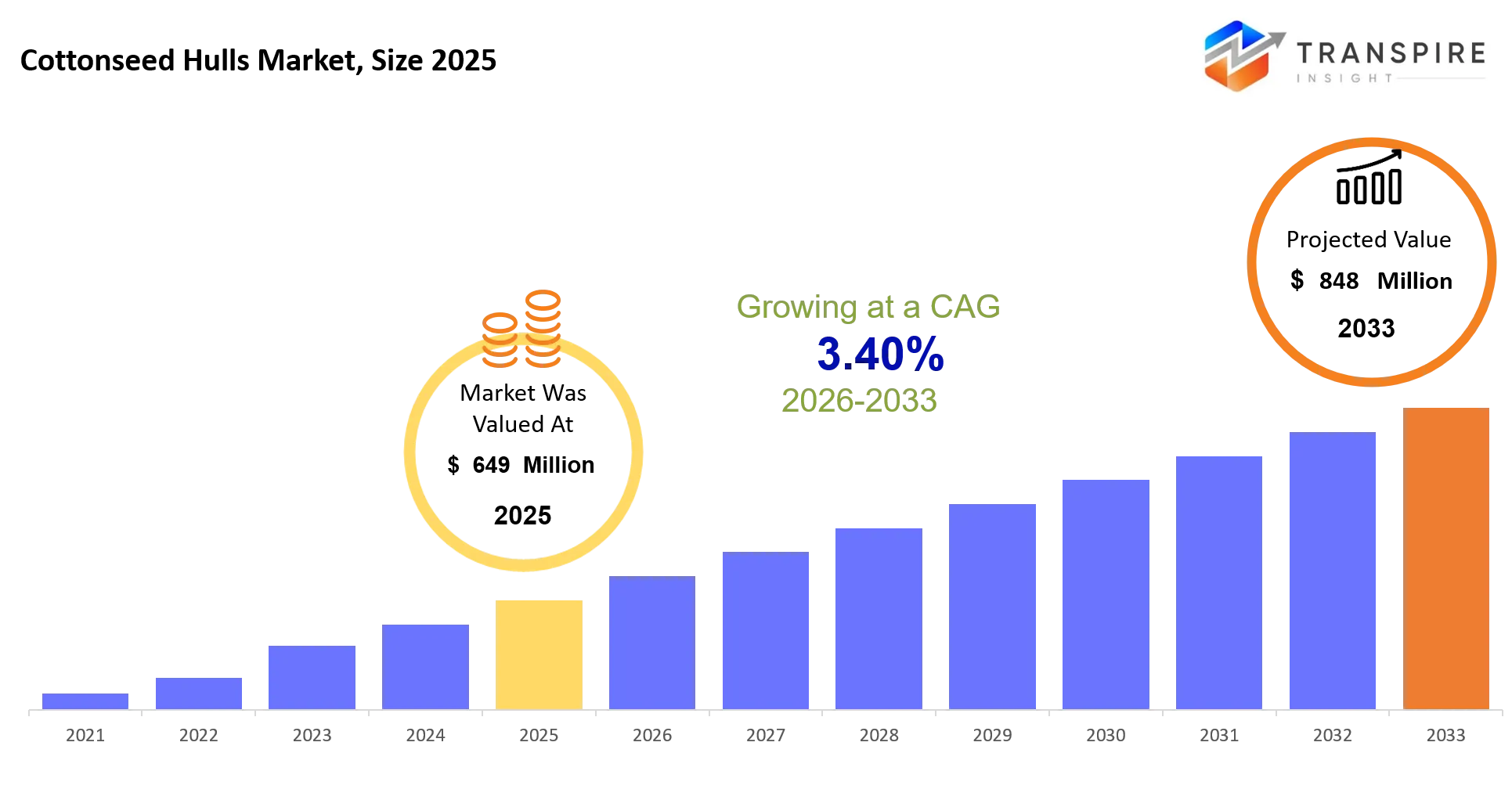
As per the Transpire Insight Analysis, the Cottonseed Hulls Market size is estimated at USD 649 million in 2025 and is anticipated to reach USD 848 million by 2033, growing at a CAGR of 3.40% from 2026 to 2033.
The global cottonseed hull market turns raw, bulk cotton processing waste into marketable feedstuffs, soil improvers, fuel pellets, mushroom production media, and chemical feedstocks. In the last three to five years, demand shifted from loose and local sale to ground, pelletized, tested products travelling greater distances to larger automated feed and bioeconomy systems. The first structural change is circular-bioeconomy policy and purchasing: mills are increasingly profiting from cotton fractions while making end-of-line disposal less costly. A more recent driver is the boom in pelletizers and bio-based value-adding projects as buyers look for lower transport costs and less fossil-based alternatives. In a trend parallel to ginning and cottonseed refinery growth, productivity grows as residue is generated, processing densifies and distributes, saleable products grow to new end-users, and utilization creates value for waste. Mushroom production and biochemical research are both on the rise.
Cottonseed Hulls Market Size & Forecast:
- Global Market Size 2025: USD 649 Million
- Expected Market Value (2033): USD 848 Million
- Forecast CAGR (2026–2033): 3.40%
- Leading Region in 2025: North America
- Fastest Growing Region: Asia Pacific
- Key Company Profiles: ADM, Cargill, Louis Dreyfus Company, Olam Agri, Wilmar International, Bunge, PYCO Industries, Planters Cotton Oil Mill, National Cottonseed Products Association, Cotton Incorporated, J.G. Boswell Company, Delta Pine, Bayer Crop Science, Viterra, ETG
Key Cottonseed Hulls Market Insights:
The market is changing from selling bulk residues to specification-grade materials, and quality control is as critical as volume of supply. Processors are gaining a competitive edge with integration of ginning, testing, pelletization, traceability, and higher value outlets.
- Ground hulls are 44%, with ADM and Cargill working on feed-grade quality controls and automation of hull sizing.
- Pelletized hulls are 21%, and PYCO is increasing the capacity of mill-linked distribution due to the densification resulting in lower freight, dust, and storage friction.
- Loose hulls account for 15%, primarily in the gins, where regional mills and cooperatives maintain low-processing supply models.
- Processed hulls represent 10%, and Bunge and integrated crushers are focusing on safety verification, digestibility and traceable by-products.
- Organic hulls have a 14.8% CAGR, while certification is moving buyers towards premium and documented supply.
- Premium feed grade accounts for 2% and lab-based formulations are providing margin opportunities for specialist suppliers.
- Other formats account for 1%, with niche development in customized substrates, sorbents, composites and industrial inputs.
- Olam Agri, Wilmar, LDC and Viterra are transitioning from spot to origin-linked contracts and digitally documented deliveries.
- Optical sorting, moisture sensors, and predictive pellet controls are emerging as differentiators for processors targeting export and speciality markets.
What are the Key Drivers, Restraints, and Opportunities in the Cottonseed Hulls Market?
Driver:
Feed-cost inflation and more aggressive circularity targets are prompting dairy and beef producers to substitute some purchased roughage with cottonseed hulls. The short-run incentive is forage shortfalls caused by drought, which tend to cut hay availability and raise prices. Adjacent cotton areas can be more cost-efficient by grinding or pelleting the residue- repeated procurement arrangements optimize processing plant capacity, and gossypol and aflatoxin assays facilitate plant feeding controls and broaden acceptance to regional livestock-feeding and feed-mill users.
Restraint:
Variable moisture and fibre grade, contamination, seasonality, and risk of free-gossypol limit formulation rate hinder cross-border commerce. This continues due to the hull composition variations with cultivar, gin settings, storage, and climate; and the small processing plants often don't have labs, dryers, and traceability; thus, buyers reduce the valuation of the not-checked loads.
Opportunity:
Digitized sorting and low-temperature and extrusion-based conditioning have the potential to convert lower-quality by-product into feed, substrate, and fuel to specification grade. Investment in regional hubs in India, Pakistan, China, Brazil and the USA, integrating near- gin drying, optical sorting, pellet mills and contracted logistics could reduce waste, increase compliance and make available for sale more valuable mushroom substrates, furfural, sorbents and renewable pellets rather than bulk roughage.
What Has the Impact of Artificial Intelligence Been on the Cottonseed Hulls Market?
Artificial intelligence has yet to replace buyer utilization of cottonseed hulls, but it is optimizing grading, handling, and processing. Computer vision can view colour, foreign matter, particle size, and visible mould at receiving, and sensor information can govern mills for grinding, drying, and pelletizing to targeted moisture and density. Machine-learning algorithms project throughput, weather, storage parameters, lab analysis, and customer requirements to predict available hull volume, risk of contamination, pellet quality, and expected delivery timing.
The practical impact is reduced energy costs, diminished loads rejected, improved inventory turnover, and more uniform feedstock or substrate series.
AI-based formulation can suggest hull inclusion for a given ration to optimize fiber, digestibility, animal type, and safety parameters. The challenge is that coarser ginning adds imbalance to records, and models do not predict concealed gossypol, aflatoxin, or fungus until confirmed by lab testing. Investment in automation, sensor upkeep, IT security, and technical capacity is a barrier for small players. AI strengthens quality control; it does not displace sampling, testing, or regulation.
In July 2026, the National Institute of Seeds (INASE) mandated AI-driven monitoring systems. This action enhances regulatory traceability and combats illegal seed use in processing facilities.
Key Cottonseed Hulls Market Trends:
The market is changing from low-value disposal of residues to measurable and specification-based biomass utilisation. Processing, traceability, and local circular-economy economics are all key elements in the cotton ginning-to-feed, substrate, and energy-buyers nexus where growth is strongest.
- Denser formats are reducing storage volume, dust and handling losses, and freight cost, and are replacing loose trading.
- Feed buyers are shifting from opportunistic buying to testing, due to greater moisture, mold, aflatoxin and gossypol concerns.
- Dairy and beef are the commercial foundations, and poultry demand continues to be limited by fibre and safety suitability.
- Cotton processors are increasingly moving their dryers, mills and quality laboratories together, and are converting seasonal residue to year-round inventory by moving hulls.
- Agricultural-fibre substrates are being used by mushroom growers, allowing them to generate additional value outside of the roughage market.
- As substitution economics become more attractive in the local energy market due to the volatility of energy prices, biomass users are considering hull pellets and blended fuels.
- Digital procurement is moving from the dealer relationship to the traceable contract, online agri-platforms, and scheduled bulk delivery.
- The value chain is expanding beyond feed with research progressing toward furfural, biosorbents, biocomposites, and soil inputs.
Cottonseed Hulls Market Segmentation
By Product Type:
Ground Cottonseed Hulls dominate with 44% market share because their consistency benefits feed blending and enhances digestibility for high-volume commercial feed mill manufacturing. Pelletized Cottonseed Hulls hold 21% because their portability, decreased storage losses, and automated feeding make them attractive. Loose Cottonseed Hulls hold 15%, as they are still relevant for certain livestock operations, especially regionally. Processed Cottonseed Hulls hold 10%, due to more consistent quality and quality control. Organic Cottonseed Hulls, although holding 7%, register the fastest expansion with a 14.8% CAGR as certified livestock and organic crop markets. A new premium Feed Grade Hull market has developed, at 2%, for specific nutritional needs, while Others account for 1%.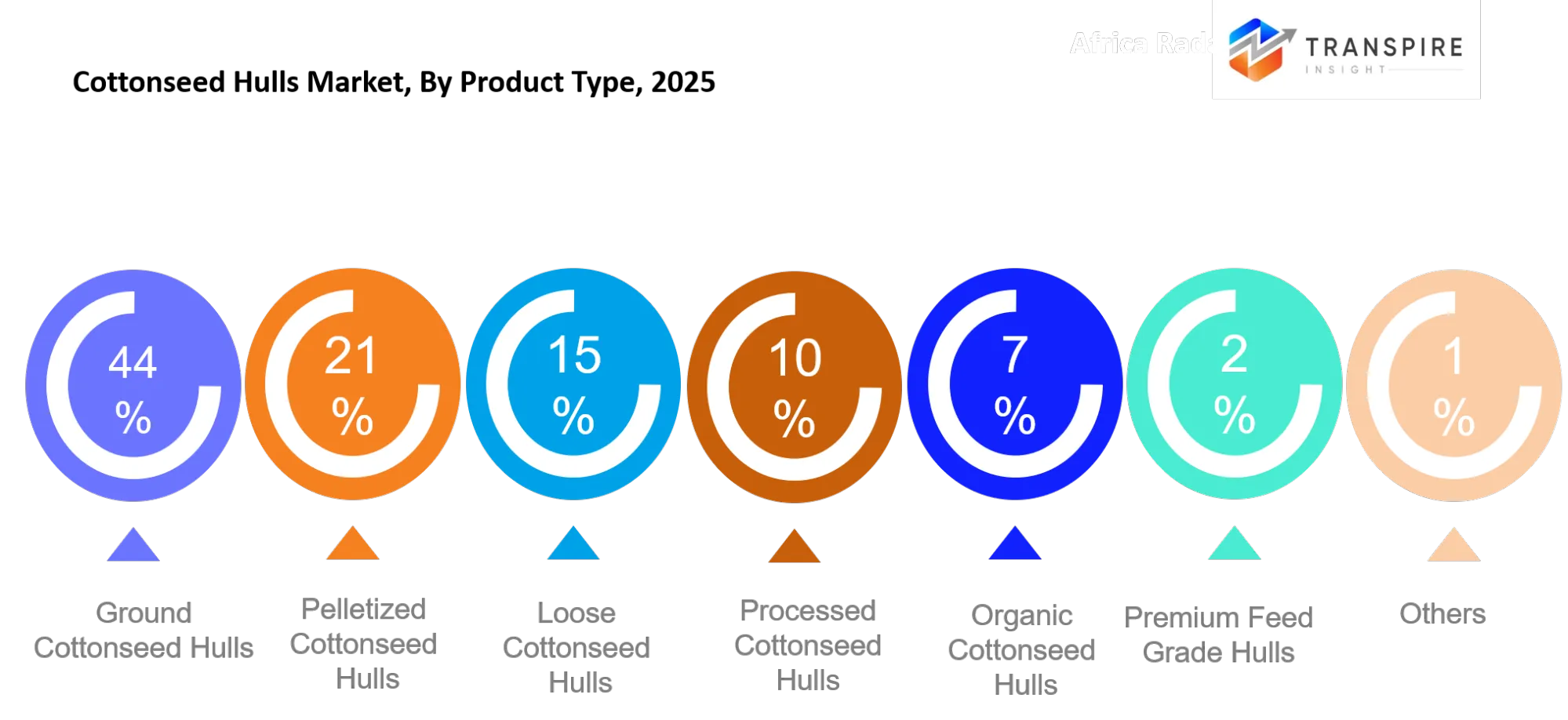
By Application:
Animal feed continues to be the dominant revenue stream as cottonseed hulls offer more efficient utilization of fibre in dairy and beef diets. Demand for dairy feed strengthens as a result of improved rumen health; cost-effective roughage inclusion drives demand for beef cattle feed. Poultry feed retains niche usage in formulated diets, while soil conditioner, biomass fuel, mushroom cultivation and other niche applications show diversification of opportunities for commercial use beyond livestock feeding.
By End User:
Livestock farms remain the main consumers because of the ongoing feeding demand; then feed manufacturers combine fibre components derived from standardized sources in the form of commercial feed mixtures; dairy farms reinforce the premium demand; agricultural cooperatives raise the regional procurement efficiency; biomass producers develop industrial diversification; the horticulture industry enlarges the application of controlled production systems.
By Distribution Channel:
Direct sales are prevalent in commercial transactions via long-term processor-feed manufacturer agreements. Agricultural dealers and cooperatives enhance regional availability, while wholesalers facilitate bulk transhipments. Agricultural online procurement platforms progressively enhance transparency, online pricing, and broader supplier sourcing. With stringent quality requirements, buyers tend to call for standardized specifications, fixed scheduling, and traceable lots instead of opportunistic spot purchase, thus enabling more efficient global market coordination.
By Processing Method:
Raw material is for close-to-market price-sensitive users; Processed & Pelletized grades for trade over distance; Ground grades allow precise formulation; Sterilized grades for mushrooms and controlled horticulture; Future winners will link certification & traceability and flexible processing to application-specific value, leading to increased reliability for exporters & Industrial buyers.
What are the Key Use Cases Driving the Cottonseed Hulls Market?
Dairy and beef feeding continues to be the primary use case, in line with the leading Ground Cottonseed Hulls segment and similar to preference for controlled roughage. Ground material may be incorporated into rations closer to livestock farms or feed manufacturers, reducing the cost of forage while providing the structure to support rumen health.
Additional expanding uses are soil ameliorant and biomass fuel, depending on fibre, ash and safety parameters. Pelletized products are preferred by co-operatives and biomass users since the enhanced density facilitates storage, mechanization and regional distribution.
Potential new applications include mushroom cultivation using sterilized or processed hulls as a substrate; pilots are focused on furfural, biosorbents, biocomposites and wastewater treatment. This would substitute some of the feed demand and favour reliable chemistry, traceability and contamination control.
|
Report Metrics |
Details |
|
Market size value in 2025 |
USD 649 Million |
|
Market size value in 2026 |
USD 671 Million |
|
Revenue forecast in 2033 |
USD 848 Million |
|
Growth rate |
CAGR of 3.40% from 2026 to 2033 |
|
Base year |
2025 |
|
Historical data |
2021 - 2024 |
|
Forecast period |
2026 - 2033 |
|
Report coverage |
Revenue forecast, competitive landscape, growth factors, and trends |
|
Regional scope |
United States; Canada; Mexico; United Kingdom; Germany; France; Italy; Spain; Denmark; Sweden; Norway; China; Japan; India; Australia; South Korea; Thailand; Brazil; Argentina; South Africa; Saudi Arabia; United Arab Emirates |
|
Key companies profiled |
ADM, Cargill, Louis Dreyfus Company, Olam Agri, Wilmar International, Bunge, PYCO Industries, Planters Cotton Oil Mill, National Cottonseed Products Association, Cotton Incorporated, J.G. Boswell Company, Delta Pine, Bayer Crop Science, Viterra, ETG |
|
Customization scope |
Free report customisation (country, regional & segment scope). Avail customised purchase options to meet your exact research needs. |
|
Report Segmentation |
By Product Type (Ground Cottonseed Hulls, Pelletized Cottonseed Hulls, Loose Cottonseed Hulls, Organic Cottonseed Hulls, Processed Cottonseed Hulls, Premium Feed Grade Hulls, Others); By Application (Animal Feed, Dairy Feed, Beef Cattle Feed, Poultry Feed, Soil Conditioning, Biomass Fuel, Mushroom Cultivation, Others); By End User (Livestock Farms, Feed Manufacturers, Dairy Farms, Agricultural Cooperatives, Biomass Producers, Horticulture Industry, Others); By Distribution Channel (Direct Sales, Agricultural Dealers, Cooperatives, Online Agri Platforms, Wholesalers, Others); By Processing Method (Raw, Processed, Pelletized, Ground, Sterilized, Others) |
Which Regions are Driving the Cottonseed Hulls Market Growth?
North America accounts for 41% of this because it has an integrated system of cotton ginning, feed manufacturing, dairy and beef production. Co-operatives, distribution channels, storage facilities and testing laboratories guarantee the secure flow of raw materials from gins to the livestock market, while sustainability reports stimulate the conversion into feeds, fuels and industrial products. Institutionalized handling and contracts lower the risks for quality, supply and procurement to commercial users. In June 2026, Cargill launched an Integrated Dairy Development Initiative in Maharashtra in partnership with Syngenta Foundation India and Digital Green India. This program expands scientific dairy management and nutrition solutions across rural livestock ecosystems.
Europe accounts for 22%, below North America, but uses conformity rather than cotton volume as a basis to trade. Circular-economy procurement, biomass replacement and traceability demands sustain imported/blended product demand. Buyers impose certification, contamination controls, and carbon accounting. Processed grades and professional suppliers are preferred. The market is more consistent, but verifiable material may achieve premium prices.
Asia Pacific comprises 27% and is the most rapidly expanding at a CAGR of 15.6%, and the dynamics are being shifted by India & China's livestock, mushroom and biomass ecosystems, where remote origin can substitute used feed inputs. Pellet mills and regional aggregation centres are mitigating access issues outside the cotton zones. Latin America comprises 6%, Middle East & Africa 4%, and has potential for testing and sterilization capacity for high-end feed, mushroom substrate, and bio-based products. In July 2026, theNational Bank for Agriculture and Rural Development (NABARD)partnered with MAHAPREIT to finance green infrastructure. This initiative expands funding for rural regional aggregation centres and biogas systems that utilize agricultural residues.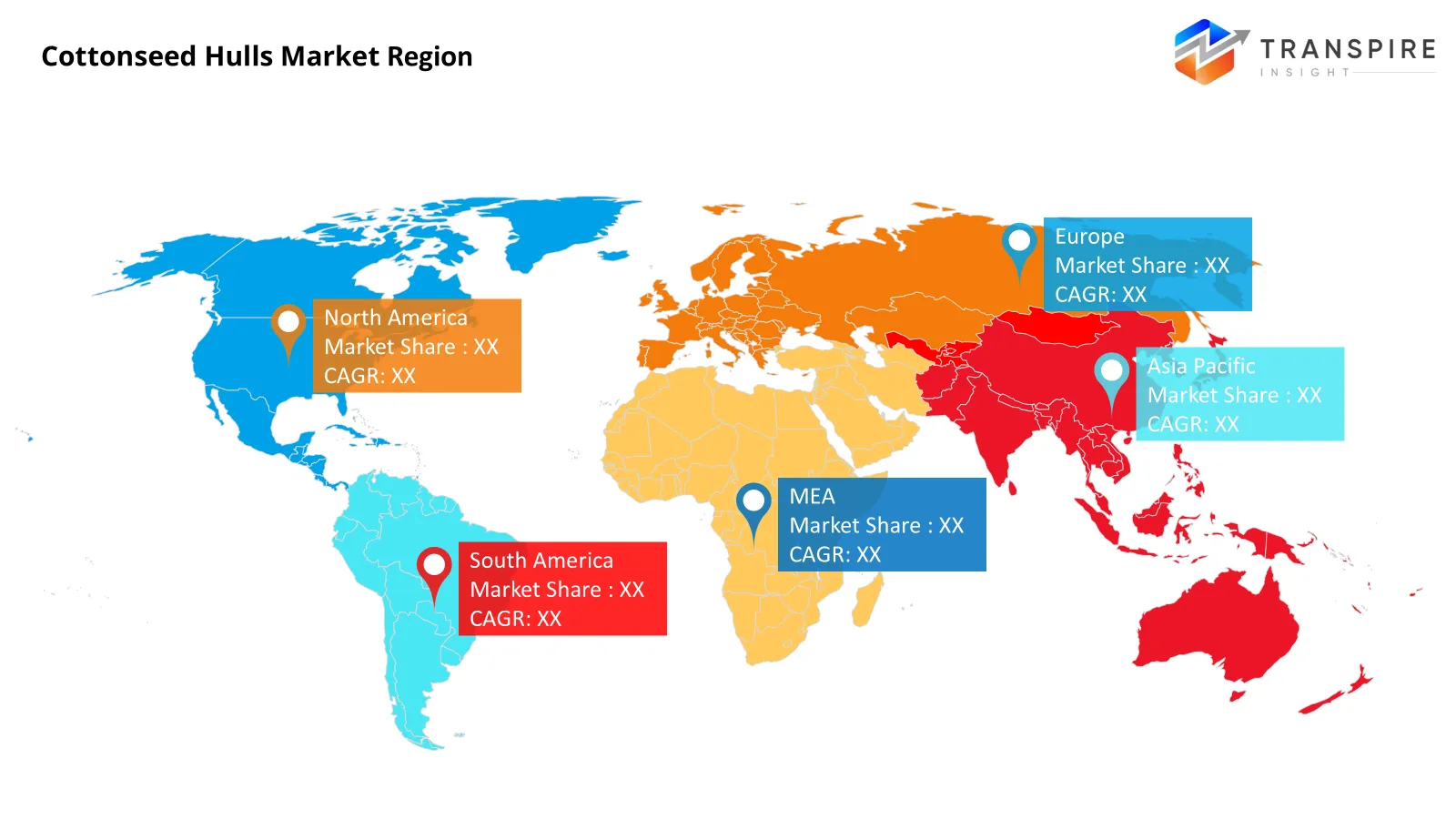
Who are the Key Players in the Cottonseed Hulls Market, and how do they Compete?
The industry is split between large integrated agribusinesses, regional cottonseed processors, co-ops and technical associations. Larger players compete on sourcing, logistics, user relationships and utilization. More specialized players compete on raw hull consistency and niche grades. Growing markets of demand for traceable, tested processed hulls for feed and mushroom growing.
ADM, Cargill, Bunge, Louis Dreyfus Company, Olam Agri, Wilmar International, and Viterra apply cost and network strategies: they cluster cottonseeds, optimize crushing and transportation, and promote hull-meal and hull-oil cross-selling. Origin proximity is central for Olam, ADM and Bunge, which are diversifying more through sustainability information and supply-chain traceability. ETG exploits regional sourcing with emerging-market distribution.
Competing with PYCO Industries, Planters Cotton Oil Mill, J.G. Boswell Company and Delta Pine on regional integration, mill proximity and reliable feed-grade supply. Growing up through capacity, contracts, and dealers. Differentiation of the National Cottonseed Products Association and Cotton Incorporated using standards, technical education, and market development. Competition between Bayer Crop Science indirectly through a higher cotton yield and input-linked supply potential. Innovation by pelletization, testing, and application of bio-based products. Application expertise reduces the distance.
Key Players are:
- ADM
- Cargill
- Louis Dreyfus Company
- Olam Agri
- Wilmar International
- Bunge
- PYCO Industries
- Planters Cotton Oil Mill
- National Cottonseed Products Association
- Cotton Incorporated
- J.G. Boswell Company
- Delta Pine
- Bayer Crop Science
- Viterra
- ETG
Recent Development News
- In March 2026, Bunge expanded industrial supply lines for cotton-processing by-products to support alternative commodity applications. This strategic focus accelerates the adoption of low-cost, high-fibre cottonseed hulls across multi-industry verticals, including furfural chemical synthesis and advanced bio-based material manufacturing.
- In May 2026, Louis Dreyfus Company partnered with PepsiCo to expand a regenerative agriculture program in Canada. The collaboration promotes sustainable crop production practices that strengthen long-term oilseed and cotton-related agricultural value chains while supporting responsible raw material sourcing for downstream feed ingredients.
What Strategic Insights Define the Future of the Cottonseed Hulls Market?
The market is evolving toward dual structures-low-cost local hulls for nearby feed customers and certified processed grades for longer-haul, industrial, and niche markets. Margins will depend on controlling moisture, contaminant testing, density, traceability, and proof of waste-diversion benefits. An unanticipated risk is that weather variation can depress yields at the same time it changes hull chemistry, causing shortfalls while customers are demanding tighter specifications. Rising regulations around gossypol, aflatoxin, dust, and emissions could leave poorly equipped processors stranded. The next frontier will likely be regional biorefineries- speciality dehulling, drying, pelletizing, sterilizing, mushroom-substrate production, furfural, and bio-based composites. Recommendations: lock up multi-year gin and feed contracts, install modular, sensor-driven quality control, and segment production for different end uses. Focus on APAC markets, North American standards, and European compliance to command premiums. Collaborate with mushroom growers, who can help create validated speciality grades, spreading the risk of volume fluctuations while building margin.
Key Segmentations are:
By Product Type
- Ground Cottonseed Hulls
- Pelletized Cottonseed Hulls
- Loose Cottonseed Hulls
- Organic Cottonseed Hulls
- Processed Cottonseed Hulls
- Premium Feed Grade Hulls
- Others
By Application
- Animal Feed
- Dairy Feed
- Beef Cattle Feed
- Poultry Feed
- Soil Conditioning
- Biomass Fuel
- Mushroom Cultivation
- Others
By End User
- Livestock Farms
- Feed Manufacturers
- Dairy Farms
- Agricultural Cooperatives
- Biomass Producers
- Horticulture Industry
- Others
By Distribution Channel
- Direct Sales
- Agricultural Dealers
- Cooperatives
- Online Agri Platforms
- Wholesalers
- Others
By Processing Method
- Raw
- Processed
- Pelletized
- Ground
- Sterilized
- Others
Regional Outlook
North America
- US
- Canada
- Mexico
Europe
- Germany
- UK
- France
- Italy
- Spain
- Russia
- Rest of Europe
Asia Pacific
- China
- Japan
- India
- South Korea
- Australia
- Rest of Asia Pacific
South America
- Brazil
- Argentina
- Rest of South America
Middle East & Africa
- UAE
- Saudi Arabia
- Qatar
- South Africa
- Rest of the Middle East & Africa
Frequently Asked Questions
Find quick answers to common questions.
The Cottonseed Hulls Market size was valued at USD 649 million in 2025 and is poised to reach USD 848 million by 2033, expanding at a 3.40% CAGR.
Key segments for the Cottonseed Hulls Market are By Product Type (Ground Cottonseed Hulls, Pelletized Cottonseed Hulls, Loose Cottonseed Hulls, Organic Cottonseed Hulls, Processed Cottonseed Hulls, Premium Feed Grade Hulls, Others); By Application (Animal Feed, Dairy Feed, Beef Cattle Feed, Poultry Feed, Soil Conditioning, Biomass Fuel, Mushroom Cultivation, Others); By End User (Livestock Farms, Feed Manufacturers, Dairy Farms, Agricultural Cooperatives, Biomass Producers, Horticulture Industry, Others); By Distribution Channel (Direct Sales, Agricultural Dealers, Cooperatives, Online Agri Platforms, Wholesalers, Others); By Processing Method (Raw, Processed, Pelletized, Ground, Sterilized, Others).
Growth is primarily driven by cost-efficient livestock roughage demand, drought-related forage shortages, pelletization and processing investments, circular-economy policies, and expanding applications in mushroom cultivation, biomass fuel, furfural, soil conditioning, and wastewater treatment.
The Cottonseed Hulls Market is led by major manufacturers including ADM, Cargill, Louis Dreyfus Company, Olam Agri, Wilmar International, Bunge, PYCO Industries, Planters Cotton Oil Mill, National Cottonseed Products Association, Cotton Incorporated, J.G. Boswell Company, Delta Pine, Bayer Crop Science, Viterra, ETG.
North America holds 41% of the market, supported by integrated cotton ginning, feed manufacturing, livestock production, cooperative networks, storage infrastructure, testing capacity, and established contracts between processors and feed buyers.
Key opportunities include regional pelletization hubs, AI-enabled grading and traceability, organic and premium feed grades, sterilized mushroom substrates, biomass fuel, furfural, biosorbents, bio-composites, wastewater treatment, and Asia-Pacific processing partnerships.
- ADM
- Cargill
- Louis Dreyfus Company
- Olam Agri
- Wilmar International
- Bunge
- PYCO Industries
- Planters Cotton Oil Mill
- National Cottonseed Products Association
- Cotton Incorporated
- J.G. Boswell Company
- Delta Pine
- Bayer Crop Science
- Viterra
- ETG
About the Authors

Chetan Dhatrak
I’m Chetan Dhatrak, a Senior Research Analyst at Transpire Insight, specializing in the Consumer Goods, Foods and Beverages industry. I focus on analyzing market trends, consumer behavior, competitive landscapes, and industry developments to deliver accurate, data-driven insights. My research at Transpire Insight is built on credible sources and in-depth analysis, helping businesses and readers better understand market dynamics, emerging opportunities, and evolving consumer preferences. I’m committed to creating reliable, well-researched content that supports informed decision-making and reflects the latest developments in the consumer goods and food & beverage sectors.

Chakradhar Khansole
Chakradhar serves as the Research Director at Transpire Insight, bringing over 8 years of experience in technology, innovation, and strategic market intelligence. He specializes in transforming complex market data into actionable business insights that enable organizations to make informed, growth-oriented decisions. Recognized for his strategic vision and analytical expertise, Chakradhar leads high-impact research initiatives, delivering comprehensive market assessments, competitive intelligence, and forward-looking industry analysis.
Recently Published Reports
-
Apr 2026
Baby Infant Formula Market
Baby Infant Formula Market Size, Share & Analysis Report By ype (Infant Milk, Follow On Milk, Specialty Baby Milk, Growing-Up Milk), By Ingredient (Carbohydrate, Fat, Protein, Minerals, Vitamins, and Others), By Product Form (Powder, Liquid, and Ready-to-feed), By Distribution Channels (Supermarket/Hypermarket, Specialty Store, Pharmacies, Online Retail, and Others), and Geography (North America, Europe, Asia-Pacific, Middle East and Africa, South and Central America), 2021 - 2031
-
Apr 2026
Edible Insects for Animal Feed Market
Edible Insects for Animal Feed Market Size, Share & Analysis Report By Type (Insect Powder, Insect Meal, Insect Bar, Insect Paste, Insect Oil, and Others), By Insect Type (Beetles, Cricket, Caterpillar, Hymenoptera, Orthoptera, Tree Bugs, and Others), By Application (Livestock, Pet Food, and Aquaculture), By Livestock Type (Poultry, Swine, and Others), and Geography (North America, Europe, Asia-Pacific, Middle East and Africa, South and Central America), 2021 - 2031
-
Apr 2026
Food Industry Disinfection and Bacterial Control Market
Food Industry Disinfection and Bacterial Control Market Size, Share & Analysis Report By Type (Chemical Disinfectants, Physical Disinfectants, and Biocides and Antimicrobials), By Application (Food Processing Equipment Surface Disinfection, Food Preparation Areas Surface Disinfection, Storage Areas Surface Disinfection, Anti-microbial Coatings Food Preservation, and Preservative Solutions Food Preservation), By End User (Meat and Poultry Processing, Dairy Processing, Seafood Processing, Bakery and Confectionery, Restaurants and Commercial Kitchens, and Food Service Providers), By Sales Channel (Online, Offline), and Geography (North America, Europe, Asia-Pacific, Middle East and Africa, South and Central America), 2021 - 2031
-
May 2026
Freeze Dried Food Market
Freeze Dried Food Market Size, Share & Analysis Report By Product Type (Fruits, Vegetables, Freeze-Dried Dairy Products, Freeze-Dried Meat and Seafood, Freeze-Dried Pet Food, and Prepared Meal), By Nature (Organic, and Conventional), By Form (Powdered, Granules, and Diced), By End Use (Breakfast Cereals, Dairy Products, Bakery & Confectionery, Nutritional Bars & Supplements, Powdered Beverages, Snacks, and Retail (Household)), and Geography (North America, Europe, Asia-Pacific, Middle East and Africa, South and Central America), 2021 - 2031