

Asia Pacific Canned Mushroom Market Summary
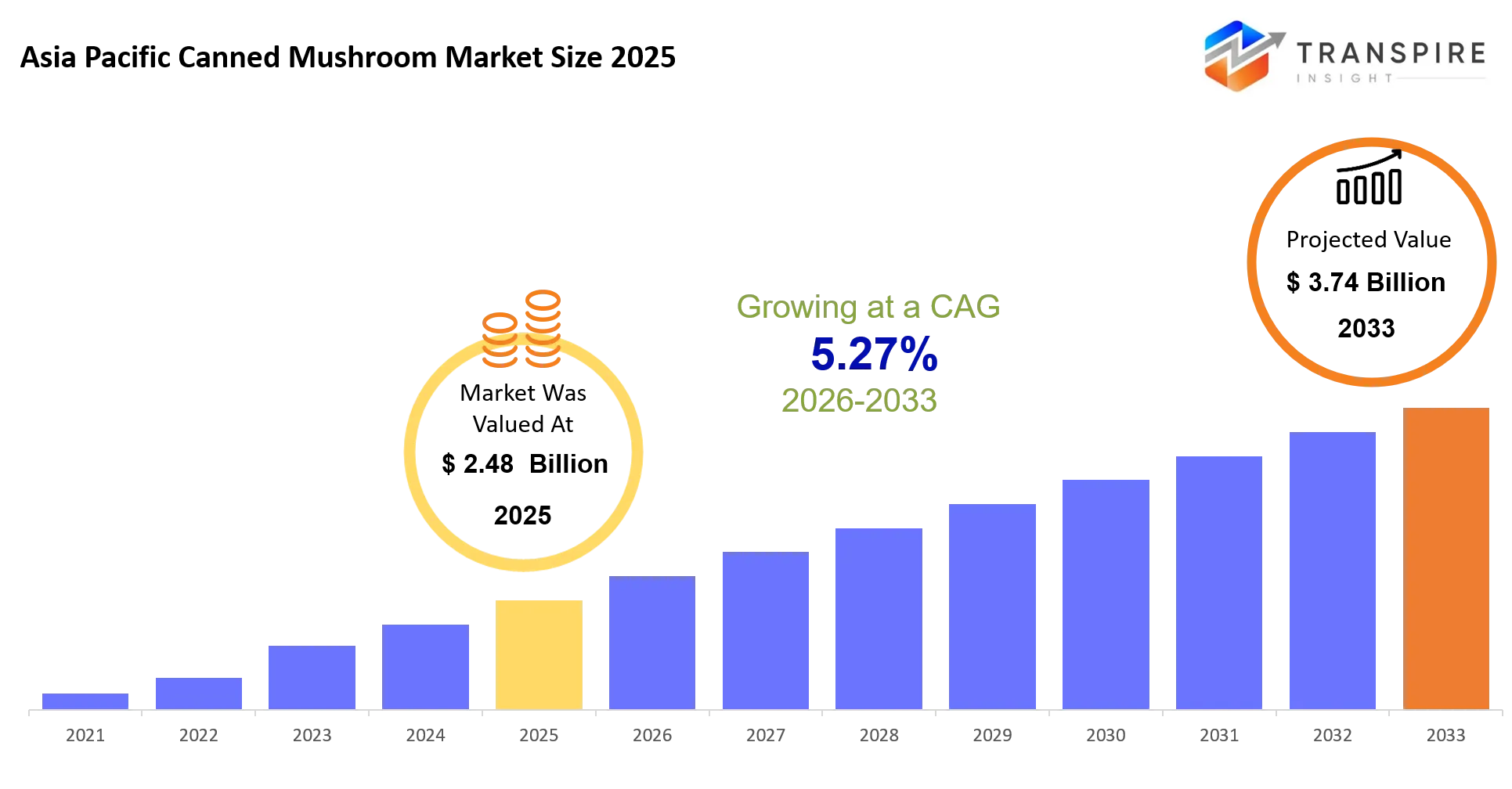
As per Transpire Insight Analysis the Asia Pacific Canned Mushroom Market size is estimated at USD 2.48 Billion in 2025 and is anticipated to reach USD 3.74 Billion by 2033, growing at a CAGR of 5.27% from 2026 to 2033.
The Asia Pacific Canned Mushroom Market kind of matters a great deal when it comes to getting shelf-stable mushrooms to processors, restaurants, retail chains, and institutional kitchens that want steady quality, longer keeping life, and dependable availability year round. By putting mushrooms into cans, companies can reduce the whole seasonal swings, and also handle perishability more effectively than with fresh. It also helps reduce food waste, and makes it less annoying to ship, both inside the region and out toward export markets. In practice canned mushrooms turn into a kind of key add on for ready meals, soups, pizzas, sauces, and those quick service restaurant menus where speed is everything
Over the last five years, things have been drifting toward more automated processing, higher end mushroom types and tougher food safety rules. This change is influenced by export requirements and what modern retail chains now expect. When pandemic supply chains got shaky, many manufacturers started diversifying where they source from and expanding regional processing capacity, so they were less dependent on one country only. Meanwhile, as convenience food production keeps growing, and as foodservice networks slowly bounce back, processors are working to lock in steady raw material supply. At the same time they’re investing in value-added canned products, so you end up with higher production volumes, wider retail presence, and revenue that keeps trending upward across the whole regional market.
Asia Pacific Canned Mushroom Market Size & Forecast:
- Asia Pacific Canned Mushroom Market Size 2025: USD 2.48 Billion
- Expected Market Value 2033: USD 3.74 Billion
- Forecast CAGR: 5.27%
- Leading region in 2025:
- Fastest Growing region:
- Key Profile: Bonduelle, Greenyard, Prochamp, Monterey Mushrooms, Costa Group, The Mushroom Company, Dhruv Agro, Shanghai Finc Bio-Tech, Agro Dutch Industries, Monaghan Mushrooms, Lutèce Holdings, Banken Champignons, OKECHAMP, Giorgio Fresh, Scelta Mushrooms
Key Market Insights
- East Asia sort of dominates the Asia Pacific Canned Mushroom Market, taking about 58% of the market share in 2025, mostly because China has a large scale mushroom cultivation and processing industry… which just keeps getting bigger.
- South Asia meanwhile is projected to grow the quickest through 2033, helped by organized retail expansion and people buying more processed foods, like it’s becoming more normal.
- In the product segment, whole canned mushrooms are leading, roughly 36% share, and this is largely pushed by foodservice and hospitality use cases.
- Sliced canned mushrooms stay in the number two spot at around 28%, while seasoned mushroom products are expected to see the fastest growth through 2033, sort of steadily gaining attention.
- Looking at applications, ready meals and processed food manufacturing make up nearly 42% of demand. Quick-service restaurants are expected to be the fastest-growing application stream.
- From an end-user view, food processing companies account for around 48%, while institutional catering and cloud kitchens are increasing procurement volumes quite rapidly.
- Major players like Bonduelle, Greenyard, Prochamp, Monterey Mushrooms, Costa Group, and Agro Dutch Industries keep strengthening their positions via product updates and more regional manufacturing expansion.
- At the same time manufacturers are investing more in automated canning, quality inspection systems,and traceability technologies… mostly to boost export compliance and overall operational efficiency.
- Regional suppliers are also expanding their cooperation with supermarket chains and private label brands, so distribution networks get a bit stronger across the emerging Asia Pacific economies.
- Premium organic , specialty and mixed mushroom lines have been picking up traction since 2022. This is because consumers want more differentiated packaged options, and retailers are widening what they offer on the premium shelf, kind of steadier than before.
What are the Key Drivers, Restraints, and Opportunities in the Asia Pacific Canned Mushroom Market?
The main engine behind the Asia Pacific canned mushroom industry is kind of that fast push in processed food manufacturing and more organized foodservice pathways, across China India Southeast Asia, and Australia, you know. It’s less about one single thing and more about the whole momentum toward ready to eat products and a tighter distribution setup, which makes growers and processors move quicker.. Ready meal makers, frozen food producers, pizza brands, and institutional caterers all want ingredients with steady quality and longer shelf life, things that are still on hand no matter the season’s harvest ups and downs. At the same time, investments in automated canning lines plus integrated mushroom cultivation have helped lower production costs and also raise product uniformity, so companies can handle bigger retail deals and export contracts, then bring in better revenues, overall.
One big restraint is the real structural tie to farm schedules, and also climate sensitive cultivation practices. Mushroom growing at scale really depends on managed environments, dependable compost quality, and steady labor availability. Meanwhile, energy prices keep moving upward, labor pools can be thin, and there are swings in steel packaging costs , which all adds to production expense that cannot be balanced out quickly. Because of this, these structural issues reduce how flexible production can be, squeeze manufacturer margins , and slow down capacity growth, especially for smaller regional processors that have less buffer.
A noticeable opportunity is premiumization together with export focused, value added product lines. Organic certified canned mushrooms, distinctive kinds like shiitake and oyster mushrooms, plus low sodium processed options are drawing premium retail buyers across the Asia Pacific region. Backing advanced processing capabilities, digital traceability tools, and eco oriented packaging is making export channels more competitive, while also unlocking room in premium supermarket shelves, online grocery websites, and international foodservice supply routes.
What Has the Impact of Artificial Intelligence Been on the Asia Pacific Canned Mushroom Market?
Artificial intelligence and advanced digital technologies are, in a way, reshaping canned mushroom production—by improving cultivation , processing quality assurance, and even supply chain management. Computer vision systems do the mushroom inspection during grading and sorting, and they spot defects, discoloration , plus size variations in a steadier way than a person can manage all day long. And then there are AI-powered production management platforms that sort of “coordinate” washing, slicing, blanching, sterilization, and packaging steps by continuously watching equipment performance and the production parameters too.
Machine learning models also enable predictive maintenance across processing sites, by looking at vibration signals, temperature patterns, and equipment utilization data, to flag possible failures before they actually happen. Because of this, equipment availability tends to rise, unplanned downtime is pushed down, and production scheduling gets smoother, while maintenance costs stay lower. AI-driven demand forecasting helps manufacturers align raw mushroom procurement with seasonal retail and foodservice demand, which in turn reduces inventory losses and improves supply chain efficiency overall.
Still, AI adoption doesn’t move as fast as you might expect, mainly because implementation costs are high, and digital infrastructure is limited among small and medium-sized processors. A lot of facilities keep using older processing equipment, the kind that can’t easily connect with AI-based monitoring platforms. Plus, production data can be inconsistent across cultivation sites, and that makes prediction accuracy harder to trust, so large-scale digital transformation is usually more practical for vertically integrated producers than for smaller, independent manufacturers.
Key Market Trends
- Since 2021, manufacturers have been speeding up automation investments, to help with processing efficiency, less labor reliance ,and steadier production outcomes.
- Premium canned mushroom varieties, like shiitake and oyster mushrooms, keep growing pretty fast, because retailers are diversifying their packed food lineups.
- Over 60% of big processors have upgraded digital traceability systems since 2022 to meet export rules, and also those retailer quality expectations.
- Private-label canned mushroom production is rising across supermarket chains, which is basically creating fresh manufacturing partnerships, and boosting factory utilization rates too.
- Firms such as Bonduelle, Greenyard, and Prochamp are still expanding their regional processing capacities, to cut delivery time, and to strengthen their market footprint.
- Sustainable packaging efforts are moving quicker as well, manufacturers are trimming metal usage, and improving recyclable packaging types across most product categories.
- Online grocery sales have become a more meaningful distribution route since 2020, which pushes processors to introduce premium ,and specialty canned mushroom ranges.
- Production sites are increasingly using AI-enabled quality inspection systems, and that cuts product rejection rates by about 15% to 20% in automated processing settings.
- Export-focused manufacturers continue widening their sourcing networks, trying to lower the risk of supply disruptions that happened during recent global logistics headaches.
- Strategic investments that combine integrated mushroom cultivation and processing have improved supply stability, operational performance, and longer-term competitiveness across the Asia Pacific canned mushroom industry.
Asia Pacific Canned Mushroom Market Segmentation
By Mushroom Type
Button Mushrooms still take the largest share, mainly because broad consumer acceptance , a balanced flavor , and this kind of flexible use in day to day cooking help keep sales steady through both retail and foodservice. Shiitake Mushrooms keep picking up attention from premium packaged foods and Asian cuisine, and Oyster Mushrooms get noticed for a soft texture, plus a distinctive taste that people tend to remember. Straw Mushrooms remain really relevant for classic recipes across several Southeast Asian countries. Portobello Mushrooms also do well, they back premium meal prep and specialty retail shelves.
Mixed Mushrooms create variety, especially for ready meal producers and food manufacturers who want blended taste profiles that feel more rounded. Specialty Mushrooms bring extra value via unusual appearance, texture, and culinary applications, so the products fit well with premium positioning. Others cover regional mushroom types that match local food preferences and seasonal needs. Overall, product diversification will continue, because it gives customers more choices across multiple consumption categories.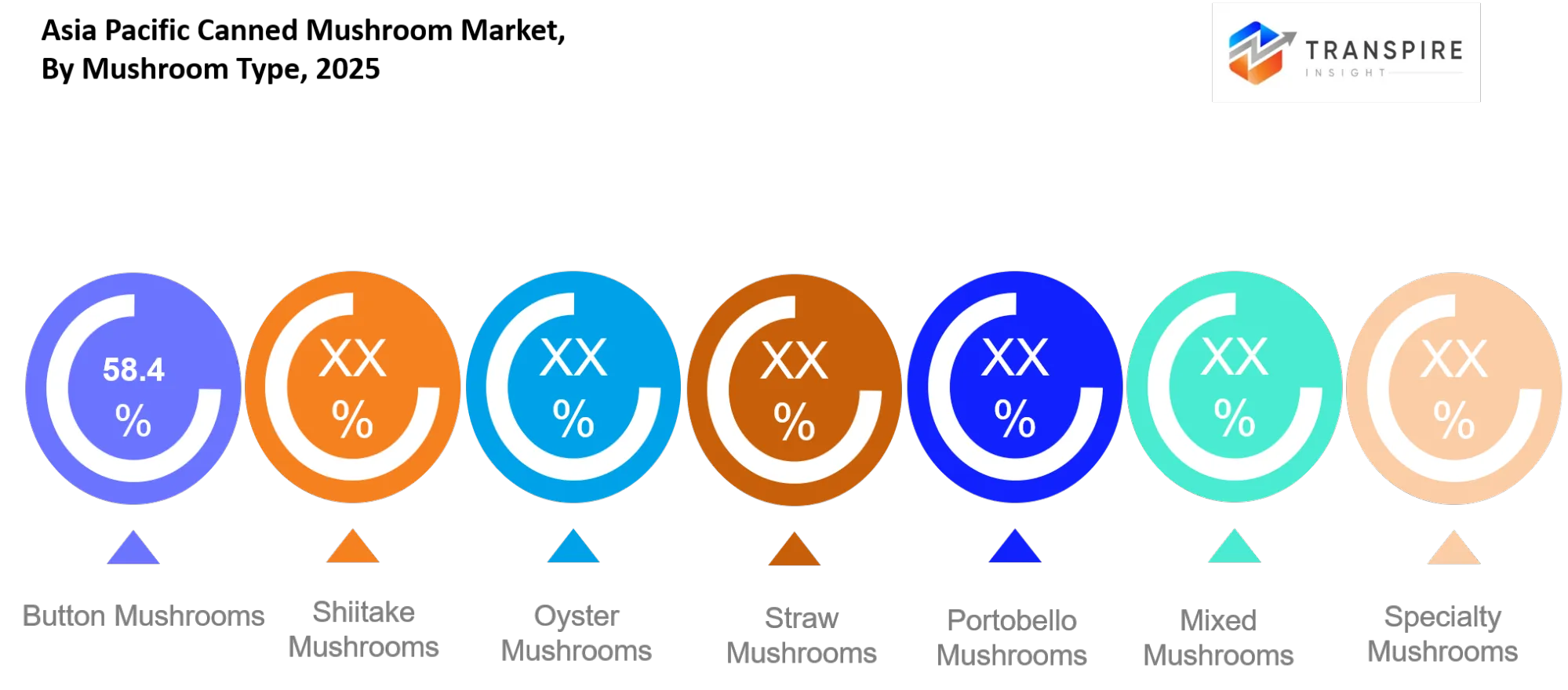
By Product Type
Mushrooms still show up as the go-to pick for foodservice kitchens since the visual look and overall shape stay intact even after processing, so it’s kind of the safer bet. Sliced Mushrooms help a lot with convenience, especially for pizza producers , restaurants , and ready meal manufacturers because the prep time drops. Diced Mushrooms tend to fit in sauces, soups, fillings, and other processed foods, where a uniform bite size brings more consistency and less fuss. Mushroom Pieces & Stems offer a more economical approach for bigger manufacturing runs, without really changing how the product works in recipes.
Organic Canned Mushrooms keep growing, mostly through premium grocery outlets that put certified food products front and center. Seasoned Mushrooms add extra value with ready-to-use flavor notes that work for both home meals and commercial kitchens. Premium Mushrooms are aimed at consumers who want better quality processed food, often with specialty varieties. And then there are Others, which can include customized product formats made for regional tastes or industrial applications.
By Distribution Channel
Supermarkets & Hypermarkets see the biggest sales numbers, partly because there s a wide product selection, and the shelves look really visible which pushes people into more repeat visits. Convenience Stores help with the quick runs people need, especially in dense urban areas where packaged food demand keeps growing month after month. Online Retail kind of widens the whole market access by using home delivery services, plus a larger assortment that reaches both metro areas and newer emerging cities. Specialty Food Stores zoom in on premium, imported, organic, and gourmet canned mushroom products, but mainly for specific customer circles.
Wholesale Distributors keep things moving in a smooth way between processors, retailers, and commercial buyers, using supply networks that are already in place. Food Service Suppliers deliver consistently to restaurants, hotels, and institutional kitchens, they rely on that steady inventory through the year. Direct Sales help manufacturers stay close with bigger commercial buyers, through tailored supply arrangements that actually fit their needs. Others usually mean regional distributors and independent retail channels that serve local markets, sort of in smaller pockets around the area.
By Application
Household Consumption is still a pretty major application, because canned mushrooms make meal prep quicker, and they also help the food sit around in storage longer than many people expect. For Restaurants, they buy steady product quality for pizzas, soups, noodles, salads, and different cooked dishes, again and again all year. Hotels lean on stable ingredient supply so the menu stays consistent across several dining services, not just one. Meanwhile, ready-to-Eat Meals are more and more using canned mushrooms, since the extended shelf life makes packaged food production run more efficiently.
Frozen Food Processing also turns to canned mushrooms, mainly for standardized ingredient quality and better production efficiency. Pizza & Bakery manufacturers put mushroom toppings and fillings in multiple commercial product lines, not only one format. Food Manufacturing uses canned mushrooms inside sauces, snacks, processed meals, canned foods, and seasoning blends so large-scale production keeps moving. Others, like institutional kitchens, and specialty food uses, serve regional consumption habits, and they do it in their own way.
By End User
Retail Consumers kind of drive most of the buying activity, since packaged mushrooms bring convenience, they store with less hassle and they stay reliably available. Meanwhile Food Processing Companies lock in bigger procurement numbers for ready meals, soups, sauces, frozen products, and other packaged food manufacturing needs. Hotels & Restaurants on the other hand lean on dependable product quality so their menu preparation stays consistent, even when the seasonal harvest conditions shift around. Catering Services also tend to purchase canned mushrooms for faster food prep, especially during large events and day to day commercial dining operations.
Then you have institutional buyers, like schools, hospitals, and corporate dining facilities, where stable supply matters and food costs are supposed to stay controlled. Supermarket Chains expand private-label product lines through long term sourcing agreements with nearby manufacturers, not just one time deals. Exporters help with international trade by providing processed mushroom products that meet global quality, along with packaging standards. Others cover specialty retailers, independent distributors, and smaller niche commercial food businesses operating across regional markets.
What are the Key Use Cases Driving the Asia Pacific Canned Mushroom Market?
Household meal preparation is still the biggest use case, mostly because canned mushrooms give a consistent quality, decent shelf life, and they really don’t demand much preparation time. They are ready at hand for everyday cooking, and both whole and sliced options slide into soups, stir-fries, pasta, pizzas, and rice based dishes. Because of that, retail consumption is still the main revenue driver, kinda straightforward but true.
On the commercial side, restaurants, hotels, and food manufacturing businesses are steadily pushing further adoption as menu standardization and production efficiency become more important. Ready-to-eat meal producers, frozen food processors, and pizza makers depend on canned mushrooms to keep a steady flavor profile, cut down on ingredient waste, and also make inventory management easier throughout the year .
Looking ahead, new uses keep showing up like premium organic meal kits, cloud kitchens, and plant based prepared foods that really need dependable mushroom inputs, plus that extended storage life. Export focused specialty food manufacturers are also rolling out premium mushroom blends and seasoned products, which opens fresh commercial chances across regional retail shelves and international foodservice channels.
|
Report Metrics |
Details |
|
Market size value in 2025 |
USD 2.48 Billion |
|
Market size value in 2026 |
USD 2.61 Billion |
|
Revenue forecast in 2033 |
USD 3.74 Billion |
|
Growth rate |
CAGR of 5.27% from 2026 to 2033 |
|
Base year |
2025 |
|
Historical data |
2021 - 2024 |
|
Forecast period |
2026 - 2033 |
|
Report coverage |
Revenue forecast, competitive landscape, growth factors, and trends |
|
Regional scope |
United States; Canada; Mexico; United Kingdom; Germany; France; Italy; Spain; Denmark; Sweden; Norway; China; Japan; India; Australia; South Korea; Thailand; Brazil; Argentina; South Africa; Saudi Arabia; United Arab Emirates |
|
Key company profiled |
Bonduelle, Greenyard, Prochamp, Monterey Mushrooms, Costa Group, The Mushroom Company, Dhruv Agro, Shanghai Finc Bio-Tech, Agro Dutch Industries, Monaghan Mushrooms, Lutèce Holdings, Banken Champignons, OKECHAMP, Giorgio Fresh, Scelta Mushrooms |
|
Customization scope |
Free report customization (country, regional & segment scope). Avail customized purchase options to meet your exact research needs. |
|
Report Segmentation |
By Mushroom Type (Button Mushrooms, Shiitake Mushrooms, Oyster Mushrooms, Straw Mushrooms, Portobello Mushrooms, Mixed Mushrooms, Specialty Mushrooms, Others); By Product Type (Whole Mushrooms, Sliced Mushrooms, Diced Mushrooms, Mushroom Pieces & Stems, Organic Canned Mushrooms, Seasoned Mushrooms, Premium Mushrooms, Others); By Distribution Channel (Supermarkets & Hypermarkets, Convenience Stores, Online Retail, Specialty Food Stores, Wholesale Distributors, Food Service Suppliers, Direct Sales, Others); By Application (Household Consumption, Restaurants, Hotels, Ready-to-Eat Meals, Frozen Food Processing, Pizza & Bakery, Food Manufacturing, Others); By End User (Retail Consumers, Food Processing Companies, Hotels & Restaurants, Catering Services, Institutional Buyers, Supermarket Chains, Exporters, Others) |
Which Regions are Driving the Asia Pacific Canned Mushroom Market Growth?
East Asia sort of leads the market , and China kind of shows up as the biggest in production and processing capacity, backed by an integrated mushroom cultivation approach, advanced food processing infrastructure, and pretty extensive export networks. Strong agricultural supply chains keep raw materials available all year for processors serving both local buyers and international channels. Strict food safety rules , plus investment in automated canning facilities, helps lock in product quality and makes exports feel more competitive. Japan and South Korea also reinforce regional leadership, mainly via premium packaged food consumption and retail distribution systems that are already established.
Oceania comes in as the second-largest contributor, and it’s mostly due to steady food manufacturing activity and consistent investment in premium packaged food products, not so much the huge production volume angle. Australia keeps demand fairly reliable through organized retail, institutional foodservice , and value-added food processing industries. High quality standards and a well-built cold chain logistics setup support stable market performance even though production capacity is comparatively smaller. That whole balanced setup creates dependable revenue flows for both regional and international suppliers.
South Asia is expected to grow the quickest through 2026–2033, because India is accelerating investments in mushroom cultivation, food processing facilities, and organized retail infrastructure. The spread of online grocery platforms , along with packaged food manufacturing, makes processed mushroom products more reachable across cities. Government support for food processing and agricultural value addition has also nudged private investment toward more modern processing plants.
Who are the Key Players in the Asia Pacific Canned Mushroom Market and How Do They Compete?
Competition still feels a bit moderately fragmented, like multinational food firms are side by side with regional mushroom processors, and then there are export-driven manufacturers too. The main things that really decide who wins are cost- efficient production, steady product quality, processing know-how, distribution coverage, and those long-term supply agreements that everyone keeps talking about. Meanwhile the established players keep pushing manufacturing efficiency further, and the regional folks try to stand out via specialty mushroom varieties, private-label production, and export capability, which is kinda different.
Bonduelle basically stands out with branded packaged vegetables, advanced processing technologies, and wide retail distribution across many international markets. Greenyard, on the other hand, leans on integrated sourcing paired with private-label manufacturing, so it can respond flexibly to supermarket chains and food manufacturers. Monterey Mushrooms puts the spotlight on cultivation expertise and value-added mushroom products, and it keeps foodservice relationships solid by delivering dependable product quality.
Shanghai Finc Bio-Tech takes advantage of China’s big cultivation base, plus a vertically integrated production setup, to help keep export competitiveness. Agro Dutch Industries emphasizes large-scale processing and international certifications, that way it can enter export markets that demand strict quality standards. Monaghan Mushrooms keeps expanding its premium mushroom offerings, while also leaning into sustainability initiatives. That supports brand differentiation, and it helps its commercial foodservice customers with consistent year-round supply, so there are fewer surprises later on.
Company List
• Bonduelle
• Greenyard
• Prochamp
• Monterey Mushrooms
• Costa Group
• The Mushroom Company
• Dhruv Agro
• Shanghai Finc Bio-Tech
• Agro Dutch Industries
• Monaghan Mushrooms
• Lutèce Holdings
• Banken Champignons
• OKECHAMP
• Giorgio Fresh
• Scelta Mushrooms
Recent Development News
In January 2026, Bonduelle Group announced that all global operations achieved B Corp certification. The certification strengthens sustainability credentials and enhances competitiveness across international packaged food markets.https://www.bonduelle.com/en/medias-relations/press-releases/ (Bonduelle)
In May 2025, Bonduelle Group reported third-quarter fiscal results while reaffirming operational priorities despite a challenging macroeconomic environment. Continued operational investments supported business resilience and long-term packaged food growth initiatives.https://www.bonduelle.com/en/investors/financial-news/ (Bonduelle)
In January 2025, Monaghan Mushrooms launched its "Make it a Mushroom Moment" consumer campaign. The initiative promotes mushroom consumption across retail markets and strengthens product visibility among foodservice and household consumers.https://www.monaghan.eu/news/ (Monaghan Mushrooms)
What Strategic Insights Define the Future of the Asia Pacific Canned Mushroom Market?
The market seems to be moving toward higher-value processed products, backed by automation, more integrated mushroom cultivation, and better premium food manufacturing, instead of just chasing simple volume growth. In practice, food processors are likely going to push harder into traceability systems, automated quality checks , and those specialty mushroom products, because retailers keep asking for consistent results and clearer supply chain transparency.
One not-so-obvious risk here is that raw material production can get concentrated in only a few cultivation regions, so processors become rather exposed to climate shocks, disease outbreaks, and even input cost swings that are hard to predict. Still, there’s an emerging opening too: premium organic, low-sodium, and specialty mushroom offerings that are made with online grocery platforms in mind , plus export customers.
Firms that diversify cultivation sources, modernize their processing facilities, and form long-term partnerships with organized retailers and food manufacturers will probably end up better placed to protect margins and capture new growth, all the way through 2033.
Asia Pacific Canned Mushroom Market Report Segmentation
By Mushroom Type
• Button Mushrooms
• Shiitake Mushrooms
• Oyster Mushrooms
• Straw Mushrooms
• Portobello Mushrooms
• Mixed Mushrooms
• Specialty Mushrooms
• Others
By Product Type
• Whole Mushrooms
• Sliced Mushrooms
• Diced Mushrooms
• Mushroom Pieces & Stems
• Organic Canned Mushrooms
• Seasoned Mushrooms
• Premium Mushrooms
• Others
By Distribution Channel
• Supermarkets & Hypermarkets
• Convenience Stores
• Online Retail
• Specialty Food Stores
• Wholesale Distributors
• Food Service Suppliers
• Direct Sales
• Others
By Application
• Household Consumption
• Restaurants
• Hotels
• Ready-to-Eat Meals
• Frozen Food Processing
• Pizza & Bakery
• Food Manufacturing
• Others
By End User
• Retail Consumers
• Food Processing Companies
• Hotels & Restaurants
• Catering Services
• Institutional Buyers
• Supermarket Chains
• Exporters
• Others
Frequently Asked Questions
Find quick answers to common questions.
The Expected Asia Pacific Canned Mushroom Market size for the Market will be USD 3.74 Billion in 2033.
Key Segments for the Asia Pacific Canned Mushroom Market are By Mushroom Type (Button Mushrooms, Shiitake Mushrooms, Oyster Mushrooms, Straw Mushrooms, Portobello Mushrooms, Mixed Mushrooms, Specialty Mushrooms, Others); By Product Type (Whole Mushrooms, Sliced Mushrooms, Diced Mushrooms, Mushroom Pieces & Stems, Organic Canned Mushrooms, Seasoned Mushrooms, Premium Mushrooms, Others); By Distribution Channel (Supermarkets & Hypermarkets, Convenience Stores, Online Retail, Specialty Food Stores, Wholesale Distributors, Food Service Suppliers, Direct Sales, Others); By Application (Household Consumption, Restaurants, Hotels, Ready-to-Eat Meals, Frozen Food Processing, Pizza & Bakery, Food Manufacturing, Others); By End User (Retail Consumers, Food Processing Companies, Hotels & Restaurants, Catering Services, Institutional Buyers, Supermarket Chains, Exporters, Others).
Major Asia Pacific Canned Mushroom Market Players are Bonduelle, Greenyard, Prochamp, Monterey Mushrooms, Costa Group, The Mushroom Company, Dhruv Agro, Shanghai Finc Bio-Tech, Agro Dutch Industries, Monaghan Mushrooms, Lutèce Holdings, Banken Champignons, OKECHAMP, Giorgio Fresh, Scelta Mushrooms.
The Current Asia Pacific Canned Mushroom Market size is USD 2.48 Billion in 2025.
The Asia Pacific Canned Mushroom Market CAGR is 5.27% from 2026 to 2033.
• Bonduelle
• Greenyard
• Prochamp
• Monterey Mushrooms
• Costa Group
• The Mushroom Company
• Dhruv Agro
• Shanghai Finc Bio-Tech
• Agro Dutch Industries
• Monaghan Mushrooms
• Lutèce Holdings
• Banken Champignons
• OKECHAMP
• Giorgio Fresh
• Scelta Mushrooms
About the Authors

Chetan Dhatrak
I’m Chetan Dhatrak, a Senior Research Analyst at Transpire Insight, specializing in the Consumer Goods, Foods and Beverages industry. I focus on analyzing market trends, consumer behavior, competitive landscapes, and industry developments to deliver accurate, data-driven insights. My research at Transpire Insight is built on credible sources and in-depth analysis, helping businesses and readers better understand market dynamics, emerging opportunities, and evolving consumer preferences. I’m committed to creating reliable, well-researched content that supports informed decision-making and reflects the latest developments in the consumer goods and food & beverage sectors.

Chakradhar Khansole
Chakradhar serves as the Research Director at Transpire Insight, bringing over 8 years of experience in technology, innovation, and strategic market intelligence. He specializes in transforming complex market data into actionable business insights that enable organizations to make informed, growth-oriented decisions. Recognized for his strategic vision and analytical expertise, Chakradhar leads high-impact research initiatives, delivering comprehensive market assessments, competitive intelligence, and forward-looking industry analysis.
Recently Published Reports
-
Apr 2026
Baby Infant Formula Market
Baby Infant Formula Market Size, Share & Analysis Report By ype (Infant Milk, Follow On Milk, Specialty Baby Milk, Growing-Up Milk), By Ingredient (Carbohydrate, Fat, Protein, Minerals, Vitamins, and Others), By Product Form (Powder, Liquid, and Ready-to-feed), By Distribution Channels (Supermarket/Hypermarket, Specialty Store, Pharmacies, Online Retail, and Others), and Geography (North America, Europe, Asia-Pacific, Middle East and Africa, South and Central America), 2021 - 2031
-
Apr 2026
Edible Insects for Animal Feed Market
Edible Insects for Animal Feed Market Size, Share & Analysis Report By Type (Insect Powder, Insect Meal, Insect Bar, Insect Paste, Insect Oil, and Others), By Insect Type (Beetles, Cricket, Caterpillar, Hymenoptera, Orthoptera, Tree Bugs, and Others), By Application (Livestock, Pet Food, and Aquaculture), By Livestock Type (Poultry, Swine, and Others), and Geography (North America, Europe, Asia-Pacific, Middle East and Africa, South and Central America), 2021 - 2031
-
Apr 2026
Food Industry Disinfection and Bacterial Control Market
Food Industry Disinfection and Bacterial Control Market Size, Share & Analysis Report By Type (Chemical Disinfectants, Physical Disinfectants, and Biocides and Antimicrobials), By Application (Food Processing Equipment Surface Disinfection, Food Preparation Areas Surface Disinfection, Storage Areas Surface Disinfection, Anti-microbial Coatings Food Preservation, and Preservative Solutions Food Preservation), By End User (Meat and Poultry Processing, Dairy Processing, Seafood Processing, Bakery and Confectionery, Restaurants and Commercial Kitchens, and Food Service Providers), By Sales Channel (Online, Offline), and Geography (North America, Europe, Asia-Pacific, Middle East and Africa, South and Central America), 2021 - 2031
-
May 2026
Freeze Dried Food Market
Freeze Dried Food Market Size, Share & Analysis Report By Product Type (Fruits, Vegetables, Freeze-Dried Dairy Products, Freeze-Dried Meat and Seafood, Freeze-Dried Pet Food, and Prepared Meal), By Nature (Organic, and Conventional), By Form (Powdered, Granules, and Diced), By End Use (Breakfast Cereals, Dairy Products, Bakery & Confectionery, Nutritional Bars & Supplements, Powdered Beverages, Snacks, and Retail (Household)), and Geography (North America, Europe, Asia-Pacific, Middle East and Africa, South and Central America), 2021 - 2031