

Middle East and Africa Mushroom Market Size & Forecast:
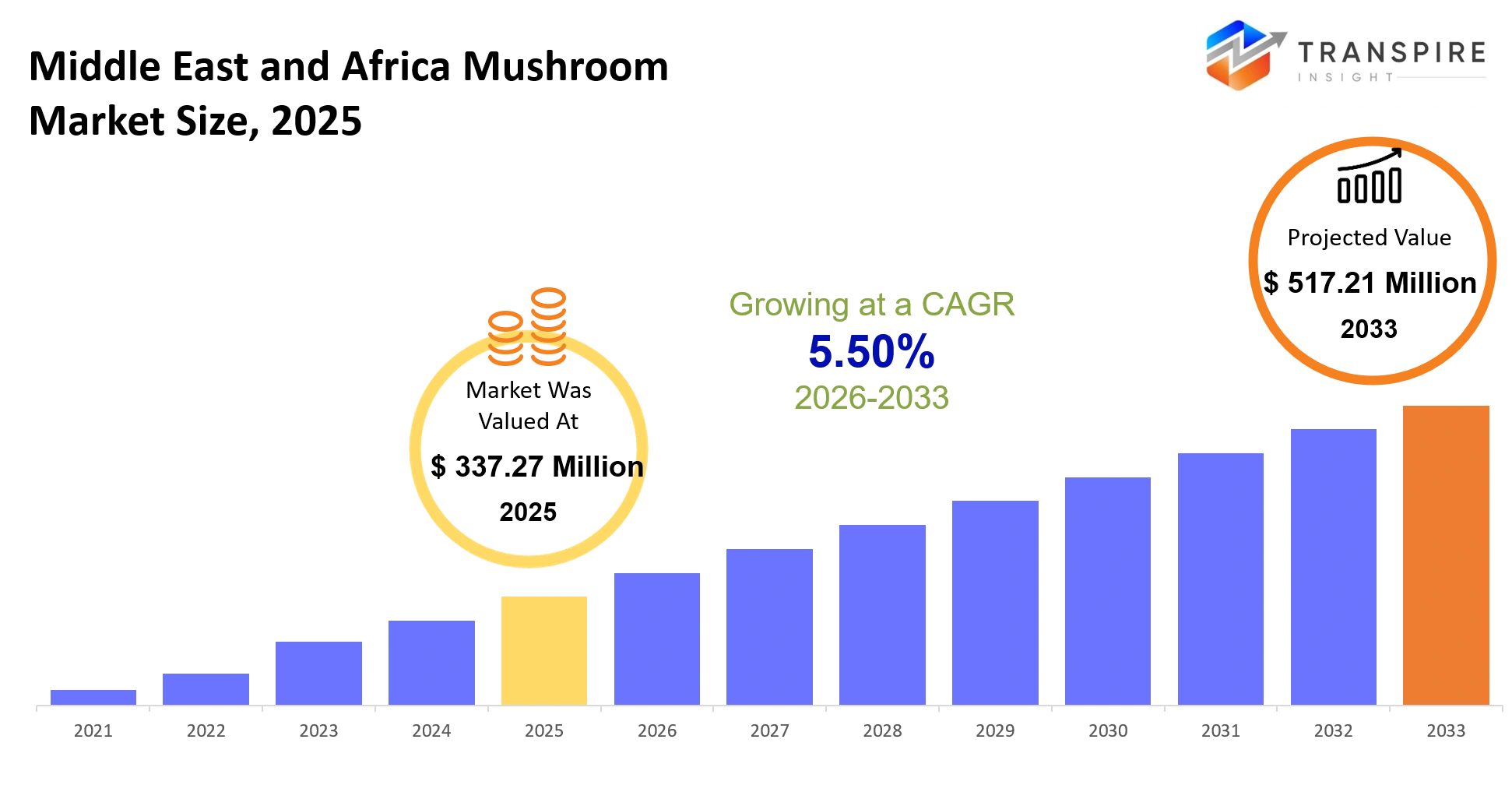
- Middle East and Africa Mushroom Market Size 2025: USD 337.27 Million
- Middle East and Africa Mushroom Market Size 2033: USD 517.21 Million
- Middle East and Africa Mushroom Market CAGR: 5.50%
- Middle East and Africa Mushroom Market Segments: By Product Type (Button Mushrooms, Shiitake Mushrooms, Oyster Mushrooms, Enoki Mushrooms, Others); By Form (Fresh, Frozen, Dried, Canned, Others); By Application (Food Processing, Retail Consumption, Pharmaceuticals, Nutraceuticals, Others); By Distribution Channel (Supermarkets, Specialty Stores, Online Retail, Others)
To learn more about this report,  Download Free Sample Report
Middle East and Africa Mushroom Market Summary
The Middle East and Africa Mushroom Market was valued at USD 337.27 Million in 2025. It is forecast to reach USD 517.21 Million by 2033. That is a CAGR of 5.50% over the period.
Mushroom industry keeps a big role in supplying fresh, processed, and specialty fungi to food manufacturers, retailers, restaurants, pharmaceutical producers, and nutraceutical companies across the Middle East and Africa. And beyond simply being a food ingredient, mushrooms act like a cost-effective protein option, they also bring dietary fiber, vitamins, and various functional compounds that help product development in health-oriented consumer segments.
Over the last 5 years, the market has been nudging away from the older style of selling only conventional fresh mushrooms, toward value added formats like dried, frozen, fortified, and functional mushroom products. This kind of switch really picked up after pandemic era supply chain disruptions showed weak points in imported food sourcing, and it pushed more investment into regional cultivation capability. Meanwhile, retail modernization is expanding in a noticeable way, organized foodservice channels are growing too, so people get easier access to mushrooms across Gulf countries, and in parts of Africa. As manufacturers start rolling out premium varieties and functional components, mushrooms are moving beyond plain eating, toward wellness driven use cases, convenience, and ingredient applications. This movement is opening up revenue pathways and it is supporting wider adoption across several end use industries.
Key Market Insights
- Gulf Cooperation Council countries led, at about 38% market share in 2025, backed by solid retail, and also by steady food imports.
- Southern Africa is showing the quickest momentum as a regional cluster, through 2033, mostly because of commercial cultivation investments, and the growing food processing pull.
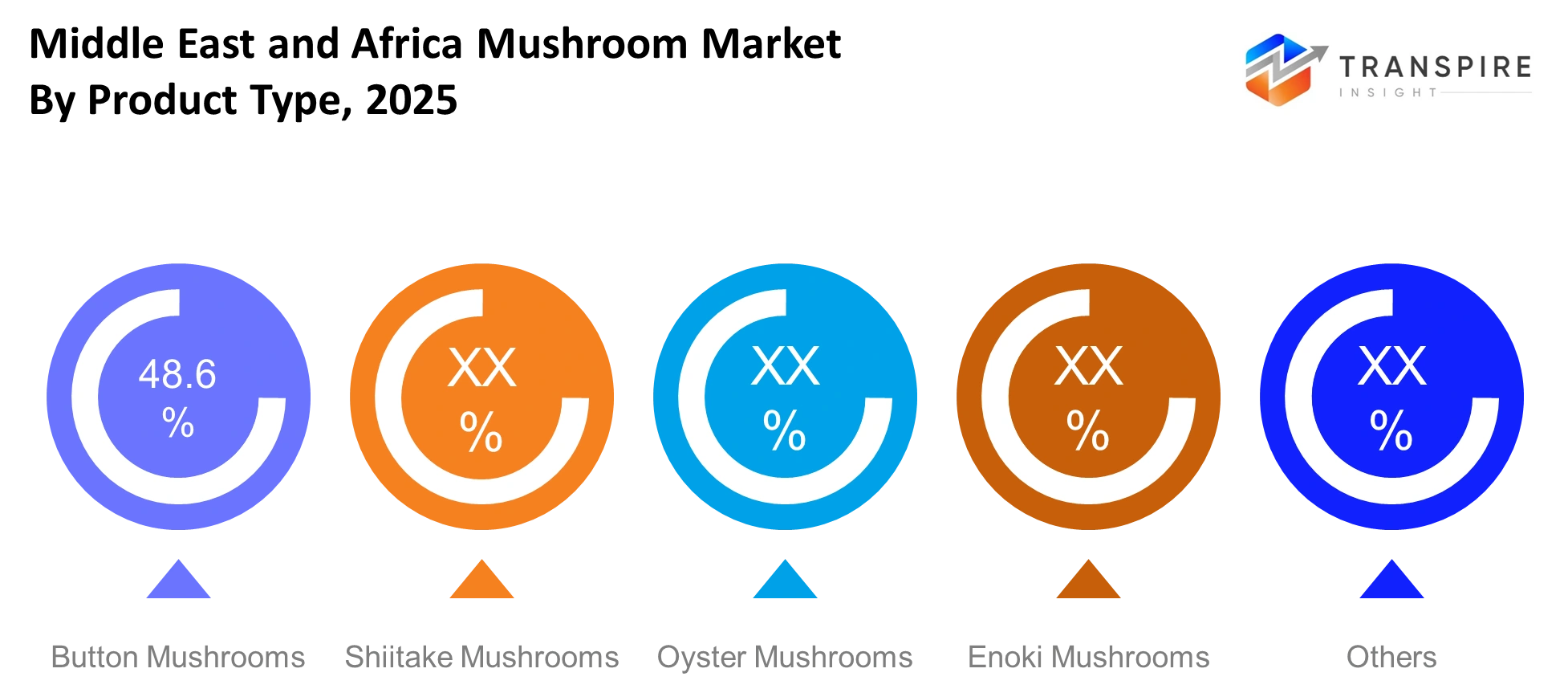
- Button mushrooms pretty much grabbed the leading position, with over 55% share in 2025, mostly because they end up everywhere, on retail shelves, and also on foodservice menus.
- Oyster mushrooms sit as the second-largest segment, helped along by cultivation costs that are relatively lower, and by their flexible culinary uses too.
- Shiitake mushrooms are forecast to grow at above 7% through 2033, with premium eating habits plus wellness positioning working in their favor.
- On the application side, food processing made up nearly 42% of overall demand in 2025, so it is still the dominant use case, by far.
- Nutraceutical applications are also picking up pace quickly, as manufacturers start weaving mushroom extracts into supplements as well as functional food items.
- Supermarkets stayed the biggest distribution channel, exceeding 45% in 2025, supported by expanding organized retail networks.
- Companies such as Monaghan Mushrooms, Bonduelle, Monterey Mushrooms, Scelta Mushrooms, and Greenyard continue widening their reach using product innovation, and supply partnerships along the way.
- Overall, producers keep investing in controlled-environment cultivation, better packaging technology, and shelf-life enhancement solutions, to strengthen their competitive edge in the market.
What are the Key Drivers, Restraints, and Opportunities in the Middle East and Africa Mushroom Market?
The strongest growth driver is basically the expansion of modern retail and foodservice infrastructure across the Gulf states and the big urban centers of Africa. Larger supermarket chains, hotel groups and quick-service restaurant operators, are increasingly needing consistent, year round supplies of fresh food along with processed mushrooms. This shift has sort of pushed investment toward commercial cultivation facilities, plus cold chain logistics. As supply reliability keeps improving, mushrooms get more shelf presence, and also more menu penetration, which directly backs sales growth across retail and institutional channels
Still, the biggest structural barrier is limited local cultivation capacity. Commercial mushroom farming needs climate controlled growing spaces, specialized substrate prep, and a good level of technical expertise. A lot of countries in the region continue leaning on imported products. That makes the market vulnerable to logistics costs, currency swings, and even supply disruptions. And since agricultural infrastructure development needs substantial capital and a long setup period, this can’t be fixed quickly. So, market penetration slows down and in some emerging markets revenue potential stays capped
There is also a solid opportunity in functional mushrooms and value added mushroom ingredients. Food manufacturers are increasingly looking at mushroom powders, extracts, and fortified formats for nutritional beverages, supplements, and foods focused on wellness. Specialty types like shiitake and oyster mushrooms are getting more commercial attention, because consumers in the region are asking for products with added nutritional value. Investments in controlled environment agriculture and vertical farming technologies could also strengthen domestic production capability further and, in turn, support wider distribution
What Has the Impact of Artificial Intelligence Been on the Middle East and Africa Mushroom Market?
Artificial intelligence and some advanced digital tech are, little by little, changing how mushroom cultivation happens, and also how the supply chain gets managed across the region. More commercial growers are now quietly switching to AI enabled environmental control systems, to track temperature, humidity, carbon dioxide levels, and substrate status in real time. In practice these setups can automatically fine tune the growing surroundings, so producers end up keeping crop quality pretty steady, while also cutting down on operational waste, and that kind of thing.
At the same time machine learning models are helping with predictive cultivation approaches. Past production records, local weather patterns, and continuous environmental readings can be blended to estimate yield results, flag disease risks early, and schedule harvest timing more smartly. Several bigger growers say they’re seeing better use of resources, plus less swing in output, because the whole process is data driven, sort of like less guesswork.
On top of that, digital monitoring platforms are making inventory management and distribution plans easier, mostly because they give clearer visibility across cultivation, packaging, and retail logistics. Those tools can lower spoilage and improve how reliably the product shows up for buyers. And inside controlled growing facilities, automation can reduce how much human labor is needed, while still enabling more regular production cycles.
However, even with all those positives, AI adoption is still not everywhere. The costs to implement can be high, and the whole system depends on having trustworthy data collection in place. A lot of small and medium sized growers do not have the digital backbone needed to run advanced analytics properly, which slows down how quickly the technology spreads through the wider industry.
Key Market Trends
- Since 2021 , the rollout of specialty mushroom launches has jumped a lot, because retailers are now stretching premium food categories across the Gulf markets.
- Investments in controlled environment cultivation kept rising, with commercial growers putting in roughly 20%–25% more from 2022 into 2025.
- Meanwhile, food manufacturers are more often mixing mushroom powders into nutritional items , and also into functional food formulations, kinda broadly.
- Organized retail channels have also been giving more shelf room for packaged mushrooms, by almost 15% since 2023 across important Gulf markets.
- Premium types like shiitake and oyster mushrooms got more attention too, mainly through restaurant and hospitality partnerships.
- Across the region, producers are leaning on automated climate control systems to keep output steady, and to cut crop losses which happen in the real world.
- At the same time, supply chains moved toward localized cultivation after disruptions showed up during international logistics bottlenecks.
- Companies such as Monaghan Mushrooms , and Scelta Mushrooms have pushed further into innovation work for fortified , processed mushroom products.
- Frozen and dried mushroom formats are getting more traction as distributors looked for longer shelf life solutions, rather than quick turnover.
- And nutraceutical manufacturers increased the sourcing of mushroom derived ingredients between 2024 and 2026, for supplement development.
Middle East and Africa Mushroom Market Segmentation
By Product Type
Button mushrooms kinda take the biggest chunk of regional consumption, mostly because they’re easy to find, reasonably priced, and work well in a lot of different dishes. In practice, foodservice operators, retailers, and food processors use them all the time in ready meals, salads, soups, and basically on restaurant menus. The thing that helps too is that production stays fairly stable, and supply chains are already set up which backs up broad commercial adoption.
Shiitake mushrooms are still climbing into more premium food categories, mainly on account of their unmistakable flavor profile and also nutritional benefits. Oyster mushrooms are attractive to commercial growers, since the cultivation process is comparatively flexible, and it can fit pretty well with efforts to grow more locally. Enoki mushrooms show up often in specialty retail and hospitality, especially where there’s an international cuisine angle. Then other types, like portobello and specialty gourmet mushrooms, are able to support smaller niche demand, particularly in premium foodservice and in health minded consumer groups.
To learn more about this report, Download Free Sample Report
By Form
Fresh mushroom products make up the biggest share of sales, at least that’s what most buyers seem to want ,because supermarkets, restaurants, and foodservice operators prefer that kind of natural bite and flavor. When cold-chain networks are expanded across the biggest urban centers, it also helps fresh items show up more often, and really across most of the year, even when seasons change.
Meanwhile frozen mushrooms keep getting more traction with food processors, largely because a longer shelf life helps with inventory handling , and it lowers spoilage. Dried mushrooms still matter too, offering a sort of everyday convenience for both food manufacturers and consumers who want a concentrated taste along with extended storage capability. Canned mushrooms remain useful in institutional catering and in processed food manufacturing where consistency matters. Other versions like powders and extracts are starting to grow as well, especially for functional food and nutraceutical uses.
By Application
Food Processing is currently the leading application segment because manufacturers use mushrooms in ready meals, sauces, frozen foods, soups and snack products. This steady pull from industrial food production sites helps keep purchasing volumes fairly stable across the region
Retail Consumption still looks like a major application area , mostly as supermarket penetration keeps rising and products are easier to get in more places. Pharmaceuticals use mushroom derived compounds for some targeted therapeutic purposes and also for research work. Nutraceuticals are turning into a noticeable growth category too, driven by dietary supplements and general wellness oriented products. Other uses cover ingredient solutions for specialty food formulations and for commercial catering operations, where consistency and flavor matter.
By Distribution Channel
Supermarkets keep the largest distribution share because organized retail formats give wide product visibility and steady consumer access, you know that kind of thing. In the same time, expansion of modern grocery chains across Gulf countries has helped mushroom sales grow, and it also made category development more mature.
Specialty stores back premium varieties and health oriented products, aimed at those niche consumer groups. Online retail is still expanding too, as digital grocery platforms keep boosting convenience, plus home delivery capability. Other channels, like wholesale markets, foodservice distributors, and traditional retailers, still matter a lot for reaching commercial buyers and local consumer markets as well.
What are the Key Use Cases Driving the Middle East and Africa Mushroom Market?
The primary use case still kind of sits in food processing where mushrooms act as ingredients across ready meals, soups sauces , frozen foods and packaged food products. It’s mostly because this application keeps pulling the largest volume demand, since manufacturers need steady supplies and very standardized quality for mass production.
Other use cases are growing too, especially in retail grocery and hospitality. Supermarkets keep expanding their mushroom product variety, while hotels, restaurants, and catering teams are adding more premium mushroom varieties to menus, to sort of stand out in their food offering.
Meanwhile there are emerging angles in nutraceuticals and functional food ingredients, more people are looking at mushroom powders, extracts, and fortified formulations. Supplement manufacturers and wellness oriented food brands seem interested. Specialty mushroom ingredients also look like they can fit into alternative protein products and newer nutrition applications during the forecast period.
|
Report Metrics |
Details |
|
Market size value in 2025 |
USD 337.27 Million |
|
Market size value in 2026 |
USD 355.48 Million |
|
Revenue forecast in 2033 |
USD 517.21 Million |
|
Growth rate |
CAGR of5.50% from 2026 to 2033 |
|
Base year |
2025 |
|
Historical data |
2021 - 2024 |
|
Forecast period |
2026 - 2033 |
|
Report coverage |
Revenue forecast, competitive landscape, growth factors, and trends |
|
Regional scope |
Middle East and Africa (Saudi Arabia, United Arab Emirates, South Africa, Rest of Middle East and Africa) |
|
Key company profiled |
Monaghan Mushrooms, Bonduelle, Okechamp, Costa Group, Drinkwater Mushrooms, Monterey Mushrooms, Smithy Mushrooms, Banken Champignons, Greenyard, Agro Dutch, CMP Mushrooms, The Mushroom Company, Scelta Mushrooms, Fresh Mushroom Europe, Hirano Mushroom |
|
Customization scope |
Free report customization (country, regional & segment scope). Avail customized purchase options to meet your exact research needs. |
|
Report Segmentation |
By Product Type (Button Mushrooms, Shiitake Mushrooms, Oyster Mushrooms, Enoki Mushrooms, Others); By Form (Fresh, Frozen, Dried, Canned, Others); By Application (Food Processing, Retail Consumption, Pharmaceuticals, Nutraceuticals, Others); By Distribution Channel (Supermarkets, Specialty Stores, Online Retail, Others) |
Which Regions are Driving the Middle East and Africa Mushroom Market Growth?
The Gulf Cooperation Council region seems to lead in market revenue generation, mostly because of strong purchasing power, decent retail infrastructure and a lot of foodservice activity, like pretty regular foot traffic. Countries like the United Arab Emirates and Saudi Arabia keep solid import networks, plus cold chain systems, and that helps products stay available through out the year. Newer supermarkets and the hospitality industry kind of lock in steady demand, across both fresh and processed mushroom types. On top of that, strong investment capacity makes it easier to adopt controlled-environment cultivation technologies, even when the setup costs feel heavy at first.
Southern Africa is the second-largest regional contributor ,and it is backed by established agricultural capabilities, and a relatively more developed local cultivation base. Rather than relying on imports as much as Gulf markets do, Southern Africa benefits from domestic production capacity and practical know-how in farming. Ongoing investment in commercial farming operations supports supply that is more reliable, and it also keeps market conditions steadier. Then, food processing industries add extra pull, so both fresh and processed mushroom products keep moving in the system.
East Africa is currently emerging as the fastest-growing region all the way to 2033, and the pace is noticeable. Newer investments in commercial agriculture, greenhouse cultivation, and food distribution infrastructure have expanded production opportunities. At the same time, urbanization and retail modernization are widening access to mushroom products across key markets. For investors, and for new entrants too, this phase feels like a window to set up production facilities and distribution networks before competition ramps up too much.
Who are the Key Players in the Middle East and Africa Mushroom Market and How Do They Compete?
Competition still feels kinda moderately fragmented, since international producers, specialty processors, and agri suppliers are all moving through different stages of the value chain. In practice, product quality, cultivation efficiency, supply reliability, and distribution reach seem to be the big competitive levers. Even though many established firms keep pretty solid commercial ties with retailers and foodservice operators, you can see how innovation in specialty mushrooms plus functional ingredients is opening up some room for differentiation, here and there.
Monaghan Mushrooms basically leans hard into cultivation innovation, sustainability initiatives, and value added mushroom products, not just raw growing. They have put money into vitamin D enhanced mushroom offerings, and also into advanced cultivation systems, which helps them lock in a stronger premium market position. Bonduelle, meanwhile, relies on its wide food distribution networks and processing muscle to support broad market access across packaged food categories. Monterey Mushrooms differentiates by leaning on large scale production know how, and they keep a diversified product portfolio which helps them stay flexible.
Scelta Mushrooms puts emphasis on processed mushroom ingredients, and on industrial food applications more than anything else. Their acquisition activity, plus an ingredient first strategy, helps them expand into higher value product segments. Greenyard strengthens its market presence with integrated sourcing, processing, and distribution, and that integrated approach tends to help match retailer expectations for consistent supply, and steady product quality.
Company List
- Monaghan Mushrooms
- Bonduelle
- Okechamp
- Costa Group
- Drinkwater Mushrooms
- Monterey Mushrooms
- Smithy Mushrooms
- Banken Champignons
- Greenyard
- Agro Dutch
- CMP Mushrooms
- The Mushroom Company
- Scelta Mushrooms
- Fresh Mushroom Europe
- Hirano Mushroom
Recent Development News
In March 2026, Monaghan Mushrooms promoted and expanded commercialization of its Vitamin D-enhanced mushroom range through retail partnerships. The initiative strengthened value-added mushroom offerings and supported premium product positioning in key consumer markets.https://www.fruitnet.com/
In June 2025, Scelta Mushrooms acquired Comé and secured financing support from ING. The transaction strengthened vertical integration capabilities and expanded processed mushroom operations for global food industry customers.https://squarefield.com
In November 2024, Monaghan Mushrooms announced commercialization of peat-free mushroom production technology. The development advanced sustainable cultivation practices and positioned the company for future regulatory and environmental requirements.https://www.monaghan.eu/
What Strategic Insights Define the Future of the Middle East and Africa Mushroom Market?
The market is sort of structurally shifting toward higher-value outputs, localized cultivation, and functional ingredient use, i mean it’s not just about the usual scale. Growth in the next five to seven years will be shaped less by raw volume expansion and more by diversification of what gets sold, controlled environment agriculture, and how well it plugs into health leaning food categories. Commercial producers who can blend cultivation know how with processing abilities will take a bigger chunk of the future value, like it’s pretty clear.
There’s also a less obvious risk , and it’s about depending on imported cultivation inputs, niche substrates, and specific technical expertise. If supply gets disrupted, or if currency volatility rises, production economics can get hit pretty fast , and that could slow expansion efforts in emerging markets. Meanwhile, specialty mushroom ingredients showing up in supplements, wellness foods and alternative protein products feel like a real emerging opening, yet it’s still kinda underdeveloped across most of the region.
Market players should put priority on investment for local production infrastructure, digital cultivation technologies, and value added processing capabilities. Firms that build integrated supply lines while also expanding their specialty product ranges will likely be in the best spot to earn premium margins and stay competitively strong, long term.
Middle East and Africa Mushroom Market Report Segmentation
By Product Type
- Button Mushrooms
- Shiitake Mushrooms
- Oyster Mushrooms
- Enoki Mushrooms
- Others
By Form
- Fresh
- Frozen
- Dried
- Canned
- Others
By Application
- Food Processing
- Retail Consumption
- Pharmaceuticals
- Nutraceuticals
- Others
By Distribution Channel
- Supermarkets
- Specialty Stores
- Online Retail
- Others
Frequently Asked Questions
Find quick answers to common questions.
The expected Middle East and Africa Mushroom Market size for the market will be USD 517.21 Million in 2033.
Key segments for the Middle East and Africa Mushroom Market are By Product Type (Button Mushrooms, Shiitake Mushrooms, Oyster Mushrooms, Enoki Mushrooms, Others); By Form (Fresh, Frozen, Dried, Canned, Others); By Application (Food Processing, Retail Consumption, Pharmaceuticals, Nutraceuticals, Others); By Distribution Channel (Supermarkets, Specialty Stores, Online Retail, Others).
Major Middle East and Africa Mushroom Market players are Monaghan Mushrooms, Bonduelle, Okechamp, Costa Group, Drinkwater Mushrooms, Monterey Mushrooms, Smithy Mushrooms, Banken Champignons, Greenyard, Agro Dutch, CMP Mushrooms, The Mushroom Company, Scelta Mushrooms, Fresh Mushroom Europe, Hirano Mushroom.
The Middle East and Africa Mushroom Market size is USD 337.27 Million in 2025.
The Middle East and Africa Mushroom Market CAGR is 5.50% from 2026 to 2033.
- Monaghan Mushrooms
- Bonduelle
- Okechamp
- Costa Group
- Drinkwater Mushrooms
- Monterey Mushrooms
- Smithy Mushrooms
- Banken Champignons
- Greenyard
- Agro Dutch
- CMP Mushrooms
- The Mushroom Company
- Scelta Mushrooms
- Fresh Mushroom Europe
- Hirano Mushroom
About the Authors

Chetan Dhatrak
I’m Chetan Dhatrak, a Senior Research Analyst at Transpire Insight, specializing in the Consumer Goods, Foods and Beverages industry. I focus on analyzing market trends, consumer behavior, competitive landscapes, and industry developments to deliver accurate, data-driven insights. My research at Transpire Insight is built on credible sources and in-depth analysis, helping businesses and readers better understand market dynamics, emerging opportunities, and evolving consumer preferences. I’m committed to creating reliable, well-researched content that supports informed decision-making and reflects the latest developments in the consumer goods and food & beverage sectors.

Chakradhar Khansole
Chakradhar serves as the Research Director at Transpire Insight, bringing over 8 years of experience in technology, innovation, and strategic market intelligence. He specializes in transforming complex market data into actionable business insights that enable organizations to make informed, growth-oriented decisions. Recognized for his strategic vision and analytical expertise, Chakradhar leads high-impact research initiatives, delivering comprehensive market assessments, competitive intelligence, and forward-looking industry analysis.
Recently Published Reports
-
Apr 2026
Baby Infant Formula Market
Baby Infant Formula Market Size, Share & Analysis Report By ype (Infant Milk, Follow On Milk, Specialty Baby Milk, Growing-Up Milk), By Ingredient (Carbohydrate, Fat, Protein, Minerals, Vitamins, and Others), By Product Form (Powder, Liquid, and Ready-to-feed), By Distribution Channels (Supermarket/Hypermarket, Specialty Store, Pharmacies, Online Retail, and Others), and Geography (North America, Europe, Asia-Pacific, Middle East and Africa, South and Central America), 2021 - 2031
-
Apr 2026
Edible Insects for Animal Feed Market
Edible Insects for Animal Feed Market Size, Share & Analysis Report By Type (Insect Powder, Insect Meal, Insect Bar, Insect Paste, Insect Oil, and Others), By Insect Type (Beetles, Cricket, Caterpillar, Hymenoptera, Orthoptera, Tree Bugs, and Others), By Application (Livestock, Pet Food, and Aquaculture), By Livestock Type (Poultry, Swine, and Others), and Geography (North America, Europe, Asia-Pacific, Middle East and Africa, South and Central America), 2021 - 2031
-
Apr 2026
Food Industry Disinfection and Bacterial Control Market
Food Industry Disinfection and Bacterial Control Market Size, Share & Analysis Report By Type (Chemical Disinfectants, Physical Disinfectants, and Biocides and Antimicrobials), By Application (Food Processing Equipment Surface Disinfection, Food Preparation Areas Surface Disinfection, Storage Areas Surface Disinfection, Anti-microbial Coatings Food Preservation, and Preservative Solutions Food Preservation), By End User (Meat and Poultry Processing, Dairy Processing, Seafood Processing, Bakery and Confectionery, Restaurants and Commercial Kitchens, and Food Service Providers), By Sales Channel (Online, Offline), and Geography (North America, Europe, Asia-Pacific, Middle East and Africa, South and Central America), 2021 - 2031
-
May 2026
Freeze Dried Food Market
Freeze Dried Food Market Size, Share & Analysis Report By Product Type (Fruits, Vegetables, Freeze-Dried Dairy Products, Freeze-Dried Meat and Seafood, Freeze-Dried Pet Food, and Prepared Meal), By Nature (Organic, and Conventional), By Form (Powdered, Granules, and Diced), By End Use (Breakfast Cereals, Dairy Products, Bakery & Confectionery, Nutritional Bars & Supplements, Powdered Beverages, Snacks, and Retail (Household)), and Geography (North America, Europe, Asia-Pacific, Middle East and Africa, South and Central America), 2021 - 2031