
Corrosion-Resistant Rebar Market Summary:
According to Transpire Insights, a detailed research report on the market reflects that the infrastructure application segment dominates the Corrosion-Resistant Rebar Market, accounting for approximately 64% of the total market share worldwide. Epoxy-coated rebar remains the leading product type, contributing around 43% of the market owing to its cost-effectiveness and widespread adoption in bridges, highways, and marine infrastructure. North America leads the regional landscape with approximately 38% of the market share, supported by extensive infrastructure rehabilitation programs and stringent durability standards. ArcelorMittal S.A. leads the competitive landscape with approximately USD 68.3 billion in annual revenue and an estimated 16-20% market share, making it the leading contributor to market development, technological innovation, advanced corrosion-resistant rebar manufacturing, expanding production capabilities, and long-term industry growth dynamics.
Market Snapshot
- Market Value (2025): USD 4495 Million.
- Expected Market Value (2026): USD 4733 Million.
- Estimated Market Value (2033): USD 6796 Million.
- Forecast CAGR (2026-2033): 5.30%.
- Leading Region in 2025: Asia Pacific
- Second-largest Region: North America Europe
- Fastest Growing Region: Europe
Introduction
The corrosion-resistant rebar market includes the production, distribution, and use of advanced corrosion-resistant reinforcing bars used to improve the durability of concrete structures. They include epoxy-coated, galvanized, stainless steel and fiber-reinforced polymer rebars that are widely used in bridges, highways, tunnels, marine infrastructure, industrial facilities and other critical construction projects where they are exposed to moisture, chlorides, and aggressive chemicals. They enhance structural integrity, minimize maintenance requirements, and aid in the long-term performance of infrastructure by mitigating corrosion-induced degradation. Market adoption is increasing ly, driven by higher investments in resilient infrastructure, sustainable construction methods and tough building standards. Continued improvements in material technologies and protective coatings are helping to boost product performance, making corrosion-resistant rebar an important solution for the development of modern, durable and economically viable construction projects across a range of end-use sectors.
For instance:-
- North America: Infrastructure Reinvention: Significant investment in bridge rehabilitation, transportation improvements and resilient infrastructure, backed by government funding and the rise of domestic manufacturing, is fueling the adoption of corrosion-resistant rebar in major construction projects.
- Asia Pacific: “Massive investments in highways, metro rail, smart cities and industrial projects, coupled with increasing demand for durable construction materials, are driving accelerated deployment of corrosion-resistant rebar across the region.

Key Market Highlights: -
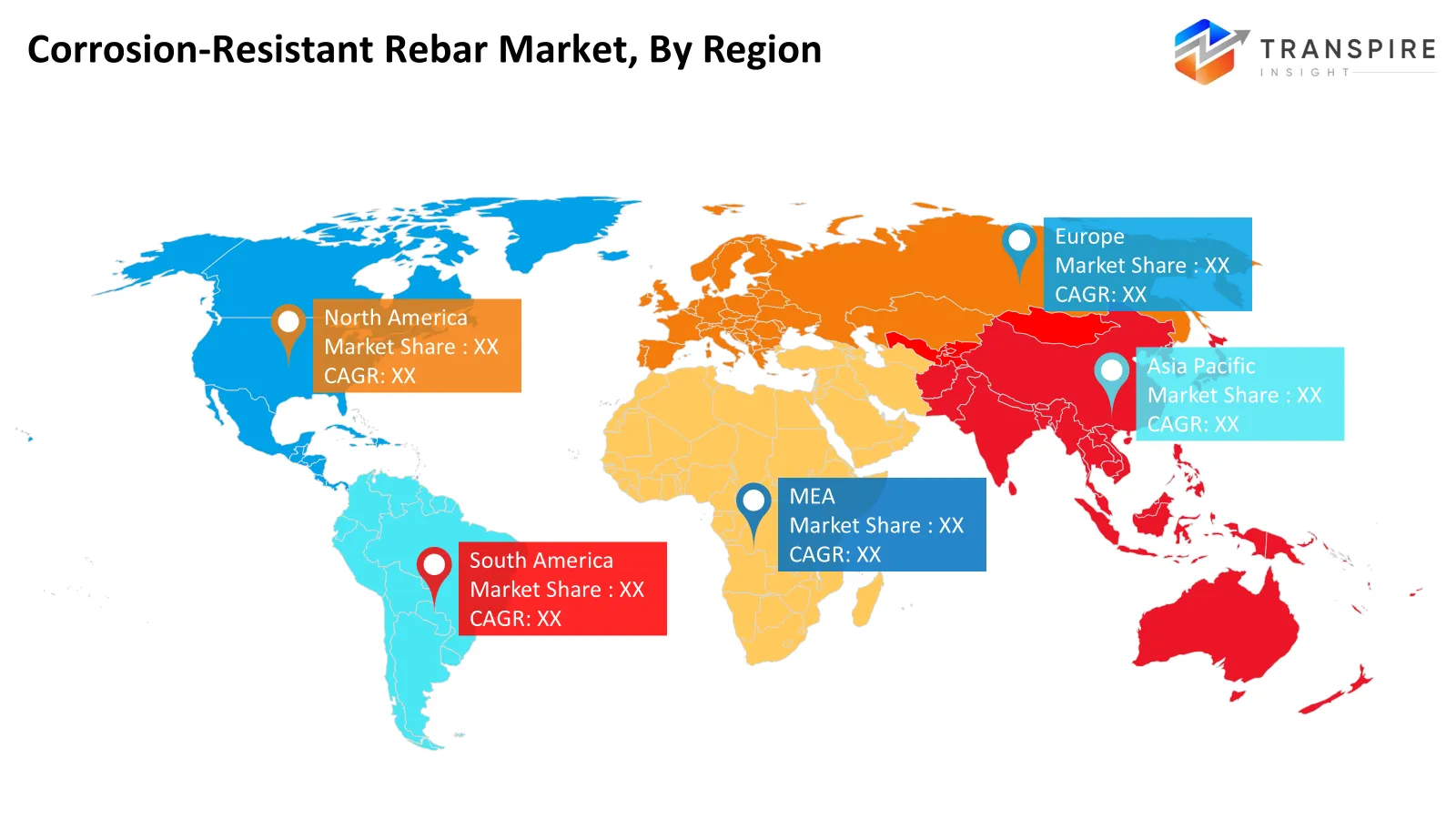
- Asia Pacific is expected to grow at a rapid CAGR in the Corrosion-Resistant Rebar Market by holding around 40% of the share during the forecast period.
- North America is anticipated to hold roughly 25% share of the Corrosion-Resistant Rebar Market over the predicted timeframe.
- Europe is anticipated to hold nearly 21%share of the Corrosion-Resistant Rebar Market over the predicted timeframe.
- 4 By Product Type, the Glass Fiber Reinforced Polymer dominated the market and holds nearly 70% share in 2025 and is projected to grow at a substantial CAGR during the forecast period.
- By Material, Fiberglass dominated the market and holds close to 60% share in 2025 and is projected to grow at a substantial CAGR during the forecast period.
- By Application, the Buildings dominated the market and holds about 45% share in 2025 and is projected to grow at a substantial CAGR during the forecast period.
- Government Infrastructure Support: Government investments in resilient infrastructure, sustainable construction policies, and stricter durability standards are driving the adoption of corrosion-resistant rebar in transportation, marine, industrial, and public infrastructure projects around the world.
How is Technology Driving Growth in the Corrosion-Resistant Rebar Market?
Continuous advancements in material engineering, protective coating technologies, and modern manufacturing processes are propelling the Corrosion-Resistant Rebar Market forward, fueled by technology. Innovations like fiber-reinforced polymer (FRP), galvanized, stainless steel and advanced epoxy-coated rebar provide enhanced corrosion resistance, greater structural durability and a longer service life in aggressive environments. Automation in production technologies enhances product consistency, manufacturing efficiency and quality with less material waste. Besides, the gradual deployment of digital monitoring solutions for infrastructure maintenance aids asset performance and encourages a greater adoption of corrosion-resistant rebar in transportation, marine, industrial, and commercial construction projects across the world.
Market Drivers
The growth of the corrosion resistant rebar market is driven by rising investments in infrastructure modernization, increasing demand for durable construction materials, and strict regulations to develop long-lasting structures.The market growth is fueled by rapid urbanization, expansion of transportation networks, development of marine infrastructure and increasing rehabilitation of aging bridges and highways. Governments committed to resilient and sustainable construction have international priorities in promoting corrosion resistant reinforcement solutions for public domain infrastructure projects. In addition, ongoing improvements in epoxy-coated, galvanized, stainless steel, and fiberglass reinforced plastic (FRP) rebar technologies are improving product performance, extending the service life of structures, lowering maintenance costs, and driving long-term growth of the market.
For Instance: Europe: Sustainable Construction Initiatives: Stringent durability regulations, growing infrastructure rehabilitation programs, and a high focus on low carbon construction materials are driving demand for advanced corrosion-resistant rebar in transportation, marine and energy infrastructures.
Restrain
The Corrosion-Resistant Rebar Market is challenged by the higher initial cost of advanced reinforcement materials as compared to conventional steel rebar. Adoption is limited by the lack of awareness of the long-term lifecycle benefits, in particular in price sensitive and developing markets. In addition, some types of corrosion resistant rebar require special handling, installation, and compatibility issues that make the project more complex. Budget limitations and an ongoing focus on upfront construction costs also limit market penetration.
Analysis of Prices and Consumer Behaviour
Epoxy-coated rebar is the largest segment in the corrosion-resistant rebar market with a share of around 43% and is driven by the extensive application of epoxy-coated rebar in bridges, highways, marine infrastructure, and commercial construction projects. Due to improved corrosion resistance, longer service life, advanced manufacturing processes, and lower lifecycle maintenance costs, the cost of stainless steel and fiber-reinforced polymer (FRP) rebar is expected to be 30-50% higher than that of traditional carbon steel rebar. Corrosion-resistant rebar infrastructure applications make up about 64% of total demand, with increased investments in transportation, coastal and public infrastructure projects. The infrastructure and civil engineering segment is projected to account for about 64% of total market demand, driven by rigid durability standards and long-term asset protection needs. End user buying behavior shows that 58% of end users value long term durability, corrosion resistance and life cycle cost savings over the initial purchase price. Another 36% of buyers favor long-term procurement contracts and strategic supplier partnerships to secure consistent product quality, stable pricing, and reliable supply for large-scale infrastructure and construction projects.
Top Companies in the Corrosion-Resistant Rebar Market
- ArcelorMittal
- Gerdau
- Nucor Corporation
- Tata Steel
- Commercial Metals Company
- Outokumpu
- Nippon Steel
- Jindal Steel & Power
- Pultrall
- Schöck Bauteile
- Owens Corning
- SGL Carbon
- Dextra Group
- Neuvokas
- Fibrolux
Corrosion-Resistant Rebar Market Segmentation
The Corrosion-Resistant Rebar Market share is divided into five categories: By Product Type, By Material, By Application, By End User, By Distribution Channel.
The Glass Fiber Reinforced Polymer dominated the market, accounting for nearly 70% in 2025 and is expected to rise at a significant CAGR during the forecast period.
The Corrosion-Resistant Rebar Market is segmented by product type into epoxy-coated rebar, stainless steel rebar, galvanized rebar, frp rebar, mmfx rebar, basalt fiber rebar, composite rebar, others. Among these, the Glass Fiber Reinforced Polymer dominated the market, accounting for nearly 70 % in 2025 and expected to increase at a significant CAGR during the forecast period. use of Glass Fiber Reinforced Polymer rebar continues to grow driven by increasing investments in durable infrastructure, improved corrosion resistance, lighter weight and longer service life.
The Fiberglass dominated the market, accounting for close to 60% in 2025, and is expected to rise at a significant CAGR during the forecast period
The Corrosion-Resistant Rebar Market is segmented by material into steel, stainless steel, fiberglass, basalt fiber, carbon fiber, composite materials, zinc-coated steel, others. Among these, the Fiberglass dominated the market, accounting for close to 60% in 2025 and expected to increase at a significant CAGR during the forecast period. The adoption of fiberglass in construction projects across the globe is expected to be driven by increasing demand for lightweight and corrosion resistant reinforcement, improved durability and economical infrastructure solutions.
The Buildings dominated the market, accounting for about 45% in 2025 and is expected to rise at a significant CAGR during the forecast period.
The Corrosion-Resistant Rebar Market is by application into bridges, highways, buildings, marine structures, tunnels, industrial plants, water treatment facilities, others Among these, the Buildings dominated the market, accounting for about 45% in 2025 and expected to increase at a significant CAGR during the forecast period. The buildings segment continues to grow ly, driven by increased residential and nonresidential construction, stringent durability standards, and a growing need to have reinforced structures with long service lives.

Regional Segment Analysis of the Corrosion-Resistant Rebar Market
- Europe (Germany, France, U.K., Italy, Spain, Rest of Europe)
- North America (U.S., Canada, Mexico)
- Asia-Pacific (China, Japan, India, Rest of APAC)
- South America (Brazil and the Rest of South America)
- The Middle East and Africa (UAE, South Africa, Rest of MEA)
Asia Pacific is expected to grow at a rapid CAGR in the Corrosion-Resistant Rebar Market, holding around 40% of the share during the forecast period.
Rapid urbanization, increasing transportation and marine infrastructure and increasing government investments in sustainable construction projects are likely to drive the highest growth in the Corrosion-Resistant Rebar Market in the Asia Pacific region. The rising adoption of advanced corrosion-resistant reinforcement technologies, infrastructure development policies, and the increasing demand for durable building materials in China, India, Japan, and Southeast Asia are supporting further regional market expansion throughout the forecast period.
North America is the fastest-growing region in the Corrosion-Resistant Rebar Market during the period, holding roughly 25% share.
The North American region is expected to see robust growth in the Corrosion-Resistant Rebar Market due to rising investments in infrastructure rehabilitation, bridge replacement, highways, and marine construction projects. Strict building codes emphasizing structural durability and corrosion protection are accelerating adoption of products. Rising government expenditure, increasing demand for sustainable construction materials, and ongoing technological advancements in epoxy-coated, stainless steel, and fiber-reinforced polymer rebar are further fuelling the regional market growth during the forecast period.
Europe is the fastest-growing region in the Corrosion-Resistant Rebar Market during the period, holding nearly 21% share.
The market for corrosion-resistant rebar is projected to witness significant growth in Europe, driven by increased investment in infrastructure modernization, transportation networks, marine facilities, and renewable energy projects. Corrosion-resistant reinforcement materials are being pushed by tough environmental regulations and construction standards.The regional market growth is driven by increasing focus on sustainable building practices, as well as ongoing advancements in high-performance rebar technologies, throughout the forecast period.
Strategies for Market Growth in Non-Leading Regions:
The development of non-leading regions through efficient and scalable corrosion-resistant rebar manufacturing technologies would strengthen regional production capabilities and improve supply chain efficiency. There is scope to increase local production of epoxy coated, galvanized, stainless steel and fiber reinforced polymer (FRP) rebar which would reduce project costs and reliance on imports. Strategic partnerships with construction companies, infrastructure developers, engineering firms, contractors and material distributors will enhance market penetration. • Expand training programs on advanced manufacturing, installation practices, quality assurance and corrosion protection technologies to improve technical expertise.Flexible financing, long-term purchase agreements and public-private partnerships will also boost affordability and promote wider adoption. We will support collaborative efforts with governments, infrastructure development agencies and sustainable construction programs with digital procurement platforms and modern distribution networks to improve market access and fuel sustainable growth in emerging economies.
Future Market Trends for the Corrosion-Resistant Rebar Market: -
- Advanced Material Innovation: The growing adoption of epoxy coated, galvanized, stainless steel, and fiber-reinforced polymer (FRP) rebar is improving corrosion resistance, structural durability, and long-term infrastructure performance across challenging construction applications.
- Rising Infrastructure Applications: Investments in transportation networks, marine infrastructure, industrial facilities, and urban development projects are increasing, driving demand for corrosion-resistant rebar to extend asset life and reduce maintenance needs.
- Sustainable Manufacturing Practices: The corrosion-resistant rebar market is witnessing sustainable growth due to the growing focus on low-carbon steel manufacturing, recycled materials, energy-efficient manufacturing processes, and eco-friendly construction practices.
Recent Development
- In April 2026: Jindal Stainless Ltd. has launched Jindal Infinity stainless steel rebars in Amritsar, Punjab, entering the retail market backing durable, corrosion-resistant infrastructure with a phased pan-India expansion plan.
- In June 2026: Infrastructure developers increasingly favored lightweight and corrosion-resistant reinforcement solutions for marine, transportation, and high-durability construction projects, expediting the penetration of Glass Fiber Reinforced Polymer (GFRP) rebar.
- In August 2026, regional manufacturers ramped up production of corrosion-resistant rebar to support coastal infrastructure development, aligning with government initiatives centered around resilient construction, sustainable materials and long-term structural durability.
Market Segment
This study forecasts revenue at , regional and country levels from 2020 to 2033. Transpire Insights has segmented the Corrosion-Resistant Rebar Market based on the below-mentioned segments:
Corrosion-Resistant Rebar Market, By Product Type
- Epoxy-coated Rebar
- Stainless Steel Rebar
- Galvanized Rebar
- FRP Rebar
- MMFX Rebar
- Basalt Fiber Rebar
- Composite Rebar
- Others
Corrosion-Resistant Rebar Market, By Material
- Steel
- Stainless Steel
- Fiberglass
- Basalt Fiber
- Carbon Fiber
- Composite Materials
- Zinc-coated Steel
- Others
Corrosion-Resistant Rebar Market, By Application
- Bridges
- Highways
- Buildings
- Marine Structures
- Tunnels
- Industrial Plants
- Water Treatment Facilities
- Others
Corrosion-Resistant Rebar Market, By End User
- Construction Companies
- Infrastructure Developers
- Government Projects
- Industrial Contractors
- Real Estate Developers
- Marine Contractors
- Utility Companies
- Others
Corrosion-Resistant Rebar Market, By Distribution Channel
- Direct Sales
- Steel Distributors
- Construction Material Suppliers
- OEMs
- Online B2B
- Wholesalers
- Dealers
- Others
Corrosion-Resistant Rebar Market, By Regional Analysis
North America
- US
- Canada
- Mexico
Europe
- Germany
- UK
- France
- Italy
- Spain
- Russia
- Rest of Europe
Asia Pacific
- China
- Japan
- India
- South Korea
- Australia
- Rest of Asia Pacific
South America
- Brazil
- Argentina
- Rest of South America
Middle East & Africa
- UAE
- Saudi Arabia
- Qatar
- South Africa
- Rest of the Middle East & Africa
Frequently Asked Questions
Find quick answers to common questions.
Growing infrastructure investments, stringent durability standards, and increasing demand for long-lasting, low-maintenance construction materials are driving the adoption of corrosion-resistant rebar worldwide.
Corrosion-resistant rebar provides superior durability, minimizes maintenance costs, extends structural lifespan, and delivers excellent performance in marine, transportation, and industrial infrastructure applications.
Glass Fiber Reinforced Polymer (GFRP) rebar leads the market due to its lightweight design, exceptional corrosion resistance, high strength, and long-term structural performance.
Asia Pacific is expected to register the fastest growth, supported by rapid urbanization, expanding infrastructure projects, and increasing investments in sustainable construction technologies.
Key trends include advanced corrosion-resistant materials, sustainable manufacturing process.
- ArcelorMittal
- Gerdau
- Nucor Corporation
- Tata Steel
- Commercial Metals Company
- Outokumpu
- Nippon Steel
- Jindal Steel & Power
- Pultrall
- Schöck Bauteile
- Owens Corning
- SGL Carbon
- Dextra Group
- Neuvokas
- Fibrolux
About the Authors

Pankaj Ghogare Patil
I am Pankaj Ghogare Patil, a Senior Research Analyst at Transpire Insight, specializing in the Pharmaceutical, Chemicals & Materials, Healthcare IT, and Biotechnology industry. My expertise lies in conducting comprehensive market research, analyzing industry trends, evaluating competitive landscapes, and translating complex data into actionable insights. At Transpire Insight, I closely follow emerging technologies, regulatory developments, and market innovations to create accurate, well-researched, and informative content that helps businesses and professionals make informed decisions. I am committed to producing credible, evidence-based articles that reflect industry best practices while making technical topics accessible and valuable for a broad audience.

Chakradhar Khansole
Chakradhar serves as the Research Director at Transpire Insight, bringing over 8 years of experience in technology, innovation, and strategic market intelligence. He specializes in transforming complex market data into actionable business insights that enable organizations to make informed, growth-oriented decisions. Recognized for his strategic vision and analytical expertise, Chakradhar leads high-impact research initiatives, delivering comprehensive market assessments, competitive intelligence, and forward-looking industry analysis.
Recently Published Reports
-
May 2026
Healthcare Polymer Packaging Market
Healthcare Polymer Packaging Market Size, Share & Analysis Report By Packaging Type (Syringes, IV Bottles and Pouches, Clamshells, Blisters, Bottles & Jars, Containers, Tubes, IV Parental Packaging, Others), By Type (Regulated, Non-regulated), By Polymer Type (LDPE (Low-Density Polyethylene), HDPE (High-Density Polyethylene), Homo-polymer (Homo), Random Copolymer (Random), Block Copolymer (Block), PET, Polystyrene, Polyvinyl Chloride, Polyamide/EVOH, Others), and Geography (North America, Europe, Asia-Pacific, Middle East and Africa, South and Central America), 2021 - 2031
-
Apr 2026
Hydrophilic Tape (Waterstop) Market
Hydrophilic Tape (Waterstop) Market Size, Share & Analysis Report By Type (Bentonite-Based Hydrophilic Tape, Rubber-Based Hydrophilic Tape), By Application (Residential Buildings, Commercial Buildings, Infrastructure Projects), and Geography (North America, Europe, Asia-Pacific, Middle East and Africa, South and Central America), 2021 - 2031
-
Apr 2026
Metalens Market
Metalens Market Size, Share & Analysis Report By Type (Visible Light Metalens, and Infrared Metalens), By Application (Consumer Electronics, Automotive Electronics, Industrial, Medical, and Others), and Geography (North America, Europe, Asia-Pacific, Middle East and Africa, South and Central America), 2021 - 2031
-
Apr 2026
PBT Resin Market
PBT Resin Market Size, Share & Analysis Report By Type (Reinforced PBT Resin, Unreinforced PBT Resin), By Processing Method (Injection Molding, Extrusion, Blow Molding, Others), By End-User (Automotive, Electrical & Electronics, Consumer Appliances, Industrial Machinery, Medical Devices, Packaging, Others), and Geography (North America, Europe, Asia-Pacific, Middle East and Africa, South and Central America), 2021 - 2031