
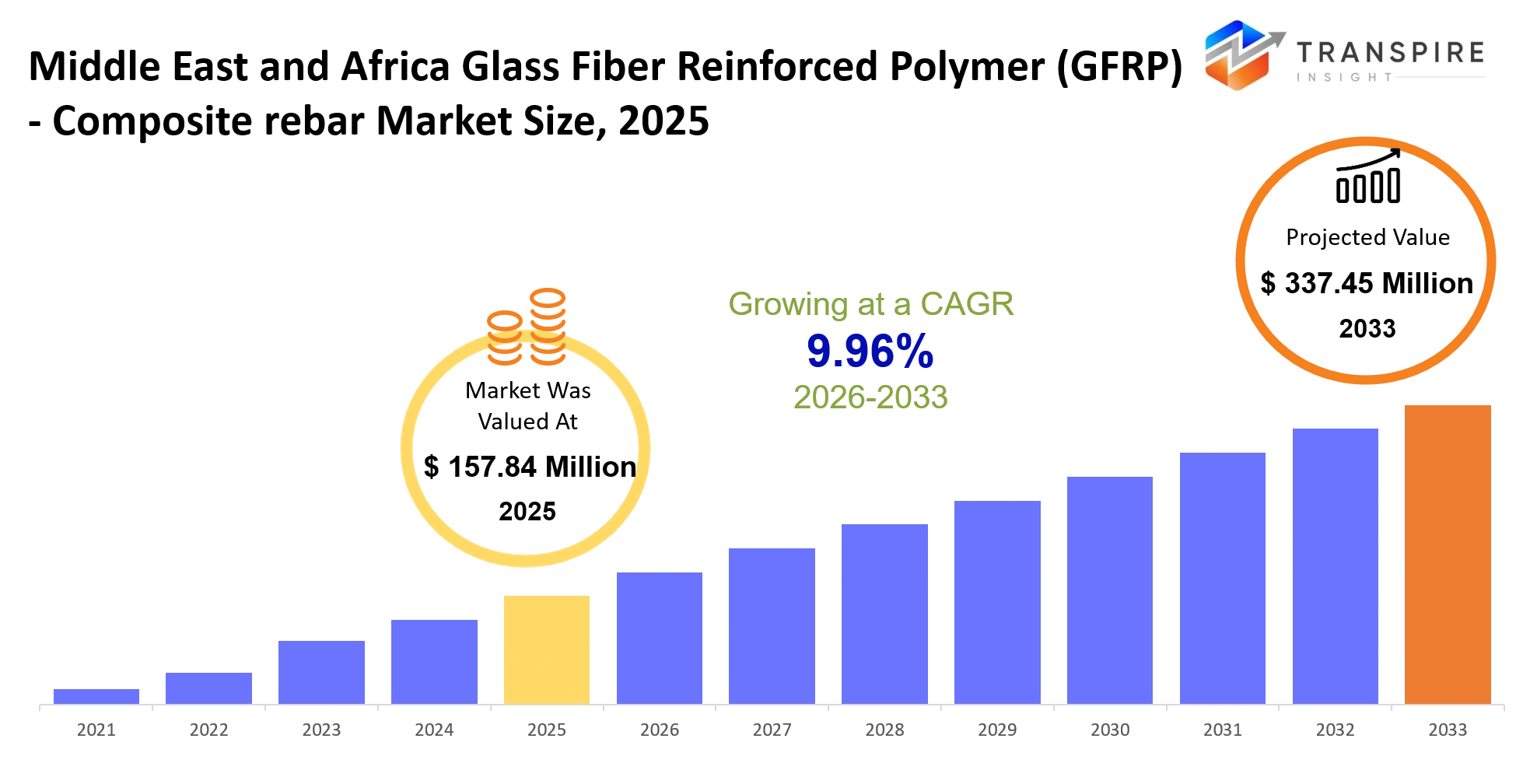
Middle East and Africa Glass Fiber Reinforced Polymer (GFRP) - Composite rebar Market Size & Forecast:
- Middle East and Africa Glass Fiber Reinforced Polymer (GFRP) - Composite rebar Market Size 2025: USD 157.84 Million
- Middle East and Africa Glass Fiber Reinforced Polymer (GFRP) - Composite rebar Market Size 2033: USD 337.45 Million
- Middle East and Africa Glass Fiber Reinforced Polymer (GFRP) - Composite rebar Market CAGR: 9.96%
- Middle East and Africa Glass Fiber Reinforced Polymer (GFRP) - Composite rebar Market Segments: By Resin Type (Vinyl Ester Resin, Polyester Resin, Epoxy Resin, Polyurethane Resin, Hybrid Resin, Others); By Fiber Type (E-Glass Fiber, S-Glass Fiber, AR-Glass Fiber, Continuous Fiber, Others); By Application (Bridges & Highways, Marine Structures, Residential Construction, Commercial Buildings, Tunnels, Industrial Facilities, Others); By End User (Construction Companies, Infrastructure Developers, Government Projects, Marine Industry, Industrial Sector, Others).
To learn more about this report,  Download Free Sample Report
Middle East and Africa Glass Fiber Reinforced Polymer (GFRP) - Composite rebar Market Summary
The Middle East and Africa Glass Fiber Reinforced Polymer (GFRP) - Composite rebar Market was valued at USD 157.84 Million in 2025. It is forecast to reach USD 337.45 Million by 2033. That is a CAGR of 9.96% over the period.
The Middle East and Africa Glass Fiber Reinforced Polymer (GFRP) Composite Rebar Market does a lot more than people think, in a kind of, not always obvious way. It supports the service life of concrete infrastructure that has to live with harsh settings like coastal environments, desalination facilities, bridges, ports, tunnels, and water treatment plants. When you compare it with classic steel reinforcement, GFRP rebar doesn’t corrode, so project owners can trim maintenance costs and also try to sidestep early structural decline. Over the last five years, the market feels like it moved, sort of from smaller, more niche jobs into bigger public works,and industrial builds, where engineers are now looking at lifecycle performance more than just the initial purchase price.
A big driver is the region increasing investment in shoreline infrastructure, desalination plants and longer-term asset resilience, especially in Gulf countries. In other words, when governments and private developers want longer service intervals and less money going to upkeep, GFRP rebar keeps getting written into specifications, and not only in limited segments. This is broadening the project pipeline, boosting supplier revenues, and pushing the commercialization of composite reinforcement technologies throughout the area.
Key Market Insights
- The Middle East and Africa Glass Fiber Reinforced Polymer (GFRP) - Composite rebar Market is benefiting from infrastructure projects that prioritize a 75–100-year service life, rather than the older steel reinforcement solutions.
- In 2025 Gulf Cooperation Council countries alone accounted for roughly 60%+ of the regional demand, mostly because desalination plants, ports and marine infrastructure investments are getting pushed forward.
- The Middle East, overall, seems to dominate the regional market share due to big government funded construction programs and a steady uptake in coastal environments where durability really matters.
- Africa is forecast to be the fastest-growing regional market through 2033, since transportation, water, and energy infrastructure investments keep accelerating, almost like a domino effect.
- For resin type, vinyl ester resin-based GFRP rebar held the largest share in 2025. This was supported by stronger chemical resistance and a durability track record, especially when exposure conditions are harsh.
- Epoxy resin products showed up as the second-largest segment, representing an estimated 25–30% of market demand in industrial construction projects, where performance specs tend to be strict.
- High-strength GFRP rebar is expected to register the quickest growth through 2033, because engineers are specifying higher-performance reinforcement for high critical infrastructure assets.
- In terms of end use, bridges, marine structures, and waterfront developments together accounted for more than 35% of regional application demand in 2025, mainly driven by corrosion-related maintenance issues that keep coming back.
- Government infrastructure agencies remain the leading end-user group, while private industrial developers look like the fastest expanding customer category, especially as new projects move to execution.
- Key companies including Owens Corning, Pultron Composites, Dextra Group, Schoeck, FiReP Rebar, and Sireg Geotech are putting money into product certifications, forming strategic partnerships, building regional manufacturing capacity, and improving resin technologies, to keep their competitive position solid.
What are the Key Drivers, Restraints, and Opportunities in the Middle East and Africa Glass Fiber Reinforced Polymer (GFRP) - Composite rebar Market?
The primary drive behind market expansion is, like, the stronger focus on infrastructure durability in really aggressive corrosion conditions. Across the Gulf region, Governments are pouring money into ports, desalination facilities, wastewater plants, coastal transportation links, and industrial corridors where ordinary steel reinforcement can face faster deterioration. Also as lifecycle cost analysis turns into a normal procurement checklist, many asset owners slowly realize that paying more at the beginning for better material can be balanced out by much less money spent on maintenance and rebuilding across decades. This is, basically, pushing up specification rates for GFRP rebar in big infrastructure tenders and it is lifting supplier revenues too.
Still, the biggest restraint is the higher upfront cost when you compare it to conventional steel reinforcement. And that is not just a surface issue, it is structural. It comes from specialized manufacturing routines, specific raw material needs, certification expenses, and also the fact that regional production capacity is limited. A lot of contractors keep using procurement models that look mainly at the initial project budget rather than total lifecycle economics, so adoption gets delayed, and then market penetration stays lower in projects where every dollar is counted.
A strong opportunity is sitting in the fast expansion of desalination systems and coastal development initiatives across the Middle East. Nations like Saudi Arabia and the UAE continue investing billions in water security, plus coastal industrial assets, where corrosion resistance is not optional it is a core engineering expectation. As engineering standards keep adding non-metallic reinforcement options into the mix, suppliers that lock in regional certifications and build local manufacturing collaborations are in a good position to grab large future project volumes.
What Has the Impact of Artificial Intelligence Been on the Middle East and Africa Glass Fiber Reinforced Polymer (GFRP) - Composite rebar Market?
Artificial intelligence is gradually reshaping the GFRP composite rebar value chain, kind of like a quieter remix happening across smarter manufacturing, quality checking, and infrastructure asset management. Manufacturers are rolling out AI-enabled vision systems to look at fiber alignment, resin distribution, surface quality, and even the dimensional consistency during pultrusion. With these automated inspections, they cut down on material waste, make production more steady and repeatable, and speed up the whole quality assurance rhythm.
At the same time machine learning is being used to forecast equipment troubles on pultrusion lines by watching temperature profiles, production speeds, vibration signals, and the resin curing conditions too. Predictive maintenance, in practice, helps keep operational uptime higher, and reduces those annoying unplanned shutdowns. Then on the infrastructure side, people are using digital twins along with AI-assisted structural monitoring to judge reinforced concrete performance, anticipate degradation risks, and fine tune maintenance plans for bridges, marine facilities, and industrial installations.
All of this tends to support lower operating costs, stronger manufacturing yields, improved product dependability, and more reliable lifecycle management for reinforced structures. Still, adoption is held back because integration costs are high, and there aren’t enough historical datasets that match composite reinforcement materials. Also, many regional manufacturers do not really have the digital infrastructure, or the specialized analytics know-how, needed to fully use advanced AI platforms, so widespread rollout across the market stays slower than it could be.
Key Market Trends
- Since 2021, a few Gulf infrastructure agencies have started mixing lifecycle cost evaluation into their procurement choices, which kinda helped with wider acceptance of composite reinforcement systems.
- Meanwhile, coastal projects kept on rising and GFRP rebar requirements went up by roughly 20–30% across certain Gulf developments between 2022 and 2025, not everywhere but enough to notice.
- Manufacturers have also moved away from export-only setups and leaned into regional production partnerships. That helps with supply security and also cuts logistics costs, though the transition wasn’t instant.
- Dextra, during 2025, strengthened its market visibility through industry collaboration activities and nonmetallic construction advocacy programs, which landed it more often in project discussions.
- Since 2023, product certifications and compliance with international construction standards have become a real differentiator in competition.
- And engineers are increasingly recommending GFRP reinforcement for desalination plants, wastewater facilities, and marine structures, especially where steel corrosion still keeps showing up as the persistent issue.
- On the production side, digital manufacturing, and automated quality inspection systems are showing up more often with premium composite reinforcement producers . It feels like there is a sort of push there. Also, strategic alliances between material suppliers and infrastructure contractors picked up in 2025, to speed adoption faster or, at least, make it easier to roll out.
- Then there is the whole recyclable resin technologies topic, plus thermoplastic composite developments. Those have really come forward as notable innovation directions starting around 2024.
- Overall, the competition is no longer only about pure cost pressure, it seems to have shifted toward durability performance, certification coverage, and a more hands on technical engineering support vibe.
Middle East and Africa Glass Fiber Reinforced Polymer (GFRP) - Composite rebar Market Segmentation
By Resin Type
Middle East and Africa Glass Fiber Reinforced Polymer (GFRP) – Composite rebar Market shows a pretty clear split across resin categories, and the material choice tends to follow durability needs, the environmental exposure, and what people expect structurally. Vinyl Ester Resin still sits in a big spot because it offers strong defense against corrosion, moisture, and chemical aggression especially in tough infrastructure settings. Polyester Resin gets widely picked too, mainly because it usually costs less, and it fits typical construction routines without too much trouble. Epoxy Resin is often preferred when projects need stronger mechanical performance and a more steady long term structural reliability.
Then there is Polyurethane Resin, which supports specialized uses where bend-ability, flexibility, and impact resistance really matter. Hybrid Resin is a kind of blend approach, where multiple resin systems are combined so performance can stay steadier across varying operating conditions. Others covers emerging formulations, basically new recipes created for project specific engineering needs, depending on what the site demands. The demand picture feels like it’s shifting toward lifecycle performance focus, even while infrastructure owners keep weighing material durability with construction speed, plus the usual maintenance considerations over time.
By Fiber Type
Fiber type segmentation sort of emphasizes how reinforcement materials actually shape strength, durability, and those overall performance traits. E-Glass Fiber is getting substantial use, mostly because the cost-to-performance ratio looks favorable and it is widely available, across a lot of construction projects. S-Glass Fiber, meanwhile, supports uses where you need higher tensile strength, and better structural capabilities in general. AR-Glass Fiber is starting to gain real importance where resistance to alkaline conditions becomes a must-have type of requirement.
Continuous Fiber helps reinforce structural integrity by keeping reinforcement properties steady, it also improves load-bearing performance in a pretty direct way. The need for more advanced fiber solutions is still growing, especially as project specifications get more focused on long-term durability. There are also other options, like specialized fiber configurations that are developed for niche engineering jobs. Overall, material selection is increasingly driven by performance targets, environmental exposure conditions, and the expected service life of reinforced structures.
By Application
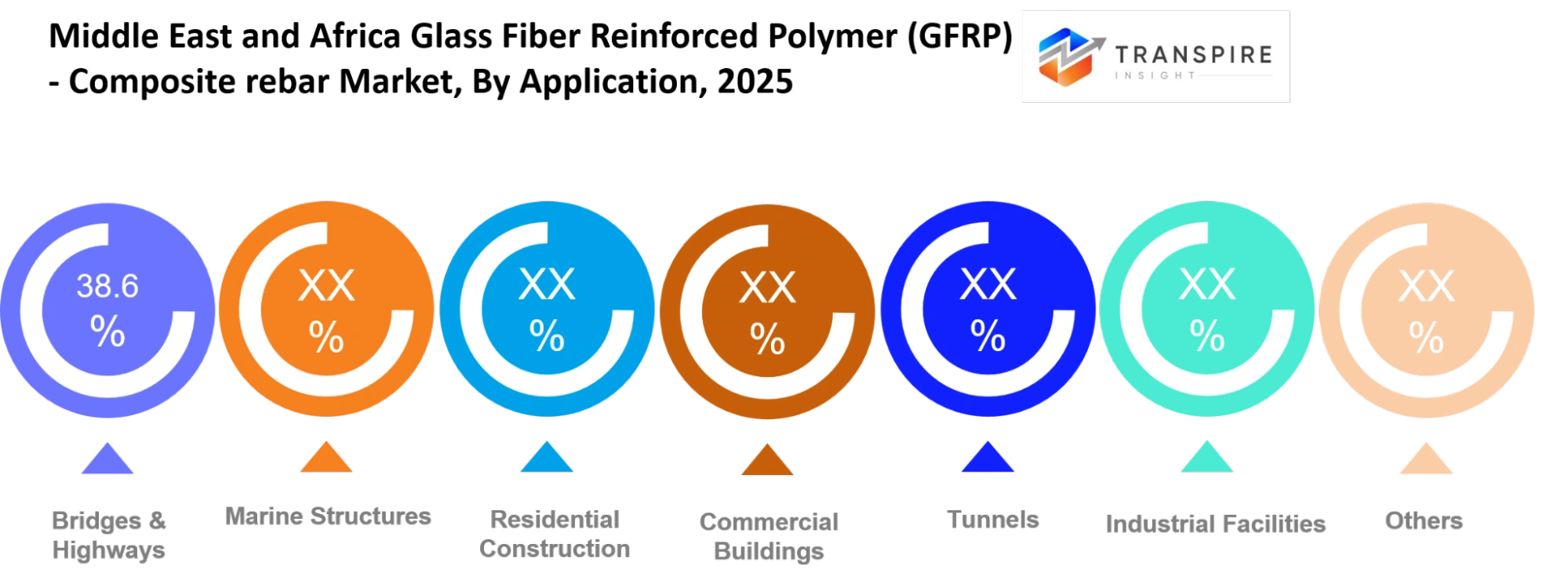
Application segmentation shows up in lots of infrastructure and construction scenarios where corrosion resistance, and durability in general, translates into real measurable benefits. Like Bridges & Highways, this is a huge application zone, because transportation assets need a long service life and less frequent maintenance shut downs. Marine Structures also see steady demand, mainly because saltwater environments are constant and they speed up the typical decline of regular reinforcement materials. In Residential Construction, composite reinforcement is still being adopted, but usually in selected jobs, where the goal is long-term structural protection.
Commercial Buildings tend to choose reinforcement solutions that help preserve durability and bring down the lifecycle upkeep. Tunnels, meanwhile, lean on advanced reinforcement materials to keep structural stability when conditions are rough and operational loads don’t really pause. Industrial Facilities depend on corrosion resistant reinforcement because processing environments often include moisture alongside chemicals, so the usual options just don’t hold up as well. Then there are Others, meaning specialized infrastructure tasks where long-term performance stays front and center during the design stage, and not just as an afterthought.
To learn more about this report, Download Free Sample Report
By End User
End user segmentation kind of shows participation from organizations in charge of infrastructure development, construction execution, and asset management. Construction Companies are a major user group because they’re involved in transportation, commercial, and residential projects, all needing reliable reinforcement materials that last. Infrastructure Developers help adoption along through investments in large-scale projects aimed at a longer service life, like really extended timelines. Government Projects also bring big demand via public infrastructure programs, where the focus is on long-term operational efficiency.
Marine Industry applications use composite reinforcement to deal with harsh coastal and offshore conditions, which is a pretty constant problem there. In the Industrial Sector, demand stays tied to plants and facilities that need protection against corrosion, and sometimes chemical exposure too. The “Others” category covers specialized project owners and engineering organizations, pursuing advanced construction solutions. Overall, end-user preferences are drifting toward lifecycle cost management, asset durability goals, and reduced maintenance requirements across those important infrastructure investments.
What are the Key Use Cases Driving the Middle East and Africa Glass Fiber Reinforced Polymer (GFRP) - Composite rebar Market?
The largest use case seems to be infrastructure reinforcement for bridges, marine structures, ports, seawalls, and other coastal transportation assets. These kinds of projects see the highest demand, because being exposed to saltwater and chloride rich environments tends to speed up steel corrosion. So, the long life composite reinforcement ends up looking economically attractive across the full life of the asset.
Past the usual core infrastructure, adoption is also moving into desalination facilities, wastewater treatment plants, industrial processing sites, and even underground construction projects. Utility operators and industrial developers are using GFRP reinforcement more and more when the conditions are chemically aggressive. In those settings, maintenance interruptions can quickly turn into major operational costs, which is why the choice matters.
Newer applications are also showing up, like renewable energy infrastructure, data centers, smart city developments, and more advanced precast construction systems. As governments chase resilience and sustainability targets over the long run, these newer areas should keep generating extra growth possibilities during the forecast period.
|
Report Metrics |
Details |
|
Market size value in 2025 |
USD 157.84 Million |
|
Market size value in 2026 |
USD 173.56 Million |
|
Revenue forecast in 2033 |
USD 337.45 Million |
|
Growth rate |
CAGR of9.96% from 2026 to 2033 |
|
Base year |
2025 |
|
Historical data |
2021 - 2024 |
|
Forecast period |
2026 - 2033 |
|
Report coverage |
Revenue forecast, competitive landscape, growth factors, and trends |
|
Regional scope |
Middle East and Africa (Saudi Arabia, United Arab Emirates, South Africa, Rest of Middle East and Africa) |
|
Key company profiled |
Owens Corning, Pultron Composites, Dextra Group, Schoeck, FiReP Rebar, Hughes Brothers, Neuvokas, Sireg Geotech, Marshall Composite Technologies, Armastek, BP Composites, Fiberline, Pultrall, Kodiak Fiberglass, Mateenbar. |
|
Customization scope |
Free report customization (country, regional & segment scope). Avail customized purchase options to meet your exact research needs. |
|
Report Segmentation |
By Resin Type (Vinyl Ester Resin, Polyester Resin, Epoxy Resin, Polyurethane Resin, Hybrid Resin, Others); By Fiber Type (E-Glass Fiber, S-Glass Fiber, AR-Glass Fiber, Continuous Fiber, Others); By Application (Bridges & Highways, Marine Structures, Residential Construction, Commercial Buildings, Tunnels, Industrial Facilities, Others); By End User (Construction Companies, Infrastructure Developers, Government Projects, Marine Industry, Industrial Sector, Others). |
Which Regions are Driving the Middle East and Africa Glass Fiber Reinforced Polymer (GFRP) - Composite rebar Market Growth?
The Middle East is, honestly, kind of the dominant regional market. Gulf countries keep spending big on ports, desalination plants, industrial corridors, tourism infrastructure, and transportation networks—things that really need corrosion-resistant construction materials. Because government-backed infrastructure outlays stay relatively steady, composite reinforcement suppliers get a reliable stream of projects. On top of that, strong engineering standards plus the ability to deliver large projects at scale help keep the market lead in place.
South Africa shows up as one of the most meaningful secondary contributors to regional revenue. In contrast to the Gulf region, growth there feels more like infrastructure rehabilitation and the replacement of aging assets, rather than launching totally new megaprojects. Ongoing investment in transport systems, water management, and industrial facilities keeps demand moving at a consistent pace. There’s also an established engineering ecosystem that gives a dependable basis for continued market activity.
As for the rest of Africa, it is expected to post the fastest growth during the forecast period. Several countries are ramping up investment in ports, urban mobility, energy infrastructure, and water treatment facilities. More involvement from international development institutions and infrastructure investors has improved access to project funding. For newcomers, and for investors looking ahead, that expansion means a real chance to build distribution channels and lock in early roles in developing infrastructure markets between 2026 and 2033.
Who are the Key Players in the Middle East and Africa Glass Fiber Reinforced Polymer (GFRP) - Composite rebar Market and How Do They Compete?
Market competition is somewhat fragmented, like, you see international composite specialists right next to regional manufacturers. Most firms sort of set themselves apart using corrosion resistance performance and then engineering certifications. They also lean on project references, manufacturing capabilities,and technical support services which is honestly a pretty practical mix. As international construction standards become more important, product qualification is now more often a deciding factor, especially when someone is buying for large infrastructure projects.
Pultron Composites is leaning hard into advanced pultrusion technology and it promotes the Mateenbar product line for environments that are highly corrosive. Their approach is more about long term infrastructure durability, plus strong real world performance in marine settings. They have also pushed to expand business development capacities, in order to speed up adoption across key international markets, bit by bit.
Dextra Group differentiates mainly with broad international certification coverage and project specific engineering support. They actively chase partnerships, industry collaborations,and they also explore innovative resin technologies so that nonmetallic reinforcement solutions get broader acceptance. It’s more than just selling,it’s about fitting the solution to the job.
Owens Corning uses its composite materials knowhow and strategic manufacturing partnerships to reinforce its position in the market. At the same time, Schoeck concentrates on advanced composite engineering applications. FiReP Rebar and Sireg Geotech then compete through more specialized reinforcement technologies and infrastructure focused solutions,covering the needs of the build sector in a narrower but targeted way.
Company List
- Owens Corning
- Pultron Composites
- Dextra Group
- Schoeck
- FiReP Rebar
- Hughes Brothers
- Neuvokas
- Sireg Geotech
- Marshall Composite Technologies
- Armastek
- BP Composites
- Fiberline
- Pultrall
- Kodiak Fiberglass
- Mateenbar
Recent Development News
"In October 2025, Bekaert and IKK Mateenbar entered a strategic partnership agreement. The collaboration aims to develop hybrid reinforcement systems combining GFRP rebar and fiber-reinforced concrete solutions for infrastructure projects across the Middle East and North Africa, expanding adoption of corrosion-resistant construction technologies.
Source: https://www.bekaert.com
What Strategic Insights Define the Future of the Middle East and Africa Glass Fiber Reinforced Polymer (GFRP) - Composite rebar Market?
The market seems to be moving— kinda structurally— toward performance-led infrastructure design, where the durability across the full lifecycle ends up mattering a lot more than the upfront material expense. This kind of shift is getting pushed by the region’s rising spending on coastal assets, water systems, transportation corridors, and industrial installations, all of which really need long service lives even when conditions get corrosive. And as engineering expectations evolve, GFRP reinforcement is likely to go from being a niche, almost specialized fix to a more commonly specified construction option.
There’s also a quieter risk, it’s raw material concentration paired with resin supply volatility. If manufacturers lean too hard on specialized fiberglass and resin inputs then they could get hit by pricing swings and supply interruptions, which then ripple straight into project economics.
At the same time, there’s a promising angle too. A real opportunity is to integrate GFRP reinforcement in big desalination, hydrogen, and renewable power infrastructure undertakings. These sectors call for materials that can handle harsh, aggressive surroundings while still staying reliable. To capture that momentum, firms should focus on local manufacturing alliances, nearby certifications, and strong technical advisory support, so they can get early wins in specification and improve their long-term competitiveness.
Middle East and Africa Glass Fiber Reinforced Polymer (GFRP) - Composite rebar Market Report Segmentation
By Resin Type
- Vinyl Ester Resin
- Polyester Resin
- Epoxy Resin
- Polyurethane Resin
- Hybrid Resin
- Others
By Fiber Type
- E-Glass Fiber
- S-Glass Fiber
- AR-Glass Fiber
- Continuous Fiber
- Others
By Application
- Bridges & Highways
- Marine Structures
- Residential Construction
- Commercial Buildings
- Tunnels
- Industrial Facilities
- Others
By End User
- Construction Companies
- Infrastructure Developers
- Government Projects
- Marine Industry
- Industrial Sector
- Others
Frequently Asked Questions
Find quick answers to common questions.
The expected Middle East and Africa Glass Fiber Reinforced Polymer (GFRP) - Composite rebar Market size for the market will be USD 337.45 Million in 2033.
Key segments for the Middle East and Africa Glass Fiber Reinforced Polymer (GFRP) - Composite rebar Market are By Resin Type (Vinyl Ester Resin, Polyester Resin, Epoxy Resin, Polyurethane Resin, Hybrid Resin, Others); By Fiber Type (E-Glass Fiber, S-Glass Fiber, AR-Glass Fiber, Continuous Fiber, Others); By Application (Bridges & Highways, Marine Structures, Residential Construction, Commercial Buildings, Tunnels, Industrial Facilities, Others); By End User (Construction Companies, Infrastructure Developers, Government Projects, Marine Industry, Industrial Sector, Others).
Major Middle East and Africa Glass Fiber Reinforced Polymer (GFRP) - Composite rebar Market players are Owens Corning, Pultron Composites, Dextra Group, Schoeck, FiReP Rebar, Hughes Brothers, Neuvokas, Sireg Geotech, Marshall Composite Technologies, Armastek, BP Composites, Fiberline, Pultrall, Kodiak Fiberglass, Mateenbar.
The Middle East and Africa Glass Fiber Reinforced Polymer (GFRP) - Composite rebar Market size is USD 157.84 Million in 2025.
The Middle East and Africa Glass Fiber Reinforced Polymer (GFRP) - Composite rebar Market CAGR is 9.96% from 2026 to 2033.
- Owens Corning
- Pultron Composites
- Dextra Group
- Schoeck
- FiReP Rebar
- Hughes Brothers
- Neuvokas
- Sireg Geotech
- Marshall Composite Technologies
- Armastek
- BP Composites
- Fiberline
- Pultrall
- Kodiak Fiberglass
- Mateenbar
About the Authors

Pankaj Ghogare Patil
I am Pankaj Ghogare Patil, a Senior Research Analyst at Transpire Insight, specializing in the Pharmaceutical, Chemicals & Materials, Healthcare IT, and Biotechnology industry. My expertise lies in conducting comprehensive market research, analyzing industry trends, evaluating competitive landscapes, and translating complex data into actionable insights. At Transpire Insight, I closely follow emerging technologies, regulatory developments, and market innovations to create accurate, well-researched, and informative content that helps businesses and professionals make informed decisions. I am committed to producing credible, evidence-based articles that reflect industry best practices while making technical topics accessible and valuable for a broad audience.

Chakradhar Khansole
Chakradhar serves as the Research Director at Transpire Insight, bringing over 8 years of experience in technology, innovation, and strategic market intelligence. He specializes in transforming complex market data into actionable business insights that enable organizations to make informed, growth-oriented decisions. Recognized for his strategic vision and analytical expertise, Chakradhar leads high-impact research initiatives, delivering comprehensive market assessments, competitive intelligence, and forward-looking industry analysis.
Recently Published Reports
-
May 2026
Healthcare Polymer Packaging Market
Healthcare Polymer Packaging Market Size, Share & Analysis Report By Packaging Type (Syringes, IV Bottles and Pouches, Clamshells, Blisters, Bottles & Jars, Containers, Tubes, IV Parental Packaging, Others), By Type (Regulated, Non-regulated), By Polymer Type (LDPE (Low-Density Polyethylene), HDPE (High-Density Polyethylene), Homo-polymer (Homo), Random Copolymer (Random), Block Copolymer (Block), PET, Polystyrene, Polyvinyl Chloride, Polyamide/EVOH, Others), and Geography (North America, Europe, Asia-Pacific, Middle East and Africa, South and Central America), 2021 - 2031
-
Apr 2026
Hydrophilic Tape (Waterstop) Market
Hydrophilic Tape (Waterstop) Market Size, Share & Analysis Report By Type (Bentonite-Based Hydrophilic Tape, Rubber-Based Hydrophilic Tape), By Application (Residential Buildings, Commercial Buildings, Infrastructure Projects), and Geography (North America, Europe, Asia-Pacific, Middle East and Africa, South and Central America), 2021 - 2031
-
Apr 2026
Metalens Market
Metalens Market Size, Share & Analysis Report By Type (Visible Light Metalens, and Infrared Metalens), By Application (Consumer Electronics, Automotive Electronics, Industrial, Medical, and Others), and Geography (North America, Europe, Asia-Pacific, Middle East and Africa, South and Central America), 2021 - 2031
-
Apr 2026
PBT Resin Market
PBT Resin Market Size, Share & Analysis Report By Type (Reinforced PBT Resin, Unreinforced PBT Resin), By Processing Method (Injection Molding, Extrusion, Blow Molding, Others), By End-User (Automotive, Electrical & Electronics, Consumer Appliances, Industrial Machinery, Medical Devices, Packaging, Others), and Geography (North America, Europe, Asia-Pacific, Middle East and Africa, South and Central America), 2021 - 2031