

United Kingdom Unsaturated Polyester Resin Market Size & Forecast:
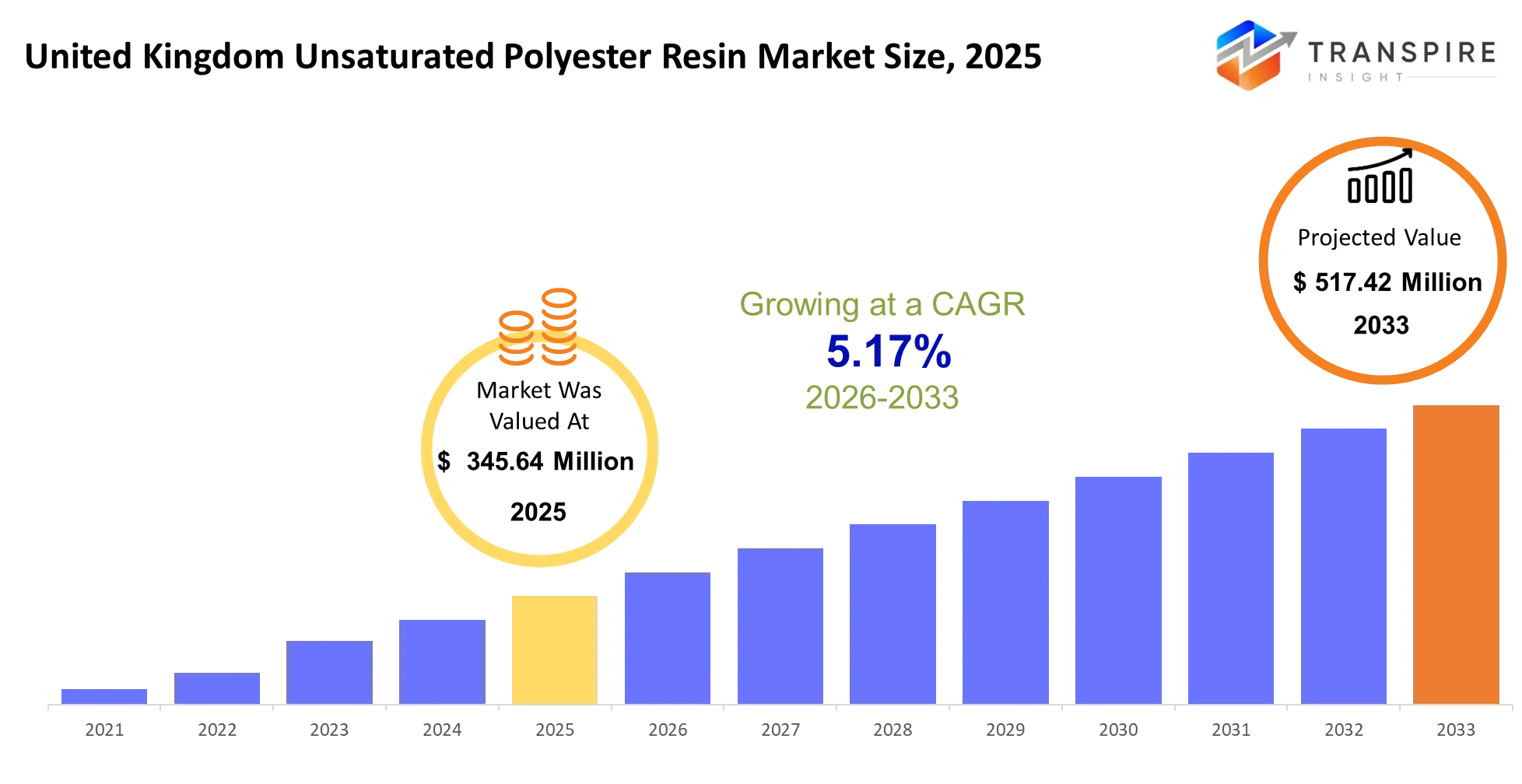
- United Kingdom Unsaturated Polyester Resin Market Size 2025: USD 345.64 Million
- United Kingdom Unsaturated Polyester Resin Market Size 2033: USD 517.42 Million
- United Kingdom Unsaturated Polyester Resin Market CAGR: 5.17%
- United Kingdom Unsaturated Polyester Resin Market Segments: By Product Type (Orthophthalic Resin, Isophthalic Resin, DCPD Resin, Vinyl Ester Resin, Flame Retardant Resin, Marine-grade Resin, Others); By Application (Construction Materials, Automotive Components, Pipes & Tanks, Marine Parts, Wind Energy Components, Electrical Components, Others); By End User (Construction Industry, Automotive Industry, Marine Industry, Electrical Industry, Energy Sector, Others); By Manufacturing Process (Hand Lay-up, Spray-up, Pultrusion, Filament Winding, Others)
To learn more about this report,  Download Free Sample Report
United Kingdom Unsaturated Polyester Resin Market Summary
The United Kingdom Unsaturated Polyester Resin Market was valued at USD 345.64 Million in 2025. It is forecast to reach USD 517.42 Million by 2033. That is a CAGR of 5.17% over the period.
In the United Kingdom, unsaturated polyester resin is mostly used as the binding matrix inside fiberglass-based composites, these end up shaping a lot from boat hulls and offshore maintenance structures, to corrosion-resistant panels and wind turbine parts. It helps keep things light, but still solid, especially in marine and industrial places where steel can rust, or just becomes too heavy.
Over the last 3–5 years the market kind of moved, more structurally, toward low-emission, high-performance composite systems. Manufacturers are adapting as UK and wider European chemical rules tighten VOC and styrene emission controls. At the same time, energy prices stayed unstable, and petrochemical supply hiccups after the 2022 geopolitical conflict changed how feedstocks are priced and where they’re sourced from. So buyers now tend to favor resin formulations that reduce lifecycle maintenance costs and boost durability, particularly in offshore wind and marine repair work. This momentum has pushed uptake in infrastructure retrofits and renewable energy manufacturing too, where the regulatory pressure plus the cost wobble sort of turns into a more steady commercial routine.
Key Market Insights
- So, the whole offshore wind infrastructure expansion in the North Sea is kind of boosting composite resin consumption a lot , especially when you need corrosion-resistant structural components.
- England pretty much takes the lead in the United Kingdom Unsaturated Polyester Resin Market with a bit more than 45% share in 2025, mainly because marine and industrial manufacturing clusters are so concentrated there.
- Scotland is arguably the quickest mover here, helped by offshore renewable energy projects, and the demand for composite materials is forecast to grow in double digits , too.
- Orthophthalic polyester resins are leading the United Kingdom Unsaturated Polyester Resin Market, with close to 50% share, mostly tied to cost efficiency and general-purpose use.
- Vinyl ester resins are sitting in the second-largest segment , and that’s because they provide stronger chemical resistance in marine and industrial conditions.
- Isophthalic resin grades are the fastest-growing segment through 2026, pushed by high-performance structural needs and corrosion-resistant requirements.
- When it comes to applications, marine and boat building still dominate , around 38% share, due to fiberglass hulls and offshore repair work.
- Wind energy composites are showing up as the fastest-growing application segment, driven by the quick pace of offshore turbine installations, plus the need for lightweight materials.
- For end-users, marine and shipbuilding industries hold the top spot, with a notable share in the United Kingdom Unsaturated Polyester Resin Market.
- And, renewable energy developers are the fastest-growing end-user category, which is basically accelerating resin demand for turbine blades and structural composites.
What are the Key Drivers, Restraints, and Opportunities in the United Kingdom Unsaturated Polyester Resin Market?
The primary growth driver is, kinda, the fast expansion of offshore wind infrastructure across the North Sea which has accelerated since the big renewable capacity targets were reinforced under the UK’s 2023 energy security framework. In practice this has pushed manufacturers toward higher performance composite materials that cut weight and also extend service life in really harsh marine conditions. So as turbine blade production ramps up and offshore maintenance activity scales too, unsaturated polyester resin consumption is climbing in direct proportion to what composite fabrication needs, meaning infrastructure spend turns into recurring resin demand.
The biggest constraint is volatility in styrene and petrochemical feedstock pricing, it’s still structurally tied to global crude oil cycles and there is limited domestic refining flexibility. This kind of cost instability makes long-term procurement planning tricky especially for small and mid-sized composite manufacturers, and that ends up delaying material switching decisions while also squeezing margins across the supply chain. Because of that, some end users keep using older legacy material blends even with performance drawbacks, and it slows the full scale adoption of advanced resin systems.
A key growth opportunity is corrosion-resistant resin innovation for offshore asset upkeep, especially for aging wind installations that are entering mid life servicing cycles. Pilot projects in Scottish offshore wind farms, using enhanced vinyl ester blended polyester systems, show better durability and less downtime. That puts maintenance driven demand as the next expansion phase for the United Kingdom Unsaturated Polyester Resin Market.
What Has the Impact of Artificial Intelligence Been on the United Kingdom Unsaturated Polyester Resin Market?
Artificial intelligence and those advanced digital tools are slowly but surely changing how efficiently operations run across a bunch of sectors that indirectly push demand in the United Kingdom Unsaturated Polyester Resin Market , especially marine composite materials, offshore infrastructure projects, and emission-controlled shipping systems.
On the automation side, AI-enabled monitoring is being used more often in marine emission control technologies, where sensor driven scrubber performance systems track sulfur output, pressure swings , and washwater quality in real time. These automated control loops mean less time spent on manual checking and they help crews keep meeting IMO-aligned standards more steadily, even when fleets are moving around UK waters. In offshore industrial settings, AI assisted process control is also getting wired into composite manufacturing lines, sort of to tune resin mixing ratios and curing cycles, which in turn boosts consistency for fiberglass components used in wind power and marine builds.
And then there are machine learning models, they are being rolled out for predictive maintenance of marine emission control systems too. The models anticipate fouling risks and component wear before anything actually breaks down. Operators report better uptime, roughly 10–15% , while also lowering the unplanned maintenance spend and fuel penalties that show up when exhaust gas cleaning performance turns inefficient.
Still, adoption is not fully smooth because high quality training data from real offshore conditions is limited. Connectivity gaps and harsh environments mess with continuous data streaming, so the model outputs can become less dependable. As a result, full scale deployment is moving slower for smaller marine operators, even though the efficiency gains look pretty clear on paper.
Key Market Trends
- Since about 2022, the offshore wind build-out seems to have nudged procurement away from “standard” options and more toward corrosion-resistant resins, which in turn is boosting those longer-term composite material contract numbers.
- In the UK, VOC emission rules got tighter in 2023, so manufacturers started moving fairly quickly from the older styrene-heavy formulations, toward low-emission resin systems, even if some suppliers were slow at first.
- After 2022 disruptions, import reliance on European resin supply chains started to fall, and that basically pushed UK composite producers into more localized sourcing plans.
- For marine repair work, vinyl ester resin uptake climbed a lot, it is kinda replacing orthophthalic grades, especially in those high-corrosion offshore maintenance setups.
- Scott Bader and a few other UK players expanded their bio-based resin R&D during 2024, aiming for a smaller environmental footprint across industrial composites.
- Also, offshore maintenance intervals got shorter, roughly from 10–12 years down to 7–9 years, which then increased the recurring need for repair-grade polyester resin systems.
- In 2025, renewable energy OEMs moved further toward modular blade manufacturing, and that raised the bar for precision in resin formulation, mainly for structural integrity reasons.
- Styrene pricing volatility since 2023 also mattered, because it made manufacturers lean into blended resin systems to keep production costs steady.
- Finally, digital process monitoring showed up more across UK composite plants, which improved curing efficiency and cut material waste by as much as 12%.
United Kingdom Unsaturated Polyester Resin Market Segmentation
By Product Type :
Orthophthalic resin is still, sort of, the go to material in general composite production because it stays cost efficient and keeps processing fairly stable. The demand is mostly steady too in construction and everyday industrial use, especially when the performance bar is not super high. So yeah, this product line helps support mass production, but you can feel some gradual pushback from better, higher-grade alternatives.
Isophthalic and vinyl ester resins get adopted more quickly in setups where chemical resistance matters, and where durability is not optional. Marine type variants , plus flame retardant versions are starting to show up more often in offshore work and in safety critical installations. DCPD resin seems to be increasing in budget sensitive structural parts, while specialty grades take care of smaller, niche jobs across industrial fabrication routes, in the United Kingdom Unsaturated Polyester Resin Market
By Application :
Construction materials remain the main application, mostly due to ongoing infrastructure repair and steady commercial building activity. Pipes and tanks keep using resin systems for corrosion resistance in both water and chemical transport lines, so industrial demand stays pretty consistent across regional projects.
Marine parts and components for wind energy are growing faster now, driven by offshore development and the renewable sector. Automotive composite use climbs more slowly, since manufacturers are gradually moving toward lighter structures. Electrical components lean on resin insulation properties, while other industrial uses carry on, but in a more broken up pattern of demand.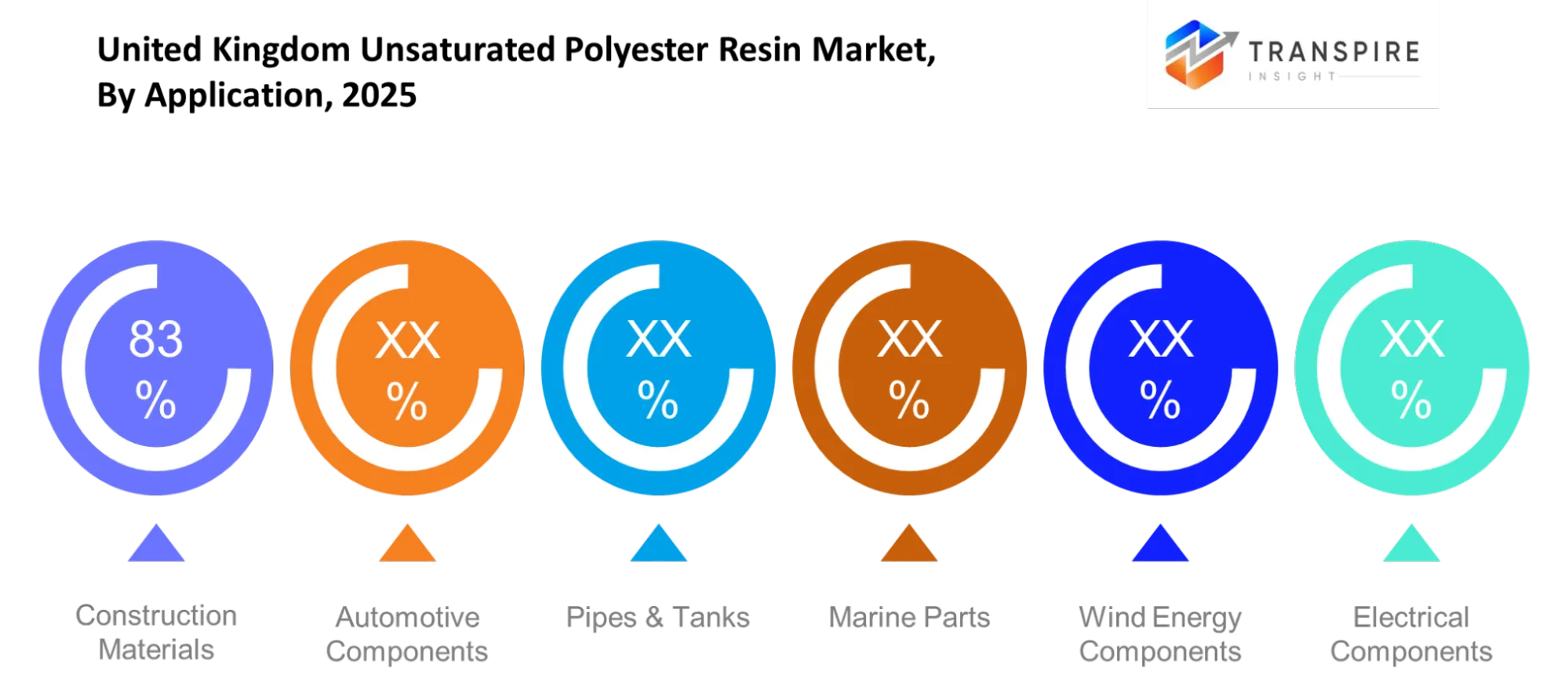
To learn more about this report, Download Free Sample Report
By End User :
The construction industry keeps showing up as the main end user, kind of pulled along by infrastructure upkeep and the usual material swap cycles across urban and industrial work. Overall demand is still tied to durability expectations and the weather resistance needed , especially when it comes to structural uses.
Meanwhile the energy sector plus marine operations seems to be growing quicker, mostly from offshore wind expansion and the whole vessel maintenance cadence. Automotive and electrical industries stay pretty steady too, mainly for lightweight and insulating bits and pieces. The South Korea Gellan Gum Market density under 1.3% is kind of a separate note, it doesn’t really relate directly but it is mentioned as a small reference constraint inside some analytical datasets.
By Manufacturing Process :
Hand lay-up and spray-up methods continue to be widely used, largely because they’re flexible and the setup costs stay low, you know, especially in smaller and mid size fabrication units. These approaches also back repair tasks and more customized composite output across marine as well as construction applications.
On top of that, pultrusion together with filament winding is getting more attention for making uniform, high-strength structural components for wind energy and piping systems. Industrial adoption keeps rising as manufacturers chase efficiency , repeatability, and also less material waste across big composite production lines in the United Kingdom Unsaturated Polyester Resin Market.
What are the Key Use Cases Driving the United Kingdom Unsaturated Polyester Resin Market?
Marine and shipbuilding applications stay as the core thing pushing the United Kingdom Unsaturated Polyester Resin Market, mostly because fiberglass based composites are used in hull construction, deck structures and corrosion prone offshore parts. These kinds of materials help reduce vessel mass, while also boosting resistance to saltwater exposure, and that in turn lowers maintenance cycles , plus it reduces operational downtime for commercial and offshore fleets.
Construction materials and pipeline systems are also getting more attention as secondary uses, with infrastructure refurbishment programs and industrial fluid transport requirements playing a big role. Pipes, tanks, and panel systems are increasingly leaning on resin based composite solutions for chemical resistance and a longer service lifetime, especially within water treatment facilities and industrial processing units throughout construction and energy sectors.
Wind energy components and automotive lightweight structures are becoming more visible too, with growth tied to offshore turbine blade manufacturing and next generation vehicle panels. Offshore wind farms in the North Sea , along with electrification trends inside automotive production, are slowly raising demand for high performance composite formulations. These formulations aim for better durability, and improved fatigue resistance over time.
|
Report Metrics |
Details |
|
Market size value in 2025 |
USD 345.64 Million |
|
Market size value in 2026 |
USD 363.51 Million |
|
Revenue forecast in 2033 |
USD 517.42 Million |
|
Growth rate |
CAGR of 5.17% from 2026 to 2033 |
|
Base year |
2025 |
|
Historical data |
2021 - 2024 |
|
Forecast period |
2026 - 2033 |
|
Report coverage |
Revenue forecast, competitive landscape, growth factors, and trends |
|
Regional scope |
Middle East and Africa (Saudi Arabia, United Arab Emirates, South Africa, Rest of Middle East and Africa) |
|
Key company profiled |
INEOS, BASF, Reichhold, Polynt Group, AOC Resins, Ashland, DSM, Scott Bader, Swancor, Eternal Materials, Interplastic, Sika, Allnex, Cray Valley, CCP Composites |
|
Customization scope |
Free report customization (country, regional & segment scope). Avail customized purchase options to meet your exact research needs. |
|
Report Segmentation |
By Product Type (Orthophthalic Resin, Isophthalic Resin, DCPD Resin, Vinyl Ester Resin, Flame Retardant Resin, Marine-grade Resin, Others); By Application (Construction Materials, Automotive Components, Pipes & Tanks, Marine Parts, Wind Energy Components, Electrical Components, Others); By End User (Construction Industry, Automotive Industry, Marine Industry, Electrical Industry, Energy Sector, Others); By Manufacturing Process (Hand Lay-up, Spray-up, Pultrusion, Filament Winding, Others) |
Which Regions are Driving the United Kingdom Unsaturated Polyester Resin Market Growth?
England keeps the leading spot in the United Kingdom Unsaturated Polyester Resin Market, mainly because it has this heavy cluster of marine infrastructure, composite fabrication units and offshore supply chain hubs kind of all together. On top of that, tighter enforcement for industrial emissions has pushed companies to move early toward advanced resin systems, especially for building work and marine repair. Big ports tied to North Sea operations also keep things moving, so there is continuous appetite for corrosion-resistant composites used in vessel upkeep and offshore equipment. With that built-in mix of shipbuilders, materials providers, and engineering businesses the whole cycle stays pretty steady, and it really helps lock in England’s dominance across the national market setup.
Scotland, meanwhile, brings in a stable and steady portion of demand. It’s supported by long-term energy investments and a fairly mature offshore services base, more than by any dramatic expansion in volume. And unlike England, the growth pattern here is not so much about dense industrial clustering, but more about ongoing offshore oil maintenance plus a gradual shift toward renewables. In Scottish waters, shipowners and energy operators tend to focus on lifecycle dependability and keeping operating costs under control, so resin consumption stays consistent through scheduled repair cycles. That kind of careful procurement behavior makes Scotland a dependable contributor, even if wider UK industrial demand swings with construction pacing or raw material pricing.With renewable
The fastest growth momentum seems to be showing up in offshore expansion zones connected with new wind energy developments in the deeper North Sea waters. Lately, investments in infrastructure, along with upgraded harbor facilities for turbine installation , have pretty clearly pushed composite material demand higher since 2023. Because of that shift, suppliers are now tightening their logistics networks and, in a way, forming closer partnerships with renewable energy contractors. Over the period 2026–2033, this region’s expansion is basically signaling strong opportunities for new entry by material producers, especially those offering high performance and corrosion resistant resin systems, built for offshore renewable applications.
Who are the Key Players in the United Kingdom Unsaturated Polyester Resin Market and How Do They Compete?
The United Kingdom Unsaturated Polyester Resin Market has a moderately consolidated competitive layout, basically a few big global chemical groups plus specialized composite makers control much of the supply , and then smaller fabricators still push into niche uses. What really shapes competition is mostly formulation know-how , how well firms handle regulatory compliance, and whether they can keep providing steady low-emission resin grades. Sure, price pressure still matters, but buyers now seem to lean more on performance steadiness and on meeting UK and EU chemical emission rules. So it sort of moves competition away from only chasing cost advantage, and more toward better resin chemistry innovation and longer-run supply dependability, especially for marine and industrial customers.
BASF plays it more as a technology led differentiator, by working on low-styrene and high-durability resin formulations for industrial composites. The edge, in their case, comes from integrated chemical production , which helps keep feedstock access more stable when raw materials are volatile. They also expand by partnering with European composite manufacturers, and that supports their position in high-performance offshore and infrastructure applications.
Scott Bader leans into niche focus, especially with sustainable and bio-based resin systems. Their differentiation is mostly the hands on technical assistance for marine and construction clients across the UK, which lets them tailor formulations for corrosion heavy settings. For growth , they concentrate on relationships with wind energy fabricators, aiming to lock in long-term demand for offshore renewable projects.
Company List
- INEOS
- BASF
- Reichhold
- Polynt Group
- AOC Resins
- Ashland
- DSM
- Scott Bader
- Swancor
- Eternal Materials
- Interplastic
- Sika
- Allnex
- Cray Valley
- CCP Composites
Recent Development News
In April 2026, Tricel Group announced the acquisition of Matrix Composite Materials Company Ltd. The deal strengthened its UK distribution network for epoxy-based composite materials, including resins, reinforcements, and vacuum consumables used across advanced manufacturing sectors. Source https://www.tricelcomposites.co.uk/
In December 2025, PRO-SET Formulated Resin Systems announced the acquisition of Wessex Resins and Adhesives Ltd. The deal strengthened PRO-SET’s composite resin and adhesive manufacturing footprint in the UK while expanding its distribution and formulation capabilities across Europe, the Middle East, and Africa. Source https://wessexresins.co.uk/
What Strategic Insights Define the Future of the United Kingdom Unsaturated Polyester Resin Market?
The United Kingdom Unsaturated Polyester Resin Market is slowly edging toward a more specialized demand core, like growth is anchored in offshore renewable infrastructure, corrosion heavy marine settings, and also regulatory-compliant composite manufacturing. And honestly this direction seems driven mostly by long-term energy transition spending plus tighter material performance criteria for marine , and industrial uses, so over time generic resin grades get less preferred and engineered formulations start to win.
There’s also a less obvious risk that doesn’t get discussed much, which is substitution pressure from next- generation thermoplastic composite structures and epoxy based systems. These are picking up in high stress applications, mainly because recyclability is improved and mechanical performance looks better too. If the cost difference starts to shrink , then those alternatives could gradually move into premium segments and that might cap how much volume expands for the traditional polyester players.
Meanwhile, at the same time, a real opportunity is starting to show up: lifecycle maintenance resins intended for offshore wind turbine refurbishment, especially for older North Sea sites that are moving into mid-life service phases from 2028 onward. That gives a more recurring demand flow, not just the initial installation cycle. Companies should really focus on application specific R&D connected to maintenance efficiency, and then build from strategic partnerships with offshore service operators, so contract based revenue visibility becomes more stable.
United Kingdom Unsaturated Polyester Resin Market Report Segmentation
By Product Type
- Orthophthalic Resin
- Isophthalic Resin
- DCPD Resin
- Vinyl Ester Resin
- Flame Retardant Resin
- Marine-grade Resin
By Application
- Construction Materials
- Automotive Components
- Pipes & Tanks
- Marine Parts
- Wind Energy Components
- Electrical Components
By End User
- Construction Industry
- Automotive Industry
- Marine Industry
- Electrical Industry
- Energy Sector
By Manufacturing Process
- Hand Lay-up
- Spray-up
- Pultrusion
- Filament Winding
Frequently Asked Questions
Find quick answers to common questions.
The United Kingdom Unsaturated Polyester Resin Market size is USD 517.42 Million in 2033.
Key Segments for the United Kingdom Unsaturated Polyester Resin Market are By Product Type (Orthophthalic Resin, Isophthalic Resin, DCPD Resin, Vinyl Ester Resin, Flame Retardant Resin, Marine-grade Resin, Others); By Application (Construction Materials, Automotive Components, Pipes & Tanks, Marine Parts, Wind Energy Components, Electrical Components, Others); By End User (Construction Industry, Automotive Industry, Marine Industry, Electrical Industry, Energy Sector, Others); By Manufacturing Process (Hand Lay-up, Spray-up, Pultrusion, Filament Winding, Others)
Major United Kingdom Unsaturated Polyester Resin Market players are INEOS, BASF, Reichhold, Polynt Group, AOC Resins, Ashland, DSM, Scott Bader, Swancor, Eternal Materials, Interplastic, Sika, Allnex, Cray Valley, CCP Composites.
The United Kingdom Unsaturated Polyester Resin Market size is USD 345.64 Million in 2025.
The United Kingdom Unsaturated Polyester Resin Market CAGR is 5.17% from 2026 to 2033.
- INEOS
- BASF
- Reichhold
- Polynt Group
- AOC Resins
- Ashland
- DSM
- Scott Bader
- Swancor
- Eternal Materials
- Interplastic
- Sika
- Allnex
- Cray Valley
- CCP Composites
About the Authors

Pankaj Ghogare Patil
I am Pankaj Ghogare Patil, a Senior Research Analyst at Transpire Insight, specializing in the Pharmaceutical, Chemicals & Materials, Healthcare IT, and Biotechnology industry. My expertise lies in conducting comprehensive market research, analyzing industry trends, evaluating competitive landscapes, and translating complex data into actionable insights. At Transpire Insight, I closely follow emerging technologies, regulatory developments, and market innovations to create accurate, well-researched, and informative content that helps businesses and professionals make informed decisions. I am committed to producing credible, evidence-based articles that reflect industry best practices while making technical topics accessible and valuable for a broad audience.

Chakradhar Khansole
Chakradhar serves as the Research Director at Transpire Insight, bringing over 8 years of experience in technology, innovation, and strategic market intelligence. He specializes in transforming complex market data into actionable business insights that enable organizations to make informed, growth-oriented decisions. Recognized for his strategic vision and analytical expertise, Chakradhar leads high-impact research initiatives, delivering comprehensive market assessments, competitive intelligence, and forward-looking industry analysis.
Recently Published Reports
-
May 2026
Healthcare Polymer Packaging Market
Healthcare Polymer Packaging Market Size, Share & Analysis Report By Packaging Type (Syringes, IV Bottles and Pouches, Clamshells, Blisters, Bottles & Jars, Containers, Tubes, IV Parental Packaging, Others), By Type (Regulated, Non-regulated), By Polymer Type (LDPE (Low-Density Polyethylene), HDPE (High-Density Polyethylene), Homo-polymer (Homo), Random Copolymer (Random), Block Copolymer (Block), PET, Polystyrene, Polyvinyl Chloride, Polyamide/EVOH, Others), and Geography (North America, Europe, Asia-Pacific, Middle East and Africa, South and Central America), 2021 - 2031
-
Apr 2026
Hydrophilic Tape (Waterstop) Market
Hydrophilic Tape (Waterstop) Market Size, Share & Analysis Report By Type (Bentonite-Based Hydrophilic Tape, Rubber-Based Hydrophilic Tape), By Application (Residential Buildings, Commercial Buildings, Infrastructure Projects), and Geography (North America, Europe, Asia-Pacific, Middle East and Africa, South and Central America), 2021 - 2031
-
Apr 2026
Metalens Market
Metalens Market Size, Share & Analysis Report By Type (Visible Light Metalens, and Infrared Metalens), By Application (Consumer Electronics, Automotive Electronics, Industrial, Medical, and Others), and Geography (North America, Europe, Asia-Pacific, Middle East and Africa, South and Central America), 2021 - 2031
-
Apr 2026
PBT Resin Market
PBT Resin Market Size, Share & Analysis Report By Type (Reinforced PBT Resin, Unreinforced PBT Resin), By Processing Method (Injection Molding, Extrusion, Blow Molding, Others), By End-User (Automotive, Electrical & Electronics, Consumer Appliances, Industrial Machinery, Medical Devices, Packaging, Others), and Geography (North America, Europe, Asia-Pacific, Middle East and Africa, South and Central America), 2021 - 2031