
Container Glass Market Summary:
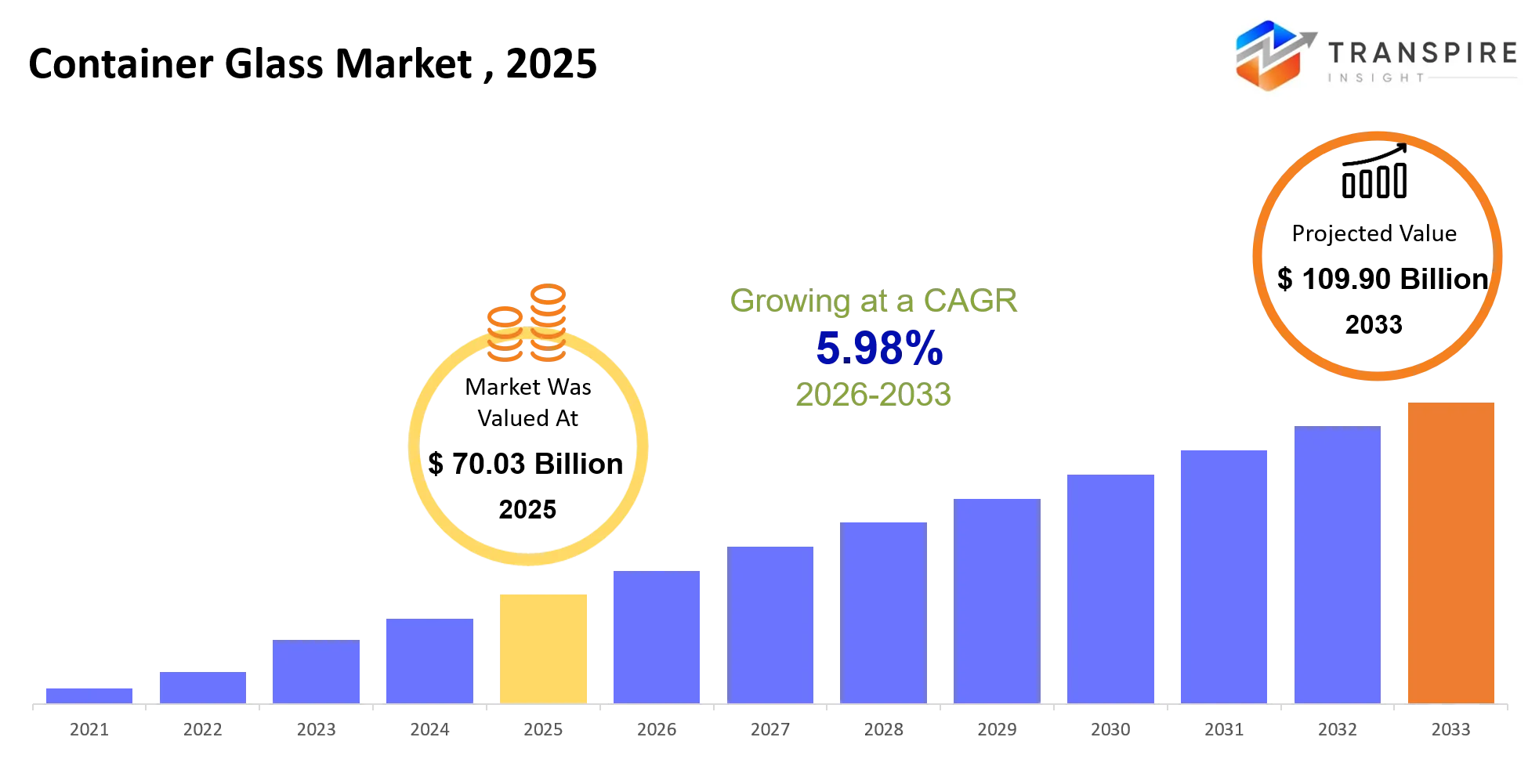
As per the Transpire Insight Analysis, The Container Glass Market size is estimated at USD 70.03 billion in 2025 and is anticipated to reach USD 109.90 billion by 2033, growing at a CAGR of 5.98% from 2026 to 2033.
The container glass market provides bottles, jars and specialised containers for protecting, storing and transporting beverages, food, medicines, cosmetics and chemicals. Its importance lies in its use in packaging and in product retention, premium branding, and reuse and recovery of materials. In the past three to five years, the industry has moved from traditional furnace-based production to lightweight container design, automated quality control and a decarbonization approach to manufacturing reflecting rising energy prices, sustainability commitments and more challenging packaging regulations. An industry structural change is Europe's Packaging and Packaging Waste Regulation, effective as of August 2026 and revising requirements for recyclable and circular packaging. The driver behind these developments is the need for producers to operate to meet demands for greater compliance and more energy-focused production costs, and for this reason investments in higher-efficiency furnaces, recycled glass and lightweight designs are increasing, helping producers to use less material, operate more flexibly and keep existing customers.
Container Glass Market Size & Forecast:
- Market Size 2025: USD 70.03 Billion
- Expected Market Value (2033): USD 109.90 Billion
- Forecast CAGR (2026–2033): 5.98%
- Leading Region in 2025: Asia Pacific
- Fastest Growing Region: Asia Pacific
- Key Company Profiles: O-I Glass, Verallia, Ardagh Group, Vidrala, Vetropack, Gerresheimer, BA Glass, Stoelzle Glass Group, Şişecam, Nihon Yamamura Glass, Vitro, Amcor, Saverglass, Zignago Vetro, Wiegand-Glas.
Key Container Glass Market Insights:
This isn't just about volume in containers anymore: the market is now vying in clean cullet, low-carbon melting capacity, and lightweight design. Producers that integrate recycled feedstock security and verified emissions reduction into their operations are securing longer-term contracts with beverage and pharmaceutical companies.
- Beverage-glass decarbonization is the heart of the investment war in the market, with product demand accounting for 55.0%.
- O-I Glass is continuing to improve its modular melting platform (MAGMA) for shorter-run, flexible production requirements.
- In FY 2025, Verallia achieved 57.7% external cullet use and invested EUR 14 million in cullet recycling facilities until FY 2026.
- The NextGen furnace at Obernkirchen from Ardagh is fueled by 80% green electricity and 20% gas, thereby reducing its footprint by 64%.
- Vidrala started its EUR 180 million modernization of Caudete in June 2026 with an initial 10% output increase in mind.
- Vetropack will embark on large-scale production of lightweight bottles with enhanced thermal strength starting in 2026.
- Wiegand-Glas received the necessary investment for a 420-tonne-per-day hybrid furnace – one that can accept up to 90% recycled cullet.
- Stoelzle is improving the Czech pharmaceutical-glass plant, and BA Glass is increasing its use of cullet throughout Iberia and Poland.
- Gerresheimer has announced a separation of its container glass business to focus on pharmaceutical and biotech applications in the future.
What are the Key Drivers, Restraints, and Opportunities in the Container Glass Market?
Driver:
Sustainability-led packaging procurement is strengthening glass adoption, particularly in premium beverages, food, and cosmetics. Glass’s recyclability, inertness, and established refill systems make it attractive to brands seeking packaging that protects product quality while supporting circularity targets. The EU’s Packaging and Packaging Waste Regulation, applicable from August 2026, adds regulatory pressure to packaging design and recovery practices. This encourages suppliers to invest in recycled cullet, lightweight bottles, and reusable formats, supporting customer retention and higher-value packaging contracts.
Restraint:
Energy-intensive melting remains a structural cost barrier. Furnaces operate continuously, making energy prices, maintenance requirements, and production interruptions difficult to manage. Electrification and hybrid furnace upgrades require substantial capital, while recycled glass availability and quality can vary by region. These constraints particularly affect smaller producers, whose limited investment capacity restricts modernization and margins.
Opportunity:
Furnace modernization and circular supply-chain investment offer long-term growth potential. Hybrid melting, renewable electricity, lightweight container engineering, and improved cullet sorting can reduce emissions and operating costs. For example, FEVE reported more than €600 million in annual European decarbonisation investment, covering electrification, hybrid furnaces, hydrogen trials, and circular logistics. Emerging manufacturing hubs in India also offer opportunities to establish regional capacity closer to beverage, pharmaceutical, and cosmetics customers.
Driver Impact Analysis – Container Glass Market
|
Driver |
Relative Impact on Growth (%) |
Geographic Relevance |
Impact Timeline |
Demand Strength |
Growth Mechanism (5–10 words) |
Key Beneficiaries (5–10 words) |
Major Constraint (5–10 words) |
|
Rising demand for sustainable and recyclable packaging |
28% |
Europe, North America, Asia Pacific |
Medium-term (2–4 years) |
High |
Plastic substitution and sustainability commitments increase glass packaging adoption. |
Container glass manufacturers, beverage brands, recycling companies, packaging converters. |
Higher production costs and competition from lightweight alternative packaging materials. |
|
Growing consumption of beverages, packaged food, and premium products |
24% |
Asia Pacific, North America, Europe |
Short-term (≤2 years) |
High |
Expanding beverage consumption and premiumization increase bottle and jar requirements. |
Beverage producers, food manufacturers, glass container suppliers, packaging distributors. |
Consumer spending fluctuations and substitution by flexible packaging formats. |
|
Regulatory pressure and circular economy initiatives |
19% |
Europe, North America |
Medium-term (2–4 years) |
High |
Packaging regulations encourage recyclable formats and recycled-content procurement. |
Glass manufacturers, recycling operators, packaging compliance providers, sustainability-focused brands. |
Inconsistent recycling regulations and insufficient collection infrastructure. |
|
Technological advancements in lightweighting and energy-efficient manufacturing |
16% |
Europe, Asia Pacific, North America |
Long-term (≥4 years) |
Medium |
Lightweight bottles and furnace modernization improve efficiency and competitiveness. |
Glass producers, furnace technology vendors, equipment manufacturers, logistics providers. |
High capital expenditure and lengthy furnace modernization cycles. |
|
Expanding pharmaceutical, cosmetics, and speciality glass packaging applications |
13% |
Asia Pacific, Europe, North America |
Long-term (≥4 years) |
Medium |
Pharmaceutical growth and premium cosmetics expand specialised container demand. |
Pharmaceutical packaging suppliers, cosmetics brands, speciality glass manufacturers. |
Stringent quality requirements and qualification barriers for specialised containers. |
|
Total |
100% |
— |
— |
— |
— |
— |
— |
What Has the Impact of Artificial Intelligence Been on the Container Glass Market?
Data-driven inspection and control systems for process optimisation. Among the most common applications of AI in the sector, smart, scalable machine vision and deep-learning tools are used to inspect bottles and jars on the production line, checking for cracks, bubbles and other inclusions, as well as dimensional and surface issues-all at line speed. The adoption of automated inspection rather than manual inspection helps improve consistency across the supply chain and will play a role in preventing faulty containers from reaching customers. Technologies such as process monitoring based on cloud-platform analysis of furnace conditions, temperature profiles, forming parameters, and signals from a measurement device on the production line can help optimise operations. Predictive maintenance models can detect abnormal behaviour of machines before breakdowns or unplanned downtime occur, and data analytics can help operators identify repeating patterns of defects and refine process parameter settings. Microsoft's case study on Piramal Glass described monitoring thousands of production variables in real-time and a 1% gain in production efficiency.
In June 2026, Glass Futures launched an AI-driven digital twin of its multi-fuel pilot furnace at its centre of excellence in St Helens, UK. This digital model processes over 11,000 simultaneous calculations to predict glass output and test low-carbon manufacturing processes. Glass Futures Launches AI-driven Digital Twin to Reinvent Glass Manufacturing.
Key Container Glass Market Trends:
The packaging market is increasingly moving towards manufacturing resilience as well as packaging volume. Businesses that are integrated with sourcing materials in circular processes, furnace efficiency, and custom formats are more likely to safeguard their margins and secure their premium contracts.
- The recycled cullet is now a key input as EPR schemes and recycled content regulations influence purchasing.
- Deposit-return systems are growing and enhancing bottle collection and developing more consistent cullet supplies.
- Recyclable and returnable glass bottles are making a comeback as policies and programs for reusing bottles take hold.
- Lightweight bottle design decreases the amount of glass used and transport emissions while maintaining strength.
- The hybrid, electric, and oxy-fuel furnace technologies are taking off to reduce melting emissions.
- Distinctive shapes, embossing, and high-clarity glass are fueling the demand for premium spirits, craft beers, and cosmetics.
- Market demand for high-purity vials and ampoules, particularly for biologics and injectables, is increasing.
- Cullet quality has improved, and higher recycled-content batches are possible due to optical sorting and automated sorting of contaminants.
- Brands are now making packaging carbon data a commercial necessity and are seeking suppliers with verified low-carbon glass.
Container Glass Market Segmentation
Product Type:
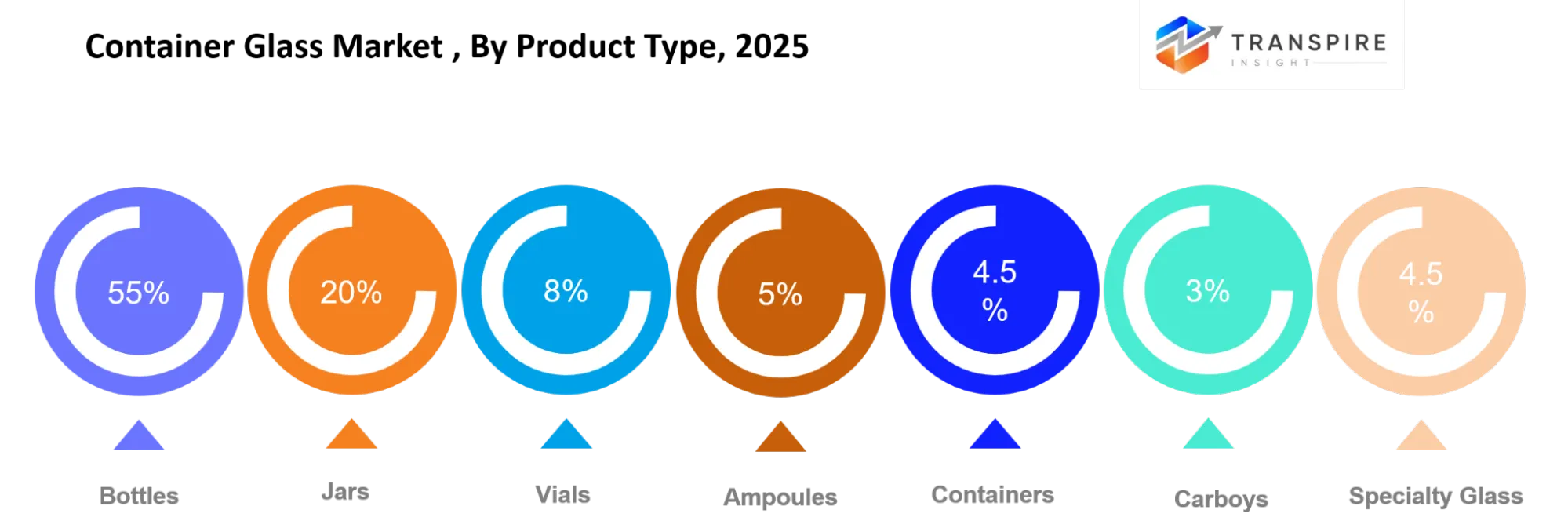
Bottles dominate with a 55.0% share because they serve the largest, most repeat-purchase categories: beer, wine, spirits, soft drinks, water, and premium food. Their growth logic rests on refill systems, lightweighting, and recycled-content compliance, making them the primary channel for low-carbon glass investment. Jars account for 20.0%, supported by preserves, sauces, spreads, and premium food brands seeking reusable, visually transparent packaging. Vials represent 8.0% and ampoules 5.0%, together forming the fastest-moving pharmaceutical cluster; vials and ampoules are associated with a 7.2% CAGR due to injectables, vaccines, and biologics. Containers hold 4.5%, carboys 3.0%, specialty glass 2.5%, and others 2.0%, reflecting narrower industrial, laboratory, and customised uses.
Glass Type:
Soda-lime glass remains the principal material for mainstream bottles and jars, supported by established manufacturing economics, scalability, and recyclability. Borosilicate glass serves pharmaceutical, chemical, and specialised applications requiring thermal resistance and chemical stability. Flint glass supports premium packaging through transparency and visual appeal, while amber and green glass provide light protection for sensitive beverages and formulations. Clear and colored glass strengthen brand differentiation. Speciality formulations are expected to gain relevance as packaging performance, durability, and regulatory requirements become increasingly demanding across industries.
End Use:
Food and beverage packaging represents a major end-use category, supported by established retail distribution, packaged-food consumption, and beverage manufacturing networks. Pharmaceutical applications require dependable container integrity, contamination protection, and compatibility with sensitive formulations. Cosmetics and personal care brands prioritize premium presentation, distinctive designs, and product differentiation. Chemical packaging requires resistance to product interactions, while household products benefit from durable, reusable containers. Future demand will increasingly reflect product-specific packaging requirements, sustainability commitments, and manufacturers’ efforts to balance functional performance with customer experience.
Application:
Beverage packaging remains a commercially important application, supported by bottles for water, soft drinks, beer, wine, and spirits. Food packaging benefits from jars and containers designed for preservation, storage, and product protection. Pharmaceutical packaging creates opportunities for precision-engineered vials, ampoules, and specialized containers. Cosmetic packaging supports premium branding through customized shapes, finishes, and decorative features. Chemical, household, and specialty packaging require material compatibility and dependable performance. Manufacturers increasingly pursue application-specific designs to improve product differentiation, material efficiency, and customer retention.
Color:
Clear glass supports visibility, product presentation, and premium positioning across beverages, food, and cosmetics. Amber glass protects against light exposure, making it suitable for pharmaceuticals, chemicals, and selected beverages. Green glass combines distinctive appearance with established beverage packaging applications. Blue, brown, black, opaque, and other colored formats support specialised branding, product differentiation, and functional requirements. Colour selection increasingly reflects both marketing strategy and packaging performance. Manufacturers are expanding decorative capabilities while balancing customisation, production efficiency, recyclability, and customer expectations across different industries.
Distribution:
Direct sales remain important for large beverage manufacturers, pharmaceutical companies, and multinational packaging buyers seeking volume agreements, consistent quality, and supply reliability. Distributors and wholesalers extend market access to regional customers, while packaging suppliers and contract manufacturers support customized requirements and integrated production arrangements. Online procurement is improving product discovery, quotation processes, and purchasing convenience, particularly for smaller buyers. Retail channels primarily support smaller-scale and speciality packaging transactions. Future distribution competitiveness will depend on responsive logistics, customer relationships, inventory management, and the ability to accommodate changing order volumes and specifications.
What are the Key Use Cases Driving the Container Glass Market?
The core use case is beverage packaging, anchored by bottles, which represent 55.0% of the product mix. Beer, wine, spirits, water, and premium soft drinks rely on glass for inertness, shelf appeal, and compatibility with refill and return systems.
Expanding applications include food jars, cosmetics bottles, and household and chemical containers, where brands use glass to signal quality, enable reuse, and meet recyclability expectations. Pharmaceutical packaging is also broadening as vials and ampoules support injectables, vaccines, and sensitive biologics.
Emerging use cases include low-carbon premium bottles made with high cullet content, smart-labelled collectable glass for spirits and cosmetics, and lightweight refillable formats for urban retail and e-commerce. These applications connect circular-material investment directly to brand value and regulatory readiness.
|
Report Metrics |
Details |
|
Market size value in 2025 |
USD 70.03 Billion |
|
Market size value in 2026 |
USD 73.20 Billion |
|
Revenue forecast in 2033 |
USD 109.90 Billion |
|
Growth rate |
CAGR of 5.98% from 2026 to 2033 |
|
Base year |
2025 |
|
Historical data |
2021 - 2024 |
|
Forecast period |
2026 - 2033 |
|
Report coverage |
Revenue forecast, competitive landscape, growth factors, and trends |
|
Regional scope |
United States; Canada; Mexico; United Kingdom; Germany; France; Italy; Spain; Denmark; Sweden; Norway; China; Japan; India; Australia; South Korea; Thailand; Brazil; Argentina; South Africa; Saudi Arabia; United Arab Emirates |
|
Key companies profiled |
O-I Glass, Verallia, Ardagh Group, Vidrala, Vetropack, Gerresheimer, BA Glass, Stoelzle Glass Group, Şişecam, Nihon Yamamura Glass, Vitro, Amcor, Saverglass, Zignago Vetro, Wiegand-Glas |
|
Customization scope |
Free report customization (country, regional & segment scope). Available customized purchase options to meet your exact research needs. |
|
Report Segmentation |
Product Type (Bottles, Jars, Vials, Ampoules, Containers, Carboys, Specialty Glass, Others)Glass Type (Soda-Lime Glass, Borosilicate Glass, Flint Glass, Amber Glass, Green Glass, Clear Glass, Colored Glass, Others)End Use (Food & Beverage, Pharmaceuticals, Cosmetics, Chemicals, Household Products, Alcoholic Beverages, Personal Care, Others)Application (Beverage Packaging, Food Packaging, Pharmaceutical Packaging, Cosmetic Packaging, Chemical Packaging, Household Packaging, Specialty Packaging, Others)Color (Clear, Amber, Green, Blue, Brown, Black, Opaque, Others)Distribution (Direct Sales, Distributors, Wholesalers, Packaging Suppliers, Contract Manufacturers, Online Procurement, Retail, Others) |
Which Regions are Driving the Container Glass Market Growth?
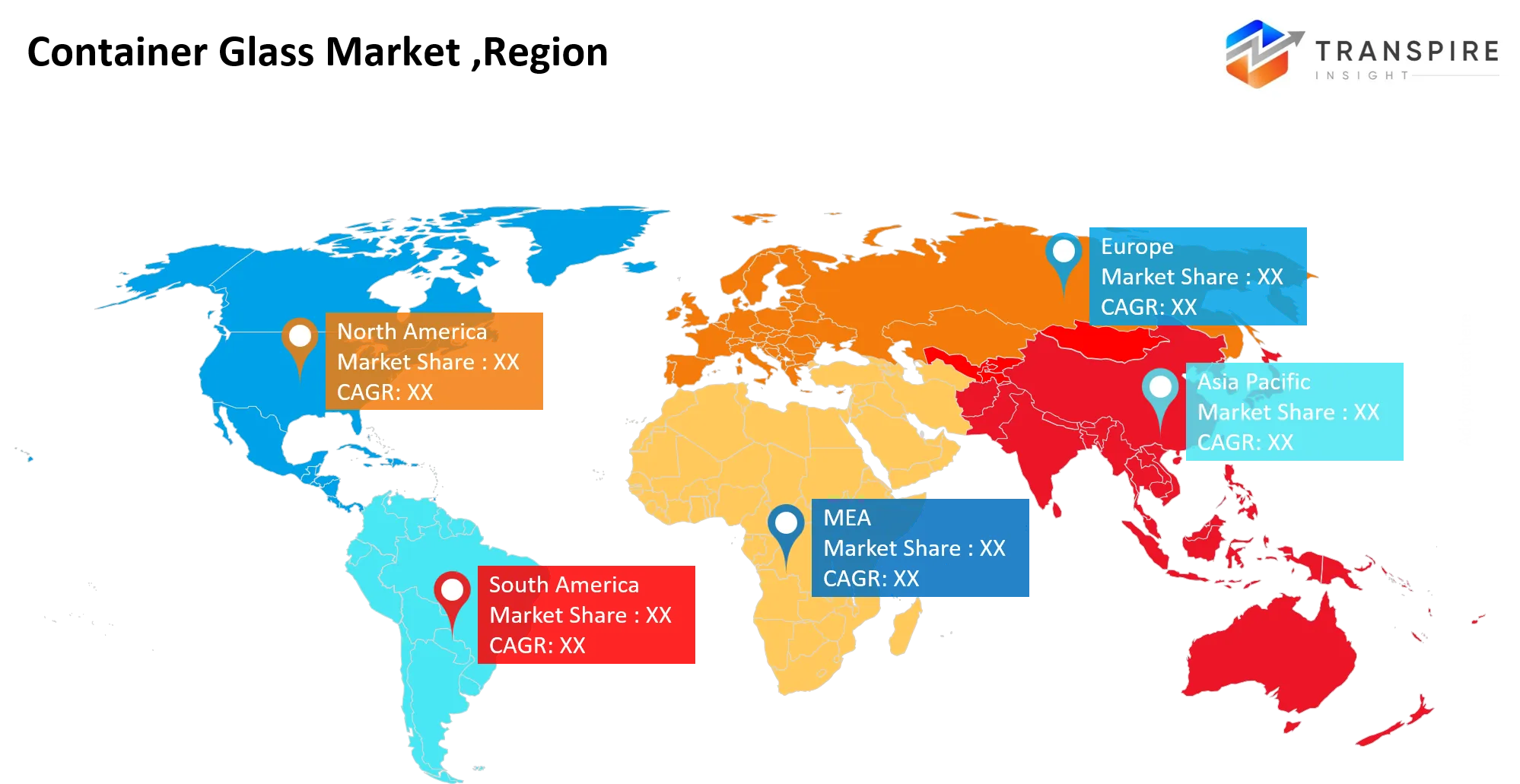
Asia Pacific continues to lead with a 33.5% market share and fastest-growing region with a CAGR of 6.4%. This signals the growth of lucrative beverage-producing clusters in China and India, the strengthening of pharmaceutical production, and an upward demand for premium packaging. Recent investments in state-of-the-art furnaces, local cullet distribution systems, and rapid forming capacity are successfully bridging the supply/demand gap in the region. However, the undercurrents for additional demand are already arising, as India's estimated CAGR of 6.0% and China's 5.3% CAGR are indicative of current demand depth.
In July 2026, Gerresheimer started operations at its newly constructed 40,000-square-meter facility in Zhenjiang Dagang, China, to manufacture tubular glass packaging.
Europe, with a 29.0% share, continues to be the market leader. Following its volume-based growth, Asia Pacific is also entering the race on a quality basis, with Europe racing ahead by means of regulation, reuse infrastructure, and decarbonized manufacturing. The EU Glass Recycling rate of 80.8% helps provide a reliable cullet flow. The PPWR comes into force in August 2026 and drives lightweight, refillable, and high recycled content products.
In February 2026, INTERPOOL (a multi-country packaging initiative) launched a collaborative, cross-border project combining 14 partners from France, Belgium, the Netherlands, and Germany.
North America accounts for 21.5% of the market, as consumers show keen interest in craft beverages, bottled premiumisation and pharmaceutical substitutes. With more disciplined growth than its counterparts in Asia Pacific, North America is expected to see a steady growth of 2.5% in the US and 2.9% in Canada, as bag-in-boxes and bottles benefit from further progress in deposit-return systems. The remaining potential markets for sustainability drivers are Latin America (8.5%) and the Middle East and Africa (7.5%), where there are local bottling facilities and packaged food consumption continues to grow.
In March 2026, Ball Corporation partnered with Grupo Mariza to launch Nutrinéctar, the first juice in a can in Brazil to feature the ASI Responsible Aluminium Sourcing label. The initiative ensures certified aluminium traceability across the entire packaging value chain, directly supporting localised sustainable bottling and beverage capacity expansion in Latin America.
Who are the Key Players in the Container Glass Market, and how do they compete?
Competitive pressures in the container glass market include furnace scale, proximity, production cost, energy intensity, customer relationships, and packaging (speciality and premium). Large manufacturers pursue the beverage and food customer with a focus on consistency, cost, and supply chain flexibility. In contrast, regional and niche manufacturers emphasise quality finishes and technical knowledge of formats and capacity.
Furnace investment and high transport costs provide a counterbalance to regional manufacturing, with large organizations focusing on broad market and capacity restructuring, sustainability, and capital deployment. O-I's "Fit to Win" program intends to increase capacity and profitability, while Ardagh Group's "Clearly Ardagh" provides a focus on optimising glass volume and capital investment. Verallia connects regional development to furnace electrification and packaging premiumization. Vidrala, Vetropack, BA Glass, and Şişecam prioritise proximity to production and customers, and efficiency in manufacturing. Gerresheimer and Stoelzle Glass Group foster their niche focus through speciality glass and pharmaceuticals, where quality standards differentiate formats. Nihon Yamamura Glass, Vitro, Amcor, Saverglass, Zignago Vetro, and Wiegand-Glas create competitive advantage through regional relationships, special formats, technical expertise, and product range; their growth ambitions strive to strike a balanced approach between customer-specific innovation, energy, and capital investment.
Key Players are:
- O-I Glass
- Verallia
- Ardagh Group
- Vidrala
- Vetropack
- Gerresheimer
- BA Glass
- Stoelzle Glass Group
- Şişecam
- Nihon Yamamura Glass
- Vitro
- Amcor
- Saverglass
- Zignago Vetro
- Wiegand-Glas
Container Glass Market — Enhanced Competitive Benchmarking
|
Company |
Est. Revenue Share Range |
Key Offerings |
Strategic Positioning |
Geographic Strength |
Technology Focus |
|
O-I Glass, Inc. |
Estimated 8–12% |
Beverage bottles, food jars, spirits bottles, pharmaceutical containers |
scale leadership through customer proximity and manufacturing optimisation |
North America, Europe, Latin America |
Lightweight glass, furnace efficiency, recycled cullet |
|
Ardagh Group – Glass Packaging |
Estimated 6–10% |
Beer bottles, wine bottles, spirits containers, food jars |
Large-scale beverage packaging supplier emphasising operational efficiency |
Europe, North America, Latin America |
Lightweighting, furnace modernisation, recycled glass |
|
Verallia |
Estimated 5–8% |
Wine bottles, beer bottles, spirits bottles, food jars |
European leadership supported by premium packaging and sustainability |
Europe, Latin America |
Low-carbon furnaces, lightweight bottles, digital manufacturing |
|
BA Glass |
Estimated 2–4% |
Wine bottles, beer bottles, food jars, soft-drink containers |
Regional-scale challenger combining customised packaging and customer collaboration |
Europe, North America |
Glass lightweighting, cullet recycling, energy efficiency |
|
Vidrala |
Estimated 2–4% |
Beverage bottles, wine bottles, beer bottles, food containers |
Efficient regional producer emphasising profitability and industrial optimisation |
Europe, Latin America |
Furnace efficiency, lightweight packaging, recycled glass |
|
Şişecam |
Estimated 2–4% |
Beverage bottles, food jars, beer bottles, spirits containers |
Integrated glass producer leveraging regional manufacturing and international expansion |
Europe, Middle East, Asia Pacific |
Furnace optimisation, energy efficiency, glass recycling |
|
Vetropack |
Estimated 1–3% |
Beverage bottles, wine bottles, food jars, lightweight containers |
Regional specialist focused on customer responsiveness and sustainable packaging |
Europe, selected Eastern European markets |
Lightweight glass, recycled cullet, furnace modernisation |
|
Gerresheimer |
Estimated 1–3% |
Pharmaceutical glass bottles, vials, ampoules, speciality containers |
Premium pharmaceutical packaging specialist emphasising quality and compliance |
Europe, North America, Asia Pacific |
High-purity glass, precision forming, inspection systems |
|
Nihon Yamamura Glass |
Estimated 1–2% |
Beverage bottles, beer bottles, food jars, spirits containers |
Japan-focused packaging specialist with established beverage relationships |
Asia Pacific, Japan |
Lightweight containers, glass forming, production automation |
|
Nampak |
Estimated 1–2% |
Beverage bottles, beer bottles, food jars, returnable containers |
Southern African packaging incumbent supported by regional manufacturing scale |
Africa, Southern Africa |
Furnace efficiency, lightweighting, recycled glass |
Recent Development News
In October 2026, Hindusthan National Glass & Industries Ltd. announced plans to invest ₹300–500 crore in manufacturing capacity expansion and operational improvements. The investment is expected to support production recovery, strengthen manufacturing capabilities, and improve the company’s profitability outlook amid rising operational requirements.
In June 2026, Ardagh Glass Packaging-North America launched a new American-made 700ml liquor bottle as part of its expanded stock spirits portfolio. The product launch broadens its standardized glass packaging options for spirits producers, supporting customer requirements for differentiated packaging and greater product availability.
In June 2026, Şişecam and BG Container Glass (BGC) signed a strategic memorandum of understanding to collaborate on glass manufacturing innovation and sustainability. The partnership focuses on production optimisation, research and development, glass product development, and operational efficiency, supporting improvements in manufacturing performance and sustainable packaging capabilities.
What Strategic Insights Define the Future of the Container Glass Market?
The market for container glass is moving towards carbon-linked sourcing where buyers will evaluate suppliers not only on cost but on verified Scope 3 reductions, cullet traceability and lightweight performance. The riskiest e miscue for a company with which the increasing need for recycled content is emerging would be a cullet shortage. Increasing demand for recycled content increases demand for clean colour-sorted flint and amber cullet, which could become more price-competitive and enable fewer suppliers to produce more cullet, putting upward pressure on input prices and supply for non-cullet companies. And the opportunity is in higher recycled-content, premium low-carbon glass products like refillable bottles, premium lightweight wine and spirits bottles, and pharma vials that can integrate higher recycled glass content to support compliance and commercial differentiation and margins. Strategically, companies should sign long-term cullet supply contracts, accelerate their shift to hybrid or electric furnaces, and collaborate with recycling programs early to ensure alignment with new sustainability demands and avoid disruption, reduce risks from carbon volatility, and remain competitive.
Key Segmentations are:
Product Type
- Bottles
- Jars
- Vials
- Ampoules
- Containers
- Carboys
- Speciality Glass
- Others
Glass Type
- Soda-Lime Glass
- Borosilicate Glass
- Flint Glass
- Amber Glass
- Green Glass
- Clear Glass
- Colored Glass
- Others
End Use
- Food & Beverage
- Pharmaceuticals
- Cosmetics
- Chemicals
- Household Products
- Alcoholic Beverages
- Personal Care
- Others
Application
- Beverage Packaging
- Food Packaging
- Pharmaceutical Packaging
- Cosmetic Packaging
- Chemical Packaging
- Household Packaging
- Speciality Packaging
- Others
Color
- Clear
- Amber
- Green
- Blue
- Brown
- Black
- Opaque
- Others
Distribution
- Direct Sales
- Distributors
- Wholesalers
- Packaging Suppliers
- Contract Manufacturers
- Online Procurement
- Retail
- Others
Frequently Asked Questions
Find quick answers to common questions.
The container glass market size was valued at USD 70.03 billion in 2025 and is poised to reach USD 109.90 billion by 2033, expanding at a 5.98% CAGR.
Key segments for the container glass market are Product Type (Bottles, Jars, Vials, Ampoules, Containers, Carboys, Specialty Glass, Others)Glass Type (Soda-Lime Glass, Borosilicate Glass, Flint Glass, Amber Glass, Green Glass, Clear Glass, Colored Glass, Others)End Use (Food & Beverage, Pharmaceuticals, Cosmetics, Chemicals, Household Products, Alcoholic Beverages, Personal Care, Others)Application (Beverage Packaging, Food Packaging, Pharmaceutical Packaging, Cosmetic Packaging, Chemical Packaging, Household Packaging, Specialty Packaging, Others)Color (Clear, Amber, Green, Blue, Brown, Black, Opaque, Others)Distribution (Direct Sales, Distributors, Wholesalers, Packaging Suppliers, Contract Manufacturers, Online Procurement, Retail, Others).
Growth is primarily driven by rising demand for sustainable packaging, increasing beverage and food consumption, pharmaceutical packaging requirements, premiumization in cosmetics and spirits, and growing preference for recyclable and reusable glass containers.
The container glass market is led by major manufacturers including O-I Glass, Verallia, Ardagh Group, Vidrala, Vetropack, Gerresheimer, BA Glass, Stoelzle Glass Group, Şişecam, Nihon Yamamura Glass, Vitro, Amcor, Saverglass, Zignago Vetro, Wiegand-Glas.
Asia-Pacific accounts for approximately 33.5% of the container glass market, supported by expanding food and beverage industries, urbanisation, rising pharmaceutical demand, manufacturing capacity, and growing consumption of packaged products.
Opportunities include premium low-carbon glass packaging, lightweight and refillable containers, high-cullet-content production, pharmaceutical glass expansion, and sustainable packaging solutions aligned with evolving environmental regulations.
- O-I Glass
- Verallia
- Ardagh Group
- Vidrala
- Vetropack
- Gerresheimer
- BA Glass
- Stoelzle Glass Group
- Şişecam
- Nihon Yamamura Glass
- Vitro
- Amcor
- Saverglass
- Zignago Vetro
- Wiegand-Glas
About the Authors

Kartik bhong
I am Kartik Bhong, a Senior Research Analyst at Transpire Insight, specializing in the Packaging, Manufacturing, and Construction industry. My work focuses on analyzing market trends, emerging technologies, industry regulations, and competitive landscapes to deliver accurate, data-driven insights. I am passionate about transforming complex industry information into clear, practical content that helps businesses, professionals, and decision-makers stay informed and make confident strategic decisions. Through continuous research and a strong commitment to accuracy, I strive to create reliable, well-researched content that reflects the latest developments across these dynamic industries and supports the vision of Transpire Insight in delivering valuable market intelligence.

Chakradhar Khansole
Chakradhar serves as the Research Director at Transpire Insight, bringing over 8 years of experience in technology, innovation, and strategic market intelligence. He specializes in transforming complex market data into actionable business insights that enable organizations to make informed, growth-oriented decisions. Recognized for his strategic vision and analytical expertise, Chakradhar leads high-impact research initiatives, delivering comprehensive market assessments, competitive intelligence, and forward-looking industry analysis.
Recently Published Reports
-
Apr 2026
Pharmaceutical Cold Chain Packaging Market
Pharmaceutical Cold Chain Packaging Market By Material (Plastic,(Polyethylene (PE), Polypropylene (PP), Polyethylene Terephthalate (PET), Expanded Polystyrene (EPS), Polyurethane (PU),Others), Paper, Metal, Others), By Product (Small Boxes, Pallets, Large Sized Pallet Containers, Others), By End Use (Biopharmaceutical Companies, Clinical Research Organizations, Hospitals, Research Institutes, Logistics and Distribution Companies, Others)”, By Industry Analysis, Size, Share, Growth, Trends, and Forecasts 2026-2033
-
Apr 2026
Active & Intelligent Packaging Market
Active & Intelligent Packaging Market By Type (Active Packaging, Smart Packaging), By Material (Polymer-Based, Paper & Board-Based, Metal-Based, Glass-Based), By Technology (Time-Temperature Indicators, Freshness Indicators, RFID, Antimicrobial Packaging, Modified Atmosphere Packaging), By Application (Food & Beverages, Pharmaceutical, Cosmetics & Personal Care, Electronics & Consumer Goods, Others), By Industry Analysis, Size, Share, Growth, Trends, and Forecasts 2026-2033
-
Apr 2026
Biodegradable Cut Flower Packaging Market
Biodegradable Cut Flower Packaging Market By Material Type (Paper & Paperboard, Biodegradable Plastics, Natural Fibers, Molded Pulp, Others), By Product Type (Sleeves, Wraps, Boxes & Cartons, Bags & Pouches, Inserts & Holders), By Application (Roses, Carnations, Tulips, Chrysanthemums, Mixed Flowers, Others) and By Distribution Channel (Direct Sales, Distributors & Wholesalers, Online Channels), By Industry Analysis, Size, Share, Growth, Trends, and Forecasts 2026-2033
-
May 2026
Pharmaceutical Packaging Market
Pharmaceutical Packaging Market By Material Type (Plastic, Glass, Metal, Paper & Paperboard, Others), By Packaging Type (Bottles, Blister Packs, Vials, Ampoules, Pouches & Sachets, Others) and By End User (Hospitals & Clinics, Retail Pharmacies, Online Pharmacies, Pharmaceutical Manufacturers), By Industry Analysis, Size, Share, Growth, Trends, and Forecasts 2026-2033