
Commercial Aircraft Windows And Windshields Market Summary:
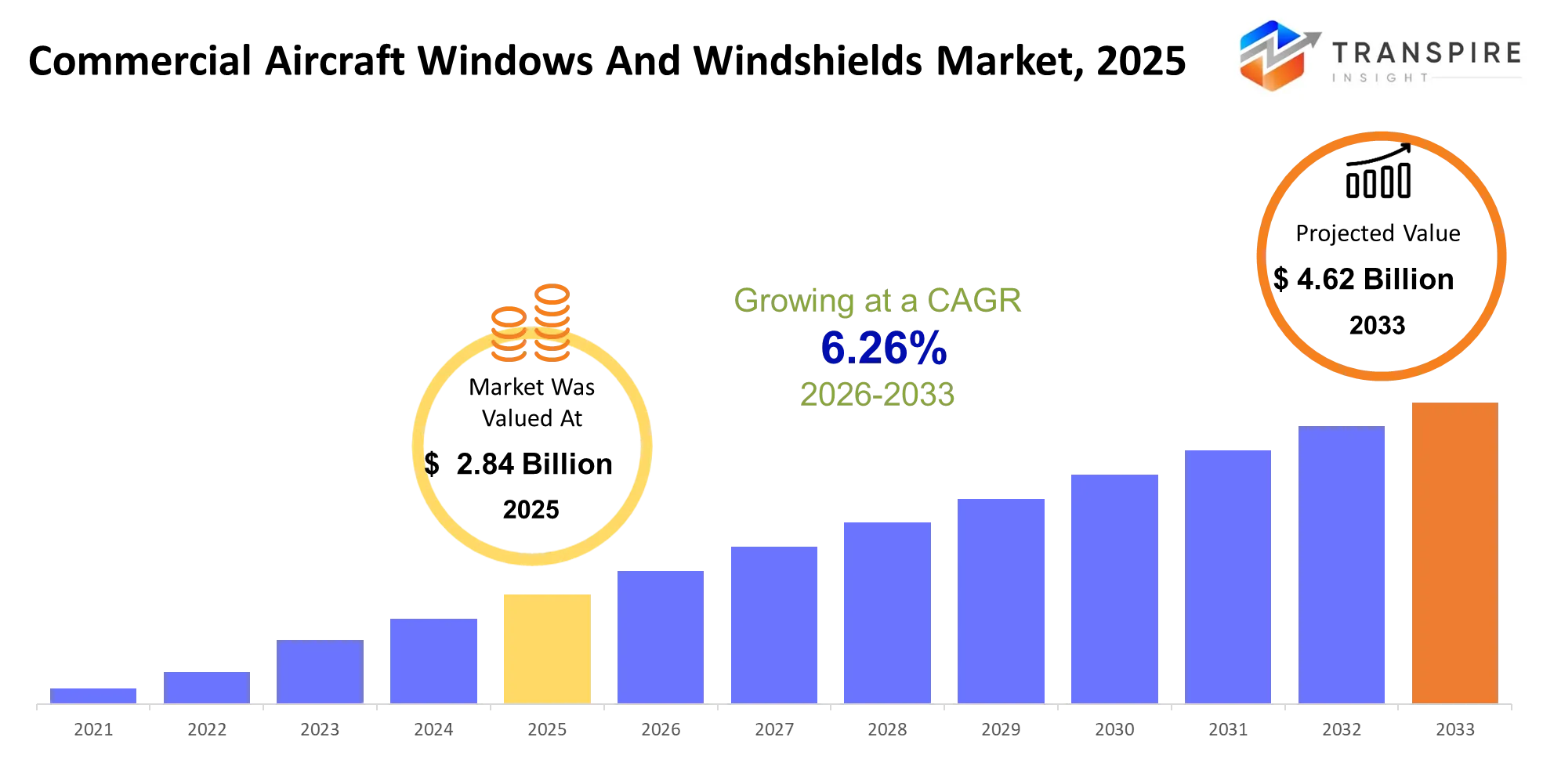
As per Transpire Insight, the Commercial Aircraft Windows And Windshields Market size is estimated at USD 2.84 billion in 2025 and is anticipated to reach USD 4.62 billion by 2033, growing at a CAGR of 6.26%from 2026 to 2033.
The commercial aircraft windows and windshields market provides flight-deck windshields, cabin windows, and other transparent parts that protect people on board, keep visibility clear and meet safety standards. In the past three to five years, there has been a shift towards lightweight laminate, improved coatings and electronically dimmable glass. Aircraft manufacturers and airlines have become concerned with passenger comfort as well as the efficiency of flights. A major development in the industry is the trend from fixed windows to sophisticated windows that have the capacity to regulate heat and light, such as electrochromic windows. The latest development by Airbus in its A330neo. The market is increasing due to more production of planes and upgrading of fleets, leading to the need for OEMs. In addition, old aircraft require spare parts and maintenance, adding to the demand. On the other hand, improvements in transparent materials enable manufacturers to solve the problem of impact resistance, visibility, lightweight and durability.
Commercial Aircraft Windows And Windshields Market Size & Forecast:
- Market Size 2025: USD 2.84 Billion
- Expected Market Value (2033): USD 4.62 Billion
- Forecast CAGR (2026–2033): 6.26%
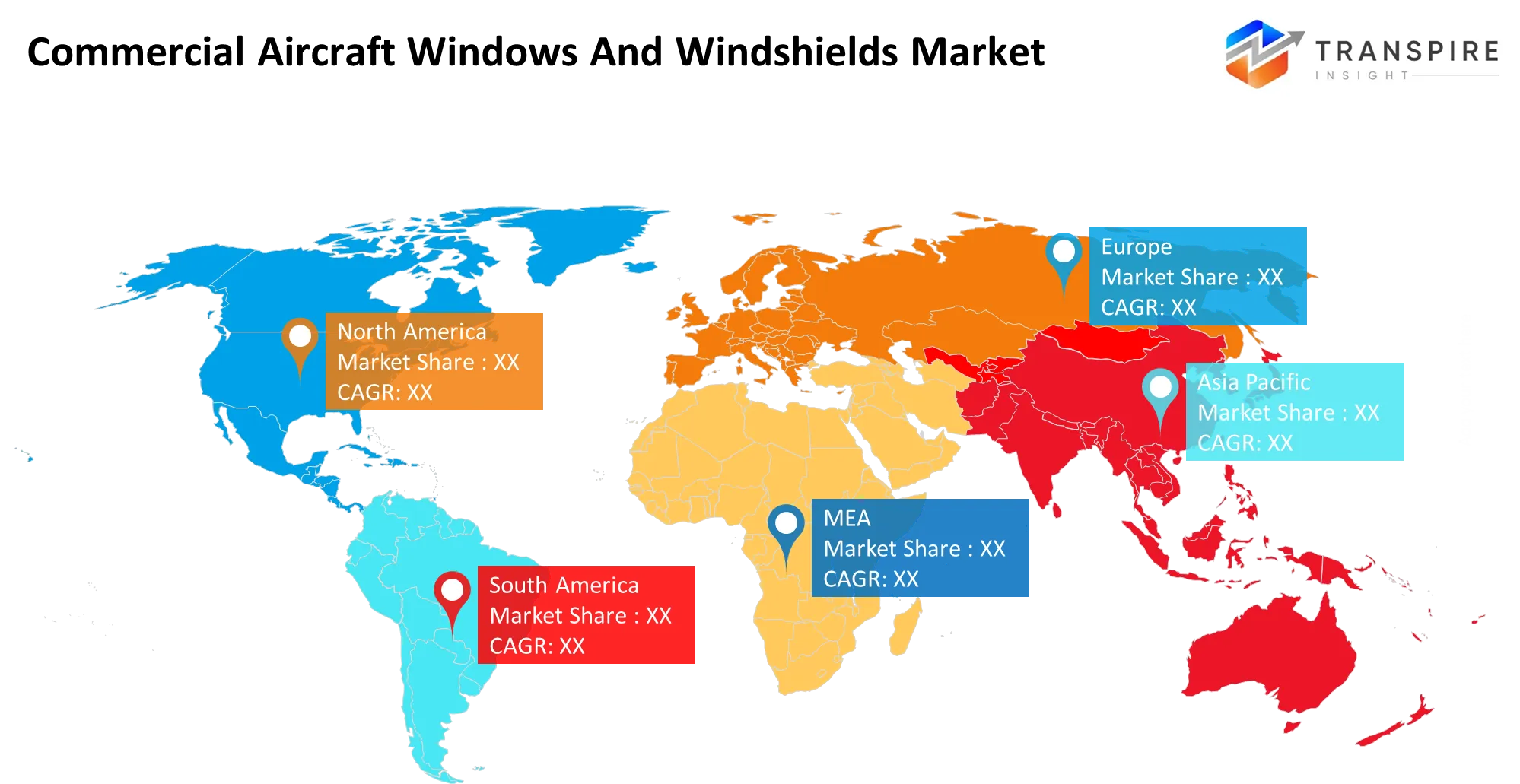
- Leading Region in 2025: North America
- Fastest Growing Region: Asia Pacific
- Key Company Profiles: PPG Industries, Gentex, GKN Aerospace, Saint-Gobain Sully, Lee Aerospace, The NORDAM Group, Control Logistics, Aerospace Transparencies, Aeropair, Plexiglas, Spartech, Texstars, Glasfloss, Raytheon Technologies, Safran
Key Market Insights:
The market for commercial aircraft windows and windshields is moving towards lightweight and passenger-friendly glass products, and narrow-body aircraft are the base demand drivers.
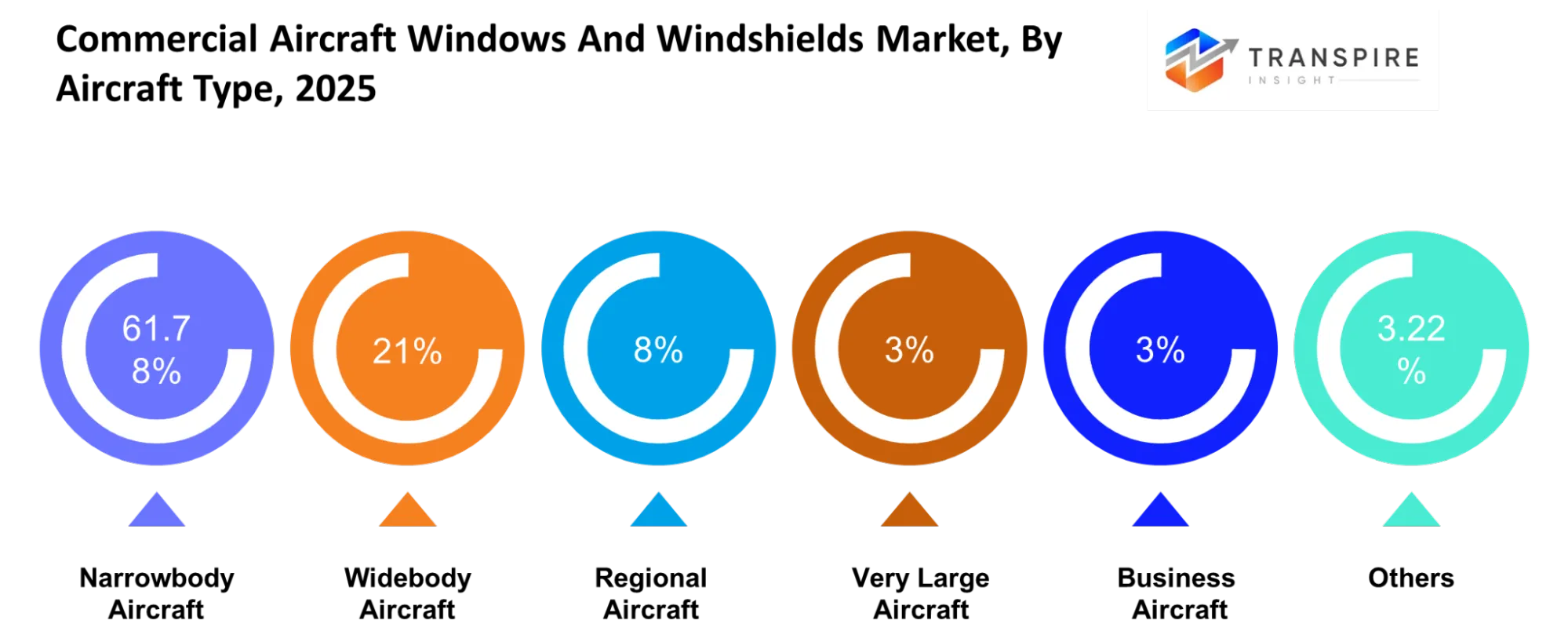
- Narrowbody aircraft constitute 61.78% of the market, making single-aisle programs an important part of supplier planning; GKN Aerospace continues supplying passenger windows for the major commercial platforms.
- Widebody aircraft account for 21%, providing opportunities in the advanced cabin glazing segment; Gentex continues developing the electronically dimmable windows for the Airbus and Boeing aircraft.
- Regional aircraft comprise 8%, providing consistent demand for replacements and maintenance; PPG supplies flight deck and cabin transparency solutions for the ATR and other regional platforms.
- Very large aircraft comprise 3%, being a relatively small segment but with higher technical requirements, where high-performance windshields and cabin systems are required; suppliers compete through certification capabilities and engineering expertise.
- Business aircraft comprise 3%, with passenger comfort and optical quality affecting product choices; Saint-Gobain continues supporting business aircraft cockpit and cabin windows with its glass and acrylic solutions.
What are the Key Drivers, Restraints, and Opportunities in the Commercial Aircraft Windows And Windshields Market?
Drivers
There has been an increase in the production of commercial aircraft, along with upgrades in the fleet and the use of glazing technology advancements. New aircraft manufacturing needs the installation of windows and windshields, which creates demand for replacements in the fleet. The introduction of new technologies such as electrochromic and laminated glass increases the value of installations per piece.
Restraints
Certification, qualification tests, and special manufacturing maintain a high barrier to entry. The aerospace transparencies need to be able to resist pressure, heat, erosion, bird strikes and repetitive servicing cycles, so manufacturers cannot launch products as fast as in other, less regulated sectors. These constraints will also make the integration with the current aircraft difficult and expensive.
Opportunities
The opportunities are in lightweight and intelligent glass, as well as in retrofit and aftermarket. Manufacturers who combine features like electrochromic management, durability, ice-resistance and easy replacement can target both current and future aircraft programs. The Asia-Pacific market is also interesting for entry because of growing numbers of aircraft manufacturing, airlines' fleets, and maintenance work there.
What Has the Impact of Artificial Intelligence Been on the Commercial Aircraft Windows And Windshields Market?
Artificial intelligence is revolutionising the aircraft windows and windshields market via inspection, maintenance and manufacturing support, but not as a substitute for transparency. In manufacturing, the application of AI-based computer vision solutions can be helpful in identifying various defects on surfaces, such as scratches, bubbles, coating defects, dimensional changes, among others. AI will help technicians to identify any issues early and minimise inspection time. AI can also be helpful in the optimisation of the production process through the use of the information from the machines and the quality of results to find the conditions that cause defects or rework. In the service segment, predictive analytics can be used by the operators and the maintenance team in identifying the patterns that could relate to deterioration, sealing problems, heating system failure or replacement. The company PPG has intelligent window systems that can be used to determine the condition of the heating system in the aircraft. There are various challenges when it comes to implementing AI in the aerospace industry, such as validation against stringent standards, high costs, lack of training data and the need for human intervention.
Instance
In August 2026, Odysight.ai and Boeing collaborated to show how artificial intelligence-driven computer vision could be used in predicting maintenance needs for planes, which would help identify component problems earlier and enhance inspection effectiveness. It could help in early detection of aircraft window and windshield damage.
Key Market Trends:
There is a trend in the market moving away from simple transparent materials and towards lightweight, durable and electronically controlled glazing. Value provided by suppliers has changed from simple production to materials development, intelligent functions, lifecycle and aircraft integration.
- Window design in the cabin of aircraft is becoming more aligned with passenger experience design, where viewing space and optical performance are becoming more and more relevant during the development process of an aircraft.
- Electrochromics have gone from being a luxury product to becoming more mature as a cabin product, especially after Airbus and Boeing started adopting electronically dimming systems.
- Coatings are becoming more relevant as the suppliers focus on improving the scratch resistance, water shedding, ultraviolet protection and optical performance of their windows.
- Windows are becoming more multifunctional as they not only serve the function of structural protection but also have ice, fog, hydrophobic and heating functions.
- The aftermarket is becoming strategically more significant for replacement windows, windshield repairs, and refurbishments.
- Digital design, testing and inspection are becoming more relevant as optical distortion becomes less important.
Commercial Aircraft Windows And Windshields Market Segmentation
By Aircraft Type
The narrowbody aircraft have the highest market position, accounting for 61.78% of the overall market position, followed by widebody aircraft accounting for 21% of the market position, regional aircraft accounting for 8% of the market position, very large aircraft accounting for 3% of the market position, business aircraft accounting for 3% of the market position, and others accounting for 3.22% of the market position. The dominance of narrowbody aircraft is due to the huge number of single-aisle commercial aircraft.
By Application
The cabin windows and passenger windows have been identified as the most repetitive applications of transparent materials since all passenger planes require many transparent panels. The cockpit windshields have high technical specifications in view of having to facilitate visibility under conditions of pressure, temperature, impact and environmental exposure. Emergency exits, door windows and observation windows cater for other applications. The future growth in terms of applications is going to be in favour of materials that will combine safety, ease of replacement, optical properties and passenger comfort.
By Materials
Glass laminates, acrylics and polycarbonates are all significant in view of their different technical specifications. The composite materials and smart glasses provide new possibilities in terms of weight savings and electronic control of lighting. The future trend is thus going to be towards material combinations rather than using only one substrate. The future competition will thus become based on the supplier’s qualification of the light structures.
By Technology
The conventional laminated glazing will still be required in all the existing fleets, but heated and anti-ice glazing will continue to play their role in making visibility easy during tough weather conditions. Electrochromic technology, which has a compound annual growth rate of 7.72%, is the fastest-growing segment in this industry, signifying increased interest in electronically controlled cabin environments. Other features such as dimmable, UV-protective, impact-resistant and smart windows serve other purposes besides mere visibility.
By End Market
The demand by original equipment manufacturers will be directly related to the number of new aircraft being manufactured, while the aftermarket, maintenance, repair & operation, and retrofits will generate steady income from the current installed base of aircraft. OEM business will provide longer qualification cycles and sustainable supply relationships. on the other hand, the aftermarket will have an opportunity to benefit through availability, repair capacity, and fleet coverage. The future market will have to be equally balanced between the two.
What are the Key Use Cases Driving the Commercial Aircraft Windows And Windshields Market?
Use case is high-volume glazing in narrow-body commercial aircraft, which of the market. Cabin windows and passenger windows serve the purpose of visibility, natural light and environmental segregation in accordance with the safety and durability norms of an aircraft. The installed base leads to ongoing demand from the OEMs and aftermarket. Further applications could be cockpit windshields, emergency exit windows and door windows wherein the supplier needs to strike a balance between optical quality, pressure handling, impact resistance, deicing capabilities and lifespan. MRO service providers would require solutions in this space. Future use cases are smart and electronically controlled glazing. Electrochromic smart windows would enable control of light transmission and thereby provide greater passenger comfort.
|
Report Metrics |
Details |
|
Market size value in 2025 |
USD 2.84 Billion |
|
Market size value in 2026 |
USD 3.02 Billion |
|
Revenue forecast in 2033 |
USD 4.62 Billion |
|
Growth rate |
CAGR of 6.26%from 2026 to 2033 |
|
Base year |
2025 |
|
Historical data |
2021 - 2024 |
|
Forecast period |
2026 - 2033 |
|
Report coverage |
Revenue forecast, competitive landscape, growth factors, and trends |
|
Regional scope |
United States; Canada; Mexico; United Kingdom; Germany; France; Italy; Spain; Denmark; Sweden; Norway; China; Japan; India; Australia; South Korea; Thailand; Brazil; Argentina; South Africa; Saudi Arabia; United Arab Emirates |
|
Key company profiled |
PPG Industries, Gentex, GKN Aerospace, Saint-Gobain Sully, Lee Aerospace, The NORDAM Group, Control Logistics, Aerospace Transparencies, Aeropair, Plexiglas, Spartech, Texstars, Glasfloss, Raytheon Technologies, Safran |
|
Customization scope |
Free report customization (country, regional & segment scope). Avail customized purchase options to meet your exact research needs. |
|
Report Segmentation |
By Aircraft Type (Narrowbody Aircraft, Widebody Aircraft, Regional Aircraft, Very Large Aircraft, Business Aircraft, Others); By Application (Cabin Windows, Cockpit Windshields, Emergency Exit Windows, Passenger Windows, Door Windows, Observation Windows, Others); By Material (Glass Laminates, Acrylic, Polycarbonate, Composite Materials, Smart Glass, Others); By Technology (Conventional Laminates, Heated/Anti-ice, Electrochromic, Dimmable, UV-resistant, Impact-resistant, Smart Windows, Others); By End Market (OEM, Aftermarket, MRO, Retrofit, Replacement, Others) |
Which Regions are Driving the Commercial Aircraft Windows And Windshields MarketGrowth?
North America
North America dominates the market with a 34.25% market share due to the presence of a well-developed aircraft manufacturing industry and a significant number of aeroplanes in the region. The market presence of North America is driven by the existing aircraft original equipment manufacturers (OEMs), transparency suppliers, certification expertise and MRO facilities in place. The high aftermarket dynamics drive repeat purchases of windshields, windows and repair services for cabins.
In June 2026, PPG made an announcement regarding the innovation and growth in capacity within the Aerospace business as well as its traditional strengths in the field of aircraft transparencies in commercial aviation. This is in recognition of North America's importance as a key centre of innovation and manufacturing in the field of aircraft transparency technology.
Europe
Europe accounts for 30% of the market. It is driven by existing aircraft manufacturing programs and strong engineering capabilities. In addition, the European manufacturers focus on weight reduction in the aircraft interiors and electronic control features in passenger compartments.
In September 2025, Satair and Saint-Gobain Sully extended their distribution agreement concerning their supply of aircraft cabin and cockpit windows. Satair maintained its status as the distributor of Saint-Gobain Sully's cabin windows fitted on Airbus and ATR aircraft, enhancing Europe's network for the aircraft transparency aftermarket sector. https://aeromorning.com/en/satair-renews-exclusive-agreement-with-saint-gobain-sully
Asia Pacific
Asia Pacific holds 25% of the market share and is the fastest-growing market region, which is estimated to grow at a CAGR of 7.75%. The growth of airline fleet size, passenger traffic, and aerospace manufacturing activities in the region has made it an important region for the industry. It offers opportunities to MRO companies, parts replacement companies, and manufacturers looking to set up manufacturing facilities or service centres in the region.
In May 2026, a strategic partnership was made between Cabinair Group and Summit Lenso to modify the aircraft and offer cabin solutions in the Asia-Pacific region, focusing on Thailand. https://aviationweek.com/mro/mro-industry-rolling-daily-updates-may-2026
Who are the Key Players in the Commercial Aircraft Windows And Windshields Marketand how do they compete?
The competition in the aircraft windows and windshields market is driven by certification know-how, material science, production capacity, and long-term relationships with aircraft makers. PPG Industries, GKN Aerospace, Saint-Gobain, and Gentex operate in competition with specialised manufacturers Nordam and Lee Aerospace. In the current market environment, the competitive emphasis shifts from transparent material supply to lightweight design, intelligent glazing, coating technologies, repair, and lifecycle management.PPG stands out with its wide product range of commercial, regional and general aviation transparencies, including glass, acrylic and polycarbonate technologies, coatings, heating systems and replacement solutions. PPG’s expansion strategy involves supplying components to OEMs and servicing aircraft aftermarket through the provision of comprehensive transparency-related solutions to the major airframe platforms.
Commercial Aircraft Windows And Windshields Marketcompanies
- PPG Industries
- Gentex
- GKN Aerospace
- Saint-Gobain Sully
- Lee Aerospace
- The NORDAM Group
- Control Logistics
- Aerospace Transparencies
- Aeropair
- Plexiglas
- Spartech
- Texstars
- Glasfloss
- Raytheon Technologies
- Safran
Recent Development News
- In April 2026, Gentex further refined its electronic window technology for Airbus and Boeing projects. The new electrochromic windows by Gentex are characterised by increased speed of transition and deeper darkness, which help to align with the industry trend towards intelligent electronically controlled window glass technology. https://www.gentex.com/files/Gentex_Corporate_Overview_2026.pdf
- In June 2025, Isoclima Group joined forces with Miru Smart Technologies as part of a strategic partnership to promote electrochromic smart windows across the aerospace sector and other specialist markets. This partnership brings together Miru’s innovative electrochromic glass technology with the glazing expertise of Isoclima. https://mirucorp.com/news/isoclima-and-miru-announce-strategic-partnership-to-accelerate-next-gen-smart-glazing-adoption/
What Strategic Insights Define the Future of the Commercial Aircraft Windows And Windshields Market?
The future trends for the commercial aircraft windows and windshields market will include lighter products, enhanced glazing and support through its life cycle. New generation aircraft programs will lead to OEM demand; however, aftermarket replacement, MROs and retrofits could be a continuous revenue source due to the ageing of the aircraft. Electrochromic windows could attract more attention as they would offer both passenger comfort and electronically managed lighting and heat. Advanced coatings and composite laminates might add to their strength and durability, without being heavy in terms of weight. A potential pitfall in this situation could be the fact that lengthy certification processes may hinder commercial use of innovative materials or designs, and suppliers will have to incur high development costs before revenue starts coming in. The new opportunity for suppliers will be the retrofitting of electronic control of glazing and enhanced transparency into existing aircraft.
By Aircraft Type
- Narrowbody Aircraft
- Widebody Aircraft
- Regional Aircraft
- Very Large Aircraft
- Business Aircraft
By Application
- Cabin Windows
- Cockpit Windshields
- Emergency Exit Windows
- Passenger Windows
- Door Windows
- Observation Windows
By Material
- Glass Laminates
- Acrylic
- Polycarbonate
- Composite Materials
- Smart Glass
By Technology
- Conventional Laminates
- Heated/Anti-ice
- Electrochromic
- Dimmable
- UV-resistant
- Impact-resistant
- Smart Windows
By End Market
- OEM
- Aftermarket
- MRO
- Retrofit
- Replacement
By Regional Analysis
North America
- US
- Canada
- Mexico
Europe
- Germany
- UK
- France
- Italy
- Spain
- Russia
- Rest of Europe
Asia Pacific
- China
- Japan
- India
- South Korea
- Australia
- Rest of Asia Pacific
South America
- Brazil
- Argentina
- Rest of South America
Middle East & Africa
- UAE
- Saudi Arabia
- Qatar
- South Africa
- Rest of the Middle East & Africa
Frequently Asked Questions
Find quick answers to common questions.
The commercial aircraft windows and windshields market size was valued at USD 2.84 billion in 2025 and is poised to reach USD 4.62 billion by 2033, expanding at a 6.26% CAGR
Key segments for the commercial aircraft windows and windshields market are By Aircraft Type (Narrowbody Aircraft, Widebody Aircraft, Regional Aircraft, Very Large Aircraft, Business Aircraft, Others); By Application (Cabin Windows, Cockpit Windshields, Emergency Exit Windows, Passenger Windows, Door Windows, Observation Windows, Others); By Material (Glass Laminates, Acrylic, Polycarbonate, Composite Materials, Smart Glass, Others); By Technology (Conventional Laminates, Heated/Anti-ice, Electrochromic, Dimmable, UV-resistant, Impact-resistant, Smart Windows, Others); By End Market (OEM, Aftermarket, MRO, Retrofit, Replacement, Others)
Growth is primarily driven by an increase in manufacturing and delivery of commercial aeroplanes, growth in passenger traffic, an increase in demand for upgrading and replacing aircraft, and the use of new, lightweight, and sophisticated windows and windscreens.
The market is led by major manufacturers including PPG Industries, Gentex, GKN Aerospace, Saint-Gobain Sully, Lee Aerospace, The NORDAM Group, Control Logistics, Aerospace Transparencies, Aeropair, Plexiglas, Spartech, Texstars, Glasfloss, Raytheon Technologies, Safran
North America accounts for 34.25% of the worldwide commercial aircraft windows and windshields industry due to the region's strong presence of aerospace manufacturing industries and aircraft manufacturers and suppliers, as well as the high requirement for aircraft refurbishments and continuous development of advanced window products
Opportunities in the commercial aircraft windows & windscreens market include designing lightweight and impact resistant glazing, incorporation of smart & electro chromatic windows, aircraft retro fitment and replacement services, and provision of state-of-the-art window systems in future fuel efficient aircraft.
- PPG Industries
- Gentex
- GKN Aerospace
- Saint-Gobain Sully
- Lee Aerospace
- The NORDAM Group
- Control Logistics
- Aerospace Transparencies
- Aeropair
- Plexiglas
- Spartech
- Texstars
- Glasfloss
- Raytheon Technologies
- Safran
About the Authors

Tejashri Dhatrak
I am Tejashri Dhatrak, a Senior Research Analyst at Transpire Insight, specializing in the Aerospace and Defence sector. My work focuses on analyzing industry trends, defence technologies, market developments, and emerging innovations that shape the global aerospace and security landscape. At Transpire Insight, I research complex topics, evaluate credible sources, and transform technical insights into accurate, well-structured, and easy-to-understand content for industry professionals and decision-makers. My goal is to provide reliable, research-backed information that helps readers stay informed about defence capabilities, aerospace advancements, strategic developments, and the evolving dynamics of the global defence ecosystem.

Chakradhar Khansole
Chakradhar serves as the Research Director at Transpire Insight, bringing over 8 years of experience in technology, innovation, and strategic market intelligence. He specializes in transforming complex market data into actionable business insights that enable organizations to make informed, growth-oriented decisions. Recognized for his strategic vision and analytical expertise, Chakradhar leads high-impact research initiatives, delivering comprehensive market assessments, competitive intelligence, and forward-looking industry analysis.
Recently Published Reports
-
Apr 2026
Aerospace Fluoropolymers Market
Aerospace Fluoropolymers Market Size, Share & Analysis Report By Type (PTFE, FEP, PFA, ETFE, and Others), By Application (Electrical Insulation, Seals & Gaskets, Coatings, and Others), By End User (Commercial Aviation, Military Aviation, General Aviation, and Others), and Geography (North America, Europe, Asia-Pacific, Middle East and Africa, South and Central America), 2021 - 2031
-
Apr 2026
Airborne SATCOM System Market
Airborne SATCOM System Market Size, Share & Analysis Report By Type (SATCOM Terminals, Transceivers, Airborne Radio, Modems and Routers, SATCOM Radomes, and Other), By Application (Government and Defense and Commercial), and Geography (North America, Europe, Asia-Pacific, Middle East and Africa, South and Central America), 2021 – 2031
-
Apr 2026
Ship Leasing Market
Ship Leasing Market Size, Share & Analysis Report By Vessel Type (Container Ships, Bulk Carriers, Tankers, and Specialized Vessels), By Lease Duration (Short-Term Lease (Less than 1 year), Medium-Term Lease (1-5 years), and Long-Term Lease (More than 5 years)), By Lease Type (Bareboat Charter, Time Charter, Financial Lease, and Others), By End-User Industry (Oil and Gas, Manufacturing and Industrial, Automotive, Agriculture and Food, Retail and Consumer Goods, and Others), and Geography (North America, Europe, Asia-Pacific, Middle East and Africa, South and Central America), 2021 – 2031
-
Apr 2026
Thread Rolling Dies Market
Thread Rolling Dies Market Size, Share & Analysis Report By Type (Flat Thread Rolling Dies, Circular (Cylindrical) Dies, Tangential Thread Rolling Dies, Planetary Thread Rolling Dies, and Other Types), By Material Type (High-Speed Steel (HSS), Carbide, Tool Steel, Alloy Steel, and Other Specialized Alloys), By Distribution Channel (Direct Sales, Distributors and Dealers, and Online Platforms), By Application (Automotive Industry, Aerospace and Defense, Construction and Infrastructure, Industrial Machinery, Electronics and Electrical Components, Medical Devices, and Fastener Production), and Geography (North America, Europe, Asia-Pacific, Middle East and Africa, South and Central America), 2021 – 2031
Our Clients