
Europe Polycarbonate Market Size & Forecast:
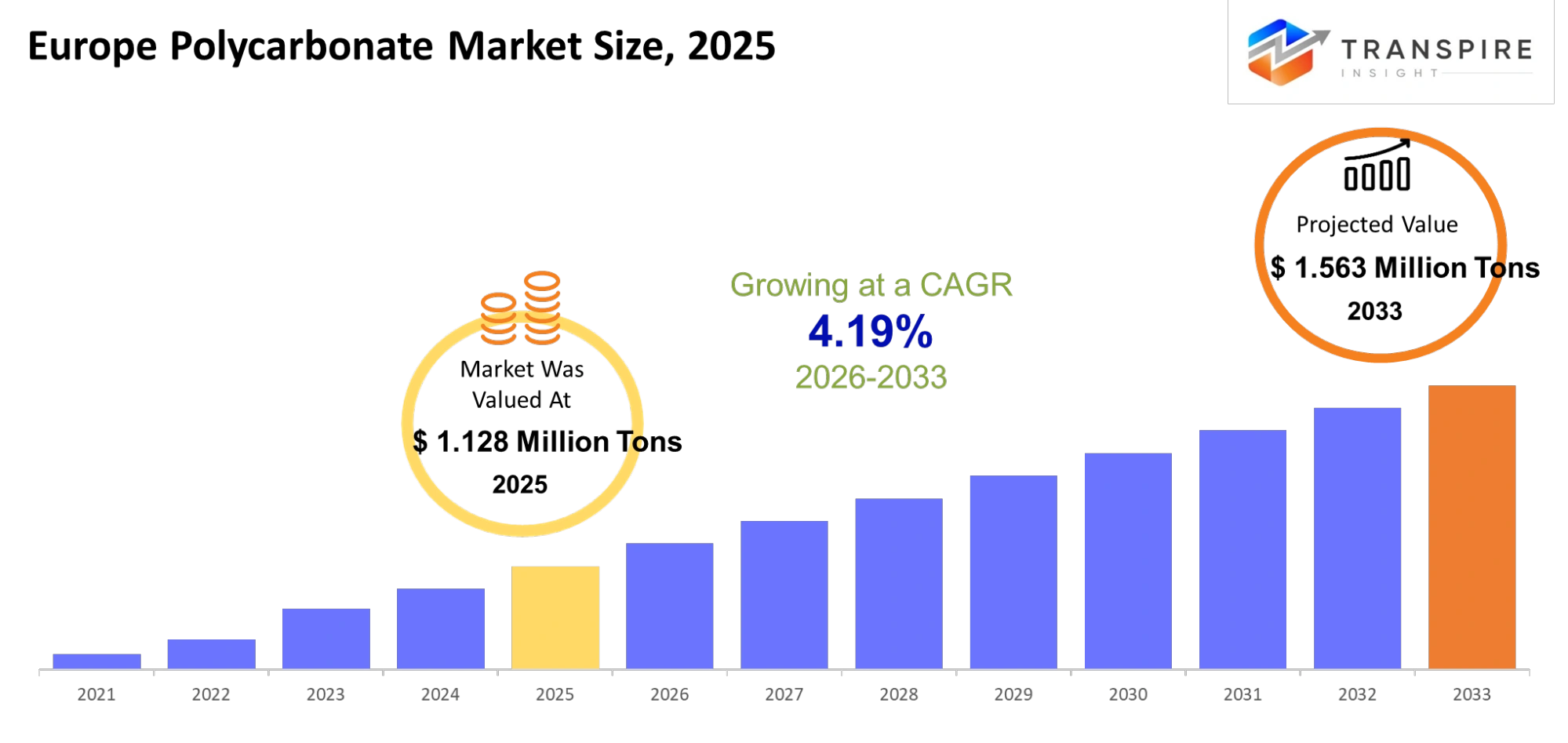
- Europe Polycarbonate Market Size 2025: 1.128 Million Tons
- Europe Polycarbonate Market Size 2033: 1.563 Million Tons
- Europe Polycarbonate Market CAGR: 4.19%
- Europe Polycarbonate Market Segments: By Type (Standard Polycarbonate, Flame Retardant Polycarbonate, Optical Grade Polycarbonate, Others); By Application (Automotive, Electronics, Construction, Medical Devices, Packaging, Others); By End-User (Automotive Industry, Electronics Industry, Construction Industry, Healthcare Sector, Packaging Industry, Others); By Form (Sheets, Films, Granules, Others)
To learn more about this report,  Download Free Sample Report
Europe Polycarbonate Market Summary
The Europe Polycarbonate Market was valued at 1.128 Million Tons in 2025. It is forecast to reach 1.563 Million Tons by 2033. That is a CAGR of 4.19% over the period.
Polycarbonate in Europe functions as a high-performance workhorse material that replaces heavier or less durable alternatives in applications such as machine guards, transport glazing, electrical housings, and marine panels. The solution addresses the practical situation which requires three elements: impact resistance and transparent materials and lightweight products to maintain safety standards and durability requirements and energy efficiency needs.
The market has undergone structural changes during the past few years, which now supports circularity through the commercial implementation of recyclate-based polycarbonate and closed-loop systems that have moved beyond their pilot testing stage. The European Union established stricter regulations for single-use plastics and carbon emissions reporting, which forced OEMs to rethink their material selection processes and supplier traceability systems.
The change has resulted in new purchasing patterns. The manufacturing industry now focuses on materials that provide lower lifecycle emissions while meeting compliance standards, which results in better performance of advanced polycarbonate grades. The ability to verify recycled material content and dependable product performance enables suppliers to obtain better contracts and extended supply partnerships.
Key Market Insights
- The European Polycarbonate Market in 2025 Germany holds the largest market share at approximately 28% because of its robust automotive and industrial manufacturing sectors.
- The electronics assembly industry and low-cost production hubs drive Eastern Europe to become the fastest-growing region from 2025 to 2030.
- Virgin polycarbonate dominates the market with approximately 62% share in 2025 because it consistently performs well in high-spec industrial and optical applications.
- The second-largest market share belongs to recycled polycarbonate which gains popularity because of European Union circular economy regulations and original equipment manufacturer sustainability objectives.
- The bio-based and advanced recycled grades represent the fastest-growing segment through 2030, driven by carbon reduction commitments and regulatory compliance.
- The automotive glazing and components market segment holds the largest share at approximately 35% because of electric vehicle design requirements for lightweight materials and impact-resistant components.
- The electrical and electronics segments will experience their highest growth rates from 2025 to 2030 because of rising demand for materials that can withstand heat and flames in various devices and infrastructure systems.
- The automotive sector serves as the primary end-use market in 2025 because it controls approximately 38% of total demand which receives support from electric vehicle manufacturing and lightweight material adoption.
- The construction and infrastructure sector represents the fastest-growing end-user market because of its increasing use of energy-efficient building materials and transparent insulation panels.
- Companies achieve market edge through advanced recycling technologies and chemical recycling investments which enable them to meet sustainability requirements while establishing their products as premium offerings.
What are the Key Drivers, Restraints, and Opportunities in the Europe Polycarbonate Market?
Driver:
The European Polycarbonate Market experiences its highest growth rate because of automotive electrification. The European Union mandates fleet emission reductions combined with its plan to ban internal combustion engines by 2035 which forces original equipment manufacturers to develop lighter vehicles with better energy performance. The application of polycarbonate as an alternative to glass and metal enables lighter construction of glazing systems and lighting fixtures and battery enclosures which still meet impact resistance standards. The adoption of this technology results in higher material consumption for every vehicle produced because electric vehicles need more polycarbonate materials to achieve their range requirements which results in increased revenue for their suppliers.
Restraint:
Feedstock price fluctuations together with energy-demanding production methods represent the two major fundamental obstacles that our organization faces. Polycarbonate production depends on bisphenol-A and phosgene derivatives which face two challenges that include petrochemical price fluctuations and European Union regulatory requirements. Production costs have increased because essential manufacturing sites now face higher electricity rates. The existing problems require lengthy resolution periods because their solutions depend on worldwide supply networks and local energy regulations. Producers experience decreased profit margins while cost-sensitive sectors such as construction and consumer goods face obstacles to implementing new technologies.
Opportunity:
The European Polycarbonate Market will enter its next growth phase because advanced recycling technologies provide a clear pathway to this success. The chemical recycling facilities in Germany and the Netherlands enable closed-loop recovery of high-grade polycarbonate from automotive and electronics waste. Material producers and OEMs have established partnerships that develop headlamp and glazing waste reprocessing from pilot phase to commercial operation. The process establishes premium product streams which contain verified recycled content thus creating new business opportunities with manufacturers who prioritize sustainable practices.
What Has the Impact of Artificial Intelligence Been on the Europe Polycarbonate Market?
The European manufacturing networks are currently experiencing a transformation in their polycarbonate manufacturing processes because of artificial intelligence and advanced digital technologies. The implementation of AI-driven control systems by producers enables them to initiate automation processes for reactor conditions and to execute real-time monitoring of polymerization stability while adjusting temperature and pressure parameters. The process results in reduced batch variability with consistent yield achievement, which directly impacts decrease of material waste and energy consumption. Machine vision systems in compounding and extrusion lines identify micro-defects present in transparent sheets and optical components, which enables the establishment of automated quality control systems that enhance operational efficiency while decreasing product rejection rates.
Machine learning models operate as predictive maintenance tools for equipment that processes materials at high temperatures. The systems use vibration and pressure and thermal data analysis to predict equipment failure which will occur before it causes production interruptions, which results in improved plant operational time and decreased unexpected shutdowns. Some facilities report maintenance cost reductions of 10 to 15 percent alongside measurable gains in operational efficiency. AI-based simulations optimize material formulations used in specific applications such as automotive glazing and electronics housings, which results in faster product development through shorter development cycles.
The current situation presents an obstacle that limits adoption. The process of AI integration into existing chemical plants requires both substantial financial resources and intricate system upgrades which delays the implementation process for both older production facilities and smaller production sites.
Key Market Trends
- The original equipment manufacturers (OEMs) have stopped using virgin resins since 2020 and now use recycled polycarbonate blends which contain more than 30% certified recycled material according to their contract specifications.
- The EU Green Deal regulations created evidence-based results which caused manufacturers to develop methods for monitoring their complete supply chain greenhouse gas emissions.
- The automotive industry raised its use of polycarbonate materials for electric vehicle parts by more than 20% since 2021 because of its need to create lighter vehicles with better battery performance.
- The 2022 energy cost increases compelled manufacturers to change their operational methods which led to faster plant efficiency improvements and distribution of production sites throughout Europe.
- Chemical recycling reached its first commercial stage after 2023 when Covestro and SABIC developed their closed-loop polycarbonate recycling programs.
- Electronics manufacturers began to use flame-retardant high-heat materials because safety regulations became stricter and electronic devices decreased in size.
- Supply chain disruptions during 2021 to 2023 led to longer-term supplier agreements which reduced spot purchasing and increased contract-based procurement models.
- Eastern Europe became a production hub after 2022 because lower operating costs and nearby automotive assembly plants attracted business investments.
- The adoption of digital manufacturing processes increased after 2021 because AI quality control systems improved defect management and production efficiency in extrusion and molding operations.
Europe Polycarbonate Market Segmentation
By Type:
The highest market share belongs to standard polycarbonate which accounts for more than 50% of total demand because it can be used in automotive, construction and industrial applications. The material achieves its leading market share because it provides cost-effective solutions which maintain balanced mechanical strength for production processes requiring high production rates. The second most popular type of polycarbonate is flame retardant polycarbonate because the fire safety regulations which govern electronic equipment and electrical systems require it. Optical grade polycarbonate exists as a smaller market segment which generates high revenue because it is needed for automotive lighting systems and medical optical equipment.
Flame retardant variants gain momentum due to tightening EU safety regulations, especially in electronics and EV battery systems. The demand for optical grades increases because advanced lighting and display technologies now require higher levels of precision. Standard grades face margin pressure due to commoditization and feedstock cost volatility.
The market will experience its future growth through specialty grades especially recycled and high-performance specialty grades. Product developers are shifting toward differentiated formulations, while investors focus on segments aligned with regulatory compliance and advanced applications.
By Application:
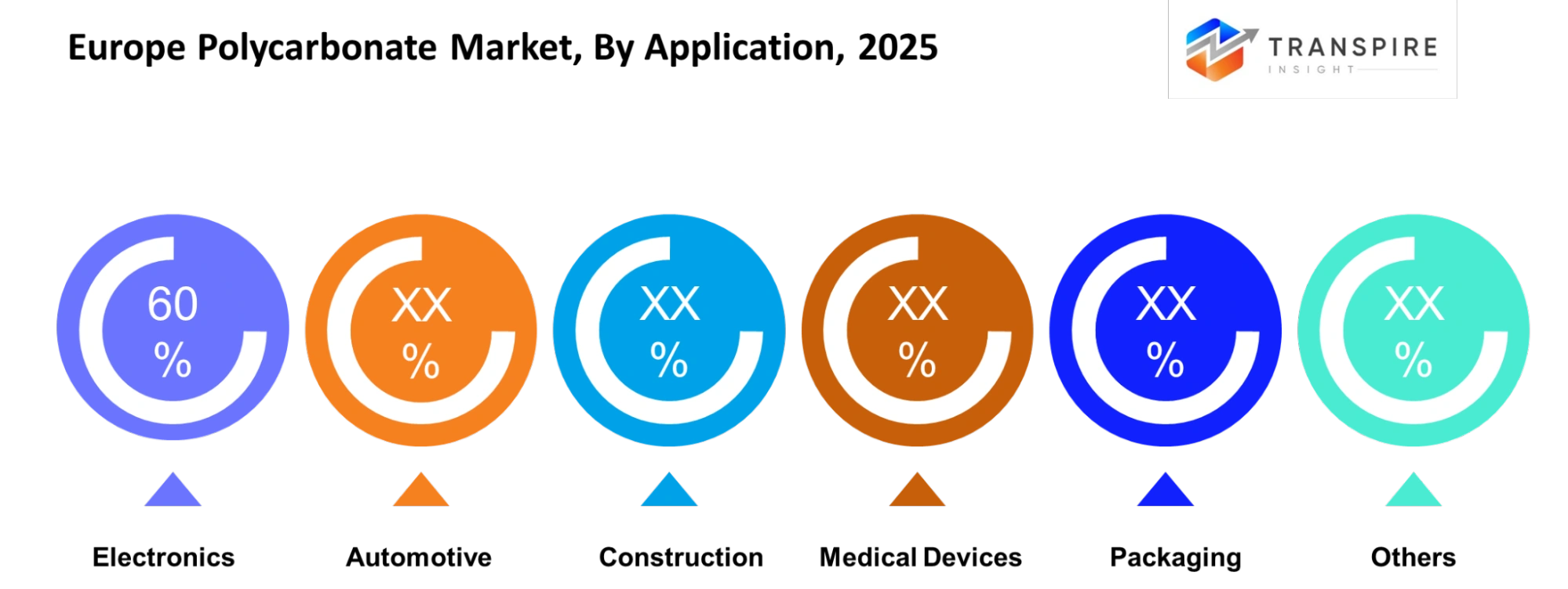
The 35% market share for automotive applications exists because EV component integration and glazing and lightweight structural systems continue to increase. The electronics sector ranks as the second biggest market segment because users require materials that can withstand heat and flame. The construction industry shows consistent growth through its use of roofing sheets and panels and insulation systems.
Automotive development exists because regulations require reduced emissions which forces manufacturers to use different materials that weigh less. The electronics industry experiences rapid growth because devices and infrastructure move toward smaller sizes and implement stricter safety requirements. The construction sector maintains its current level of activity but encounters challenges because of budget constraints and the availability of competing materials.
The upcoming years will witness greater adoption of electric vehicles and intelligent electronic devices. The manufacturers will generate new revenue streams through their planned expansion into medical and advanced industrial applications.
To learn more about this report, Download Free Sample Report
By End-User:
The automotive industry leads all sectors because it consumes materials at high rates while its designs develop into new technologies. The electronics industry holds the second position because it maintains constant production levels which require advanced technical capabilities. The construction industry and the healthcare sector generate smaller yet constant revenue streams.
The automotive industry needs more lightweight and durable materials because both electrification and safety design changes will increase vehicle demand. The strict compliance requirements together with the advanced performance needs drive businesses to adopt more electronic systems. Healthcare applications expand because of the need for sterilization and the requirement for transparent optical materials.
Future demand is expected to diversify because healthcare and electronics sectors will gain market share. The end users will search for materials that have certification and traceability and deliver high performance, which will impact the way suppliers develop their business strategies and form long-term agreements.
By Form:
Granules hold the largest market share for injection molding and extrusion processes because they account for 60% of the total market. The second largest segment after this consists of sheets which construction and automotive industries use for their glazing needs. Films currently exist as a minor segment, but they are experiencing growth especially within the fields of electronics and specialized packaging.
The demand for granules stays strong because they offer manufacturing facilities the ability to process materials through different production methods. The demand for transparent impact-resistant building materials drives the expanding use of sheet applications. The demand for thin yet durable layers used in electronic components drives the increasing use of films.
The future market expansion will focus on films and modern sheet applications which feature recyclable materials and improved functionality. The manufacturing sector will need to develop new processing methods which meet current design standards and sustainability demands.
What are the Key Use Cases Driving the Europe Polycarbonate Market?
Automotive applications create the highest demand because electric vehicles require lightweight glazing and headlamp lenses and battery housings. EU emission targets and efficiency standards push manufacturers to replace glass and metal with impact-resistant, lightweight polycarbonate which leads to higher material consumption for every vehicle.
The fields of electronics and construction continue to experience consistent growth. Device manufacturers rely on flame-retardant grades for circuit protection and compact designs, while construction firms use multiwall sheets for energy-efficient roofing and daylight panels that meet insulation standards.
New use cases have emerged in the fields of medical devices and advanced mobility systems. Polycarbonate is gaining traction in sterilizable surgical equipment and diagnostic housings. The market for autonomous vehicle sensors and protective covers has expanded because these products require both durability and optical clarity.
|
Report Metrics |
Details |
|
Market size value in 2025 |
1.128 Million Tons |
|
Market size value in 2026 |
1.173 Million Tons |
|
Revenue forecast in 2033 |
1.563 Million Tons |
|
Growth rate |
CAGR of 4.19% from 2026 to 2033 |
|
Base year |
2025 |
|
Historical data |
2021 - 2024 |
|
Forecast period |
2026 - 2033 |
|
Report coverage |
Revenue forecast, competitive landscape, growth factors, and trends |
|
Regional scope |
Europe (Germany, United Kingdom, France, Italy, Spain, Rest of Europe) |
|
Key company profiled |
Bayer, SABIC, Covestro, Teijin, Mitsubishi Chemical, LG Chem, Chi Mei, Trinseo, Idemitsu Kosan, Asahi Kasei, RTP Company, Ensinger, BASF, Dow, Evonik |
|
Customization scope |
Free report customization (country, regional & segment scope). Avail customized purchase options to meet your exact research needs. |
|
Report Segmentation |
By Type (Standard Polycarbonate, Flame Retardant Polycarbonate, Optical Grade Polycarbonate, Others); By Application (Automotive, Electronics, Construction, Medical Devices, Packaging, Others); By End-User (Automotive Industry, Electronics Industry, Construction Industry, Healthcare Sector, Packaging Industry, Others); By Form (Sheets, Films, Granules, Others) |
Which Regions are Driving the Europe Polycarbonate Market Growth?
The regulatory framework which exists in Western Europe operates with strict enforcement while the region has developed its industrial base to advanced levels hence the region maintains its leading position. The automotive and electronics and advanced manufacturing sectors drive demand in Germany and France and the Netherlands which serve as primary market access points. The European Union enforces its carbon reporting requirements together with material traceability standards which result in companies continuously adopting high-quality recycled polycarbonate products. The established system which includes original equipment manufacturers and compounders and recyclers enables both creative progress and the maintenance of extended contractual agreements for supply.
Northern Europe exists as an stable region which contributes to sustainability through procurement practices which Sweden and Denmark implement. The leader pattern gets demonstrated through this area because it uses more environmentally certified materials which meet high specifications instead of producing large quantities of materials. The combination of government financial incentives together with consistent industrial production methods establishes a pattern for demand during specific periods. The combination of dependable policy enforcement together with effective public-private partnerships enables manufacturers to achieve their operational needs.
Eastern Europe experiences its highest growth rate because companies require manufacturing sites to relocate their operations while they seek better cost efficiency. The automotive and electronics assembly sectors have attracted new investments to Poland and Hungary and Romania since 2022. The combination of low labor expenses with Western market accessibility drives companies to move their operations to this area. The ongoing business development creates avenues for new businesses to create local supply networks which will allow them to meet rising market needs until 2033.
Who are the Key Players in the Europe Polycarbonate Market and How Do They Compete?
The Europe Polycarbonate Market displays medium market concentration because several major companies hold substantial market power while smaller compounders and recyclers establish specialized market segments. Companies protect their market position through their technological expertise and combined supply chain operations and their ability to follow regulatory standards instead of relying solely on price competition. Currently, organizations compete based on material performance and certified recycled content and their capacity to comply with stringent European Union sustainability and traceability requirements. The market for new competitors has not been disrupted by new entrants who now target specific markets that include recycled materials and specialized product categories.
Covestro develops its unique value proposition through technology-based differentiation that includes its circular polycarbonate products which contain certified recycled content and use mass balance methods. Through strategic partnerships with automotive OEMs Covestro secures long-term contracts which enable both parties to develop specific materials for their applications. SABIC utilizes its worldwide operational capabilities and cutting-edge materials research to produce high-performance polycarbonate blends which meet the needs of electric vehicle and electronic device markets, backed by its European research and development facilities.
Trinseo develops its business model through specialty products and customer-tailored compounds which enable the company to achieve higher profits from select markets while avoiding efforts to dominate overall market share. Mitsubishi Engineering-Plastics uses precision materials to create optical and electronic products which depend on consistent quality control as their key competitive advantage. Teijin Limited develops its business through high-performance resin products and regional partnerships, which drive its focus on lightweighting solutions that support automotive electrification developments.
Company List
- Bayer
- SABIC
- Covestro
- Teijin
- Mitsubishi Chemical
- LG Chem
- Chi Mei
- Trinseo
- Idemitsu Kosan
- Asahi Kasei
- RTP Company
- Ensinger
- BASF
- Dow
- Evonik
Recent Development News
In April 2026, Covestro AG announced the acquisition of a specialty polycarbonate compounding business from a European engineering plastics firm to strengthen its advanced materials portfolio in automotive and electronics applications. https://www.covestro.com
In March 2026, SABIC completed the acquisition of a European high-performance thermoplastics distributor to expand its regional polycarbonate market reach and enhance supply chain capabilities across Europe. https://www.sabic.com
What Strategic Insights Define the Future of the Europe Polycarbonate Market?
The European Polycarbonate Market now progresses toward low-carbon circular material systems while European Union regulations about emissions and waste recovery and product traceability requirements become more stringent. The next five to seven years will show that companies with recycling content certification and industrial capacity will gain competitive advantage over companies with larger operational scale. New supplier selection processes will emerge from this transition because it will affect how suppliers are chosen in automotive and electronics supply chains.
The hidden danger exists because regulatory bodies have not yet determined how they will classify chemical recycling processes and bisphenol-A usage which creates problems for product development and investment schedules. An advanced mobility and battery ecosystem opportunity has emerged through which polycarbonate material will serve as an alternative to metals for thermal management and protective components.
Market participants should prioritize their investment efforts toward establishing closed-loop recycling partnerships with original equipment manufacturers and waste processing facilities. The early acquisition of feedstock resources and certification capacity will enable suppliers to obtain high-value contracts when compliance standards become more rigorous.
Europe Polycarbonate Market Report Segmentation
By Type
- Standard Polycarbonate
- Flame Retardant Polycarbonate
- Optical Grade Polycarbonate
- Others
By Application
- Automotive
- Electronics
- Construction
- Medical Devices
- Packaging
- Others
By End-User
- Automotive Industry
- Electronics Industry
- Construction Industry
- Healthcare Sector
- Packaging Industry
- Others
By Form
- Sheets
- Films
- Granules
- Others
Frequently Asked Questions
Find quick answers to common questions.
The Europe Polycarbonate Market size is 1.563 Million Tons in 2033.
Key segments for the Europe Polycarbonate Market are By Type (Standard Polycarbonate, Flame Retardant Polycarbonate, Optical Grade Polycarbonate, Others); By Application (Automotive, Electronics, Construction, Medical Devices, Packaging, Others); By End-User (Automotive Industry, Electronics Industry, Construction Industry, Healthcare Sector, Packaging Industry, Others); By Form (Sheets, Films, Granules, Others).
Major Europe Polycarbonate Market players are Bayer, SABIC, Covestro, Teijin, Mitsubishi Chemical, LG Chem, Chi Mei, Trinseo, Idemitsu Kosan, Asahi Kasei, RTP Company, Ensinger, BASF, Dow, Evonik.
The Europe Polycarbonate Market size is 1.128 Million Tons in 2025.
The Europe Polycarbonate Market's CAGR is 4.19% from 2026 to 2033.
- Bayer
- SABIC
- Covestro
- Teijin
- Mitsubishi Chemical
- LG Chem
- Chi Mei
- Trinseo
- Idemitsu Kosan
- Asahi Kasei
- RTP Company
- Ensinger
- BASF
- Dow
- Evonik
Recently Published Reports
-
Apr 2026
Healthcare Polymer Packaging Market
Healthcare Polymer Packaging Market Size, Share & Analysis Report By Packaging Type (Syringes, IV Bottles and Pouches, Clamshells, Blisters, Bottles & Jars, Containers, Tubes, IV Parental Packaging, Others), By Type (Regulated, Non-regulated), By Polymer Type (LDPE (Low-Density Polyethylene), HDPE (High-Density Polyethylene), Homo-polymer (Homo), Random Copolymer (Random), Block Copolymer (Block), PET, Polystyrene, Polyvinyl Chloride, Polyamide/EVOH, Others), and Geography (North America, Europe, Asia-Pacific, Middle East and Africa, South and Central America), 2021 - 2031
-
Apr 2026
Hydrophilic Tape (Waterstop) Market
Hydrophilic Tape (Waterstop) Market Size, Share & Analysis Report By Type (Bentonite-Based Hydrophilic Tape, Rubber-Based Hydrophilic Tape), By Application (Residential Buildings, Commercial Buildings, Infrastructure Projects), and Geography (North America, Europe, Asia-Pacific, Middle East and Africa, South and Central America), 2021 - 2031
-
Apr 2026
Metalens Market
Metalens Market Size, Share & Analysis Report By Type (Visible Light Metalens, and Infrared Metalens), By Application (Consumer Electronics, Automotive Electronics, Industrial, Medical, and Others), and Geography (North America, Europe, Asia-Pacific, Middle East and Africa, South and Central America), 2021 - 2031
-
Apr 2026
PBT Resin Market
PBT Resin Market Size, Share & Analysis Report By Type (Reinforced PBT Resin, Unreinforced PBT Resin), By Processing Method (Injection Molding, Extrusion, Blow Molding, Others), By End-User (Automotive, Electrical & Electronics, Consumer Appliances, Industrial Machinery, Medical Devices, Packaging, Others), and Geography (North America, Europe, Asia-Pacific, Middle East and Africa, South and Central America), 2021 - 2031