
Europe Commercial Aircraft Windshield & Windows Market Summary
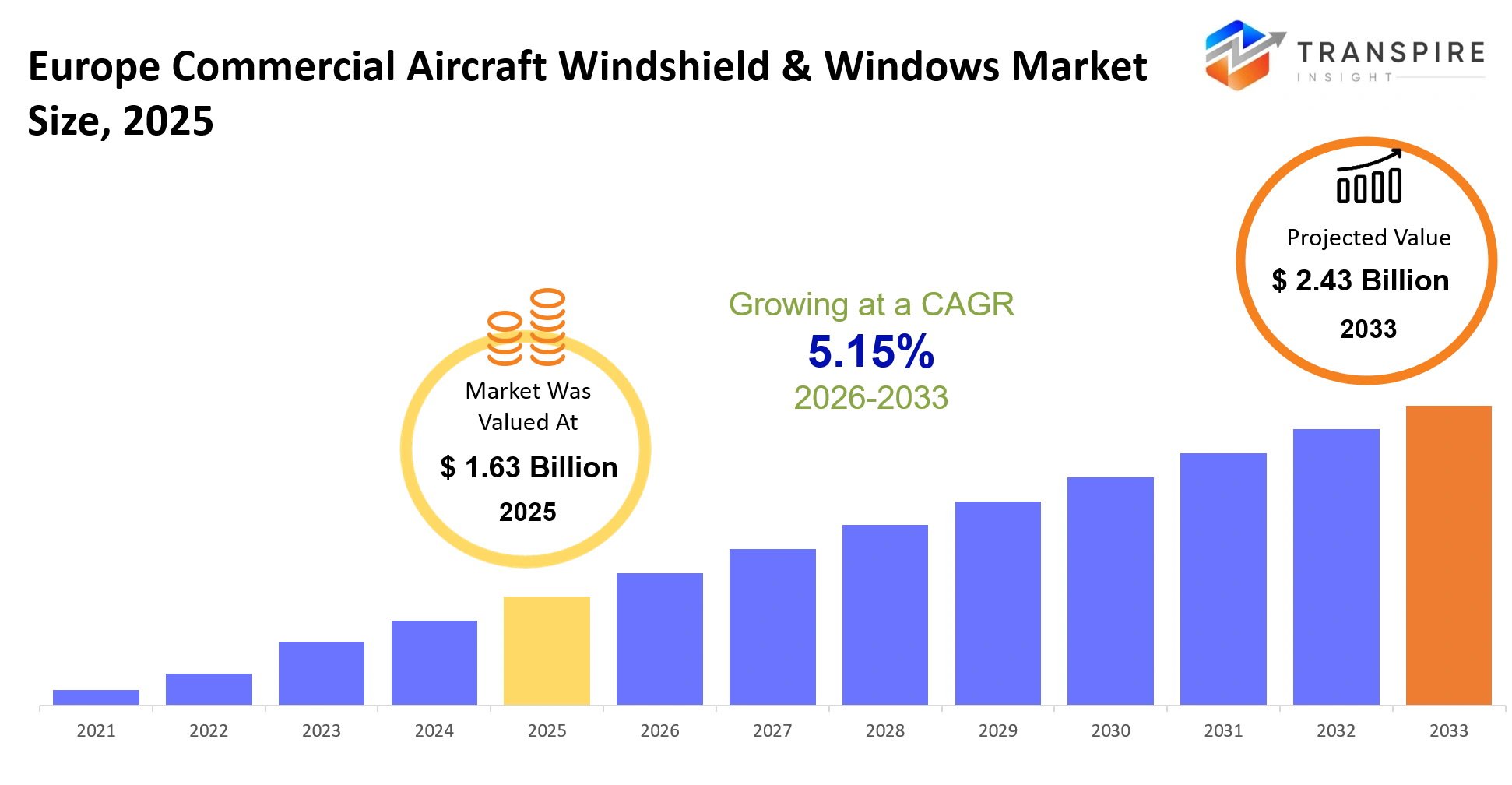
As per Transpire Insight Analysis the Europe Commercial Aircraft Windshield & Windows Market size is estimated at USD 1.63 Billion in 2025 and is anticipated to reach USD 2.43 Billion by 2033, growing at a CAGR of 5.15% from 2026 to 2033.
The Europe Commercial Aircraft Windshield & Windows Market kindof keeps flight operations safe and efficient, mainly by using high strength transparent structures that shield flight crews and passengers from sudden pressure swings, bird strikes, rough weather exposure, and temperature changes, while still keeping things clearly visible during basically every stage of flight. Aircraft makers, maintenance providers, and airlines often lean on modern glazing systems, these can help boost operational reliability, stretch out maintenance intervals , and stay aligned with tough aviation safety requirements. In the last five years the market has been moving toward lighter but more durable multi layer materials, plus smarter window technologies, which in turn support fuel efficiency and better lifecycle results. After the COVID-19 pandemic, and with geopolitical tensions going on, supply chain disruptions revealed some weak points in aerospace component sourcing , so manufacturers started diversifying suppliers and pushing harder on regional production. And as aircraft production slowly rebounds , and fleets get modernized , spending on next generation windshield and window systems should grow, opening up bigger aftermarket opportunities while also supporting long term revenue growth via replacement cycles, and the adoption of advanced materials.
Europe Commercial Aircraft Windshield & Windows Market Size & Forecast:
- Europe Commercial Aircraft Windshield & Windows Market Size 2025: USD 1.63 Billion
- Expected Market Value 2033: USD 2.43 Billion
- Forecast CAGR: 5.15%
- Leading region in 2025: France, Germany, and the United Kingdom
- Fastest Growing region: Poland, the Czech Republic, and Romania
- Key Profile: PPG Industries, Saint-Gobain, GKN Aerospace, Gentex Corporation, Lee Aerospace, Nordam Group, Aerospace Transparencies, Llamas Plastics, Control Logistics, The Gill Corporation, General Electric, Boeing, Airbus, Daher, Triumph Group.
Key Market Insights
- Western Europe kind of dominated the Europe Commercial Aircraft Windshield & Windows Market, holding nearly 62% market share in 2025, helped by those aerospace manufacturing clusters in France, Germany ,and the United Kingdom.
- Meanwhile, Central and Eastern Europe will stay the fastest-growing regional market during 2025–2033, pushed by expanding aircraft maintenance capabilities and aerospace supplier investments in Poland and Romania.
- On the product side, OEM-installed windshields came in as the leading segment with about 58% market share in 2025 ,since aircraft production programs kept steady procurement volumes.
- Passenger cabin windows were the second-largest segment too because narrow-body fleet deliveries kept feeding large scale replacement and installation efforts among European operators.
- Looking ahead, smart and lightweight composite window systems should become the fastest-growing segment through 2033, backed by fuel-efficiency targets , and wider adoption of advanced materials.
- For applications, narrow-body commercial aircraft took the dominant spot with nearly 64% share in 2025, basically showing sustained fleet usage on regional and short-haul routes.
- Wide-body aircraft refurbishment is set to see the quickest application growth over the forecast period ,as international traffic recovery ramps up modernization programs.
- As for end users, aircraft OEMs stayed in front with roughly 55% market share in 2025, supported by ongoing commercial aircraft production across Europe.
- Independent MRO providers are expected to emerge as the fastest-growing end-user category through 2033, driven by aging fleets and higher windshield replacement frequencies.
What are the Key Drivers, Restraints, and Opportunities in the Europe Commercial Aircraft Windshield & Windows Market?
The most powerful growth driver is basically the modernization of Europe’s commercial aircraft fleet, just under tighter fuel efficiency and emissions rules. Lightweight glazing technologies became kinda attractive commercially, when airlines were really pushing to lower operating costs, while also staying in line with environmental requirements. Advanced chemically strengthened glass, acrylic laminates and refined coatings helped cut aircraft mass and also keep parts in use longer, service life extended. With fewer replacements needed, lifecycle economics look better. As a result, airlines sped up retrofit initiatives while OEMs put next generation windshield systems into newer aircraft platforms, which ends up supporting steady revenue growth in both manufacturing and the aftermarket side.
The main restraint is the way specialized aerospace grade material suppliers are concentrated, along with all the certification hurdles. Each windshield design needs long qualification cycles, hands-on testing, and regulatory sign off before it can even go commercial. So, that whole path drags out production timelines and it also narrows how quickly suppliers can be diversified. From the Transpire Insight review of regional procurement notices and product launch pacing, supply chain concentration still shows up as the key execution risk. If production slips, aircraft deliveries get delayed, aftermarket parts become less available, and near term revenue chances across the European aerospace supply chain get squeezed.
A big chance is in stitching smart transparency technologies together with digital aircraft health monitoring systems, it kinda feels like a natural fit. If you embed sensors that can read thermal stress, spot impact damage, and track coating degradation then there is real added value, not only what you’d get from the usual glazing products. Putting money into predictive maintenance platforms across France, Germany, Poland, and the United Kingdom, supports this shift in a very direct way. And as connected aircraft adoption grows, intelligent window systems should help lock in steadier aftermarket revenues, while also pushing up fleet availability and making maintenance planning a lot more efficient.
What Has the Impact of Artificial Intelligence Been on the Europe Commercial Aircraft Windshield & Windows Market?
Artificial intelligence is reshaping aircraft transparency, manufacturing and upkeep in a way that kind of feels, automating quality checks, keeping a closer eye on production, plus managing certification paperwork across aerospace plants, it is doing this in a more streamlined fashion than before. With computer vision, tiny surface flaws get inspected, coating consistency is monitored, and even laminate alignment is checked, all with more repeatability than people can get during manual inspection. This tends to cut down manufacturing mistakes and strengthens compliance with those strict aviation requirements.
On top of that, machine learning models sift through operational data coming from commercial fleets to anticipate windshield degradation, thermal stress patterns, bird-strike vulnerability, and even replacement timing before failures show up. Those predictive tools let maintenance providers plan inventory with a bit more precision, which also means fewer nasty surprises and less unexpected aircraft time sitting on the ground.
AI supported demand forecasting meanwhile helps suppliers synchronize production runs with OEM delivery milestones, and with aftermarket replacement rhythms too. The result is better use of resources, and lower procurement costs, at least in theory, and in practice for many programs that can actually integrate well. Digital twins add another layer by supporting performance simulation, evaluating structural behavior under different pressure levels and temperature swings before any physical testing happens.
Altogether, these updates can boost manufacturing efficiency, speed up maintenance turnaround, and improve overall aircraft availability. Still, the big rollout is held back by high integration costs plus fragmented operational datasets across airlines, manufacturers, and maintenance organizations. When standardized performance data is hard to access, model accuracy drops in real world conditions, so large scale deployment progresses more slowly, even though the technology still has long term commercial promise.
Key Market Trends
- Since 2022, airlines have been speeding up the replacement of older windshield setups with lighter laminated glazing, in order to reduce overall aircraft mass and… yeah, improve fuel efficiency.
- During 2023–2025, Airbus pushed wider adoption of advanced transparency materials across several commercial aircraft programs, which in turn is strengthening demand for high performance glazing suppliers, in a pretty noticeable way.
- Electrically heated cockpit windshields started getting broader adoption after 2023, helping with all weather operational reliability and also lowering the times maintenance teams have to step in.
- Between 2023 and 2025, some European MRO providers increased spending on windshield inspection and repair capabilities, so aircraft are stuck on the ground less, and the component service life stretches out longer too.
- After 2024, AI enabled optical inspection systems showed up more often, supporting better manufacturing accuracy , and reducing quality-control defects during glazing production.
- Supply chain strategies shifted after 2022, with manufacturers leaning into dual source procurement, to cut reliance on a single supplier of aerospace grade glass, plus acrylic materials.
- For 2024–2025, smart windows with embedded sensors became a bigger commercial topic, allowing predictive maintenance and real time structural health monitoring, as if it’s standard equipment now.
- Starting in 2023, sustainability rules helped drive greater use of recyclable glazing materials, and also lower emission manufacturing processes across European aerospace production sites.
- And from 2023 to 2025, aerospace glazing suppliers kept tightening partnerships with aircraft OEMs, which helped accelerate certification of next generation windshield technologies for upcoming commercial aircraft platforms.
Europe Commercial Aircraft Windshield & Windows Market Segmentation
By Product Type :
Cockpit windshields hold a major spot in most designs, because commercial aircraft need strong visibility, high impact resistance, and dependable performance when weather conditions shift around. At the same time, cabin windows and passenger windows keep getting attention, since airlines spend on better passenger comfort and also an upgraded cabin look, especially during refurbishment programs. Emergency exit windows still stay a key safety piece that has to satisfy strict aviation certification rules. Side windows help with operational sightlines while keeping structural integrity during long service intervals, without that slow degradation effect people worry about.
Laminated windows also keep moving up in preference, since multi layer construction boosts durability and adds resistance against bird strikes and pressure swings. Heated windows support safer flight operations by stopping ice from building up, and they also cut down fog during nasty weather. Ongoing improvements in coatings, lighter materials, and refined manufacturing methods will continue backing long term product development across commercial aviation. Other specialized window systems will likely show up too, in tailored aircraft configurations, plus in advanced fleet modernization efforts.
By Material :
Acrylic still gets used a lot, partly because of its lightweight construction and optical clarity, plus cost efficiency, it fits lots of commercial aircraft window uses, pretty well. Glass laminates remain a pick for cockpit settings that are tough, where high strength and impact resistance are not optional. Polycarbonate materials work for certain builds that need strong durability, and also keep the weight lower. So material selection keeps getting tuned to juggle safety, performance, upkeep needs, and the day to day operating costs.
Composite materials, and also multi-layer systems , keep drawing interest as manufacturers try to cut aircraft mass without giving up structural capability. UV resistant materials support staying visually clear over time, and they also reduce long term deterioration from sunlight exposure. Scratch resistant materials extend the service life by limiting surface damage during everyday operations and routine maintenance. Other advanced materials will keep showing up too, to back product innovation as commercial aircraft technology shifts toward lighter and more durable transparency solutions.
By Aircraft Type :
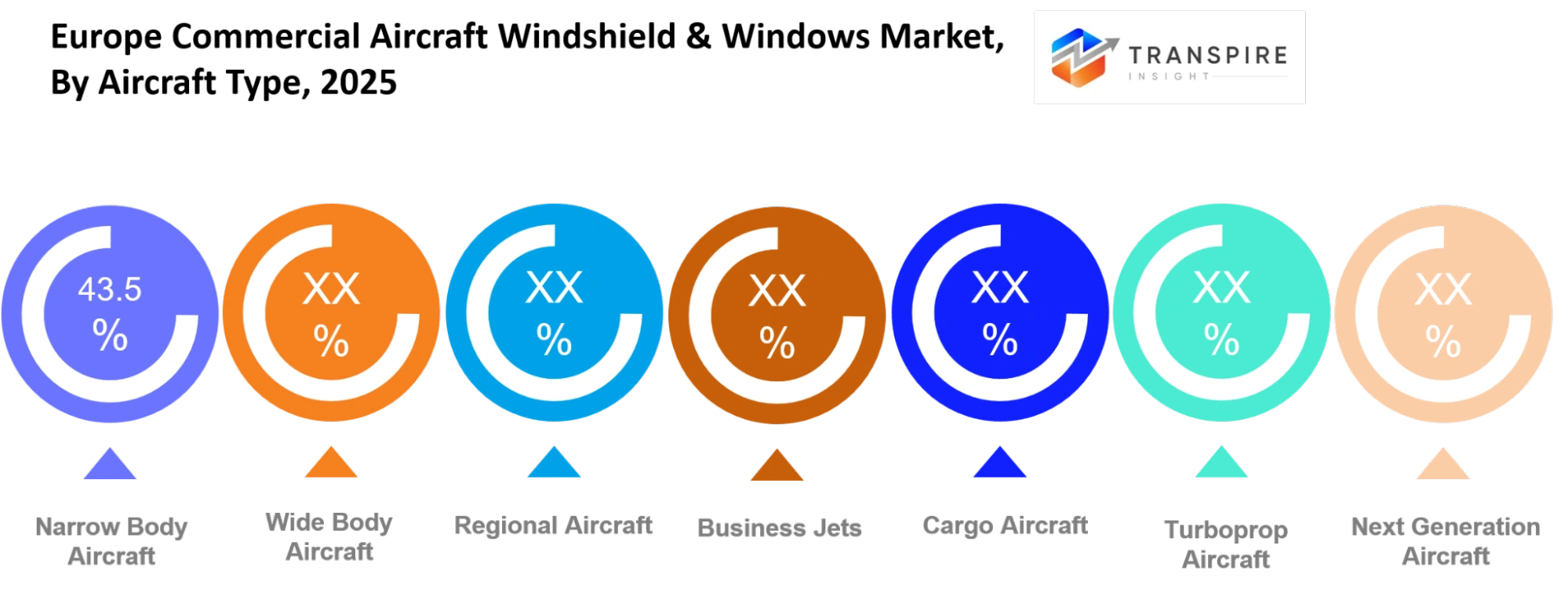
Narrow body aircraft seem to have the most demand , because short and medium trip operations keep producing large volumes and also they pull in frequent maintenance cycles. Wide body aircraft keep opening steady opportunities , mainly via long haul fleet modernization and the usual replacement work. Regional aircraft support demand that comes from domestic connectivity programs and the ongoing widening of regional airline networks. Business jets keep a comparatively stable role as well, through premium cabin improvements and customized transparency solutions, you know.
Cargo aircraft keep driving replacement demand, since really intensive operating schedules raise the maintenance frequency especially for windshield and window systems. Turboprop aircraft support a fairly consistent procurement pattern across regional transportation networks. Next generation aircraft, at the same time , are encouraging take-up of lightweight glazing technologies , advanced coatings, and better thermal performance overall. Other specialized aircraft groups will keep adding value through fleet renewal efforts and application specific transparency requirements.
By Application :
OEM applications actually make up the biggest piece , mostly because each freshly manufactured commercial airplane needs certified windshield and window setups done before delivery. Replacement keeps moving, i mean it still stays strong, since routine inspections keep spotting damaged or aging transparency systems that really call for a scheduled swap. MRO services are still growing as airlines push for quicker turnaround times and better fleet availability. Maintenance planning continues to back steady demand across commercial aviation, almost like a quiet baseline
At the same time, fleet upgrade and retrofit efforts roll in lightweight glazing systems that help with operational efficiency and cut down on the amount of upkeep needed. Cabin modernization work also supports installing upgraded passenger windows, with stronger insulation and durability. Leasing operations tend to drive timely replacement and refurbishment, especially before aircraft change hands between different operators. Beyond that, other use cases will keep generating extra opportunities, via more specialized refurbishment efforts and operational improvement projects.
By End User :
Aircraft manufacturers are still, sort of the biggest end users because commercial aircraft production means they keep buying certified windshield and window systems, over and over. Airlines bring in a lot of demand too, mostly from scheduled maintenance, replacement plans, and those fleet modernization budgets. MRO providers keep expanding their service capabilities as older aircraft end up needing more frequent inspection work , repairs, and component swaps. Long term maintenance agreements also help keep purchasing steadier across the aviation world.
Leasing companies are continuing to invest in refurbishment before an aircraft is delivered to new operators, that helps their residual asset value. Defense organizations and government agencies add extra pull as they do transport aircraft maintenance along with modernization efforts. Flight schools are smaller in volume but they stay consistent, since commercial training aircraft need procurement as part of ongoing course support. Other end users will also keep contributing through specialized aviation operations and customized aircraft maintenance programs.
What are the Key Use Cases Driving the Europe Commercial Aircraft Windshield & Windows Market?
Aircraft manufacturers pretty much sit as the biggest application area, since each time a new commercial aircraft is coming in for delivery it still needs certified cockpit windshields and cabin windows. Because of long production schedules, and really tight aviation certification standards, plus the steady fleet renewal cycle , original equipment manufacturers across Europe keep seeing consistent purchasing activity, you know, the usual kind of rhythm.
Replacement programs together with MRO services also keep expanding, as airlines as well as independent maintenance providers extend aircraft service life, but they still need to stay aligned with strict safety and airworthiness rules. At the same time fleet upgrade work nudges customers toward lighter yet stronger glazing systems, so you get better operational efficiency , and less maintenance downtime , which is always a plus in practice.
Meanwhile, emerging opportunities are starting to form around smart aircraft transparency systems with embedded sensors, basically they monitor structural condition during operation, sort of in real time. Next-generation aircraft programs and aircraft leasing companies are likewise assessing advanced window technologies, aiming to make inspections simpler, support predictive maintenance, and lift the long-term asset value across the forecast period .
|
Report Metrics |
Details |
|
Market size value in 2025 |
USD 1.63 Billion |
|
Market size value in 2026 |
USD 1.71 Billion |
|
Revenue forecast in 2033 |
USD 2.43 Billion |
|
Growth rate |
CAGR of 5.15% from 2026 to 2033 |
|
Base year |
2025 |
|
Historical data |
2021 - 2024 |
|
Forecast period |
2026 - 2033 |
|
Report coverage |
Revenue forecast, competitive landscape, growth factors, and trends |
|
Country scope |
Europe (Germany, United Kingdom, France, Italy, Spain and Rest of Europe) |
|
Key company profiled |
PPG Industries, Saint-Gobain, GKN Aerospace, Gentex Corporation, Lee Aerospace, Nordam Group, Aerospace Transparencies, Llamas Plastics, Control Logistics, The Gill Corporation, General Electric, Boeing, Airbus, Daher, Triumph Group. |
|
Customization scope |
Free report customization (country, regional & segment scope). Avail customized purchase options to meet your exact research needs. |
|
Report Segmentation |
By Product Type (Cockpit Windshields, Cabin Windows, Passenger Windows, Emergency Exit Windows, Side Windows, Laminated Windows, Heated Windows, Others); By Material (Acrylic, Polycarbonate, Glass Laminates, Composite Materials, Multi-Layer Materials, UV Resistant Materials, Scratch Resistant Materials, Others); By Aircraft Type (Narrow Body Aircraft, Wide Body Aircraft, Regional Aircraft, Business Jets, Cargo Aircraft, Turboprop Aircraft, Next Generation Aircraft, Others); By Application (OEM, Replacement, MRO Services, Fleet Upgrades, Retrofits, Cabin Modernization, Leasing Operations, Others); By End User (Aircraft Manufacturers, Airlines, MRO Providers, Leasing Companies, Defense Organizations, Government Agencies, Flight Schools, Others). |
Which Regions are Driving the Europe Commercial Aircraft Windshield & Windows Market Growth?
Western Europe accounts for roughly 62% of the Europe Commercial Aircraft Windshield & Windows Market, so it ends up, kinda the dominant regional market. Strict aviation safety rules, a mature aerospace setup, and the steady commercial aircraft production coming out of France, Germany and the United Kingdom help keep it there. There’s also a dense web of aircraft manufacturers, certified parts suppliers, engineering houses and maintenance operations, and this tends to improve regional supply chain efficiency , plus it keeps product availability steady. With ongoing aircraft modernization plans, steady research spending and long-running OEM production commitments, Western Europe should keep leading for most of the forecast timeframe.
Southern Europe also stays dependable, in a more “quiet but consistent” way. Italy and Spain get to benefit from stable aerospace production, steady maintenance activity, and aviation industrial policies that have been around for years. Commercial aviation spending typically expands in a controlled manner, not with sudden leaps in capacity, which means procurement cycles for windshield and window systems remain predictable. Established maintenance hubs, experienced technical staff, and dependable airline operations create repeating replacement demand across several aircraft categories. Add economic resilience and continuous adherence to European aviation regulations, and you get a region that works as a stable, long-term revenue driver.
Central and Eastern Europe kind of represent the fastest-growing regional market as Poland, the Czech Republic and Romania keep expanding aerospace manufacturing capacity and aircraft maintenance infrastructure, and yea it keeps going. More recent investment in industrial facilities, supplier localization , and fleet modernization has bolstered the regional need for certified aircraft transparency systems. Also, logistics networks are getting better , plus government support for aerospace manufacturing has made it easier for international suppliers to broaden their operations across the region after 2024. All this momentum should open up attractive possibilities for manufacturers , technology providers, and investors who are aiming for durable expansion between 2026 and 2033.
Who are the Key Players in the Europe Commercial Aircraft Windshield & Windows Market and How Do They Compete?
Competition across the Europe Commercial Aircraft Windshield & Windows Market is still sort of moderately consolidated , mainly because certification rules, deep technical know how, and those long, product qualification cycles keep the supplier pool rather tight. Technology performance, regulatory compliance, manufacturing precision and even the way aftermarket service is handled all tend to matter more than price by itself. Incumbent aerospace suppliers keep defending their market spot with advanced material selections, certified production processes, and long term supply agreements . At the same time, more focused firms try to gain ground via innovation, and by offering more targeted service packages that fit what operators need.
PPG Industries stands out with advanced aerospace coatings and high-performance transparency technologies, which help improve durability and day to day operational reliability for commercial aircraft. Saint-Gobain Sully keeps pushing lightweight glazing solutions, emphasizing strong optical performance, plus ongoing investment in materials progress to back fuel efficiency targets. GKN Aerospace boosts its competitiveness by bringing advanced manufacturing methods and engineering capability into lightweight aircraft transparency parts, while also expanding collaboration with aircraft manufacturers .
The NORDAM Group is geared toward repair, overhaul, and replacement services which help push component life farther, while also trimming airline upkeep costs—overall giving them a solid aftermarket position. Lee Aerospace instead concentrates on tailored aircraft transparency solutions, plus responsive technical support, so replacement and specialty applications can be delivered more quickly for operators across Europe. Ongoing investment in product development, cooperation with regional partners, and certified manufacturing capability will stay the main approach for reinforcing their competitive stance through the forecast period.
Company List
- PPG Industries
- Saint-Gobain
- GKN Aerospace
- Gentex Corporation
- Lee Aerospace
- Nordam Group
- Aerospace Transparencies
- Llamas Plastics
- Control Logistics
- The Gill Corporation
- General Electric
- Boeing
- Airbus
- Daher
- Triumph Group
Recent Development News
In September 2025, Satair and Saint-Gobain Sully renewed their exclusive multi-year distribution agreement for aircraft transparency products. The renewed partnership continued Satair’s worldwide distribution role for Saint-Gobain Sully cabin windows used on Airbus and ATR aircraft, strengthening aftermarket availability and supply support.
Source: https://www.satair.com/
In March 2026, Vertical Aerospace selected Isoclima S.p.A. as a strategic transparency partner for the Valo aircraft program. Isoclima will design and manufacture the complete transparency suite including pilot and passenger canopies and glazing systems, strengthening certified transparency supply capability for next-generation aircraft programs.
Source: https://www.sec.gov/
What Strategic Insights Define the Future of the Europe Commercial Aircraft Windshield & Windows Market?
Europe’s Commercial Aircraft Windshield and Windows Market is likely to shift toward more high-value transparency systems in the next 5–7 years. Aircraft makers and operators will keep leaning into lightweight materials, better durability and digital upkeep capabilities, even if some teams move slower than expected. For growth, the biggest push comes from fleet modernization, mixed with tighter efficiency targets that essentially “pull” advanced glazing into more programs.
There is still a quieter risk though, the kind that hides in plain sight: supply chain concentration. Since only a limited set of certified suppliers handle specialized aerospace materials, that can lead to production hiccups, and it also increases procurement exposure to sudden shortages or delays. At the same time, a newer opening is forming around smart transparency systems with embedded sensors. These units can enable real time condition monitoring and predictive maintenance, especially for next-generation aircraft efforts.
Market players should, in my view, broaden supplier diversification. Meanwhile they also need to invest in sensor enabled glazing technologies, plus build closer partnerships with OEMs to catch the next wave of demand coming soon.
Europe Commercial Aircraft Windshield & Windows Market Report Segmentation
By Product Type
- Cockpit Windshields
- Cabin Windows
- Passenger Windows
- Emergency Exit Windows
- Side Windows
- Laminated Windows
- Heated Windows
By Material
- Acrylic
- Polycarbonate
- Glass Laminates
- Composite Materials
- Multi-Layer Materials
- UV Resistant Materials
- Scratch Resistant Materials
By Aircraft Type
- Narrow Body Aircraft
- Wide Body Aircraft
- Regional Aircraft
- Business Jets
- Cargo Aircraft
- Turboprop Aircraft
- Next Generation Aircraft
By Application
- OEM
- Replacement
- MRO Services
- Fleet Upgrades
- Retrofits
- Cabin Modernization
- Leasing Operations
By End User
- Aircraft Manufacturers
- Airlines
- MRO Providers
- Leasing Companies
- Defense Organizations
- Government Agencies
- Flight Schools
Frequently Asked Questions
Find quick answers to common questions.
The expected Europe Commercial Aircraft Windshield & Windows Market size for the market will be USD 2.43 Billion in 2033.
Key segments for the Europe Commercial Aircraft Windshield & Windows Market are By Product Type (Cockpit Windshields, Cabin Windows, Passenger Windows, Emergency Exit Windows, Side Windows, Laminated Windows, Heated Windows, Others); By Material (Acrylic, Polycarbonate, Glass Laminates, Composite Materials, Multi-Layer Materials, UV Resistant Materials, Scratch Resistant Materials, Others); By Aircraft Type (Narrow Body Aircraft, Wide Body Aircraft, Regional Aircraft, Business Jets, Cargo Aircraft, Turboprop Aircraft, Next Generation Aircraft, Others); By Application (OEM, Replacement, MRO Services, Fleet Upgrades, Retrofits, Cabin Modernization, Leasing Operations, Others); By End User (Aircraft Manufacturers, Airlines, MRO Providers, Leasing Companies, Defense Organizations, Government Agencies, Flight Schools, Others).
Major Europe Commercial Aircraft Windshield & Windows Market players are PPG Industries, Saint-Gobain, GKN Aerospace, Gentex Corporation, Lee Aerospace, Nordam Group, Aerospace Transparencies, Llamas Plastics, Control Logistics, The Gill Corporation, General Electric, Boeing, Airbus, Daher, Triumph Group.
The Europe Commercial Aircraft Windshield & Windows Market size is USD 1.63 Billion in 2025.
The Europe Commercial Aircraft Windshield & Windows Market CAGR is 5.15% from 2026 to 2033.
- PPG Industries
- Saint-Gobain
- GKN Aerospace
- Gentex Corporation
- Lee Aerospace
- Nordam Group
- Aerospace Transparencies
- Llamas Plastics
- Control Logistics
- The Gill Corporation
- General Electric
- Boeing
- Airbus
- Daher
- Triumph Group
About the Authors

Tejashri Dhatrak
I am Tejashri Dhatrak, a Senior Research Analyst at Transpire Insight, specializing in the Aerospace and Defence sector. My work focuses on analyzing industry trends, defence technologies, market developments, and emerging innovations that shape the global aerospace and security landscape. At Transpire Insight, I research complex topics, evaluate credible sources, and transform technical insights into accurate, well-structured, and easy-to-understand content for industry professionals and decision-makers. My goal is to provide reliable, research-backed information that helps readers stay informed about defence capabilities, aerospace advancements, strategic developments, and the evolving dynamics of the global defence ecosystem.

Chakradhar Khansole
Chakradhar serves as the Research Director at Transpire Insight, bringing over 8 years of experience in technology, innovation, and strategic market intelligence. He specializes in transforming complex market data into actionable business insights that enable organizations to make informed, growth-oriented decisions. Recognized for his strategic vision and analytical expertise, Chakradhar leads high-impact research initiatives, delivering comprehensive market assessments, competitive intelligence, and forward-looking industry analysis.
Recently Published Reports
-
Apr 2026
Aerospace Fluoropolymers Market
Aerospace Fluoropolymers Market Size, Share & Analysis Report By Type (PTFE, FEP, PFA, ETFE, and Others), By Application (Electrical Insulation, Seals & Gaskets, Coatings, and Others), By End User (Commercial Aviation, Military Aviation, General Aviation, and Others), and Geography (North America, Europe, Asia-Pacific, Middle East and Africa, South and Central America), 2021 - 2031
-
Apr 2026
Airborne SATCOM System Market
Airborne SATCOM System Market Size, Share & Analysis Report By Type (SATCOM Terminals, Transceivers, Airborne Radio, Modems and Routers, SATCOM Radomes, and Other), By Application (Government and Defense and Commercial), and Geography (North America, Europe, Asia-Pacific, Middle East and Africa, South and Central America), 2021 – 2031
-
Apr 2026
Ship Leasing Market
Ship Leasing Market Size, Share & Analysis Report By Vessel Type (Container Ships, Bulk Carriers, Tankers, and Specialized Vessels), By Lease Duration (Short-Term Lease (Less than 1 year), Medium-Term Lease (1-5 years), and Long-Term Lease (More than 5 years)), By Lease Type (Bareboat Charter, Time Charter, Financial Lease, and Others), By End-User Industry (Oil and Gas, Manufacturing and Industrial, Automotive, Agriculture and Food, Retail and Consumer Goods, and Others), and Geography (North America, Europe, Asia-Pacific, Middle East and Africa, South and Central America), 2021 – 2031
-
Apr 2026
Thread Rolling Dies Market
Thread Rolling Dies Market Size, Share & Analysis Report By Type (Flat Thread Rolling Dies, Circular (Cylindrical) Dies, Tangential Thread Rolling Dies, Planetary Thread Rolling Dies, and Other Types), By Material Type (High-Speed Steel (HSS), Carbide, Tool Steel, Alloy Steel, and Other Specialized Alloys), By Distribution Channel (Direct Sales, Distributors and Dealers, and Online Platforms), By Application (Automotive Industry, Aerospace and Defense, Construction and Infrastructure, Industrial Machinery, Electronics and Electrical Components, Medical Devices, and Fastener Production), and Geography (North America, Europe, Asia-Pacific, Middle East and Africa, South and Central America), 2021 – 2031
Our Clients