

Coconut Derivatives Market Summary:
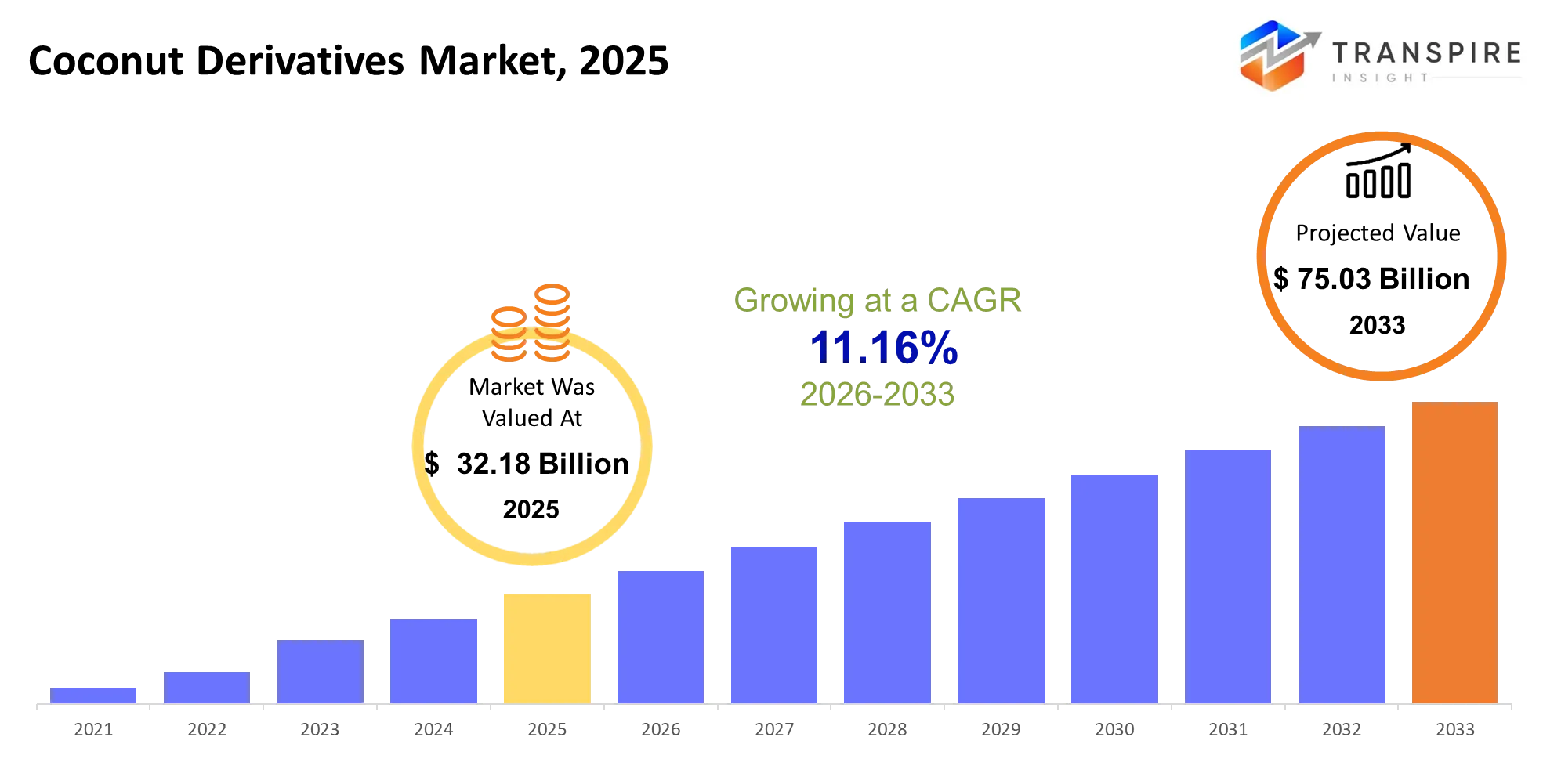
As per the Transpire Insight Analysis, The Coconut Derivatives Market size is estimated at USD 32.18 billion in 2025 and is anticipated to reach USD 75.03 billion by 2033, growing at a CAGR of 11.16% from 2026 to 2033.
The market for coconut derivatives is evolving away from bulk sales of raw ingredients and toward premium, application-ready ingredients used in foods, beverages, personal care, and wellness products. In the last three to five years, processors have diversified from the traditional high-volume products such as coconut oil and desiccated coconuts toward virgin coconut oil, coconut milk, functional powders, and speciality ingredients, while focusing on increasing extraction yields and longer shelf life. A structural shift is underway toward being more circular in the use of by-products; shells, press cake, and other waste streams are increasingly becoming sourcing material for food ingredients, packaging material, and bioplastics, driven by growing sustainability, stricter food-safety standards, and investments in local value addition. The volatile coconut supplies and prices have been a trigger for the switch, spurring processors to increase yields and develop more premium products with greater profit potential. This, coupled with efficiency gains, increasingly premium ingredients, and wider end-product application, will support ongoing revenue growth.
Coconut Derivatives Market Size & Forecast:
- Market Size 2025: USD 32.18 Billion
- Expected Market Value (2033): USD 75.03 Billion
- Forecast CAGR (2026–2033): 11.16%
- Leading Region in 2025: Asia Pacific
- Fastest Growing Region: North America
- Key Company Profiles: Nestlé, The Vita Coco Company, PepsiCo, Danone, Dabur, Marico, Axelum Resources, Franklin Baker, PT Pulau Sambu, Sambu Group, iTi Tropicals, Celebes Coconut Corporation, Goya Foods, Aroy-D, Theppadungporn Coconut.
Key Coconut Derivatives Market Insights:
Value capture is becoming more important than raw coconut volume, with processors looking to specialise in oils, plant-based ingredients and functional formats. The investments made by companies in traceability and integrated processing and by-product utilisation are beginning to have a positive effect on margins and minimise exposure to supply volatility.
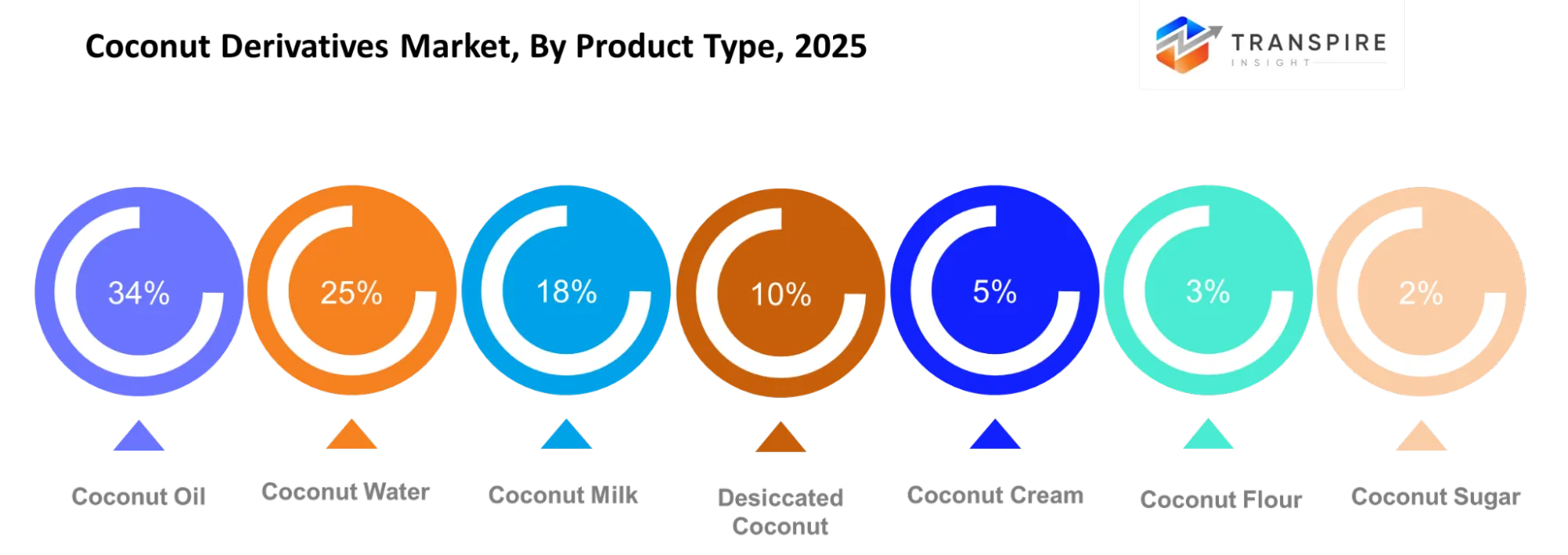
- Coconut oil’s 34% share is being redefined by MCT and cold-pressed formats, with Nestlé and Danone investing in clinical nutrition SKUs.
- For Gen Z fitness consumers, Coconut water (25%) was the platform for Vita Coco and PepsiCo to introduce low-sugar, electrolyte-fortified beverages.
- Coconut milk (18%) and cream (5%) are being combined with oat and almond, as Axelum Resources and Theppadungporn Coconut work towards creating barista-grade emulsions.
- AI vision at PT Pulau Sambu and Franklin Baker saves 15% waste by automating the grading process using desiccated coconut.
- Coconut flour (3%) and sugar (2%) are competing for gluten-free and low-GI claims, with Goya Foods and Aroy-D aiming at the Latin and Asian diaspora markets.
- EU exports are now organic and fair trade, leading Sambu Group and iTi Tropicals into blockchain traceability pilots.
- The 22% share of North America is fueled by clean-label cosmetics, in which Dabur and Marico are reformulating hair and skin lines using coconut surfactants.
- Latin America's 8% and MEA's 5.76% are becoming low-cost processing hubs, with Celebes Coconut Corporation and The Vita Coco Company developing integrated farm-to-bottle plants.
What are the Key Drivers, Restraints, and Opportunities in the Coconut Derivatives Market?
Driver:
Additional growth is the result of value-added processing, such as virgin coconut oil, coconut milk, speciality powders and functional ingredients. This occurs as processing companies and food processors turn to application-specific ingredients that can command higher margins than bulk or lightly processed coconut. Further value is created by increasing revenues per tonne by producing differentiated ingredients for beverages, bakery, cosmetics and nutraceutical applications, as well as increased throughput resulting from supply recovery.
Restraint:
Raw-material availability remains the main constraint. Ageing plantations, slow replanting, fragmented farm structures and uneven mechanisation restrict reliable coconut supply, while weather disruptions can quickly raise copra and processing costs. The issue persists because plantation renewal takes years, limiting processors’ ability to respond quickly to price or demand changes and creating volatility in procurement and margins.
Opportunity:
The strongest opportunity lies in circular, technology-led processing that converts more of each coconut into saleable outputs. Recent research highlights ultrasonic, enzyme-assisted and fermentation routes for converting virgin coconut oil press cake into functional food ingredients, while other work identifies packaging and nutraceutical applications for shells and fibre. Investment in integrated processing hubs, especially across Asia-Pacific producing regions, could therefore raise resource efficiency, diversify revenue streams and reduce waste-related costs. India's 2026 policy support reinforces adoption.
What Has the Impact of Artificial Intelligence Been on the Coconut Derivatives Market?
Artificial intelligence will start to affect coconut derivatives in the next decade, mainly through process optimisation in production. In processing plants, machine-vision cameras can now evaluate coconuts for defects, colour and maturity, helping with better raw-material sorting and fewer misformed batches. Machine learning applied to harvest, weather and inventory data can help optimise procurement timing, improve scheduling and manage stocks.
AI-driven optimisation can calibrate extraction, drying and concentration parameters in line with capacities, thereby optimising yield while monitoring energy and water consumption. Forecasting models across supply chains can identify potential shortages in supplies and guide purchasing. AI can help monitor product quality, with sensors detecting moisture and temperature levels or characteristic variations in a product. Challenges in adoption include the cost of sensor and automation infrastructure, and how to connect them, as well as the lack of historical data, or the differences between farms and processing sites, which reduce the accuracy of AI models. Therefore, more likely than replacing plant staff is the layer of decision-support and optimisation AI creates.
In August 2026, Ben Tre Import-Export Joint Stock Corporation (Betrimex) partnered with tech developers to officially implement the industry’s first AI-powered intelligent coconut-counter. This vision-system project automates raw-material inventory tracking by instantly recording and analysing high-resolution data on a centralised dashboard.
https://www.ilo.org/resource/news/ai-and-circular-economies-new-future-coconut-sector
Key Coconut Derivatives Market Trends:
The market is shifting from coconut extraction to higher-value, traceable, and resource-efficient coconut ingredients. More and more processors are monetising larger portions of the coconut and incorporating technology to hedge against raw-material volatility to safeguard margins.
- As processors look to higher-value formulations, virgin and speciality oils are becoming more common supplements to conventional oil.
- Coconut processing is moving from single-output plants to integrated plants that allow the monetisation of the oil, milk, fibres, shells and press-cake residues.
- Food manufacturers are shifting from using basic coconut ingredients to coconut powders, concentrates and functional blends for applications.
- The increased volatility has driven buyers to consider shorter procurement cycles, closer relationships with suppliers and more stringent inventory management.
- Food-safety expectations are moving toward operational standards in 2026, including food testing, traceability and quality uniformity throughout the food supply chain.
- The processing technology is shifting towards lower water/energy/chemical processing, which can boost yields and support sustainability claims.
- With increased research, coconut by-products are becoming significant, as press cake, shell and fibre are now being used as food, packaging and bio-based inputs.
- Producing regions are focusing on local value addition, so that farmers and processors can capture a greater share of value before export, and more value in producing countries and local economies.
Coconut Derivatives Market Segmentation
By Product Type:
Coconut oil leads with 34%, supported by extensive use in food, cosmetics, and personal care, while coconut water records the fastest growth at 12.3% CAGR, driven by functional beverage innovation. Coconut milk accounts for 18%, supported by dairy alternatives and culinary products, while desiccated coconut holds 10% through bakery and confectionery applications. Coconut cream contributes 5%, coconut flour 3%, coconut sugar 2%, and other derivatives 3%, reflecting growing product diversification.
By Coconut Type:
Mature coconut holds the strongest processing relevance because its developed kernel supports oil, milk, cream, and desiccated coconut extraction, while young and fresh coconut are more suited to beverages and minimally processed applications. Organic and conventional coconuts serve differentiated pricing and certification needs, with hybrid varieties offering scope for yield improvement.
By Form:
Liquid and concentrated formats are well suited to beverages, sauces, and foodservice applications, offering convenient processing and formulation. Powder and solid formats provide longer shelf life, easier transportation, and efficient ingredient handling for manufacturers. Frozen and paste forms support culinary and ready-to-use applications, while granulated formats are gaining relevance in sweeteners and functional foods. These format variations allow processors to address diverse industrial and consumer requirements.
By Application:
Food and beverage remains the principal application area, supported by coconut oil, milk, cream, flour and desiccated coconut used in cooking, bakery, confectionery and plant-based products. Cosmetics and personal care are expanding higher-value applications through oils, creams and moisturising formulations. Nutraceuticals and pharmaceuticals are also creating specialised opportunities, particularly for functional ingredients, while animal feed and household products provide additional outlets for diversified coconut derivatives.
By End User:
Food manufacturers and beverage companies remain the principal buyers, using coconut derivatives across processed foods, beverages, bakery and dairy alternatives. Cosmetic and personal-care companies generate higher-value demand for coconut oils, creams, and specialty ingredients. Pharmaceutical and nutraceutical companies are expanding applications through functional formulations. Restaurants and hotels also contribute through bulk culinary consumption, while households provide a broad consumer base for packaged coconut products.
By Distribution Channel:
Supermarkets and hypermarkets remain important for broad consumer access and established coconut-based products, while specialty stores target premium, organic, and health-focused buyers. Foodservice and wholesale channels support bulk procurement by restaurants, hotels and food manufacturers. Online retail is expanding access to niche coconut ingredients, enabling smaller brands to reach specialised consumers. This multichannel shift is improving product availability while supporting premiumisation and more targeted purchasing.
By Nature:
Organic, natural and cold-pressed products are gaining differentiation through cleaner positioning, premium quality and stronger traceability, while conventional, refined and unrefined grades continue serving cost-sensitive, volume-driven applications. Across the portfolio, processors are strengthening quality controls, certification and sourcing transparency to meet buyer requirements. These practices help manufacturers maintain consistent specifications, build trust across international supply chains, and support premium pricing for specialised coconut derivatives in food, personal care and wellness applications.
What are the Key Use Cases Driving the Coconut Derivatives Market?
The main use case is coconut oil in food manufacturing and cosmetics, which is essential for soaps, lotions, and baked goods because of its lauric acid and emulsifier qualities. This explains the 34% product share and long-term demand from industrial customers.
Use case extensions include coconut water in sports & functional beverages because of the electrolyte composition replacing synthetic additives, and coconut milk/cream in plant-based dairy as a vegan product with lactose-free customers.
Emerging use cases include coconut sugar in low-GI baking, coconut flour in gluten-free baking, and coconut MCT oils in nutraceuticals & clinical nutrition, which have a faster-than-market-adoption rate and are being studied for R&D refinement and premium prices.
|
Report Metrics |
Details |
|
Market size value in 2025 |
USD 32.18 Billion |
|
Market size value in 2026 |
USD 35.77 Billion |
|
Revenue forecast in 2033 |
USD 75.03 Billion |
|
Growth rate |
CAGR of 11.16% from 2026 to 2033 |
|
Base year |
2025 |
|
Historical data |
2021 - 2024 |
|
Forecast period |
2026 - 2033 |
|
Report coverage |
Revenue forecast, competitive landscape, growth factors, and trends |
|
Regional scope |
United States; Canada; Mexico; United Kingdom; Germany; France; Italy; Spain; Denmark; Sweden; Norway; China; Japan; India; Australia; South Korea; Thailand; Brazil; Argentina; South Africa; Saudi Arabia; United Arab Emirates |
|
Key companies profiled |
Nestlé, The Vita Coco Company, PepsiCo, Danone, Dabur, Marico, Axelum Resources, Franklin Baker, PT Pulau Sambu, Sambu Group, iTi Tropicals, Celebes Coconut Corporation, Goya Foods, Aroy-D, Theppadungporn Coconut |
|
Customization scope |
Free report customisation (country, regional & segment scope). Available customised purchase options to meet your exact research needs. |
|
Report Segmentation |
By Product Type (Coconut Oil, Coconut Water, Coconut Milk, Coconut Cream, Desiccated Coconut, Coconut Flour, Coconut Sugar, Others); By Coconut Type (Mature Coconut, Young Coconut, Fresh Coconut, Dried Coconut, Organic Coconut, Conventional Coconut, Hybrid Coconut, Others); By Form (Liquid, Powder, Solid, Frozen, Concentrated, Granulated, Paste, Others); By Application (Food & Beverage, Cosmetics, Personal Care, Pharmaceuticals, Nutraceuticals, Animal Feed, Household Products, Others); By End User (Households, Food Manufacturers, Beverage Companies, Cosmetic Companies, Pharmaceutical Companies, Restaurants, Hotels, Others); By Distribution Channel (Supermarkets, Hypermarkets, Specialty Stores, Convenience Stores, Online Retail, Foodservice, Wholesale, Others); By Nature (Organic, Conventional, Natural, Processed, Cold-pressed, Refined, Unrefined, Others). |
Which Regions are Driving the Coconut Derivatives Market Growth?
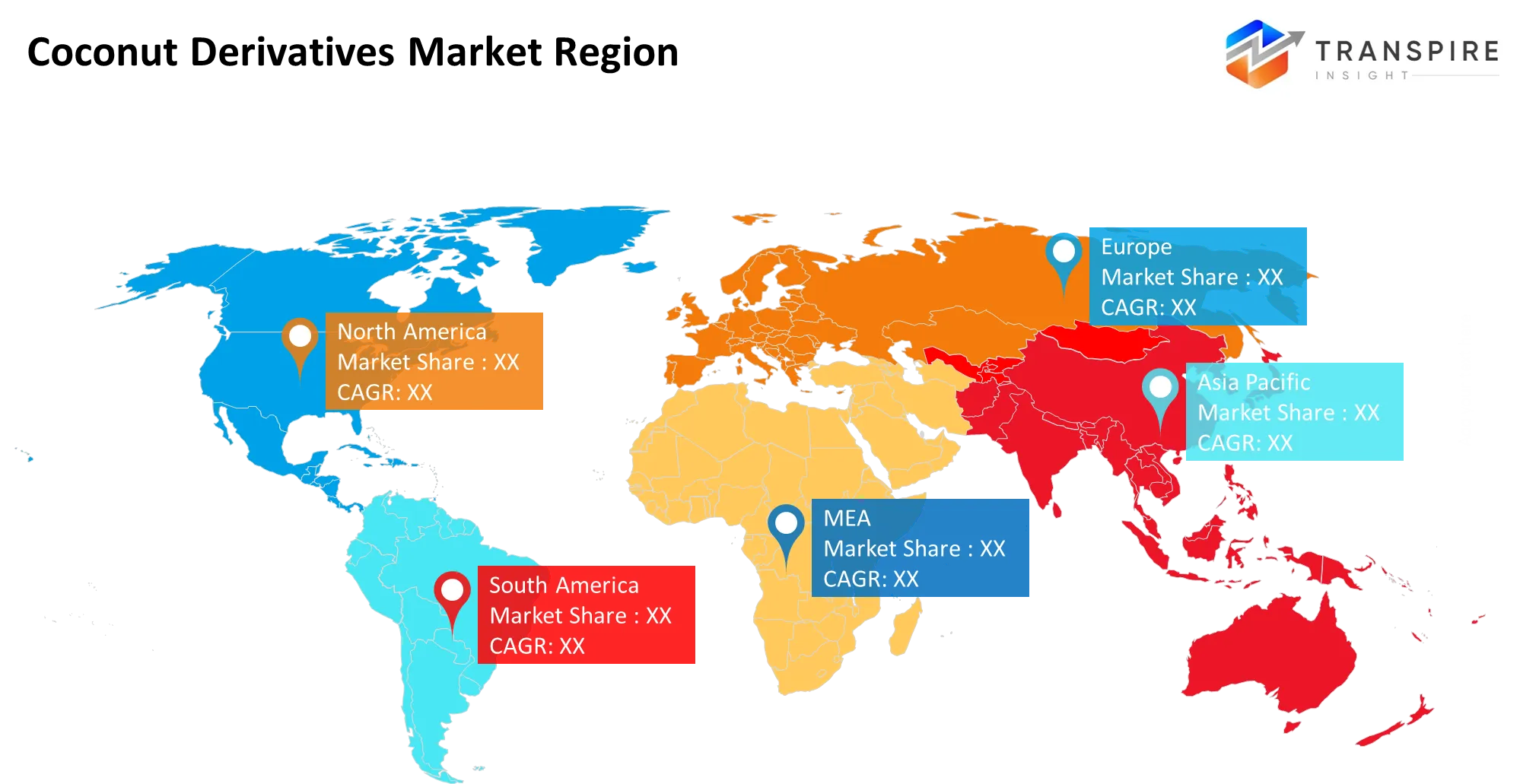
Asia Pacific leads the coconut derivatives market with 46.24%, supported by its concentration of coconut cultivation, processing capacity and established export networks. Countries such as the Philippines, Indonesia, India and Thailand provide an integrated ecosystem spanning farming, collection, extraction and ingredient manufacturing. Government programmes supporting plantation renewal, processing infrastructure and farmer productivity are helping strengthen regional supply resilience. Strong domestic consumption of coconut oil, milk and culinary ingredients further gives processors a stable base alongside export sales.
In July 2026, The Vita Coco Company acquired Copra for USD 175 million in upfront consideration, gaining access to Thai Nam Hom coconuts and expanding processing capacity in Thailand.
Europe is responsible for 18%. Europe has mature organic and clean-label certification processes, a refined food manufacturing sector, and compliance with demanding traceability regulations that give preference to higher-end derivatives. Europe has a more mature market as coconut derivatives form part of many plant-based foods, bakery and confectionery, personal care products and speciality retail. There is also increased demand for traceable and sustainable sourcing.
In July 2026, The Coconut Collab launched a new minimalist 100% pure Coconut Cream completely free of added emulsifiers, stabilisers, or preservatives. This launch directly satisfies the European demand for ultra-clean-label, non-ultra-processed food (non-UPF) options by utilising high-quality coconuts sourced ethically from Sri Lanka's 'Coconut Triangle'.
https://www.thegrocer.co.uk/news/the-coconut-collab-launches-non-upf-coconut-cream/720934.article
North America has a 22% share and the highest growth rate, with a 12.0% CAGR: functional and dairy alternative beverages, and natural personal-care products are fueling regional growth. From defused products to functional and flavoured offerings, recent innovation has added new opportunities for coconut derivatives beyond emerging shelf-worthy food and beverage applications and into hydration, nutrition and speciality ingredients. Investment in branded formats and convenience channels is building consumer reach and retail penetration. The real opportunity is the convergence of functional formulations, transparent sourcing and localised reach.
In February 2026, Coco5 secured a $10 million funding round led by Loop Capital to scale its electrolyte-enhanced coconut water and expand its operational capacity.
https://www.foodbusinessnews.net/articles/29731-coconut-water-company-scores-10-million-in-funding
Who are the Key Players in the Coconut Derivatives Market, and how do they compete?
The market is fragmented but consolidating, with integrated players controlling farm development, processing, and branding. Competition is based on lower production costs and higher-quality products, not only on lower product prices. Developing this premium niche entails stronger innovation and certification, differentiation of products and applications.
Innovators Nestlé and Danone benefit from innovation-led, vertically integrated plant-based portfolios; PepsiCo and The Vita Coco Company focus on differentiated beverage formats, positionings and added value functions. Dabur and Marico compete with a trusted presence and strong portfolio of branded coconut-oil products in Asian countries. Axelum Resources, Franklin Baker, PT Pulau Sambu and Sambu Group compete with integrated processing, scale of export and supply-chain integration for superior product consistency and competitive production cost. ITi Tropicals offers differentiated ingredients for industrial applications. Celebes Coconut Corporation promotes domestic sourcing and value-added coconut exports. Goya Foods focuses on ethnic-food distribution channels and a wide product portfolio to grow coconut-based cooking ingredients. Aroy-D and Theppadungporn Coconut differentiate with Thailand-grown culinary product portfolios and international distribution. Higher standards and product-specific formats (certifications, specialised applications, processing) are what future growth depends on, rather than on volume market shares.
Key Players are:
- Nestlé
- The Vita Coco Company
- PepsiCo
- Danone
- Dabur
- Marico
- Axelum Resources
- Franklin Baker
- PT Pulau Sambu
- Sambu Group
- iTi Tropicals
- Celebes Coconut Corporation
- Goya Foods
- Aroy-D
- Theppadungporn Coconut
Recent Development News
- In July 2026, ITC Foods launched a novel fusion beverage called "B Natural Coconut Cola" in India. This product blends the hydration benefits of natural coconut water with the flavour and carbonation of traditional cola, providing a zero-caffeine, low-calorie, and zero-added-sugar option targeted at health-conscious consumers looking for functional drink alternatives.https://www.foodtechbiz.com/product-launches/b-natural-launches-coconut-cola
- In August 2026, ALO Drink rolled out two new additions to its 100% not-from-concentrate coconut beverage portfolio across the United States. The expansion introduced "100% Coconut Water with Chocolate" and "100% Coconut Water with Pineapple" into nationwide grocery channels to capture growing consumer demand for premium, naturally hydrating tropical flavours.https://www.bevnet.com/pr/2026/07/29/alo-drink-to-debut-bold-new-100-coconut-water-with-chocolate--coconut-water-with-pineapple-flavors-in-august
- In June 2026, CocoGoodsCo launched its Prebiotics Coconut Water at the Summer Fancy Food Show. The product combines coconut water with 6 grams of prebiotic fiber from five plant-based sources, extending coconut-based ingredients into functional nutrition and value-added beverage applications.https://www.prnewswire.com/news-releases/sustainable-coconut-innovation-cocogoodsco-shines-at-fancy-food-show-2026-302813077.html
What Strategic Insights Define the Future of the Coconut Derivatives Market?
The market is moving towards integrated value creation, with processors realising multiple revenue streams per coconut rather than a reliance on one derivative. The risk in the shadow is plantation productivity. Ageing trees and fragmented, climate-disturbed farms can pressure supply even if downstream processing increases. Such a structural margin risk means processors face the dual challenge of higher raw-material prices to keep up with an unrelenting customer push for lower prices. The opportunity in the shadows is circular processing technologies that turn press cake, fibre and shells into functional ingredients, packaging inputs or bio-based materials. Producers that blend applications with traceability can help improve resource utilisation and also generate new, higher-price pools. Strategically, focus should be on integrated processing hubs, predictive procurement, planting renewal and application-specific product development. Collaborations with farmers, tech providers and food businesses can fast-track this shift and alleviate pressure on commodity markets.
Key Segmentations are:
By Product Type
- Coconut Oil
- Coconut Water
- Coconut Milk
- Coconut Cream
- Desiccated Coconut
- Coconut Flour
- Coconut Sugar
- Others
By Coconut Type
- Mature Coconut
- Young Coconut
- Fresh Coconut
- Dried Coconut
- Organic Coconut
- Conventional Coconut
- Hybrid Coconut
- Others
By Form
- Liquid
- Powder
- Solid
- Frozen
- Concentrated
- Granulated
- Paste
- Others
By Application
- Food & Beverage
- Cosmetics
- Personal Care
- Pharmaceuticals
- Nutraceuticals
- Animal Feed
- Household Products
- Others
By End User
- Households
- Food Manufacturers
- Beverage Companies
- Cosmetic Companies
- Pharmaceutical Companies
- Restaurants
- Hotels
- Others
By Distribution Channel
- Supermarkets
- Hypermarkets
- Specialty Stores
- Convenience Stores
- Online Retail
- Foodservice
- Wholesale
- Others
By Nature
- Organic
- Conventional
- Natural
- Processed
- Cold-pressed
- Refined
- Unrefined
- Others
By Regional Analysis
North America
- United States
- Canada
- Mexico
Europe
- Germany
- United Kingdom
- France
- Spain
- Italy
- Rest of Europe
Asia Pacific
- Japan
- China
- Australia & New Zealand
- South Korea
- India
- Rest of Asia Pacific
South America
- Brazil
- Argentina
- Rest of South America
Middle East & Africa
- Saudi Arabia
- United Arab Emirates
- South Africa
- Rest of the Middle East & Africa
Frequently Asked Questions
Find quick answers to common questions.
The coconut derivatives market size was valued at USD 32.18 billion in 2025 and is poised to reach USD 75.03 billion by 2033, expanding at an 11.16% CAGR.
Key segments for the coconut derivatives market are By Product Type (Coconut Oil, Coconut Water, Coconut Milk, Coconut Cream, Desiccated Coconut, Coconut Flour, Coconut Sugar, Others); By Coconut Type (Mature Coconut, Young Coconut, Fresh Coconut, Dried Coconut, Organic Coconut, Conventional Coconut, Hybrid Coconut, Others); By Form (Liquid, Powder, Solid, Frozen, Concentrated, Granulated, Paste, Others); By Application (Food & Beverage, Cosmetics, Personal Care, Pharmaceuticals, Nutraceuticals, Animal Feed, Household Products, Others); By End User (Households, Food Manufacturers, Beverage Companies, Cosmetic Companies, Pharmaceutical Companies, Restaurants, Hotels, Others); By Distribution Channel (Supermarkets, Hypermarkets, Specialty Stores, Convenience Stores, Online Retail, Foodservice, Wholesale, Others); By Nature (Organic, Conventional, Natural, Processed, Cold-pressed, Refined, Unrefined, Others).
Growth is primarily driven by value-added processing, expansion of plant-based foods and beverages, functional nutrition applications, premium organic and cold-pressed products, and improved utilisation of coconut by-products.
The coconut derivatives market is led by major manufacturers including Nestlé, The Vita Coco Company, PepsiCo, Danone, Dabur, Marico, Axelum Resources, Franklin Baker, PT Pulau Sambu, Sambu Group, iTi Tropicals, Celebes Coconut Corporation, Goya Foods, Aroy-D, Theppadungporn Coconut.
Asia Pacific, holding 46.24% of the market, drives dynamics through its strong coconut cultivation base, integrated processing infrastructure, export networks, supportive agricultural programmes, and substantial domestic consumption
Commercial opportunities include integrated processing, circular utilisation of coconut waste, functional coconut ingredients, premium organic products, AI-enabled supply-chain optimisation, plantation renewal, and expansion across North American and European speciality markets.
- Nestlé
- The Vita Coco Company
- PepsiCo
- Danone
- Dabur
- Marico
- Axelum Resources
- Franklin Baker
- PT Pulau Sambu
- Sambu Group
- iTi Tropicals
- Celebes Coconut Corporation
- Goya Foods
- Aroy-D
- Theppadungporn Coconut
About the Authors

Chetan Dhatrak
I’m Chetan Dhatrak, a Senior Research Analyst at Transpire Insight, specializing in the Consumer Goods, Foods and Beverages industry. I focus on analyzing market trends, consumer behavior, competitive landscapes, and industry developments to deliver accurate, data-driven insights. My research at Transpire Insight is built on credible sources and in-depth analysis, helping businesses and readers better understand market dynamics, emerging opportunities, and evolving consumer preferences. I’m committed to creating reliable, well-researched content that supports informed decision-making and reflects the latest developments in the consumer goods and food & beverage sectors.

Chakradhar Khansole
Chakradhar serves as the Research Director at Transpire Insight, bringing over 8 years of experience in technology, innovation, and strategic market intelligence. He specializes in transforming complex market data into actionable business insights that enable organizations to make informed, growth-oriented decisions. Recognized for his strategic vision and analytical expertise, Chakradhar leads high-impact research initiatives, delivering comprehensive market assessments, competitive intelligence, and forward-looking industry analysis.
Recently Published Reports
-
Apr 2026
Baby Infant Formula Market
Baby Infant Formula Market Size, Share & Analysis Report By ype (Infant Milk, Follow On Milk, Specialty Baby Milk, Growing-Up Milk), By Ingredient (Carbohydrate, Fat, Protein, Minerals, Vitamins, and Others), By Product Form (Powder, Liquid, and Ready-to-feed), By Distribution Channels (Supermarket/Hypermarket, Specialty Store, Pharmacies, Online Retail, and Others), and Geography (North America, Europe, Asia-Pacific, Middle East and Africa, South and Central America), 2021 - 2031
-
Apr 2026
Edible Insects for Animal Feed Market
Edible Insects for Animal Feed Market Size, Share & Analysis Report By Type (Insect Powder, Insect Meal, Insect Bar, Insect Paste, Insect Oil, and Others), By Insect Type (Beetles, Cricket, Caterpillar, Hymenoptera, Orthoptera, Tree Bugs, and Others), By Application (Livestock, Pet Food, and Aquaculture), By Livestock Type (Poultry, Swine, and Others), and Geography (North America, Europe, Asia-Pacific, Middle East and Africa, South and Central America), 2021 - 2031
-
Apr 2026
Food Industry Disinfection and Bacterial Control Market
Food Industry Disinfection and Bacterial Control Market Size, Share & Analysis Report By Type (Chemical Disinfectants, Physical Disinfectants, and Biocides and Antimicrobials), By Application (Food Processing Equipment Surface Disinfection, Food Preparation Areas Surface Disinfection, Storage Areas Surface Disinfection, Anti-microbial Coatings Food Preservation, and Preservative Solutions Food Preservation), By End User (Meat and Poultry Processing, Dairy Processing, Seafood Processing, Bakery and Confectionery, Restaurants and Commercial Kitchens, and Food Service Providers), By Sales Channel (Online, Offline), and Geography (North America, Europe, Asia-Pacific, Middle East and Africa, South and Central America), 2021 - 2031
-
May 2026
Freeze Dried Food Market
Freeze Dried Food Market Size, Share & Analysis Report By Product Type (Fruits, Vegetables, Freeze-Dried Dairy Products, Freeze-Dried Meat and Seafood, Freeze-Dried Pet Food, and Prepared Meal), By Nature (Organic, and Conventional), By Form (Powdered, Granules, and Diced), By End Use (Breakfast Cereals, Dairy Products, Bakery & Confectionery, Nutritional Bars & Supplements, Powdered Beverages, Snacks, and Retail (Household)), and Geography (North America, Europe, Asia-Pacific, Middle East and Africa, South and Central America), 2021 - 2031