

Coconut Products Market Summary:
According to Transpire Insights, a detailed research report on the market reflects that the food and beverage application segment dominates the Coconut Products Market, accounting for approximately 71.29% of the total share worldwide, equivalent to around USD 18.86 billion in 2025. Vita Coco leads the market with approximately USD 609.78 million in annual revenue and an estimated 18% market share, making it a leading contributor to market development, innovation, advanced coconut product production, expanding manufacturing capabilities, and growth dynamics.
Market Snapshot
- Market Value (2025): USD 9.08 Billion.
- Expected Market Value (2026): USD 9.82 Billion.
- Estimated Market Value (2033): USD 17.40 Billion.
- Forecast CAGR (2026–2033): 8.52%.
- Leading Region in 2025: Asia Pacific
- Second-largest Region: Europe
- Fastest Growing Region: North America
Introduction
The coconut products market is characterized by the presence of a wide range of processed and value-added products derived from coconut such as coconut meat, coconut water, coconut milk, coconut cream, coconut oil and desiccated coconut. These products find increasing use in food and beverage, cosmetics and personal care, nutraceuticals, and other industrial applications. “The market is becoming important as consumers are increasingly moving toward natural, plant-based, clean-label and dairy-free options.” Functional, nutritional, moisturizing and hydrating benefits of coconut based products also help in their adoption by various end-use industries. The increasing demand for plant-based foods, functional beverages, natural personal care products and sustainable ingredients is further creating opportunities for market expansion. Moreover, the coconut products market's overall growth prospects are being boosted by technological innovations in coconut processing, product innovation and increasing commercialization of value-added coconut derivatives.
For instance:
- North America: Strong retail distribution and increasing online sales channels are boosting demand for plant-based foods, natural hydration, clean-label ingredients and coconut-based personal care products.
- Asia Pacific: Asia Pacific is expected to be a prominent region in the coconut products market, owing to the abundant coconut production, rising processing capabilities, rising domestic consumption, and investments in value-added products.

Market Highlights: -
- Asia Pacific is expected to grow at a rapid CAGR in the Coconut Products Market by holding around 33% of the share during the forecast period.
- Europe is anticipated to hold roughly 28% share of the Coconut Products Market over the predicted time frame.
- North America is anticipated to hold around 29% share of the Coconut Products Market over the predicted time frame.
- By Product Type, the Coconut oil dominated the market and holds nearly 45% share in 2025 and is projected to grow at a substantial CAGR during the forecast period.
- By Form, the Liquid dominated the market and holds nearly 83.4% share in 2025 and is projected to grow at a substantial CAGR during the forecast period.
- By Application, the Food & Beverages dominated the market and holds nearly 45% share in 2025 and is projected to grow at a substantial CAGR during the forecast period.
- Government initiatives in support of coconut cultivation, palm replacement, farmer organizations, processing infrastructure, value-added production, quality certification, and export promotion are strengthening the coconut products market and improving industry competitiveness.
How is Technology Driving Growth in the Coconut Products Market?
Technology is driving the coconut products market growth by improving processing efficiency, product quality, shelf life, and utilization of resources. Advanced extraction techniques such as cold-pressed and enzyme-assisted processing help to support better quality coconut oil, milk and other value added products while retaining desirable nutritional and functional properties. High pressure processing and other non-thermal preservation technologies are helping to extend the shelf life of coconut water and perishable products while maintaining the product properties. Automation and digital supply-chain technologies are increasing the efficiency, traceability and distribution of manufacturing, while e-commerce platforms are giving access to coconut-based products on international markets.
|
Report Metrics |
Details |
|
Market size value in 2025 |
USD 9.08 Billion |
|
Market size value in 2026 |
USD 9.82Billion |
|
Revenue forecast in 2033 |
USD 17.40 Billion |
|
Growth rate |
CAGR of 8.52%% from 2026 to 2033 |
|
Base year |
2025 |
|
Historical data |
2021 - 2024 |
|
Forecast period |
2026 - 2033 |
|
Report coverage |
Revenue forecast, competitive landscape, growth factors, and trends |
|
Regional scope |
United States; Canada; Mexico; United Kingdom; Germany; France; Italy; Spain; Denmark; Sweden; Norway; China; Japan; India; Australia; South Korea; Thailand; Brazil; Argentina; South Africa; Saudi Arabia; United Arab Emirates |
|
Key company profiled |
Nestlé, PepsiCo, The Vita Coco Company, The Coca-Cola Company, McCormick & Company, Taste Nirvana, Axelum Resources, Franklin Baker, Thai Coconut Public Company, Renuka Foods, iTi Tropicals, Edward & Sons, Celebes Coconut Corporation, PT Coconut, The Coconut Company |
|
Customization scope |
Free report customization (country, regional & segment scope). Avail customized purchase options to meet your exact research needs. |
|
Report Segmentation |
By Product Type (Coconut Oil, Coconut Milk, Coconut Water, Coconut Cream, Desiccated Coconut, Coconut Flour, Coconut Sugar, Others); By Form (Liquid, Solid, Powder, Frozen, Concentrated, Dried, Paste, Others); By Application (Food & Beverages, Cosmetics & Personal Care, Nutraceuticals, Pharmaceuticals, Animal Feed, Household Products, Industrial Applications, Others); By Distribution Channel (Supermarkets & Hypermarkets, Convenience & Grocery Stores, Specialty Stores, Online Retail, Foodservice, Direct Sales, Distributors, Others); By End User (Households, Food Manufacturers, Beverage Companies, Cosmetic Manufacturers, Restaurants & Cafés, Pharmaceutical Companies, Nutraceutical Companies, Others) |
Market Drivers
Growing Demand for Plant-Based and Natural Products: Increasing consumer preference for plant-based, organic, clean-label, and naturally derived products is driving demand for coconut-based foods, beverages, personal care products, and nutraceuticals. Increasing use of dairy alternatives such as coconut milk and cream is driving applications in the food and beverage industry. The increasing consumption of coconut water for a natural hydration drink is also contributing to the growth of the market. Coconut oil and other coconut-derived ingredients are becoming increasingly popular in the cosmetics and personal care industry, because they have natural functional properties. Increasing retail distribution, e-commerce penetration, sustainable sourcing and product innovation also support the coconut products market.
For Instance: - Europe: The growth of the market in the region is supported by the increasing penetration of plant-based foods, natural cosmetics, sustainable ingredients, and coconut-based dairy alternatives. The growth of the market is also supported by the strict sustainability and traceability requirements.
Restrain
Climate Vulnerability and Supply Constraints In the market, supply risks for coconut products stem from extreme weather, droughts and climate change in major producing regions. Coconut palms take a long time to mature, so you can’t quickly increase production if demand increases. Fresh coconut products are perishable and thus add to the costs of transportation and cold-chain. Competition from alternative plant-based ingredients, such as soy, almond and oat, may also limit market growth in price-sensitive applications, exacerbating pricing pressure.
Analysis of Prices and Consumer Behaviour
The coconut products market is dominated by coconut oil and coconut-based ingredients, with the food and beverage industry accounting for a significant portion of the total market demand, driven primarily by the increasing consumption of coconut milk, coconut water, cream, oil and desiccated coconut in food and beverage applications. Premium organic and cold-pressed coconut products are expected to be priced higher than conventional products owing to better processing, quality certification, sustainable sourcing, and consistent product quality.Packaged and processed coconut products account for around 45% of the total coconut product sales due to their convenience, versatility, longer shelf life and increasing retail availability. The demand for coconut derived products is around 70% from the food & beverage and personal care industries. The consumer buying behavior reveals that 55% of consumers value product quality, natural ingredients, sustainability and nutritional attributes the most. A further 33% of buyers prefer bulk purchase agreements or long-term contracts to cut the cost of procurement and ensure a steady flow of coconut products to the international markets.
Who are the Key Players in the Coconut Products Market and how do they compete?
To compete in the international market, companies in the Coconut Products Market need to concentrate on solutions for end-use industries, product innovations, and creating distribution networks ly. This type of competition, trying not just for price but also for product quality, advanced processing technologies, sustainable sourcing, value added coconut products & integration with modern distribution & retail platforms, means ongoing product development and helps organizations to achieve greater product quality, supply efficiency, resource optimization & market reach.
Innovation in coconut-based food & beverage products, plant-based solutions, sustainable sourcing practices, diversified product portfolios contribute to Nestlé’s stronger market position. PepsiCo sets itself apart from its competitors by developing high-quality coconut products for beverages, food processing, plant-based applications and consumer markets. Vita Coco Company expands its position by providing integrated solutions in coconut water, functional beverages, product innovation and sustainable sourcing, helping consumers and retailers access convenient, natural and value-added coconut products.
Top Companies in the Coconut Products Market
- Nestlé
- PepsiCo
- The Vita Coco Company
- The Coca-Cola Company
- McCormick & Company
- Taste Nirvana
- Axelum Resources
- Franklin Baker
- Thai Coconut Public Company
- Renuka Foods
- iTi Tropicals
- Edward & Sons
- Celebes Coconut Corporation
- PT Coconut
- The Coconut Company
Market Segmentation
The Coconut Products Market share is divided into five categories: By Product Type, By Form, By Application, By Distribution Channel, By End User.
The Coconut oil dominated the market, accounting for nearly 45% in 2025 and is expected to rise at a significant CAGR during the forecast period.
The Coconut Products Market is segmented by product type into coconut oil, coconut milk, coconut water, coconut cream, desiccated coconut, coconut flour, coconut sugar, others. Among these, the Coconut oil dominated the market, accounting for nearly 45% in 2025 and expected to increase at a significant CAGR during the forecast period. The natural, versatile and multifunctional qualities of coconut oil are driven by a broad consumer preference for such ingredients in food, beverages, cosmetics, and personal care.
The Liquid dominated the market, accounting for nearly 83.4% in 2025, and is expected to rise at a significant CAGR during the forecast period.
The Coconut Products Market is segmented by form into liquid, solid, powder, frozen, concentrated, dried, paste, others. Among these, the Liquid dominated the market, accounting for nearly 83.4% in 2025 and expected to increase at a significant CAGR during the forecast period. Supported by convenience and versatility and consumer demand, driven by widespread use of liquid coconut products in beverages, food processing and plant-based applications.
The Food & Beverages dominated the market, accounting for nearly 45% in 2025 and is expected to rise at a significant CAGR during the forecast period.
The Coconut Products Market is segmented by application into food & beverages, cosmetics & personal care, nutraceuticals, pharmaceuticals, animal feed, household products, industrial applications, others. Among these, the Food & Beverages dominated the market, accounting for nearly 45% in 2025 and expected to increase at a significant CAGR during the forecast period. Backed by clean-label trends, product versatility and growing consumption, propelled by rising coconut water, milk, oil and plant-based foods demand.

Regional Segment Analysis of the Coconut Products Market:
- North America (U.S., Canada, Mexico)
- Europe (Germany, France, U.K., Italy, Spain, Rest of Europe)
- Asia-Pacific (China, Japan, India, Rest of APAC)
- South America (Brazil and the Rest of South America)
- The Middle East and Africa (UAE, South Africa, Rest of MEA)
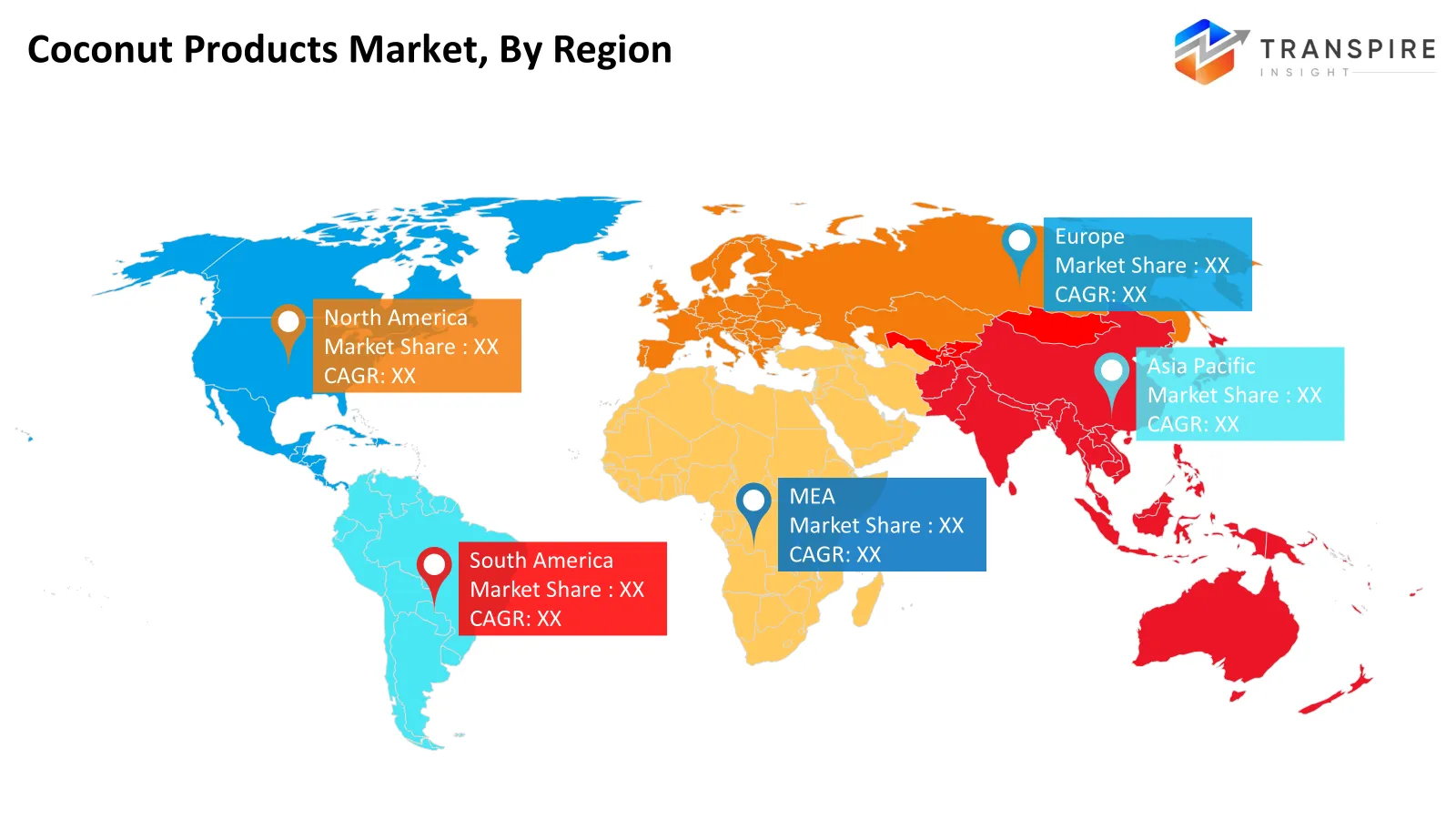
Asia Pacific is the fastest-growing region in the Coconut Products Market during the period, holding around 33% share.
Asia Pacific is expected to dominate the coconut products market due to abundant coconut cultivation, high availability of raw materials, growing processing infrastructure, and increasing domestic consumption. Countries including Indonesia, the Philippines, & India have established coconut production and processing ecosystems that enable a range of value-added products. Moreover, rising demand for coconut water, coconut milk, and coconut oil, along with rising exports and investments in modern processing technologies are bolstering the market position of the region.
Europe is expected to grow at a rapid CAGR in theCoconut Products Market, holding roughly28% of the share during the forecast period.
The Coconut Products Market is expected to grow at a rapid pace in Europe due to the growing demand for plant-based foods, natural cosmetics, clean-label ingredients & coconut-based dairy alternatives. Rising consumer awareness about sustainable sourcing, organic products, and healthier beverage options is driving market growth. Regional demand is further boosted by strong retail infrastructure, established food processing industries, rising imports of coconut derived ingredients & continuous product innovation. Additionally, increasing investments in traceable, ethically-sourced and environmentally responsible coconut products, combined with strict sustainability standards, are prompting manufacturers to expand their presence across European markets.
North America is the fastest-growing region in the Coconut Products Market during the period, holding around 29% share.
The coconut products market is witnessing strong growth in North America as more consumers are choosing plant-based, organic, clean-label and functional products. The growing demand for coconut water, coconut milk, coconut oil and dairy alternatives is broadening the application scope in food, beverages, cosmetics and nutraceuticals. Furthermore, the market is also expanding due to rising health awareness, product innovations, e-commerce penetration, and strong retail networks. Moreover, regional market development is being fortified by higher investments in sustainable sourcing, premium coconut products and convenient packaged formats.
Strategies for Market Growth in Non-Leading Regions:
Development of non-leading regions through efficient and scalable coconut processing and value-addition technologies would benefit small to medium-sized processors. The local cultivation and processing of coconut and the setting up of regional manufacturing facilities for coconut products can reduce import dependency and lower the overall cost of production. Moreover, thru strategic alliances with regional farmers, coconut processors, food and beverage manufacturers, cosmetics companies and distributors, market penetration for coconut product suppliers will improve. Training programs and technical skill development will be necessary to increase knowledge of coconut cultivation, processing, quality control and product standardization. Moreover, flexible financing options, long-term supply agreements, and contract manufacturing arrangements will make coconut products more accessible and will promote their adoption across various end-use industries. Enhanced accessibility to coconut products and sustainable worldwide market growth in developing regions will be achieved by increased collaborations with government, agricultural and food processing organizations and the utilization of digital sales channels.
Future Market Trends for the Coconut Products Market: -
- Plant-Based and Functional Products – Growing consumer interest in dairy-free foods, coconut milk, cream, yogurt, coconut water and value added snacks will stimulate creativity in products and uptake.
- Clean-Label Beauty & Wellness Demand for natural, organic, and plant-based ingredients from consumers will drive the use of coconut oil and coconut-based ingredients in cosmetics, personal care, and wellness products.
- Sustainability and Supply Chain Innovation With a greater emphasis on sustainable sourcing, environmentally friendly packaging, digital traceability and climate resilient coconut growing, manufacturers will be pushed to improve supply-chain efficiency and improve long-term market sustainability.
Recent Development
April 2026: Alpro expanded its plant-based product range and bolstered innovation in the coconut products market with the introduction of a matcha green tea coconut-and-soy hybrid drink.
February 2026: Coconut product manufacturers boosted processing capacity via investments in facilities and acquisitions, supporting increased production of coconut-derived ingredients and meeting growing demand for plant-based products.
This study forecasts revenue at , regional and country levels from 2020 to 2033. Transpire Insights has segmented the Coconut Products Market based on the below-mentioned segments:
Coconut Products Market, By Product Type
- Coconut Oil
- Coconut Milk
- Coconut Water
- Coconut Cream
- Desiccated Coconut
- Coconut Flour
- Coconut Sugar
- Others
Coconut Products Market, By Form
- Liquid
- Solid
- Powder
- Frozen
- Concentrated
- Dried
- Paste
- Others
Coconut Products Market, By Application
- Food & Beverages
- Cosmetics & Personal Care
- Nutraceuticals
- Pharmaceuticals
- Animal Feed
- Household Products
- Industrial Applications
- Others
Coconut Products Market, By Distribution Channel
- Supermarkets & Hypermarkets
- Convenience & Grocery Stores
- Specialty Stores
- Online Retail
- Foodservice
- Direct Sales
- Distributors
- Others
Coconut Products Market, By End User
- Households
- Food Manufacturers
- Beverage Companies
- Cosmetic Manufacturers
- Restaurants & Cafés
- Pharmaceutical Companies
- Nutraceutical Companies
- Others
Coconut Products Market, By Regional Analysis
North America
- US
- Canada
- Mexico
Europe
- Germany
- UK
- France
- Italy
- Spain
- Russia
- Rest of Europe
Asia Pacific
- China
- Japan
- India
- South Korea
- Australia
- Rest of Asia Pacific
South America
- Brazil
- Argentina
- Rest of South America
Middle East & Africa
- UAE
- Saudi Arabia
- Qatar
- South Africa
- Rest of the Middle East & Africa
Frequently Asked Questions
Find quick answers to common questions.
Rising demand for plant-based foods, clean-label ingredients, natural beverages, dairy alternatives, cosmetics, and sustainable coconut-derived products is driving market growth.
Coconut oil dominates due to its versatile applications across food, beverages, cosmetics, personal care, wellness, and other consumer product industries.
Asia Pacific dominates due to abundant coconut cultivation, strong processing infrastructure, rising domestic consumption, exports, and investments in value-added coconut products.
Advanced extraction, non-thermal preservation, automation, digital traceability, and e-commerce are improving processing efficiency, product quality, shelf life, and market accessibility.
Plant-based products, functional beverages, clean-label beauty, sustainable sourcing, eco-friendly packaging, digital traceability, and climate-resilient cultivation will shape future market growth.
- Nestlé
- PepsiCo
- The Vita Coco Company
- The Coca-Cola Company
- McCormick & Company
- Taste Nirvana
- Axelum Resources
- Franklin Baker
- Thai Coconut Public Company
- Renuka Foods
- iTi Tropicals
- Edward & Sons
- Celebes Coconut Corporation
- PT Coconut
- The Coconut Company
About the Authors

Chetan Dhatrak
I’m Chetan Dhatrak, a Senior Research Analyst at Transpire Insight, specializing in the Consumer Goods, Foods and Beverages industry. I focus on analyzing market trends, consumer behavior, competitive landscapes, and industry developments to deliver accurate, data-driven insights. My research at Transpire Insight is built on credible sources and in-depth analysis, helping businesses and readers better understand market dynamics, emerging opportunities, and evolving consumer preferences. I’m committed to creating reliable, well-researched content that supports informed decision-making and reflects the latest developments in the consumer goods and food & beverage sectors.

Chakradhar Khansole
Chakradhar serves as the Research Director at Transpire Insight, bringing over 8 years of experience in technology, innovation, and strategic market intelligence. He specializes in transforming complex market data into actionable business insights that enable organizations to make informed, growth-oriented decisions. Recognized for his strategic vision and analytical expertise, Chakradhar leads high-impact research initiatives, delivering comprehensive market assessments, competitive intelligence, and forward-looking industry analysis.
Recently Published Reports
-
Apr 2026
Bottled Water Market
Bottled Water Market Size, Share & Analysis Report By Product Type (Still Bottled Water, Carbonated Bottled Water, Functional Bottled Water, and Others), By Packaging (PET, Cans, and Others), By Sales Channel (Supermarkets/Hypermarkets, Convenience Stores/Drug Stores, Grocery Stores/Club Stores, Foodservice, and Others) and Geography (North America, Europe, Asia-Pacific, Middle East and Africa, South and Central America), 2021 - 2032
-
Apr 2026
Color Cosmetic Packaging Market
Color Cosmetic Packaging Market Size, Share & Analysis Report By Application (Mascara Packaging, Liquid Packaging, and Liquid Face), By Type (Tubes & Bottles, Pens & Markers, Compacts & Containers, and Droppers & Pumps), and Geography (North America, Europe, Asia-Pacific, Middle East and Africa, South and Central America), 2021 - 2031
-
Apr 2026
External Microphone For Camera Market
External Microphone For Camera Market Size, Share & Analysis Report By Type (Shotgun Microphone, Lavalier Microphone, and Others), By Application (Digital Camera, Professional Video Camera, and Others), and Geography (North America, Europe, Asia-Pacific, Middle East and Africa, South and Central America), 2021 - 2031
-
Apr 2026
Foot Orthotic Insoles Market
Foot Orthotic Insoles Market Size, Share & Analysis Report By Type (Pre-fabricated, and Custom-made), By Material (Thermoplastic, Composite Carbon Fiber, and Others), By Distribution Channel (Drug Stores, Hospitals & Clinics, and Others), and Geography (North America, Europe, Asia-Pacific, Middle East and Africa, South and Central America), 2021 - 2031