
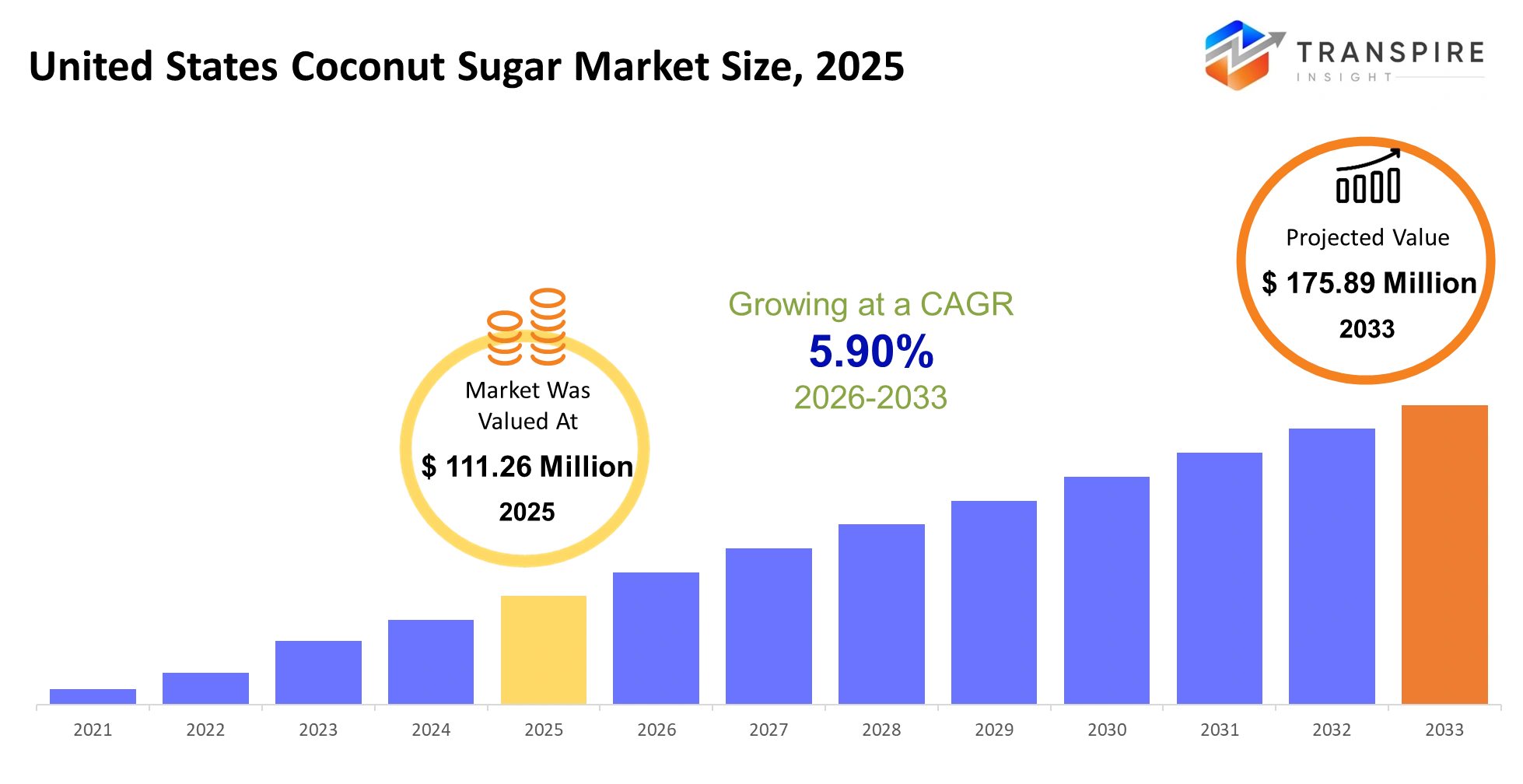
United States Coconut Sugar Market Size & Forecast:
- United States Coconut Sugar Market Size 2025: USD 111.26 Million
- United States Coconut Sugar Market Size 2033: USD 175.89 Million
- United States Coconut Sugar Market CAGR: 5.90%
- United States Coconut Sugar Market Segments:By Type (Organic, Conventional, Raw, Processed), By Form (Granules, Powder, Syrup, Blocks), By Application (Food & Beverage, Bakery, Confectionery, Dairy), By Distribution Channel (Online, Retail, Specialty Stores, Supermarkets), By End-User (Consumers, Food Companies, Retailers, Restaurants).
To learn more about this report,  Download Free Sample Report
United States Coconut Sugar Market Summary:
The United States Coconut Sugar Market size is estimated at USD 111.26 Million in 2025 and is anticipated to reach USD 175.89 Million by 2033, growing at a CAGR of 5.90% from 2026 to 2033. The United States coconut sugar market is experiencing continuous expansion because customers increasingly choose natural sweeteners that undergo minimal processing. Coconut sugar has become more popular because people are currently more aware of health benefits and wellness advantages. The demand for products continues to grow because customers now use these items in organic food products and beverage items and bakery goods. Customers can access products through e-commerce platforms and specialty retail stores, while sustainable product sourcing and clean-label consumer preferences influence purchasing behaviour across different customer segments.
Key Market Trends & Insights:
- The consumer market shows a growing trend which moves from refined sugar products to natural sweetener options. Health-conscious customers prefer coconut sugar because it requires basic processing and originates from natural plant materials.
- Coconut sugar is often viewed as a superior choice because people worry about their blood sugar levels and the rising number of lifestyle diseases. The substance attracts users who desire to maintain consistent energy levels because of its glycemic index rating.
- Food manufacturers use coconut sugar as a sweetener for their organic products and clean-label products. This practice matches consumer preferences for transparent product information which contains fewer additives and features familiar ingredients.
- Coconut sugar is now used extensively in commercial bakery products and drinks and candy. Its mild caramel flavouring serves as a popular choice for use in high-quality products and artisanal goods.
- Coconut sugar costs more than conventional sugar which makes it a high-end product. Yet a portion of consumers shows willingness to spend extra money because they believe they will gain health advantages and environmental advantages from the product.
United States Coconut Sugar Market Segmentation
By Type
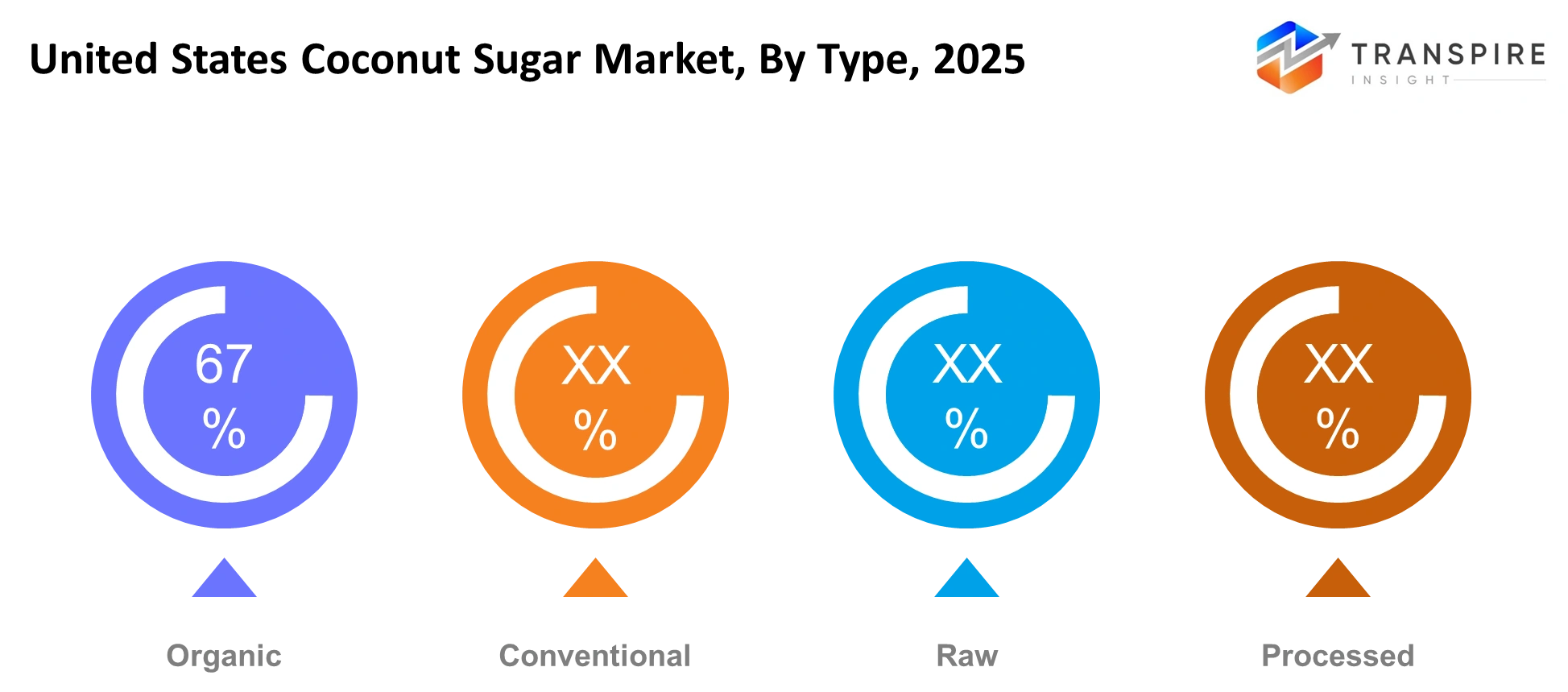
- Organic: Healthy consumers have shown keen interest in the recent times in the coconut sugar that is organic, salt-free foods without the use of synthetic chemicals.The product meets the growing need for organic products because it contains no synthetic fertilisers or pesticides. The product attracts customers who value sustainable and authentic products which provide better nutritional content.
- Conventional: Customers can find conventional coconut sugar at multiple locations because it costs less than organic coconut sugar. Price-sensitive consumers choose this product because it offers natural sweetener options which they prefer to refined sugar. The product functions as a suitable daily use option because it contains minimal processing despite not having organic certification.
- Raw: The value of raw coconut sugar has increased because its low processing methods enable the product to keep more of its original natural nutrients. The product attracts customers who seek to create their dishes using only authentic natural ingredients. The product attracts niche health markets because it provides natural texture and enhanced flavour while maintaining authentic product qualities and nutritional value.
- Processed: Coconut sugar processing allows manufacturers to produce a product that retains its original texture and colour while achieving extended storage life. The product serves as a vital component in industrial food production because it enables manufacturers to produce identical products throughout their operations. The product remains popular despite nutrient loss during processing because it offers convenient handling and maintains industrial system compatibility.
To learn more about this report, Download Free Sample Report
By Form
- Granules: The most common form of coconut sugar exists as granulated coconut sugar because it provides both easy usage and multiple application possibilities. The sweetener functions as a direct substitute for standard sugar across all cooking methods, including baking and beverage preparation.Consumers use the product because its natural texture allows them to use it as a daily sweetener without changing their regular routine.
- Powder: The powder form of coconut sugar exists as a very fine substance which enables users to achieve perfect mixture results through its application at their choosing. The ingredient serves its purpose in baking and dessert creation and specialty drink preparation. The product achieves quick dissolution, which improves both texture and consistency of premium and artisanal food products that depend on their visual appearance and mouthfeel characteristics.
- Syrup: Coconut sugar syrup exists as a liquid product which enables users to blend it easily into their drinks and dessert creations. The product has become popular among customers who prefer natural liquid sweeteners. The product delivers rich flavour with smooth texture which customers can use for drizzling purposes, drink flavouring or gourmet recipe enhancement.
- Blocks: A coconut sugar block represents a traditional coconut sugar form which contains fewer processing steps and delivers stronger flavour strength. The product has established a following among particular ethnic cuisines and specific market segments. The product requires more effort for usage but attracts customers who want genuine products that follow conventional cooking methods.
By Application
- Food & Beverage: Coconut sugar serves as a primary ingredient for the food and beverage industry, which uses the sweetener for its beverages and sauces and processed food products. The ingredient serves as a preferred choice for health-focused products because it originates from nature and has a mild, sweet taste which meets the demand for clean product labelling with transparent information.
- Bakery: Coconut sugar provides bakeries with two main benefits because it produces a caramel taste and improves product textures. The ingredient shows its common usage across premium artisanal products which range from cakes and cookies to breads. Bakers can create complex taste experiences through traditional baking recipes when they use the ingredient because it has a distinctive flavour.
- Confectionery: Coconut sugar has become a popular ingredient for confectionery products, which include chocolates and candies. The product provides consumers with a natural substitute for refined sugar, which enables them to experience sweet flavours without major health risks. The sweetener creates a subtle flavour that complements various dessert dishes.
- Dairy: Coconut sugar serves as a sweetener for dairy products which include yogurt and flavoured milk and desserts. The product meets the rising market demand for healthier dairy products because it maintains its natural composition. The product improves taste while helping dairy products achieve clean-label certification.
By Distribution Channel
- Online: Online platforms expand the distribution of coconut sugar products to consumers who enjoy accessible product selection and simple product comparison. E-commerce development enables niche brands and premium brands to establish direct contact with their intended customers.
- Retail: Coconut sugar sales through traditional retail stores maintain their ongoing significance. Daily consumers can easily access grocery stores and local shops. Store shelf visibility builds customer trust, which increases their impulse purchases of healthier products.
- Specialty Stores: Coconut sugar distribution occurs through specialty stores that include organic and health food retail channels. Premium natural products attract customers to these stores. Staff recommendations, together with curated selections, create a better shopping experience that impacts customer purchasing choices.
- Supermarkets: Coconut sugar products are widely distributed through supermarkets which sell them at low prices. The store serves various customers, which leads to increased product popularity. Health and organic sections display products to draw in customers who want healthier sugar options.
By End-User
- Consumers: Health-conscious consumers use coconut sugar as a sugar replacement because of their specific dietary needs. People have increased market demand for coconut sugar because they use it as a complete sweetener substitute for table sugar in their culinary and beverage preparation.
- Food Companies: With the increase in consumer preference for all-natural, food-processing companies have incorporated coconut sugar into very many foods. The ingredient enables brands to market their products as healthier options while providing customers with complete product information, especially for organic and premium product categories.
- Retailers: Retailers create major effects because they decide which products to sell and how they will promote coconut sugar items to their customers. The methods used to place products in stores, together with staff recommendations, create major effects on product visibility, which results in increased customer awareness and sales to different market segments.
- Restaurants: Restaurants start to include coconut sugar in their menus, which health-conscious customers who spend more money at premium restaurants. Restaurants use the ingredient to create desserts and beverages and specialty dishes which meet the growing demand from customers who prefer natural, sustainable food options.
Country Insights
The coconut sugar market in the United States continues to develop according to changing consumer patterns and the rising demand for healthier food choices. Increasing knowledge about alternatives to refined sugar has led to the kitchen use of coconut sugar which exists in both regular cooking spaces and upscale food establishments. Urban customers create a market demand because they prefer products which contain natural plant-based materials and show their actual contents.
California and New York represent regions with strong health and wellness developments which lead to greater adoption rates because their residents practice organic food consumption and their markets offer innovative food products. The rise of e-commerce platforms together with the growth of specialized health stores has improved coconut sugar distribution across the United States. The market remains small when compared to traditional sweeteners, yet it continues to expand because of sustainability issues and ethical sourcing methods and the growing trend of food and beverage industry experimentation.
Recent Development News
In March 2026, Demand for Natural Sweeteners Increased Across the U.S.: Consumers are increasingly choosing natural sugar substitutes, boosting interest in coconut sugar. Health awareness and clean-label trends are driving this shift.
In January 2026, U.S. Tariffs Influence Coconut-Based Product Pricing: Trade policies introduced in 2025 have led to pricing instability in coconut-derived ingredients, indirectly impacting coconut sugar costs.
|
Report Metrics |
Details |
|
Market size value in 2025 |
USD 111.26 Million |
|
Market size value in 2026 |
USD 117.79 Million |
|
Revenue forecast in 2033 |
USD 175.89 Million |
|
Growth rate |
CAGR of 5.90% from 2026 to 2033 |
|
Base year |
2025 |
|
Historical data |
2021 – 2024 |
|
Forecast period |
2026 – 2033 |
|
Report coverage |
Revenue forecast, competitive landscape, growth factors, and trends |
|
Country scope |
United States |
|
Key company profiled |
Big Tree Farms, Nutiva, Wholesome Sweeteners, BetterBody Foods, Madhava, NOW Foods, Terrasoul, Navitas Organics, Bob’s Red Mill, Domino Foods, SunOpta, Earth Circle Organics, Naturel West, Associated British Foods, Cargill. |
|
Customization scope |
Free report customization (country, regional & segment scope). Avail customized purchase options to meet your exact research needs. |
|
Report Segmentation |
By Type (Organic, Conventional, Raw, Processed), By Form (Granules, Powder, Syrup, Blocks), By Application (Food & Beverage, Bakery, Confectionery, Dairy), By Distribution Channel (Online, Retail, Specialty Stores, Supermarkets), By End-User (Consumers, Food Companies, Retailers, Restaurants). |
Key United States Coconut Sugar Company Insights
The United States coconut sugar market shows a competitive environment which consists of several companies that use product quality and sustainable practices and innovative solutions to differentiate themselves from competitors. The main companies in the market, Nutiva, Coconut Secret and Big Tree Farms, establish their market presence through their organic product range and their commitment to ethical sourcing. Companies are developing new products while improving their supply chain operations to satisfy increased customer demand. The companies Madhava and Navitas Organics use consumer education together with their clean-label products to create customer trust while expanding their business presence.
Company List
- Big Tree Farms
- Nutiva
- Wholesome Sweeteners
- BetterBody Foods
- Madhava
- NOW Foods
- Terrasoul
- Navitas Organics
- Bob’s Red Mill
- Domino Foods
- SunOpta
- Earth Circle Organics
- Naturel West
- Associated British Foods
- Cargill
United States Coconut Sugar Market Report Segmentation
By Type
- Organic
- Conventional
- Raw
- Processed
By Form
- Granules
- Powder
- Syrup
- Blocks
By Application
- Food & Beverage
- Bakery
- Confectionery
- Dairy
By Distribution Channel
- Online
- Retail
- Specialty Stores
- Supermarkets
By End-User
- Consumers
- Food Companies
- Retailers
- Restaurants
Frequently Asked Questions
Find quick answers to common questions.
The approximate United States Coconut Sugar Market size for the market will be USD 175.89 Million in 2033.
The key segments of the United States Coconut Sugar Market are By Type (Organic, Conventional, Raw, Processed), By Form (Granules, Powder, Syrup, Blocks), By Application (Food & Beverage, Bakery, Confectionery, Dairy), By Distribution Channel (Online, Retail, Specialty Stores, Supermarkets), By End-User (Consumers, Food Companies, Retailers, Restaurants).
Major players in the United States Coconut Sugar Market are Big Tree Farms, Nutiva, Wholesome Sweeteners, BetterBody Foods, Madhava, NOW Foods, Terrasoul, Navitas Organics, Bob’s Red Mill, Domino Foods, SunOpta, Earth Circle Organics, Naturel West, Associated British Foods, Cargill.
The current market size of the United States Coconut Sugar Market is USD 111.26 Million in 2025.
The United States Coconut Sugar Market CAGR is 5.90%.
- Big Tree Farms
- Nutiva
- Wholesome Sweeteners
- BetterBody Foods
- Madhava
- NOW Foods
- Terrasoul
- Navitas Organics
- Bob’s Red Mill
- Domino Foods
- SunOpta
- Earth Circle Organics
- Naturel West
- Associated British Foods
- Cargill
Recently Published Reports
-
Apr 2026
Baby Infant Formula Market
Baby Infant Formula Market Size, Share & Analysis Report By ype (Infant Milk, Follow On Milk, Specialty Baby Milk, Growing-Up Milk), By Ingredient (Carbohydrate, Fat, Protein, Minerals, Vitamins, and Others), By Product Form (Powder, Liquid, and Ready-to-feed), By Distribution Channels (Supermarket/Hypermarket, Specialty Store, Pharmacies, Online Retail, and Others), and Geography (North America, Europe, Asia-Pacific, Middle East and Africa, South and Central America), 2021 - 2031
-
Apr 2026
Edible Insects for Animal Feed Market
Edible Insects for Animal Feed Market Size, Share & Analysis Report By Type (Insect Powder, Insect Meal, Insect Bar, Insect Paste, Insect Oil, and Others), By Insect Type (Beetles, Cricket, Caterpillar, Hymenoptera, Orthoptera, Tree Bugs, and Others), By Application (Livestock, Pet Food, and Aquaculture), By Livestock Type (Poultry, Swine, and Others), and Geography (North America, Europe, Asia-Pacific, Middle East and Africa, South and Central America), 2021 - 2031
-
Apr 2026
Food Industry Disinfection and Bacterial Control Market
Food Industry Disinfection and Bacterial Control Market Size, Share & Analysis Report By Type (Chemical Disinfectants, Physical Disinfectants, and Biocides and Antimicrobials), By Application (Food Processing Equipment Surface Disinfection, Food Preparation Areas Surface Disinfection, Storage Areas Surface Disinfection, Anti-microbial Coatings Food Preservation, and Preservative Solutions Food Preservation), By End User (Meat and Poultry Processing, Dairy Processing, Seafood Processing, Bakery and Confectionery, Restaurants and Commercial Kitchens, and Food Service Providers), By Sales Channel (Online, Offline), and Geography (North America, Europe, Asia-Pacific, Middle East and Africa, South and Central America), 2021 - 2031
-
May 2026
Freeze Dried Food Market
Freeze Dried Food Market Size, Share & Analysis Report By Product Type (Fruits, Vegetables, Freeze-Dried Dairy Products, Freeze-Dried Meat and Seafood, Freeze-Dried Pet Food, and Prepared Meal), By Nature (Organic, and Conventional), By Form (Powdered, Granules, and Diced), By End Use (Breakfast Cereals, Dairy Products, Bakery & Confectionery, Nutritional Bars & Supplements, Powdered Beverages, Snacks, and Retail (Household)), and Geography (North America, Europe, Asia-Pacific, Middle East and Africa, South and Central America), 2021 - 2031