
Cocoa Liquor Market Summary:
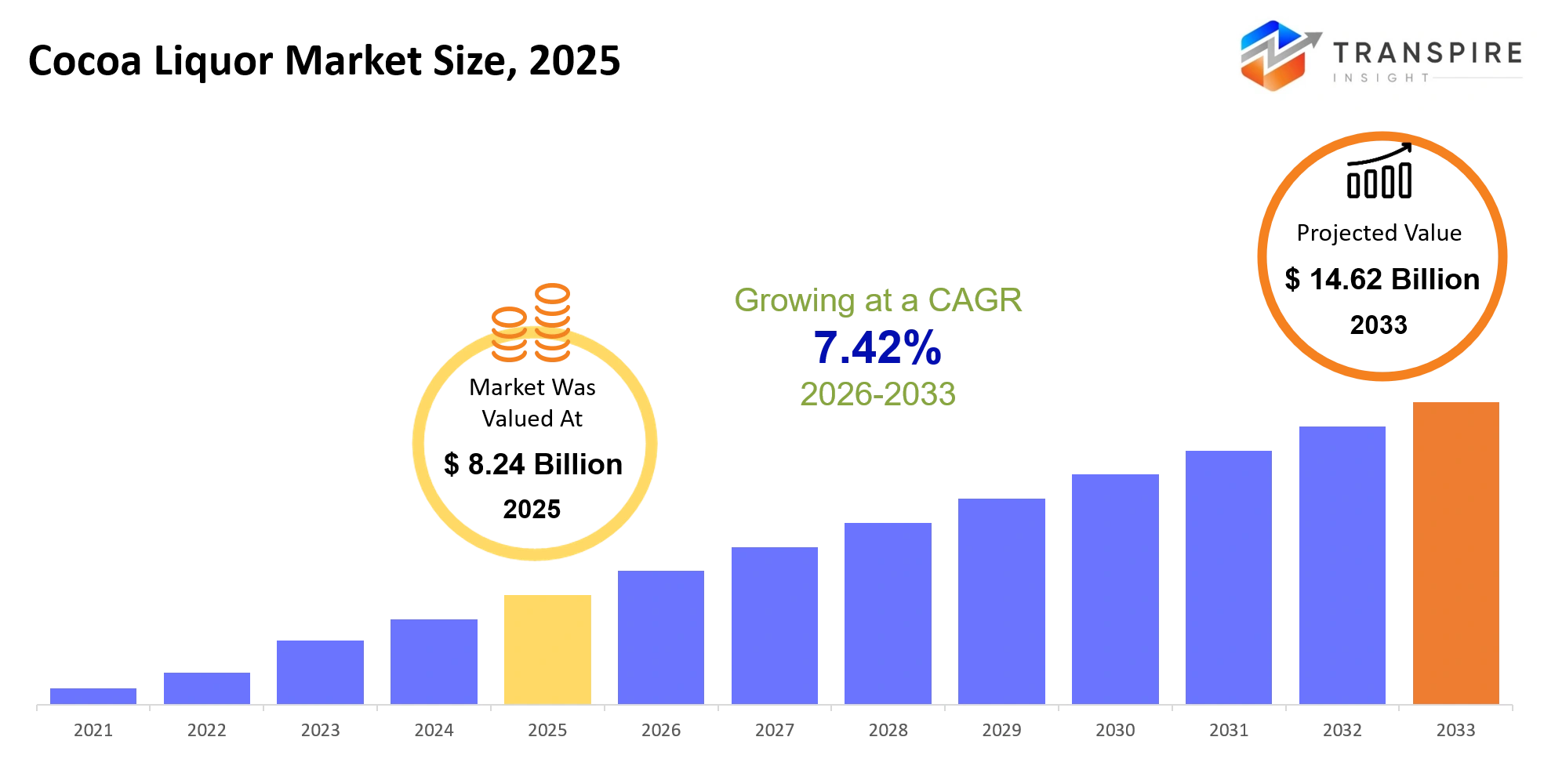
As per Transpire Insight Analysis, the Cocoa Liquor Market size is estimated at USD 8.24 Billion in 2025 and is anticipated to reach USD 14.62 Billion by 2033, growing at a CAGR of 7.42% from 2026 to 2033. Drivers for growth in the world market for cocoa liquor include increased demand for gourmet chocolates, increasing cocoa product consumption, and sustainability of cocoa.
cocoa liquor is very significant for the confectionery industry. This is due to the fact that it provides the product necessary for the production of various candies and chocolates. Consumers' preferences have changed; now they require high-quality chocolate and also want to be aware of its ingredients. Such an attitude leads to the changes that manufacturers apply in the production process of cocoa. They start to renew their plants and ensure the quality of ingredients they use. There is one significant driver that is causing such behaviour of the market participants. It is the growing demand of consumers for dark chocolate and premium confectionery. Such a tendency can be seen on markets and through online channels. As a result, manufacturers of chocolate start to produce it in larger quantities.
There will be continued growth of the cocoa liquor market due to the increasing demand for speciality chocolates and other products that contain cocoa. This will result in an increased demand for quality cocoa liquor, which will benefit companies and ensure continuous expansion of the market. The market for cocoa liquor will continue to grow due to the increased demand for premium cocoa-based products.
Cocoa Liquor Market Size & Forecast:
- Market Size 2025: USD 8.24 Billion
- Expected Market Value (2033): USD 14.62 Billion
- Forecast CAGR (2026–2033): 7.42%
- Leading Region in 2025: Europe
- Fastest Growing Region: Asia Pacific
- Key Company Profiles: Barry Callebaut, Cargill, Olam Food Ingredients, Blommer Chocolate, ECOM Agroindustrial, Fuji Oil, Guan Chong, JB Foods, Cemoi, Puratos, Ferrero, Nestlé, Mondelez International, Mars Incorporated, Hershey.
Key Market Insights:
The market for cocoa liquor has been developing constantly, with emphasis being made on the production of high-quality products using sustainable resources and advanced technology. Increased investments in building reliable supplies of cocoa and development of new products contribute to increased competition in the industry.
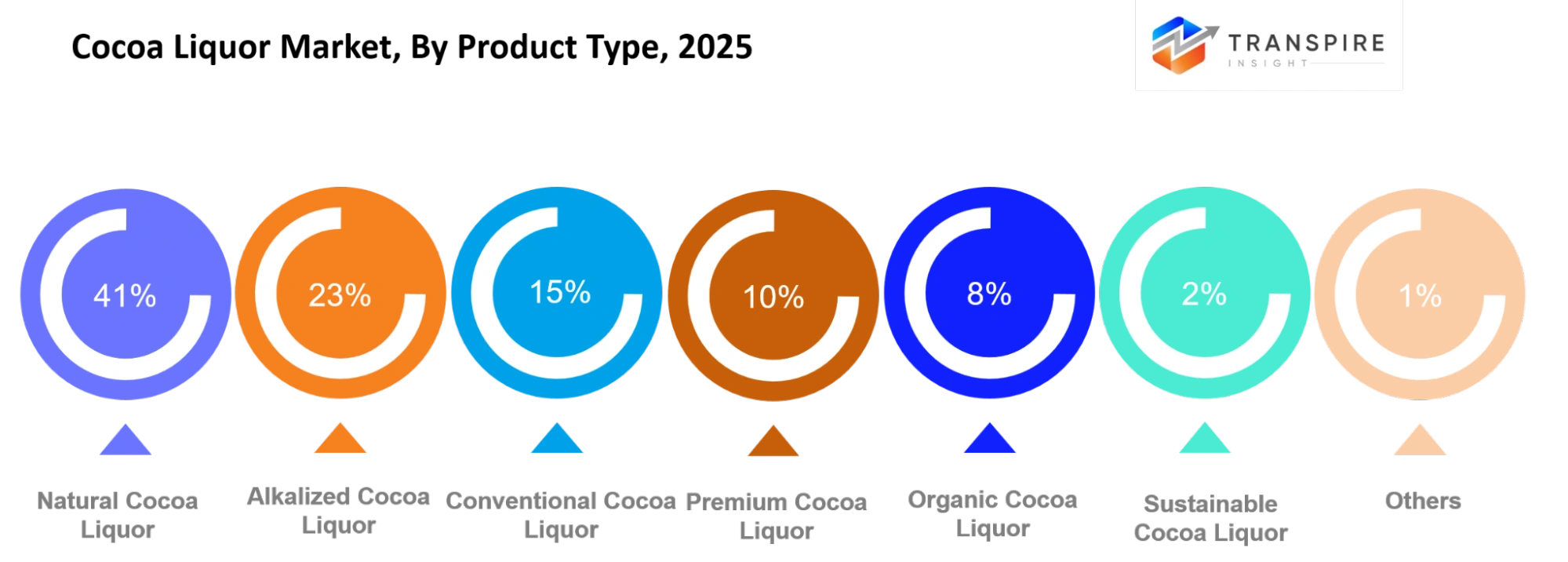
- The leading product type is Natural Cocoa Liquor, having a market share of 41% due to its wide application in chocolate making and genuine taste of cocoa.
- Organic Cocoa Liquor is expected to show the highest CAGR of 14.9% owing to the increasing inclination towards organic and healthy foods among consumers.
- Alkalized Cocoa Liquor makes up 23% of the market; companies have improved their processing techniques to maintain even colours and flavours in their products.
- Conventional Cocoa Liquor holds 15% of the market because of its economical pricing and common use in mass production of foods.
- The Premium Cocoa Liquor comprises 10% of the market due to increasing popularity of gourmet chocolates and candies.
- Organic and sustainable production practices are driving companies to source certified cocoa and develop a transparent cocoa supply chain.
- Quality assurance of products through digital and automated technology will make the production process more efficient and consistent.
- Increasing consumer preference for ethical ingredient sourcing is affecting procurement policies of companies.
- Manufacturers are developing new products to cater for bakery, dairy, beverages, and nutraceutical applications.
What are the Key Drivers, Restraints, and Opportunities in the Cocoa Liquor Market?
Drivers
The market for cocoa liquor has been growing due to an increase in demand for premium chocolates, bakery products, dairy products, and beverages. One of the reasons for this development has been the increased preference of consumers for premium-quality cocoa ingredients that have real flavour. This has prompted players in the industry to improve their cocoa processing technology and production capabilities, as well as source their cocoa ingredients from credible sources. Premium confectioneries and clean-label foods have played an important role in fueling this adoption in the market.
Restraints
Despite high demand in the market, there are still challenges in terms of volatility of cocoa bean prices and uncertainties in the supply chain. Cocoa production is still very sensitive to climatic factors, crop disease, and the productivity of the farms in producing nations. This problem tends to make the availability of raw materials uncertain and costly, making it hard for companies to price their products in the long run.
Opportunities
There is an opportunity in the increase in the production of sustainable and organic cocoa liquor. More food manufacturers are looking for sources that have sustainability certification. It is believed that the continued investment in digital supply chain tracking, sustainable farming relationships, and rapidly growing markets in the Asia Pacific will generate future business success and competitive advantage.
What Has the Impact of Artificial Intelligence Been on the Cocoa Liquor Market?
Artificial Intelligence has become significant in terms of enhancing efficiencies and quality in the international cocoa liquor market. AI systems are utilised by cocoa processors to assess quality, control the roast profile, and automate the production process, thereby ensuring uniformity in taste and texture. With analysis of production data, AI has helped in identifying variances in the process and minimising loss of raw materials.
AI has improved predictive powers in the cocoa value chain. The companies employ machine learning to predict availability and demand for beans to help manufacturers procure the required beans, prevent operational interruptions and respond to changes in the market environment. In addition, AI has been employed in the quality assurance process, where defects in processing are detected to minimise losses. Using the technology may pose certain difficulties for many processors of cocoa. The high cost of implementing the technology, compatibility with existing manufacturing processes, and the requirement of having skilled technical specialists can become a constraint on its use, especially for small and medium enterprises. Nevertheless, constant investment in manufacturing and logistics processes through intelligent manufacturing and intelligent supply chains is predicted to pay off in terms of productivity and sustainability. In March 2025, Scientists in cooperation with Ferrero Italia created a machine learning-based quality control system which utilizes chemical fingerprints to differentiate between defective cocoa liquor and high-quality ones. This technology showed an accuracy of up to 93%, which ensured the possibility of more effective quality control and constant cocoa liquor production.
Key Market Trends:
Market trends in the cocoa liquor sector indicate ongoing development towards sustainable raw-material sourcing, the production of high-end cocoa liquor, and the adoption of new technological solutions in the production process.
- There is a change in customer behaviour towards purchasing conventional cocoa products and an increasing demand for high-end and sustainably sourced cocoa liquor.
- Processors are introducing automation systems for the production process and digital technologies for the quality control system to ensure consistency of their production and decrease production losses.
- The trend of creating organic and natural cocoa products becomes more visible due to the awareness about the health and environmental issues that can be caused by conventional cocoa products.
- Manufacturers are building their supply chain through cooperation with certified cocoa farmers and sustainability programs.
- High-end chocolate brands are developing their product line-up with high-end cocoa liquor incorporated into it.
- More money is being invested in the implementation of energy-efficient processing technologies to decrease production costs.
Cocoa Liquor Market Segmentation
By Product Type
Natural Cocoa Liquor enjoys a dominant market share of 41% owing to its popularity in making chocolates because of its flavorful characteristics. The market share of Alkalized Cocoa Liquor is 23% since it is used in products that need a mild and darker taste. Conventional Cocoa Liquor has a share of 15%, while that of Premium Cocoa Liquor is 10% because of rising demand for premium confectionery products. Organic Cocoa Liquor commands a share of 8% and is expected to grow at the highest CAGR of 14.9% as consumers' preference towards organic and sustainably sourced raw materials increases. Sustainable Cocoa Liquor has 2%, while Others make up the balance of 1%.
By Application
Chocolate production is still the predominant application segment that accounts for most of the cocoa liquor market as it acts as the primary ingredient used for the production of chocolates. The bakery and confectionery industry is steadily growing its usage to improve taste and texture, and beverage manufacturers are using cocoa liquor in the preparation of premium quality drinks. Usage in the dairy and nutraceutical sectors is also growing, with manufacturers developing cocoa-based products to cater to consumers' changing needs.
By End User
The chocolate manufacturers still are the predominant end users because of their constant demand for quality cocoa ingredients. Food processing and beverage manufacturers are increasing procurement for developing new products, and the bakery and dairy industries are expanding their uses of cocoa liquor in premium quality products.
By Distribution Channel
The direct sales channel remains the most popular one for distribution because it allows the manufacturers to establish long-term sourcing agreements with major food companies. Distributors of ingredients have become highly relevant in addressing the needs of regional manufacturers, whereas exporters keep expanding their presence in international markets. Online B2B sales channels are becoming increasingly common for facilitating the procurement process and accessing suppliers from around the world. Wholesalers and other distribution channels are involved in helping the market grow through product availability for different industries.
By Processing Methods
Fermentation of cocoa liquor remains the most common method of processing due to its better flavour development and wider acceptance in business. Roasting continues to be widely used for its benefits in terms of aroma and consistency, but cold-processing of cocoa liquor has become increasingly popular as it helps preserve natural properties of the ingredient. Speciality processing methods have become more common for premium chocolate manufacturers, and others keep evolving through new investments in advanced technologies.
What are the Key Use Cases Driving the Cocoa Liquor Market?
The use of cocoa liquor in the manufacture of chocolate continues to be the major application that fuels the market for cocoa liquor globally. The segment of Natural Cocoa Liquor holds a market share due to its importance in making chocolate bars, pralines, filled chocolates, and other confectionery items. The unique cocoa taste and its creamy nature make it a popular ingredient for all types of chocolate manufacturers.
Cocoa liquor, apart from being used in chocolate, has also gained popularity in bakery products, desserts, beverages, and ice creams as a source of improving the taste, colour, and quality of the products. Food manufacturers have started using this ingredient in premium recipes catering to the changing consumer tastes. New applications in the nutraceuticals and functional food items are emerging for the cocoa-based ingredients due to their natural cocoa compounds.
|
Report Metrics |
Details |
|
Market size value in 2025 |
USD 8.24 Billion |
|
Market size value in 2026 |
USD 8.86 Billion |
|
Revenue forecast in 2033 |
USD 14.62 Billion |
|
Growth rate |
CAGR of 7.42% from 2026 to 2033 |
|
Base year |
2025 |
|
Historical data |
2021 - 2024 |
|
Forecast period |
2026 - 2033 |
|
Report coverage |
Revenue forecast, competitive landscape, growth factors, and trends |
|
Regional scope |
United States; Canada; Mexico; United Kingdom; Germany; France; Italy; Spain; Denmark; Sweden; Norway; China; Japan; India; Australia; South Korea; Thailand; Brazil; Argentina; South Africa; Saudi Arabia; United Arab Emirates |
|
Key company profiled |
Barry Callebaut, Cargill, Olam Food Ingredients, Blommer Chocolate, ECOM Agroindustrial, Fuji Oil, Guan Chong, JB Foods, Cemoi, Puratos, Ferrero, Nestlé, Mondelez International, Mars Incorporated, Hershey. |
|
Customization scope |
Free report customization (country, regional & segment scope). Avail customized purchase options to meet your exact research needs. |
|
Report Segmentation |
By Product Type (Natural Cocoa Liquor, Alkalized Cocoa Liquor, Organic Cocoa Liquor, Conventional Cocoa Liquor, Premium Cocoa Liquor, Sustainable Cocoa Liquor, Others); By Application (Chocolate Manufacturing, Bakery & Confectionery, Beverages, Dairy Products, Ice Cream, Nutraceuticals, Others); By End User (Chocolate Manufacturers, Food Processing Companies, Beverage Companies, Bakery Industry, Dairy Industry, Retail Brands, Others); By Distribution Channel (Direct Sales, Ingredient Distributors, Online B2B Platforms, Exporters, Wholesalers, Others); By Processing Method (Fermented, Roasted, Cold Processed, Specialty Processing, Others). |
Which Regions are Driving the Cocoa Liquor Market Growth?
North America
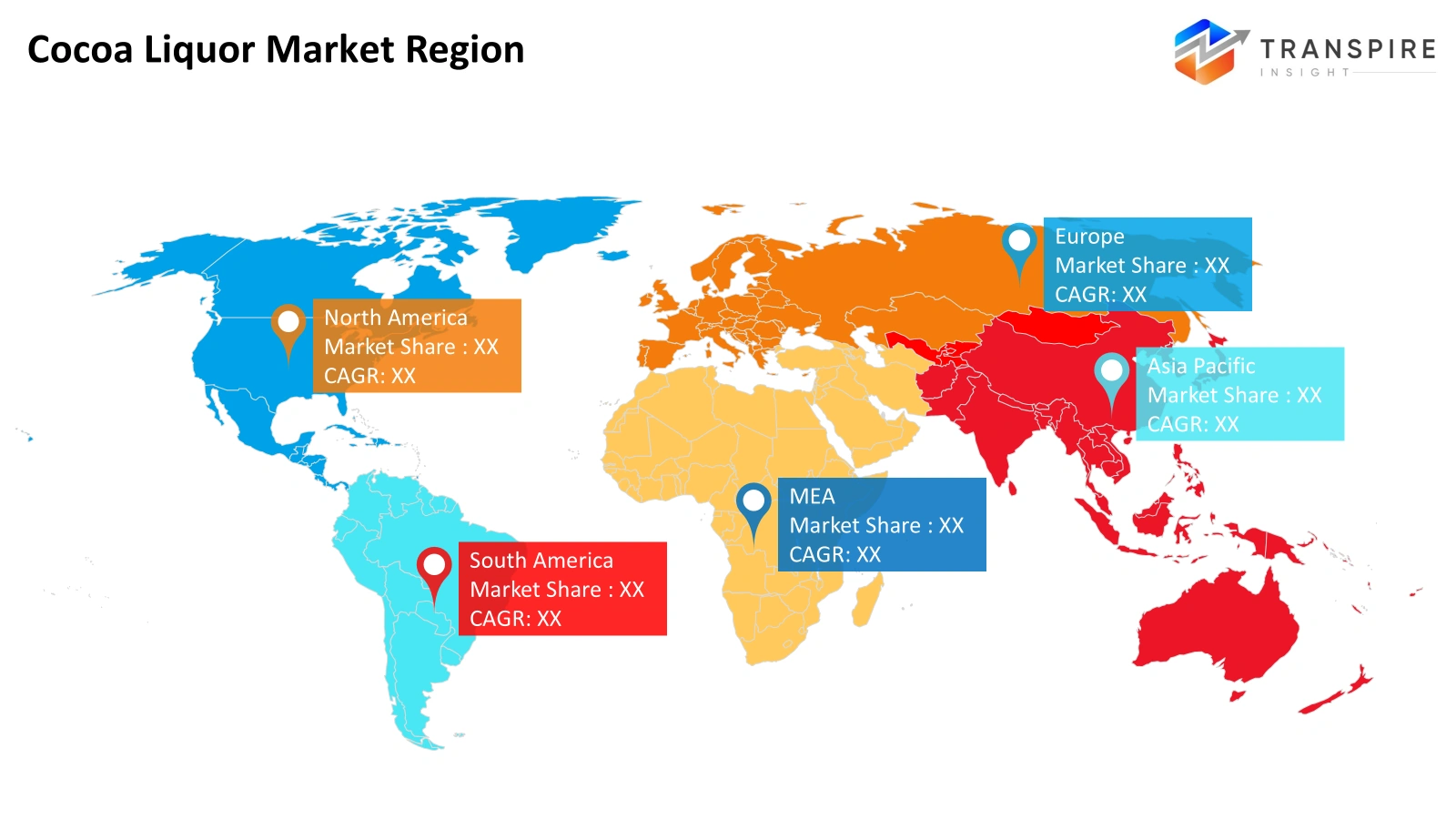
North America has a 28% share in the market and shows stable growth due to the rising demand for premium chocolates, organic confections, and clean-label foods. When compared to Europe, North America has robust retail channels, established food processing companies, and constant product innovation efforts. Increasing investments in sustainable sourcing of ingredients and premium product introductions will help drive market expansion in the future. Consumption of cocoa-containing ingredients in bakery, beverages, and dairy segments is driving the growth and stability of the market.In July 2025, Cargill made significant investments in its cocoa and chocolate supply chain through various projects aimed at increasing sustainable cocoa processing and supply for the North American food and confectionery industry. The company's investments enhance its cocoa liquor and cocoa ingredient supply chains and make them more efficient and sustainable.
Europe
The share of Europe in the cocoa liquor market is at 37%, driven by its developed chocolate production industry, advanced cocoa processing plants, and rising demand for premium chocolate confections. This market includes a number of famous chocolate manufacturers that require high-quality cocoa for their product uniformity. Europe also has robust food quality regulations and an increasing trend towards sustainable cocoa sourcing that helps maintain its market position. Constant investments in product innovations and development of premium chocolates are expected to ensure its dominance in the coming years.
Asia Pacific
Asia Pacific holds a share of 27% of the market and is expected to register the fastest CAGR of 15.8%. The growing trend of urbanization, higher income levels, and changes in dietary preferences are creating an increased demand for chocolates in countries such as China, India, and other South Asian countries. Chocolate manufacturing companies all over the world are putting efforts to develop infrastructure and establish their distribution network in this region because of rising demand. With the introduction of premium products in the confectionery industry, huge opportunities exist for the cocoa liquor market.In January 2026, Barry Callebaut noted continued growth of its business in the Asia Pacific region due to improved demand for cocoa ingredients from chocolate manufacturers, increased demand in China, growing sales in India and new customer wins in Australia.
Who are the Key Players in the Cocoa Liquor Marketand how do they Compete?
The competition in the world market of cocoa liquor is characterised by companies that have a competitive advantage due to sustainable sourcing of raw materials, efficiency of processing, the quality of the products, and logistics opportunities. In order to strengthen their position in the market, players develop their capabilities in terms of increasing production capacities, introducing value-added cocoa ingredients, and building relations with cocoa producers.
Barry Callebaut, Cargill, and Olam Food Ingredients (OFI) are leading manufacturers that aim at increasing their processing capacity and sustainable cocoa sourcing. They offer differentiated products in terms of certified supply chain, innovative processing technology, and unique cocoa products for use in the food manufacturing processes. The differentiation in the cocoa market also lies in their ability to build relations with farmers. Blommer Chocolate Company, JB Foods Limited, ECOM Agroindustrial, Cemoi, and Guan Chong Berhad are competing on the basis of developing product portfolios, optimising operations, and entering high-growth regional markets. Companies are making investments in high-quality cocoa ingredients, digital quality management, and environmentally friendly production in order to meet the new requirements of consumers.
Cocoa Liquor Market companies
- Barry Callebaut
- Cargill
- Olam Food Ingredients
- Blommer Chocolate
- ECOM Agroindustrial
- Fuji Oil
- Guan Chong
- JB Foods
- Cemoi
- Puratos
- Ferrero
- Nestlé
- Mondelez International
- Mars Incorporated
- Hershey
Recent Development News
In February 2026, the Barry Callebaut Innovation Centre was inaugurated in Singapore, which consists of an Artificial Intelligence Centre of Excellence and innovative cocoa and chocolate research centres as well. This innovation centre will help accelerate innovations, optimise production processes, and develop next-gen cocoa ingredients.
Source: https://www.edb.gov.sg
In April 2025, Cargill extended its collaboration with a large cocoa farming project in Bahia, Brazil, in support of cultivating high-yielding cocoa. This venture intends to secure future supply of cocoa beans, increase diversity in sourcing from outside West Africa, and ensure sustainability in the cocoa processing value chain.
Source: https://www.reuters.com
What Strategic Insights Define the Future of the Cocoa Liquor Market?
The cocoa liquor market will get bigger in the future if people focus on using ingredients that are kind to the environment and using new machines to make the product. Companies that are honest about where they get their cocoa, use cocoa and make special products will do well because people's tastes are changing. The cocoa industry has some problems like relying on cocoa from places, which means they have to deal with bad weather, sick plants and changing prices.. There are still good things about cocoa because more people want organic, sustainable and special cocoa. This is especially true in the Asia-Pacific region, where things are growing fast. The cocoa liquor market has a chance to grow in this region.
Key Segmentations are:
By Product Type
- Natural Cocoa Liquor
- Alkalized Cocoa Liquor
- Organic Cocoa Liquor
- Conventional Cocoa Liquor
- Premium Cocoa Liquor
- Sustainable Cocoa Liquor
By Application
- Chocolate Manufacturing
- Bakery & Confectionery
- Beverages
- Dairy Products
- Ice Cream
- Nutraceuticals
By End User
- Chocolate Manufacturers
- Food Processing Companies
- Beverage Companies
- Bakery Industry
- Dairy Industry
- Retail Brands
By Distribution Channel
- Direct Sales
- Ingredient Distributors
- Online B2B Platforms
- Exporters
- Wholesalers
By Processing Method
- Fermented
- Roasted
- Cold Processed
- Speciality Processing
Regional Outlook
North America
- United States
- Canada
- Mexico
Europe
- Germany
- United Kingdom
- France
- Spain
- Italy
- Rest of Europe
Asia Pacific
- Japan
- China
- Australia & New Zealand
- South Korea
- India
- Rest of Asia Pacific
South America
- Brazil
- Argentina
- Rest of South America
Middle East & Africa
- Saudi Arabia
- United Arab Emirates
- South Africa
- Rest of the Middle East & Africa
Frequently Asked Questions
Find quick answers to common questions.
The cocoa liquor market size was valued at USD 8.24 Billion in 2025 and is poised to reach USD 14.62 Billion by 2033, expanding at a 7.42% CAGR.
Key segments for the cocoa liquor market are By Product Type (Natural Cocoa Liquor, Alkalized Cocoa Liquor, Organic Cocoa Liquor, Conventional Cocoa Liquor, Premium Cocoa Liquor, Sustainable Cocoa Liquor, Others); By Application (Chocolate Manufacturing, Bakery & Confectionery, Beverages, Dairy Products, Ice Cream, Nutraceuticals, Others); By End User (Chocolate Manufacturers, Food Processing Companies, Beverage Companies, Bakery Industry, Dairy Industry, Retail Brands, Others); By Distribution Channel (Direct Sales, Ingredient Distributors, Online B2B Platforms, Exporters, Wholesalers, Others); By Processing Method (Fermented, Roasted, Cold Processed, Specialty Processing, Others).
Growth is primarily driven by increased demand for chocolates and confectionery products, changing consumer preferences for higher-quality and dark chocolates, increase in the uses of foods and beverages, increased disposable income in developing countries, and increased use of sustainable cocoa by.
The market is led by major manufacturers including Barry Callebaut, Cargill, Olam Food Ingredients, Blommer Chocolate, ECOM Agroindustrial, Fuji Oil, Guan Chong, JB Foods, Cemoi, Puratos, Ferrero, Nestlé, Mondelez International, Mars Incorporated, Hershey.
Europe has 37% of the world's market share for cocoa liquor, with its flourishing chocolate production sector, large consumer base for fine cocoa products, processing plants, and major confectionery producers playing significant roles in this regard.
Opportunities created by increasing demand for premium and artisanal chocolates, growth in the consumption of chocolate in emerging economies, and preference for sustainable and ethical cocoa. Other opportunities include increased uses of cocoa liquor in bakery and confectionery products and beverages, as well as the production of organic and single-origin cocoa.
- Barry Callebaut
- Cargill
- Olam Food Ingredients
- Blommer Chocolate
- ECOM Agroindustrial
- Fuji Oil
- Guan Chong
- JB Foods
- Cemoi
- Puratos
- Ferrero
- Nestlé
- Mondelez International
- Mars Incorporated
- Hershey
About the Authors

Chetan Dhatrak
I’m Chetan Dhatrak, a Senior Research Analyst at Transpire Insight, specializing in the Consumer Goods, Foods and Beverages industry. I focus on analyzing market trends, consumer behavior, competitive landscapes, and industry developments to deliver accurate, data-driven insights. My research at Transpire Insight is built on credible sources and in-depth analysis, helping businesses and readers better understand market dynamics, emerging opportunities, and evolving consumer preferences. I’m committed to creating reliable, well-researched content that supports informed decision-making and reflects the latest developments in the consumer goods and food & beverage sectors.

Chakradhar Khansole
Chakradhar serves as the Research Director at Transpire Insight, bringing over 8 years of experience in technology, innovation, and strategic market intelligence. He specializes in transforming complex market data into actionable business insights that enable organizations to make informed, growth-oriented decisions. Recognized for his strategic vision and analytical expertise, Chakradhar leads high-impact research initiatives, delivering comprehensive market assessments, competitive intelligence, and forward-looking industry analysis.
Recently Published Reports
-
Apr 2026
Baby Infant Formula Market
Baby Infant Formula Market Size, Share & Analysis Report By ype (Infant Milk, Follow On Milk, Specialty Baby Milk, Growing-Up Milk), By Ingredient (Carbohydrate, Fat, Protein, Minerals, Vitamins, and Others), By Product Form (Powder, Liquid, and Ready-to-feed), By Distribution Channels (Supermarket/Hypermarket, Specialty Store, Pharmacies, Online Retail, and Others), and Geography (North America, Europe, Asia-Pacific, Middle East and Africa, South and Central America), 2021 - 2031
-
Apr 2026
Edible Insects for Animal Feed Market
Edible Insects for Animal Feed Market Size, Share & Analysis Report By Type (Insect Powder, Insect Meal, Insect Bar, Insect Paste, Insect Oil, and Others), By Insect Type (Beetles, Cricket, Caterpillar, Hymenoptera, Orthoptera, Tree Bugs, and Others), By Application (Livestock, Pet Food, and Aquaculture), By Livestock Type (Poultry, Swine, and Others), and Geography (North America, Europe, Asia-Pacific, Middle East and Africa, South and Central America), 2021 - 2031
-
Apr 2026
Food Industry Disinfection and Bacterial Control Market
Food Industry Disinfection and Bacterial Control Market Size, Share & Analysis Report By Type (Chemical Disinfectants, Physical Disinfectants, and Biocides and Antimicrobials), By Application (Food Processing Equipment Surface Disinfection, Food Preparation Areas Surface Disinfection, Storage Areas Surface Disinfection, Anti-microbial Coatings Food Preservation, and Preservative Solutions Food Preservation), By End User (Meat and Poultry Processing, Dairy Processing, Seafood Processing, Bakery and Confectionery, Restaurants and Commercial Kitchens, and Food Service Providers), By Sales Channel (Online, Offline), and Geography (North America, Europe, Asia-Pacific, Middle East and Africa, South and Central America), 2021 - 2031
-
May 2026
Freeze Dried Food Market
Freeze Dried Food Market Size, Share & Analysis Report By Product Type (Fruits, Vegetables, Freeze-Dried Dairy Products, Freeze-Dried Meat and Seafood, Freeze-Dried Pet Food, and Prepared Meal), By Nature (Organic, and Conventional), By Form (Powdered, Granules, and Diced), By End Use (Breakfast Cereals, Dairy Products, Bakery & Confectionery, Nutritional Bars & Supplements, Powdered Beverages, Snacks, and Retail (Household)), and Geography (North America, Europe, Asia-Pacific, Middle East and Africa, South and Central America), 2021 - 2031