

Asia Pacific Premium Chocolate Market Size & Forecast:
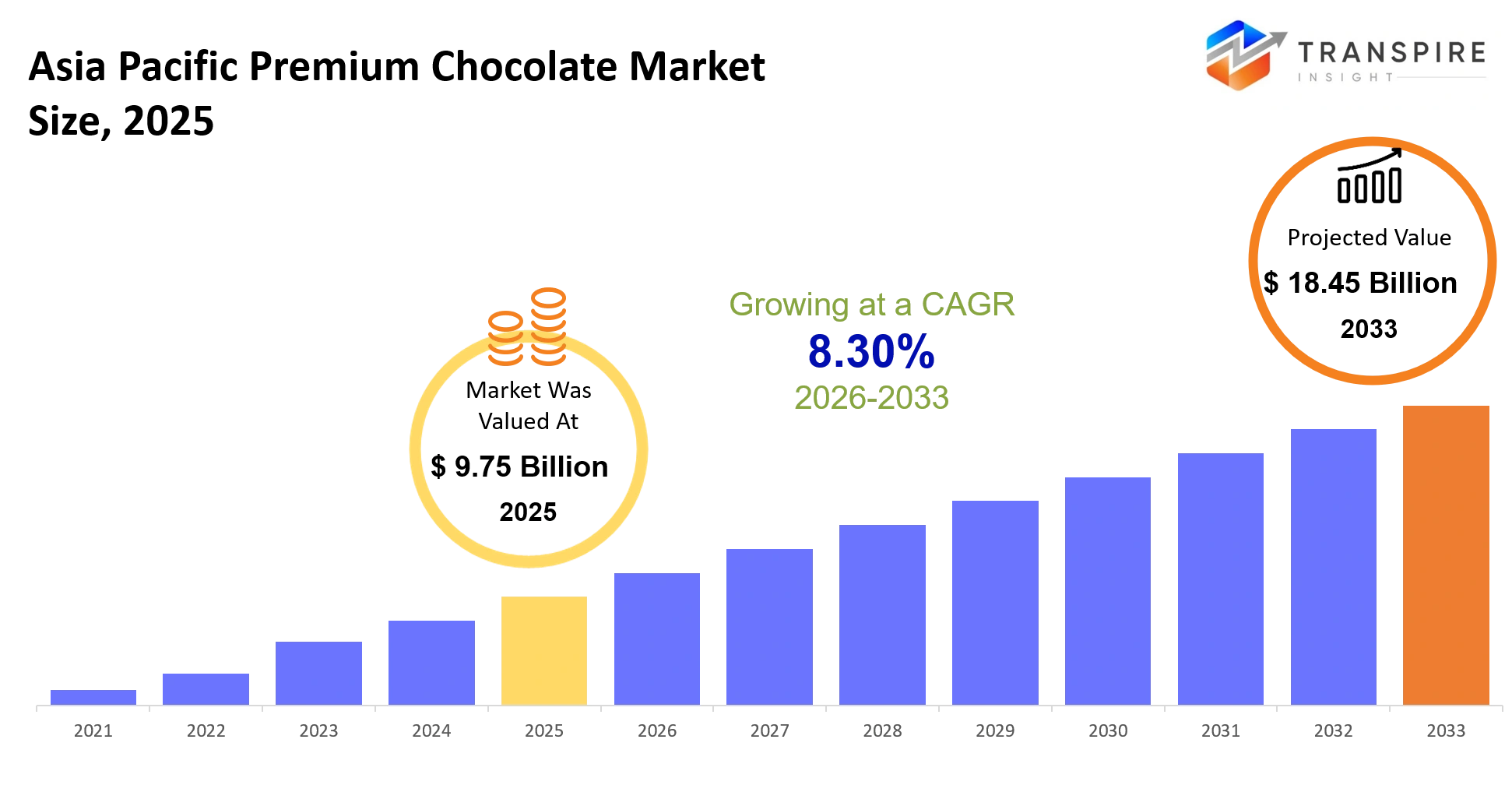
- Asia Pacific Premium Chocolate Market Size 2025: USD 9.75 Billion
- Asia Pacific Premium Chocolate Market Size 2033: USD 18.45 Billion
- Asia Pacific Premium Chocolate Market CAGR: 8.30%
- Asia Pacific Premium Chocolate Market Segments: By Product Type (Dark Chocolate, Milk Chocolate, White Chocolate, Filled Chocolate, Organic Chocolate, Others); By Distribution Channel (Supermarkets, Specialty Stores, Online Retail, Duty Free Stores, Others); By Packaging (Bars, Boxes, Gift Packs, Others); By End User (Adults, Millennials, Premium Consumers, Others)
Asia Pacific Premium Chocolate Market Summary
The Asia Pacific Premium Chocolate Market was valued at USD 9.75 Billion in 2025. It is forecast to reach USD 18.45 Billion by 2033. That is a CAGR of 8.30% over the period.
Beyond a sweet treat, the Asia Pacific premium chocolate market can act as an instrument of revenue extraction for brands by commanding higher consumer spend through product uniqueness, giving opportunities and an element of experience in consuming these products. Premium chocolate manufacturers can compete on quality of ingredients, the origin of their cocoa beans, craftsmanship, ethically produced ingredients, innovative flavour profiles thereby enabling retailers and foodservice players to reap more margins in comparison to a mass market chocolate offering. The Asia Pacific premium chocolate market has experienced a structural move towards premiumisation over the last 3-5 years.
Quality, sourcing, ingredient transparency and provenance are now primary evaluation points for consumer purchase. A significant catalyst for this change was the disruption to retail and supply chains caused by the pandemic, encouraging indulgence consumption at home and an accelerated shift to both Direct-to-consumer (DTC) and e-commerce platforms. With increasing disposable income across the leading Asia Pacific economies and greater disposable income available for accessible luxury products, premium chocolate products can command higher price points. This has allowed manufacturers to introduce a broader product portfolio, expand into a wider array of urban markets and drive revenue growth through greater value, and not just volume, alone.
Key Market Insights
- East Asia is expected to hold around 45%+ market share in the Asia Pacific Premium Chocolate Market, with leading positions for Japan, China, and South Korea.
- Australia also holds considerable market share, as a result of its high level of premium confectionery consumption and number of specialty chocolate brands.
- The Chinese industry will continue to reap large revenues from consumption among affluent consumers of imported and single-origin chocolate varieties.
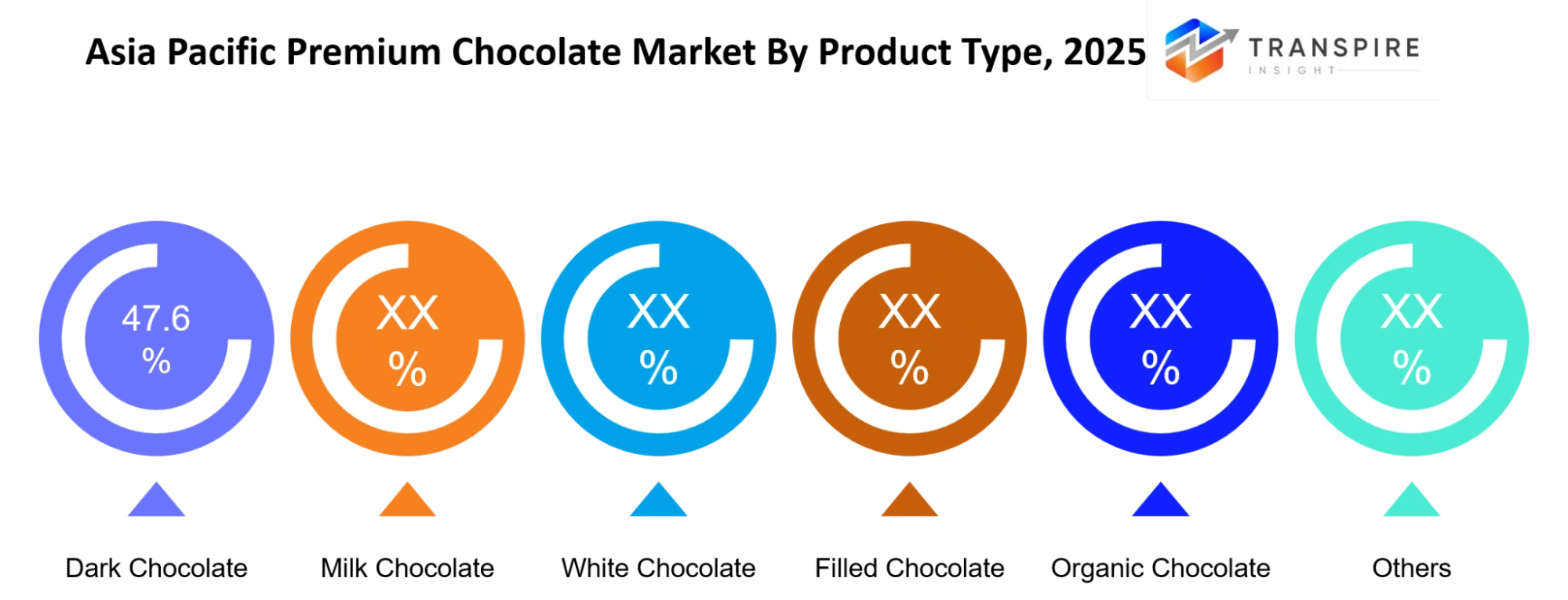
- Dark chocolate is anticipated to take the top spot at around 40% market share due to its connotations with quality, its high cocoa content and premium positioning.
- Milk chocolate holds the second largest share, due to its widespread consumption and prevalence in gifts.
- Premium/single-origin & artisanal chocolates – this product category shows fastest growth throughout the forecast period.
- Organic & Fair Trade chocolates: gaining more significance with chocolate brands focusing on responsible & traceable cocoa supply chains.
- Retail consumption: dominates with more than 60% premium chocolates consumption in the entire region.
- Premium gifting: fastest growing application driven by festive events & corporate gifting schemes.
- Specialty store and luxury retail: reinforcing premium products awareness and market reach.
What are the Key Drivers, Restraints, and Opportunities in the Asia Pacific Premium Chocolate Market?
A primary driver is increasing premiumization of F&B consumption throughout Asia Pacific. Greater household disposable incomes, the expansion of the middle class, and increased accessibility to luxury products worldwide are driving demand toward quality products rather than high-volume confectionery. In turn many manufacturers of chocolates have sought to produce high-priced, single origin chocolates, artesian chocolates and special edition, deluxe chocolates. With high-priced chocolates perceived to be 'accessible luxury goods', or a gift, the higher revenues from these, across a range of distribution channels (specialist stores, online, premium supermarket), are appealing.
The number one restraint is, and continues to be the highly volatile supply and prices of cocoa on the global market. Cocoa cultivation is highly concentrated in only a few developing economies which makes them vulnerable to climate change, diseases of cocoa plants, and local politics of those areas, which in turn make manufacturers reliant. High quality cocoa beans and traced source cannot be readily substituted because the unique properties they contribute cannot be replicated. The industry will naturally seek to improve costs through a reduced supply of available suitable product and thus an increase in product price, which can be prohibitive for price-sensitive markets such as that of Asia-Pacific.
A major future opportunity is the development of premium chocolate products which combine indulgence with functional benefit attributes. Companies are investing heavily in chocolates that use high cocoa content, botanicals, lower sugar and wellness-focused formulations. Chinese, Korean and Singaporean markets for such premium chocolates are evolving with the consumers in these regions actively searching for luxury food that offers both sensory pleasure and wellness benefits. Brands that can seamlessly blend both premium and wellness credentials are well positioned to exploit this opportunity for further market growth.
What Has the Impact of Artificial Intelligence Been on the Asia Pacific Premium Chocolate Market?
AI and other high-tech digital technologies are having a growing impact on operations across the Asia Pacific premium chocolate industry. AI-powered quality control systems utilizing computer vision are being implemented by manufacturers to inspect the shape, texture, consistency of the coating, and packaging quality of chocolate during the manufacturing process. These automated systems require a lesser degree of human intervention during the inspection process and are capable of decreasing production efficiency while decreasing waste levels. Machine learning systems are being used to enhance demand planning and inventory control processes.
Through an evaluation of retail sales patterns, seasonal consumption cycles, performance of promotional campaigns, and regional consumption patterns, manufacturing facilities can enhance their production plans and avoid the problems associated with excess inventory. Premium chocolate producers benefit from these planning systems because premium goods generally have a greater associated value for inputs and their supply chains are often more complicated. Machine learning systems can also be used to better monitor inventory control and provide enhanced traceability for cocoa purchasing.
By enabling businesses to pinpoint sourcing risks and monitor the overall performance of vendors, machine learning technology will enable them to predict supply chain disruptions from natural disasters or transportational issues. Enhanced inventory availability and a more stable production process are some of the advantages of these new systems. At the operational level, digital technology use is associated with higher levels of production uptime, decreased levels of waste, and increased inventory turnover rates.
There are, however, obstacles that need to be addressed in terms of AI utilization. Some regional manufacturers employ dispersed legacy systems and require substantial investments to achieve interoperability. The limited amount of historical production and consumption data can also hinder model precision, especially within the narrow and frequently shifting consumer behavior of some premium chocolate sectors.
Key Market Trends
- Brands of premium chocolate expanded in2020 in terms of distribution channels by extending the coverage of direct-to-consumer, diminishing reliance on brick-and-mortar distribution stores, and widening customers in the region.
- The increasing demand for single-origin, traceable cocoa forced producers to invest in certified sourcing practices and clear supply chains.
- Profitable market segments between2021 and 2025 was premium gifting where the brand produced limited-edition products during seasonal occasions, and for corporate occasions.
- Major manufacturers such as Ferrero, Lindt & Sprungli, and Mondelez grew their premium offerings to access growing consumer expenditure on higher margin items.
- Manufacturers invested in a higher degree of digital forecasting as their reliance on manual forecasts for inventory management and distribution was challenged during the pandemic.
- Expectations for sustainability were translated from marketing claims into purchasing decision requirements encouraging certification such as through the Rainforest Alliance.
- The popularity of dark chocolate premium brands continued to grow with rising associations between higher cocoa content and authentic products.
- Southeast Asia transitioned from a smaller premium chocolate market into a strategically growing area due to rising income levels in urban areas, while developing a wider network of specialty retailers.
- The reach of premium chocolates expanded significantly on the internet post 2020. As a result, smaller, artisanal companies could compete against larger multinational chocolate companies on a more equal footing.
- Rising prices and limited supply of cocoa encouraged manufacturers to spread sourcing risk across different areas, reducing dependency on potentially risky regions for the supply of cocoa.
Asia Pacific Premium Chocolate Market Segmentation
By Product Type :
Dark chocolate remains a dominant product segment in the Asia Pacific Premium Chocolate Market due to high cocoa content, diverse flavors, and the upscale nature of the segment. Most manufacturers consistently launch more products with a high percentage of cocoa, single origin, and limited edition products targeting consumers that are quality focused.
Milk chocolate holds the dominant segment due to its well-balanced sweetness and high consumer acceptance. White chocolate, filled chocolate, organic chocolate and other variety chocolates add to the range by offering unique flavors, textures, and ingredients, to cater to changing consumer tastes and building upon the premium offerings in the segment.
By Distribution Channel :
Supermarkets are significant channels due to good product visibility, ease of access and strong customer foot traffic. Large chains enable premium chocolate brands to have wide distribution reach with impulse buying opportunity and can also be leveraged for season oriented activities.
Specialty stores appeal to consumers looking for premium collections and unique shopping experiences. The online retail sector is crucial and provides convenience for consumers. Duty free stores and other channels such as gourmet stores help with premium sales through travelers and gifting requirements.
By Packaging :
Chocolate bar packaging is the dominant pack type due to ease of consumption, portability and suited for everyday purchase. Bar packaging is also commonly utilized by manufacturers when launching new flavors, luxury ingredients and limited-edition items, and still make them accessible at more than one sales channel.
Boxes and gift packs play a crucial role in premium positioning due to perceived added value of the product. Luxury packaging design often serves decorative purposes for festive occasions, corporate gifting, or for gift-giving occasions, while the other packaging forms adds additional variety of choices for brands catering to varied consumption needs.
By End User :
Adults hold the largest share of premium consumption due to their purchasing ability, preference towards sophisticated confectionery products. Premium chocolate manufacturers address the adult consumers by using complex flavors, luxury ingredients and products which are developed for personal enjoyment or as a gift item.
Millennials are influential consumer segments; they experiment with a wide range of flavor varieties, and are drawn to unique brand stories associated with sustainable sources and new product experience. Consumers with premium purchases drive the sales of artisanal chocolate, single-origin products and collections of exclusive products, while other consumer segments account for the various demographic and psychographic preferences within this segment.
What are the Key Use Cases Driving the Asia Pacific Premium Chocolate Market?
The major use of premium chocolate products falls under direct consumption, primarily by individual consumers buying in retail channels/ organized retail, such as the supermarkets. These consumers have a consistent buying pattern, seeking for better quality ingredients, unique taste and luxurious consumption that could allow purchasing above the usual price.
Corporate gifting & seasonal gifting are emerging applications, expanding into business and retail markets.premium boxed chocolates and collection of assortments were increasingly being used during festivals, corporate functions and customer interaction activities. Increasing use of these products across online channels had further allowed millennial and premium consumer segments to make online purchases of these products.
Other emerging applications such as personalized premium chocolate assortments, and wellness-oriented chocolates having high cocoa percentage or ingredients conferring specific health benefits. Moreover, luxury hotels, boutique hotels and travel retail channels also considered exclusive chocolate products for exclusive customer experiences. These applications, although present in small proportions, are expected to open up new avenues of revenue.
|
Report Metrics |
Details |
|
Market size value in 2025 |
USD 9.75 Billion |
|
Market size value in 2026 |
USD 10.56 Billion |
|
Revenue forecast in 2033 |
USD 18.45 Billion |
|
Growth rate |
CAGR of 8.30% from 2026 to 2033 |
|
Base year |
2025 |
|
Historical data |
2021 - 2024 |
|
Forecast period |
2026 - 2033 |
|
Report coverage |
Revenue forecast, competitive landscape, growth factors, and trends |
|
Regional scope |
Asia Pacific (India, China, Japan, Australia, South Korea, Rest of Asia Pacific) |
|
Key company profiled |
Lindt, Ferrero, Mars, Mondelez, Nestle, Godiva, Hershey, Ghirardelli, Meiji, Lotte, Royce, Patchi, Toblerone, Valrhona, Guylian |
|
Customization scope |
Free report customization (country, regional & segment scope). Avail customized purchase options to meet your exact research needs. |
|
Report Segmentation |
By Product Type (Dark Chocolate, Milk Chocolate, White Chocolate, Filled Chocolate, Organic Chocolate, Others); By Distribution Channel (Supermarkets, Specialty Stores, Online Retail, Duty Free Stores, Others); By Packaging (Bars, Boxes, Gift Packs, Others); By End User (Adults, Millennials, Premium Consumers, Others) |
Which Regions are Driving the Asia Pacific Premium Chocolate Market Growth?
With significant purchasing power, a developed retail infrastructure and strong consumer acceptance of premium food products, East Asia continues to dominate the Asia Pacific Premium Chocolate Market. Japan, South Korea and China are supported by well-established distribution systems which offer a route between international and local premium chocolate products and city consumers. Strong e-commerce systems and robust digital platforms have helped enable domestic and international brands to swiftly enter new premium and limited edition chocolate products. Established gifting traditions, robust specialist retail systems, and an ever-growing demand for premium sweets in East Asia will continue to dominate the market.\
The Asia Pacific Premium Chocolate Market is bolstered by Oceania which offers consistent market revenue through a variety of growth opportunities that are driven by product quality, the concept of sustainability, and steady consumer purchasing behaviors. Stable purchasing behavior among consumers in Australia and New Zealand over the past several years have established a persistent demand for ethically produced and premium chocolate products due to a well-established retail market. By contrast to the East Asian market where consumers drive revenue through growing numbers of city dwellers and developing markets, market expansion for premium chocolates in Oceania is driven through repeat consumer purchases driven through transparency in products. It is expected that there will continue to be opportunities for investment through long-term, steady demand of products in Oceania, thereby encouraging further product innovation and brand building.
As increasing disposable incomes are realized and more middle class citizens are able to consume confectionery products in Southeast Asia, it is being observed as a growth market that is advancing at the fastest pace of any regional market in the Asia Pacific Premium Chocolate Market. For many developing countries such as Indonesia, Vietnam, Thailand and the Philippines, increased interest and penetration for premium retail formats and international chocolate brands have been noted in past years. The swift adoption of digital commerce across this market also provides consumers greater access to premium chocolate products from city centers out to smaller towns. As growth within Southeast Asia continues, opportunities are being presented for further investment and introduction into the market from 2026 to 2033. Growth will particularly center on premium gifting, specialist retail, and direct-to-consumer market segments.
Who are the Key Players in the Asia Pacific Premium Chocolate Market and How Do They Compete?
The competitive scenario within Asia Pacific Premium Chocolate Market comprises globally established confectionery manufacturers and niche specialists who are competing on the basis of brand recognition, product quality and production, source of the beans, and innovations. Market competition is relatively consolidated within the premium end of this market due to strong brand recall value among established manufacturers and broad distribution network. However smallartisanalbrands of chocolate are receiving significant recognition on account of unique flavors, restricted batch productions, and origin specific cocoa choices. Thus product differentiation over competitive pricing is still a major form of market capturing in this segment.
Ferrero, strengthens its competitive position in the market through offering premium gifting products and robust seasonal range that cater to Asian customers across diverse markets. Premium packaging, widely recognized range of products and expanding modern retail and e-commerce channels are sustaining its mass market approach toward the premium confectionery section. Lindt & Sprengli further enhances its market share by making use of its expertise of Swiss chocolates, offering high cocoa content products and continuing product innovation and up-gradation of premium chocolates. Access to a booming Asian consumer base and unique flavor range designed for regional tastes continue to aid its penetration in the market. Mondelez International targets expanding premium portfolio and exploiting large retail distribution networks to capture a larger market share across Asia. The investment in digital trade and premium branding practices aids Mondelez International to attract a younger affluent customer base. Nestl uses product differentiation, responsible sourcing efforts, and inclusion of sustainable practices in the premium chocolate segment to gain market advantage. Godiva still maintains a dominant position in the niche through luxury image, premium gifting sets, and collection-specific, custom-crafted, high-end products.
Company List
- Lindt
- Ferrero
- Mars
- Mondelez
- Nestle
- Godiva
- Hershey
- Ghirardelli
- Meiji
- Lotte
- Royce
- Patchi
- Toblerone
- Valrhona
- Guylian
Recent Development News
In February 2026, Puratos announced the launch of the world's first professional chocolate product containing cultured cocoa. The development, supported through collaboration with California Cultured, introduces a new cocoa innovation pathway that could help premium chocolate manufacturers address long-term cocoa supply and sustainability challenges.
Source https://www.puratos.com/
In February 2026, Puratos expanded its investment-led partnership with California Cultured to commercialize cultured-cocoa chocolate products. The initiative strengthens food technology adoption in premium chocolate production and positions the company at the forefront of alternative cocoa ingredient development. Source https://www.prnewswire.com/
What Strategic Insights Define the Future of the Asia Pacific Premium Chocolate Market?
The Asia Pacific Premium Chocolate Market is on a value based growth path where product differentiation will overtake volume growth. Traceable sourcing, a higher premium placed on the quality of the ingredients and a customized consumer experience across digital and physical platforms will define the strongest competitive differentiator in the next 5 to 7 years. With a rising integration of premium chocolate in gift giving, lifestyle consumption patterns and wellness oriented purchase motivations, manufacturers will be competing more on the story and the authenticity of the product than simply the price.
A lesser evident threat is the concentration risk within cocoa sourcing and climate driven disruptions impacting the major producing countries. Despite consumer demand, prolonged raw material shortages can lead to escalated costs and constraints on product availability leading to pressure on margins all down the value chain.
A nascent opportunity exists in the area of functional premium chocolates where botanical ingredients, lower sugar options and cocoa led wellness based products in the rapidly growing urban centers of Southeast Asia may well be at the forefront of demand. The current imperative for players is to lock in diversified cocoa sourcing relationships today and invest into premium innovation platforms that enable the company to react rapidly to evolving consumer demands and ingredient supply constraints.
Asia Pacific Premium Chocolate Market Report Segmentation
By Product Type
- Dark Chocolate
- Milk Chocolate
- White Chocolate
- Filled Chocolate
- Organic Chocolate
By Distribution Channel
- Supermarkets
- Specialty Stores
- Online Retail
- Duty Free Stores
By Packaging
- Bars
- Boxes
- Gift Packs
By End User
- Adults
- Millennials
- Premium Consumers
Frequently Asked Questions
Find quick answers to common questions.
The Asia Pacific Premium Chocolate Market size is USD 18.45 Billion in 2033.
Key segments for the Asia Pacific Premium Chocolate Market are By Product Type (Dark Chocolate, Milk Chocolate, White Chocolate, Filled Chocolate, Organic Chocolate, Others); By Distribution Channel (Supermarkets, Specialty Stores, Online Retail, Duty Free Stores, Others); By Packaging (Bars, Boxes, Gift Packs, Others); By End User (Adults, Millennials, Premium Consumers, Others).
Major Asia Pacific Premium Chocolate Market players are Lindt, Ferrero, Mars, Mondelez, Nestle, Godiva, Hershey, Ghirardelli, Meiji, Lotte, Royce, Patchi, Toblerone, Valrhona, Guylian.
The Asia Pacific Premium Chocolate Market size is USD 9.75 Billion in 2025.
The Asia Pacific Premium Chocolate Market CAGR is 8.30% from 2026 to 2033.
- Lindt
- Ferrero
- Mars
- Mondelez
- Nestle
- Godiva
- Hershey
- Ghirardelli
- Meiji
- Lotte
- Royce
- Patchi
- Toblerone
- Valrhona
- Guylian
About the Authors

Chetan Dhatrak
I’m Chetan Dhatrak, a Senior Research Analyst at Transpire Insight, specializing in the Consumer Goods, Foods and Beverages industry. I focus on analyzing market trends, consumer behavior, competitive landscapes, and industry developments to deliver accurate, data-driven insights. My research at Transpire Insight is built on credible sources and in-depth analysis, helping businesses and readers better understand market dynamics, emerging opportunities, and evolving consumer preferences. I’m committed to creating reliable, well-researched content that supports informed decision-making and reflects the latest developments in the consumer goods and food & beverage sectors.

Chakradhar Khansole
Chakradhar serves as the Research Director at Transpire Insight, bringing over 8 years of experience in technology, innovation, and strategic market intelligence. He specializes in transforming complex market data into actionable business insights that enable organizations to make informed, growth-oriented decisions. Recognized for his strategic vision and analytical expertise, Chakradhar leads high-impact research initiatives, delivering comprehensive market assessments, competitive intelligence, and forward-looking industry analysis.
Recently Published Reports
-
Apr 2026
Baby Infant Formula Market
Baby Infant Formula Market Size, Share & Analysis Report By ype (Infant Milk, Follow On Milk, Specialty Baby Milk, Growing-Up Milk), By Ingredient (Carbohydrate, Fat, Protein, Minerals, Vitamins, and Others), By Product Form (Powder, Liquid, and Ready-to-feed), By Distribution Channels (Supermarket/Hypermarket, Specialty Store, Pharmacies, Online Retail, and Others), and Geography (North America, Europe, Asia-Pacific, Middle East and Africa, South and Central America), 2021 - 2031
-
Apr 2026
Edible Insects for Animal Feed Market
Edible Insects for Animal Feed Market Size, Share & Analysis Report By Type (Insect Powder, Insect Meal, Insect Bar, Insect Paste, Insect Oil, and Others), By Insect Type (Beetles, Cricket, Caterpillar, Hymenoptera, Orthoptera, Tree Bugs, and Others), By Application (Livestock, Pet Food, and Aquaculture), By Livestock Type (Poultry, Swine, and Others), and Geography (North America, Europe, Asia-Pacific, Middle East and Africa, South and Central America), 2021 - 2031
-
Apr 2026
Food Industry Disinfection and Bacterial Control Market
Food Industry Disinfection and Bacterial Control Market Size, Share & Analysis Report By Type (Chemical Disinfectants, Physical Disinfectants, and Biocides and Antimicrobials), By Application (Food Processing Equipment Surface Disinfection, Food Preparation Areas Surface Disinfection, Storage Areas Surface Disinfection, Anti-microbial Coatings Food Preservation, and Preservative Solutions Food Preservation), By End User (Meat and Poultry Processing, Dairy Processing, Seafood Processing, Bakery and Confectionery, Restaurants and Commercial Kitchens, and Food Service Providers), By Sales Channel (Online, Offline), and Geography (North America, Europe, Asia-Pacific, Middle East and Africa, South and Central America), 2021 - 2031
-
May 2026
Freeze Dried Food Market
Freeze Dried Food Market Size, Share & Analysis Report By Product Type (Fruits, Vegetables, Freeze-Dried Dairy Products, Freeze-Dried Meat and Seafood, Freeze-Dried Pet Food, and Prepared Meal), By Nature (Organic, and Conventional), By Form (Powdered, Granules, and Diced), By End Use (Breakfast Cereals, Dairy Products, Bakery & Confectionery, Nutritional Bars & Supplements, Powdered Beverages, Snacks, and Retail (Household)), and Geography (North America, Europe, Asia-Pacific, Middle East and Africa, South and Central America), 2021 - 2031