Automotive Anti-Lock Braking System and Electronic Stability Control Market Summary:
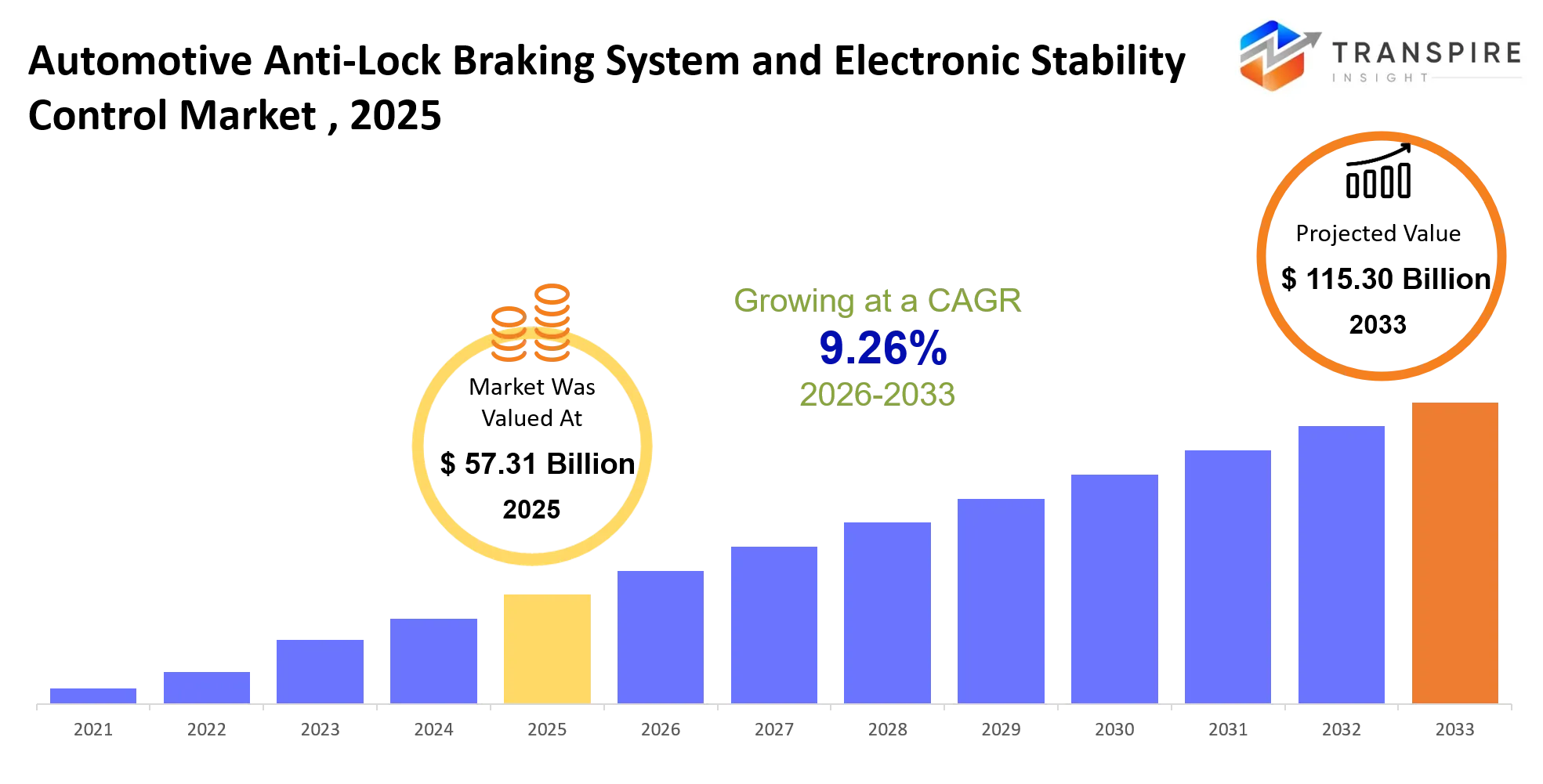
As per the Transpire Insight Analysis, The Automotive Anti-Lock Braking System and Electronic Stability Control Market size is estimated at USD 57.31 billion in 2025 and is anticipated to reach USD 115.30 billion by 2033, growing at a CAGR of 9.26% from 2026 to 2033.
The auto market is evolving from the application of basic braking protection into an integrated vehicle-movement control system. By functioning as an aid for vehicle manufacturers, ABS and ESC systems allow the wheels to maintain traction, avoid skidding, and provide directional stability during emergency braking, cornering, and bad-weather conditions. In recent years, the market has experienced a transition toward electronically integrated braking architecture incorporating ABS, ESC, traction control, and driver-assistance functions. This has led to structural shifts toward software-directed vehicle dynamics, enabled by faster electronics and better sensor integration. India's upcoming ESC requirement for trucks provides the most significant need-for-event order process for a safe-weather Braking System. That, alongside OEM commitments as demonstrated by the three CVs nominated by ZF, highlights regulatory readiness translating into supplier relationships. Therefore, OSS penetration and the opportunities for system/component suppliers will be driven by consistent safety standards and more complex vehicle platforms.
Automotive Anti-Lock Braking System and Electronic Stability Control Market Size & Forecast:
- Market Size 2025: USD 57.31 Billion
- Expected Market Value (2033): USD 115.30 Billion
- Forecast CAGR (2026–2033): 9.26%
- Leading Region in 2025: Asia Pacific
- Fastest Growing Region: North America
- Key Company Profiles: Bosch, Continental, ZF, Hitachi Astemo, HL Mando, Knorr-Bremse, Autoliv, Denso, Hyundai Mobis, ADVICS, Nissin Kogyo, Brembo, Aptiv, Valeo, JTEKT.
Key Automotive Anti-Lock Braking System and Electronic Stability Control Market Insights:
The traditional braking hardware market is undergoing a transformation to an integrated electronic EV-safety platform market, with suppliers focusing on lightweight designs, software flexibility, and compatibility with electrification. OEMs are increasingly looking for suppliers who can provide them with an entire braking-control architecture, local engineering support, and cost-effective solutions in various vehicle categories.
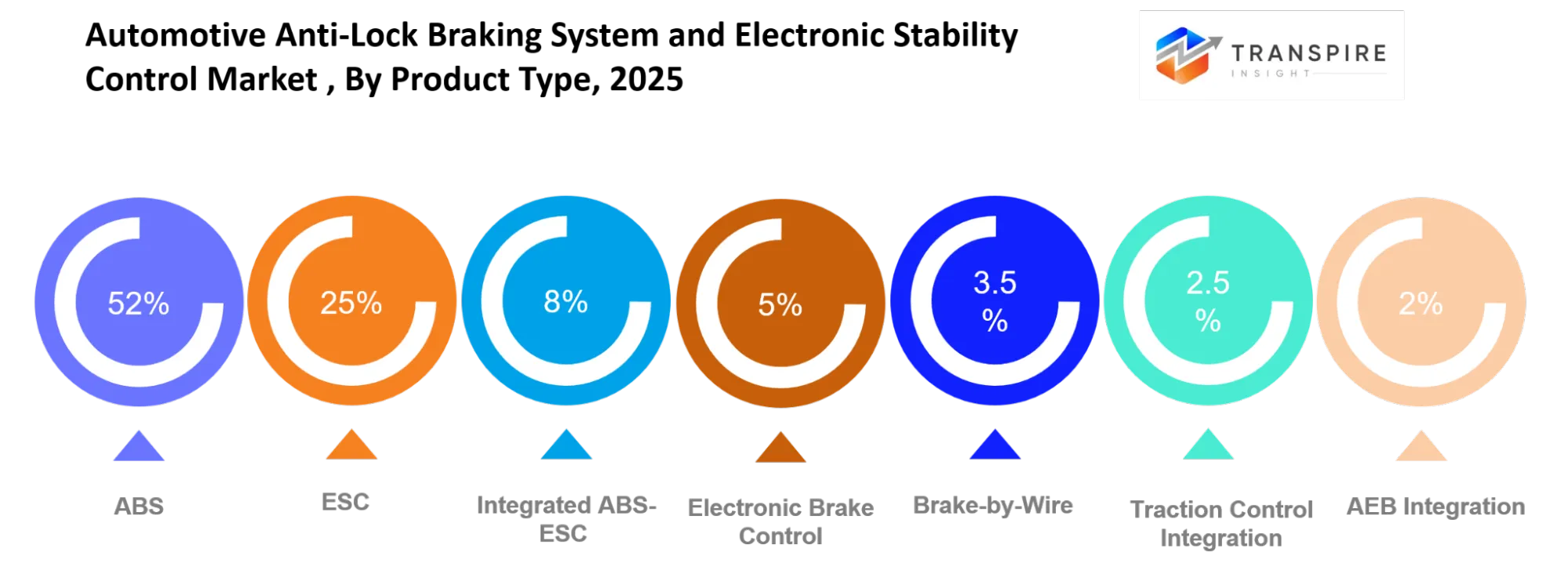
- ABS-ESC at 8.0% is taking a share of the system-type as OEMs integrate wheel-slip, yaw, traction, and even emergency-braking control into fewer modules, while the ABS share remains at 52.0%.
- OEM installations remain 91.05% of sales, indicating that braking value is being captured on factory platforms, and not upgrades.
- The CAGR of Electric ABS technology is 12.95% due to the need to balance regenerative braking and friction braking in electrified vehicles.
- The ABS/ESC integration is forecast to account for more than 60% of new OEM installations by 2030, up from around 45%, indicating a trend toward integrated components.
- As part of its expansion into the Indian commercial vehicle market, Bosch announced a 2026 collaboration with Brakes India and Wheels India to bring software-based electronic air-braking systems to commercial vehicles in the country.
- ZF started manufacturing Electric Park Brake in its local plant in Chennai in 2026, leveraging regional manufacturing to reduce costs, cut supply chains, and create high-volume programmes in Asia.
- Brembo's Sensify brake-by-wire system went into series production with the introduction of electronic wheel control and AI-based braking-force modulation.
- Knorr-Bremse is making redundant braking available for Level 4 trucks, and is transforming commercial-vehicle braking to fail-active autonomy support.
- The move towards electrification is now transforming the core stability control, and the share of regenerative-braking-compatible ESC is projected to grow from 10-15% of new light-vehicle systems in 2026 to 40-55% by 2035.
- Modular ECUs with embedded algorithms are becoming a requirement, and AI-based sensor fusion and predictive diagnostics are becoming requirements for procurement.
What are the Key Drivers, Restraints, and Opportunities in the Automotive Anti-Lock Braking System and Electronic Stability Control Market?
Driver:
Regulatory mandate is the primary revenue driver. EU General Safety Regulation, UN R13/R140 regulations, FMVSS 126, and the NHTSA FMVSS 127 Automatic Emergency Braking (AEB) rule are expanding the required scope of stability control, emergency braking, and electronic brake actuation. Policymakers now consider braking as a crash-avoidance platform rather than as a safety-critical mechanical component; this explains why the bill of materials value increases with the addition of electronic control units, sensors, hydraulic modulators, actuators, and calibration software, especially for commercial vehicles and entry-level models that weren't previously covered under electronic stability control.
Restraint:
Cost and integration complexity continue to limit adoption in price-sensitive segments. Integrated ABS-ESC, brake-by-wire, and AI-assisted functions require ASIL-D functional-safety validation, cybersecurity controls, precise sensor calibration, and semiconductor supply resilience. The constraint persists because emerging-market OEMs must balance compliance with affordability, while brake-by-wire programmes face 18–24 month validation cycles and higher engineering expenditure.
Opportunity:
Electrification and software-defined vehicle development create opportunities for integrated braking solutions. Electric vehicles require coordinated friction and regenerative braking to maintain predictable deceleration while recovering energy. Manufacturers can develop electro-hydraulic systems, intelligent brake controllers, and sensor-fusion capabilities. India's expanding electric two-wheeler and commercial vehicle manufacturing ecosystem offers opportunities for locally engineered ABS platforms, while advanced vehicle-motion control creates scope for higher-value integrated ABS-ESC solutions.
Driver Impact Analysis – Automotive Anti-Lock Braking System and Electronic Stability Control Market.
|
Driver |
Relative Impact on Growth (%) |
Geographic Relevance |
Impact Timeline |
Demand Strength |
Growth Mechanism |
Key Beneficiaries |
Major Constraint |
|
Mandatory Vehicle Safety Regulations and Government Road Safety Standards |
30% |
Europe, North America, Asia-Pacific |
Short-term (≤2 years) |
High |
Regulatory compliance accelerates mandatory ABS and ESC installations. |
Bosch, Continental, ZF, automotive OEMs |
Regulatory differences and vehicle certification costs. |
|
Rising Vehicle Production and Increasing Safety System Penetration |
25% |
Asia-Pacific, North America, Europe |
Medium-term (2–4 years) |
High |
Higher vehicle production expands integrated braking system volumes. |
Brake system manufacturers, automotive component suppliers, OEMs |
Production volatility and automotive supply-chain disruptions. |
|
Growing Road Safety Awareness and Demand for Accident Prevention Technologies |
20% |
North America, Europe, Asia-Pacific |
Short-term (≤2 years) |
High |
Safety awareness increases adoption of advanced braking technologies. |
ABS and ESC manufacturers, automotive OEMs, consumers |
Price sensitivity and limited consumer purchasing power. |
|
Electrification and Integration of Advanced Driver Assistance Systems (ADAS) |
15% |
China, Europe, North America |
Long-term (≥4 years) |
High |
EV platforms require integrated braking and stability controls. |
Brake-by-wire suppliers, semiconductor vendors, technology manufacturers |
High development costs and integration complexity. |
|
Expanding Motorcycle, Commercial Vehicle and Emerging-Market Safety Adoption |
10% |
India, China, Southeast Asia, Latin America |
Medium-term (2–4 years) |
Medium |
Two-wheeler and fleet safety requirements expand ABS demand. |
Motorcycle OEMs, commercial vehicle suppliers, aftermarket providers |
Cost constraints and uneven regulatory enforcement. |
|
Total |
100% |
What Has the Impact of Artificial Intelligence Been on the Automotive Anti-Lock Braking System and Electronic Stability Control Market?
Artificial intelligence helps advance automotive ABS and ESC from preventing car braking to predicting vehicle motion. Artificial intelligence can analyse data from sensors and determine whether there are variations in wheel speed, steering angle, and yaw rate, as well as road-condition measurements, to make more accurate estimates of what the vehicle is doing. When used with sensor fusion, the electronic controller can spot instability earlier and then more precisely distribute brake and torque.
For electric vehicles and software-defined vehicles, braking controllers have to work between friction and regenerative braking and traction management. Predictive control can intervene more smoothly during a turn or sudden directional change and offer better control in low-traction conditions. Honda's integrated dynamics control addresses the interaction of high-precision sensors, AI, and predictive motion control to anticipate vehicle behaviour and provide more stability. On the technical level, advanced algorithms could, in principle, offer better control response, more efficient calibration and better vehicle testing, driven by simulation-based validation. Nevertheless, it is currently constrained by processing cost, software validation, cyber security issues and the need to deliver reliable performance under multiple road and weather conditions. As a result, artificial intelligence complements rather than substitutes traditional safety-critical ABS and ESC logic.
In October 2026, Honda established a strategic partnership with physical AI solutions provider Applied Intuition. The automaker will leverage the partner's Vehicle OS software to accelerate the in-house development of its centralized, upgradeable, and highly personalised software-defined vehicle (SDV) platform across multiple powertrains.
Key Automotive Anti-Lock Braking System and Electronic Stability Control Market Trends:
From standalone braking protection to connected vehicle-motion management, software, sensors, and electronic controllers are collaborating in the market. The focus of OEMs has recently been on integrated safety architectures, localised production of parts and predictive braking systems.
- ABS and ESC are no longer just compliance products, but part of an integrated platform with AEB, traction control and vehicle-dynamics management.
- As EV growth demands a redesign of hydraulic-electric arbitration for seamless regenerative braking and friction braking.
- Brake-by-wire is moving beyond high-dollar demo projects to common usage, to minimise reliance on the old pedal-to-caliper linkages.
- One-box integrated brake units are taking the place of separate ABS, ESC and booster functions, reducing duplication and increasing the amount of software.
- Beyond just being present in the system, regulators are increasing requirements for performance, connected-vehicle activity, and brake-particle emissions.
- Advanced braking systems are becoming more and more a competitive rating tool, not just a regulatory requirement, with NCAP increasingly giving credit for advanced braking as points.
- Two-wheeler ABS requirements are bringing electronically controlled braking into India and Brazil, where it's high-volume and low cost.
- Insurance, uptime, and safety compliance concerns are encouraging adoption of ESC and electronic braking in medium-duty delivery trucks as well.
- Braking is moving from a fixed calibration to adaptive braking based on the condition, with the help of AI technologies like sensor fusion and predictive diagnostics.
- The software-based nature of braking makes cybersecurity, ISO 26262 compliance, and OTA-update capability key purchasing requirements.
Automotive Anti-Lock Braking System and Electronic Stability Control Market Segmentation
System Type:
"The largest component in this category remains the anti-lock brake system (ABS), with a 52.0% share of the market, given its initial popularity as an anti-wheel slip feature and, now, compliance with standard mandates," states the report. The ABS is followed by the electronic stability control (ESC) at 25.0%, and a combined ABS-ESC unit at 8.0%. Electronic brake control at 5.0%, brake-by-wire at 3.5%, integrated traction control at 2.5%, autonomous emergency braking (AEB) integration at 2.0%, and miscellaneous others at 2.0% follow. Future growth drivers of this sector will be, in particular, the consolidated brake controllers, which integrate braking, stability, and advanced driver assistance features while accommodating the new electrified powertrain of vehicles, says the report.
Vehicle Type:
Passenger cars remain the primary volume contributor, supported by factory-fitted ABS and ESC requirements across vehicle platforms. Electric and hybrid vehicles represent faster value-growth opportunities because regenerative braking requires coordination with conventional friction braking. Light commercial vehicles, trucks and buses are gaining adoption through fleet-safety regulations and OEM upgrades. Meanwhile, two-wheelers offer substantial penetration potential as manufacturers introduce compact, affordable ABS configurations in price-sensitive motorcycle segments.
Component:
Electronic control units, sensors, and hydraulic modulators form the core system architecture, while valves, pumps, and actuators execute braking interventions. Growing ADAS integration is increasing the importance of accurate sensors and faster ECUs for real-time vehicle stability management. Software is also becoming a stronger differentiation factor through calibration, diagnostics, and system updateability. Suppliers investing in integrated hardware-software platforms can improve vehicle compatibility, reduce development complexity, and strengthen long-term OEM relationships.
ABS Type:
4-channel configurations remain important in passenger cars and commercial vehicles because they enable independent wheel-level braking control. Three-channel and two-channel systems serve selected vehicle architectures, while single-channel configurations support cost-sensitive two-wheelers. Motorcycle ABS represents an important expansion opportunity as safety requirements extend across more affordable models. Commercial vehicle ABS also benefits from fleet modernisation and regulatory compliance, encouraging suppliers to develop durable braking platforms suited to heavier loads and demanding operating conditions.
Technology:
Hydraulic systems retain their established position because of proven reliability, manufacturing familiarity and comparatively lower integration costs. However, electro-hydraulic and electro-mechanical architectures are gaining attention as vehicle electronics become more sophisticated. Brake-by-wire, regenerative braking integration, sensor fusion, and AI-assisted control represent emerging development areas. Electric ABS technology is projected to grow at a 12.95% CAGR, supported by electrification and the need to coordinate regenerative and friction braking efficiently across electric vehicle platforms.
Sales Channel:
OEM installations account for 91.05% of the market, demonstrating the importance of factory-integrated braking safety systems. Automakers increasingly prefer validated ABS and ESC configurations that can be calibrated alongside vehicle electronics during development. Aftermarket, replacement, and retrofit channels serve older vehicles and specialised fleet requirements. Dealer installations and independent workshops support maintenance and component replacement, while fleet installations create opportunities for upgrading commercial vehicles with improved electronic braking and stability-control capabilities.
What are the Key Use Cases Driving the Automotive Anti-Lock Braking System and Electronic Stability Control Market?
Passenger cars represent a core use case, where ABS and ESC support emergency braking, cornering stability, and skid prevention. This directly supports the dominance of ABS at 52.0% and the growing integration of electronic stability functions across vehicle platforms.
Expanding applications include two-wheelers, buses, trucks and light commercial vehicles. Motorcycle ABS improves braking control on slippery roads, while commercial vehicle ESC helps maintain stability under heavy loads, sudden manoeuvres and uneven road conditions. India's upcoming truck safety requirements are accelerating OEM adoption.
Emerging applications involve electric and hybrid vehicles, where ABS must coordinate regenerative braking with friction braking. AI-assisted motion control, brake-by-wire, and integrated vehicle-dynamics systems are creating additional opportunities for advanced safety applications.
|
Report Metrics |
Details |
|
Market size value in 2025 |
USD 57.31 Billion |
|
Market size value in 2026 |
USD 62.02 Billion |
|
Revenue forecast in 2033 |
USD 115.30 Billion |
|
Growth rate |
CAGR of 9.26% from 2026 to 2033 |
|
Base year |
2025 |
|
Historical data |
2021 - 2024 |
|
Forecast period |
2026 - 2033 |
|
Report coverage |
Revenue forecast, competitive landscape, growth factors, and trends |
|
Regional scope |
United States; Canada; Mexico; United Kingdom; Germany; France; Italy; Spain; Denmark; Sweden; Norway; China; Japan; India; Australia; South Korea; Thailand; Brazil; Argentina; South Africa; Saudi Arabia; United Arab Emirates |
|
Key companies profiled |
Bosch, Continental, ZF, Hitachi Astemo, HL Mando, Knorr-Bremse, Autoliv, Denso, Hyundai Mobis, ADVICS, Nissin Kogyo, Brembo, Aptiv, Valeo, JTEKT. |
|
Customization scope |
Free report customization (country, regional & segment scope). Available customized purchase options to meet your exact research needs. |
|
Report Segmentation |
System Type (ABS, ESC, Integrated ABS-ESC, Electronic Brake Control, Brake-by-Wire, Traction Control Integration, Autonomous Emergency Braking Integration, Others)Vehicle Type (Passenger Cars, Light Commercial Vehicles, Heavy Commercial Vehicles, Two-Wheelers, Buses, Trucks, Electric Vehicles, Hybrid Vehicles)Component (Electronic Control Units, Sensors, Hydraulic Modulators, Valves, Pumps, Actuators, Software, Others)ABS Type (4-Channel, 3-Channel, 2-Channel, Single-Channel, Integrated, Motorcycle ABS, Commercial Vehicle ABS, Others)Technology (Hydraulic, Electro-Hydraulic, Electro-Mechanical, Brake-by-Wire, Regenerative Braking Integration, Sensor Fusion, AI-Assisted, Others)Sales Channel (OEM, Aftermarket, Replacement, Retrofit, Fleet Installation, Dealer Installation, Independent Workshops, Others). |
Which Regions are Driving the Automotive Anti-Lock Braking System and Electronic Stability Control Market Growth?
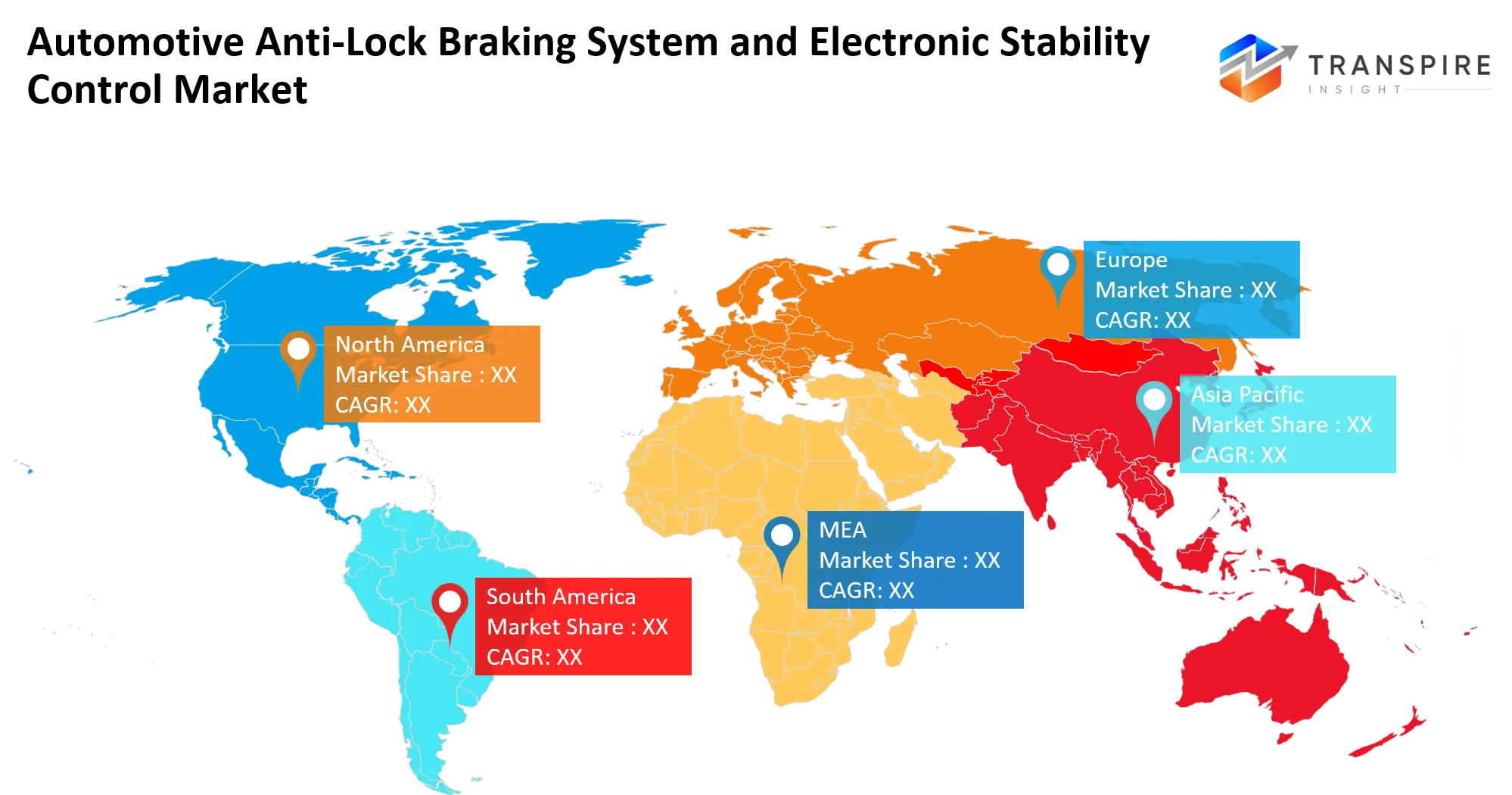
Asia Pacific has the largest market share of 36.10%, which is due to a combination of the world's largest vehicle production base and on-boarding of safety norms in China, India, Japan, South Korea, and ASEAN countries. The area advantage is size. Chinese EV production, Indian two-wheeler ABS mandates, and Korean electronics capabilities create red-hot demand for low-cost ABS and advanced B2W platforms simultaneously. Supporting policies, a complete supply chain, and a high-volume manufacturing setup allow suppliers to localise manufacturing and reduce time to market; thus, Korea has evolved as the hub for volume production and the main testing ground for low-cost electronic braking solutions.
In October 2026, Chery Automobile, and Orient Motion introduced the world's first mass-produced electromechanical brake (EMB) brake-by-wire system. This new architecture successfully deploys advanced engineering plastics in high-stress components such as the full plastic brake pedal, Motor Gear Unit, and Domain Control Unit, validating the region's position as a launchpad for next-generation dry electronic braking.
https://www.basf.com/jp/en/media/news-releases/asia-pacific/2026/10/apac-26-118
Europe holds 28.0% of the market and trades off depth of regulation rather than volume. Today's 92% fitment rate of EBS in new light vehicles signals a maturing stage of safety compliance, UN / UNECE-based regulations, Euro NCAP standards, and early onset of Cybersecurity and Brake-by-wire specifications. European manufacturing delivers more value per car than Asia Pacific with premium platforms, innovations in electrics, high software content in chassis controls, and other features generating a stable demand layer even as production unit count expands more slowly.
In May 2026, BWI Group launched the mass production of its iDBC1 integrated brake control system (1-Box) in Europe. This brake-by-wire milestone equips new-generation models for a leading automaker, resolving a critical engineering bottleneck at the chassis execution layer to unlock advanced autonomous driving capabilities.
North America, 22.0%, is the fastest-growing major region with an estimated 13.28% compound annual growth rate; recent factors include a mandatory NHTSA requirement for automatic emergency braking, electric vehicle platform investments, insurance-led safety adoption, and Bosch's new brake-by-wire capacity in Mexico. Latin America, 8.0%, is driven by country-specific Brazilian legislation regarding two-wheeler anti-lock braking systems and regional manufacturing. The Middle East & Africa, 5.9%, is a long-term opportunity based on fleet modernization and import-led vehicle safety requirements.
In January 2026, introduced a market-first, true brake-by-wire system at the Consumer Electronics Show (CES). This launch significantly impacts software-defined and automated vehicle architectures by offering increased design flexibility, enhanced safety redundancy, and a path toward generating over 7 billion euros in cumulative sales by 2032.
https://us.bosch-press.com/pressportal/us/en/press-release-29504.html
Who are the Key Players in the Automotive Anti-Lock Braking System and Electronic Stability Control Market, and how do they compete?
The industry remains somewhat consolidated, with Bosch, Continental, ZF, and Denso representing over 60% of revenue. But distinctions are emerging based on software, electrification skill, and regional cost advantages rather than sheer scale of hydraulic brakes.
Bosch's innovation-and-scale focus is on expanding brake-by-wire production in Mexico and deploying big ADAS and electrification portfolios. Its strength is in system integration across sensors, actuators, and software. Continental pursues an innovation strategy with intelligent braking module development and driver-assist integrations; it is differentiated by sensing-to-actuation coherence and is ready for Level 4. ZF is leveraging scale with WABCO for commercial-vehicle integration and large-scale electromechanical brake-by-wire commitments in passenger cars. Hitachi Astemo targets niche markets such as high-performance motorcycle braking and light, compact cars. HL Mando and Hyundai Mobis are competing on low-cost production and regional integration of ABS systems for Korean and ASEAN OEMs. Knorr-Bremse's differentiator is redundant, fail-active braking for autonomous trucks. Brembo's Sensify platform is focused on software-defined, OEM-specific braking for the premium market. Denso, ADVICS, Nissin Kogyo, Autoliv, Aptiv, Valeo, and JTEKT are competing on OEM integration, sensor/electronics expertise, and targeted expansion into EV and ADAS-linked content.
Key Players are:
- Bosch
- Continental
- ZF
- Hitachi Astemo
- HL Mando
- Knorr-Bremse
- Autoliv
- Denso
- Hyundai Mobis
- ADVICS
- Nissin Kogyo
- Brembo
- Aptiv
- Valeo
- JTEKT
Automotive Anti-Lock Braking System and Electronic Stability Control Market — Enhanced Competitive Benchmarking
|
Company |
Est. Revenue Share Range |
Key Offerings |
Strategic Positioning |
Geographic Strength |
Technology Focus |
|
Robert Bosch GmbH |
18–23% |
ABS Generation 9, ESP®, ESP® modules, integrated power brakes |
leadership through broad OEM penetration |
Europe, Asia Pacific, North America |
Advanced ESP algorithms, integrated brake control |
|
ZF Friedrichshafen AG |
12–16% |
Integrated Brake Control (IBC), ESCsmart, pneumatic ABS, hydraulic ABS |
Integrated braking leadership across passenger and commercial vehicles |
Europe, North America, Asia Pacific |
Electrohydraulic braking, regenerative control, vehicle stability |
|
AUMOVIO SE |
9–13% |
MK 120, MK C1, MK C2, MK C2D |
Premium integrated braking and brake-by-wire differentiation |
Europe, North America, Asia Pacific |
One-box braking, redundancy, cybersecurity, OTA functionality |
|
DENSO Corporation |
6–9% |
Vehicle Dynamic Control Systems, stability-control ECUs, brake pressure sensors, steering sensors |
OEM-focused safety electronics and vehicle-control integration |
Asia Pacific, North America, Europe |
Vehicle dynamics control, sensor integration, electronic control |
|
Hitachi Astemo, Ltd. |
5–8% |
ABS systems, ESC systems, wheel-speed sensors, integrated braking components |
Japanese OEM relationships and diversified chassis expertise |
Asia Pacific, North America, Europe |
Electronic brake control, wheel-speed sensing, stability management |
|
HL Mando Corporation |
4–7% |
ABS, ESC, MGH-100AD, IDB2 integrated braking |
Competitive Tier-1 with cost-efficient integrated systems |
Asia Pacific, North America, Europe |
Integrated dynamic braking, OTA updates, redundant control |
|
Hyundai Mobis Co., Ltd. |
4–6% |
MEB, iMEB, ABS, ESC-integrated electronic braking |
OEM integration and expansion beyond Hyundai Motor Group |
Asia Pacific, North America, Europe |
Electronic brake actuation, regenerative braking, fail-safe control |
|
ADVICS Co., Ltd. |
3–5% |
ABS, ESC, brake assist, traction control systems |
Toyota-linked engineering and high-volume OEM supply |
Asia Pacific, North America, Europe |
Integrated hydraulic braking, traction and stability control |
|
Knorr-Bremse AG |
2–4% |
Commercial vehicle EBS, ABS, electronic brake control, stability-related braking functions |
Commercial vehicle specialization and fleet safety expertise |
Europe, North America, Asia Pacific |
Electro-pneumatic braking, axle-level control, brake-by-wire |
|
BWI Group |
1–3% |
ABS, ESC, electronic brake control, integrated chassis systems |
Focused chassis technology supplier serving OEMs |
Asia Pacific, Europe, North America |
Electronic stability algorithms, brake control, chassis integration |
Recent Development News
In June 2026, Brembo and Ningbo SAFE Brakes Systems established a joint venture, BRSF Active Safety Solutions, in India to manufacture motorcycle Anti-lock Braking Systems (ABS). Brembo will hold a 60% stake, with a dedicated manufacturing facility in Chakan, Pune, focusing on single-channel and dual-channel ABS solutions. The initiative is expected to strengthen local manufacturing capabilities and support the adoption of motorcycle braking safety technologies in India.
In April 2026, Bosch Limited announced the acquisition of 100% of Bosch Chassis Systems India, through a cash transaction and preferential equity issuance. The acquisition is expected to strengthen Bosch's vehicle motion control portfolio and expand its capabilities in automotive active safety technologies, including Anti-lock Braking Systems (ABS), Electronic Stability Control (ESC), and advanced braking solutions.
In May 2026, Brembo commenced full industrial-scale production of its Sensify brake-by-wire intelligent integrated braking platform for an undisclosed major vehicle manufacturer. This product launch represents a critical transition toward software-defined vehicle architectures, embedding the system as standard fitment to directly support advanced driver assistance systems (ADAS) and autonomous driving capabilities.
What Strategic Insights Define the Future of the Automotive Anti-Lock Braking System and Electronic Stability Control Market?
The market is moving towards integrated vehicle-motion control systems, where ABS and ESC no longer serve as safety components but form part of the vehicle's overall control system. Developing compact electro-hydraulic and electromechanical platforms for electric vehicles, regenerative braking, and automated driving is likely to be the major strategic driver. However, suppliers face risks related to rising levels of complexity: software failures, cybersecurity and inconsistent calibration across different vehicle platforms could raise validation costs and limit OEM programs. Suppliers need to develop modular braking architectures for passenger cars, commercial vehicles and electric two-wheelers that can be applied across a wide portfolio without requiring re-engineering. They will need local manufacturing and engineering partners to help cut costs and meet country-specific safety regulations. Suppliers should also plan to build up their electronic control, sensor, and software validation expertise. Reduced product homogeneity may lead to more reliance on integrated vehicle-safety systems rather than individual braking components to gain competitive advantage.
Key Segmentations are:
System Type
- ABS
- ESC
- Integrated ABS-ESC
- Electronic Brake Control
- Brake-by-Wire
- Traction Control Integration
- Autonomous Emergency Braking Integration
- Others
Vehicle Type
- Passenger Cars
- Light Commercial Vehicles
- Heavy Commercial Vehicles
- Two-Wheelers
- Buses
- Trucks
- Electric Vehicles
- Hybrid Vehicles
Component
- Electronic Control Units
- Sensors
- Hydraulic Modulators
- Valves
- Pumps
- Actuators
- Software
- Others
ABS Type
- 4-Channel
- 3-Channel
- 2-Channel
- Single-Channel
- Integrated
- Motorcycle ABS
- Commercial Vehicle ABS
- Others
Technology
- Hydraulic
- Electro-Hydraulic
- Electro-Mechanical
- Brake-by-Wire
- Regenerative Braking Integration
- Sensor Fusion
- AI-Assisted
- Others
Sales Channel
- OEM
- Aftermarket
- Replacement
- Retrofit
- Fleet Installation
- Dealer Installation
- Independent Workshops
- Others
Frequently Asked Questions
Find quick answers to common questions.
The automotive anti-lock braking system and electronic stability control market size was valued at USD 57.31 billion in 2025 and is poised to reach USD 115.30 billion by 2033, expanding at a 9.26% CAGR.
Key segments for the automotive anti-lock braking system and electronic stability control market are System Type (ABS, ESC, Integrated ABS-ESC, Electronic Brake Control, Brake-by-Wire, Traction Control Integration, Autonomous Emergency Braking Integration, Others)Vehicle Type (Passenger Cars, Light Commercial Vehicles, Heavy Commercial Vehicles, Two-Wheelers, Buses, Trucks, Electric Vehicles, Hybrid Vehicles)Component (Electronic Control Units, Sensors, Hydraulic Modulators, Valves, Pumps, Actuators, Software, Others)ABS Type (4-Channel, 3-Channel, 2-Channel, Single-Channel, Integrated, Motorcycle ABS, Commercial Vehicle ABS, Others)Technology (Hydraulic, Electro-Hydraulic, Electro-Mechanical, Brake-by-Wire, Regenerative Braking Integration, Sensor Fusion, AI-Assisted, Others)Sales Channel (OEM, Aftermarket, Replacement, Retrofit, Fleet Installation, Dealer Installation, Independent Workshops, Others).
Growth is primarily driven by stringent vehicle safety regulations, rising OEM integration of ABS and ESC, increasing electric vehicle production, demand for advanced braking technologies, and growing adoption of electronic stability systems in commercial vehicles and two-wheelers.
The automotive anti-lock braking system and electronic stability control market is led by major manufacturers including Bosch, Continental, ZF, Hitachi Astemo, HL Mando, Knorr-Bremse, Autoliv, Denso, Hyundai Mobis, ADVICS, Nissin Kogyo, Brembo, Aptiv, Valeo, and JTEKT.
Asia Pacific accounts for 36.10% of the market, supported by large-scale vehicle production, stringent two-wheeler safety requirements, expanding electric vehicle manufacturing, established automotive supply chains, and strong OEM investments in electronic braking technologies.
Opportunities exist in electric vehicle-compatible ABS, integrated ABS-ESC platforms, brake-by-wire technologies, AI-assisted braking systems, motorcycle ABS penetration, and local manufacturing of advanced electronic braking components.
- Bosch
- Continental
- ZF
- Hitachi Astemo
- HL Mando
- Knorr-Bremse
- Autoliv
- Denso
- Hyundai Mobis
- ADVICS
- Nissin Kogyo
- Brembo
- Aptiv
- Valeo
- JTEKT
About the Authors

Mayur Shinde
I am Mayur Shinde, a Senior Research Analyst at Transpire Insight, specializing in the Automotive & Transportation and Information & Communication Technology (ICT) Industry. My work focuses on analyzing emerging market trends, technological advancements, competitive landscapes, and industry developments to deliver accurate, data-driven insights. I am passionate about transforming complex market information into clear, actionable content that helps businesses, professionals, and decision-makers stay informed and make confident strategic decisions.

Chakradhar Khansole
Chakradhar serves as the Research Director at Transpire Insight, bringing over 8 years of experience in technology, innovation, and strategic market intelligence. He specializes in transforming complex market data into actionable business insights that enable organizations to make informed, growth-oriented decisions. Recognized for his strategic vision and analytical expertise, Chakradhar leads high-impact research initiatives, delivering comprehensive market assessments, competitive intelligence, and forward-looking industry analysis.
Recently Published Reports
-
Apr 2026
ATV & UTV Market
ATV & UTV Market Size, Share & Analysis Report By Type (ATV, and UTV), By Variants (Less Than 400 CC, 400 CC To 800 CC, and More Than 800 CC), and Geography (North America, Europe, Asia-Pacific, Middle East and Africa, South and Central America), 2021 - 2031
-
Apr 2026
Automotive Central Gateway Module Market
Automotive Central Gateway Module Market Size, Share & Analysis Report By Type (Ethernet Central Gateway Module, CAN Central Gateway Module, LIN Central Gateway Module, and FlexRay), By Application (Powertrain Control, Body Control, Infotainment System, Advanced Driver Assistance Systems (ADAS), and Others), By End User (Passenger Vehicles, and Commercial Vehicles), and Geography (North America, Europe, Asia-Pacific, Middle East and Africa, South and Central America), 2021 - 2031
-
Apr 2026
Automotive Engine Oil Filter Market
Automotive Engine Oil Filter Market Size, Share & Analysis Report By Filter Type (Fuel Filter, Engine Oil Filter, Hydraulic Oil Filter, and Others), By Filter Media (Cellulose, Synthetic, and Micro), By Sales Channel (OEMs, and Aftermarket), By Vehicle Type (Passenger Cars, Light Commercial Vehicles, Heavy Duty Trucks, Buses and Coaches, and Off-road Vehicles), and Geography (North America, Europe, Asia-Pacific, Middle East and Africa, South and Central America), 2021 - 2031
-
Apr 2026
Automotive Parts Aluminium Die Casting Market
Automotive Parts Aluminium Die Casting Market Size, Share & Analysis Report By Production Process (Pressure Die Casting, Vacuum Die Casting, Squeeze Die Casting, Gravity Die Casting), By Application (Body Parts, Engine Parts, Transmission Parts, Battery And Related Components, Other Application Types), and Geography (North America, Europe, Asia-Pacific, Middle East and Africa, South and Central America), 2021 - 2031
Our Clients