
Automatic Pill Dispenser Market Summary:
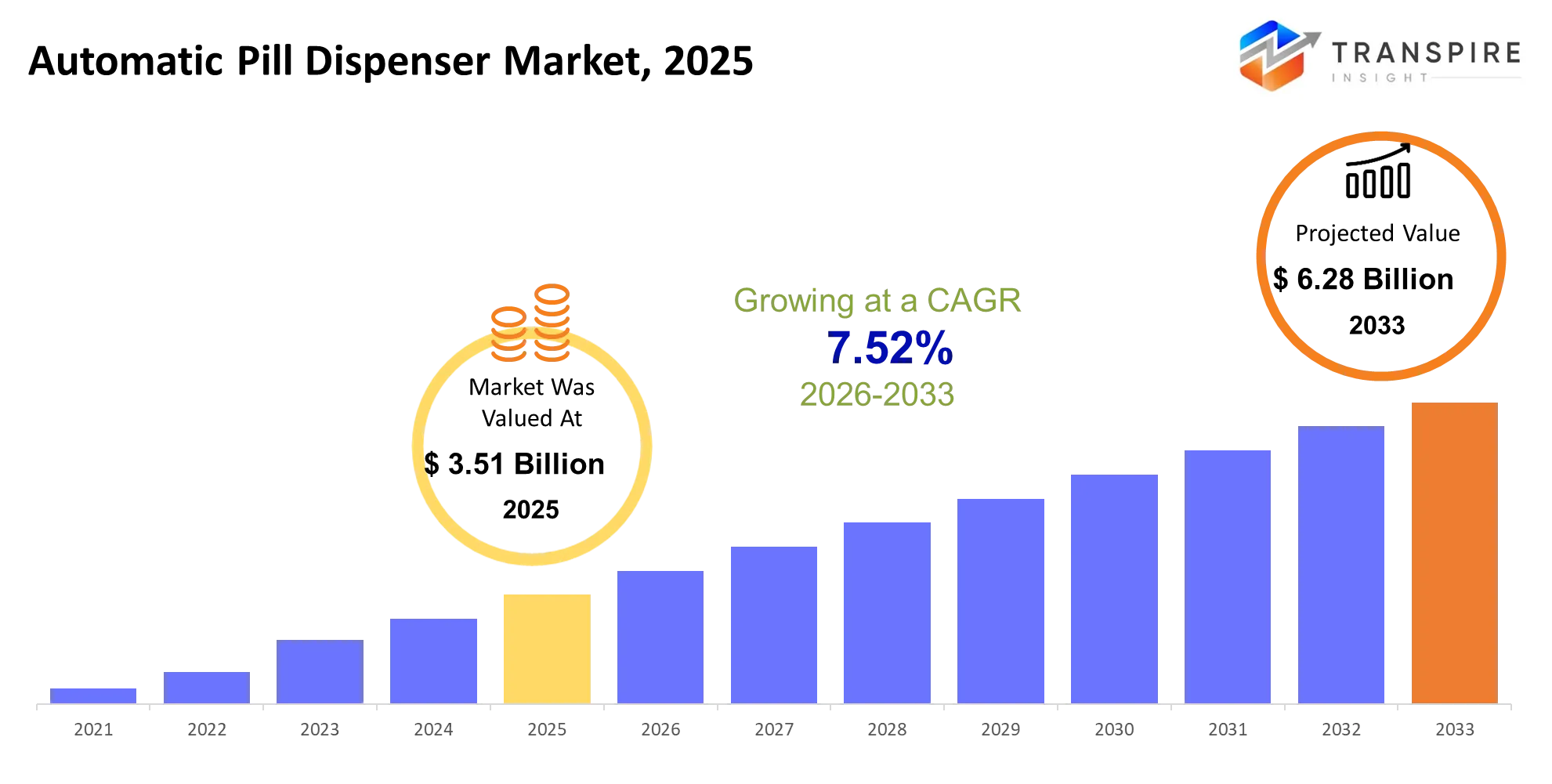
As per the Transpire Insight, The Automatic Pill Dispenser Market size is estimated at USD 3.51 billion in 2025 and is anticipated to reach USD 6.28 billion by 2033, growing at a CAGR of 7.52% from 2026 to 2033.
The market for automatic pill dispensers has recently begun to evolve from simple timed-release products to connected medication management platforms that help patients, caregivers, and clinicians track medication adherence. Over the past three to five years, manufacturers have been combining scheduled drug dispensing with mobile alerts, remote monitoring, and caregiver notification, especially for elderly and polypharmacy patients. A major structural shift has been from stand-alone electronic timed medication dispensers to connected home health devices capable of sharing adherence information with healthcare providers and care teams. With chronic diseases on the rise and home care and assisted living increasing in popularity, this shift is vital to prevent avoidable complications, trips to the doctor or ER, and unnecessary healthcare costs. Families and clinicians are increasingly turning to automated dispensing devices to help manage the drug regimen, with the proliferation of health services moving into patients' homes making dosage certainty coupled with remote oversight more relevant for home and long-term care.
Automatic Pill Dispenser Market Size & Forecast:
- Market Size 2025: USD 3.51 Billion
- Expected Market Value (2033): USD 6.28 Billion
- Forecast CAGR (2026–2033): 7.52%
- Leading Region in 2025: North America
- Fastest Growing Region: Asia-Pacific
- Key Company Profiles: Hero Health, MedMinder, Philips, MedReady, TabTime, LiveFine, MedQ, DoseControl, e-pill, PharmRight, Spencer Health Solutions, Medipense, PillPack, Omnicell, Capsa Healthcare.
Key Automatic Pill Dispenser Market Insights:
The market is moving away from single-dose reminder devices and towards integrated medication-care platforms, where adherence data, caregiver alerts, and remote monitoring will govern value. Competition is shifting from hardware capacity to software, interoperability, and recurring service models.
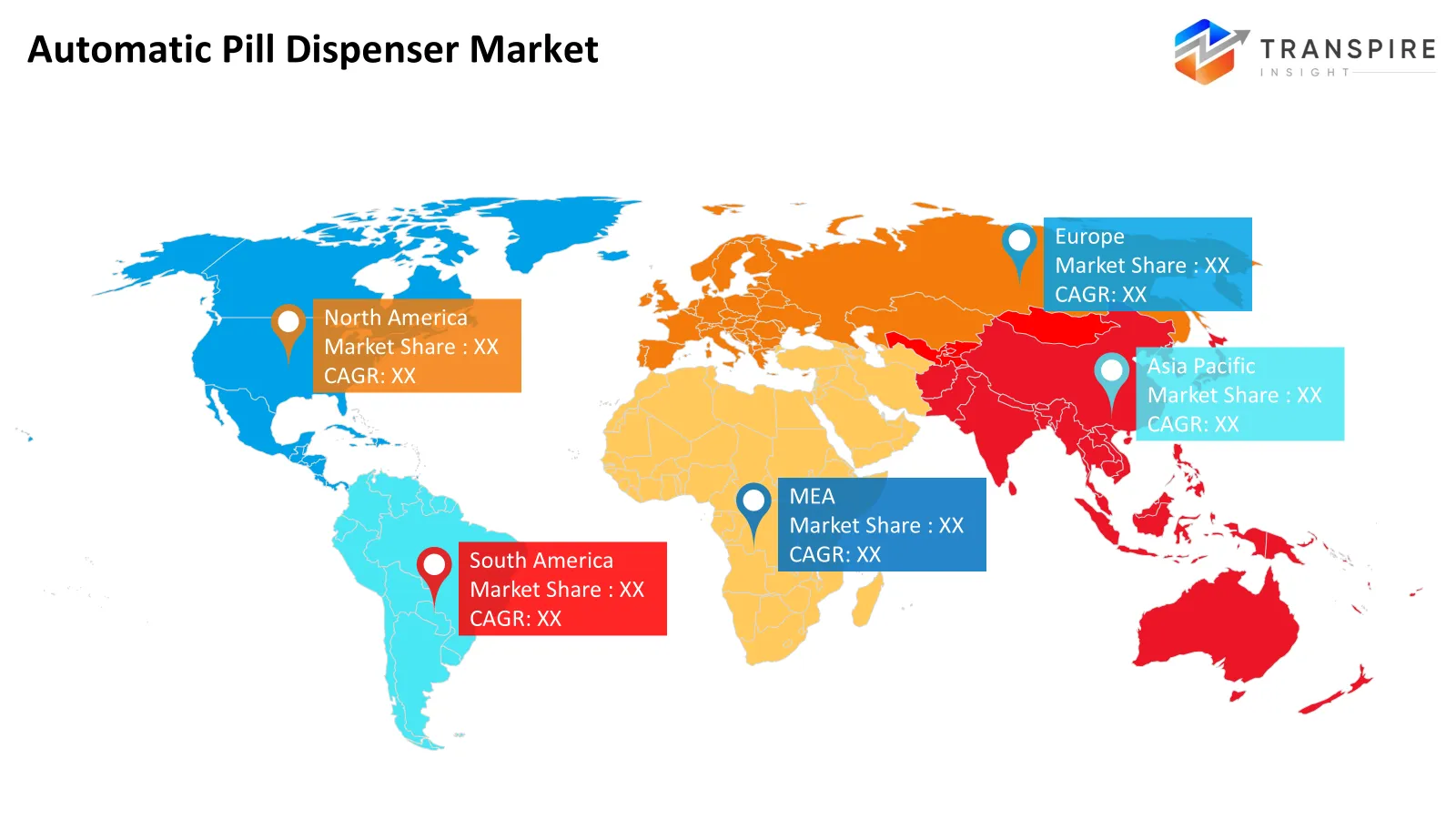
- North America holds the lead at 42.80% due to robust remote-care facilities and a shortage of caregivers.
- Hero Health continues to make progress with smart dispensing subscription offerings and is introducing caregiver dashboards and home-delivered medication coordination.
- In 2026, MedMinder extended its remote-monitoring and digital-health integration efforts to focus on elderly and chronic-care adherence.
- Philips launched an AI-powered dispenser with user-behaviour learning for customising schedules.
- Omnicell's offerings include hospital and pharmacy automation solutions, focusing on secure and auditable medication workflows.
- The European region accounts for 29.00% of demand, with interoperability, accessibility, and data protection being the key priorities for buyers.
- Asia Pacific is the largest market segment, accounting for a 20.00% share and growing at a CAGR of 11.60% due to an ageing population and hospital infrastructure.
- Latin America represents 4.50% and the Middle East & Africa 3.70%, where affordability and pharmacy-led distribution are still the key factors.
- Family-managed pill boxes are becoming a thing of the past, and cloud-based systems with caregiver alerts and adherence tracking are taking their place.
What are the Key Drivers, Restraints, and Opportunities in the Automatic Pill Dispenser Market?
Driver:
Growth is being driven by the practical difficulty of managing multiple prescriptions, particularly among older adults and patients with chronic conditions. Complex dosing schedules, forgetfulness, and limited caregiver availability have encouraged households and care facilities to adopt programmable dispensers. Remote alerts and dispensing records make missed doses more visible, allowing caregivers to intervene sooner. This improves the value proposition of connected devices for homecare providers and long-term care operators. Research into medication adherence among older Indian adults also reflects the need to evaluate practical combinations of pill organisers and digital reminders.
Restraint:
High upfront prices, recurring connectivity costs, and the effort required to load and configure devices limit adoption. These barriers persist because many users need assistance with setup, while existing care systems may lack compatible digital infrastructure. Concerns about privacy, mechanical failures, and incorrect dispensing can also discourage purchases when reliability is critical.
Opportunity:
Connected homecare programmes offer a route to broader adoption. Manufacturers can develop affordable dispensers with multilingual voice alerts, caregiver dashboards, and offline backup. In emerging markets such as India, partnerships with pharmacies, hospitals, and homecare providers could support assisted onboarding and subscription-based services. Integrating adherence records into care workflows may create recurring revenue beyond hardware sales, while pilot programmes can establish evidence of usability and clinical value.
Driver Impact Analysis for the Automatic Pill Dispenser Market:
|
Driver |
Relative Impact on Growth (%) |
Geographic Relevance |
Impact Timeline |
Demand Strength |
Growth Mechanism |
Key Beneficiaries |
Major Constraint |
|
Rising elderly population and increasing chronic disease prevalence |
28% |
North America, Europe, Japan |
Long-term (≥4 years) |
High |
Supports regular medication management for elderly patients |
Dispenser manufacturers, senior care providers, patients |
High device costs and limited affordability |
|
Growing need for medication adherence and error reduction |
24% |
North America, Europe |
Short-term (≤2 years) |
High |
Reduces missed doses, incorrect timing, and medication errors |
Healthcare providers, pharmacies, patients |
Resistance to technology adoption among users |
|
Integration of IoT, AI, and remote medication monitoring |
20% |
North America, Asia-Pacific |
Medium-term (2–4 years) |
High |
Enables connected reminders, adherence tracking, and caregiver alerts |
Smart device vendors, software developers, caregivers |
Data privacy concerns and connectivity limitations |
|
Expansion of home healthcare and ageing-in-place services |
16% |
North America, Europe, Asia-Pacific |
Medium-term (2–4 years) |
High |
Supports independent living and reduces caregiver workload |
Home healthcare agencies, device suppliers, families |
Limited reimbursement and upfront purchase costs |
|
Increasing digital healthcare investment and institutional adoption |
12% |
North America, Europe, Asia-Pacific |
Long-term (≥4 years) |
Medium |
Encourages automated dispensing across hospitals and care facilities |
Healthcare technology firms, hospitals, pharmaceutical distributors |
Integration costs and regulatory compliance requirements |
|
Total |
100% |
— |
— |
— |
— |
— |
— |
What Has the Impact of Artificial Intelligence Been on the Automatic Pill Dispenser Market?
Artificial intelligence shifts the concept of the programmable medication-release device from scheduled release to an intelligent medication-management platform. In automation, machine-learning algorithms are used to dynamically update reminders, segment out high-risk patients, and enable an in-place, real-time view of pharmaceutical inventory within institutional cabinets. The predictive value of these systems is particularly promising; analytics can leverage doses missed, refill patterns, behavioural indicators, and contextual awareness to spot signs of nonadherence days in advance to enable action by caregivers or clinicians before a clinical event. On the operational side, artificial intelligence improves pharmacy workflow by barcode verification, stock alerts, remote management of the device, and timestamped adherence records, supporting clinical-trial enrollment and care-coordination efforts. More and more cloud-connected dispensers are tying all of these capabilities to mobile apps and alerts for caregivers.
The major challenge is integration and precision. The artificial intelligence models require reliable connectivity, accurate dose-level data, and validation across different patients' types of non-adherence to avoid false alerts and build trust. The expense of implementation and low level of integration with hospital information systems limits adoption to large care organisations.
In April 2026, BD (Becton, Dickinson and Company) launched its AI-enabled Pyxis™ Pro Dispensing Solution and BD® Incada™ Connected Care Platform in the European market.
Key Automatic Pill Dispenser Market Trends:
The market is shifting from simple reminder products to connected products that will capture medication access and enable caregiver intervention. Reliability, usability, and integration into everyday healthcare services are increasingly factors in competitive differentiation.
- Standalone timers are being replaced by connected dispensers that send adherence events remotely.
- Routine reminders are being replaced with exception-based alerts for missed doses by the caregiver.
- Homecare providers are turning to remote monitoring to help patients in their care without being physically present.
- Large screens, easy-to-reach controls, voice feedback, and easy loading are increasingly a priority in product design.
- Sensor integration is helping to identify dispensing events, but it is still challenging to confirm ingestion.
- Companies are investigating subscription models that include hardware, monitoring, and continuous technical assistance.
- Pharmacy and healthcare collaborations are enabling adherence to be incorporated into medication-management programmes.
- For connected devices, privacy protection, reliability of connection, and offline operation are starting to become key factors in the purchase decision.
Automatic Pill Dispenser Market Segmentation
Product Type:
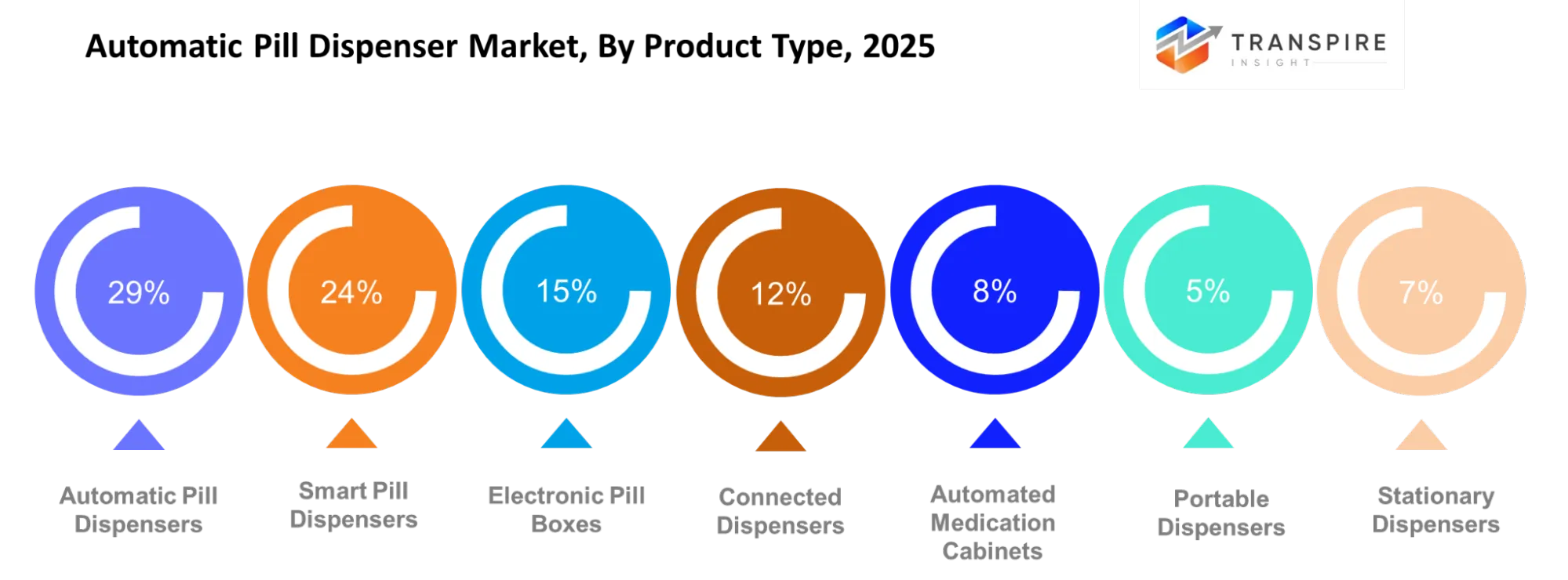
Automatic pill dispensers hold the leading position at 29.00%, supported by their broad use across home care, nursing facilities, and pharmacies; their growth logic lies in reliable scheduled dispensing, while future value will depend on connectivity and service add-ons. Smart pill dispensers account for 24.00% and are expanding through app-based monitoring, while electronic pill boxes represent 15.00% as a lower-cost entry point. Connected dispensers hold 12.00%, automated medication cabinets 8.00%, portable dispensers 5.00%, stationary dispensers 4.00%, and medication management systems 3.00%; together, these form the remaining 100% of the product landscape. Smart/connected devices represent 38.70% of the market, while IoT-connected dispensers are growing at a 14.90% CAGR, showing that remote visibility is becoming the core purchasing reason rather than an optional feature.
Medication Type:
Tablets and capsules dominate automatic pill dispenser use because their standardised shapes and sizes support accurate compartment-based dispensing. Softgels, powders, and liquids require specialised handling mechanisms, increasing product complexity and cost. Support for multiple medications is becoming a competitive differentiator as patients manage increasingly complex prescription schedules. Controlled-medication dispensing presents a higher-value institutional opportunity because secure access, dispensing records, and diversion prevention are important operational requirements. Future innovation will focus on flexible dosing formats, reliable delivery, and safer medication management.
Application:
Home healthcare is a major adoption setting, particularly for elderly people and patients managing chronic conditions who need consistent medication routines. Automated reminders and scheduled dispensing help reduce dependence on family members for everyday supervision. Hospitals, nursing homes, assisted-living facilities, pharmacies, clinics, and long-term-care providers use these devices to standardise medication workflows and reduce manual workload. Adoption increasingly depends on integration with existing care procedures, staff training, and dependable operation. Homecare expansion creates opportunities for remotely supervised medication management.
Technology:
Electronic timers remain the foundation of automatic pill dispensing, providing scheduled alerts and controlled dose release. IoT connectivity, mobile applications, Bluetooth, and Wi-Fi extend functionality through remote notifications and caregiver monitoring. Voice alerts improve accessibility for users with visual or cognitive difficulties, while AI-based medication management may identify recurring missed-dose patterns. However, connected features require dependable networks, appropriate cybersecurity, and user-friendly interfaces. Future differentiation will depend on combining reliable dispensing with meaningful monitoring rather than adding technology that complicates everyday use.
End User:
Elderly patients and people with chronic diseases need accessible devices that simplify medication routines and reduce missed doses. Caregivers value timely alerts and visibility into dispensing events, helping them support patients without continuous physical supervision. Hospitals, pharmacies, nursing facilities, and homecare providers prioritise secure operation, accountability, and compatibility with existing medication workflows. These distinct requirements encourage manufacturers to develop both simple household products and advanced institutional systems. Future adoption will depend on balancing ease of use, dependable performance, affordability, and the level of supervision required.
Distribution Channel:
Online retail is expanding access to automatic pill dispensers by allowing consumers to compare features, prices, and connectivity options before purchasing. Direct-to-consumer sales also help manufacturers explain product benefits and reach homecare customers. Pharmacies and speciality stores provide product guidance, while medical-equipment dealers, hospitals, and distributors support institutional procurement. Direct sales remain important for larger deployments requiring demonstrations, installation, and staff training. Going forward, manufacturers that combine digital purchasing with reliable after-sales support, accessible instructions, and responsive service are better positioned to build customer trust and repeat business.
What are the Key Use Cases Driving the Automatic Pill Dispenser Market?
The core use case is home-based medication adherence for elderly and chronic-disease patients, directly linked to the dominance of automatic and smart dispensers. These devices release tablets and capsules on schedule, notify caregivers of missed doses, and reduce dependence on family members for daily supervision.grandviewresearch+1
Expanding applications include nursing homes, assisted-living facilities, hospitals, and pharmacies, where automated cabinets and connected dispensers support staff efficiency, barcode verification, inventory control, and safer handling of multiple medications. Long-term-care providers increasingly use adherence records to coordinate care and demonstrate compliance.researchandmarkets+1
Emerging use cases include AI-based adherence prediction for high-risk patients, remote medication management through telehealth, and connected dispensing in clinical trials and speciality therapies. These applications link IoT-connected devices, mobile apps, and AI-based medication management to value-based, decentralised care.
|
Report Metrics |
Details |
|
Market size value in 2025 |
USD 3.51 Billion |
|
Market size value in 2026 |
USD 3.78 Billion |
|
Revenue forecast in 2033 |
USD 6.28 Billion |
|
Growth rate |
CAGR of 7.52% from 2026 to 2033 |
|
Base year |
2025 |
|
Historical data |
2021 - 2024 |
|
Forecast period |
2026 - 2033 |
|
Report coverage |
Revenue forecast, competitive landscape, growth factors, and trends |
|
Regional scope |
United States; Canada; Mexico; United Kingdom; Germany; France; Italy; Spain; Denmark; Sweden; Norway; China; Japan; India; Australia; South Korea; Thailand; Brazil; Argentina; South Africa; Saudi Arabia; United Arab Emirates |
|
Key companies profiled |
Hero Health, MedMinder, Philips, MedReady, TabTime, LiveFine, MedQ, DoseControl, e-pill, PharmRight, Spencer Health Solutions, Medipense, PillPack, Omnicell, Capsa Healthcare |
|
Customization scope |
Free report customization (country, regional & segment scope). Available customized purchase options to meet your exact research needs. |
|
Report Segmentation |
Product Type (Automatic Pill Dispensers, Smart Pill Dispensers, Electronic Pill Boxes, Connected Dispensers, Automated Medication Cabinets, Portable Dispensers, Stationary Dispensers, Medication Management Systems); Medication Type (Tablets, Capsules, Softgels, Powders, Liquids, Controlled Medications, Multiple Medications); Application (Home Healthcare, Hospitals, Nursing Homes, Assisted Living, Pharmacies, Clinics, Long-Term Care); Technology (Electronic Timers, IoT Connectivity, Mobile Apps, Bluetooth, Wi-Fi, Voice Alerts, AI-Based Medication Management); End User (Elderly Patients, Chronic Disease Patients, Caregivers, Hospitals, Pharmacies, Nursing Facilities, Homecare Providers); Distribution Channel (Online Retail, Pharmacies, Medical Equipment Dealers, Hospitals, Specialty Stores, Direct Sales, Distributors). |
Which Regions are Driving the Automatic Pill Dispenser Market Growth?
North America dominates the market with a 42.80% market share in the automatic pill dispenser market due to mature home healthcare services, remote patient monitoring services, and widespread institutional medication-management systems in the country. The market benefits from chronically ill patients and the ageing population that meet operationally to ensure medication adherence. The US FDA proposes operating regulations including scheduled medication discharge, event-recording, and patient-notifications for remote medication management systems, which in turn favours homecare vendors, caregivers, and healthcare facilities pursuing prescriptive control over the medication.
In April 2026, PersonalRX acquired MedMinder, expanding direct-to-home integrated pharmacy services and smart pill-box adherence monitoring for chronic care patients.
https://pitchbook.com/profiles/company/54051-67
Europe accounts for 29.00% of the market, where healthcare infrastructure, elderly population structure, and demand for independent living have historically fueled growth. Market opportunity is tempered by each country's healthcare payment system, care-provider procurement, and need for localisation of products to serve multiple languages and service models. While the existence of public healthcare infrastructure and eldercare services lays a strong foundation to sell and deploy the product in the institutional or home environments, here too, a patchwork of fragmented reimbursement and procurement hurdles could pose challenges to market standardisation.
In January 2026, the European digital chronic-care companyOvivaannounced a €200 million Series D funding round to fuel the expansion of its AI-enabled, evidence-backed digital care solutions across Europe.
https://oviva.com/global/en/press/
Asia Pacific is the leading territory with an 11.60% CAGR and is responsible for 20.00% of market demand. The recent growth in the region has come from the increase in hospital infrastructure, rise in healthcare expenditure and an accelerating ageing population in several key markets. Opportunities lie in affordable connected dispensers, native language interfaces, and channels working with pharmacies or insurers that enable remotely managed medicine delivery beyond high-income households.
In January 2026, Swisslog Healthcare expanded its operations into India (headquartered in Gurugram) as a core part of its broader growth strategy across the Asia-Pacific region.
https://www.swisslog-healthcare.com/en-gb/company/news/2026/02/india-expansion-2026
Who are the Key Players in the Automatic Pill Dispenser Market, and how do they compete?
Competition is shifting from feature-based to ecosystem-based competition. Companies are competing on adherence analytics, caregiver engagement, pharmacy presence, and recurring revenue from services. Though commodity pricing for hardware still matters, provider differentiation is emerging more through a dispenser's home care, telehealth, and institutional medication-care compatibility.
Hero Health takes an innovation-based consumer play with smart dispensing, a caregiver dashboard, and medication management. It deploys direct-to-consumer, home-care as its growth channel. Med Minder is pursuing a remote-monitoring niche with caregiver alerts, a digital-health play, and elderly medical management. It expands via connectivity and health-app compatibility. Philips deploys behavioural AI-enabled personalisation, using behavioural analytics for medication-schedule customisation as its competitive differentiator, and expands via a health tech brand. Omnicell pursues institutional innovation, with pharmacy automation, medication-packaging security, and auditability, using long-term care, hospital pharmacy, and hospital sales channels. Capsa Healthcare specialises in care-facility infrastructure. Spencer Health Solutions, Medipense, Dose Control, e-pill, Tab Time, Live Fine, MedQ, and Pharm Right charge consumers for portability, niche dispensing, or caregiver care. Amazon's Pill Pack uses medi pack delivery, rather than hardware.
Key Players are:
- Hero Health
- MedMinder
- Philips
- MedReady
- TabTime
- LiveFine
- MedQ
- DoseControl
- e-pill
- PharmRight
- Spencer Health Solutions
- Medipense
- PillPack
- Omnicell
- Capsa Healthcare
Automatic Pill Dispenser Market — Enhanced Competitive Benchmarking
| Company | Est. Revenue Share Range | Key Offerings | Strategic Positioning | Geographic Strength | Technology Focus |
| Omnicell | Estimated 8–14% | XR2 central pharmacy automation; XT dispensing cabinets; Pharmacy Carousel; medication management software | Enterprise automation leader serving hospitals and health systems | North America; Europe | Connected dispensing, robotics, inventory analytics |
| Becton Dickinson (BD) | Estimated 7–13% | Parata ULTRA; Parata XF; ATP pouch packaging; BD Rowa Dose | Broad pharmacy automation portfolio spanning packaging and dispensing | North America; Europe | Robotic storage, pouch packaging, RFID tracking |
| Swisslog Healthcare | Estimated 4–8% | AutoPack; automated medication carousels; pharmacy storage and retrieval; integrated workflow systems | Integrated hospital automation with end-to-end workflow capabilities | North America; Europe; Asia Pacific | Automated packaging, robotic retrieval, workflow integration |
| Hero Health | Estimated 2–5% | Hero Smart Dispenser; medication management app; caregiver alerts; adherence support services | Consumer-focused smart dispensing with subscription-based services | North America | Connected dispensing, dose tracking, remote alerts |
| MedMinder | Estimated 2–5% | Smart Pill Dispenser; connected medication app; prescription packaging and delivery; pharmacy support | Integrated home medication management and service-led adherence | North America | Cellular/Wi-Fi connectivity, caregiver monitoring, adherence analytics |
| MedReady | Estimated 1–3% | MR-357 cellular dispenser; 1750 monitored dispenser; 1700 standalone dispenser; compliance monitoring | Practical, value-oriented dispensers for home and care settings | North America | Timed dispensing, cellular alerts, remote compliance monitoring |
| Pivotell | Estimated 1–3% | Mk3/11 dispenser; Mk3/24 dispenser; Advance GSM dispenser; pharmacy filling accessories | Specialist positioning for older adults and supported-care users | Europe, particularly the UK | Rotating dose trays, timed alarms, GSM notifications |
| Evondos | Estimated 1–4% | Automated medication dispensing service; medication pouches; remote monitoring; care-provider support | Service-led automation for home care and independent living | Europe, particularly Nordic markets | Automated pouch dispensing, remote supervision, care integration |
| Livi | Estimated 1–3% | Automated medication dispenser; dose reminders; remote care monitoring; medication adherence support | Connected medication support for home care and assisted living | Europe, particularly Nordic markets | Scheduled dispensing, connectivity, caregiver notifications |
| PharmAdva | Estimated 1–3% | Automated medication dispensing solutions; medication adherence systems; care-facility dispensing support | Specialist solutions for medication adherence and care delivery | North America | Automated dose access, adherence support, dispensing safety |
Recent Development News
- In March 2026, BD partnered with Sinteco to integrate robotic unit-dose packaging with connected medication management systems across European hospitals. The collaboration is designed to automate medication preparation, improve dose traceability, reduce manual handling errors, and help healthcare professionals manage dispensing workflows more efficiently. https://www.bd.com/en-uk/about-bd/news-and-media/news/2026/3-11-2026
- In September 2026, Hero Health, Inc. was officially recognized as one of TIME’s World's Top HealthTech Companies of 2026. This industry accolade validates the company's ongoing expansion in end-to-end medication management, driven by its automated home dispenser's ability to safely sort, track, and dispense multi-month prescription supplies. https://time.com/about-time/
- In September 2026, Custom Health completed its acquisition of Spencer Health Solutions, bringing the spencer® smart medication dispenser, in-home monitoring technology, and intellectual property under full ownership. The acquisition is expected to strengthen Custom Health’s home-based medication management capabilities and improve operational margins. https://www.customhealth.com/blog/custom-health-completes-acquisition-of-spencer-health-solutions-bringing-in-home-medication-dispensing-technology-fully-in-house
What Strategic Insights Define the Future of the Automatic Pill Dispenser Market?
The connected Medication Management tracking developments are gradually progressing by including the dispensing hardware as one element of a universal homecare system. Given that smart and connected devices form 38.70% of products and Internet of Things-connected dispensers are expected to grow at a CAGR of 14.90%, the equipment providers should emphasise robust connectivity, user-friendly interfaces, and useful caregiver alarms, rather than implementing features without tangible benefits. The unnoticed pitfall is that the documented dispensing activity may be misinterpreted as actual medication ingestion, leading to unwarranted confidence in adherence results. Connectivity issues, privacy issues, and complicated setup may further diminish user confidence, especially for elderly users. The new opportunity is in pharmacies, homecare, and device partners collaborating to offer onboarding, monitoring, and support, especially for cost-sensitive multilingual solutions with a predicted CAGR of 11.60% in the Asia Pacific region. In terms of strategy, providers should test usability and reliability using live pilots, incorporate offline protocols, ensure data security, and showcase benefits to support large-scale deployment.
Key Segmentations are:
Product Type
- Automatic Pill Dispensers
- Smart Pill Dispensers
- Electronic Pill Boxes
- Connected Dispensers
- Automated Medication Cabinets
- Portable Dispensers
- Stationary Dispensers
- Medication Management Systems
Medication Type
- Tablets
- Capsules
- Softgels
- Powders
- Liquids
- Controlled Medications
- Multiple Medications
Application
- Home Healthcare
- Hospitals
- Nursing Homes
- Assisted Living
- Pharmacies
- Clinics
- Long-Term Care
Technology
- Electronic Timers
- IoT Connectivity
- Mobile Apps
- Bluetooth
- Wi-Fi
- Voice Alerts
- AI-Based Medication Management
End User
- Elderly Patients
- Chronic Disease Patients
- Caregivers
- Hospitals
- Pharmacies
- Nursing Facilities
- Homecare Providers
Distribution Channel
- Online Retail
- Pharmacies
- Medical Equipment Dealers
- Hospitals
- Speciality Stores
- Direct Sales
- Distributors
By Regional Analysis
North America
- US
- Canada
- Mexico
Europe
- Germany
- UK
- France
- Italy
- Spain
- Russia
- Rest of Europe
Asia Pacific
- China
- Japan
- India
- South Korea
- Australia
- Rest of Asia Pacific
South America
- Brazil
- Argentina
- Rest of South America
Middle East & Africa
- UAE
- Saudi Arabia
- Qatar
- South Africa
- Rest of the Middle East & Africa
Frequently Asked Questions
Find quick answers to common questions.
The automatic pill dispenser market size was valued at USD 3.51 billion in 2025 and is poised to reach USD 6.28 billion by 2033, expanding at a 7.52% CAGR.
Key segments for the automatic pill dispenser market are Type (Functional Foods, Fortified & Healthy Bakery Products, Healthy Snacks & Beverages, Dietary & Weight Management Foods, Sports & Energy Foods), Nature (Organic, Conventional), Calorie Content (Low Calories, No Calories, Reduced Calories), Distribution Channel (Supermarkets & Hypermarkets, Convenience Stores, Online Retail, Specialty Stores).
Growth is primarily driven by ageing populations, rising chronic disease prevalence, medication non-adherence, increasing home healthcare adoption, and advancements in connected dispensing and remote patient monitoring technologies.
The automatic pill dispenser market is led by major manufacturers, including Hero Health, MedMinder, Philips, MedReady, TabTime, LiveFine, MedQ, DoseControl, e-pill, PharmRight, Spencer Health Solutions, Medipense, PillPack, Omnicell, and Capsa Healthcare.
North America holds a 42.80% market share, supported by established home healthcare infrastructure, ageing demographics, chronic disease management needs, and widespread adoption of connected healthcare technologies.
Key opportunities include affordable IoT-enabled dispensers, AI-based adherence monitoring, pharmacy partnerships, subscription-based remote care services, and expansion into emerging markets through localised products.
- Hero Health
- MedMinder
- Philips
- MedReady
- TabTime
- LiveFine
- MedQ
- DoseControl
- e-pill
- PharmRight
- Spencer Health Solutions
- Medipense
- PillPack
- Omnicell
- Capsa Healthcare
About the Authors

Pankaj Ghogare Patil
I am Pankaj Ghogare Patil, a Senior Research Analyst at Transpire Insight, specializing in the Pharmaceutical, Chemicals & Materials, Healthcare IT, and Biotechnology industry. My expertise lies in conducting comprehensive market research, analyzing industry trends, evaluating competitive landscapes, and translating complex data into actionable insights. At Transpire Insight, I closely follow emerging technologies, regulatory developments, and market innovations to create accurate, well-researched, and informative content that helps businesses and professionals make informed decisions. I am committed to producing credible, evidence-based articles that reflect industry best practices while making technical topics accessible and valuable for a broad audience.

Chakradhar Khansole
Chakradhar serves as the Research Director at Transpire Insight, bringing over 8 years of experience in technology, innovation, and strategic market intelligence. He specializes in transforming complex market data into actionable business insights that enable organizations to make informed, growth-oriented decisions. Recognized for his strategic vision and analytical expertise, Chakradhar leads high-impact research initiatives, delivering comprehensive market assessments, competitive intelligence, and forward-looking industry analysis.
Recently Published Reports
-
Jul 2026
Alopecia Treatment Market
Alopecia Treatment Market Size, Share & Analysis Report By Disease Type (Alopecia Areata, Cicatricial Alopecia, Traction Alopecia, Alopecia Totalis, Androgenetic Alopecia, Alopecia Universalis, and Other Disease Types), By Treatment Type (Topical Treatments, Oral Medications, Injectable Therapies, and Hair Transplantation), By Gender (Male, and Female), By Distribution Channel (Hospitals and Clinics, Retail Pharmacies, and Online Retailers), and Geography (North America, Europe, Asia-Pacific, Middle East and Africa, South and Central America), 2021 - 2031
-
Jul 2026
Medical Ultrasound Probe Market
Medical Ultrasound Probe Market Size, Share & Analysis Report By Type (Linear Type, Convex Type, Endocavitary Probe, Phased Array/Cardiac Probe, Transesophageal (TEE) Probe, and Others), By Application (Ophthalmology, Cardiology, Musculoskeletal, Oncology, Obstetrics & Gynecology, General Imaging, and Others), By End User (Hospitals & Clinics, Diagnostic Centers, Ambulatory Surgical Centers, and Others), and Geography (North America, Europe, Asia-Pacific, Middle East and Africa, South and Central America), 2021 – 2031
-
May 2026
Biosimilars Market
Biosimilars Market By Product Type (Monoclonal Antibodies, Recombinant Hormones, Erythropoietin, G-CSF, Others), By Indication (Oncology, Autoimmune Diseases, Blood Disorders, Diabetes, Others), By Manufacturing Type (In-House Manufacturing, Contract Manufacturing), By Distribution Channel (Hospital Pharmacies, Retail Pharmacies, Online Pharmacies), By Industry Analysis, Size, Share, Growth, Trends, and Forecasts 2021-2033
-
Apr 2026
Gastrointestinal Endoscopy Market
Gastrointestinal Endoscopy Market By Type (Rigid Gastrointestinal Endoscope, Flexible Gastrointestinal Endoscopes, Disposable Gastrointestinal Endoscope), By Procedure Type (Colonoscopy, Gastroscopy, Duodenoscopy, Enteroscopy, Flexible Sigmoidoscopy, Others), By Application (Diagnosis, Treatment), By End-Users (Hospitals, Ambulatory Surgical Centers, Specialty Clinics, Laboratories, Others), By Industry Analysis, Size, Share, Growth, Trends, and Forecasts 2021-2033