
Asia Pacific Voluntary Carbon Credit Market Size & Forecast:
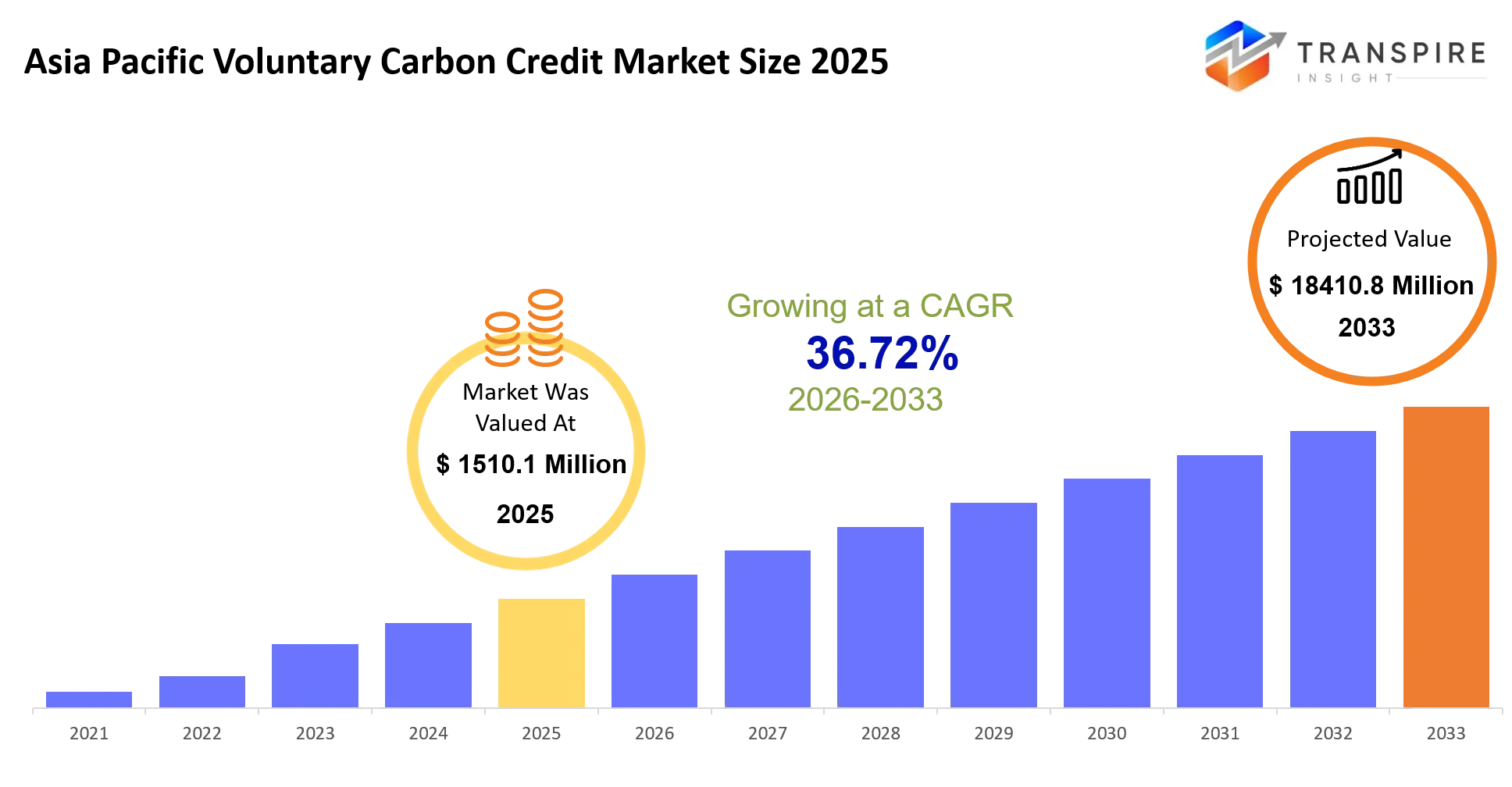
- Asia Pacific Voluntary Carbon Credit Market Size 2025: USD 1510.1 Million
- Asia Pacific Voluntary Carbon Credit Market Size 2033: USD 18410.8 Million
- Asia Pacific Voluntary Carbon Credit Market CAGR: 36.72%
- Asia Pacific Voluntary Carbon Credit Market Segments: By Component (Hardware, Software, Services, Managed Services, Professional Services, Support Services, Consulting Services, Others); By Deployment Mode (Cloud-Based, On-Premise, Hybrid, Virtual Appliances, Network-Based, Host-Based, Wireless-Based, Others); By Enterprise Size (Large Enterprises, Medium Enterprises, Small Enterprises, Government Organizations, Startups, Educational Institutions, Others); By Industry Vertical (BFSI, IT & Telecom, Healthcare, Government, Retail, Manufacturing, Energy & Utilities, Others)
Asia Pacific Voluntary Carbon Credit Market Summary
The Asia Pacific Voluntary Carbon Credit Market was valued at USD 1510.1 Million in 2025. It is forecast to reach USD 18410.8 Million by 2033. That is a CAGR of 36.72% over the period.
The Asia Pacific Voluntary Carbon Credit Market functions as a system that allows private investors to invest directly in projects that reduce carbon emissions and protect the environment in the region. To comply with strict government rules, companies buy special credits to offset the carbon they still produce in their operations and supply chains. Over the past few years, this market has changed a lot. It used to be about investments, but now it adheres to international standards such as the Integrity Council for the Voluntary Carbon Market (ICVCM) Core Carbon Principles. This change has led companies to prefer verified, trackable credits over cheap, unverified ones. The market for Asia-Pacific Voluntary Carbon Credits has shifted towards traceable, asset-backed removal options. Major cities, such as Singapore and Japan, have begun linking their carbon taxes to carbon credit programs.
This has allowed companies to use some of their carbon credits to reduce their tax liabilities. As a result, companies now see carbon credits as a way to directly improve their situation rather than just as a sustainability expense. This change has unlocked significant revenue and helped more projects be developed in the region. The growth of the Asia Pacific Voluntary Carbon Credit Market is driven by policies. Governments recognize voluntary credits for tax purposes, which has scaled up project development throughout the region. The Asia Pacific Voluntary Carbon Credit Market now offers institutional revenue.
Key Market Insights
- The Asia-Pacific Voluntary Carbon Credit Market is projected to be worth USD 9.0 billion by 2033. It will grow at a rate of 7.57% per year starting in 2025.
- The Asia Pacific region is the player in the global credit market right now. This is because it has many carbon sinks, and many nature-based removal projects are being planned.
- Forestry Credits are popular. Many big nature-based removal projects have started in ecosystems. These ecosystems include places like Indonesia and Malaysia. Forestry Credits play a role in these projects.
- Blue Carbon Credits are growing the fastest from 2026 to 2033. This is happening because people are investing more in coastal conservation.
- Afforestation and Reforestation are used the most, with over 40% of the market. This is because the methods used to measure their impact are widely accepted and easy to understand.
- Sustainable Agriculture and Blue Carbon Conservation are growing quickly. This is because they benefit the environment and are highly valued.
- Big companies are the buyers of carbon credits. They have to follow rules about the environment and social responsibility.
- Financial Institutions are buying more carbon credits. They are creating portfolios that are easy to buy and sell.
- China and other Asian countries will be the largest sources of carbon credits to be issued and traded from 2026 to 2033.
- Important companies, like ACX, Climate Impact X and South Pole, are using platforms and blockchain to grow and stay ahead of the competition.
What are the Key Drivers, Restraints, and Opportunities in the Asia Pacific Voluntary Carbon Credit Market?
Drivers
The main thing that is helping the carbon market in regions to grow is that countries are now allowing companies to use voluntary carbon assets to meet their requirements. For example, Singapore is letting companies use carbon credits to offset some of their emissions. This means that companies can use these credits to reduce the amount of taxes they have to pay. As a result companies are now planning ahead. Buying these credits for several years at a time, which gives the people who develop these projects a steady income and makes it easier for them to get funding for new projects that reduce carbon.
Restraints
The problem with the carbon market is that different countries use their own methods for measuring and tracking carbon credits. This is an issue when checking whether the data is correct. You see, every country in the Asia Pacific region does things differently. They do not all follow the same rules. This is causing problems in counting carbon credits, leading to some credits being counted multiple times. This makes it hard for companies to buy carbon credits because they worry about being accused of dishonesty in their efforts to help the environment. As a result the number of deals and the amount of money being made in the carbon market are decreasing.
Opportunities
There is a chance coming up in the carbon market, which is the sale of blue carbon credits. These credits come from projects that protect and restore areas like mangroves and seagrass. Countries like Indonesia and the Philippines are making laws to protect these areas, which allows companies to create carbon credits from them. Companies can use technology to measure how much carbon is being saved from these projects and sell high-quality credits to buyers who're willing to pay more for them. This is a chance for companies that want to invest in projects that reduce carbon and also help protect animals and plants. We will probably see more of these carbon credits in the future, which will help the carbon market grow and attract investment. The carbon market will also grow because more people want to buy carbon assets like the ones being used in Singapore.
What Has the Impact of Artificial Intelligence Been on the Asia Pacific Voluntary Carbon Credit Market?
The Asia Pacific voluntary carbon credit marketplace is changing because of intelligence and new digital technologies. They are changing the way people check assets and track transactions. Project developers use machine learning and satellite pictures to check biomass and calculate canopy cover for forestry conservation. This replaces the way of doing things, which was slow and manual. Now people can get accurate calculations of carbon sequestration rates.Project developers also use machine learning to look at weather records, deforestation and local economic trends. This helps them predict how credits they will get and check if the project is good over many years. These new technologies make things more efficient by speeding up the process of issuing credits, reducing costs and making sure everything meets standards.
However there is a problem when the weather changes in regions. Sometimes clouds and monsoons in areas block the satellite pictures, which causes gaps in the data. This makes it hard for the predictive algorithms to work properly. Because of this project developers still have to use methods to double check things, which means they do not save as much money as they could with fully automated systems. Artificial intelligence and digital technologies are helpful. They are not perfect especially when it comes to the Asia Pacific voluntary carbon credit marketplace and its use of artificial intelligence.
Key Market Trends
- National governments changed their approach from export models to strict tracking of domestic registries. This was done to preserve the contributions that each country had determined for itself.
- Corporate buyers are now moving away from low-cost credits that helped avoid emissions. Instead they are choosing to pay more for credits that are based on nature and remove carbon from the atmosphere.
- In 2025 digital exchanges started using automated contracts. These contracts enable settlement of transactions and clear tracking of where products come from.
- Project developers are now using soil sensors. These were integrated in 2026. Provide real-time data on carbon sequestration for agricultural projects.
- Independent auditors are using high-resolution radar technology. This helps them verify the amount of carbon stored in forests even when there is cover in certain regions.
- Major airlines have started using programs that algorithmically purchase offsets at the point of sale. This helps them manage their emissions from transport.
- Regional banking groups now have divisions dedicated to financing carbon projects. They offer funding for the initial development of these projects.
- Projects that capture methane have expanded to landfills across Southeast Asia. This is because regulations on waste management have become stricter in the region.
- In 2025 insurance providers launched guarantees for credit delivery. These guarantees protect buyers against project reversals.
- B2B procurement platforms have integrated API connections into accounting software. This automates the balancing of carbon assets.
Asia Pacific Voluntary Carbon Credit Market Segmentation
By Credit Type
The Asia Pacific Voluntary Carbon Credit Market has a lot of Forestry Credits. This is because there are big projects to plant trees and save forests in Southeast Asia. Companies like to buy Forestry Credits because they help to plant trees and stop trees from being cut down. They also like that Forestry Credits are good for the environment and the people who live near the forests. Even though Forestry Credits cost more than types of credits companies are willing to pay more for them. This is because Forestry Credits are very good at reducing carbon and people can see the difference they make.
Renewable Energy Credits are important for helping the Asia Pacific region use more solar and wind power. These credits help to reduce the amount of things we release into the air by supporting projects that use clean energy instead of fossil fuels. One good thing about Renewable Energy Credits is that we can easily track where they come from. This means that buyers can be sure that the credits they buy are real and will make a difference. It also helps to stop people from counting the credit twice.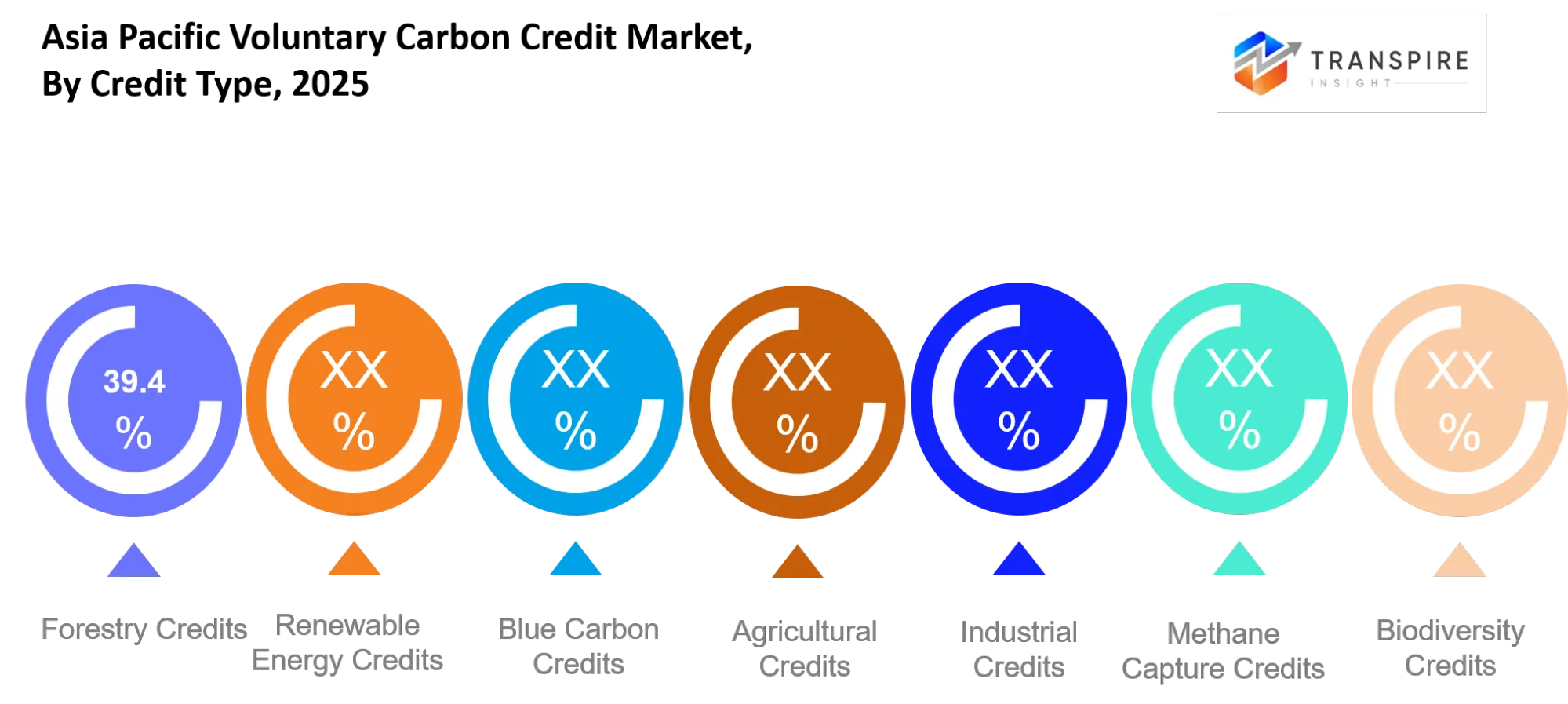
By Project Type
Afforestation projects are when we plant trees in areas where there were no trees before. This helps to absorb carbon dioxide from the air. Many countries in Asia Pacific have land that's good for planting trees and their governments support these projects. Planting trees helps to clean the air. Also gives people jobs in rural areas. Companies like to invest in these projects because it helps them to show that they care about the environment.
Reforestation projects are when we fix areas that were damaged because of much logging or land use. This helps to bring the forests that were lost. These projects are very important in areas that were hurt by people cutting down many trees. They can also help the environment to recover faster than planting trees in some cases. Companies like to buy credits from these projects because they can see the good that they do for the climate and the animals that live there.
By End User
Big companies are the buyers of voluntary carbon credits in Asia Pacific. They buy these credits to help them reach their goals of releasing bad things into the air. They also use credits to show that they care about the environment and to meet the standards that people expect from them. The companies that buy the credits are the ones that people expect to be more environmentally friendly.
Governments also buy carbon credits to help them meet their climate goals. They use credits to support projects that help the environment like planting trees and using clean energy. When governments buy credits it helps to make the market for credits stable and secure. This makes it easier for projects that help the environment to get the money they need.
By Trading Platform
Trading platforms are vital when it comes to helping the market with the buying and selling of voluntary carbon credits. Participants in the market leverage these platforms to get in touch with other participants and make transactions that meet their requirements in terms of meeting their sustainability needs. The rising trend towards carbon offsetting and commitment to climate change will fuel demand for better trading options.
The development of trading platforms in the future is expected to help with making transactions at a higher rate, providing better price discovery, and building trust in the market. This is likely to be achieved through the implementation of digital technologies and improving trading procedures within the market. Such trends in the future can lead to an increase in market efficiency in the voluntary carbon credit market.
What are the Key Use Cases Driving the Asia Pacific Voluntary Carbon Credit Market?
Corporate net-zero balancing is an area where companies buy large amounts of credits to offset their emissions.Many industrial and tech companies purchase forestry credits to balance out the emissions from their logistics and supply chains.They do this because they have to show progress towards their zero goals to financial institutions.This is a demand area because companies face a lot of pressure to reduce their emission.Supply chain decarbonization is another area that is growing fast.
- Big manufacturers in consumer electronics and autos are making their suppliers offset their production emissions.
- These manufacturers use credits from agriculture and industry to balance out emissions from making materials and components.This area is expanding quickly because companies have to account for emissions across their supply chain.
A new area that is emerging is using carbon tokens in retail finance apps and online shopping checkouts.This lets consumers buy parts of blue carbon or biodiversity credits to offset the emissions from their deliveries or transactions.While this area is still small it has a lot of potential, for growth as digital platforms make it easier for consumers to offset their emissions.
|
Report Metrics |
Details |
|
Market size value in 2025 |
USD 1510.1 Million |
|
Market size value in 2026 |
USD 2061.3 Million |
|
Revenue forecast in 2033 |
USD 18410.8 Million |
|
Growth rate |
CAGR of 36.72% from 2026 to 2033 |
|
Base year |
2025 |
|
Historical data |
2021 - 2024 |
|
Forecast period |
2026 - 2033 |
|
Report coverage |
Revenue forecast, competitive landscape, growth factors, and trends |
|
Regional scope |
Asia Pacific |
|
Key company profiled |
Verra, Gold Standard, South Pole, Climate Impact Partners, Carbon Streaming, Ecosecurities, ClimateTrade, Pachama, Sylvera, Carbonplace, AirCarbon Exchange, Xpansiv, Cloverly, Carbon Direct, TerraPass |
|
Customization scope |
Free report customization (country, regional & segment scope). Avail customized purchase options to meet your exact research needs. |
|
Report Segmentation |
By Credit Type (Forestry Credits, Renewable Energy Credits, Blue Carbon Credits, Agricultural Credits, Industrial Credits, Methane Capture Credits, Biodiversity Credits, Others); By Project Type (Afforestation, Reforestation, Renewable Energy Projects, Waste Management, Carbon Capture, Sustainable Agriculture, Conservation Projects, Others); By End User (Corporations, Governments, Financial Institutions, Energy Companies, Manufacturers, Airlines, Others); By Trading Platform (OTC Trading, Exchanges, Carbon Registries, Brokers, Digital Platforms, Auctions, Private Transactions, Others) |
Which Regions are Driving the Asia Pacific Voluntary Carbon Credit Market Growth?
Australia is the leader when it comes to the Asia Pacific carbon credit market. This is because Australia has a system in place and it makes sure that the carbon credits are real and trustworthy. The Australian Carbon Credit Unit Scheme helps projects that restore land burn savannas in a way that's good for the environment and plant trees again. These projects are checked closely by the government to make sure they are doing what they say they are doing.
Australia also has a system to measure and verify the projects and scientists are involved to make sure everything is done correctly. The people who take care of the land and the indigenous groups are also very involved in this process. This makes sure that the carbon credits are reliable and trustworthy. Companies like to buy carbon credits from Australia because they can trust that the credits are real and that they will help the environment in the run.
China is also a player in the carbon credit market.. China's strength comes from its large size and its ability to change its industries to be more environmentally friendly. China has a system to trade carbon credits. It is starting to use voluntary carbon credits again. This means that there are projects in China that can help reduce carbon emissions, especially in industries like power, cement and steel. China's market is strong because of its government policies and its focus on making industries more efficient.
Who are the Key Players in the Asia Pacific Voluntary Carbon Credit Market and How Do They Compete?
The Asia Pacific market for carbon credits is all over the place, with a lot of different groups trying to be in charge. These groups include people who make rules, people who develop projects and people who rate projects. They all want to be seen as trustworthy and get access to projects. The groups that have been around for a while, like Verra and Gold Standard, are trusted by the market. New groups that use a lot of technology are trying to change the way things are done.
Verra remains an important group in setting standards for carbon credits. They are doing this by making their rules stricter and improving their system, which makes it easier to track carbon credits. Gold Standard is doing things a bit differently by showing that their credits not help the environment but also have social benefits. This is important for companies in Asia Pacific that want to make sure they are buying credits that benefit people and the planet. South Pole is a company that develops projects and gives advice. They are growing by working with landowners and developers of renewable energy in Southeast Asia.
Sylvera is a company that uses intelligence to rate the quality of carbon credits. This helps buyers in Asia Pacific make decisions and avoids problems with their reputation. Pachamama is a company that uses satellite images and machine learning to monitor forests. This helps them keep track of the credits generated by nature-based projects. Both Sylvera and Pachama are growing by working with companies and participating in online platforms and marketplaces in Asia Pacific. The Asia Pacific voluntary carbon credit market is all about carbon credits, and these companies are all trying to make a name for themselves in this market, the Asia Pacific carbon credit market.
Company List
- Verra
- Gold Standard
- South Pole
- Climate Impact Partners
- Carbon Streaming
- EcoSecurities
- ClimateTrade
- Pachama
- Sylvera
- Carbonplace
- AirCarbon Exchange
- Xpansiv
- Cloverly
- Carbon Direct
- TerraPass
Recent Development News
In January 2026, Climate Impact X (CIX) launched a specialized spot trading contract for blue carbon credits. This contract standardizes high-integrity mangrove restoration assets from the Indo-Pacific region to improve liquidity for corporate buyers.https://www.climateimpactx.com
In November 2025, ACX (AirCarbon Exchange) entered a partnership with the Indonesia Carbon Exchange (IDX Carbon). This collaboration links digital registry networks to enable cross-border spot trading of Indonesian nature-based carbon credits under Article 6 frameworks. https://www.aircarbon.co
In March 2026, South Pole secured funding of USD 45 million from an international institutional investor consortium. The capital is designated to expand remote sensing verification technologies and accelerate the development of sustainable agriculture projects across Southeast Asia. https://www.southpole.com
What Strategic Insights Define the Future of the Asia Pacific Voluntary Carbon Credit Market?
In terms of its structure, the Asia Pacific Voluntary Carbon Credit Market will gradually shift towards providing higher-quality carbon credits that have been verified through technology, as demand for carbon credits that can clearly demonstrate their environmental impact increases among buyers. In the next five to seven years, the demand side will drive market growth rather than the need for more carbon credits since buyers will increasingly look for carbon reductions projects that can provide clear proof of their efficacy in reducing emissions.
Another threat to the market may come from a lack of diversity in the types and geographical locations of carbon projects. If the number of carbon projects declines or project performance turns out not to meet expectations, buyers could be left facing high prices for carbon credits and reputational risks due to poorly performed projects. On the other hand, the development of blue carbon projects related to mangrove forests, seagrass meadows, and marine restoration has been highlighted as a future opportunity.
Asia Pacific Voluntary Carbon Credit Market Report Segmentation
By Credit Type:
- Forestry Credits
- Renewable Energy Credits
- Blue Carbon Credits
- Agricultural Credits
- Industrial Credits
- Methane Capture Credits
- Biodiversity Credits
- Others
By Project Type:
- Afforestation
- Reforestation
- Renewable Energy Projects
- Waste Management
- Carbon Capture
- Sustainable Agriculture
- Conservation Projects
- Others
By End User:
- Corporations
- Governments
- Financial Institutions
- Energy Companies
- Manufacturers
- Airlines
- Others
By Trading Platform:
- OTC Trading
- Exchanges
- Carbon Registries
- Brokers
- Digital Platforms
- Auctions
- Private Transactions
Frequently Asked Questions
Find quick answers to common questions.
The Expected Asia Pacific Voluntary Carbon Credit Market size for the Market will be USD 18410.8 Million in 2033.
Key Segments for the Asia Pacific Voluntary Carbon Credit Market are By Credit Type (Forestry Credits, Renewable Energy Credits, Blue Carbon Credits, Agricultural Credits, Industrial Credits, Methane Capture Credits, Biodiversity Credits, Others); By Project Type (Afforestation, Reforestation, Renewable Energy Projects, Waste Management, Carbon Capture, Sustainable Agriculture, Conservation Projects, Others); By End User (Corporations, Governments, Financial Institutions, Energy Companies, Manufacturers, Airlines, Others); By Trading Platform (OTC Trading, Exchanges, Carbon Registries, Brokers, Digital Platforms, Auctions, Private Transactions, Others).
Major Asia Pacific Voluntary Carbon Credit Market Players are Verra, Gold Standard, South Pole, Climate Impact Partners, Carbon Streaming, Ecosecurities, ClimateTrade, Pachama, Sylvera, Carbonplace, AirCarbon Exchange, Xpansiv, Cloverly, Carbon Direct, TerraPass.
The Current Asia Pacific Voluntary Carbon Credit Market size is USD 1510.1 Million in 2025.
The Asia Pacific Voluntary Carbon Credit Market CAGR is 36.72% from 2026 to 2033.
- Verra
- Gold Standard
- South Pole
- Climate Impact Partners
- Carbon Streaming
- EcoSecurities
- ClimateTrade
- Pachama
- Sylvera
- Carbonplace
- AirCarbon Exchange
- Xpansiv
- Cloverly
- Carbon Direct
- TerraPass
About the Authors

Avinash Kumar
I’m Avinash Kumar, a Senior Research Analyst at Transpire Insight, with expertise in the Electronics and Semiconductor and Energy & Power industry. My work focuses on analyzing emerging technologies, market trends, industry developments, and innovation across these sectors. I specialize in transforming complex technical and market insights into clear, research-backed content that helps professionals, businesses, and decision-makers stay informed. Through continuous industry research and data-driven analysis, I strive to deliver accurate, reliable, and practical perspectives on the latest advancements shaping the semiconductor and energy landscape.

Chakradhar Khansole
Chakradhar serves as the Research Director at Transpire Insight, bringing over 8 years of experience in technology, innovation, and strategic market intelligence. He specializes in transforming complex market data into actionable business insights that enable organizations to make informed, growth-oriented decisions. Recognized for his strategic vision and analytical expertise, Chakradhar leads high-impact research initiatives, delivering comprehensive market assessments, competitive intelligence, and forward-looking industry analysis.
Recently Published Reports
-
Apr 2026
Active Power Filter Market
Active Power Filter Market Size, Share & Analysis Report By Type (Shunt Active Power Filters, Series Active Power Filter, Hybrid Active Power Filter), By Application (Harmonics Mitigation, Reactive Power Compensation, Voltage Regulation, Power Factor Correction), By Phase (Single Phase, Three Phase), By End-User Industry (Manufacturing, Healthcare, Commercial, Automotive, Oil and Gas, Others), and Geography (North America, Europe, Asia-Pacific, Middle East and Africa, South and Central America), 2021 - 2031
-
Apr 2026
Electrical Transformer Market
Electrical Transformer Market Size, Share & Analysis Report By Core (Closed, Shell, and Berry), By Insulation (Gas, Oil, Solid, Air, and Other), By Phase (Single, and Three), By Rating (100 MVA to 500 MVA, 501 MVA to 800 MVA, and 801 MVA to 1200 MVA), and Geography (North America, Europe, Asia-Pacific, Middle East and Africa, South and Central America), 2021 – 2031
-
Apr 2026
Hydraulic Piston Pumps Market
Hydraulic Piston Pumps Market Size, Share & Analysis Report By Type (Axial Piston Pumps, Radial Piston Pumps), By Operating Pressure (Low Pressure, Medium Pressure, High Pressure), By Application (Construction, Mining, Agriculture, Automotive, Oil & Gas, Industrial Machinery, Others), By End-User (OEMs, Aftermarket), and Geography (North America, Europe, Asia-Pacific, Middle East and Africa, South and Central America), 2021 – 2031
-
Apr 2026
Laboratory Gas Generators Market
Laboratory Gas Generators Market Size, Share & Analysis Report By Product (Nitrogen Gas Generator, Hydrogen Gas Generator, Zero Air Gas Generator, Purge Gas Generator, TOC Gas Generators, Others), By Application (Gas Chromatography, Liquid Chromatography-mass Spectrometry (LC-MS), Gas Analyzers, Others), By End-user (Life Science, Chemical & Petrochemical, Food & Beverage, Others), and Geography (North America, Europe, Asia-Pacific, Middle East and Africa, South and Central America), 2021 – 2031