
Middle East and Africa Carbon Credit Validation Verification and Certification Market Size & Forecast:
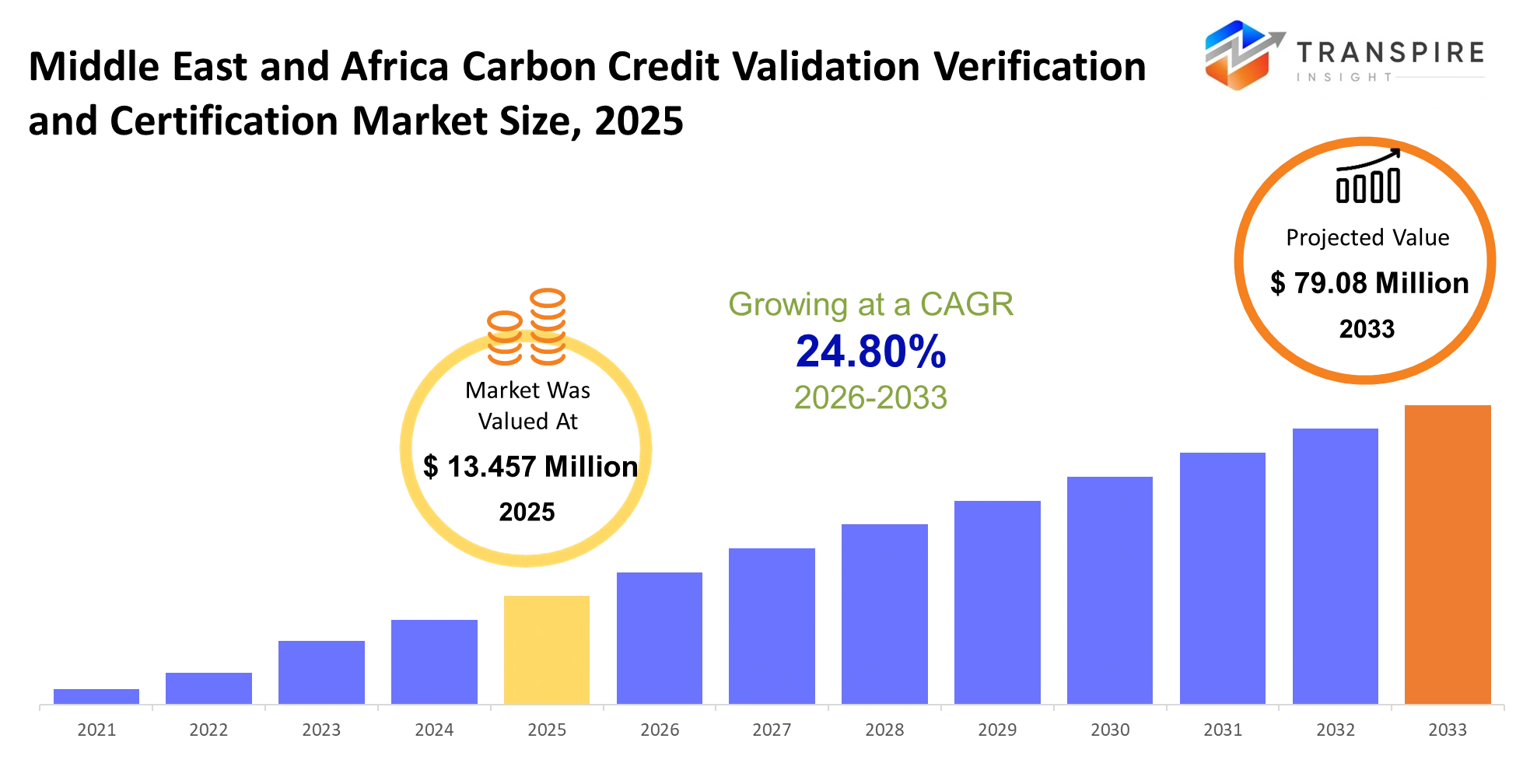
- Middle East and Africa Carbon Credit Validation Verification and Certification Market Size 2025: USD 13.457 Million
- Middle East and Africa Carbon Credit Validation Verification and Certification Market Size 2033: USD 79.08 Million
- Middle East and Africa Carbon Credit Validation Verification and Certification Market CAGR: 24.80%
- Middle East and Africa Carbon Credit Validation Verification and Certification Market Segments: By Type (Validation, Verification, Certification, Auditing), By Project (Renewable, Forestry, Carbon Capture, Energy Efficiency), By End-User (Corporate, Government, NGOs, Financial Institutions), By Application (Compliance, Voluntary, Trading).
To learn more about this report,  Download Free Sample Report
Middle East and Africa Carbon Credit Validation Verification and Certification Market Summary:
The Middle East and Africa Carbon Credit Validation Verification and Certification Market size is estimated at USD 13.457 Million in 2025 and is anticipated to reach USD 79.08 Million by 2033, growing at a CAGR of 24.80% from 2026 to 2033. The environmental services industry establishes a structured system through which carbon offset projects must achieve specific credibility standards for the Middle East and Africa market of Carbon Credit Validation Verification and Certification services which operates in Saudi Arabia, United Arab Emirates, South Africa and other parts of the Middle East and Africa region. The system will develop through government emission control regulations and corporate buyers who want to confirm their climate commitments through traceable evidence. Independent auditors will use satellite monitoring and blockchain-based registries and AI-powered assessment systems to verify emission reductions. Buyers will increasingly favor credits backed by transparent methodologies which will force project developers to achieve more demanding performance standards. The development of regional regulatory alignment will establish trading systems that enhance both trust and responsibility.
Key Market Trends & Insights:
- The United Arab Emirates and Saudi Arabia will strengthen carbon markets through stricter regulations, increasing demand for locally accredited offset credits and making regional standards more important than global certifications.
- In South Africa, carbon market development will be driven by policy frameworks linking taxes to offset eligibility, pushing verification agencies and project developers to align closely with compliance requirements.
- Across the Middle East and Africa, voluntary carbon markets will expand via cross-border projects, with digital monitoring tools improving transparency and attracting international investors.
- There will be growing collaboration between regional and global certification bodies, leading to more standardized and credible methods for measuring emission reductions.
- A shift toward real-time verification and continuous monitoring (using data analytics and satellite imaging) will replace periodic audits, enabling instant validation and building stronger trust in carbon credit systems.
Middle East and Africa Carbon Credit Validation Verification and Certification Market Segmentation
By Type
Validation- The process of validation examines documentation and baseline assumptions together with projected emission reductions at the initial stage of a carbon project before actual work commences. The Middle East and Africa will use this method to evaluate local environmental factors which include their arid land management practices and their energy transition processes. Validation bodies will provide developers with support to verify that their methodologies meet local standards because governments begin to establish official climate disclosure requirements.
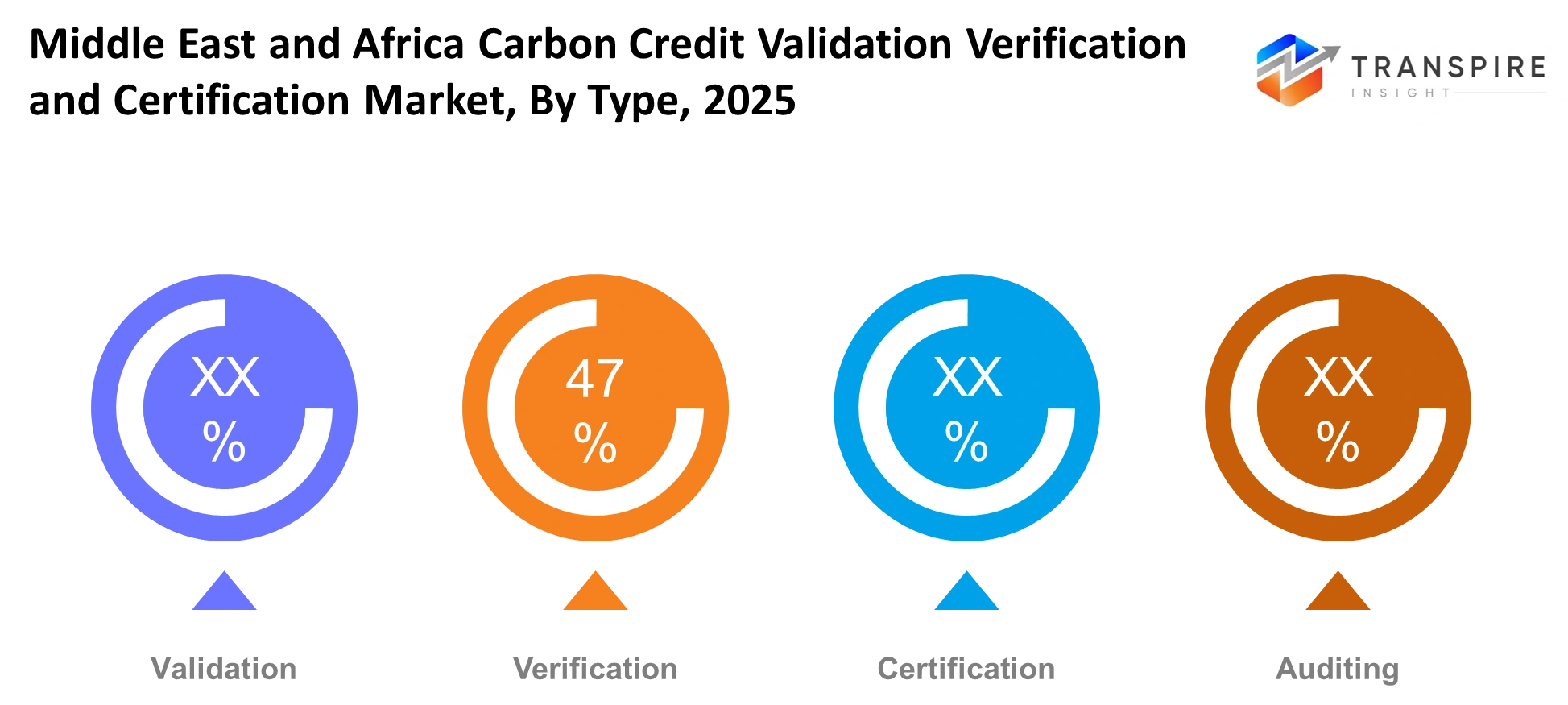
Verification- The process of verification will establish actual emission reductions which occurred following project completion. The region will become more important because investors and buyers require actual results instead of estimated outcomes. The industry will adopt field inspections and remote sensing together with data audits as standard operational methods. Verification agencies must develop strategies to handle multiple project types which include both desert solar installations and African reforestation projects while maintaining their ability to deliver dependable outcomes.
Certification- Certification serves as the ultimate validation process which enables carbon credits to be sold on the market. Middle Eastern and African countries will see their certification organizations start to operate according to both international registries and developing local certification systems. The procedure will operate more effectively because buyers will prefer credits which have established their real value through transparent and traceable processes. The certification process will establish new environmental standards which protect against double counting and maintain environmental standards.
Auditing- The auditing process will assess more than just technical validationand verification because it will also study governance systems and reporting precision and compliance with new standards. Auditors in this area will help connect international project requirements with actual conditions that exist in local projects. The auditors will evaluate the documentation systems together with the data handling practices and the organization's risk management procedures. The need for auditing will increase because organizations pursue global market recognition through their projects which will require more extensive examination for these projects to achieve their goals.
To learn more about this report, Download Free Sample Report
By Project
Renewable- Renewable energy projects will lead carbon credit production throughout the Middle East and Africa through their solar and wind energy projects. Saudi Arabia and the UAE will build large energy systems whereas African countries will create small power systems for their communities. The process will measure how much fossil fuel consumption has been reduced through its verification and validation procedures. The buyers will show strong interest in these projects because their growth potential matches the energy transition plans of their respective countries.
Forestry- The forestry projects will focus on three main activities which include reforestation and afforestation and conservation efforts in Sub-Saharan Africa. The initiatives will need thorough verification processes because they face three main obstacles which include land rights issues and biodiversity conservation needs and community participation requirements. The verification process will use satellite technology to observe how forest areas have changed throughout different time periods. The region will receive more attention for its forestry credits when the global market for nature-based solutions expands and the credits prove their ability to maintain ecological balance.
Carbon Capture- The oil-producing countries will establish carbon capture projects as their advanced technological solutions. The facilities will get emissions which come from industrial operations that will then be stored in underground facilities. The validation process requires measurement of technical accuracy through certification because measurement errors can damage the entire process. The Gulf governments will support these projects because they serve as essential components of their decarbonization efforts, which need special verification skills to be successful.
Energy Efficiency- Energy Efficiency projects will enhance industrial operations and building systems and transportation systems through their energy efficiency initiatives. The region will see both developed and developing economies implement these initiatives across their territories. The validation process will determine baseline consumption rates while the verification process will assess actual consumption reductions that were achieved. The projects will attract corporate participants because they provide affordable methods for emission reduction which will result in ongoing carbon credit production.
By End-User
Corporate- Corporate entities will remain the largest buyers and participants in carbon credit activities. The energy and manufacturing and aviation sectors will use certified credits to fulfill both their internal sustainability goals and their external reporting needs. Corporations in the Middle East and Africa will increasingly seek high-quality and locally relevant credits to improve their environmental sustainability efforts. The industry will require validation and certification providers to produce results which demonstrate both transparency and credibility.
Government- Carbon markets will require governments to function as both regulatory authorities and market participants for carbon emissions. The government will create compliance frameworks and approve methodologies while developing its own offset projects. South Africa and other countries will use policy-driven mechanisms to determine how credits get validated and verified. The public sector will lead national climate commitments which will guide market development and maintain its credibility.
NGOs- Non-governmental organizations will support projects through their development work which focuses on community development and environmental conservation. Organizations frequently partner with certification bodies to make sure projects achieve both environmental and social requirements. NGOs in Africa will drive forestry and land-use projects which depend on local community involvement. Their presence will establish a third method to build trustworthiness and accountability.
Financial Institutions- Financial institutions will increasingly integrate carbon credits into their investment strategies and risk management frameworks. Banks together with asset managers will provide funding for projects while they trade credits and create financial products linked to carbon emissions. The organization will require thorough validation and verification procedures because their financial exposure depends on creditworthiness. The certification practices in this region will experience increased professionalization and standardization because this segment will drive those changes.
By Application
Compliance- You will design compliance applications according to regulatory requirements which mandate emission reductions through either direct emissions cuts or emissions offsetting. Companies in South Africa and Middle Eastern emerging markets will utilize certified credits to fulfill their legal requirements. The validation and verification processes must follow stringent regulatory standards which permit no deviations from established procedures. The segment will verify credit accuracy and traceability through national policies which establish legal credit validation standards.
Voluntary- Organizations will use voluntary applications to reduce their emissions which exceed what regulations require. The segment will expand because companies work to achieve their sustainability goals while developing their brand identity. The Middle East and Africa will develop various projects via their voluntary markets, including renewable energy projects and community forestry projects. The buyers will focus more on transparency and storytelling about the impact of the project.
Trading- The carbon credit trading applications will enable users to transfer carbon credits between different platforms and market areas. The emergence of regional exchanges will establish structured trading activities which offer enhanced market visibility. Certification functions as a vital component that determines whether credits qualify for market listing and trading activities. Digital registries and blockchain systems will establish secure transaction frameworks, which will enhance cross-border trading operations through increased efficiency and trustworthiness.
Regional Insights
Through its environmental projects which the government will fund Saudi Arabia will increase its regional power because of its carbon credit system and energy diversification initiatives. The processes of verifying and validating renewable energy systems and carbon capture technologies will follow the established standards for large-scale renewable energy systems and carbon capture projects. Domestic entities will begin their capacity development programs because they want to decrease their need for outside auditing services. The country will develop its national certification system which aligns with both industrial requirements and environmental objectives as it develops its new regulatory framework.
The United Arab Emirates will emerge as the key focal point for carbon markets within the region by leveraging its advanced infrastructure and regulatory frameworks. The verification organizations will benefit from powerful digital systems which allow them to conduct their monitoring and reporting tasks in an efficient manner. The nation will provide platforms for foreign project promoters and certification authorities by advancing its cross-border collaborations. The organization will use its research-based approach to create verification methods which will improve its international and regional credibility and trustworthiness.
The established carbon tax system and its compliance framework will establish South Africa as a separate role from other countries. The industries will achieve consistent performance through the verification and certification processes which will follow the regulatory requirements. Local experts will continue to develop their skills especially in the fields of energy efficiency and land use. The country’s experience with policy-driven mechanisms will influence neighboring markets, encouraging the adoption of more formalized carbon management practices.
The Middle East and Africa region will show different regulatory environments which will impact project development in different ways. International standards will serve as the foundation for emerging economies while they develop their own regulatory systems. The fields of forestry and decentralized renewable energy will see increasing validation and verification activities. The growing awareness of regional collaboration will result in stronger partnerships which will help smaller markets participate in global carbon trading systems.
Recent Development News
In December, 2025, Saudi Arabia Strengthens Carbon Trading Partnerships. Saudi Arabia’s Regional Voluntary Carbon Market Company signed a new agreement to expand carbon trading collaboration, reinforcing its role in regional market development. The move supports growing transaction volumes and cross-border credit exchange. At the same time, exports from Arab economies may face carbon costs of €70–€95 per ton under European mechanisms starting 2026, pushing industries toward verified and certified credits for global competitiveness.
In May 2025, Africa Carbon Support Facility by Development Bank. The African Development Bank announced plans for a carbon market support facility aimed at scaling infrastructure and policy readiness. The initiative will help integrate credits into financial systems, including potential listing on stock exchanges. Africa currently receives only 1% of global climate finance, yet the facility aims to unlock significantly higher capital flows by strengthening validation systems and improving supply-demand balance in carbon credit transactions.
|
Report Metrics |
Details |
|
Market size value in 2025 |
USD 13.457 Million |
|
Market size value in 2026 |
USD 16.768 Million |
|
Revenue forecast in 2033 |
USD 79.08 Million |
|
Growth rate |
CAGR of 24.80% from 2026 to 2033 |
|
Base year |
2025 |
|
Historical data |
2021 – 2024 |
|
Forecast period |
2026 – 2033 |
|
Report coverage |
Revenue forecast, competitive landscape, growth factors, and trends |
|
Country scope |
Middle East and Africa (Saudi Arabia, United Arab Emirates, South Africa, Rest of Middle East and Africa) |
|
Key company profiled |
SGS, Bureau Veritas, DNV, TÜV SÜD, TÜV Rheinland, Intertek, SCS Global, Verra, Gold Standard, Carbon Trust, ERM, South Pole, ClimatePartner, EcoAct, First Climate. |
|
Customization scope |
Free report customization (country, regional & segment scope). Avail customized purchase options to meet your exact research needs. |
|
Report Segmentation |
By Type (Validation, Verification, Certification, Auditing), By Project (Renewable, Forestry, Carbon Capture, Energy Efficiency), By End-User (Corporate, Government, NGOs, Financial Institutions), By Application (Compliance, Voluntary, Trading). |
Key Middle East and Africa Carbon Credit Validation Verification and Certification Market Company Insights
Key companies operating in the Middle East and Africa carbon credit validation verification and certification market will include globally established standard-setters and assurance firms such as Verra, Gold Standard, DNV, TÜV SÜD, and Bureau Veritas, alongside advisory players like South Pole. The companies will build their operational presence in the region through alliances and their digital verification solutions while they work to develop high-integrity credits and standardised methods and open reporting systems which will help them meet increasing requirements from businesses and regulatory bodies.
Company List
- SGS
- Bureau Veritas
- DNV
- TÜV SÜD
- TÜV Rheinland
- Intertek
- SCS Global
- Verra
- Gold Standard
- Carbon Trust
- ERM
- South Pole
- ClimatePartner
- EcoAct
- First Climate
Middle East and Africa Carbon Credit Validation Verification and Certification Market Report Segmentation
By Type
- Validation
- Verification
- Certification
- Auditing
By Project
- Renewable
- Forestry
- Carbon Capture
- Energy Efficiency
By End-User
- Corporate
- Government
- NGOs
- Financial Institutions
By Application
- Compliance
- Voluntary
- Trading
Frequently Asked Questions
Find quick answers to common questions.
The approximate Middle East and Africa Carbon Credit Validation Verification and Certification Market size for the market will be USD 79.08 Million in 2033.
Key segments for the Middle East and Africa Carbon Credit Validation Verification and Certification Market By Type (Validation, Verification, Certification, Auditing), By Project (Renewable, Forestry, Carbon Capture, Energy Efficiency), By End-User (Corporate, Government, NGOs, Financial Institutions), By Application (Compliance, Voluntary, Trading).
Major players in the Middle East and Africa Carbon Credit Validation Verification and Certification Market are SGS, Bureau Veritas, DNV, TÜV SÜD, TÜV Rheinland, Intertek, SCS Global, Verra, Gold Standard, Carbon Trust, ERM, South Pole, ClimatePartner, EcoAct, First Climate.
The Middle East and Africa Carbon Credit Validation Verification and Certification Market size is USD 13.457 Million in 2025.
The Middle East and Africa Carbon Credit Validation Verification and Certification Market CAGR is 24.80%.
- SGS
- Bureau Veritas
- DNV
- TÜV SÜD
- TÜV Rheinland
- Intertek
- SCS Global
- Verra
- Gold Standard
- Carbon Trust
- ERM
- South Pole
- ClimatePartner
- EcoAct
- First Climate
Recently Published Reports
-
Apr 2026
Active Power Filter Market
Active Power Filter Market Size, Share & Analysis Report By Type (Shunt Active Power Filters, Series Active Power Filter, Hybrid Active Power Filter), By Application (Harmonics Mitigation, Reactive Power Compensation, Voltage Regulation, Power Factor Correction), By Phase (Single Phase, Three Phase), By End-User Industry (Manufacturing, Healthcare, Commercial, Automotive, Oil and Gas, Others), and Geography (North America, Europe, Asia-Pacific, Middle East and Africa, South and Central America), 2021 - 2031
-
Apr 2026
Electrical Transformer Market
Electrical Transformer Market Size, Share & Analysis Report By Core (Closed, Shell, and Berry), By Insulation (Gas, Oil, Solid, Air, and Other), By Phase (Single, and Three), By Rating (100 MVA to 500 MVA, 501 MVA to 800 MVA, and 801 MVA to 1200 MVA), and Geography (North America, Europe, Asia-Pacific, Middle East and Africa, South and Central America), 2021 – 2031
-
Apr 2026
Hydraulic Piston Pumps Market
Hydraulic Piston Pumps Market Size, Share & Analysis Report By Type (Axial Piston Pumps, Radial Piston Pumps), By Operating Pressure (Low Pressure, Medium Pressure, High Pressure), By Application (Construction, Mining, Agriculture, Automotive, Oil & Gas, Industrial Machinery, Others), By End-User (OEMs, Aftermarket), and Geography (North America, Europe, Asia-Pacific, Middle East and Africa, South and Central America), 2021 – 2031
-
Apr 2026
Laboratory Gas Generators Market
Laboratory Gas Generators Market Size, Share & Analysis Report By Product (Nitrogen Gas Generator, Hydrogen Gas Generator, Zero Air Gas Generator, Purge Gas Generator, TOC Gas Generators, Others), By Application (Gas Chromatography, Liquid Chromatography-mass Spectrometry (LC-MS), Gas Analyzers, Others), By End-user (Life Science, Chemical & Petrochemical, Food & Beverage, Others), and Geography (North America, Europe, Asia-Pacific, Middle East and Africa, South and Central America), 2021 – 2031