
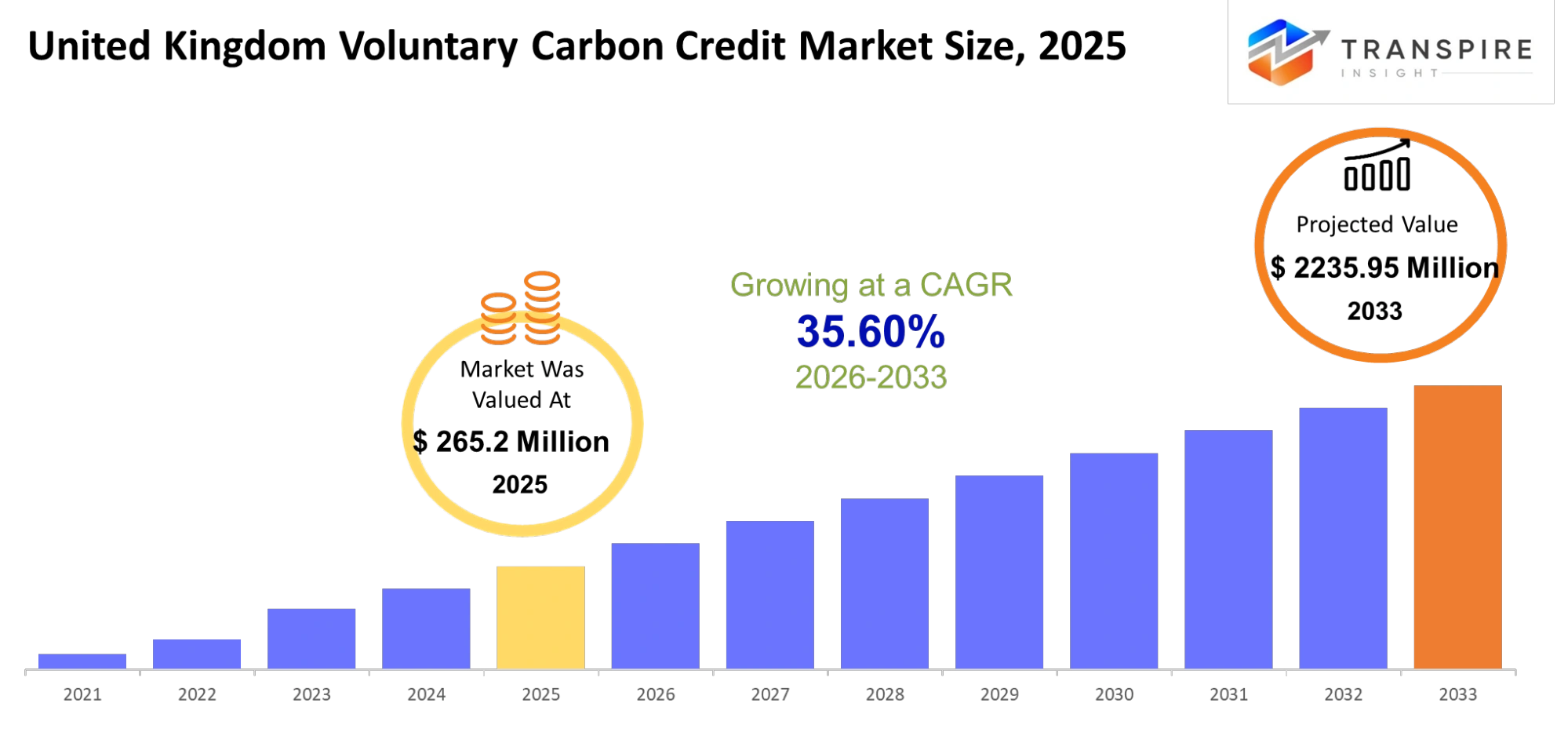
United Kingdom Voluntary Carbon Credit Market Size & Forecast:
- United Kingdom Voluntary Carbon Credit Market Size 2025: USD 265.2 Million
- United Kingdom Voluntary Carbon Credit Market Size 2033: USD 2235.95 Million
- United Kingdom Voluntary Carbon Credit Market CAGR: 35.60%
- United Kingdom Voluntary Carbon Credit Market Segments: By Type (Forestry & Land Use, Renewable Energy, Waste Management), By End-User (Corporates, Governments, NGOs), By Project Type (Avoidance Projects, Removal Projects).
To learn more about this report,  Download Free Sample Report
United Kingdom Voluntary Carbon Credit Market Summary:
The United Kingdom Voluntary Carbon Credit Market size is estimated at USD 265.2 Million in 2025 and is anticipated to reach USD 2235.95 Million by 2033, growing at a CAGR of 35.60% from 2026 to 2033.
The carbon credit market in the United Kingdom operates through voluntary emission offset trades which businesses and individuals conduct. The United Kingdom market for carbon credit purchases and verification will be shaped by three factors which include changing consumer preferences and advancements in digital carbon tracking technology and new government regulations. The industry will adopt transparent verification systems together with enhanced data reporting requirements and expanded verification options for businesses that want to demonstrate their environmental performance. The upcoming period will see digital platforms enhance trading efficiency while building greater trust among users in the region's voluntary carbon markets.
What Has the Impact of Artificial Intelligence Been on the United Kingdom Voluntary Carbon Credit Market?
The United Kingdom voluntary carbon credit market experiences transformation through artificial intelligence which enhances sustainability finance by creating more efficient methods for processing and analyzing emissions data. AI-driven systems power market research improvements through their ability to analyze machine learning data and execute predictive analytics, which assists users in comprehending both pricing trends and carbon credit characteristics. The United Kingdom voluntary carbon credit market benefits from these tools because they create operational transparency which enables corporate buyers to execute their verified offset selection process with more precise environmental assessments.
The United Kingdom voluntary carbon credit market trading platforms experience improved operational efficiency through smart automation and machine learning technologies. The systems create automated processes for verifying operations while they guarantee error-free performance and enable users to track carbon offset activities in real time. The United Kingdom voluntary carbon credit market adopts artificial intelligence technology to enhance demand forecasting capabilities through its ability to detect changes in corporate customer behavior and sustainability-focused investor patterns.
Through advanced predictive analytics, stakeholders can anticipate price fluctuations and optimize portfolio decisions with greater precision. The development of digital infrastructure will enable AI technology in the United Kingdom's voluntary carbon credit market to boost industry competition through its ability to generate instant insights and enhance regulatory compliance and develop flexible market strategies for businesses that need to meet environmental responsibility standards.
Key Market Trends & Insights:
- England covers more than half of the 2025 United Kingdom voluntary carbon credit market because businesses are increasingly adopting environmental social governance practices.
- Scotland becomes the fastest-growing area between 2025 and 2030 due to its renewable energy projects and carbon offset programs.
- Wales maintains consistent growth in the United Kingdom voluntary carbon credit market because of its forestry offset initiatives and its regional sustainability programs.
- Nature-based carbon credits hold the largest share in the United Kingdom voluntary carbon credit market at around 46% in 2025.
- Industrial carbon capture systems, together with verified emission reduction systems, produce technology-based credits which hold the second-highest market position.
- Digital tokenized credits represent the fastest-growing segment through 2025–2030 due to blockchain verification demand.
- The United Kingdom voluntary carbon credit market uses corporate emissions offsetting as its main method, with almost 60% usage in 2025.
- The supply chain decarbonization application is growing most quickly due to ESG reporting requirements and investor demands.
- Companies with more than 58percent market share drive the United Kingdom voluntary carbon credit market because they need to achieve their sustainability objectives.
- Organizations form strategic alliances with fintech platforms to grow their digital trading networks.
United Kingdom Voluntary Carbon Credit Market Segmentation
By Type:
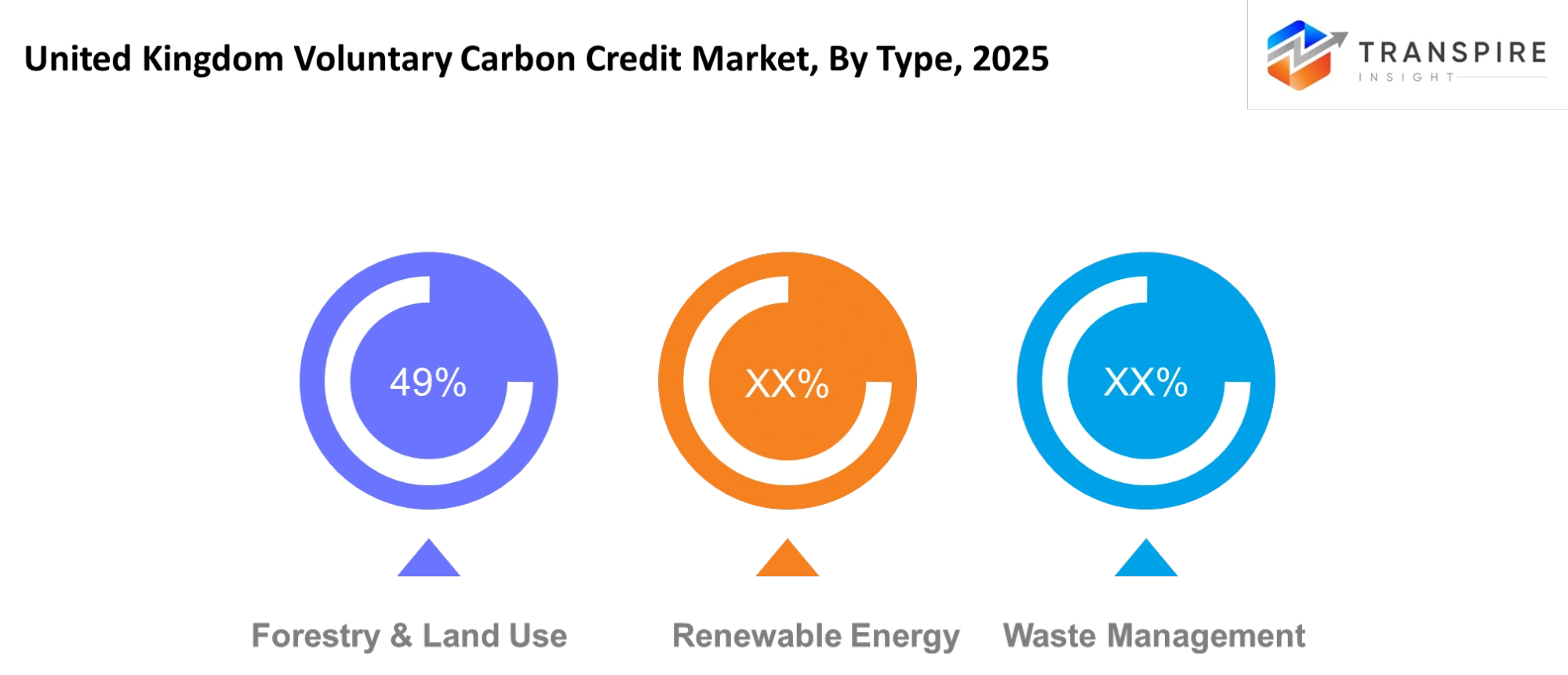
The United Kingdom Voluntary Carbon Credit Market demonstrates distinct market segments which include forestry and renewable energy and waste management. The primary focus of forestry and land use projects will remain on carbon storage capabilities and land restoration activities.
The United Kingdom Voluntary Carbon Credit Market shows increasing market demand for nature-based credits, which serve as offsets for energy transition initiatives. Corporate buyers will continue to choose verified offsets through forestry and land use as their preferred option. The development of renewable energy will progress through grid decarbonisation efforts. Waste management functions as a crucial mechanism for controlling emissions, which occur within urban and industrial areas that require sustainability reporting compliance.
To learn more about this report, Download Free Sample Report
By End-User:
The United Kingdom Voluntary Carbon Credit Market exists because businesses purchase credits to achieve their emission reduction goals and document their sustainability efforts. Governments will support structured offset frameworks and alignment of compliance. The environmental monitoring activities which NGOs will conduct through their project development and verification support will create more trustworthy carbon offset systems in various regions.
Corporate buyers will increasingly purchase carbon credits from the United Kingdom Voluntary Carbon Credit Market to achieve their ESG obligations. Government agencies will support carbon neutrality objectives through their policy initiatives and regulatory framework development. NGOs will work on environmental verification and community-focused initiatives to establish operational trust in voluntary carbon projects.
By Project Type:
The United Kingdom Voluntary Carbon Credit Market comprises two different project types which include avoidance projects that use renewable energy and conservation activities to stop emissions. The importance of removal projects will increase through the implementation of carbon capture technologies, afforestation efforts, and soil enhancement techniques. The two project types will help achieve emissions reduction targets while removal-based credits will become more popular because they provide the advantages of permanent carbon storage.
The United Kingdom Voluntary Carbon Credit Market will experience a gradual transition towards greater demand for removal projects as carbon neutrality targets strengthen. Immediate offset requirements through avoidance projects will continue to be common practice. The long-term effects of removal projects will become more important because they enable verified carbon sequestration and better environmental monitoring throughout voluntary trading systems.
What are the Main Challenges for the United Kingdom Voluntary Carbon Credit Market Growth?
The United Kingdom voluntary carbon credit market faces operational and technical obstacles, which lead to difficulties in verifying data accuracy and maintaining data integrity. The current carbon projects rely on their scattered reporting systems which will result in slower progress towards actual emission reduction assessments. The United Kingdom voluntary carbon credit market faces transparency challenges because it lacks standardized carbon measurement methods, which prevent buyers from evaluating credit quality between various projects.
The United Kingdom voluntary carbon credit market requires better expansion because its manufacturing and commercialization processes face restrictions, which generate high operational expenses through mandatory compliance requirements and verification procedures. The project approval process will experience delays because regulatory requirements for certification and auditing procedures demand more time for the assessment of emerging carbon removal technologies. The United Kingdom voluntary carbon credit market will experience cost pressures that affect smaller developers who fail to achieve the necessary verification standards and must wait for extended approval periods.
The United Kingdom voluntary carbon credit market faces two obstacles which stem from infrastructure deficiencies and adoption issues because technical skills in the market remain scarce and digital monitoring systems exist in limited supply. The emerging market participants will experience funding limitations which will impede their ability to execute projects and their capacity to enter the wider market. The United Kingdom carbon tracking system currently lacks essential infrastructure which creates limitations for real-time monitoring capabilities.
The United Kingdom voluntary carbon credit market will experience ongoing transformation through competitive market pressure and changing government regulations. The combination of different carbon reduction technologies and credit price variations will create investment uncertainty for investors. The United Kingdom voluntary carbon credit market requires advanced digital infrastructure together with standardized processes to establish trust and sustain market stability as compliance requirements evolve.
Regional Insights
The United Kingdom Voluntary Carbon Credit Market displays inconsistent regional participation because English regions show higher activity levels from their greater number of businesses and their established systems for sustainability reporting. The financial institutions and carbon registries will support London's ongoing function as the primary trading center. Scotland will increase its participation through projects that capture carbon from land and through offsets that connect with renewable energy, while Wales will sustain its stable participation through forestry initiatives and community-driven environmental projects.
The United Kingdom Voluntary Carbon Credit Market will display different regional patterns because project access will develop at different rates across various areas. The emissions-intensive industries in England together with large companies who uphold international environmental standards will create high demand for services. Scotland will gain from projects which use natural resources to create carbon offsets, particularly through peatland restoration and afforestation efforts. Wales will develop its environmental programs through public-private partnerships which will create official carbon credit development processes.
The United Kingdom Voluntary Carbon Credit Market will develop throughout the country because regional policies and infrastructure advancements determine how different areas participate in the market. Northern regions will see slower adoption due to limited project funding and technical support. The upcoming advancements in digital monitoring systems and carbon accounting frameworks will create a more equitable distribution of regional participation, which will increase transparency and accessibility throughout all locations.
Recent Development News
In March 2026, BrewDog faced asset sale to Oxygen Conservation. The company sold its Kinrara estate in Scotland—including woodland and peatland carbon credit assets—to Oxygen Conservation after abandoning its reforestation project, transferring carbon credits valued at millions of pounds. https://www.theguardian.com
In February 2026, Terradot announced acquisition of Eion. The Google-backed carbon removal firm acquired Eion to expand its carbon credit generation capabilities and scale supply in the voluntary carbon market, reflecting consolidation among carbon credit developers with UK market relevance. https://www.wsj.com
|
Report Metrics |
Details |
|
Market size value in 2025 |
USD 265.2 Million |
|
Market size value in 2026 |
USD 359.7 Million |
|
Revenue forecast in 2033 |
USD 2235.95 Million |
|
Growth rate |
CAGR of 35.60% from 2026 to 2033 |
|
Base year |
2025 |
|
Historical data |
2021 - 2024 |
|
Forecast period |
2026 - 2033 |
|
Report coverage |
Revenue forecast, competitive landscape, growth factors, and trends |
|
Regional scope |
United Kingdom |
|
Key company profiled |
Verra, Gold Standard Foundation, South Pole Group, Climate Impact Partners, EcoAct (Atos SE), Carbon Trust, TerraPass Inc., NativeEnergy LLC, 3Degrees Inc., Green Mountain Energy Company, ClimateCare, Pachama Inc., Sylvera Ltd., Carbon Streaming Corporation, Indigo Ag Inc. |
|
Customization scope |
Free report customization (country, regional & segment scope). Avail customized purchase options to meet your exact research needs. |
|
Report Segmentation |
By Type (Forestry & Land Use, Renewable Energy, Waste Management), By End-User (Corporates, Governments, NGOs), By Project Type (Avoidance Projects, Removal Projects). |
How Can New Companies Establish a Strong Foothold in the United Kingdom Voluntary Carbon Credit Market?
The new voluntary carbon credit market entrants in the United Kingdom must create their strategies which should establish their market position through their reputation and operational transparency and their technological capabilities. The organization needs to develop carbon solutions which have been certified because they need to fulfill all requirements for precise measurement and project authentication. The startups in the United Kingdom voluntary carbon credit market that develop data monitoring systems with simultaneous emissions measurement will obtain quicker trust from corporate clients who need dependable offset solutions.
The United Kingdom voluntary carbon credit market will depend on strategic partnerships between organizations and environmental consultants, auditing firms, and climate certification bodies. The companies Pachama and Sylvera show how organizations can build trust in carbon credit quality through AI-based carbon verification and satellite monitoring. The new market entrants will use each innovation method to solve two problems which include reporting inconsistencies and project verification problems that lack standardized methods.
The United Kingdom voluntary carbon credit market provides organizations with competitive advantages through its niche applications which exist in smart cities and manufacturing decarbonisation and sustainable logistics. Sector-specific carbon credit models which register carbon emissions according to industry standards will help new market players to achieve business advantages. The combination of machine learning with predictive analytics will deliver enhanced pricing precision and project selection capabilities which will lead to improved market operation efficiency.
The required elements for achieving enduring success within the United Kingdom voluntary carbon credit market include ongoing product development together with dependable digital systems and compliance with new regulatory requirements. Companies that invest early in scalable technology platforms and transparent verification systems will build stronger market credibility and expand faster within the growing global carbon economy.
Key United Kingdom Voluntary Carbon Credit Market Company Insights
The United Kingdom Voluntary Carbon Credit Market demonstrates intense competition because businesses now prioritize both operational transparency and high-quality verification and modern digital tracking solutions. The top companies will use advanced carbon measurement instruments and blockchain technology for carbon reporting to build customer trust. The South Pole organization, Carbon Trust, and Verra will maintain their role as standard setters, while new market participants will develop quick verification methods and economical credit options to enter the market.
The demand for high-integrity credits which corporate buyers require will drive up competition in the United Kingdom Voluntary Carbon Credit Market. Companies will use AI-based emissions tracking technology and satellite monitoring systems to gain competitive advantages. Sylvera and Pachama will enhance their market position through their data-driven carbon assessment services. The new technologies will enable project developers and investors to make better decisions which will lead to more trustworthy credits.
The United Kingdom Voluntary Carbon Credit Market will grow through competition which now emphasizes product quality instead of market volume. Organizations will establish auditing firm partnerships with environmental consulting companies to enhance their credibility. Market participants will work to enhance verification processes by creating transparent standards which will establish their competitive advantage and help build trust in voluntary carbon trading systems.
Company List
- Verra
- Gold Standard Foundation
- South Pole Group
- Climate Impact Partners
- EcoAct (Atos SE)
- Carbon Trust
- TerraPass Inc.
- NativeEnergy LLC
- 3Degrees Inc.
- Green Mountain Energy Company
- ClimateCare
- Pachama Inc.
- Sylvera Ltd.
- Carbon Streaming Corporation
- Indigo Ag Inc.
What are the Key Use-Cases Driving the Growth of the United Kingdom Voluntary Carbon Credit Market?
The present corporate commitment to net-zero targets functions as the primary factor driving demand within the United Kingdom carbon credit market which operates on a voluntary basis. The manufacturing and automotive industries will depend on carbon credits to control their difficult-to-control emissions sources while they continue to meet their sustainability reporting obligations. The United Kingdom voluntary carbon credit market will experience increased pressure from ESG disclosure requirements which will force businesses to incorporate carbon offset strategies into their permanent operational frameworks.
The United Kingdom voluntary carbon credit market now sees increased participation from healthcare and consumer-facing sectors because supply chains must decrease their non-direct emissions. Hospitals, pharmaceutical companies, and retail networks will invest in carbon credits linked to renewable energy and waste reduction projects. These use-cases will support cleaner operations while strengthening brand trust among environmentally conscious consumers.
The United Kingdom voluntary carbon credit market will experience growth through technology and smart infrastructure projects because data-based emissions monitoring and automated systems will drive market expansion. Smart city developments will use carbon credits to offset energy consumption from digital infrastructure, while logistics companies will adopt credits to balance transportation emissions. The market efficiency and offset allocation accuracy will benefit from integrating predictive analytics with real-time monitoring systems.
The United Kingdom voluntary carbon credit market will experience future growth through two main drivers which include increased cross-sector adoption and better digital verification systems. The development of scalable credit generation systems will result from increased partnerships between enterprises and carbon project developers, while monitoring technology innovations will provide transparent sustainability frameworks.
United Kingdom Voluntary Carbon Credit Market Report Segmentation
By Type
- Forestry & Land Use
- Renewable Energy
- Waste Management
By End-User
- Corporates
- Governments
- NGOs
By Project Type
- Avoidance Projects
- Removal Projects
Frequently Asked Questions
Find quick answers to common questions.
The approximate United Kingdom Voluntary Carbon Credit Market size for the market will be USD 2235.95 Million in 2033.
Key segments for the United Kingdom Voluntary Carbon Credit Market are By Type (Forestry & Land Use, Renewable Energy, Waste Management), By End-User (Corporates, Governments, NGOs), By Project Type (Avoidance Projects, Removal Projects).
Major United Kingdom Voluntary Carbon Credit Market players are Verra, Gold Standard Foundation, South Pole Group, Climate Impact Partners, EcoAct (Atos SE), Carbon Trust, TerraPass Inc., NativeEnergy LLC, 3Degrees Inc., Green Mountain Energy Company, ClimateCare, Pachama Inc., Sylvera Ltd., Carbon Streaming Corporation, Indigo Ag Inc.
The United Kingdom Voluntary Carbon Credit Market size is USD 265.2 Million in 2025.
The United Kingdom Voluntary Carbon Credit Market CAGR is 35.60%.
- Verra
- Gold Standard Foundation
- South Pole Group
- Climate Impact Partners
- EcoAct (Atos SE)
- Carbon Trust
- TerraPass Inc.
- NativeEnergy LLC
- 3Degrees Inc.
- Green Mountain Energy Company
- ClimateCare
- Pachama Inc.
- Sylvera Ltd.
- Carbon Streaming Corporation
- Indigo Ag Inc.
Recently Published Reports
-
Apr 2026
Italy Fluted Glass Market
Italy Fluted Glass Market By Type (Clear Fluted Glass, Frosted Fluted Glass, Tinted Fluted Glass), By Application (Interior Design, Furniture, Doors & Windows), By End-User (Residential, Commercial), By Industry Analysis, Size, Share, Growth, Trends, and Forecasts 2026-2033.
-
Apr 2026
France Rayon Fiber Market
France Rayon Fiber Market By Type (Viscose Rayon, Modal Rayon, Lyocell Rayon), Application (Textiles, Home Furnishings, Medical Textiles), By Industry Analysis, Size, Share, Growth, Trends, and Forecasts 2026-2033.
-
Apr 2026
Italy Mobile Gaming Market
Italy Mobile Gaming Market By Game Type (Action, Strategy, Casual, RPG), By Platform (Android, iOS), By Revenue Model (In-App Purchases, Advertising, Paid Apps), By Industry Analysis, Size, Share, Growth, Trends, and Forecasts 2026-2033.
-
Apr 2026
United Kingdom Voluntary Carbon Credit Market
United Kingdom Voluntary Carbon Credit Market By Type (Forestry & Land Use, Renewable Energy, Waste Management), By End-User (Corporates, Governments, NGOs), By Project Type (Avoidance Projects, Removal Projects), By Industry Analysis, Size, Share, Growth, Trends, and Forecasts 2026-2033.