

Asia Pacific Vehicle Subscription Market Size & Forecast:
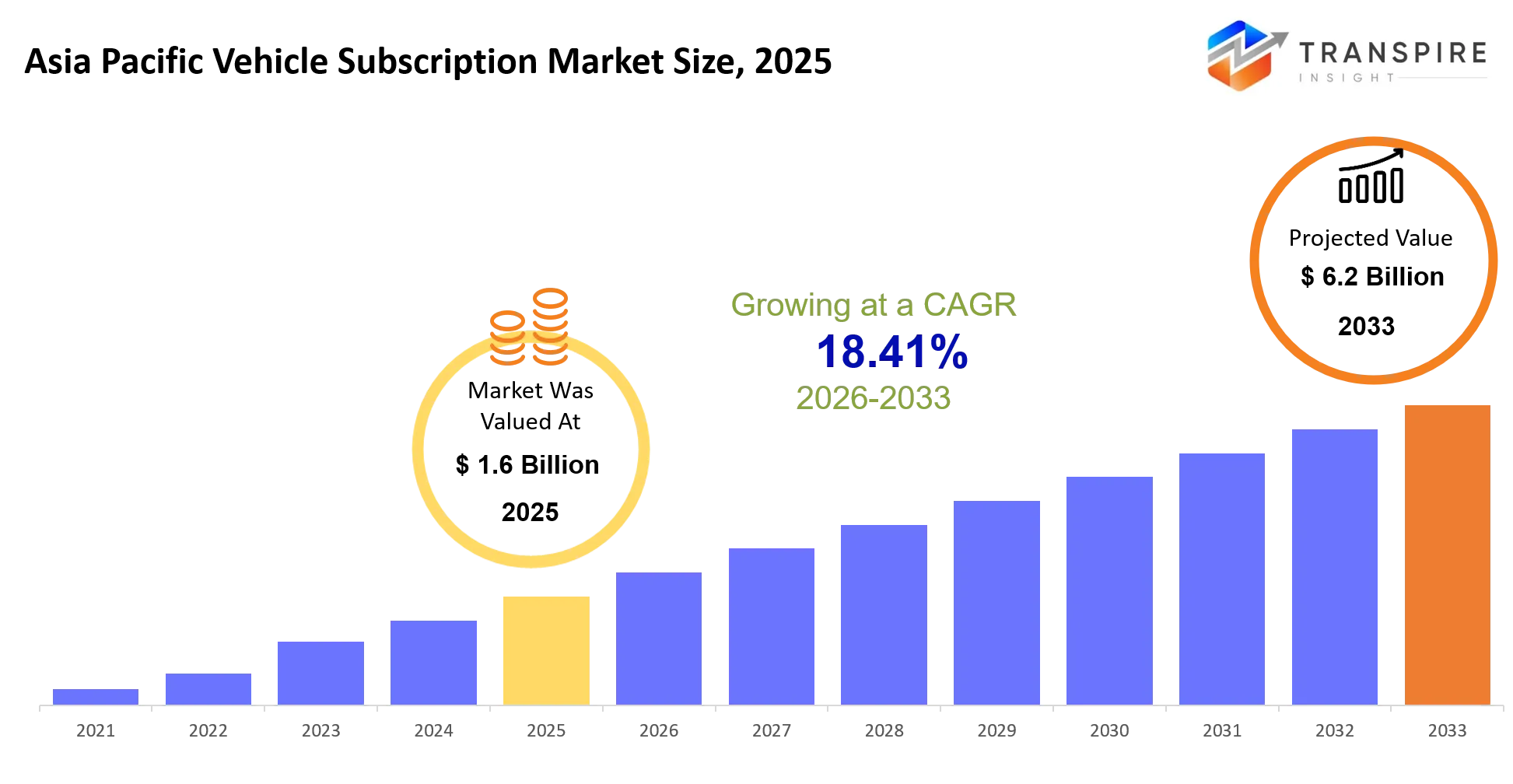
- Asia Pacific Vehicle Subscription Market Size 2025: USD 1.6 Billion
- Asia Pacific Vehicle Subscription Market Size 2033: USD 6.2 Billion
- Asia Pacific Vehicle Subscription Market CAGR: 18.41%
- Asia Pacific Vehicle Subscription Market Segments: By Vehicle Type (Passenger Cars, Luxury Cars, EVs, SUVs, Commercial Vehicles, Others); By Subscription Type (Short-Term, Long-Term, Flexible, Corporate, Others); By Provider (OEMs, Dealers, Third-Party Platforms, Others); By End User (Individuals, Businesses, Fleet Operators, Others)
To learn more about this report,  Download Free Sample Report
Asia Pacific Vehicle Subscription Market Summary
The Asia Pacific Vehicle Subscription Market was valued at USD 1.6 Billion in 2025. It is forecast to reach USD 6.2 Billion by 2033. That is a CAGR of 18.41% over the period.
In Asia Pacific, vehicle subscription services work like a flexible access kind of thing, that lets consumers and corporate fleets use cars month by month, without the big long term financing angle, basically shifting costs from ownership to actual usage. This approach is getting more and more popular with urban drivers and mobility managers, mainly because they want short commitment access to different vehicle types, and not just one option—especially in crowded cities where owning is expensive, and parking constraints kind of ruin the day.
Over the last five years, the market has changed in a more structural way, moving away from dealership-led leasing and toward OEM and digital platform driven subscription ecosystems, which are often tied into app-based fleet management. A big trigger was the pandemic era semiconductor shortage and the resulting supply chain disruption. That slowed things down, longer new car delivery cycles and it made consumers lean toward flexible access, instead of going all in on purchases.
Since then, adoption has sped up again as subscription operators improve fleet utilization, and they also add more EV offerings. So that operational flexibility gets turned into recurring revenue growth, pretty consistently.
Key Market Insights
- The Asia Pacific Vehicle Subscription Market is led by China and Japan, and together they will make up almost 45% share in 2025 , mainly because the OEM ecosystems are strong over there.
- India feels like the fastest-growing regional market, it’s set to expand rapidly in 2025–2030 , mostly from urban mobility startups and the affordability demand that keeps rising.
- In Southeast Asia the adoption is starting to show up more clearly , supported by ride hailing fleets and also corporate mobility subscriptions inside key metropolitan hubs.
- For 2025 , ICE vehicle subscriptions still dominate , with roughly a 58% share across the Asia Pacific Vehicle Subscription Market, because the supply chains are already well established.
- Electric vehicle subscriptions are the second-largest slice and they are moving up quickly too, helped by government EV incentives and OEM led launches.
- By 2030 EV based subscription services will become the fastest-growing segment, pushed forward by sustainability targets and lower operating costs , so people and fleets both see value in it.
- Personal mobility is still the main application, holding around 62% of the share, largely because urban users keep moving away from long term ownership obligations.
- Corporate fleet subscriptions are actually the fastest growing option, since enterprises lean into asset-light mobility approaches and they really focus on cost optimization.
- Individual consumers make up the biggest portion of the Asia Pacific Vehicle Subscription Market, due to increasing urbanization and these more flexible usage needs.
- Corporate and SME users are growing quickly too, pulled by the desire for scalable, maintenance-inclusive mobility solutions.
What are the Key Drivers, Restraints, and Opportunities in the Asia Pacific Vehicle Subscription Market?
The main engine behind the Asia Pacific Vehicle Subscription Market is basically that people are moving toward asset-light mobility , you know, because urban areas are getting more congested and the price of vehicle ownership feels heavy in big cities like Tokyo, Mumbai and Shanghai. At the same time, after the pandemic, supply chains got disrupted in a way that kept pushing vehicle deliveries , longer than expected, so both consumers and fleet operators leaned more into subscription-style access. So yeah, the recurring revenue story gets stronger, with operators seeing better fleet utilization , and also worrying less about idle inventory.
Now the biggest drag on the market is that operations can get pretty complicated when you factor in fleet acquisition costs plus residual value uncertainty. Subscription providers have to keep rebalancing fleets across regions, while also handling depreciation risk in both ICE and EV offerings. This is kind of a structural issue, it makes scale harder because profits end up tied to shaky used-vehicle pricing, and it forces frequent capital reinvestment— which can slow down margin expansion in emerging markets
A promising opening is electric vehicle subscription integration across tier-1 and tier-2 cities in Asia, especially since EV infrastructure keeps improving. For instance, OEM-led EV subscription experiments in South Korea and India are creating early ecosystem advantages by blending charging networks, software platforms, and bundled maintenance services. This sort of joining up is expected to kick off the next growth wave for the Asia Pacific Vehicle Subscription Market, mainly by lowering end-user uncertainty around total cost of ownership.
What Has the Impact of Artificial Intelligence Been on the Asia Pacific Vehicle Subscription Market?
Artificial intelligence is kind of reshaping the Asia Pacific Vehicle Subscription Market, mostly by fine tuning fleet allocation, pricing models, and maintenance timing across huge, spread out vehicle networks. Now operators are using AI–driven fleet management tools to sort of automate vehicle tracking, usage monitoring, and compliance write ups, so they get better operational visibility, and they have less need for manual back and forth . These tools also let subscription providers shift vehicles around, almost like on the fly, based on demand hotspots, which tends to push fleet utilization efficiency upward.
Machine learning is also being widely applied for predictive maintenance, so operators can estimate when things might fail before it actually becomes a problem. That includes battery degradation for EV fleets, or engine wear for ICE vehicles. The net effect is lower unplanned downtime and better vehicle readiness, which then supports stronger subscription retention. On top of that, AI pricing engines can revise subscription fees in real time, using demand patterns, location density, and where a vehicle is in its lifecycle, which helps with revenue optimization in a more continuous way.
Still, adoption is not fully smooth because integration costs are high, and the mobility data ecosystems are pretty fragmented across many Asia Pacific markets. A lot of operators struggle with real world data consistency, particularly when they manage fleets across multiple countries where regulation and infrastructure vary and can nudge model accuracy off target. Also, interoperability is limited between older OEM platforms and newer AI systems, and that slowdown makes large scale deployment take longer than expected.
Key Market Trends
- After 2023, it kinda seems like OEM-led subscription models just outpaced the dealer leasing channel, and then Toyota Motor Corporation (for example) started leaning harder into direct to consumer, digital platforms. Like, they moved earlier rather than later.
- Since 2024, AI driven fleet orchestration has really expanded, which has helped vehicle utilization rates go up, by shifting, underused assets in real time across city hubs. Not slowly either. More like quick reroutes and rebalancing all the time.
- EV subscription adoption jumped after 2023, mostly because China and South Korea rolled out policy incentives that cut upfront costs and also made charging infrastructure access feel easier to use.
- Corporate mobility subscriptions grew after 2022, partly because of those supply chain delays. Enterprises shifted from ownership toward flexible fleet access, to dodge the whole delivery bottleneck thing.
- Then in 2025, usage based pricing models replaced fixed monthly plans on major platforms. So instead of one flat rate, revenue can be tuned based on mileage and congestion patterns. Kind of a more granular logic.
- Also, subscription penetration pushed into Tier 2 Indian cities after 2024. Startups like Zoomcar basically leaned on low cost fleet aggregation, and it made the whole service easier to scale.
- Cross-border fleet standardization improved after 2023 too. Asian OEMs began aligning vehicle specifications more closely, so multi country subscription deployment became simpler.
- Between 2023 and 2025, residual value risk moved away from consumers and more toward operators. That created extra financial pressure, but it also supported broader subscription adoption.
- Partnerships between automakers and fintech firms increased after 2024, which helped bundle insurance, financing and subscription billing into one ecosystem, or at least one workflow.
- And in 2025, urban congestion policies added fuel to short term mobility demand, so people drifted away from ownership and toward flexible subscription access models, pretty rapidly.
Asia Pacific Vehicle Subscription Market Segmentation
By Vehicle Type :
Passenger cars sort of stay the main pick in the Asia Pacific Vehicle Subscription Market , mainly because city demand has remained steady and people want flexible ways to use cars across different neighborhoods. Since 2023, EVs and SUVs have started getting adopted a lot more , partly because charging networks expanded and people got more concerned about fuel costs. Luxury vehicles and commercial ones are moving slower but it is still a steady climb in a few chosen metro areas .
After 2023 there was a noticeable shift in demand , so manufacturers have tried to rebalance their fleets toward EVs and SUVs . Passenger car subscriptions still lead the overall volume, but commercial vehicles are being used more often for shorter operational agreements in logistics and service fields, which helps them use assets in a more efficient manner.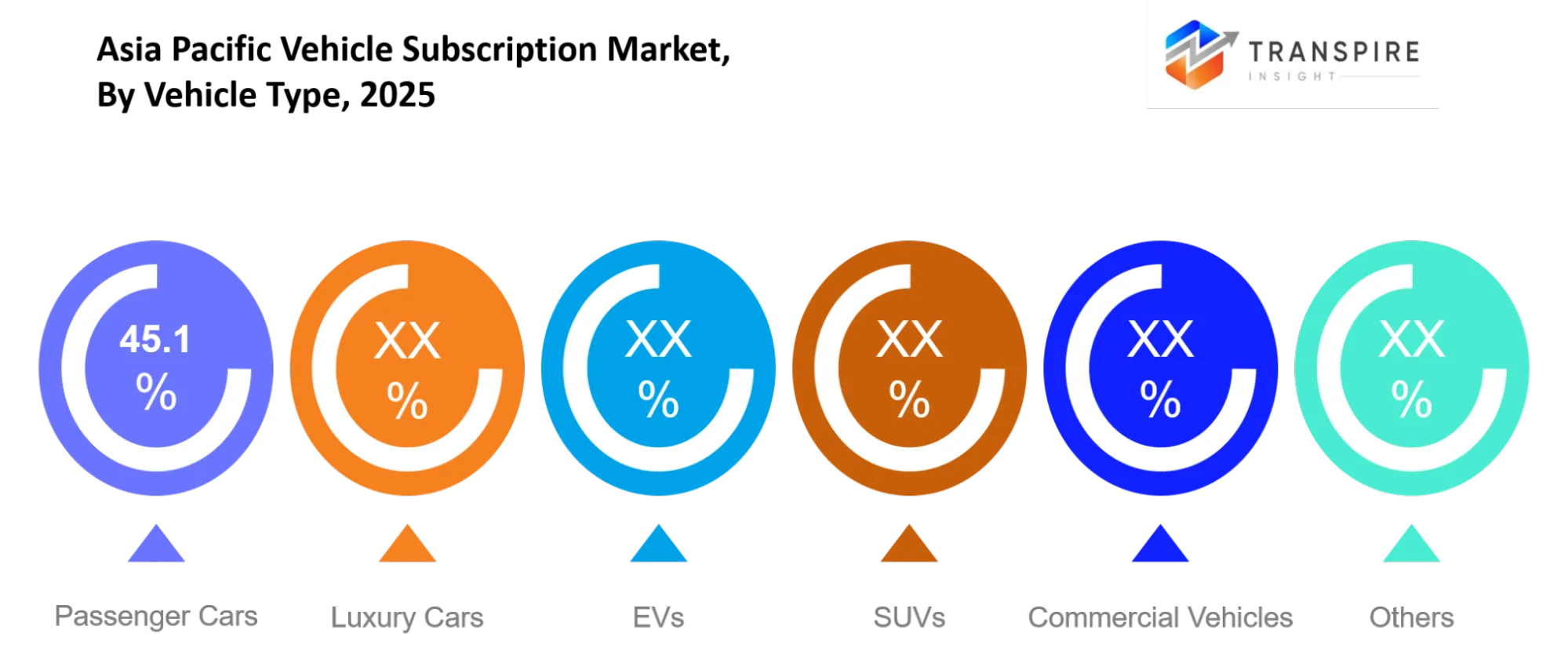
To learn more about this report, Download Free Sample Report
By Subscription Type :
In the Asia Pacific Vehicle Subscription Market , short term and more flexible plans have become way more common, because users generally prefer lower commitment options. Corporate subscriptions have increased since 2024 too, due to supply delays and the need for cost control in business mobility planning. Long term plans look pretty stable among repeat users.
Now flexible models seem to drive most of the new sign ups in urban areas , supported by app based booking systems and dynamic pricing. Corporate subscriptions are also increasingly bundled with maintenance and insurance , so businesses get less daily hassle and fleets become easier to predict in terms of cost management .
By Provider :
OEMs have kinda strengthened control across the Asia Pacific Vehicle Subscription Market, and brands like Toyota Motor Corporation are expanding direct subscription platforms since 2023. Dealer influence has backed off a bit as digital-first models keep spreading, and third-party platforms are still growing in city mobility hubs, using aggregator-based fleet access models.
The shift toward OEM-led ecosystems really seems to have picked up since 2024, with manufacturers stitching subscriptions into connected vehicle services. Third-party platforms remain relevant with that flexibility plus easier entry barriers. Dealers, on the other hand, are increasingly repositioning toward service and fleet support roles, less about ownership- based sales.
By End User :
For individuals, they’re still the largest user base in the Asia Pacific Vehicle Subscription Market. That’s mostly because urban density is rising, and people like the idea of flexible mobility access. Businesses have been adopting more since 2023 too, mainly to manage transport costs and avoid long-term asset commitments during uncertain supply conditions.
Fleet operators are showing strong growth as subscription models enable scalable vehicle access without the ownership risk. Business demand continues to rise in logistics , delivery, and corporate transport areas, where predictable monthly costs and fewer maintenance headaches help operational efficiency and also planning stability.
What are the Key Use Cases Driving the Asia Pacific Vehicle Subscription Market?
Urban personal mobility is basically still the main use case, in the Asia Pacific Vehicle Subscription Market, where people really want flexible access to cars, not the usual long term ownership. In a lot of big cities, you get heavy congestion, there is limited parking and then vehicle financing costs keep climbing ,so users lean into subscription plans that kind of bundle everything together with maintenance, insurance, and short duration flexibility in one package.
At the same time corporate mobility and last-mile logistics are getting bigger, mostly as secondary applications, especially for SMEs and fleet operators that run delivery work, move employees, or deal with short-term project based vehicle needs. They take subscriptions to cut down capital spending ,and they also avoid fleet depreciation risks, while still keeping day to day operations steady.
Some newer use cases are showing up too, like EV first mobility programs, and tourism oriented short duration subscriptions. Urban rental fleets and travel operators are starting to pull subscription vehicles into seasonal demand management, meanwhile EV subscriptions are getting more attention in low emission zones that are regulated, across Japan, South Korea ,and a few metro areas in India.
|
Report Metrics |
Details |
|
Market size value in 2025 |
USD 1.6 Billion |
|
Market size value in 2026 |
USD 1.9 Billion |
|
Revenue forecast in 2033 |
USD 6.2 Billion |
|
Growth rate |
CAGR of 18.41% from 2026 to 2033 |
|
Base year |
2025 |
|
Historical data |
2021 - 2024 |
|
Forecast period |
2026 - 2033 |
|
Report coverage |
Revenue forecast, competitive landscape, growth factors, and trends |
|
Regional scope |
Asia Pacific (India, China, Japan, Australia, South Korea, Rest of Asia Pacific) |
|
Key company profiled |
Porsche Drive, Volvo, Hyundai, Toyota, BMW, Mercedes-Benz, Maruti Suzuki, Zoomcar, Revv, Hertz, Sixt, Carbar, Finn, Myles, Carro |
|
Customization scope |
Free report customization (country, regional & segment scope). Avail customized purchase options to meet your exact research needs. |
|
Report Segmentation |
By Vehicle Type (Passenger Cars, Luxury Cars, EVs, SUVs, Commercial Vehicles, Others); By Subscription Type (Short-Term, Long-Term, Flexible, Corporate, Others); By Provider (OEMs, Dealers, Third-Party Platforms, Others); By End User (Individuals, Businesses, Fleet Operators, Others) |
Which Regions are Driving the Asia Pacific Vehicle Subscription Market Growth?
Asia kinda leads the Asia Pacific Vehicle Subscription Market, mostly because of dense urban populations, tight congestion control policies, and really solid OEM ecosystems in places like Japan and China. A lot of major cities quietly help that subscription demand, via limited parking availability , plus those high vehicle ownership costs which makes people hesitate. On top of that, integrated mobility networks and advanced digital payment systems make the whole experience feel smoother , so adoption goes up. Governments also keep pushing electric mobility, and low-emission zones in particular, which then supports subscription based access models across urban fleets, you know for both businesses and drivers.
Then you have North America-linked developed Asia markets, like Australia and South Korea, they add steady demand thanks to stable incomes and regulations that stay pretty consistent. Instead of Asia’s high-density push style, these areas lean on predictable consumer spending behavior , and fleet renewal happens more gradually. Also strong automotive financing setups and a mature leasing culture help subscriptions look like a natural extension of traditional ownership. So overall it becomes a stable revenue base, not some rapid expansion driven growth wave.
Meanwhile, Southeast Asia is showing up as the fastest-growing region. That’s largely due to rapid urbanization , and because ride-hailing and delivery ecosystems are expanding pretty quickly. New investments in urban transport infrastructure, plus digital mobility platforms , have made it easier to get a vehicle in Indonesia, Vietnam, and Thailand. Governments are even beginning to promote cleaner fleet transitions in major cities, which encourages subscription based EV take-up . Over 2026–2033, this momentum should pull in mobility startups and OEM partnerships, mainly to grab early-mover advantages in markets that are still underpenetrated .
Who are the Key Players in the Asia Pacific Vehicle Subscription Market and How Do They Compete?
In the Asia Pacific Vehicle Subscription Market, competition looks moderately fragmented. Global automakers , regional startups, and mobility platforms are basically trading on service nimbleness and digital experience, not only on straight pricing. The big established automotive groups tend to defend their spot by weaving subscription services into their existing sales plus financing channels, while newcomers keep pushing app first booking flows, quicker onboarding and shorter agreement periods to pull in city users who seem to value flexibility more than ownership.
Toyota Motor Corporation plays it through really deep subscription integration inside its connected mobility ecosystem, so vehicle access is tied together with servicing and digital diagnostics. That setup gives a noticeable advantage around fleet dependability and also cuts down the time subscribers sit around waiting. Toyota’s expansion comes via partnerships with mobility service providers, and it also keeps reinforcing its position in Japan, and in a few chosen Southeast Asian urban markets.
Hyundai Motor Company leans on EV-linked subscription schemes, using its growing electric lineup to address environmentally regulated zones in cities. Zoomcar differentiates using an asset-light fleet aggregation approach, then converts short-term rental demand into a subscription style, especially in India. Volkswagen Group leans into platform standardization across its different brands, which lets it broaden subscription rollouts across several Asian markets in a more uniform way. Sixt SE keeps expanding by emphasizing premium mobility services, plus cross border fleet management collaborations that focus on business users and higher income urban customers.
Company List
- Porsche Drive
- Volvo
- Hyundai
- Toyota
- BMW
- Mercedes-Benz
- Maruti Suzuki
- Zoomcar
- Revv
- Hertz
- Sixt
- Carbar
- Finn
- Myles
- Carro
Recent Development News
In May 2025, Ryde Group entered a partnership with Tencent Cloud to strengthen digital infrastructure for mobility services across Southeast Asia. The collaboration improves real-time fleet coordination, enabling faster vehicle matching and better app-based subscription management. The move reflects growing integration between cloud providers and mobility platforms in Asia Pacific Vehicle Subscription Market.Source https://en.wikipedia.org/
In July 2025, Ryde Group launched RydeLUXE 6, a premium electric and plug-in hybrid subscription service in Singapore targeting high-income urban users. The launch expanded its EV-focused portfolio and strengthened its position in luxury mobility subscriptions. This development highlights accelerating EV integration within subscription fleets in Asia Pacific urban markets. Source https://en.wikipedia.org/
What Strategic Insights Define the Future of the Asia Pacific Vehicle Subscription Market?
The Asia Pacific Vehicle Subscription Market is kind of structurally moving toward a platform-led mobility model, where “ownership” keeps slipping downward while integrated digital ecosystems manage access, set pricing, and improve fleet utilization, kind of all at once. This shift is pushed by the convergence of electrification, the rising pressure from urban congestion, and real-time data systems that help operators treat vehicles as continuously tuned, monetizable assets, not like fixed ownership units. Over the next 5 to 7 years, value creation should cluster more around operators who can stitch together EV fleets, charging access, and subscription billing into one clean interface.
There is also a less obvious risk. It’s growing dependence on residual value stability for EV fleets, and if battery technology evolves faster, depreciation could be ramping up quicker than the pricing models can realistically compensate for. In the end this may squeeze margins for operators who end up carrying big inventory exposure, especially when demand or resale assumptions wobble.
An emerging chance is the tier-2 city expansion across India and Southeast Asia, where the infrastructure is finally reaching a point that allows scalable EV subscription deployment. Participants should focus on modular fleet strategies and local partnerships to lower capital exposure, and at the same time grab early momentum in those underpenetrated urban pockets.
Asia Pacific Vehicle Subscription Market Report Segmentation
By Vehicle Type
- Passenger Cars
- Luxury Cars
- EVs
- SUVs
- Commercial Vehicles
By Subscription Type
- Short-Term
- Long-Term
- Flexible
- Corporate
By Provider
- OEMs
- Dealers
- Third-Party Platforms
By End User
- Individuals
- Businesses
- Fleet Operators
Frequently Asked Questions
Find quick answers to common questions.
The Expected Asia Pacific Vehicle Subscription Market size is USD 6.2 Billion in 2033.
Key Segments for the Asia Pacific Vehicle Subscription Market are By Vehicle Type (Passenger Cars, Luxury Cars, EVs, SUVs, Commercial Vehicles, Others); By Subscription Type (Short-Term, Long-Term, Flexible, Corporate, Others); By Provider (OEMs, Dealers, Third-Party Platforms, Others); By End User (Individuals, Businesses, Fleet Operators, Others).
Major Asia Pacific Vehicle Subscription Market Players are Porsche Drive, Volvo, Hyundai, Toyota, BMW, Mercedes-Benz, Maruti Suzuki, Zoomcar, Revv, Hertz, Sixt, Carbar, Finn, Myles, Carro.
The Current Asia Pacific Vehicle Subscription Market size is USD 1.6 Billion in 2025.
The Asia Pacific Vehicle Subscription Market CAGR is 18.41% from 2026 to 2033.
- Porsche Drive
- Volvo
- Hyundai
- Toyota
- BMW
- Mercedes-Benz
- Maruti Suzuki
- Zoomcar
- Revv
- Hertz
- Sixt
- Carbar
- Finn
- Myles
- Carro
About the Authors

Mayur Shinde
I am Mayur Shinde, a Senior Research Analyst at Transpire Insight, specializing in the Automotive & Transportation and Information & Communication Technology (ICT) Industry. My work focuses on analyzing emerging market trends, technological advancements, competitive landscapes, and industry developments to deliver accurate, data-driven insights. I am passionate about transforming complex market information into clear, actionable content that helps businesses, professionals, and decision-makers stay informed and make confident strategic decisions.

Chakradhar Khansole
Chakradhar serves as the Research Director at Transpire Insight, bringing over 8 years of experience in technology, innovation, and strategic market intelligence. He specializes in transforming complex market data into actionable business insights that enable organizations to make informed, growth-oriented decisions. Recognized for his strategic vision and analytical expertise, Chakradhar leads high-impact research initiatives, delivering comprehensive market assessments, competitive intelligence, and forward-looking industry analysis.
Recently Published Reports
-
Apr 2026
ATV & UTV Market
ATV & UTV Market Size, Share & Analysis Report By Type (ATV, and UTV), By Variants (Less Than 400 CC, 400 CC To 800 CC, and More Than 800 CC), and Geography (North America, Europe, Asia-Pacific, Middle East and Africa, South and Central America), 2021 - 2031
-
Apr 2026
Automotive Central Gateway Module Market
Automotive Central Gateway Module Market Size, Share & Analysis Report By Type (Ethernet Central Gateway Module, CAN Central Gateway Module, LIN Central Gateway Module, and FlexRay), By Application (Powertrain Control, Body Control, Infotainment System, Advanced Driver Assistance Systems (ADAS), and Others), By End User (Passenger Vehicles, and Commercial Vehicles), and Geography (North America, Europe, Asia-Pacific, Middle East and Africa, South and Central America), 2021 - 2031
-
Apr 2026
Automotive Engine Oil Filter Market
Automotive Engine Oil Filter Market Size, Share & Analysis Report By Filter Type (Fuel Filter, Engine Oil Filter, Hydraulic Oil Filter, and Others), By Filter Media (Cellulose, Synthetic, and Micro), By Sales Channel (OEMs, and Aftermarket), By Vehicle Type (Passenger Cars, Light Commercial Vehicles, Heavy Duty Trucks, Buses and Coaches, and Off-road Vehicles), and Geography (North America, Europe, Asia-Pacific, Middle East and Africa, South and Central America), 2021 - 2031
-
Apr 2026
Automotive Parts Aluminium Die Casting Market
Automotive Parts Aluminium Die Casting Market Size, Share & Analysis Report By Production Process (Pressure Die Casting, Vacuum Die Casting, Squeeze Die Casting, Gravity Die Casting), By Application (Body Parts, Engine Parts, Transmission Parts, Battery And Related Components, Other Application Types), and Geography (North America, Europe, Asia-Pacific, Middle East and Africa, South and Central America), 2021 - 2031
Our Clients



