
Asia Pacific Unified Threat Management Market Summary
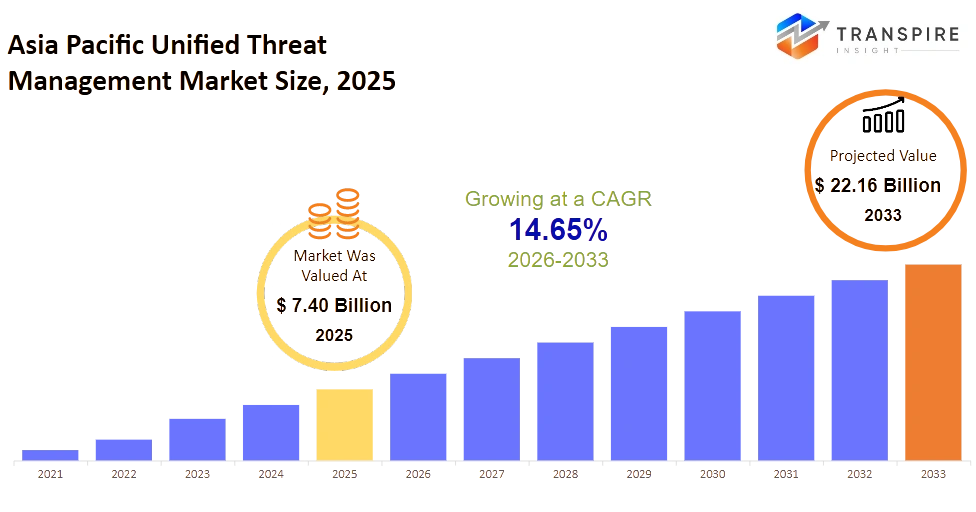
As per Transpire Insight Analysis the Asia Pacific Unified Threat Management Market size is estimated at USD 7.40 Billion in 2025 and is anticipated to reach USD 22.16 Billion by 2033, growing at a CAGR of 14.65% from 2026 to 2033.
The Asia Pacific Unified Threat Management Market helps organizations guard their business networks with one platform, like it bundles firewall, intrusion prevention, antivirus, web filtering, VPN, and application control all in the same place. In practice, businesses, government agencies, healthcare providers, manufacturers, and educational institutions end up using these setups to simplify their security operations, while also cutting down on the hassle of juggling several separate security tools. Over the past few years, the market sort of moved away from appliance-centric deployments and leaned more into hybrid, plus cloud-managed security platforms, because enterprises kept expanding remote work and they were also growing into multi-cloud environments. Then the COVID-19 pandemic really sped things up, with digital transformation putting spotlight on the gaps in older network security models. Cyberattacks also kept getting more sophisticated and, on top of that, regulatory requirements tightened across multiple Asia Pacific economies, so companies consolidated security functions to get better visibility, lower operational costs, and respond to threats more effectively. This ongoing change is even supporting longer-term service agreements, increasing software subscription revenue, and it’s driving wider adoption across both big enterprises and small, medium-sized businesses too.
Asia Pacific Unified Threat Management Market Size & Forecast:
- Asia Pacific Unified Threat Management Market Size 2025: USD 7.40 Billion
- Expected Market Value 2033: USD 22.16 Billion
- Forecast CAGR: 14.65%
- Leading region in 2025: East Asia
- Fastest Growing region: South Asia & Oceania
- Key Profile: Fortinet, Cisco, Sophos, Check Point Software, Palo Alto Networks, SonicWall, WatchGuard Technologies, Juniper Networks, Barracuda Networks, Huawei, Forcepoint, Hillstone Networks, Sangfor Technologies, Trellix, Microsoft
Key Market Insights
- In 2025, East Asia kind of dominated the market, with about 43% market share, helped by big enterprise IT spend and really advanced digital infrastructure.
- Then South Asia & Oceania, they’re still expected to be the fastest-moving regional market through 2025–2033, mostly because cloud adoption is speeding up and cybersecurity funding keeps expanding.
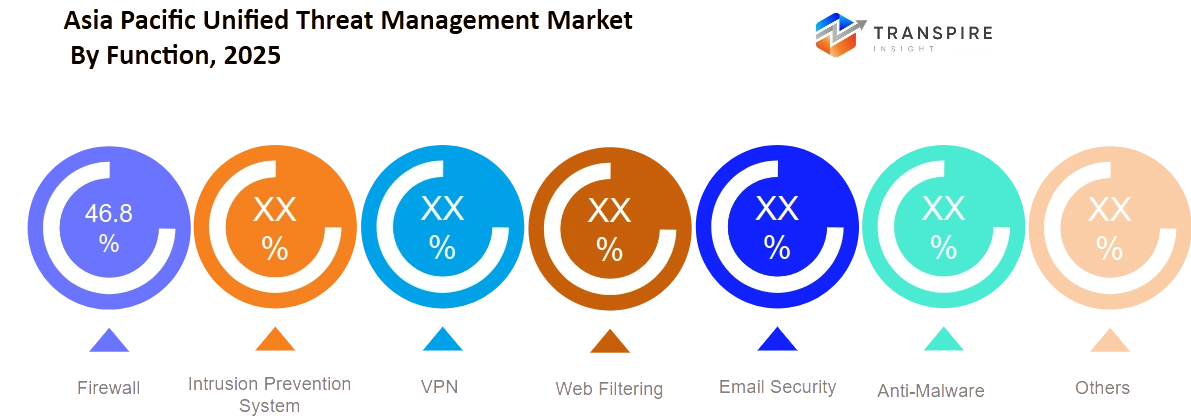
- On the product side, hardware-based UTM appliances were leading, at nearly 46% market share in 2025, which suggests ongoing rollout across enterprise networks and those critical infrastructure environments.
- Virtual, plus cloud-based UTM solutions sat in second place, as hybrid workplace security setups keep spreading across enterprises in the region.
- For growth, cloud-managed Unified Threat Management platforms are set to climb the quickest by 2033, driven by subscription-style deployment models and centralized policy administration, in other words more controlled governance.
- When it comes to application, enterprise network security held the lead with roughly 41% market share in 2025, since organizations have been merging multiple security capabilities into one unified platform.
- Cloud security along with remote workforce protection, will keep being the fastest-growing application across the forecast window, mainly because distributed IT setups are not just temporary anymore.
- As for end users, large enterprises accounted for around 61% market share in 2025, largely due to larger cybersecurity budgets, plus tougher compliance obligations.
- Small and medium-sized enterprises will be the fastest-growing end-user category, because managed security services make deployment less complicated and reduce ownership costs, overall.
What are the Key Drivers, Restraints, and Opportunities in the Asia Pacific Unified Threat Management Market?
The strongest force pushing the Asia Pacific Unified Threat Management Market forward is the quick movement toward hybrid cloud infrastructure and that whole distributed work style. It sort of sped up after organizations modernized their digital operations after the COVID-19 pandemic , and then governments added stricter cybersecurity plus data protection expectations. In the past, enterprises basically handled isolated firewalls, VPNs, and intrusion prevention systems on their own, now they tend to favor integrated platforms that cut operational hassle and give better security visibility. Also the faster rollout process tends to lower administrative costs , meanwhile subscription-based licensing builds recurring vendor income and helps more mid-sized organizations jump in.
At the same time , the biggest structural brake is still the shortage of experienced cybersecurity professionals , plus the annoying complexity of marrying legacy IT environments. A lot of companies keep using aging infrastructure, and it can’t really back advanced security policies unless they run bigger upgrades. Those migration efforts call for serious spending and longer implementation timelines. And based on Transpire Insight’s look at regional procurement announcements and launch schedules, supply chain concentration stays the main execution risk. Because of this, purchasing decisions get delayed, enterprise-wide deployments get postponed, and the upside for software and service revenue across developing markets gets muted.
The next growth phase is going to come from AI enabled threat detection, kind of stitched into Secure Access Service Edge (SASE) plus Zero Trust architectures. Governments across Southeast Asia keep putting money into digital public services, while financial institutions and manufacturers are also expanding their cloud-native operations. In practice, these sectors need one security platform that can actually guard users, applications, and endpoints through centralized oversight. Vendors that blend AI analytics with managed security services and cloud native deployment approaches will land tougher long term contracts, and also open up more recurring revenue streams.
What Has the Impact of Artificial Intelligence Been on the Asia Pacific Unified Threat Management Market?
Artificial intelligence is kind of transforming the regional unified threat management industry, mostly by automating threat monitoring, malware detection , policy enforcement and even compliance reporting across enterprise networks that keep getting more and more intricate. In practice, modern platforms are continuously looking through millions of security events , then they prioritize the most critical alerts, and they also shrink the amount of manual effort security operations teams have to do. With machine learning models, abnormal user behavior gets spotted, previously unseen attack patterns are detected, and faster containment actions are recommended so incidents don’t spread across connected environments like it would otherwise. There’s also predictive analytics, which seems to help organizations foresee network weaknesses, tune firewall policies, and distribute security resources more efficiently by leaning on historical attack trends plus day to day operational patterns.
Overall these functions improve response times, cut down false positives, keep systems more available, and can reduce operating costs for enterprises dealing with hybrid cloud infrastructure. On top of that AI-driven automation also supports managed security service providers, because it helps them offer scalable protection for small to medium sized businesses without losing control. Still, widespread adoption isn’t smooth. Integration costs can be high, especially for organizations stuck with legacy infrastructure, and AI accuracy depends a lot on high quality security data gathered from different environments. Plus, limited interoperability between older network systems and today’s AI-enabled platforms keeps slowing down implementation, particularly in a few industries where organizations are budget constrained.
Key Market Trends
- From around 2021 to 2025, enterprises mostly moved away from standalone security products toward more unified platforms, which reduced operational complexity in a pretty straight forward way, and also helped centralize policy management, at least in practice.
- After 2020, cloud-managed deployments grew really fast, so organizations could protect remote users without having to build all that heavy on-premise infrastructure stuff.
- AI-driven threat detection turned into a kind of default differentiator, while Fortinet, Palo Alto Networks, and Cisco kept pushing their intelligent security features across regional portfolios, bit by bit.
- Zero Trust adoption also picked up speed starting in 2022 , leading to tighter linkages between identity management, network access, and endpoint protection, all working together more closely.
- Managed security services saw major momentum as small and medium businesses decided to hand off day to day cybersecurity operations, partly because staffing constraints can be brutal.
- Sectors like financial services, healthcare, and manufacturing increased their cybersecurity spending too, especially once stronger regional data protection regulations were introduced across several Asia Pacific economies.
- Subscription based software licensing has been steadily replacing perpetual hardware purchasing, and that created more predictable recurring revenue for cybersecurity vendors, which everyone likes.
- Meanwhile, regional cloud infrastructure investments from global hyperscale providers boosted demand for virtual Unified Threat Management platforms that can handle multi-cloud environments.
- And between 2023 and 2025, security vendors leaned into new strategic partnerships with telecom operators as well as managed service providers, in order to accelerate regional market penetration .
Asia Pacific Unified Threat Management Market Segmentation
By Component :
Hardware appliances still help organizations that need dedicated network security infrastructure, with solid performance and centralized control, even when everything’s moving fast. On the software side, things have kept expanding too as cloud migration and virtualization keep reshaping how enterprise security gets handled. Managed services are getting more traction, mainly because many internal cybersecurity teams hit resource ceilings and deal with bigger daily operational pressure, not just one-off tasks. Meanwhile professional services stay pretty crucial for deployment planning, system integration, risk assessment, and compliance support across complex IT settings.
Security intelligence solutions improve threat detection by watching network activity and spotting weird behavior early, before incidents spread through connected systems. Other component types fill in the specialized gaps, since requirements vary by industry and also by organization size. Overall, a good mix of hardware, software, and services should keep pushing security efficiency up while dialing down management complexity, because honestly that matters. Technology vendors will likely concentrate on integrated platforms that make operations simpler, and that help keep long-term customer relationships stronger too.
By Deployment :
Cloud based deployment has grown pretty fast, because organizations want more adaptable security management across distributed networks and also remote work setups. Meanwhile, on premise deployment still fits a lot of industries that have tight regulatory rules , and they already have infrastructure investments in place. Hybrid deployment kind of takes the middle ground by combining the cloud’s flexibility with local control, especially for those sensitive workloads. SaaS delivery models have also helped software get easier to reach , while cutting down on time to get things running and lowering infrastructure expenses.
Private cloud environments stay important for larger enterprises managing confidential business data or government related information that really needs stronger oversight over how data is handled. Other deployment styles also keep showing up, to match different operational needs that can vary widely. In practice, deployment decisions now depend more and more on how the workloads get distributed, what compliance requires, and what the long term operating costs look like. Technology providers will keep pushing for more deployment flexibility, to support shifting enterprise security strategies as they evolve over time.
By Function :
Firewall solutions are still kind of the base layer for network protection, because they manage traffic and stop access that is not supposed to happen, across enterprise settings. At the same time intrusion prevention systems help the situation a bit more, by spotting and stopping suspicious behavior before it turns into a real incident that disrupts day to day business. VPN technology keeps showing up as a dependable way to safeguard remote users, since encrypted links make secure access possible from different places and teams. Web filtering solutions also do their job by reducing exposure to sketchy sites and reinforcing the organization’s internet rules, in a more controlled way.
Email security and anti-malware functions feel more and more necessary lately, since phishing attempts and ransomware campaigns keep targeting companies in multiple industries. There are other security functions too, they add coverage for specialized operational needs and the kind of cyber risks that keep appearing. When security capabilities are integrated, you get better operational visibility, and you also reduce the reliance on separate security products. Finally, ongoing updates plus smarter threat analysis should make the whole network more resilient in the years ahead.
By End User :
BFSI organizations keep investing in more advanced security platforms, to defend financial transactions, customer information, and the whole regulatory compliance set of needs. IT and telecom companies lean on integrated security systems, for guarding big digital networks and to help with cloud services that keep getting bigger. Government agencies also push up their cybersecurity muscle, to protect national infrastructure, and all kinds of sensitive public information. Healthcare providers keep modernizing security setups so connected medical devices stay protected, and confidential patient records too.
Manufacturing companies defend operational technology and the connected production environments from cyber threats that might mess with business continuity. Retail organizations strengthen payment security and customer data protection as digital commerce keeps moving across regional markets. Educational institutions are still improving network security, to back digital learning settings and research activities. The other end users will generally adopt integrated security platforms as cyber risks get more intricate across different industries.
By Enterprise Size :
Large enterprises keep leading the way on technology spend because heavy digital infrastructure ends up needing solid security orchestration and a centralized view, even when teams are already busy. Medium businesses are now more and more using integrated security platforms for extra protection without having to grow internal cyber teams, or so they say. Small enterprises often see the benefit in streamlined security solutions that cut down day to day operational complexity and help business continuity stay steady. SMEs are still moving toward subscription based security platforms that deliver enterprise level defense via cost efficient service models.
Meanwhile other business categories keep choosing deployment types based on what operations need, how much budget is free, and what regulatory obligations require. Cloud based management, plus managed security services, make things more accessible for organizations that do not have much technical bandwidth. Flexible pricing models also nudge wider adoption across organizations of different sizes. Going forward, ongoing digital transformation will help expand the use of integrated cybersecurity solutions during the forecast period.
What are the Key Use Cases Driving the Asia Pacific Unified Threat Management Market?
The largest use case sort of comes from enterprise network security, where integrated protection really helps with daily business operations across banking, government, and big corporate environments. Security teams end up buying unified platforms so they can handle firewall protection, intrusion prevention, secure remote access, and threat monitoring all through one single system. In practice this cuts down admin time a lot while still helping organizations satisfy tough regulatory and internal security requirements.
Cloud security ,and remote workforce protection keep growing across IT and telecom, healthcare, and retail organizations. Manufacturing companies also use unified security platforms to guard connected production systems and core business applications from network based attacks, while trying to keep operations running without interruptions at multiple sites.
Early adoption is starting to show up in smart factories and in public digital infrastructure projects, these often need centralized protection for connected devices and distributed networks. Educational institutions, and regional government agencies are likewise checking out more advanced security platforms to support digital transformation efforts, boost cyber resilience, and make compliance management feel a bit simpler, even as technology investments keep moving through the whole forecast period.
|
Report Metrics |
Details |
|
Market size value in 2025 |
USD 7.40 Billion |
|
Market size value in 2026 |
USD 8.51 Billion |
|
Revenue forecast in 2033 |
USD 22.16 Billion |
|
Growth rate |
CAGR of 14.65% from 2026 to 2033 |
|
Base year |
2025 |
|
Historical data |
2021 - 2024 |
|
Forecast period |
2026 - 2033 |
|
Report coverage |
Revenue forecast, competitive landscape, growth factors, and trends |
|
Regional scope |
Asia Pacific (India, China, Japan, Australia, South Korea, Rest of Asia Pacific) |
|
Key company profiled |
Fortinet, Cisco, Sophos, Check Point Software, Palo Alto Networks, SonicWall, WatchGuard Technologies, Juniper Networks, Barracuda Networks, Huawei, Forcepoint, Hillstone Networks, Sangfor Technologies, Trellix, Microsoft . |
|
Customization scope |
Free report customization (country, regional & segment scope). Avail customized purchase options to meet your exact research needs. |
|
Report Segmentation |
By Component (Hardware Appliances, Software Solutions, Managed Services, Professional Services, Security Intelligence, Others); By Deployment (Cloud-Based, On-Premise, Hybrid, SaaS, Private Cloud, Others); By Function (Firewall, Intrusion Prevention System, VPN, Web Filtering, Email Security, Anti-Malware, Others); By End User (BFSI, IT & Telecom, Government, Healthcare, Manufacturing, Retail, Education, Others); By Enterprise Size (Large Enterprises, Medium Enterprises, Small Enterprises, SMEs, Others) |
Which Regions are Driving the Asia Pacific Unified Threat Management Market Growth?
East Asia stays in the front spot, with roughly **43%** market share in 2025, and yeah the trend keeps looking solid. A mix of tough cybersecurity regulations, more mature digital infrastructure, and lots of enterprise cloud usage keeps the momentum there. A pretty complete ecosystem of major cybersecurity vendors, cloud service providers, telecom operators, and tech partners also helps things keep moving, like continuous product delivery, plus faster service expansion. And still, the steady push toward artificial intelligence , better digital infrastructure, and stronger safeguards for critical networks will likely keep the region leading through most of the forecast period.
Southeast Asia comes next, as the second-largest regional contributor, mainly because digital transformation is spreading across several economies, even if they’re not all at the same level yet. Government-driven digital economy initiatives, solid foreign investment, and gradually improving regulatory conditions give the area a stable base for long-hold cybersecurity budgets. Financial services , manufacturing, and retail organizations are modernizing their technology setups, but usually in phases , not as huge one-time rollouts. That kind of measured investment approach makes Southeast Asia a reliable source for continuing software sales and managed security revenue.
South Asia and Oceania will see the fastest growth, as governments further fortify cybersecurity frameworks and start speeding up investment into digital public infrastructure, kind of steadily. At the same time, broader cloud adoption, more reliable broadband reach, and modernization within enterprise IT environments have made it easier for integrated security platform deployment across both public ,and private sectors. Smaller organizations and medium sized businesses are also moving toward subscription based security services, mainly because the out of pocket implementation costs feel less heavy, and managed service availability keeps improving. All this momentum should open up appealing chances for tech providers, managed security companies, and long term investors in the 2026–2033 window.
Who are the Key Players in the Asia Pacific Unified Threat Management Market and How Do They Compete?
Competition in the Asia Pacific Unified Threat Management Market is kinda moderately consolidated, not fully fragmented, with major global cybersecurity vendors taking a notable share while regional service providers try to grow their local footprint. In practice, tech innovation is still the first thing people look at, then managed service ability, plus regional support networks that are easier to reach. The more established vendors keep their edge by leaning on integrated security platforms, but specialized providers often go after small and medium-sized businesses using flexible subscription models and cloud-managed services. Ongoing product development, artificial intelligence integration,and deployment that feels less complicated are the recurring drivers behind who performs better in the competition.
Fortinet stands out by using purpose-built security processors that push up inspection speed without basically hurting network performance. They also keep investing in AI-assisted threat intelligence and expand Security Operations, and that helps their adoption climb in sectors like finance, manufacturing, and government. Palo Alto Networks instead competes with a cloud-native security design, where network protection, endpoint security, and automated threat response work together inside one unified platform. Product expansion, plus technology partnerships, helps them cover more ground across hybrid setups and multi-cloud environments.
Company List
- Fortinet
- Cisco
- Sophos
- Check Point Software
- Palo Alto Networks
- SonicWall
- WatchGuard Technologies
- Juniper Networks
- Barracuda Networks
- Huawei
- Forcepoint
- Hillstone Networks
- Sangfor Technologies
- Trellix
- Microsoft
Recent Development News
In May 2026, Fortinet launched FortiSOC, a unified Security Operations Center platform powered by agentic AI. The launch expanded automated threat detection and response capabilities, strengthening integrated network security offerings used across enterprise and government environments. Sourcehttps://www.fortinet.com/
In April 2026, Check Point Software Technologies announced an integration between its AI Defense Plane and Google Cloud to secure AI agents through integrated discovery, governance, and runtime protection. The strategic partnership strengthened cloud-native security capabilities and expanded enterprise protection for hybrid IT environments.
Source https://www.checkpoint.com/
What Strategic Insights Define the Future of the Asia Pacific Unified Threat Management Market?
The Asia Pacific Unified Threat Management Market seems like it will gradually drift toward more intelligent, cloud-native security platforms that, uh, combine network protection , automation and a kind of centralized policy control all in one operating space. You can also see enterprise digital transformation moving ahead, multi-cloud setups getting bigger, and compliance rules becoming stricter, those will keep steering long-term spending decisions for both public and private players.
There’s a quieter risk too, it’s the growing reliance on a small set of cybersecurity technology providers, which can push procurement costs up, limit deployment flexibility, and honestly make integration harder for organizations running a mix of vendors, not just one.
On the upside, an emerging chance is taking shape around AI protection for operational technology environments and critical infrastructure, especially across Southeast Asia, as industrial modernization programs speed up. Market participants will likely do better when they invest in open, interoperable security architectures, the ones that connect smoothly with existing enterprise systems while also extending managed security services. In practice this could help keep customers longer, sustain recurring subscription revenue, and lower the barriers to implementation for different company sizes.
Asia Pacific Unified Threat Management Market Report Segmentation
By Component
- Hardware Appliances
- Software Solutions
- Managed Services
- Professional Services
- Security Intelligence
By Deployment
- Cloud-Based
- On-Premise
- Hybrid
- SaaS
- Private Cloud
By Function
- Firewall
- Intrusion Prevention System
- VPN
- Web Filtering
- Email Security
- Anti-Malware
By End User
- BFSI
- IT & Telecom
- Government
- Healthcare
- Manufacturing
- Retail
- Education
By Enterprise Size
- Large Enterprises
- Medium Enterprises
- Small Enterprises
- SMEs
Frequently Asked Questions
Find quick answers to common questions.
The expected Asia Pacific Unified Threat Management Market size for the market will be USD 22.16 Billion in 2033.
Key segments for the Asia Pacific Unified Threat Management Market are By Component (Hardware Appliances, Software Solutions, Managed Services, Professional Services, Security Intelligence, Others); By Deployment (Cloud-Based, On-Premise, Hybrid, SaaS, Private Cloud, Others); By Function (Firewall, Intrusion Prevention System, VPN, Web Filtering, Email Security, Anti-Malware, Others); By End User (BFSI, IT & Telecom, Government, Healthcare, Manufacturing, Retail, Education, Others); By Enterprise Size (Large Enterprises, Medium Enterprises, Small Enterprises, SMEs, Others).
Major Asia Pacific Unified Threat Management Market players are Fortinet, Cisco, Sophos, Check Point Software, Palo Alto Networks, SonicWall, WatchGuard Technologies, Juniper Networks, Barracuda Networks, Huawei, Forcepoint, Hillstone Networks, Sangfor Technologies, Trellix, Microsoft.
The Asia Pacific Unified Threat Management Market size is USD 7.40 Billion in 2025.
The Asia Pacific Unified Threat Management Market CAGR is 14.65% from 2026 to 2033.
- Fortinet
- Cisco
- Sophos
- Check Point Software
- Palo Alto Networks
- SonicWall
- WatchGuard Technologies
- Juniper Networks
- Barracuda Networks
- Huawei
- Forcepoint
- Hillstone Networks
- Sangfor Technologies
- Trellix
- Microsoft
About the Authors

Mayur Shinde
I am Mayur Shinde, a Senior Research Analyst at Transpire Insight, specializing in the Automotive & Transportation and Information & Communication Technology (ICT) Industry. My work focuses on analyzing emerging market trends, technological advancements, competitive landscapes, and industry developments to deliver accurate, data-driven insights. I am passionate about transforming complex market information into clear, actionable content that helps businesses, professionals, and decision-makers stay informed and make confident strategic decisions.

Chakradhar Khansole
Chakradhar serves as the Research Director at Transpire Insight, bringing over 8 years of experience in technology, innovation, and strategic market intelligence. He specializes in transforming complex market data into actionable business insights that enable organizations to make informed, growth-oriented decisions. Recognized for his strategic vision and analytical expertise, Chakradhar leads high-impact research initiatives, delivering comprehensive market assessments, competitive intelligence, and forward-looking industry analysis.
Recently Published Reports
-
Apr 2026
3D Optical Profiler Market
3D Optical Profiler Market Size, Share & Analysis Report By Type (Desktop 3D Optical Profiler, and Portable 3D Optical Profiler), By Technology (Confocal Technology, and White Light Interference), By End-Use Industry (Manufacturing, Research Institutions, Automotive, Aerospace and Defense, Medical Devices, and Other), and Geography (North America, Europe, Asia-Pacific, Middle East and Africa, South and Central America), 2021 - 2031
-
Apr 2026
Depth Sensor Market
Depth Sensor Market Size, Share & Analysis Report By Type (Infrared Depth Sensors, Time-of-Flight (ToF) Sensors, Stereo Vision Sensors, Structured Light Sensors, Ultrasonic Depth Sensors), By Application (Automotive, Robotics, Gaming, Consumer Electronics, Industrial Automation, Healthcare, Security & Surveillance, Others), By End Users (Automotive Manufacturers, Consumer Electronics Companies, Healthcare Providers, Industrial Companies, Security Agencies, Gaming Companies, Robotics Companies, Others), and Geography (North America, Europe, Asia-Pacific, Middle East and Africa, South and Central America), 2021 – 2031
-
Apr 2026
Digital Manufacturing Market
Digital Manufacturing Market Size, Share & Analysis Report By Component (Hardware, Software, and Services), By Technology (Robotics, 3D Printing, Internet of Things (IoT), and Others), By Application (Automotive and Transportation, Aerospace and Defense, Consumer Electronics, Industrial Machinery, and Others), By Process Type (Computer-Based Designing, Computer-Based Simulation, Computer 3D Visualization, Analytics, and Others), and Geography (North America, Europe, Asia-Pacific, Middle East and Africa, South and Central America), 2021 – 2031
-
Apr 2026
Digital Visa Services Market
Digital Visa Services Market Size, Share & Analysis Report By Type (Individual Travelers, Group Travelers), By Application (Tourism, Business Travel, Others), and Geography (North America, Europe, Asia-Pacific, Middle East and Africa, South and Central America), 2021 – 2031