

Middle East and Africa Cloud VPN Market Summary
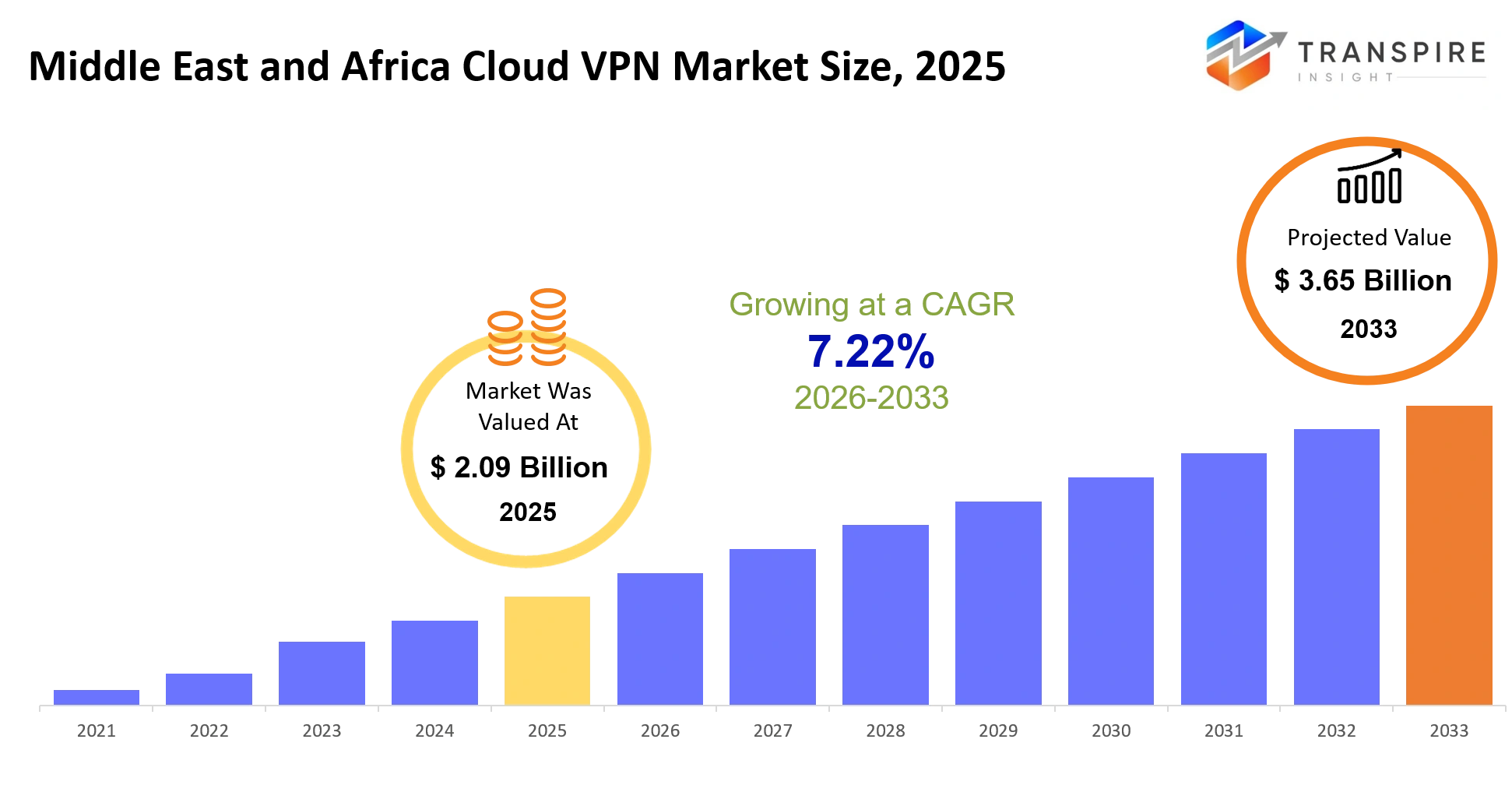
As per Transpire Insight Analysis the Middle East and Africa Cloud VPN Market size is estimated at USD 2.09 Billion in 2025 and is anticipated to reach USD 3.65 Billion by 2033, growing at a CAGR of 7.22% from 2026 to 2033.
The Middle East and Africa Cloud VPN market sort of enables organizations to give secure encrypted access to business apps, cloud platforms, and corporate networks ,mainly for employees, branch offices, and also third-party partners. In practice it helps enterprises guard sensitive data while still backing remote work, hybrid operations, and multi cloud environments across locations that are pretty spread out. Over the last five years , it feels like the market slowly backed away from those older hardware oriented VPN appliances toward cloud delivered Secure Access Service Edge , or SASE, and Zero Trust Network Access , ZTNA, setups. And really the shift seemed to accelerate a fair bit after the COVID-19 pandemic , because hybrid work became more or less a lasting thing , and enterprises started leaning on cloud infrastructure in a more consistent manner. Honestly, it’s like everyone wanted something more adaptable, less tied to a box in the rack, but with stricter identity checks too. At the same time, tighter cybersecurity regulations, plus a noticeable increase in ransomware incidents across financial services, healthcare, and government organizations has pushed companies to modernize their secure connectivity. As more enterprises move workloads into public and private clouds, cloud native VPN platforms tend to cut down infrastructure clutter, boost scalability, and also bring recurring subscription income for security vendors throughout the Middle East and Africa.
Middle East and Africa Cloud VPN Market Size & Forecast:
- Middle East and Africa Cloud VPN Market Size 2025: USD 2.09 Billion
- Expected Market Value 2033: USD 3.65 Billion
- Forecast CAGR: 7.22%
- Leading region in 2025:
- Fastest Growing region:
- Key Profile: Cisco, Palo Alto Networks, Fortinet, Check Point Software, Zscaler, VMware, Microsoft, OpenVPN, Cloudflare, Nord Security, Perimeter 81, SonicWall, Juniper Networks, Barracuda Networks, Sophos.
Key Market Insights
- Regional Analysis: the Middle East basically leads the Middle East and Africa Cloud VPN Market, grabbing about 63% market share in 2025, driven by GCC digital transformation and cybersecurity spend, though maybe a bit more than anyone first expected.
- Fastest-Growing Region: Africa should be the quickest mover through 2033, supported by cloud adoption, fintech expansion , and digital government initiatives too.
- Leading Segment: cloud-based VPN services make up roughly 58% of the market share in 2025, mainly because enterprises keep moving away from appliance-driven VPN infrastructure, toward something more flexible and nimble.
- Second-Largest Segment: hybrid cloud VPN deployments still stay pretty big, since organizations mix private data centers with public cloud environments, sort of blending two different atmospheres.
- Fastest-Growing Segment: Zero Trust Network Access solutions are expected to grow at the fastest rate through 2033, steadily taking the place of older VPN designs and methods.
- Dominant Application: enterprise remote workforce connectivity accounts for almost 42% of total revenue, because hybrid work becomes the regular operating cadence.
- Emerging Application: secure cloud access for industrial IoT and operational technology environments is increasing across manufacturing, utilities, and energy.
- Leading End User: BFSI holds around 28% market share, backed by strict regulatory compliance, and stronger cybersecurity investment levels.
- Fastest-Growing End User: healthcare organizations are accelerating deployments, as digital patient records and telemedicine platforms require tougher encrypted connectivity , and frankly it’s not optional anymore.
- Competitive Landscape: Cisco, Palo Alto Networks, Fortinet, Microsoft, Cloudflare, and Zscaler are improving their positions with AI-driven security, SASE platforms, regional cloud growth, and cybersecurity partnerships that look more strategic than before.
What are the Key Drivers, Restraints, and Opportunities in the Middle East and Africa Cloud VPN Market?
The strongest growth driver is this kind of rapid migration of enterprise workloads into public, and hybrid cloud spaces , paired with the whole adoption of Zero Trust security frameworks. Governments across the GCC , South Africa, and other nearby regional economies have been introducing stricter cybersecurity regulations , which then effectively force stronger identity verification. They also push encrypted communications and continuous access monitoring. Those policy shifts, together with ongoing ransomware attacks aimed at financial institutions, healthcare providers and government agencies, have made many organizations replace hardware VPN appliances with cloud-native platforms. Subscription-based cloud VPN services keep knocking down infrastructure costs, they also make it easier to deploy across several locations, and they open up recurring revenue opportunities for cybersecurity vendors.
Still, one big structural barrier is uneven digital infrastructure across a number of African economies. Broadband access is limited, cloud data center coverage can be inconsistent, and there are shortages of experienced cybersecurity professionals. Because of that, large-scale deployment ends up being difficult. A lot of organizations are still running legacy on-premises systems , and those demand expensive integration work before cloud VPN solutions can really deliver the full value. These constraints slow down enterprise migration and end up delaying longer-term security investments, so the potential market revenue takes a hit.
Meanwhile, there’s a real opportunity in combining AI-driven Secure Access Service Edge platforms with the expansion of hyperscale cloud infrastructure across the Middle East and Africa. Investments from Microsoft, Google Cloud, Oracle Cloud, and AWS into regional cloud availability zones are basically creating better conditions for cloud-native security services.
What Has the Impact of Artificial Intelligence Been on the Middle East and Africa Cloud VPN Market?
Artificial intelligence is, basically, reshaping cloud VPN platforms from encrypted connectivity tools into more intelligent cybersecurity systems, able to spot, examine, and react to threats in real time. In a lot of cases modern cloud VPN providers lean on AI algorithms to handle user authentication automatically, watch network traffic, figure out what looks out of place, and then tweak security policies on the fly. No manual intervention, at least not the usual kind. Machine learning models keep scoring user activity, device health, and connection patterns, so false positives drop while Zero Trust access controls get tighter. AI also helps with predictive analytics by pointing at vulnerabilities before they turn into full blown security incidents, so security teams can sort priorities for remediation and keep day to day operations from getting too disrupted.
At the same time advanced digital technologies are improving network performance using automated traffic optimization, smarter routing, and bandwidth management across hybrid cloud setups. The upside for organizations tends to be higher network availability, faster incident response, better regulatory compliance, and yes, lower operational costs, mostly because policy enforcement becomes automated. Cloud-native security platforms increasingly mix AI with Security Information and Event Management, Extended Detection and Response, plus Secure Access Service Edge, which together form a kind of unified security ecosystem.
Still, AI adoption is not completely smooth. The process is often limited by high implementation costs, a shortage of region-specific cybersecurity training data, and integration challenges with older enterprise infrastructure. When companies run on older network environments they may need significant modernization first, before AI-driven cloud VPN capabilities can deliver consistent accuracy and real operational value.
Key Market Trends
- Since 2021, many enterprises have slowly moved away from hardware VPN appliances toward cloud-native SASE platforms, which makes setup feel a bit easier and also trims operational costs.
- At the same time, Zero Trust security, once kind of an early-adopter idea, is now a mainstream enterprise plan after those big ransomware events that hit banking and government organizations.
- Microsoft, Cisco, Palo Alto Networks, and Cloudflare kept pushing AI-powered secure access platforms out through 2025 and into 2026, like a steady roll out instead of one-off releases.
- Multi-cloud adoption also kept climbing, because companies started placing applications across AWS, Azure , and Google Cloud, but they still wanted one unified encrypted connectivity experience, not three separate security stories.
- Financial institutions leaned harder into cloud VPN deployments to meet tougher cybersecurity requirements that were introduced across GCC countries after 2022.
- With AI-powered threat detection, a lot of the manual monitoring work drops, since it can automatically spot anomalous user behavior and suspicious network traffic.
- Vendors are also bundling VPN, firewall, secure web gateway and identity management into integrated, subscription-based cybersecurity platforms, so buying feels more like one package than separate tools.
- In Africa, enterprises ramped up cloud security spending as fintech ecosystems and digital payment infrastructure grew across different regional markets.
- Newer regional cloud data center investments improved service latency, and that helped adoption of cloud-delivered security platforms across the Middle East.
- Last, strategic partnerships between cybersecurity vendors and telecom operators have been strengthening managed security services for enterprise customers across the region.
Middle East and Africa Cloud VPN Market Segmentation
By Component
Cloud VPN software kind of forms the bedrock for safe remote connectivity, mainly because it encrypts the communications between people, devices, and cloud apps. VPN gateways create kind of a protected entry point between an enterprise network and the cloud infrastructure, and then security services add another layer by using threat detection, malware prevention, and policy enforcement—so the overall protection feels stronger. On top of that, VPN management platforms make things easier when it comes to configuration, user administration, and updating network policies across all those distributed business setups that never really “sit still”. And then network monitoring tools help with visibility by watching traffic, checking performance, and flagging weird activity that could mess with safe operations .
For authentication, the idea is to validate user identity using multi-factor authentication and biometric validation, which reduces the chance of unauthorized access, in practice. Some organizations use managed VPN services too, especially if they want outsourced deployment , monitoring, and maintenance rather than building internal cybersecurity teams. Other pieces you might see include logging systems, traffic optimization tools, encryption modules, and compliance management features, those support industry specific security needs, depending on the sector. When these are deployed together the result is secure, scalable, and centrally managed network environments across many different types of organizations.
By Deployment
Public cloud deployment is for organizations that need scalable, cost efficient secure connectivity, without having to maintain dedicated infrastructure, like ever. Private cloud deployment is more for enterprises who want tight governance over sensitive data and stronger regulatory compliance. Hybrid cloud environments link on-premise setups with cloud platforms, so they can move workloads in a protected way, but still keep operational flexibility, more or less. There’s also multi-cloud deployment, where teams run applications across several cloud providers, and still aim for the same uniform security policies.
SaaS based VPN solutions make things easier through subscription models, so there’s less infrastructure upkeep, and less fuss. Zero Trust VPN architectures confirm each user and each device before granting any access, which helps a lot against those ever changing cyber threats. Edge VPN solutions protect distributed branch offices and remote sites by handling the traffic closer to the users, so you get lower latency, better performance. Other deployment models exist too, for specialized operating needs in different industries, each with its own security expectations and compliance requirements.
By Application
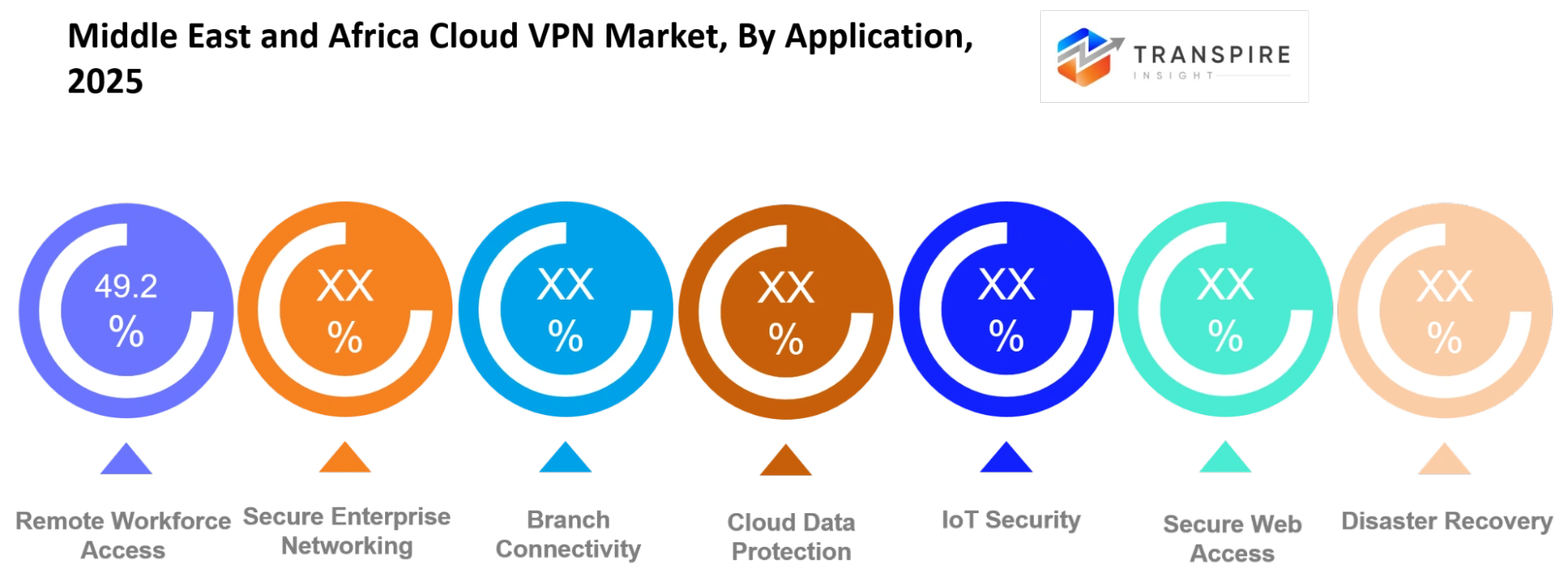
Remote workforce access kind of ends up being the biggest application here because many organizations need secure connectivity for people who work across offices, their homes, and also field sites. This secure enterprise networking is what keeps communication moving between corporate systems, cloud services, and business users, while still keeping access rules pretty consistent. Branch connectivity then links several office locations through encrypted communication paths, which supports centralized business operations in a steady way, not just “mostly.” For the cloud side, cloud data protection helps keep business information safe across public, private and hybrid cloud environments.
On another track, IoT security helps guard connected industrial devices, sensors, and operational environments from people who shouldn’t get in, plus various cyber threats. Secure web access filters and sort of controls internet traffic and then enforces security policies before users land on online applications and services. Disaster recovery backs up business continuity by keeping protected access available to backup systems when something unexpected happens. Other examples show up too, like partner collaboration, secure access for contractors, and encrypted communications for specialized business tasks, you know, the more specific operations.
By End User
BFSI still comes first as the leading end user group, because financial institutions handle very sensitive customer information and they also work inside strict cybersecurity regulations. Government organizations rely on secure comms platforms—so their confidential public services and national digital infrastructure stay protected. IT and telecom companies then roll out advanced secure connectivity solutions, to back up cloud services, network management, and enterprise customers too. Healthcare providers lock down electronic medical records, telemedicine platforms and connected clinical systems, to keep cyber threats at a distance.
Meanwhile manufacturing firms safeguard production networks, industrial control systems, and these connected factory environments from unwanted access. Retail businesses protect payment systems, online transactions, and customer data, while also enabling omnichannel operations. Education institutions help students and staff get secure access to digital learning platforms, research systems, and admin applications across multiple campuses. Other end users include logistics providers, energy companies, hospitality businesses, and professional service organizations, all of them expanding their digital operations over time.
By Enterprise Size
Big companies drive most deployments, because the more complex the operations are the more centralized security becomes a must across several offices, cloud environments , and even different countries. Mid-sized enterprises keep moving forward with cloud adoption, but they try to keep a steady balance between cybersecurity spending and day-to-day operational efficiency. Smaller firms often pick cloud-delivered security solutions, mainly because subscription pricing eases capital expenditure and makes implementation feel less disruptive. Startups tend to choose adaptable secure connectivity platforms that help them scale the business quickly , without having to sink resources into extensive infrastructure.
Government orgs need security platforms that can scale, to safeguard public digital services, citizen-related data, and communications between departments. SMEs typically improve cybersecurity strength by leaning on managed services and cloud-native platforms, since this trims down admin burdens and also helps keep operating costs under control. Other categories include nonprofits, schools , healthcare networks , and specific industrial operators who need secure digital connectivity for everyday work.
What are the Key Use Cases Driving the Middle East and Africa Cloud VPN Market?
Secure remote workforce connectivity is still the main reason organizations go after this kind of setup, really because enterprises need protected access to cloud applications, internal business systems, and confidential corporate information while teams work from multiple locations, and yes that part matters a lot. Banking, telecom, and professional service organizations therefore lean on encrypted connections, so they can keep business continuity going, while also satisfying regional cybersecurity rules , plus the regional data protection expectations.
Secure branch connectivity, together with access to cloud applications, is also getting more weight across retail, manufacturing, and healthcare. As operations spread out, they want security policies that match between headquarters, regional offices, production facilities, and the cloud platforms, but without dumping sensitive operational data where external threats could reach it. In other words it is more about controlled alignment than just “having a tunnel”.
More new use cases are showing up too, like secure connectivity aimed at industrial IoT environments and Zero Trust access for critical infrastructure. Energy utilities, smart city initiatives, and digital government programs keep expanding secure cloud networking, because connected devices plus cloud-native services are becoming a long-term part of digital transformation plans. So the whole thing keeps moving forward, even when requirements keep changing.
|
Report Metrics |
Details |
|
Market size value in 2025 |
USD 2.09 Billion |
|
Market size value in 2026 |
USD 2.24 Billion |
|
Revenue forecast in 2033 |
USD 3.65 Billion |
|
Growth rate |
CAGR of 7.22% from 2026 to 2033 |
|
Base year |
2025 |
|
Historical data |
2021 - 2024 |
|
Forecast period |
2026 - 2033 |
|
Report coverage |
Revenue forecast, competitive landscape, growth factors, and trends |
|
Regional scope |
Middle East and Africa (Saudi Arabia, United Arab Emirates, South Africa, Rest of Middle East and Africa) |
|
Key company profiled |
Cisco, Palo Alto Networks, Fortinet, Check Point Software, Zscaler, VMware, Microsoft, OpenVPN, Cloudflare, Nord Security, Perimeter 81, SonicWall, Juniper Networks, Barracuda Networks, Sophos. |
|
Customization scope |
Free report customization (country, regional & segment scope). Avail customized purchase options to meet your exact research needs. |
|
Report Segmentation |
By Component (Cloud VPN Software, VPN Gateways, Security Services, VPN Management Platforms, Network Monitoring Tools, Authentication Solutions, Managed VPN Services, Others); By Deployment (Public Cloud, Private Cloud, Hybrid Cloud, Multi-Cloud, SaaS-Based VPN, Zero Trust VPN, Edge VPN, Others); By Application (Remote Workforce Access, Secure Enterprise Networking, Branch Connectivity, Cloud Data Protection, IoT Security, Secure Web Access, Disaster Recovery, Others); By End User (BFSI, Government, IT & Telecom, Healthcare, Manufacturing, Retail, Education, Others); By Enterprise Size (Large Enterprises, Medium Enterprises, Small Enterprises, Startups, Government Organizations, SMEs, Others). |
Which Regions are Driving the Middle East and Africa Cloud VPN Market Growth?
The Middle East holds the biggest share of revenue, because governments across the Gulf Cooperation Council keep investing pretty heavily in national digital transformation along with cybersecurity frameworks. You can see this in places like the United Arab Emirates and Saudi Arabia , where comprehensive cybersecurity regulations have been rolled out, and they push enterprises to adopt safer cloud connectivity for public and private sector day to day operations. On top of that, regional cloud data centers backed by Microsoft, Oracle, Google Cloud, and Amazon Web Services, give the kind of infrastructure needed for low-latency secure access services. There’s also strong spending in financial services, smart city programs, energy infrastructure, and government digital platforms, which in turn builds a fairly stable ecosystem, supporting long-term take-up of cloud VPN solutions.
Then South Africa steps in as the second-largest regional contributor , but the growth pattern is more about enterprise modernization not so much government led digital drives. The banking sector is mature, telecommunications infrastructure keeps expanding, and there is consistent investment in cloud migration, so cybersecurity vendors end up with a dependable customer base. Adoption stays steady , mainly because organizations keep swapping out legacy network security tools for cloud delivered platforms while still meeting the Protection of Personal Information Act and other cybersecurity requirements. So basically this mix of investments results in recurring enterprise spending, and it also helps the market stay stable over the long run.
For the remainder of Africa, it’s projected to post the fastest expansion from 2026 to 2033, as digital infrastructure spending speeds up across emerging economies.
Who are the Key Players in the Middle East and Africa Cloud VPN Market and How Do They Compete?
Competition is still moderately consolidated in a sense , because big global cybersecurity companies manage to hold a meaningful portion of enterprise deployments, and at the same time specialized cloud security providers keep pushing forward using more inventive service models. Overall, “technology capability” is basically the main battleground now, so vendors are not just chasing deals by price anymore but rather they are competing via Zero Trust security, Secure Access Service Edge platforms, artificial intelligence features, and cloud-native management. On top of that, regional cloud infrastructure relationships and managed security services sway purchasing decisions, since many enterprises want something like a single integrated set-up for both networking and cybersecurity.
Cisco tries to stand out with Secure Access plus an integrated networking architecture that brings cloud security , identity management, and enterprise networking into one unified platform. Microsoft leans hard into cloud-native security by weaving Microsoft Entra Internet Access with Azure services, which helps organizations simplify identity-centered security across hybrid environments. Palo Alto Networks grows Prisma SASE by layering in AI-driven threat detection and automated policy management, which helps enterprises cut down on manual security operations , while at the same time speeding up response times.
Fortinet competes by bringing firewall technology together with secure networking and SASE abilities inside one management platform , so the setup feels more practical for teams that value day-to-day operational simplicity. Cloudflare instead highlights a globally distributed network foundation that enables secure connectivity with low latency, especially for organizations operating across several countries.
Company List
- Cisco
- Palo Alto Networks
- Fortinet
- Check Point Software
- Zscaler
- VMware
- Microsoft
- OpenVPN
- Cloudflare
- Nord Security
- Perimeter 81
- SonicWall
- Juniper Networks
- Barracuda Networks
- Sophos
Recent Development News
In April 2026, Microsoft launched enhanced Microsoft Entra Internet Access capabilities with expanded Secure Service Edge functionality. The release strengthened identity-based cloud security, Zero Trust connectivity, and secure enterprise access for distributed organizations.
Source: https://techcommunity.microsoft.com
In April 2026, Palo Alto Networks expanded Prisma SASE by introducing new AI-powered security capabilities for hybrid work environments. The update improved secure remote connectivity, automated threat detection, and cloud-delivered enterprise networking services.
Source: https://www.paloaltonetworks.com
What Strategic Insights Define the Future of the Middle East and Africa Cloud VPN Market?
In the next five to seven years, the market is going to move past “safe remote connectivity” toward more united cloud security platforms, that kind of tie together networking, identity management, artificial intelligence, and Zero Trust architecture all in one, unified subscription service. And this big change is mostly getting pushed by enterprise cloud migration, plus the digital government programs expanding, and then honestly tougher cybersecurity compliance rules across the Middle East and Africa. There’s also a quieter risk forming—like getting too dependent on a small group of global cloud providers, which could push vendor concentration up and make it harder for enterprises that want multi-cloud security strategies.
At the same time there is an emerging opening too: AI-enabled security platforms for industrial IoT , critical infrastructure, and smart city ecosystems, especially in those fast-developing African economies where everything is growing quickly. So technology providers, and investors in particular should focus on regional partnerships with telecom operators, managed service providers, and cloud infrastructure companies. That way they can shape localized cybersecurity offerings that actually fit regulatory requirements, while still delivering scalable, cloud-native security services that can grow with demand.
Middle East and Africa Cloud VPN Market Report Segmentation
By Component
- Cloud VPN Software
- VPN Gateways
- Security Services
- VPN Management Platforms
- Network Monitoring Tools
- Authentication Solutions
- Managed VPN Services
- Others
By Deployment
- Public Cloud
- Private Cloud
- Hybrid Cloud
- Multi-Cloud
- SaaS-Based VPN
- Zero Trust VPN
- Edge VPN
- Others
By Application
- Remote Workforce Access
- Secure Enterprise Networking
- Branch Connectivity
- Cloud Data Protection
- IoT Security
- Secure Web Access
- Disaster Recovery
- Others
By End User
- BFSI
- Government
- IT & Telecom
- Healthcare
- Manufacturing
- Retail
- Education
- Others
By Enterprise Size
- Large Enterprises
- Medium Enterprises
- Small Enterprises
- Startups
- Government Organizations
- SMEs
- Others
Frequently Asked Questions
Find quick answers to common questions.
The expected Middle East and Africa Cloud VPN Market size for the market will be USD 3.65 Billion in 2033.
Key segments for the Middle East and Africa Cloud VPN Market are By Component (Cloud VPN Software, VPN Gateways, Security Services, VPN Management Platforms, Network Monitoring Tools, Authentication Solutions, Managed VPN Services, Others); By Deployment (Public Cloud, Private Cloud, Hybrid Cloud, Multi-Cloud, SaaS-Based VPN, Zero Trust VPN, Edge VPN, Others); By Application (Remote Workforce Access, Secure Enterprise Networking, Branch Connectivity, Cloud Data Protection, IoT Security, Secure Web Access, Disaster Recovery, Others); By End User (BFSI, Government, IT & Telecom, Healthcare, Manufacturing, Retail, Education, Others); By Enterprise Size (Large Enterprises, Medium Enterprises, Small Enterprises, Startups, Government Organizations, SMEs, Others).
Major Middle East and Africa Cloud VPN Market players are Cisco, Palo Alto Networks, Fortinet, Check Point Software, Zscaler, VMware, Microsoft, OpenVPN, Cloudflare, Nord Security, Perimeter 81, SonicWall, Juniper Networks, Barracuda Networks, Sophos.
The Middle East and Africa Cloud VPN Market size is USD 2.09 Billion in 2025.
The Middle East and Africa Cloud VPN Market CAGR is 7.22% from 2026 to 2033.
- Cisco
- Palo Alto Networks
- Fortinet
- Check Point Software
- Zscaler
- VMware
- Microsoft
- OpenVPN
- Cloudflare
- Nord Security
- Perimeter 81
- SonicWall
- Juniper Networks
- Barracuda Networks
- Sophos
About the Authors

Mayur Shinde
I am Mayur Shinde, a Senior Research Analyst at Transpire Insight, specializing in the Automotive & Transportation and Information & Communication Technology (ICT) Industry. My work focuses on analyzing emerging market trends, technological advancements, competitive landscapes, and industry developments to deliver accurate, data-driven insights. I am passionate about transforming complex market information into clear, actionable content that helps businesses, professionals, and decision-makers stay informed and make confident strategic decisions.

Chakradhar Khansole
Chakradhar serves as the Research Director at Transpire Insight, bringing over 8 years of experience in technology, innovation, and strategic market intelligence. He specializes in transforming complex market data into actionable business insights that enable organizations to make informed, growth-oriented decisions. Recognized for his strategic vision and analytical expertise, Chakradhar leads high-impact research initiatives, delivering comprehensive market assessments, competitive intelligence, and forward-looking industry analysis.
Recently Published Reports
-
Apr 2026
3D Optical Profiler Market
3D Optical Profiler Market Size, Share & Analysis Report By Type (Desktop 3D Optical Profiler, and Portable 3D Optical Profiler), By Technology (Confocal Technology, and White Light Interference), By End-Use Industry (Manufacturing, Research Institutions, Automotive, Aerospace and Defense, Medical Devices, and Other), and Geography (North America, Europe, Asia-Pacific, Middle East and Africa, South and Central America), 2021 - 2031
-
Apr 2026
Depth Sensor Market
Depth Sensor Market Size, Share & Analysis Report By Type (Infrared Depth Sensors, Time-of-Flight (ToF) Sensors, Stereo Vision Sensors, Structured Light Sensors, Ultrasonic Depth Sensors), By Application (Automotive, Robotics, Gaming, Consumer Electronics, Industrial Automation, Healthcare, Security & Surveillance, Others), By End Users (Automotive Manufacturers, Consumer Electronics Companies, Healthcare Providers, Industrial Companies, Security Agencies, Gaming Companies, Robotics Companies, Others), and Geography (North America, Europe, Asia-Pacific, Middle East and Africa, South and Central America), 2021 – 2031
-
Apr 2026
Digital Manufacturing Market
Digital Manufacturing Market Size, Share & Analysis Report By Component (Hardware, Software, and Services), By Technology (Robotics, 3D Printing, Internet of Things (IoT), and Others), By Application (Automotive and Transportation, Aerospace and Defense, Consumer Electronics, Industrial Machinery, and Others), By Process Type (Computer-Based Designing, Computer-Based Simulation, Computer 3D Visualization, Analytics, and Others), and Geography (North America, Europe, Asia-Pacific, Middle East and Africa, South and Central America), 2021 – 2031
-
Apr 2026
Digital Visa Services Market
Digital Visa Services Market Size, Share & Analysis Report By Type (Individual Travelers, Group Travelers), By Application (Tourism, Business Travel, Others), and Geography (North America, Europe, Asia-Pacific, Middle East and Africa, South and Central America), 2021 – 2031