

Asia Pacific Technical Glass Market Summary
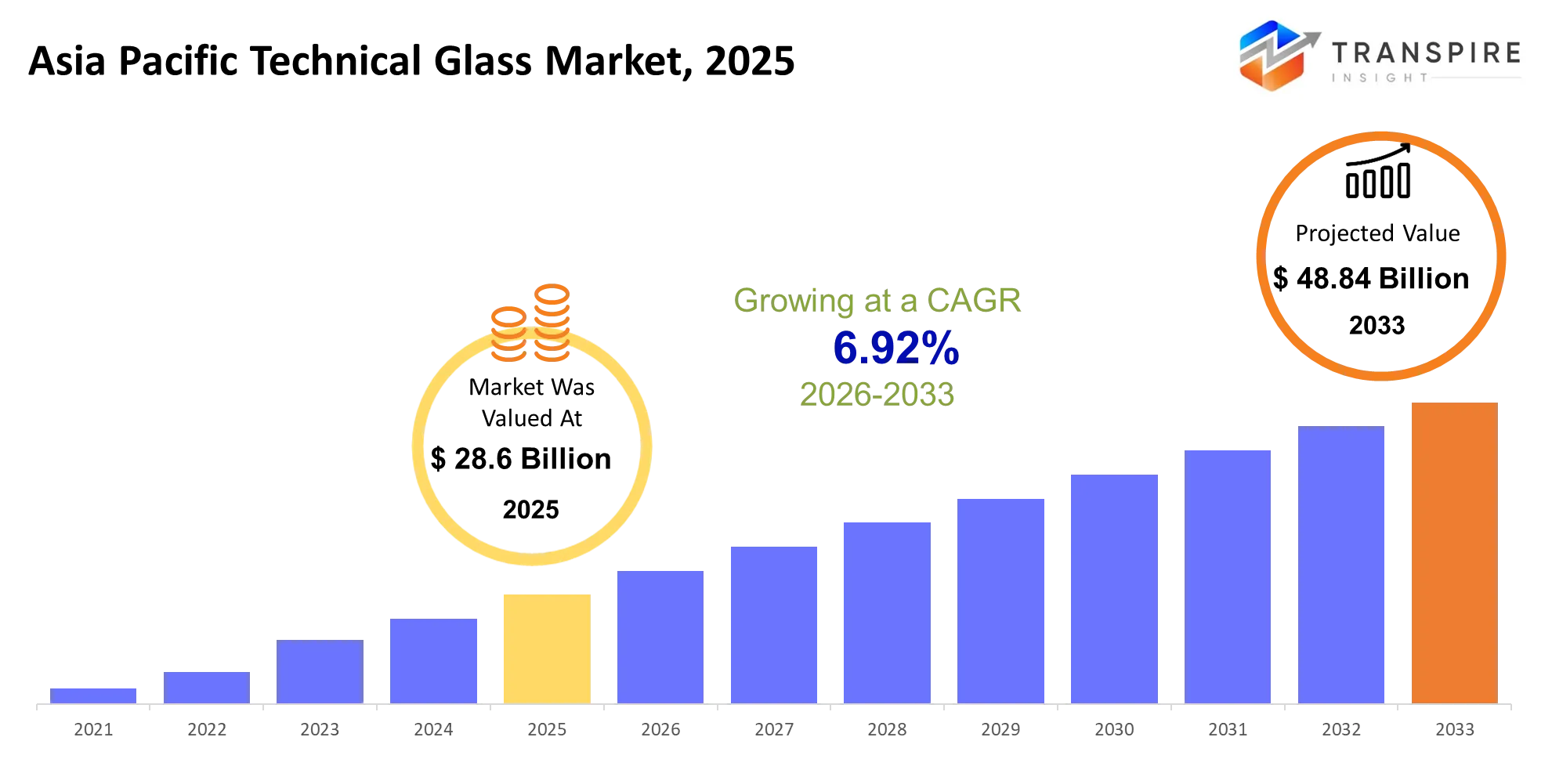
As per Transpire Insight, the Asia Pacific Technical Glass Market size is estimated at USD 28.6 Billion in 2025 and is anticipated to reach USD 48.84 Billion by 2033, growing at a CAGR of 6.92% from 2026 to 2033.
The Asia Pacific Technical Glass Market kinda supports industries that need glass with specialized optical, thermal, electrical and mechanical properties for electronics, automotive systems, medical devices, renewable energy, semiconductors, and advanced manufacturing. Unlike so called conventional glass, technical glass gives more precision performance in really tough industrial conditions where durability, transparency, insulation, and chemical resistance are must haves. Over the last five years, the market kind of shifted toward high performance ultra thin glass, which is mostly pushed by semiconductor expansion, electric vehicle output, and advanced display manufacturing. During the COVID 19 pandemic there were supply chain disruptions, then semiconductor shortages, and that whole thing basically sped up regional investments in localized manufacturing and material security across Asia Pacific. Also as electronics production keeps expanding and governments are prioritizing domestic semiconductor ecosystems, manufacturers are investing in advanced glass processing technologies and they want better yields. This shift overall strengthens production capacity , expands application areas, and keeps creating sustained revenue chances across industrial, healthcare, and consumer electronics sectors.
Asia Pacific Technical Glass Market Size & Forecast:
- Asia Pacific Technical Glass Market Size 2025: USD 28.6 Billion
- Expected Market Value 2033: USD 48.84 Billion
- Forecast CAGR: 6.92%
- Leading region in 2025: China
- Fastest Growing region: India
- Key Profile: SCHOTT AG, Corning, AGC Inc., Nippon Electric Glass, Saint-Gobain, NSG Group, Guardian Glass, Central Glass, Hoya Corporation, Ohara Inc., Swift Glass, Edmund Optics, Jenoptik, Vitro, Xinyi Glass
Key Market Insights
- Regional analysis: China is basically running the Asia Pacific technical glass market, with something like 46% share in 2025, mainly because it has a big electronics and display manufacturing ecosystem.
- India is kind of the quickest mover into 2033, mostly pushed by semiconductor incentives, electronics manufacturing growth, and those domestic production initiatives that just keep getting brought up.
- In the product segment side, Specialty optical glass seems to be out front , around 34% market share in 2025, and it’s carrying precision optics, semiconductor lithography, and medical imaging, pretty consistently. Glass ceramics stays in second place , supported by industrial gear , aerospace parts, and high-temperature engineering use cases as well.
- As for what grows the quickest, Ultra-thin technical glass should show the fastest growth through 2033. The reason is that foldable displays, wearable electronics, and advanced sensors really need lighter materials, like a lot lighter, basically.
- On application insights, Consumer electronics accounts for roughly 38% of total market revenue, largely due to smartphones, tablets, displays, and semiconductor packaging technologies, all together.
- Meanwhile renewable energy is becoming the most rapidly expanding application area because solar photovoltaics and energy storage systems lean more and more on specialized technical glass materials.
- For end-users, Electronics manufacturers are still the biggest group, at around 42% market share, while healthcare equipment manufacturers are the ones expected to expand the most later on.
- Key players basically keep trying to strengthen their positions: SCHOTT AG, Corning, AGC Inc., Nippon Electric Glass, Saint-Gobain, and NSG Group are all working on product innovation, regional manufacturing expansion, strategic collaborations, and also more advanced glass processing technologies.
What are the Key Drivers, Restraints, and Opportunities in the Asia Pacific Technical Glass Market?
The strongest driver of the Asia Pacific Technical Glass Market, in practice is the rapid expansion of semiconductor fabrication plus advanced electronics manufacturing, and also electric vehicle production. Like, government-backed industrial policies such as semiconductor incentive programs in China, India, South Korea, and Japan have sped up investments into fabrication facilities that essentially demand ultra-clean, high performance technical glass. Modern semiconductor equipment, optical systems, and precision sensors really depend on specialized glass with outstanding dimensional stability alongside optical performance. These investments then bump procurement volumes for specialty glass manufacturers, while also keeping long term production contracts in place, and lifting higher value product portfolios too.
The main restraint though is still the capital intensive nature of technical glass manufacturing. Making specialty glass needs advanced melting technology precision forming equipment cleanroom processing, and strict quality control systems. These plants come with serious upfront investments, plus long qualification cycles before they can supply industries like aerospace healthcare and semiconductor manufacturing. Because of that structural setup it becomes harder for new market entrants, capacity expansion slows, and commercialization of newer products gets delayed, which in turn constrains industry revenue growth overall.
A notable future opportunity is ultra thin glass aimed at foldable electronics, augmented reality devices, advanced sensors, and next generation automotive displays. Regional investments in flexible electronics manufacturing together with smart mobility technologies are opening up new commercial lanes for engineered glass products.
What Has the Impact of Artificial Intelligence Been on the Asia Pacific Technical Glass Market?
Artificial intelligence is kinda transforming technical glass manufacturing, by boosting production precision, quality assurance, and overall operational efficiency across modern industrial setups. In many places, machine vision systems powered by AI do the inspecting, including microscopic surface defects, coating weirdness, and dimensional shifts. They manage this at production speeds that often beat manual checks, and they also help cut down material waste. Meanwhile, machine learning algorithms are used to fine tune furnace heat levels, chemical strengthening sequences, and coating settings. They do it by continuously reading production data, which supports steadier output and tends to reduce energy consumption too.
Then there’s predictive maintenance, which is becoming kinda big. AI models track things like equipment vibration, thermal state, furnace behavior, and what the sensors output. From that, they forecast maintenance needs, before failures show up. So manufacturers tend to see higher equipment uptime, smaller maintenance spending, fewer unexpected production stoppages, and better manufacturing yields. On top of that, digital twins let engineers test process changes in a simulated space before going live. This reduces operational risk, and it can also speed up product development, without rushing blind.
Even so, AI adoption is still held back. The usual issues show up: high implementation costs, fragmented older production systems, and limited access to standardized manufacturing datasets across different facilities. Many specialty glass makers are still running older equipment, and that stuff needs costly modernization before advanced AI platforms can deliver consistent improvements. Still, as digital infrastructure expands across Asia Pacific, broader AI integration is expected to ramp up manufacturing efficiency, and strengthen competitiveness across the technical glass value chain.
Key Market Trends
- Since 2022 semiconductor investments across China, India, Japan and South Korea have gone up quite a bit , and with that came more procurement of precision optical, and kind of ultra-clean technical glass, yeah.
- Ultra thin chemically strengthened glass is now getting broader commercial uptake because foldable smartphones are more common, plus wearable devices and flexible display technologies are pushing demand too.
- Manufacturers are also automating quality checks more often, using AI vision systems, so they can lower defect rates while keeping production consistency more stable.
- At the same time regional manufacturing expansion has sped up. Companies seem to reduce dependence on overseas supply chains after pandemic disruptions, even when it’s not always smooth.
- Solar photovoltaic makers have been buying more specialized glass as well. This includes material with stronger light transmission and better weather resistance, which supports higher module efficiency.
- In automotive supply chains technical glass is being woven into digital cockpits, HUD displays, LiDAR systems and advanced driver assistance tech, and it’s becoming more integrated than before.
- SCHOTT AG, Corning, AGC Inc., and Nippon Electric Glass keep putting more into R&D, mostly aimed at high performance optical materials, and also semiconductor uses.
- Healthcare equipment producers have increased use of precision glass parts for diagnostic imaging, laboratory automation , and minimally invasive medical technologies.
- Sustainability programs have nudged factories to improve furnace efficiency, raise the use of recycled raw materials , and trim production emissions.
- Meanwhile regional governments keep backing domestic semiconductor ecosystems, and that means continued long-term commitments to specialty materials, along with advanced industrial glass manufacturing.
Asia Pacific Technical Glass Market Segmentation
By Product Type:
Technical glass products kinda meet different industrial needs depending on things like thermal stability strength optical output, and chemical resistance. Borosilicate glass actually takes the biggest share because it has excellent heat and chemical resistance, so it fits well for laboratory devices, pharmaceutical production , and also industrial processing. Quartz glass is the go to when the work demands very high temperature tolerance plus strong light transmission, especially in semiconductor manufacturing and precision optics. Aluminosilicate glass keeps growing across electronics and automotive, mainly because the mechanical strength is high, but also because it behaves well under stress. Meanwhile glass ceramics optical glass, specialty glass and the other variants support more advanced engineering tasks with very specific performance traits, you know.
Glass ceramics deliver great thermal shock resistance for tough industrial conditions and high temperature equipment too. Optical glass stays necessary for lenses, imaging systems, and scientific instruments, where accuracy is not just nice to have it directly shapes the outcome. Specialty glass covers smaller, more niche uses like advanced coatings protective displays, and high performance industrial components. The “others” group just handles tailored requirements that are built for particular manufacturing processes. And this is the key, ongoing material innovation helps makers boost durability, raise efficiency and improve product reliability across several industries, all in one go.
By Application:
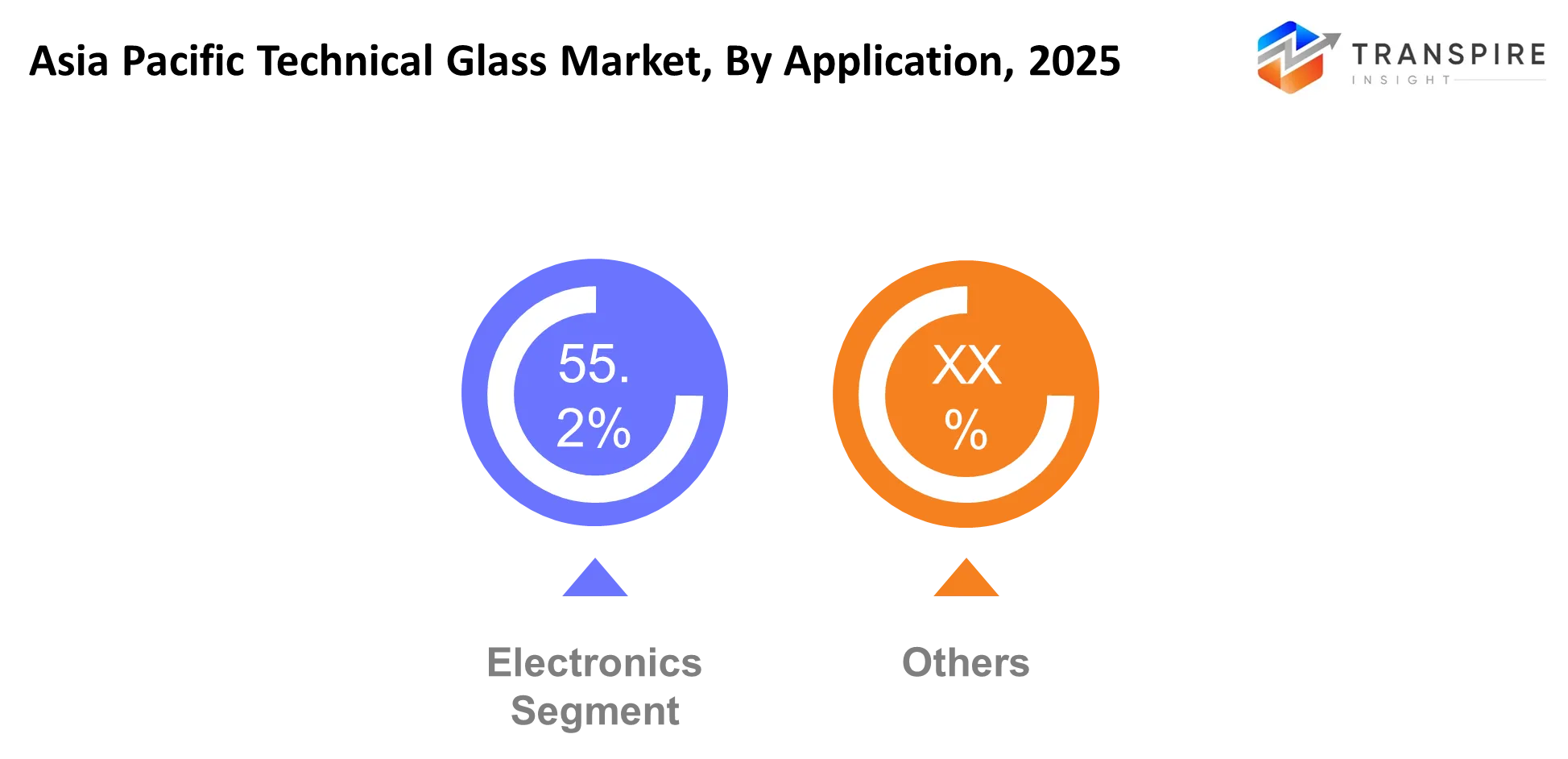
Application areas keep getting more diverse, like advanced industries need materials that can handle very demanding working conditions. Electronics are still the main use case, since semiconductors, display panels, sensors, and all kinds of electronic components really depend on high purity technical glass, for dependable operation. Automotive makers also bring in more advanced glass for lighting assemblies, sensors, displays and electric vehicle technologies, where durability as well as thermal resistance stays important.
In the healthcare field there is also a real push, because diagnostic setups, pharmaceutical processing, and medical devices call for chemically stable and contamination resistant materials. That sort of stability isn’t optional, it’s basically the point.Laboratory equipment still depends on technical glass for analytical tools, reaction vessels and testing rigs, and these pieces work under extreme temperatures or with aggressive chemicals. For aerospace, lightweight but tough glass is required for optical assemblies, cockpit displays, and protective components that face tough environments every day. In industrial machinery, technical glass shows up in inspection systems, process equipment, and in high temperature operations, while the others category supports extra industrial and scientific uses. This overall spread of applications, tends to improve long term market steadiness across multiple sectors.
By End User:
End-user industries buy technical glass based on whatever production needs, quality criteria, and product performance expectations they have. Electronics manufacturers take the largest portion, because semiconductor fabrication, display production, and electronic component manufacturing all need materials that are unusually pure and also keep their dimensions in check. Medical device companies lean on precision glass for diagnostic systems, imaging gear, and laboratory instruments , which have to keep working reliably even when they meet very strict regulatory standards. Automotive OEMs are still ramping up their technical glass use, since advanced driver assistance systems and electric vehicle technologies call for tough optical and electronic parts.
Research laboratories stay a key buyer too, since scientific trials, chemical analysis, and product development depend on high-performance laboratory glassware and precision instruments. Industrial manufacturers also put technical glass into processing units, monitoring systems, and the day-to-day production settings where heat resistance and corrosion resistance boost overall dependability. The others group covers aerospace companies, defense organizations, and niche engineering firms that ask for tailored technical glass products. Overall, varied end-user demand pushes ongoing product innovation, plus constant improvements in manufacturing.
By Manufacturing Process:
Manufacturing processes kind of decide the physical properties, dimensional accuracy , and whether a technical glass product actually fits its intended application. Float glass is still the main production approach , because it delivers fairly consistent thickness, smooth surfaces, and it also scales up efficiently for a lot of industrial uses. Rolled glass, on the other hand, often gives textured or patterned faces, which works well for special industrial tasks where extra functional traits are needed. Drawn glass is the choice when the requirement is thinner profiles, plus very good optical quality, for precision electronic gear and scientific instruments.
Molded glass lets manufacturers create more intricate forms that are not so easily made using standard flat glass techniques. With precision molding, the whole production flow can be more efficient, and material waste tends to drop when customized industrial parts are involved. The “others” group basically covers niche manufacturing methods that have been developed for high-performance glass products, especially when they need specific structural or optical characteristics. Ongoing upgrades in manufacturing tech help producers keep tighter quality control and also improve overall production efficiency.
By Distribution Channel:
Distribution channels, yeah they show the different procurement strategies used across industrial supply chains. Direct sales take the biggest share, mostly because large manufacturers often buy technical glass straight from the producers, so they can lock in product quality, get technical support, and secure long-run supply agreements too. OEM supply still counts as a key route, since original equipment manufacturers need customized glass components that match very precise engineering specifications. And then glass distributors cover the customers who want more adaptable purchasing options, plus easier access to multiple product categories from different manufacturers.
Also, distributors tend to do inventory management along with technical guidance, and they usually manage faster delivery, for small and medium-sized industrial customers, no surprise there. The others category includes online industrial procurement platforms, specialized engineering suppliers, and regional distribution partners, these types of players expand how easy it is to reach the market. Using multiple distribution channels improves product availability while letting manufacturers touch different customer groups with their own purchasing needs. Strong supply chain relationships keep supporting efficient product delivery across both domestic and international markets.
What are the Key Use Cases Driving the Asia Pacific Technical Glass Market?
Consumer electronics kind of are the biggest outlet for technical glass since smartphones, tablets, displays, semiconductor gear, and wearable devices they really need high optical clarity ,solid mechanical strength, and thermal stability ,all at once. And because manufacturing has to be so precise ,specialized glass ends up being kind of necessary, for steady product behavior and a long service life ,not just a short term run.
Healthcare equipment plus automotive systems keep adding more glass every year, driven by diagnostic imaging systems ,lab instrumentation ,head-up displays, camera modules ,LiDAR sensors, and the newer advanced driver assistance setups. At the same time renewable energy hardware also relies on engineered glass to help solar module efficiency, and to keep up environmental durability.
There are also newer uses coming into view, like foldable electronic displays ,augmented reality devices ,smart manufacturing sensors, and upgraded semiconductor packaging. With continued investment in local semiconductor fabrication and next-generation electronics production across Asia Pacific, there should be more commercial chances for high-performance engineered glass during the forecast period.
|
Report Metrics |
Details |
|
Market size value in 2025 |
USD 28.6 Billion |
|
Market size value in 2026 |
USD 30.58 Billion |
|
Revenue forecast in 2033 |
USD 48.84 Billion |
|
Growth rate |
CAGR of 6.92% from 2026 to 2033 |
|
Base year |
2025 |
|
Historical data |
2021 - 2024 |
|
Forecast period |
2026 - 2033 |
|
Report coverage |
Revenue forecast, competitive landscape, growth factors, and trends |
|
Regional scope |
Asia Pacific (India, China, Japan, Australia, South Korea, Rest of Asia Pacific) |
|
Key company profiled |
SCHOTT AG, Corning, AGC Inc., Nippon Electric Glass, Saint-Gobain, NSG Group, Guardian Glass, Central Glass, Hoya Corporation, Ohara Inc., Swift Glass, Edmund Optics, Jenoptik, Vitro, Xinyi Glass |
|
Customization scope |
Free report customization (country, regional & segment scope). Avail customized purchase options to meet your exact research needs. |
|
Report Segmentation |
By Product Type (Borosilicate Glass, Quartz Glass, Aluminosilicate Glass, Glass Ceramics, Optical Glass, Specialty Glass, Others); By Application (Electronics, Automotive, Healthcare, Laboratory Equipment, Aerospace, Industrial Machinery, Others); By End User (Electronics Manufacturers, Medical Device Companies, Automotive OEMs, Research Laboratories, Industrial Manufacturers, Others); By Manufacturing Process (Float Glass, Rolled Glass, Drawn Glass, Molded Glass, Others); By Distribution Channel (Direct Sales, OEM Supply, Glass Distributors, Others) |
Which Regions are Driving the Asia Pacific Technical Glass Market Growth?
China is leading the Asia Pacific Technical Glass Market ,sort of, because the country stitches together the region’s biggest electronics manufacturing base with deep semiconductor spending and a fairly mature supply network for specialty materials. At the same time, national industrial policies aimed at semiconductor self reliance, advanced display fabrication, and electric vehicle output are still pushing forward… so demand for high-performance technical glass keeps rising. There are also strong research organizations, grouped manufacturing hubs, and fairly efficient logistics, which lets suppliers cut turnaround times and keep delivery dependability higher, even when things get busy. With this kind of established industrial ecosystem the companies can keep innovating product designs while also reinforcing China as the largest regional revenue contributor.
Japan stays second, though the momentum feels different, more like it leans on technological precision rather than sheer production volume. Years of commitment to optical engineering, medical technology, industrial automation, and premium electronics creates a steady pull for technical glass with higher specifications. Strict shop-floor expectations and steady research and development spending help suppliers choose specialized uses—more value oriented—rather than chasing commodity style production. That more balanced industrial setup translates into consistent revenue flow and helps the region handle swings in global manufacturing activity with more resilience.
India, however, is showing the fastest growth, where government backed semiconductor initiatives, electronics manufacturing support, and industrial infrastructure investments are reshaping domestic production abilities, quite quickly, and in a noticeable way.
Who are the Key Players in the Asia Pacific Technical Glass Market and How Do They Compete?
Competition is still kinda moderately consolidated since advanced manufacturing know how, proprietary production pathways, and tight quality requirements make entry barriers pretty stubborn. Firms end up competing mainly via material innovation, optical performance, manufacturing exactness, and those long-term ties with electronics, healthcare, and semiconductor makers. Meanwhile, the established suppliers keep defending market share by keeping their research budgets going, but some selected regional manufacturers are also ramping up production capacity, to meet the rising domestic demand , somehow.
SCHOTT AG tends to concentrate on specialty glass for healthcare, semiconductor production, and precision optics, with differentiation coming from advanced glass compositions meant for harsh industrial settings. Corning, on the other hand, leans into ultra-thin as well as chemically strengthened glass technologies for consumer electronics, automotive displays, and next-generation mobile devices, and they keep expanding manufacturing partnerships across Asia. AGC Inc. brings together large-scale manufacturing capability plus advanced coating technologies, to lift optical performance, thermal resilience, and overall product durability for industrial and electronic uses.
Nippon Electric Glass specializes in high-performance display glass, electronic materials, and glass substrates used in semiconductor packaging, and they benefit from close cooperation with Japanese electronics companies. Saint-Gobain improves competitiveness through engineered material solutions, plus regional manufacturing growth that supports industrial, healthcare, and construction customers.
Company List
- SCHOTT AG
- Corning
- AGC Inc.
- Nippon Electric Glass
- Saint-Gobain
- NSG Group
- Guardian Glass
- Central Glass
- Hoya Corporation
- Ohara Inc.
- Swift Glass
- Edmund Optics
- Jenoptik
- Vitro
- Xinyi Glass
Recent Development News
- In April 2026, SCHOTT AG launched an expanded portfolio of specialty glass solutions for semiconductor manufacturing. The new products were designed to support advanced chip fabrication processes and strengthen supply capabilities for next-generation semiconductor applications.https://www.schott.com (SCHOTT AG)
- In February 2026, AGC Inc. announced an investment to expand specialty glass production capacity for electronics and automotive applications in Asia. The investment will improve regional supply capability and support growing demand for high-performance glass materials.https://www.agc.com (AGC Inc.)
- In October 2025, Corning Incorporated introduced new Gorilla Glass Ceramic technology for premium mobile devices. The launch enhanced durability and strengthened Corning's position in advanced protective glass for consumer electronics.https://www.corning.com (Corning Incorporated)
What Strategic Insights Define the Future of the Asia Pacific Technical Glass Market?
The Asia Pacific Technical Glass Market seems to be moving towards more highly specialized, application specific materials , that actually help with semiconductor fabrication, advanced medical equipment, electric vehicles, and also those intelligent electronic devices. I mean this shift is backed by regional industrial policies that push domestic manufacturing , while at the same time there is growing spending in precision engineering , and of course in advanced electronics. There’s also a less obvious concern, like the fact that critical raw material processing plus specialty manufacturing capacity ends up being concentrated in a handful of countries. That leaves supply chains somewhat exposed, especially if trade restrictions show up or geopolitics suddenly disrupts things.
At the same time, engineered ultra-thin glass for foldable displays, augmented reality hardware, and more advanced optical sensing looks like it could become a major growth lane , as real commercial adoption increases. Firms that diversify their raw material sourcing, set up regional production partnerships, and speed up investment in next generation glass technologies should be the ones that lock in long-term agreements more reliably. They also tend to improve their competitive edge across the 2026–2033 period overall.
Asia Pacific Technical Glass Market Report Segmentation
By Product Type
- Borosilicate Glass
- Quartz Glass
- Aluminosilicate Glass
- Glass Ceramics
- Optical Glass
- Specialty Glass
- Others
By Application
- Electronics
- Automotive
- Healthcare
- Laboratory Equipment
- Aerospace
- Industrial Machinery
- Others
By End User
- Electronics Manufacturers
- Medical Device Companies
- Automotive OEMs
- Research Laboratories
- Industrial Manufacturers
- Others
By Manufacturing Process
- Float Glass
- Rolled Glass
- Drawn Glass
- Molded Glass
- Others
By Distribution Channel
- Direct Sales
- OEM Supply
- Glass Distributors
- Others
Frequently Asked Questions
Find quick answers to common questions.
The expected Asia Pacific Technical Glass Market size for the market will be USD 48.84 Billion in 2033.
Key segments for the Asia Pacific Technical Glass Market are By Product Type (Borosilicate Glass, Quartz Glass, Aluminosilicate Glass, Glass Ceramics, Optical Glass, Specialty Glass, Others); By Application (Electronics, Automotive, Healthcare, Laboratory Equipment, Aerospace, Industrial Machinery, Others); By End User (Electronics Manufacturers, Medical Device Companies, Automotive OEMs, Research Laboratories, Industrial Manufacturers, Others); By Manufacturing Process (Float Glass, Rolled Glass, Drawn Glass, Molded Glass, Others); By Distribution Channel (Direct Sales, OEM Supply, Glass Distributors, Others).
Major Asia Pacific Technical Glass Market players are SCHOTT AG, Corning, AGC Inc., Nippon Electric Glass, Saint-Gobain, NSG Group, Guardian Glass, Central Glass, Hoya Corporation, Ohara Inc., Swift Glass, Edmund Optics, Jenoptik, Vitro, Xinyi Glass.
The Asia Pacific Technical Glass Market size is USD 28.6 Billion in 2025.
The Asia Pacific Technical Glass Market CAGR is 6.92% from 2026 to 2033.
- SCHOTT AG
- Corning
- AGC Inc.
- Nippon Electric Glass
- Saint-Gobain
- NSG Group
- Guardian Glass
- Central Glass
- Hoya Corporation
- Ohara Inc.
- Swift Glass
- Edmund Optics
- Jenoptik
- Vitro
- Xinyi Glass
About the Authors

Avinash Kumar
I’m Avinash Kumar, a Senior Research Analyst at Transpire Insight, with expertise in the Electronics and Semiconductor and Energy & Power industry. My work focuses on analyzing emerging technologies, market trends, industry developments, and innovation across these sectors. I specialize in transforming complex technical and market insights into clear, research-backed content that helps professionals, businesses, and decision-makers stay informed. Through continuous industry research and data-driven analysis, I strive to deliver accurate, reliable, and practical perspectives on the latest advancements shaping the semiconductor and energy landscape.

Chakradhar Khansole
Chakradhar serves as the Research Director at Transpire Insight, bringing over 8 years of experience in technology, innovation, and strategic market intelligence. He specializes in transforming complex market data into actionable business insights that enable organizations to make informed, growth-oriented decisions. Recognized for his strategic vision and analytical expertise, Chakradhar leads high-impact research initiatives, delivering comprehensive market assessments, competitive intelligence, and forward-looking industry analysis.
Recently Published Reports
-
Apr 2026
Fiber Optic Faceplates Market
Fiber Optic Faceplates Market Size, Share & Analysis Report By Type (< 300 mm2, 300-350 mm2, and > 350 mm2, By Application (Night Vision, Holographic Imaging, Medical, and Others), and Geography (North America, Europe, Asia-Pacific, Middle East and Africa, South and Central America), 2021 - 2031
-
Apr 2026
High Temperature Superconductors Market
High Temperature Superconductors Market Size, Share & Analysis Report By Type (1G HTS, and 2G HTS), By Application (Power Cable, Fault Current Limiter, and Transformer), and Geography (North America, Europe, Asia-Pacific, Middle East and Africa, South and Central America), 2021 - 2031
-
Apr 2026
Industrial Plugs and Socket Market
Industrial Plugs and Socket Market Size, Share & Analysis Report By Type (Industrial Plugs, Industrial Sockets), By Current (Up to 32 A, 32 to 125 A, Above 125 A), By Protection (Dustproof and Splash Proof, Waterproof, Explosion Proof), By End User (Heavy Industries, Oil and Gas, Chemicals and Pharmaceuticals, Power Generation, Others), and Geography (North America, Europe, Asia-Pacific, Middle East and Africa, South and Central America), 2021 - 2031
-
Apr 2026
InGaAs Avalanche Photodiodes Market
InGaAs Avalanche Photodiodes Market Size, Share & Analysis Report By Type (1100 - 1700 nm, and 1000 - 1600 nm), By Application (Missile Warning System, Muzzle Flash Detection, Wafer Defect Inspection, Laser Rangefinders, and Others), and Geography (North America, Europe, Asia-Pacific, Middle East and Africa, South and Central America), 2021 - 2031