
Asia Pacific Tail Spend Management Solutions Market Size & Forecast:
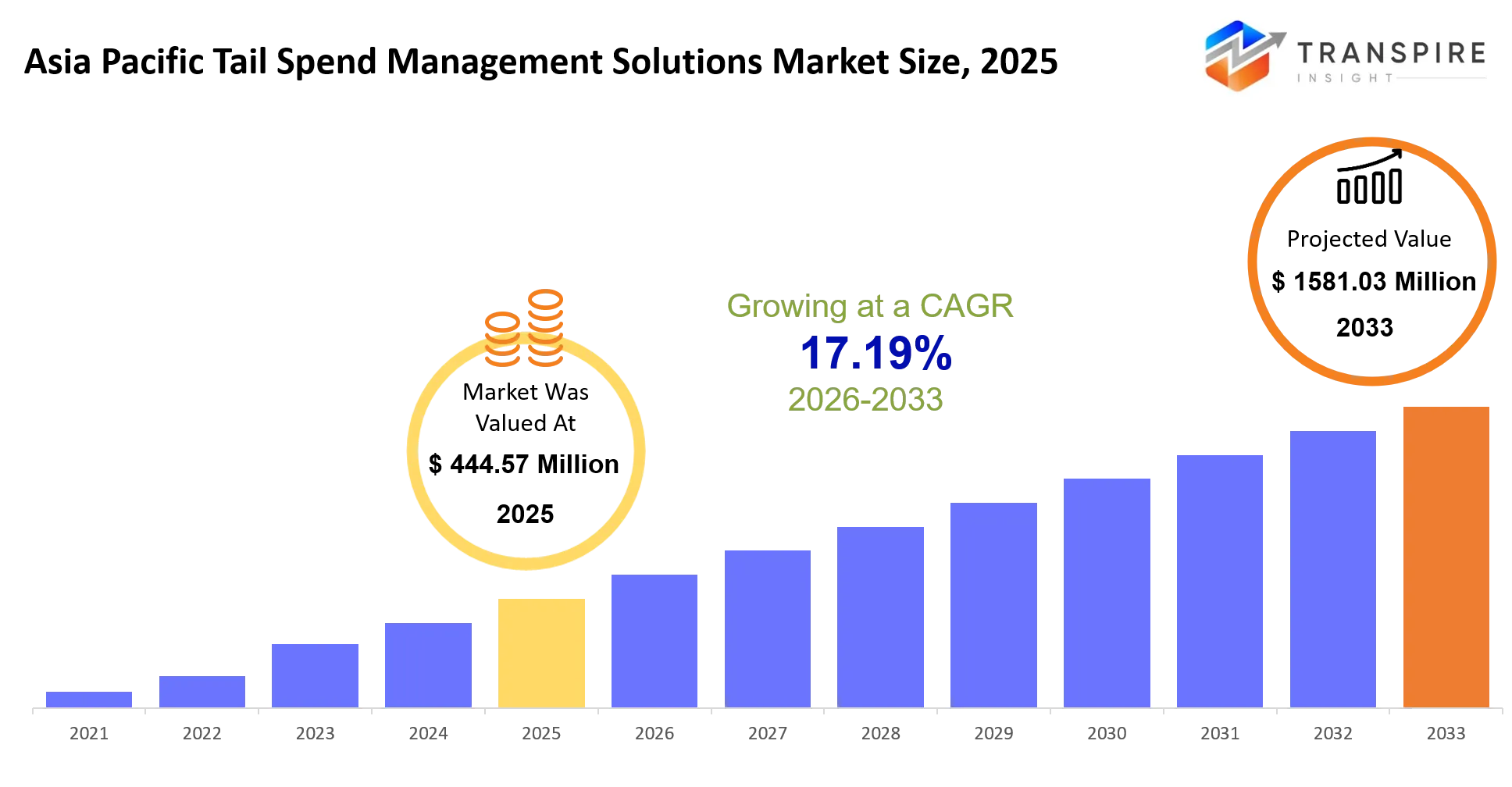
- Asia Pacific Tail Spend Management Solutions Market Size 2025: USD 444.57 Million
- Asia Pacific Tail Spend Management Solutions Market Size 2033: USD 1581.03 Million
- Asia Pacific Tail Spend Management Solutions Market CAGR: 17.19%
- Asia Pacific Tail Spend Management Solutions Market Segments: By Component (Software, Services, Consulting, Analytics, Supplier Management Tools, Others); By Deployment (Cloud, On-Premise, Hybrid, Others); By Enterprise Size (Large Enterprises, SMEs, Others); By End User (Manufacturing, BFSI, Healthcare, Retail, IT & Telecom, Government, Others)
Asia Pacific Tail Spend Management Solutions Market Summary
The Asia Pacific Tail Spend Management Solutions Market was valued at USD 444.57 Million in 2025. It is forecast to reach USD 1581.03 Million by 2033. That is a CAGR of 17.19% over the period.
Asia Pacific Tail Spend Management Solutions help companies get a grip on and optimize all that big, low value high frequency purchases that usually slip outside strategic procurement, processes. In manufacturing, logistics, energy, and industrial work, these buys can involve thousands of suppliers and transactions, and then suddenly you get hidden costs, compliance holes , and supplier relationships that feel pretty fragmented. When visibility and automation get brought into this spend area, procurement teams typically see better efficiency, and less “ operational leakage ”, which is often hard to notice at first.
Over the last three to five years , the market vibe changed a bit , from manual spend tracking and decentralized buying, to AI enabled procurement platforms that offer real time analytics, supplier consolidation, and automated sourcing workflows. Supply chain disruptions from the COVID-19 pandemic showed weaknesses in unmanaged procurement activities, and basically pushed enterprises to rethink purchasing controls. Now procurement teams are chasing more transparency, contract compliance, and cost discipline, so tail spend management solutions are being adopted faster than before. That shift is also opening up new revenue pockets for software vendors and procurement service providers, especially those who can prove savings and supplier governance at scale with actual numbers.
Key Market Insights
- The Asia Pacific Tail Spend Management Solutions Market is led by China, which will have 32 percent of the market by 2025. This is because China has a lot of factories and is using digital technology for buying and selling things.
- India is growing fast and will keep growing until 2032. This is happening because many companies in India are using technology and modernizing the way they buy things. Many small and medium sized businesses in India are also starting to use these ways of buying and selling.
- Japan and Australia also have a share of the market. This is because they have been doing things this way for a time and are very good at managing the people they buy from.
- Most companies are using software to manage their spending, which's about 58 percent of the market in 2025. They want to be able to see how much they are spending and be able to make decisions based on that information. They also want to automate some of the work.
- Some companies are also using services to help them manage their spending. These services help them make things simpler and deal with people.
- The Asia Pacific Tail Spend Management Solutions Market is also using intelligence to analyze spending. This is growing fast and will keep growing until 2032. It helps companies predict what they will need to buy and suggests people they can buy from.
- Most companies, 45 percent are using these systems to manage their buying and selling. They want to be able to control everything from one place.
- Companies are also using these systems to make sure the people they buy from are doing a job and following the rules. This is growing fast
- Some companies are also using software to make their contracts better. They want to save money and make sure the people they buy from are doing what they are supposed to do.
- Big companies have the share of the Asia Pacific Tail Spend Management Solutions Market more than 60 percent. This is because they have a lot of relationships, with the people they buy from and do a lot of business.
What are the Key Drivers, Restraints, and Opportunities in the Asia Pacific Tail Spend Management Solutions Market?
The main force pushing the Asia Pacific Tail Spend Management Solutions Market forward is kinda the move toward digital purchasing plus stronger spend visibility across big enterprises. A lot of organizations, during the recent supply chain disruptions, noticed that thousands of small low-value buys were slipping through outside the approved procurement paths. That led to cost leakage and also supplier risk , not to mention the general mess that follows. So then, these teams started putting money into AI enabled procurement tools that can spot spending patterns, group and rationalize suppliers, and help automate sourcing decisions. And once procurement groups actually see measurable savings by taking control of those scattered purchases, the adoption keeps climbing. Being able to turn formerly unmanaged spending into negotiated and compliant transactions really helps procurement efficiency, and it also supports ongoing software and service revenues.
The biggest obstacle though is still the fractured procurement setup many enterprises in the region are stuck with. Large orgs often run multiple ERP systems, separate supplier databases, and different purchasing workflows that they collected over years of expansion. To integrate tail spend management platforms with all that legacy stuff takes serious investment, a rethink of processes, and a lot of stakeholder alignment. Since those structural complications cant be fixed overnight, the implementation timelines get stretched, and procurement transformation programs usually get rolled out in stages across several years. That slows down overall market penetration and it also limits how quickly revenue can be realized in the near term.
A big growth opening sits in the take up of generative AI mixed with predictive procurement analytics, kinda like it’s not just one thing but two in tandem. Countries like India and Singapore are moving fast on enterprise technology spending, so the conditions become pretty ripe for smarter procurement solutions, yes. With advanced AI tools, teams can automatically spot savings opportunities, suggest new suppliers, and forecast purchasing risks too—so procurement groups can handle tail spend with more accuracy, and at larger scale.
What Has the Impact of Artificial Intelligence Been on the Asia Pacific Tail Spend Management Solutions Market?
Artificial intelligence and advanced digital technologies are slowly reshaping how tail spend management works, because they automate procurement tasks that used to be done via manual reviews and scattered purchasing workflows, honestly it was kind of messy. AI-powered procurement platforms can, for example, automatically sort low-value transactions, spot maverick spending, route the purchase requests to approved suppliers, and then enforce compliance rules across thousands of separate buys. As a result procurement teams end up with less admin busywork, and they can oversee larger supplier rosters more efficiently, than before.
At the same time machine learning is being used more often to forecast spending patterns , to discover ways to save costs, and to catch procurement risks early, before they spill into operations. Those models look at historical purchasing records, supplier performance indicators, and contract usage, then they can estimate future spending needs, suggest supplier consolidation approaches, and flag purchases that seem likely to drift outside the negotiated agreements. With that kind of prediction, organizations get better sourcing decisions and their budget numbers stay much closer to reality.
The operational impact is pretty significant, in practice. Enterprises that deploy AI-enabled spend analytics often see quicker procurement cycle times, better contract compliance, and clear reductions in unmanaged spending. Automated supplier suggestions and real-time spend visibility also help tighten cost control, and they improve procurement efficiency, all at once.
Still, one key limitation hangs around, integration complexity. Lots of organizations across Asia Pacific run multiple ERP systems, procurement platforms, and supplier databases at the same time. So, connecting AI solutions to these fragmented setups typically means serious investment, data cleansing, and process standardization it self, which can easily delay implementation, and it also can reduce the speed of value realization.
Key Market Trends
- Since 2021 companies have started to use intelligence to track how they spend money instead of just using spreadsheets.
- This change happened because problems in the supply chain showed that the old way of buying things was not very good.
- So companies decided to have one team handle all the purchases that different departments used to make on their own.
- The people in charge of buying things for the company are now trying to work with suppliers so they can negotiate better prices.
- After 2022 companies started to use cloud-based systems to buy things because they are faster and cheaper than the systems.
- Now computers can automatically find times when people are spending money in ways that are not allowed which helps the company follow its rules.
- Some big companies like SAP Ariba, Coupa, GEP and Zycus have added artificial intelligence tools to help them buy things smarter between 2023 and 2025.
- Companies are now connecting all their buying systems together so they can see everything they are spending money on.
- The teams that buy things for the company are not just trying to save money they are also trying to make sure the suppliers are good and that the company is following all the rules.
- Small and medium-sized businesses are starting to use software to buy things and they like it because it is cheap and easy to use.
- When companies are choosing who to buy from they are now looking at how good the supplier's at predicting what will happen which shows that they want to be smart, about how they buy things.
Asia Pacific Tail Spend Management Solutions Market Segmentation
By Component:
Software solutions sort of hold a key place in procurement transformation because these software platforms give visibility into low-value purchases that usually slip out of structured sourcing programs. Then, advanced analytics, workflow automation, supplier monitoring, and spend classification tools really help organizations spot cost leakage and push purchasing discipline, a bit more consistently. Also there’s a continued push on artificial intelligence and machine learning which has made the software capabilities stronger. In practice procurement decisions get made faster and more data-informed.
Services also matter a lot for organizations that need to put these procurement programs in place, run them, and keep improving them. Stuff like consulting, systems integration, training, and managed procurement support helps businesses get around day-to-day operational issues during rollout. And since supplier networks keep getting more complex , enterprises are more and more interested in outside help for process refinement, and for building long-term value.
By Deployment:
Cloud deployment has been turning into the go-to option for a lot of organizations because it feels more flexible, more scalable, and honestly it also reduces the infrastructure heavy lifting. With cloud platforms, procurement teams can pull spending data , view supplier information, and manage purchasing workflows from several places, all inside one kind of unified environment. The faster implementation timelines, plus subscription based pricing, have also made cloud adoption feel even easier across many sectors.
On-premise deployment still pulls in organizations, especially those with strict data governance rules ,and strong internal control needs. Bigger enterprises often choose on-premise setups, mainly when procurement data must stay inside the current corporate infrastructure. There’s also a lot of customization support there which helps when operational requirements are complicated, or when industry specific procurement practices need deeper tweaks.
Hybrid deployment is getting more attention too, simply because it mixes the control of on-premise systems with the flexibility we usually associate with cloud technology. A lot of organizations lean on hybrid models so they can move through gradual digital transformation while keeping their existing procurement investments. This style tends to cut down migration risks, and it also helps maintain business continuity during technology upgrades, even when the change is not 100% smooth at first.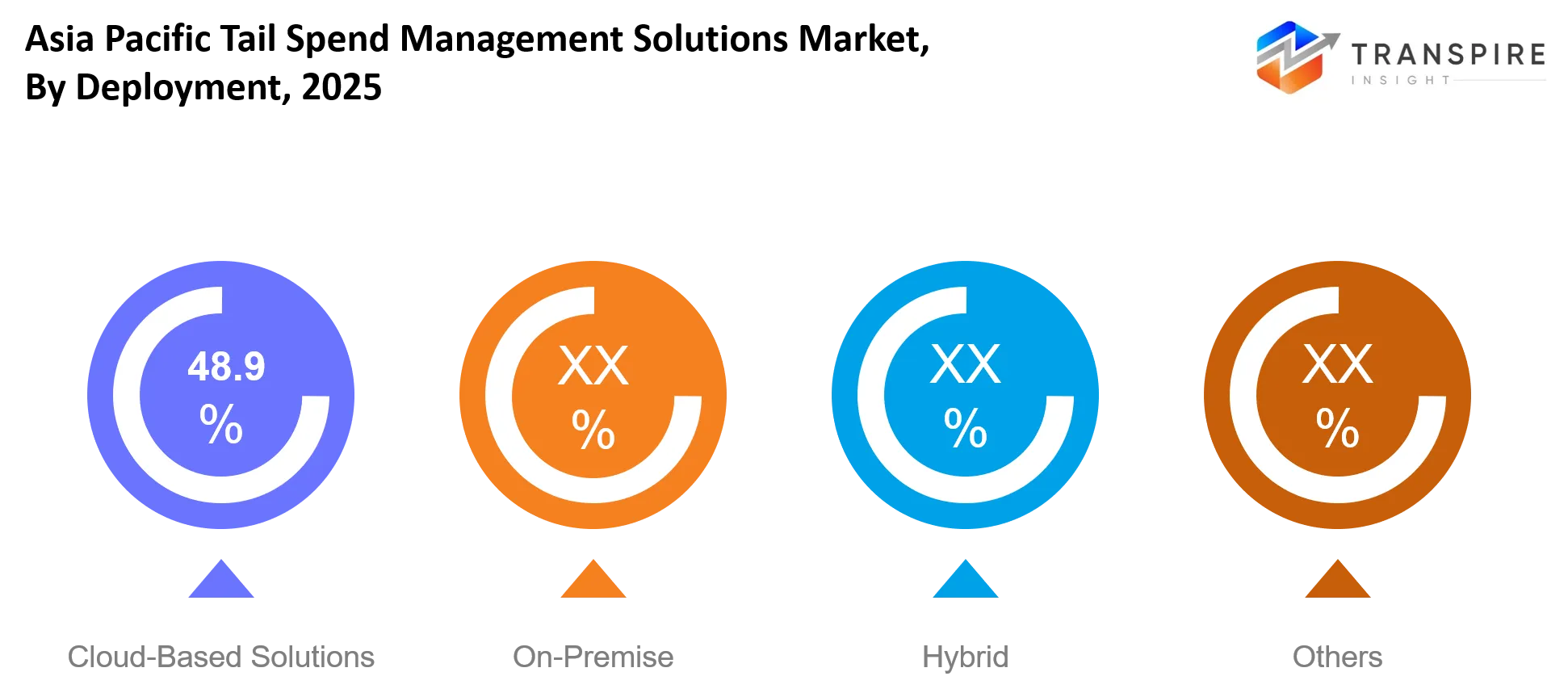
By Enterprise Size:
Big corporations, like the leading user group, seem to stand out because of huge supplier ecosystems, plus the transaction numbers are just massive. You get thousands of smaller buys, across different departments, and that honestly creates a real chance for spend visibility and cost optimization , even when the purchases are kinda “low value.” With more advanced procurement technologies, these larger players can standardize purchasing routines and also reinforce supplier governance a lot.
Meanwhile, small and medium-sized enterprises are also moving in—more and more—since digital procurement solutions feel more accessible now , and they’re often cost-effective too. Cloud-based platforms have lowered the entry barriers , so these more sophisticated procurement tools can be used without large capital spending. When a business gains better visibility into purchasing activities, it tends to tighten up budgeting accuracy and improves supplier management practices as well.
By End User:
Manufacturing still stays a big end user segment, because production facilities tend to need frequent buys of those indirect materials, upkeep supplies and operational services. Procurement optimization, like in a practical way, helps manufacturers cut down supplier fragmentation and then boost purchasing efficiency, kind of across the board. With better cost control they usually get stronger operational performance and profitability across production networks, not just one site.
Retail and consumer goods organizations are also using procurement technologies to handle a spread of supplier relationships and a lot of high purchasing activity. When spend is managed centrally, it improves compliance with procurement policies, and it can also help control those indirect costs that quietly add up. Better supplier coordination, in turn, supports inventory planning plus day to day operational efficiency, which matters more than people think.
Healthcare organizations increasingly adopt procurement solutions for managing spending across medical supplies, equipment, facility services, and the administrative purchases too. With improved purchasing visibility, healthcare providers can keep budget control while still meeting operational requirements. Regulatory compliance and supplier accountability remain key, they keep driving adoption decisions even when teams are busy.
IT and telecom firms depend on procurement platforms, to wrangle that messy supplier ecosystem and all the tech related purchasing needs. With automated workflows, buying decisions move faster and contract compliance gets better in practice. When procurement is more data driven organizations can keep a tighter grip on costs, yet still fund ongoing digital infrastructure.
In other fields, like logistics, energy, financial services, and professional services, teams are still leaning into procurement management solutions too , because they help day to day operations run smoother. People are putting more attention on supplier performance, spending transparency, and compliance, so adoption is spreading across different sectors. And as digital transformation initiatives keep rolling forward, there should be solid long term adoption opportunities.
What are the Key Use Cases Driving the Asia Pacific Tail Spend Management Solutions Market?
The primary use case for tail spend management solutions kinda is procurement and sourcing control across big manufacturing, industrial, and logistics organizations. In practice, thousands of low-value purchases happen outside the preferred supplier agreements, which creates unneeded costs and compliance risk, and it gets messy pretty fast. When teams get centralized spend visibility, plus automated sourcing tools, procurement can cut down supplier fragmentation and capture savings , so yeah this becomes the largest demand generating application overall.
Then more adoption is showing up in supplier compliance management and contract utilization monitoring. Healthcare providers use these platforms to watch supplier performance and purchasing consistency. Meanwhile retail and consumer goods firms rely on them to handle distributed purchasing activities across multiple locations and business units, kind of everywhere at once.
Also, new use cases are growing around AI driven procurement intelligence and predictive spend management. With advanced analytics, tools can spot future buying patterns , find procurement risks, and even suggest supplier consolidation opportunities. This is still pretty early stage, but it should pick up momentum as organizations chase more automation, stronger governance, and more proactive procurement decision making.
|
Report Metrics |
Details |
|
Market size value in 2025 |
USD 444.57 Million |
|
Market size value in 2026 |
USD 520.98 Million |
|
Revenue forecast in 2033 |
USD 1581.03 Million |
|
Growth rate |
CAGR of 17.19% from 2026 to 2033 |
|
Base year |
2025 |
|
Historical data |
2021 - 2024 |
|
Forecast period |
2026 - 2033 |
|
Report coverage |
Revenue forecast, competitive landscape, growth factors, and trends |
|
Regional scope |
Asia Pacific (India, China, Japan, Australia, South Korea, Rest of Asia Pacific) |
|
Key company profiled |
SAP Ariba, Coupa, GEP, Jaggaer, Oracle, Zycus, Ivalua, Basware, Synertrade, Proactis, IBM, WNS Procurement, Infosys BPM, Accenture, Genpact |
|
Customization scope |
Free report customization (country, regional & segment scope). Avail customized purchase options to meet your exact research needs. |
|
Report Segmentation |
By Component (Software, Services, Consulting, Analytics, Supplier Management Tools, Others); By Deployment (Cloud, On-Premise, Hybrid, Others); By Enterprise Size (Large Enterprises, SMEs, Others); By End User (Manufacturing, BFSI, Healthcare, Retail, IT & Telecom, Government, Others) |
Which Regions are Driving the Asia Pacific Tail Spend Management Solutions Market Growth?
China takes the lead in the Asia Pacific Tail Spend Management Solutions Market, sort of, because of the sheer size of industrial production, huge supplier webs, and those procurement digitization pushes that keep rolling across big enterprises. A lot of manufacturing groups and state-owned entities, plus multinational operators, end up driving very high volumes of indirect spend, and that means they really need better spend visibility, and more control. On top of that, government backing for digital transformation has helped, cloud-based procurement technologies and newer analytics platforms get taken up more widely. There is also a pretty mature surrounding network of software providers, consulting firms, and enterprise technology partners that keeps showing up and, honestly, keeps reinforcing leadership.
Japan sits as the second-largest regional contributor, but the story there is more about stability rather than raw scale. In Japan, procurement organizations tend to put extra weight on supplier governance, standardizing the workflow, and maintaining long-term operational efficiency. They keep investing in enterprise software and they stick to disciplined procurement habits, which builds a steadier, recurring revenue stream for the market. Compared with China adoption in Japan can feel more gradual, though the implementation quality and the way teams actually use the platform over time stays high.
India is sorta emerging as the fastest growing market, as orgs accelerate digital procurement modernization and cloud adoption. The growth in the technology sector, plus more SME participation and an added focus on procurement transparency, have kinda shifted buying behavior over the past few years. Enterprises that used to rely on manual purchasing processes are now putting money into automated spend management, plus supplier analytics platforms. This whole momentum gives real opportunities for software vendors, managed service providers and even investors looking for exposure to procurement transformation, between 2026 and 2033 .
Who are the Key Players in the Asia Pacific Tail Spend Management Solutions Market and How Do They Compete?
Competition in the Asia Pacific Tail Spend Management Solutions market is still kind of moderately concentrated, with major global procurement technology providers showing up right next to more specialized spend management and sourcing platform vendors. In practice the technology strength part is what now drives most of the competition , because more enterprises are looking at the platforms through automation, analytics, supplier intelligence and integration performance, not only procurement workflow as such. The older, established providers keep pushing to hold their ground with product expansion and ecosystem building, while the newer players try to land with more focused improvements around spend visibility, supplier management , and AI driven procurement decision support . There’s also this growing push, like competitors care more and more about implementation speed and the ability to actually show measurable procurement savings, not just promises .
SAP Ariba sets itself apart via heavy integration with enterprise resource planning environments, so procurement teams can link purchasing, supplier management, and financial data inside one unified ecosystem. This works especially well for big enterprises that want standardized procurement operations across several business units, without too much extra friction. Coupa instead leans into community-driven spend intelligence, using aggregated purchasing data to help organizations compare spending behavior and uncover savings opportunities . Their continued work on AI powered spend optimization tools has made the platform feel more valuable for procurement leaders who want decisions that are backed by data, rather than guesswork .
GEP puts a real focus on a sort of blended software and services model, so organizations get both procurement tools, and some operational know-how. The whole approach backs enterprises that are really pushing through complex procurement transformation initiatives. And then there’s Jaggaer, it has, kind of, solidified its position via more sophisticated sourcing plus supplier collaboration, so procurement needs across very tightly regulated industries get handled better. Zycus keeps moving ahead too, especially across Asia, by using AI- driven procurement automation, contract intelligence, and supplier risk management features… all meant to improve compliance while also cutting down on manual purchasing work.
Company List
- SAP Ariba
- Coupa
- GEP
- Jaggaer
- Oracle
- Zycus
- Ivalua
- Basware
- Synertrade
- Proactis
- IBM
- WNS Procurement
- Infosys BPM
- Accenture
- Genpact
Recent Development News
"In March 2026, SAP launched Next-Gen SAP Ariba. The new AI-native source-to-pay platform built on SAP Business Technology Platform (SAP BTP) introduced embedded intelligence, real-time data integration, and enhanced procurement automation, strengthening enterprise spend management capabilities across global markets.https://news.sap.com
"In April 2026, Coupa entered a five-year strategic collaboration agreement with Amazon Web Services (AWS). The partnership combines Coupa's AI-native spend management platform with AWS AI and machine learning services to accelerate procurement, finance, and supply chain transformation for enterprise customers.https://www.coupa.com
"In April 2026, Coupa expanded availability of its AI-driven spend management capabilities through AWS Marketplace as part of the AWS collaboration initiative. The move enables faster deployment of autonomous procurement technologies and broadens enterprise access to advanced spend optimization tools across global markets.https://www.prnewswire.com
What Strategic Insights Define the Future of the Asia Pacific Tail Spend Management Solutions Market?
Over the next five to seven years, the Asia Pacific Tail Spend Management Solutions Market is supposed to move beyond spend visibility and cost control, toward more autonomous procurement management, kind of like not just watching, but actually steering the process. The underlying push behind this change is the growing need to oversee increasingly tangled supplier ecosystems without adding procurement headcount. And as artificial intelligence gets more reliable in sourcing, supplier evaluation , and purchasing decisions, procurement platforms will start acting less like simple reporting tools and more like decision-support plus execution systems.
There’s also a risk that doesn’t show up right away, market concentration around a limited number of enterprise software ecosystems. If procurement platforms become more deeply integrated with ERP environments, customers may end up with higher switching costs and less vendor flexibility. That could end up slowing innovation, and even making buyers dependent on a small cluster of technology providers, which is not ideal, not at all.
On the upside, a decent opportunity is taking shape in mid-market enterprises across India and Southeast Asia, where cloud-native procurement platforms are becoming both financially and operationally workable. These companies make up a big underserved customer set, with real potential for digital transformation. Market participants should focus on modular, AI-enabled solutions that play nicely with existing business systems, so deployments are faster and implementation complexity stays lower, while also widening the overall market reach.
Asia Pacific Tail Spend Management Solutions Market Report Segmentation
By Component
- Software
- Services
- Consulting
- Analytics
- Supplier Management Tools
- Others
By Deployment
- Cloud
- On-Premise
- Hybrid
- Others
By Enterprise Size
- Large Enterprises
- SMEs
- Others
By End User
- Manufacturing
- BFSI
- Healthcare
- Retail
- IT & Telecom
- Government
- Others
Frequently Asked Questions
Find quick answers to common questions.
The Expected Asia Pacific Tail Spend Management Solutions Market size for the Market will be USD 1581.03 Million in 2033.
Key Segments for the Asia Pacific Tail Spend Management Solutions Market are By Component (Software, Services, Consulting, Analytics, Supplier Management Tools, Others); By Deployment (Cloud, On-Premise, Hybrid, Others); By Enterprise Size (Large Enterprises, SMEs, Others); By End User (Manufacturing, BFSI, Healthcare, Retail, IT & Telecom, Government, Others).
Major Asia Pacific Tail Spend Management Solutions Market Players are SAP Ariba, Coupa, GEP, Jaggaer, Oracle, Zycus, Ivalua, Basware, Synertrade, Proactis, IBM, WNS Procurement, Infosys BPM, Accenture, Genpact.
The Current Asia Pacific Tail Spend Management Solutions Market size is USD 444.57 Million in 2025.
The Asia Pacific Tail Spend Management Solutions Market CAGR is 17.19% from 2026 to 2033.
- SAP Ariba
- Coupa
- GEP
- Jaggaer
- Oracle
- Zycus
- Ivalua
- Basware
- Synertrade
- Proactis
- IBM
- WNS Procurement
- Infosys BPM
- Accenture
- Genpact
About the Authors

Mayur Shinde
I am Mayur Shinde, a Senior Research Analyst at Transpire Insight, specializing in the Automotive & Transportation and Information & Communication Technology (ICT) Industry. My work focuses on analyzing emerging market trends, technological advancements, competitive landscapes, and industry developments to deliver accurate, data-driven insights. I am passionate about transforming complex market information into clear, actionable content that helps businesses, professionals, and decision-makers stay informed and make confident strategic decisions.

Chakradhar Khansole
Chakradhar serves as the Research Director at Transpire Insight, bringing over 8 years of experience in technology, innovation, and strategic market intelligence. He specializes in transforming complex market data into actionable business insights that enable organizations to make informed, growth-oriented decisions. Recognized for his strategic vision and analytical expertise, Chakradhar leads high-impact research initiatives, delivering comprehensive market assessments, competitive intelligence, and forward-looking industry analysis.
Recently Published Reports
-
Apr 2026
3D Optical Profiler Market
3D Optical Profiler Market Size, Share & Analysis Report By Type (Desktop 3D Optical Profiler, and Portable 3D Optical Profiler), By Technology (Confocal Technology, and White Light Interference), By End-Use Industry (Manufacturing, Research Institutions, Automotive, Aerospace and Defense, Medical Devices, and Other), and Geography (North America, Europe, Asia-Pacific, Middle East and Africa, South and Central America), 2021 - 2031
-
Apr 2026
Depth Sensor Market
Depth Sensor Market Size, Share & Analysis Report By Type (Infrared Depth Sensors, Time-of-Flight (ToF) Sensors, Stereo Vision Sensors, Structured Light Sensors, Ultrasonic Depth Sensors), By Application (Automotive, Robotics, Gaming, Consumer Electronics, Industrial Automation, Healthcare, Security & Surveillance, Others), By End Users (Automotive Manufacturers, Consumer Electronics Companies, Healthcare Providers, Industrial Companies, Security Agencies, Gaming Companies, Robotics Companies, Others), and Geography (North America, Europe, Asia-Pacific, Middle East and Africa, South and Central America), 2021 – 2031
-
Apr 2026
Digital Manufacturing Market
Digital Manufacturing Market Size, Share & Analysis Report By Component (Hardware, Software, and Services), By Technology (Robotics, 3D Printing, Internet of Things (IoT), and Others), By Application (Automotive and Transportation, Aerospace and Defense, Consumer Electronics, Industrial Machinery, and Others), By Process Type (Computer-Based Designing, Computer-Based Simulation, Computer 3D Visualization, Analytics, and Others), and Geography (North America, Europe, Asia-Pacific, Middle East and Africa, South and Central America), 2021 – 2031
-
Apr 2026
Digital Visa Services Market
Digital Visa Services Market Size, Share & Analysis Report By Type (Individual Travelers, Group Travelers), By Application (Tourism, Business Travel, Others), and Geography (North America, Europe, Asia-Pacific, Middle East and Africa, South and Central America), 2021 – 2031