
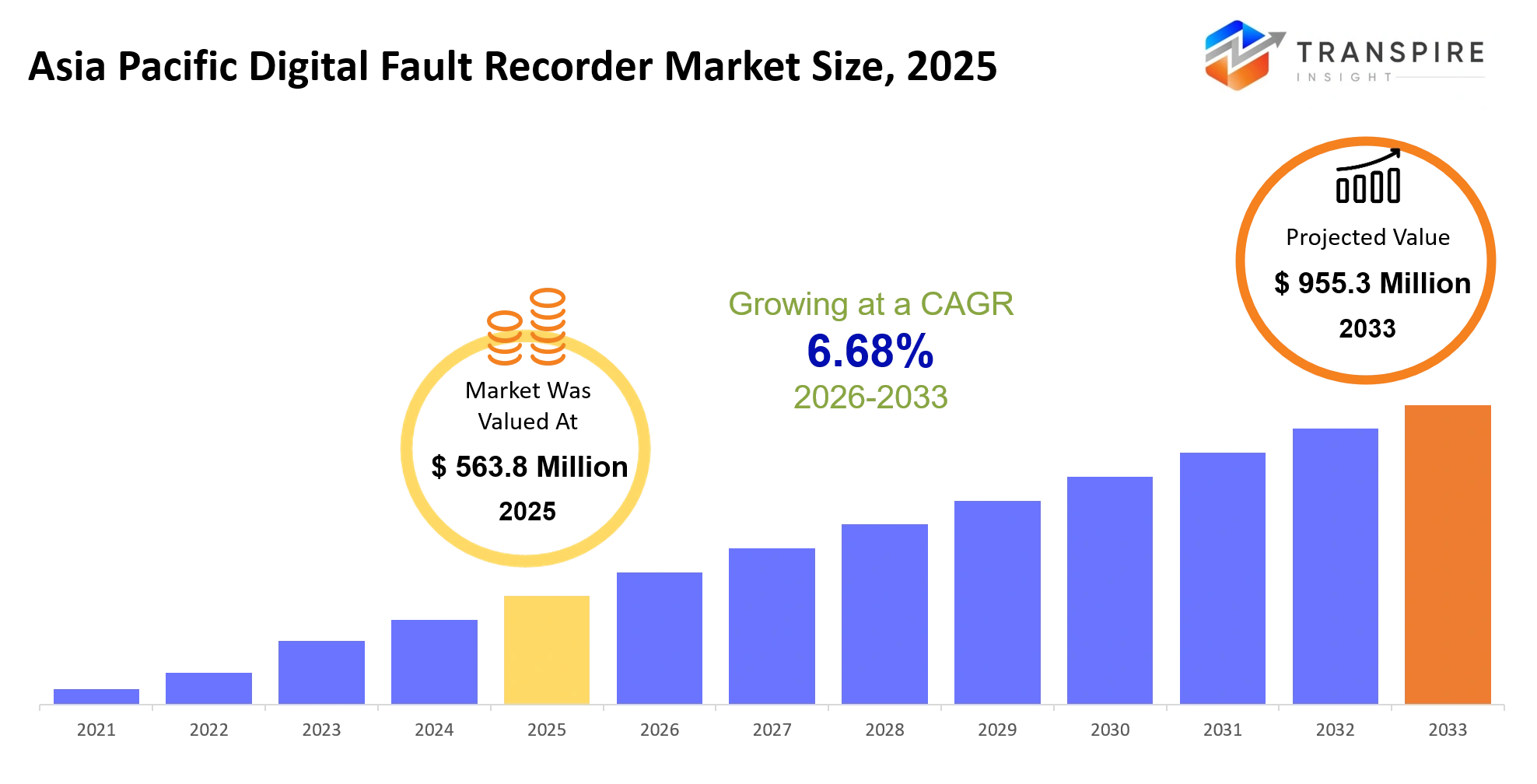
Asia Pacific Digital Fault Recorder Market Size & Forecast:
- Asia Pacific Digital Fault Recorder Market Size 2025: USD 563.8 Million
- Asia Pacific Digital Fault Recorder Market Size 2033: USD 955.3 Million
- Asia Pacific Digital Fault Recorder Market CAGR: 6.68%
- Asia Pacific Digital Fault Recorder Market Segments: By Component (Hardware, Software, Data Storage Systems, Communication Modules, Monitoring Systems, Others); By Application (Power Generation, Transmission Networks, Distribution Networks, Railways, Industrial Plants, Others); By Voltage Level (Low Voltage, Medium Voltage, High Voltage, Extra High Voltage, Others); By End User (Utilities, Industries, Railways, Government Agencies, Others).
To learn more about this report,  Download Free Sample Report
Asia Pacific Digital Fault Recorder Market Summary
The Asia Pacific Digital Fault Recorder Market was valued at USD 563.8 Million in 2025. It is forecast to reach USD 955.3 Million by 2033. That is a CAGR of 6.68% over the period.
The Asia Pacific Digital Fault Recorder Market sort of plays a critical role in modern power systems, because it captures and then analyzes electrical disturbances, equipment faults, and grid happenings in real time. Utilities, transmission operators, and industrial facilities depend on these setups to figure out the actual root causes of outages, stop the same failure from showing up again, and keep overall grid stability intact, as networks get more complex over time.
In the past five years, there’s been a structural change, from mostly standalone recording devices toward more integrated, intelligent monitoring platforms. These newer platforms combine fault recording with advanced analytics and substation automation, so yeah the whole process feels more connected. Meanwhile rapid renewable energy integration across countries like China, India, and Australia has shifted how the grid behaves, leading to more variable power flows and, in turn, a stronger need for high resolution disturbance monitoring. One big trigger was the faster push for grid modernization programs right after pandemic era infrastructure stimulus, along with energy security concerns, which pushed investment decisions. So, as utilities put more money into smarter, more resilient networks, digital fault recorders are turning into essential operational assets, which is driving broader rollout and higher spending across transmission and distribution infrastructure too.
Key Market Insights
- East Asia kinda dominates the Asia Pacific Digital Fault Recorder Market, like about 45–50% share in 2025, mostly because of China’s grid modernization programs that keep rolling out.
- South Asia is moving faster than the rest in the forecast period, backed by transmission expansion projects, plus utility digital transformation investments too.
- India continues growing its industry footprint via large-scale renewable integration, and also upgrades in high voltage transmission infrastructure, which is pretty central right now.
- Australia is starting to see rising demand for more advanced fault monitoring solutions, mainly from grid decentralization, and more renewables being pushed into the system.
- Intelligent Digital Fault Recorders are leading overall, and by 2025 they will take nearly 55% market share, thanks to advanced analytics, real time monitoring capabilities and related upgrades.
- Standalone digital fault recorders sit in the second largest slice, especially in old fashioned substations and those retrofit programs, where upgrades need to be kind of targeted.
- Integrated fault recording and disturbance analysis systems are the fastest growing segment through 2030, since utilities are pushing for centralized grid visibility, and a lot of teams want that single pane of glass vibe.
- When it comes to monitoring, transmission network observation dominates, and it is around 40% of the overall market revenue in 2025.
- For the application side, renewable energy grid integration is the fastest growing as utilities deal with more and more involved power flows, and the whole system gets a bit more sensitive.
- Also, substation automation deployments keep driving meaningful market growth, plus wider technology adoption, in a way that feels pretty steady over time.
What are the Key Drivers, Restraints, and Opportunities in the Asia Pacific Digital Fault Recorder Market?
The main force pushing the Asia Pacific Digital Fault Recorder Market forward is kind of a rapid, ongoing modernization of electricity transmission and distribution infrastructure. In places like China, India, Japan, and Australia, governments plus utilities are spending a lot on smart grids , digital substations, and renewable energy tie-ins. All of that shift makes the grid feel more complicated in practice, so there’s a real need for fast fault detection and disturbance analysis tools. And since renewable generation brings variable power flows, plus more bidirectional electricity movement, utilities also need tighter monitoring capabilities to keep everything stable. In the end this change helps drive equipment sales , software integration deals, and also recurring long-term maintenance income across the digital fault recorder space .
The biggest obstacle, though, is still the high cost and the overall complexity of upgrading older, legacy grid setups. A lot of utilities keep running aging substations that were basically never built for advanced digital monitoring. Bringing in modern fault recorders can mean communication network revisions, protection relay swaps, and yes workforce retraining as well. But because these efforts involve long asset lifetimes and regulated capital expenditure plans, adoption typically crawls. So the timeline for deployment gets delayed and revenue upside gets capped, especially in developing markets where utility budgets stay pretty tight , and it’s harder to justify the spend quickly.
There’s a big chance in pushing forward renewable energy corridors and sort of digitally linked substations across South and Southeast Asia. Big money is going into solar wind and cross border transmission links, and that is driving the need for better grid visibility. Utilities rolling out IEC 61850 digital substations are asking for integrated fault recording , event analysis, and predictive diagnostics. And once these efforts move out of pilot phase and into full rollout, the Asia Pacific Digital Fault Recorder Market seems ready to catch the next round of tech led growth.
What Has the Impact of Artificial Intelligence Been on the Asia Pacific Digital Fault Recorder Market?
Artificial intelligence and advanced digital technologies are kinda reshaping the Asia Pacific Digital Fault Recorder Market, sort of, by changing the way utilities keep an eye on, break down, and ultimately respond to grid disturbances. A lot of the newest digital fault recording systems now lean on AI-driven event classification, so they can automatically sort out fault types , separate what looks like temporary or transient disturbance from the more stubborn permanent failures and also flag the most critical incidents for operator review. With that kind of automation in place, there’s less time spent on manual analysis, and grid operators can restore service sooner after those outages happen.
On top of that, machine learning is helping push predictive maintenance from “reactive” to something more anticipatory. If you look at historical fault records, waveform data, relay events, plus equipment performance patterns, utilities can spot early warning signs—like transformer, circuit breaker, or transmission line degradation—before a full failure shows up. These predictive insights also make maintenance plans feel more precise, reduce the chance of unplanned outages, and increase how well assets get utilized across both transmission and distribution networks, not just one side.
Then there are advanced analytics platforms that connect into digital substations, which offer near real-time disturbance assessment and root-cause analysis. That means operators can narrow things down faster, keep reliability steadier, and support better operational uptime. Utilities generally gain from quicker fault localization, reduced maintenance spend and stronger alignment with grid reliability standards. And in renewable-heavy power systems, AI tools tend to help manage those increasingly complex power flows and stability issues, even when conditions shift pretty fast.
However, there is a key limitation still, linking AI with legacy grid infrastructure. A lot of utilities run older substations with pretty fractured data architectures, and that makes it kinda hard to craft those high quality standardized datasets needed for correct machine learning models, and also for large scale deployment. It’s not just one thing, more like the whole picture is uneven.
Key Market Trends
- Since 2020, utilities have kind of moved away from standalone fault recorders and toward integrated monitoring platforms, which bundle disturbance analysis with protection data, and also the substation automation side of things.
- Renewable energy keeps expanding across China, India, and Australia, and that means demand for high-resolution event recording has gone up too, because grid conditions are getting more dynamic and, frankly, harder to eyeball.
- Between 2021 and 2025 digital substation deployments then accelerated the adoption of IEC 61850 compatible recorders, which helped interoperability across transmission networks.
- At the same time, grid operators are using AI based event classification tools more often, so less manual fault investigation work, and faster restoration timelines after disturbances.
- Utilities have also changed procurement focus, they used to care only about hardware specifications, but now priorities drift toward analytics capabilities, cybersecurity features, and remote monitoring function.
- After the pandemic, major grid modernization programs expanded, and transmission operators put more budget into real-time network visibility technologies.
- Some of the bigger players—like Hitachi Energy, Siemens AG, and ABB Ltd.—have reportedly increased investment in software driven fault analysis solutions, not only the devices.
- Also, utilities increasingly link fault recorder data with asset management systems, which supports condition based maintenance instead of calendar based inspection routines.
- On top of that, cybersecurity requirements got stronger after 2022, so buyers tend to favor vendors offering secure communication protocols, and centralized event management capabilities.
- So overall differentiation is shifting, it’s not just about recording accuracy anymore, it’s about predictive diagnostics, cloud enabled analytics, and these comprehensive grid intelligence platforms, that sort of thing.
Asia Pacific Digital Fault Recorder Market Segmentation
By Component :
Hardware is basically the physical bedrock for digital fault recording setups. In general, recording units, processing units, sensors, and all sorts of interface devices catch electrical disruptions and also actual operational happenings across power grids. Over time, steady upgrades to processing speed and measurement accuracy have made it easier to catch faults faster, and then dig into event analysis in a more detailed way. Even with everything else evolving, hardware still stays kind of crucial for dependable data capture in these complicated electrical surroundings.
Software, on the other hand, is what helps with interpreting the data, sorting the events, and doing actual fault analysis. More advanced software platforms allow people to do visualization, produce reporting, and also connect everything into utility management systems. Then there’s the data storage side , where large piles of disturbance records are kept so they can be reviewed later, meet regulatory needs and help with operational planning too. Communication modules assist with the transfer of information between substations, control centers, and monitoring platforms, while monitoring systems give real time visibility of how the network conditions look at the moment. Other pieces include auxiliary accessories plus integration tools which basically improve overall system behavior and operational efficiency.
By Application :
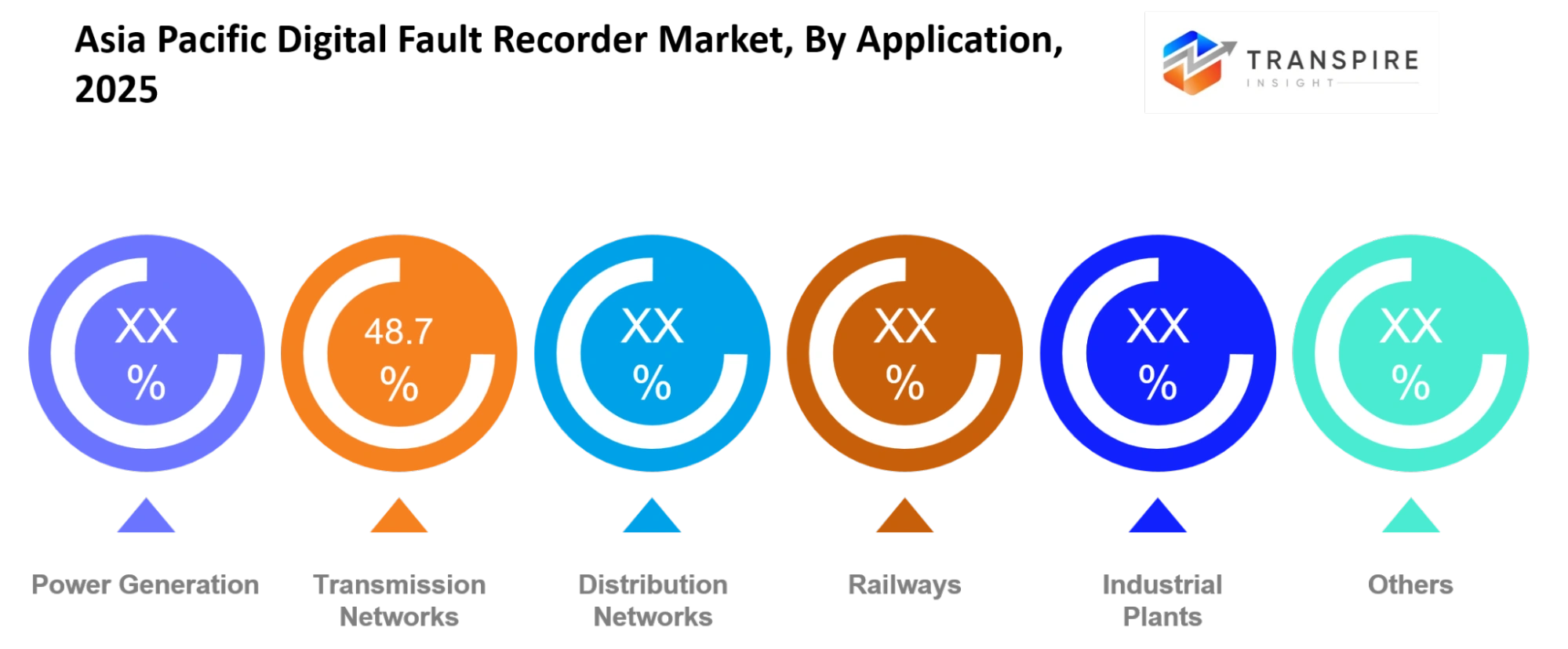
Power generation facilities use digital fault recorders, to spot what’s happening during operational disturbances , equipment malfunctions , and power quality events. When the event recording is accurate, it helps keep generation running steady and it also makes it easier to take rapid corrective actions. And since renewable energy sources are being integrated more and more, the importance of advanced monitoring inside the generating facilities has gone up a lot.
Transmission networks are also a big thing here, because when you’re moving power over long distances you need continuous fault detection, plus disturbance analysis. Distribution networks rely on these systems to lift service reliability and to shorten the outage durations. Railways depend on fault recording solutions, for monitoring traction power systems and the electrical infrastructure. Industrial plants use digital fault recorders as a way to protect critical equipment, and keep operations uninterrupted. Other uses include specialized infrastructure and public service networks, where electrical reliability stays a top priority.
To learn more about this report, Download Free Sample Report
By Voltage Level :
Low voltage applications usually focus on localised electrical systems inside commercial facilities , industrial sites and also in smaller utility installations. In that setup , digital fault recorders ( in the broad sense ) help figure out equipment failures, voltage swings, and those operational disturbances that can mess with system performance. Then medium voltage networks need stronger monitoring because the coverage is wider and the load management demands are higher , it’s more complicated overall.
As for high voltage and extra high voltage parts , they are kind of crucial for regional or national transmission systems . These voltage levels let utilities move massive amounts of electricity across really extended geographic areas , so accurate fault recording is essential for keeping network stability on track. Advanced recording technologies provide very detailed event data , and that supports fault location, system protection, and even infrastructure planning later on. Other voltage categories handle specialised applications too, but they have their own operating rules, unique operational needs , and different priorities depending on the case.
By End User :
Utilities are basically the biggest end-user group because good fault detection is needed,like, for keeping the grid stable and the service steady. Digital fault recorders help utility operators dig into disturbances, make restoration work less chaotic, and also help with long-run infrastructure stewardship . Meanwhile, all those continuing grid modernization efforts keep pushing adoption across different utility networks, even in places that are a bit slower to change.
Industries, on the other hand, use these tools to protect production sites and to reduce operational interruptions that pop up because of electrical faults. Railways rely on fault recording tech so electrical operations stay dependable ,and so transportation services keep moving. Government agencies roll out digital fault recorders inside public infrastructure programs ,to boost monitoring and improve day-to-day oversight. Other end users include groups that run specialized electrical networks and they need dependable event recording along with system analysis capabilities.
What are the Key Use Cases Driving the Asia Pacific Digital Fault Recorder Market?
The biggest part of demand comes from transmission network monitoring, where utilities use digital fault recorders to catch disturbance moments, figure out fault locations , and get the power back faster. As electricity networks keep getting more tightly interconnected, and renewable generation grows, operators want fairly detailed event data so they can keep grid stability intact and lessen how much outages really hit.
Adoption is also moving ahead in distribution systems and industrial facilities. Distribution operators lean on fault recording solutions to sharpen reliability , and cut down on service interruptions, while manufacturing plants and heavy industry use these tools to guard vital electrical assets , dig into equipment issues, and reduce expensive production downtime that can drag on.
More emerging use cases are showing up around digital substations, plus renewable energy integration projects. Utilities are starting to place advanced recording systems next to automated grid management platforms, basically to help with real time decision making. With rising investment in offshore wind links, large scale solar parks, and cross border transmission corridors, there should be new chances for fast disturbance analysis and predictive grid monitoring during the forecast period.
|
Report Metrics |
Details |
|
Market size value in 2025 |
USD 563.8 Million |
|
Market size value in 2026 |
USD 607.4 Million |
|
Revenue forecast in 2033 |
USD 955.3 Million |
|
Growth rate |
CAGR of 6.68% from 2026 to 2033 |
|
Base year |
2025 |
|
Historical data |
2021 - 2024 |
|
Forecast period |
2026 - 2033 |
|
Report coverage |
Revenue forecast, competitive landscape, growth factors, and trends |
|
Regional scope |
Asia Pacific (India, China, Japan, Australia, South Korea, Rest of Asia Pacific) |
|
Key company profiled |
Siemens Energy, ABB, Schneider Electric, GE Vernova, Hitachi Energy, SEL, NR Electric, Toshiba Energy, Mitsubishi Electric, Arteche, Eaton, OMICRON, ZIV Automation, Qualitrol, Emerson. |
|
Customization scope |
Free report customization (country, regional & segment scope). Avail customized purchase options to meet your exact research needs. |
|
Report Segmentation |
By Component (Hardware, Software, Data Storage Systems, Communication Modules, Monitoring Systems, Others); By Application (Power Generation, Transmission Networks, Distribution Networks, Railways, Industrial Plants, Others); By Voltage Level (Low Voltage, Medium Voltage, High Voltage, Extra High Voltage, Others); By End User (Utilities, Industries, Railways, Government Agencies, Others). |
Which Regions are Driving the Asia Pacific Digital Fault Recorder Market Growth?
East Asia sort of holds the biggest share of the Asia Pacific Digital Fault Recorder Market, mostly because of really broad transmission infrastructure , huge utility networks, and those ongoing grid modernization efforts. China, Japan, and South Korea keep putting money into digital substations and renewable integration, plus better grid monitoring capabilities, which then really calls for high performance fault recording systems. There’s also strong regulatory supervision around grid reliability and power quality, so utilities feel comfortable rolling out more sophisticated disturbance monitoring tools across both transmission and distribution assets. And frankly, the whole ecosystem equipment manufacturers, software providers, engineering firms, and utility operators working together helps lock in the region’s leadership.
Oceania ends up as the next biggest contributor, but the growth story is a bit different. Australia’s market seems less driven by raw network scale and more by the challenge of handling assets spread across long distances, along with rising renewable energy penetration. Utilities keep investing in network reliability, asset management , and grid resilience programs, so demand stays pretty steady for advanced monitoring technologies. Plus, stable regulatory frameworks , and long range infrastructure planning, make the region a pretty dependable source of market revenue.
South Asia looks like it is becoming the fastest growing region , mainly because of big scale transmission expansions and power sector modernization push. India has really sped up investment in renewable energy corridors, plus high voltage transmission projects, and also digital grid infrastructure, and all of that is kind of creating new needs for disturbance analyses, plus fault monitoring. There are also government-backed programs, aimed at boosting grid reliability, and cutting technical losses , which in turn expands adoption opportunities. From 2026 to 2033, this momentum should bring fairly solid prospects for technology providers, system integrators, and investors who want exposure to expanding utility infrastructure markets.
Who are the Key Players in the Asia Pacific Digital Fault Recorder Market and How Do They Compete?
In the Asia Pacific Digital Fault Recorder Market, competition is kinda moderately consolidated, and the established grid technology players tend to go head to head on technical performance, analytics features, interoperability, and service support. Not really just on price alone, if at all. Utilities are also beginning to judge vendors by how well they can fuse fault recording functions with digital substations, asset management platforms, and cybersecurity frameworks, which is a big deal. Even though longtime suppliers still hold solid positions thanks to long-standing utility ties, newer tech companies are bringing in software-driven analytics and cloud-enabled monitoring, and that in turn pokes at the older hardware-focused style.
Hitachi Energy stands out by leaning into deep integration across protection, control, and monitoring systems, so utilities can handle disturbance analysis inside wider grid automation surroundings. Their expansion approach seems centered on digital substation rollouts and advanced grid intelligence platforms across electricity networks that are modernizing fast. Siemens AG also competes via end to end digital grid solutions, where fault recording sits alongside automation and operational analytics in the same ecosystem. They keep momentum through strong engineering capability ,and extensive utility partnerships, which helps growth on major transmission projects.
ABB Ltd. kind of stresses that interoperability, and those digital substation technologies, so utilities can tie their fault recording systems into the wider network management backbone. Schneider Electric meanwhile leans hard on software- enabled monitoring, plus energy management platforms, which are supposed to give better operational sightlines and improve asset performance in a more practical way. GE Vernova draws on grid modernization know-how, and transmission technologies too, then expands via utility centered digitalization programs, along with advanced disturbance monitoring solutions, to cope with power networks that are getting more and more tangled.
Company List
- Siemens Energy
- ABB
- Schneider Electric
- GE Vernova
- Hitachi Energy
- SEL
- NR Electric
- Toshiba Energy
- Mitsubishi Electric
- Arteche
- Eaton
- OMICRON
- ZIV Automation
- Qualitrol
- Emerson
Recent Development News
In July 2025, GE Vernova announced the acquisition of Alteia. The acquisition strengthens GE Vernova’s GridOS Visual Intelligence platform by adding AI-based grid inspection and monitoring capabilities, enhancing utility asset management and digital grid analytics relevant to fault recording and disturbance monitoring applications.
Source: https://www.reuters.com/
In September 2025, Hitachi Energy was recognized as the global market share leader in grid automation products and services by ARC Advisory Group. The recognition reflects continued investment in grid automation, digital substations, and advanced monitoring technologies that support the deployment of modern disturbance recording and fault analysis systems across utility networks.
Source: https://www.hitachienergy.com/in/
What Strategic Insights Define the Future of the Asia Pacific Digital Fault Recorder Market?
The Asia Pacific Digital Fault Recorder Market seems to be walking toward a future where fault capturing becomes, uh, part of a wider grid intelligence architecture—not just a lone monitoring task. In the next five to seven years, utilities will increasingly blend disturbance recording with predictive analytics, plus automated decision support inside one kind of digital platform. And the real push under it all is the growing complication of power networks, because renewable generation keeps rising, distributed energy resources are spreading, and cross-border transmission connections are basically reshaping the electricity pathways.
There’s also a quieter risk that doesn’t always get noticed, and that is technology substitution. As utilities roll out multifunction intelligent electronic devices and more advanced grid management platforms, standalone fault recording products could start to feel pressure. This will happen unless vendors can show a crisp integration story, plus analytical value that actually sticks. Also, with market buying getting more concentrated among a small set of big utility buyers, procurement pressure might increase, and yes, sales cycles can get longer, maybe, more than people expect.
Still, there are opportunities showing up too. One notable thing is digital monitoring systems being deployed along renewable energy corridors across South Asia, and in particular, India’s expanding high-voltage transmission network. Market participants should lean into software-led analytics, interoperability, and cybersecurity strengths, because these will, over time, shape purchasing decisions and affect long term competitiveness.
Asia Pacific Digital Fault Recorder Market Report Segmentation
By Component
- Hardware
- Software
- Data Storage Systems
- Communication Modules
- Monitoring Systems
By Application
- Power Generation
- Transmission Networks
- Distribution Networks
- Railways
- Industrial Plants
By Voltage Level
- Low Voltage
- Medium Voltage
- High Voltage
- Extra High Voltage
By End User
- Utilities
- Industries
- Railways
- Government Agencies
Frequently Asked Questions
Find quick answers to common questions.
The Asia Pacific Digital Fault Recorder Market size is USD 955.3 Million in 2033.
Key segments for the Asia Pacific Digital Fault Recorder Market are By Component (Hardware, Software, Data Storage Systems, Communication Modules, Monitoring Systems, Others); By Application (Power Generation, Transmission Networks, Distribution Networks, Railways, Industrial Plants, Others); By Voltage Level (Low Voltage, Medium Voltage, High Voltage, Extra High Voltage, Others); By End User (Utilities, Industries, Railways, Government Agencies, Others).
Major Asia Pacific Digital Fault Recorder Market players are Siemens Energy, ABB, Schneider Electric, GE Vernova, Hitachi Energy, SEL, NR Electric, Toshiba Energy, Mitsubishi Electric, Arteche, Eaton, OMICRON, ZIV Automation, Qualitrol, Emerson.
The Asia Pacific Digital Fault Recorder Market size is USD 563.8 Million in 2025.
The Asia Pacific Digital Fault Recorder Market CAGR is 6.68% from 2026 to 2033.
- Siemens Energy
- ABB
- Schneider Electric
- GE Vernova
- Hitachi Energy
- SEL
- NR Electric
- Toshiba Energy
- Mitsubishi Electric
- Arteche
- Eaton
- OMICRON
- ZIV Automation
- Qualitrol
- Emerson
About the Authors

Avinash Kumar
I’m Avinash Kumar, a Senior Research Analyst at Transpire Insight, with expertise in the Electronics and Semiconductor and Energy & Power industry. My work focuses on analyzing emerging technologies, market trends, industry developments, and innovation across these sectors. I specialize in transforming complex technical and market insights into clear, research-backed content that helps professionals, businesses, and decision-makers stay informed. Through continuous industry research and data-driven analysis, I strive to deliver accurate, reliable, and practical perspectives on the latest advancements shaping the semiconductor and energy landscape.

Chakradhar Khansole
Chakradhar serves as the Research Director at Transpire Insight, bringing over 8 years of experience in technology, innovation, and strategic market intelligence. He specializes in transforming complex market data into actionable business insights that enable organizations to make informed, growth-oriented decisions. Recognized for his strategic vision and analytical expertise, Chakradhar leads high-impact research initiatives, delivering comprehensive market assessments, competitive intelligence, and forward-looking industry analysis.
Recently Published Reports
-
Apr 2026
Active Power Filter Market
Active Power Filter Market Size, Share & Analysis Report By Type (Shunt Active Power Filters, Series Active Power Filter, Hybrid Active Power Filter), By Application (Harmonics Mitigation, Reactive Power Compensation, Voltage Regulation, Power Factor Correction), By Phase (Single Phase, Three Phase), By End-User Industry (Manufacturing, Healthcare, Commercial, Automotive, Oil and Gas, Others), and Geography (North America, Europe, Asia-Pacific, Middle East and Africa, South and Central America), 2021 - 2031
-
Apr 2026
Electrical Transformer Market
Electrical Transformer Market Size, Share & Analysis Report By Core (Closed, Shell, and Berry), By Insulation (Gas, Oil, Solid, Air, and Other), By Phase (Single, and Three), By Rating (100 MVA to 500 MVA, 501 MVA to 800 MVA, and 801 MVA to 1200 MVA), and Geography (North America, Europe, Asia-Pacific, Middle East and Africa, South and Central America), 2021 – 2031
-
Apr 2026
Hydraulic Piston Pumps Market
Hydraulic Piston Pumps Market Size, Share & Analysis Report By Type (Axial Piston Pumps, Radial Piston Pumps), By Operating Pressure (Low Pressure, Medium Pressure, High Pressure), By Application (Construction, Mining, Agriculture, Automotive, Oil & Gas, Industrial Machinery, Others), By End-User (OEMs, Aftermarket), and Geography (North America, Europe, Asia-Pacific, Middle East and Africa, South and Central America), 2021 – 2031
-
Apr 2026
Laboratory Gas Generators Market
Laboratory Gas Generators Market Size, Share & Analysis Report By Product (Nitrogen Gas Generator, Hydrogen Gas Generator, Zero Air Gas Generator, Purge Gas Generator, TOC Gas Generators, Others), By Application (Gas Chromatography, Liquid Chromatography-mass Spectrometry (LC-MS), Gas Analyzers, Others), By End-user (Life Science, Chemical & Petrochemical, Food & Beverage, Others), and Geography (North America, Europe, Asia-Pacific, Middle East and Africa, South and Central America), 2021 – 2031