

Europe Medium Voltage Switchgear Market Size & Forecast:
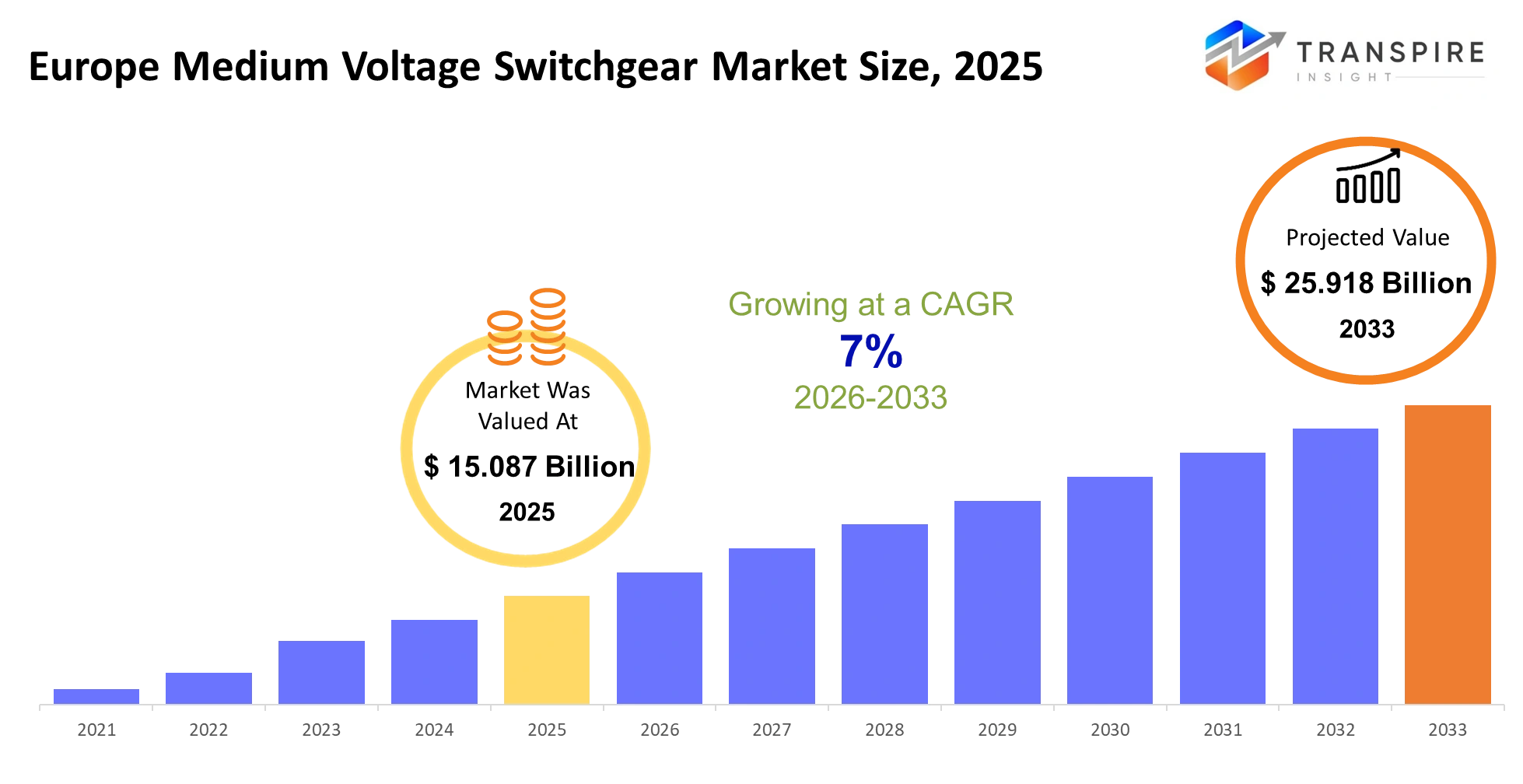
- Europe Medium Voltage Switchgear Market Size 2025: USD 15.087 Billion
- Europe Medium Voltage Switchgear Market Size 2033: USD 25.918 Billion
- Europe Medium Voltage Switchgear Market CAGR: 7%
- Europe Medium Voltage Switchgear Market Segments: By Type (Air Insulated, Gas Insulated, Vacuum, Others); By Application (Power Distribution, Industrial, Commercial, Utilities, Others); By End-User (Utilities, Industries, Infrastructure, Commercial Buildings, Others); By Voltage (3–15kV, 15–36kV, Above 36kV, Others).
To learn more about this report,  Download Free Sample Report
Europe Medium Voltage Switchgear Market Summary
The Europe Medium Voltage Switchgear Market was valued at USD 15.087 Billion in 2025. It is forecast to reach USD 25.918 Billion by 2033. That is a CAGR of 7% over the period.
The Europe Medium Voltage Switchgear Market enables safe distribution of electricity across utilities, industrial plants, and renewable grids by controlling, isolating, and protecting medium-voltage power networks. The system enables actual energy delivery which prevents power outages while maintaining energy supply stability for cities and factories and infrastructure systems. The system functions as the main operational link between high-voltage transmission systems and all points where energy reaches customers.
The market has undergone a fundamental change during the past three to five years as it has moved away from SF₆-based insulation systems toward vacuum and clean-air technologies. The European Union F-gas regulatory framework became stricter which required utilities to alter their procurement procedures because of the impending phase-out dates. The energy transition together with the rapid growth of wind and solar power generation created unstable grid conditions which needed advanced switching systems that could operate with quick responses.
Grid adoption patterns have changed because of two main factors which include increases in regulatory demands and the development of more complex renewable energy systems. Utilities now prioritize lifecycle compliance and digital monitoring over upfront cost, leading to faster replacement cycles for legacy infrastructure. The market now demands modular switchgear solutions which include software capabilities that enable them to handle decentralized energy distribution and bidirectional power flows throughout European distribution networks.
Key Market Insights
- The Europe Medium Voltage Switchgear Market in Western Europe will achieve its largest market share of 45% in 2025 because of advanced grid development and strict enforcement of SF₆ phase-out regulations.
- The fastest-growing area in Eastern Europe will achieve 7 to 9 percent annual growth which will continue until 2030 because of EU-supported upgrades to grid infrastructure and projects that integrate renewable energy sources.
- Gas insulated switchgear has the biggest market share because cities need to save space but vacuum switchgear will show the fastest growth because companies need to meet environmental regulations.
- The Europe Medium Voltage Switchgear Market reaches its highest value through 15 to 36kV voltage range implementation which occurs at distribution substations and renewable energy connection points.
- Utilities spend money to build grid systems which includes decentralized energy networks making power distribution applications the main application area with more than 50 percent market share.
- Electric vehicle manufacturing facilities and data centers together with electrified production centers have made industrial operations the second largest growing market segment.
- The primary user group for this product remains utilities whereas smart city infrastructure projects emerge as the fastest growing sector in product usage.
- The companies ABB Siemens Schneider Electric Hitachi Energy and Lucy Electric use SF₆-free technology and digital switchgear to improve their market competitiveness.
- European companies active in the Medium Voltage Switchgear Market are developing technology leadership through partnerships and acquisitions which includes Lucy Electric's development of vacuum technology.
- European Union decarbonization targets will determine which businesses gain competitive advantages through software-based grid intelligence and predictive maintenance systems and modular substations.
What are the Key Drivers, Restraints, and Opportunities in the Europe Medium Voltage Switchgear Market?
The European medium voltage switchgear market needs to adopt vacuum and alternative gas insulation technologies because EU F-gas regulations require utilities and manufacturers to stop using SF₆ gas. The regulatory framework has created new procurement cycles that force utilities to replace their gas-insulated systems before the scheduled replacement dates. Urban substations and renewable integration nodes now require complete equipment replacements instead of minor upgrades, which provides equipment suppliers with continuous revenue from their compliant products.
The main obstacle prevents organizations from implementing SF₆-free technology because they require expensive and difficult modifications to their current grid systems. Substations across Southern and Eastern Europe face technical difficulties and high costs because their original designs used permanent gas-insulated systems. The structural design of the system prevents smaller utilities and municipal operators from adopting the system because they need to have greater financial resources. The system prevents businesses from achieving complete operation because it stops them from generating revenue during the period when they need to comply with quick government requirements.
Digital substations that receive EU funding for grid modernization represent a new opportunity for development, which Europeans should implement in their Eastern European regions. Poland and Romania are investing resources into smart grid corridors, which will enable renewable energy integration and automated switchgear operations. Companies that provide modular SF₆-free platforms with digital capabilities will benefit from increasing demand because infrastructure development will proceed at a faster rate until 2030.
What Has the Impact of Artificial Intelligence Been on the Europe Medium Voltage Switchgear Market?
The process of transforming switchgear ecosystems through artificial intelligence and digital technologies improves grid infrastructure operations through automated systems and advanced diagnostic tools which boost equipment efficiency during their complete operational lifespan. Utilities are increasingly deploying AI-enabled monitoring systems that track equipment health in real time, optimize load balancing, and automate compliance reporting for SF₆-free installations. Digital control platforms now use substation sensor data to control switching operations through automatic adjustments which decrease the need for human operators while improving grid response times during renewable energy generation changes.
Machine learning models are used to predict upcoming maintenance needs through their analysis of past equipment failures and present operational conditions which enable them to estimate future insulation damage and circuit breaker conditions and thermal stress levels. The process of equipment maintenance planning has become more efficient because condition-based servicing extends equipment life while decreasing unplanned outages. The European pilot projects show that utilities achieve maintenance cost reductions while their systems operate with better uptime when predictive algorithms replace the fixed-interval servicing models that they used before.
The adoption of AI technology in organizations faces major obstacles because organizations lack unified and dependable historical data which prevents accurate model development for actual operational conditions. Mid-sized utilities face high integration expenses because they need to install sensors and communication modules into their outdated substation systems. Digitalization transforms operational reliability standards while it drives manufacturers to develop complete software-based switchgear systems which replace traditional equipment.
Key Market Trends
- The European Union has enforced stricter regulations on F-gas emissions since 2023, which has led utilities to switch from SF₆-based systems to vacuum and clean-air technology.
- Schneider Electric and Siemens have expanded digital switchgear integration, shifting from hardware-only offerings to software-enabled grid management platforms since 2024.
- ABB has accelerated its deployment of SF₆-free products by developing eco-friendly solutions which replace traditional gas insulated systems across its European urban substations.
- After 2023, grid operators have adopted modular substations because they deliver faster installation times and better adaptability to renewable energy projects.
- Since 2024, Eastern European utilities have changed their procurement methods by selecting EU-funded modernization projects instead of using traditional cost-based criteria for switchgear selection.
- The market for vacuum circuit breakers has experienced continuous growth because manufacturers are discontinuing gas-based insulation systems in response to European Union regulatory requirements.
- The implementation of predictive maintenance capabilities in switchgear has become more popular among industrial buyers since 2025, which results in decreased downtime and enhanced productivity for facilities that consume high amounts of energy.
- The expansion of offshore wind energy in Northern Europe has increased the demand for compact high-reliability switchgear solutions, which connect to offshore grid infrastructure projects.
- Since 2024, suppliers have increased their local supply chain operations to decrease their need for essential components, which include insulation gases and high-performance interrupter materials.
Europe Medium Voltage Switchgear Market Segmentation
By Type:
The European market for medium voltage switchgear sees gas insulated switchgear as its leading technology because of its compact design which fits better into urban substations that have limited available space. The industrial and utility sectors select this particular technology because it provides dependable operations with minimum maintenance needs, which proves essential for environments that have heavy infrastructure. The air insulated systems maintain a considerable market presence in both rural areas and applications that require installation space beyond their operational capabilities. The medium voltage range now adopts vacuum switchgear because of its effective arc-quenching performance and its environmentally friendly design.
The segment growth driver exists because regulators require companies to stop using SF₆ systems, which creates demand for vacuum systems and environmentally friendly gas solutions. Urban grid modernization projects further reinforce the shift toward compact gas insulated solutions. The adoption of advanced insulated systems faces challenges because advanced technology proves too expensive for areas that prioritize cost control. The period from now until 2027 will see vacuum systems and modern gas insulated systems increase their market share because environmental regulations will protect utilities and industrial customers.
The product development teams must shift their focus toward developing SF₆-free insulation systems and creating modular product design solutions. Investors will gain advantages from companies which possess extensive patent collections related to alternative gases and vacuum technology. Buyers will increasingly evaluate lifecycle cost and regulatory compliance rather than initial capital expenditure alone.
By Application:
The European medium voltage switchgear market experiences its highest demand from power distribution which continues to receive funding for both grid sustainability and renewable energy system implementation. The utility companies require their services because they need to update their substations for two reasons which include handling distributed energy resources and dealing with changing electricity demand. Energy-intensive industrial sectors particularly automotive and chemical and heavy manufacturing applications maintain a significant industrial presence. The emergence of commercial infrastructure through data centers and large buildings creates additional demand because electrification requirements continue to expand.
The primary growth driver for this market segment exists because decentralized energy systems need dedicated facilities for their power distribution and protection mechanisms. Distribution grid operators need flexible switches that can integrate renewable energy sources into their systems. Industrial organizations implement advanced technologies to enhance operational uptime while decreasing energy consumption. These use cases require complete automation and continuous system observation because they operate differently from standard applications.
The upcoming development phase will focus on distribution systems which use digital technology to enable two-way power transmission capabilities. Product developers must integrate smart monitoring features and grid communication capabilities. The companies that achieve success will combine dependable hardware products with energy management software that operates through their systems.
By End-User:
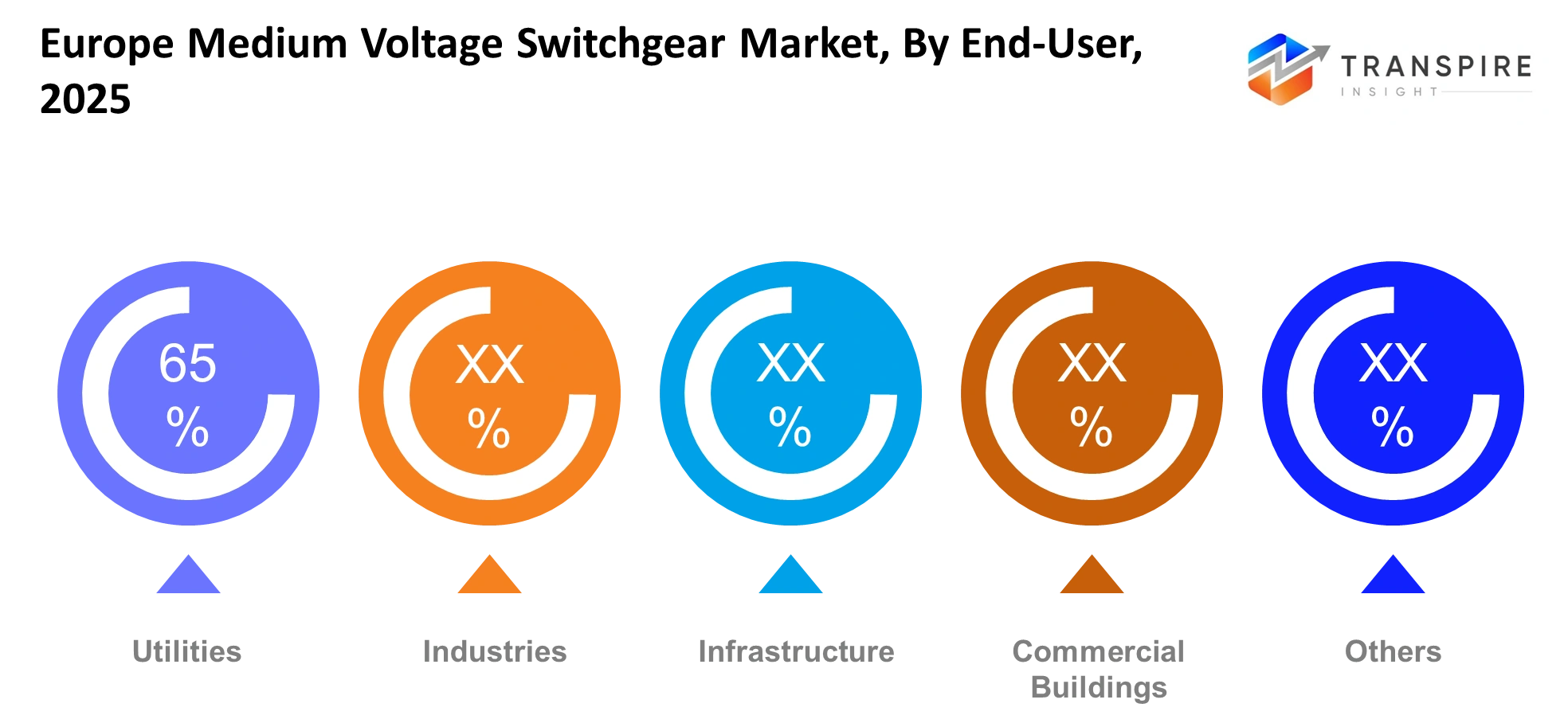
The Europe medium voltage switchgear market sees its highest demand from utilities because they operate extensive grid modernization projects which comply with decarbonization rules. The infrastructure operators use these systems to sustain grid stability while they incorporate renewable energy sources into their operations.The industrial sector represents the second-largest market portion because manufacturing and process industries maintain ongoing electrical power utilization. The power requirements of commercial buildings remain constant through their operation of data centers and high-density energy facilities.
The primary growth driver is electrical power usage throughout various customer segments but utility companies show the most growth because of their obligation to meet legal requirements and receive financial support. Infrastructure initiatives which include smart cities and transport electrification projects create additional demand which utilities will lead. Industrial users require dependable systems which operate efficiently so they will implement modern switchgear technologies. Commercial users now prioritize energy resilience together with backup power solutions.
The utility sector will maintain its demand base throughout the forecast period while industrial and infrastructure sectors will experience quicker percentage growth. Manufacturers need to create flexible systems which can meet the requirements of both big projects and small-scale operations. Companies that operate in multiple markets will provide better investment opportunities for investors than those who rely exclusively on utility customers.
To learn more about this report, Download Free Sample Report
By Voltage:
The 15–36kV segment holds the strongest position in the Europe medium voltage switchgear market as it aligns closely with distribution-level applications across urban and industrial networks. This voltage range supports most utility substations and renewable integration points, making it the backbone of regional grid infrastructure. The 3–15kV segment maintains relevance in localized industrial and commercial installations where lower voltage distribution is sufficient. Transmission systems above 36kV operate for specialized uses yet they account for a limited market share because they involve extended operational requirements and expensive operational costs.
The market for this segment experiences growth because distributed generation systems and electrification projects which operate between 15 to 36 kV standards are expanding their operations. The existing distribution grid system enables renewable energy plants and EV charging infrastructure to create demand within this voltage range. The adoption of lower voltage systems increases continuously because industrial automation systems and commercial building electrification projects require their use. Utilities prefer to enhance their operational efficiency through existing transmission infrastructure optimization which leads to delayed implementation of high-voltage systems.
The 15 to 36 kilovolt range will become the primary standard for connecting decentralized energy systems with national power grids during future development. Product developers should focus on creating modular systems which will work efficiently within this specific voltage range. Investors will find the strongest returns in companies that dominate distribution-level switchgear innovation rather than transmission-focused solutions.
What are the Key Use Cases Driving the Europe Medium Voltage Switchgear Market?
European medium voltage switchgear needs arise primarily from utility distribution networks which are currently undergoing extensive infrastructure updates due to grid modernization efforts and renewable energy integration initiatives. Utilities need dependable compact systems that operate without SF₆ to achieve load stability during wind and solar power fluctuations. This segment generates the highest demand because it directly supports national energy security and regulatory compliance targets.
Industrial manufacturing and transport electrification are expanding applications, particularly in automotive plants, data centers, and EV charging infrastructure. End users require medium voltage systems with strong durability because they need to handle high power levels while maintaining continuous service. Offshore wind farms and other renewable energy plants increasingly depend on advanced switchgear technology to establish secure grid connections and perform load balancing functions.
The new applications of microgrids will create operational systems for urban districts while energy storage systems will be introduced at distribution points. Cities are currently working on decentralized energy resilience strategies which have created increasing momentum for these developing applications. The new demand layers which will emerge over time will exceed the typical procurement patterns that utilities follow.
|
Report Metrics |
Details |
|
Market size value in 2025 |
USD 15.087 Billion |
|
Market size value in 2026 |
USD 16.143 Billion |
|
Revenue forecast in 2033 |
USD 25.918 Billion |
|
Growth rate |
CAGR of 7% from 2026 to 2033 |
|
Base year |
2025 |
|
Historical data |
2021 - 2024 |
|
Forecast period |
2026 - 2033 |
|
Report coverage |
Revenue forecast, competitive landscape, growth factors, and trends |
|
Regional scope |
Europe (Germany, United Kingdom, France, Italy, Spain, Rest of Europe) |
|
Key company profiled |
ABB, Siemens, Schneider Electric, Eaton, GE, Hitachi Energy, Mitsubishi Electric, Toshiba, Hyundai Electric, Larsen & Toubro, CG Power, Ormazabal, Lucy Electric, Powell Industries, Fuji Electric. |
|
Customization scope |
Free report customization (country, regional & segment scope). Avail customized purchase options to meet your exact research needs. |
|
Report Segmentation |
By Type (Air Insulated, Gas Insulated, Vacuum, Others); By Application (Power Distribution, Industrial, Commercial, Utilities, Others); By End-User (Utilities, Industries, Infrastructure, Commercial Buildings, Others); By Voltage (3–15kV, 15–36kV, Above 36kV, Others). |
Which Regions are Driving the Europe Medium Voltage Switchgear Market Growth?
The Europe medium voltage switchgear market shows Western Europe as its leading market because this region dedicated itself to creating strict laws which required grid decarbonization and SF₆ phase-out from the beginning. Germany France and the Netherlands lead large-scale grid modernization programs because they have high renewable energy usage and their industrial sectors require more electricity. The region operates through an interconnected system which includes utility companies and original equipment manufacturers and research centers, which help spread new technologies throughout the market. The partnership between regulators and key suppliers has developed a continuous process for introducing advanced switchgear systems.
The Nordic region represents a smaller but highly stable contributor, distinguished by its long-standing focus on sustainability rather than regulatory pressure alone. The region develops through ongoing financial backing, which funds both hydro-based facilities and renewable energy networks that maintain operational efficiency at existing levels. The electricity companies in Sweden Norway and Finland focus on creating digital grid systems, which help them forecast system maintenance requirements instead of implementing extensive system upgrades. The system creates predictable demand patterns, which enable businesses to establish permanent contracts that guarantee dependable material procurement processes.
The Eastern European region experiences the highest growth rate because the region undergoes rapid infrastructure development while receiving significant EU funding for grid modernization projects. The countries of Poland Romania and Hungary are upgrading their outdated transmission and distribution systems, which they acquired from past technologies, to handle their growing renewable energy resources. The recent changes to regulatory standards, which now comply with EU energy transition benchmarks, have made it possible for organizations to proceed with their major substation and distribution automation initiatives.For market entrants and investors, this region offers high volume growth potential, but success will depend on cost-efficient offerings and strong local execution capabilities.
Who are the Key Players in the Europe Medium Voltage Switchgear Market and How Do They Compete?
The Europe medium voltage switchgear market is moderately consolidated because a small group of global companies controls most of the market while they compete separately for advanced grid technologies. The competition now centers on technology leadership for SF₆-free insulation and digital monitoring and lifecycle service models instead of basic equipment supply. The existing market players maintain their market position through product portfolio improvements but they struggle against sustainable and modular solution experts who operate with flexible business models. Utilities continue to consider pricing as an important factor for procurement processes but they now view technology compliance with EU climate regulations as the main factor that determines competitiveness.
ABB uses its UniGear platform and SF₆-free switchgear innovations to establish technology-based differentiation which allows the company to focus on environmental sustainability and consistent performance at high-voltage levels. Through its grid digitalization and gas-insulated switchgear products that feature advanced monitoring and automation features Siemens strengthens its presence in Western Europe utility modernization initiatives. Schneider Electric uses its EcoStruxure-enabled architecture to create energy management systems which combine hardware components with software solutions, enabling the company to differentiate on system intelligence rather than equipment alone. Hitachi Energy targets utilities that want to stop using SF₆ systems by promoting eco-efficient technologies such as AirPlus insulation and solutions for grid reliability. Lucy Electric expands its presence in the market through specific acquisitions and partnerships which help it build a stronger position in utility distribution networks throughout Europe.
Company List
- ABB
- Siemens
- Schneider Electric
- Eaton, GE
- Hitachi Energy
- Mitsubishi Electric
- Toshiba
- Hyundai Electric
- Larsen & Toubro
- CG Power
- Ormazabal
- Lucy Electric
- Powell Industries
- Fuji Electric
Recent Development News
In April 2026, Lucy Group completed acquisition of Nuventura GmbH. The deal expands Lucy Electric’s presence in the European medium voltage switchgear market by adding primary SF₆-free technology capabilities, positioning the company to meet accelerating demand driven by EU regulatory phase-outs of SF₆-based equipment.
Source: https://www.lucyelectric.com/(Lucy Electric)
In August 2025, Schneider Electric entered a long-term strategic agreement with E.ON. The partnership accelerates deployment of SF₆-free medium voltage switchgear across European distribution networks, supporting grid decarbonization and compliance with upcoming EU F-gas regulations effective from 2026.
Source: https://www.se.com/(Schneider Electric)
What Strategic Insights Define the Future of the Europe Medium Voltage Switchgear Market?
The Europe medium voltage switchgear market is currently undergoing fundamental changes because electrical systems need to grow rapidly and electrical grids need to operate as independent networks, which drives market development through the integration of renewable energy sources and electric vehicle charging stations and digital grid control systems instead of traditional capacity expansion methods. The next five to seven years will experience regulatory-driven decarbonization as the main industry driver because the energy sector will implement immediate SF₆ phase-out procedures that influence every aspect of product design and distribution throughout the supply chain.
The emerging clean-air insulation systems and vacuum interrupter components face supply-side concentration risk, which creates potential supply bottlenecks and unpredictable price changes despite the market showing strong demand indicators.
The Eastern and Southern European markets present a valuable opportunity because they need to upgrade their old substations through hybrid digital switchgear, which matches existing EU modernization programs for grid infrastructure development.
The market players need to adopt modular SF₆-free platform designs that provide software-based lifecycle services, because their competitive advantage will depend on their ability to merge hardware capabilities with grid intelligence and regulatory compliance requirements.
Europe Medium Voltage Switchgear Market Report Segmentation
By Type
- Air Insulated
- Gas Insulated
- Vacuum
- Others
By Application
- Power Distribution
- Industrial
- Commercial
- Utilities
- Others
By End-User
- Utilities
- Industries
- Infrastructure
- Commercial Buildings
- Others
By Voltage
- 3–15kV
- 15–36kV
- Above 36kV
- Others
Frequently Asked Questions
Find quick answers to common questions.
The Europe Medium Voltage Switchgear Market size is USD 25.918 Billion in 2033.
Key segments for the Europe Medium Voltage Switchgear Market are By Type (Air Insulated, Gas Insulated, Vacuum, Others); By Application (Power Distribution, Industrial, Commercial, Utilities, Others); By End-User (Utilities, Industries, Infrastructure, Commercial Buildings, Others); By Voltage (3–15kV, 15–36kV, Above 36kV, Others).
Major Europe Medium Voltage Switchgear Market players are ABB, Siemens, Schneider Electric, Eaton, GE, Hitachi Energy, Mitsubishi Electric, Toshiba, Hyundai Electric, Larsen & Toubro, CG Power, Ormazabal, Lucy Electric, Powell Industries, Fuji Electric.
The Europe Medium Voltage Switchgear Market size is USD 15.087 Billion in 2025.
The Europe Medium Voltage Switchgear Market CAGR is 7% from 2026 to 2033.
- ABB
- Siemens
- Schneider Electric
- Eaton, GE
- Hitachi Energy
- Mitsubishi Electric
- Toshiba
- Hyundai Electric
- Larsen & Toubro
- CG Power
- Ormazabal
- Lucy Electric
- Powell Industries
- Fuji Electric
Recently Published Reports
-
Apr 2026
Active Power Filter Market
Active Power Filter Market Size, Share & Analysis Report By Type (Shunt Active Power Filters, Series Active Power Filter, Hybrid Active Power Filter), By Application (Harmonics Mitigation, Reactive Power Compensation, Voltage Regulation, Power Factor Correction), By Phase (Single Phase, Three Phase), By End-User Industry (Manufacturing, Healthcare, Commercial, Automotive, Oil and Gas, Others), and Geography (North America, Europe, Asia-Pacific, Middle East and Africa, South and Central America), 2021 - 2031
-
Apr 2026
Electrical Transformer Market
Electrical Transformer Market Size, Share & Analysis Report By Core (Closed, Shell, and Berry), By Insulation (Gas, Oil, Solid, Air, and Other), By Phase (Single, and Three), By Rating (100 MVA to 500 MVA, 501 MVA to 800 MVA, and 801 MVA to 1200 MVA), and Geography (North America, Europe, Asia-Pacific, Middle East and Africa, South and Central America), 2021 – 2031
-
Apr 2026
Hydraulic Piston Pumps Market
Hydraulic Piston Pumps Market Size, Share & Analysis Report By Type (Axial Piston Pumps, Radial Piston Pumps), By Operating Pressure (Low Pressure, Medium Pressure, High Pressure), By Application (Construction, Mining, Agriculture, Automotive, Oil & Gas, Industrial Machinery, Others), By End-User (OEMs, Aftermarket), and Geography (North America, Europe, Asia-Pacific, Middle East and Africa, South and Central America), 2021 – 2031
-
Apr 2026
Laboratory Gas Generators Market
Laboratory Gas Generators Market Size, Share & Analysis Report By Product (Nitrogen Gas Generator, Hydrogen Gas Generator, Zero Air Gas Generator, Purge Gas Generator, TOC Gas Generators, Others), By Application (Gas Chromatography, Liquid Chromatography-mass Spectrometry (LC-MS), Gas Analyzers, Others), By End-user (Life Science, Chemical & Petrochemical, Food & Beverage, Others), and Geography (North America, Europe, Asia-Pacific, Middle East and Africa, South and Central America), 2021 – 2031