

Asia Pacific Stadium And Arena Management Solution Market Size & Forecast:
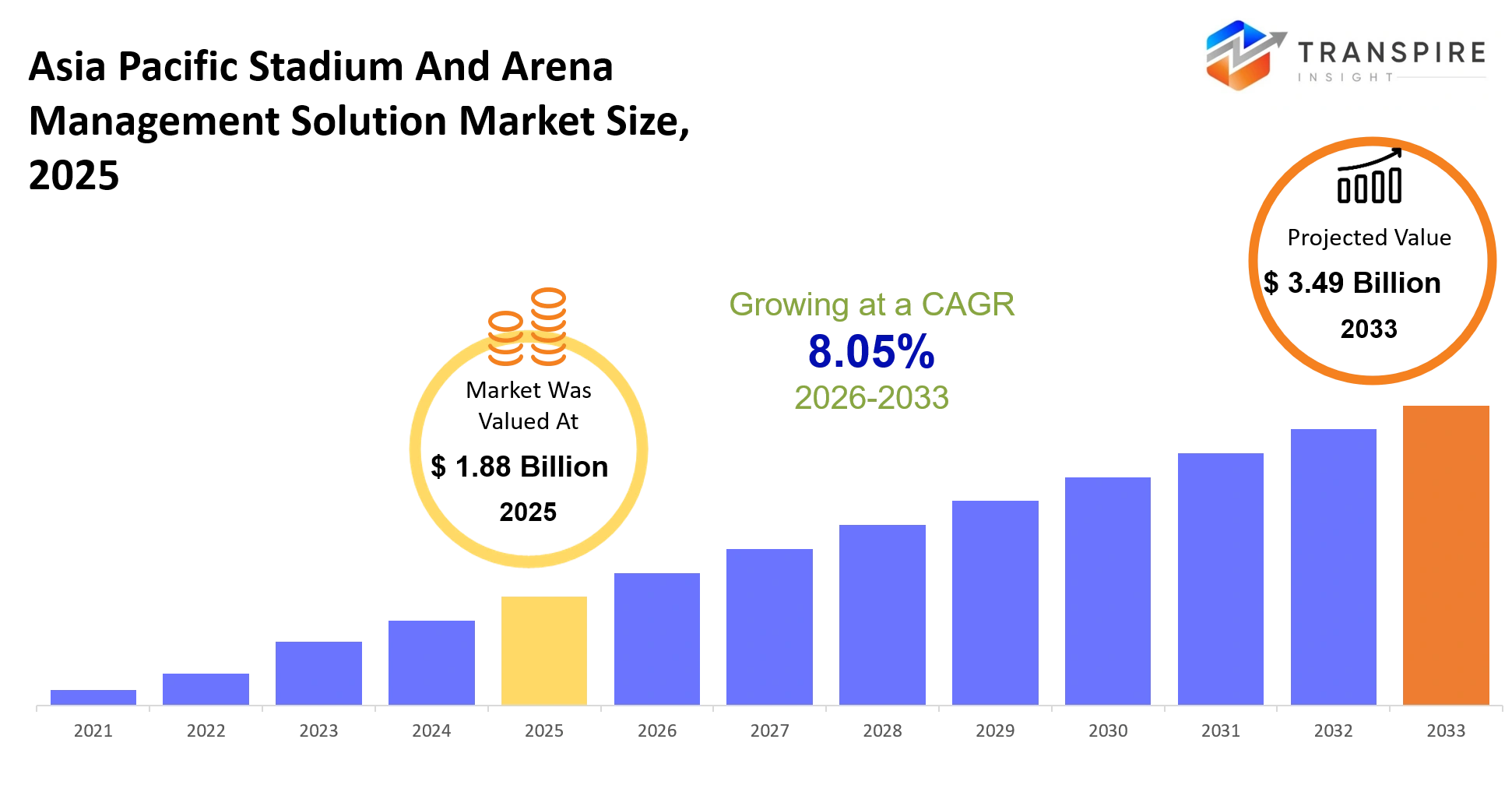
- Asia Pacific Stadium And Arena Management Solution Market Size 2025: USD 1.88 Billion
- Asia Pacific Stadium And Arena Management Solution Market Size 2033: USD 3.49 Billion
- Asia Pacific Stadium And Arena Management Solution Market CAGR: 8.05%
- Asia Pacific Stadium And Arena Management Solution Market Segments: By Solution Type (Event Management Solutions, Security Management Solutions, Ticketing Solutions, Crowd Analytics Solutions, Others); By Application (Sports Stadiums, Concert Arenas, Convention Centers, Others); By End User (Sports Organizations, Event Companies, Government Authorities, Others)
To learn more about this report,  Download Free Sample Report
Asia Pacific Stadium And Arena Management Solution Market Summary
The Asia Pacific Stadium And Arena Management Solution Market was valued at USD 1.88 Billion in 2025. It is forecast to reach USD 3.49 Billion by 2033. That is a CAGR of 8.05% over the period.
The role of the stadium and arena management solution providers in Asia Pacific is to provide tools that help stadium and arena operators manage the day to day operation of a large facility; from ticketing, access control, security monitoring, crowd movement, concession management, to facility maintenance and repairs under a unified operational view. The role of the market is therefore to facilitate venue operators running high-density events securely and profitably, thereby driving more revenue per visitor through real-time data and automated workflows.
Since 2018 the segment has been in the process of migrating from legacy on-premise to modern cloud native, interconnected systems that provide coordination among several functions within a venue. The structural migration trend was subsequently driven and enabled by mass reopening of stadium and arenas across the Asia Pacific region following the pandemic; with venue operators struggling to balance the uncertainty around attendance rules and increasing security demand, operators were spurred on to speed up their adoption of coordinated digital management systems in their venues to ensure controlled crowd density and minimized congestion at entry points.
Key Market Insights
- China is the largest, accounting for approximately 38% of the Asia Pacific Stadium And Arena Management Solution Market share in 2025 due to substantial smart stadium investment.
- India is projected to grow at the highest rate from 2025 to 2030 owing to expansion of IPL and new multi-purpose stadium constructions.
- Japan and South Korea see significant uptake of latest venue automation and AI-powered crowd management solutions.
- Integrated stadium management platform held the largest share of around 45% of the Asia Pacific Stadium And Arena Management Solution Market share in 2025.
- Access control and security solutions are the second largest market segment on the back of expanding safety compliance mandates.
- Cloud based SAAS venue management solution is expected to be the fastest growing segment over 2025 to 2030, succeeding legacy on-premise systems.
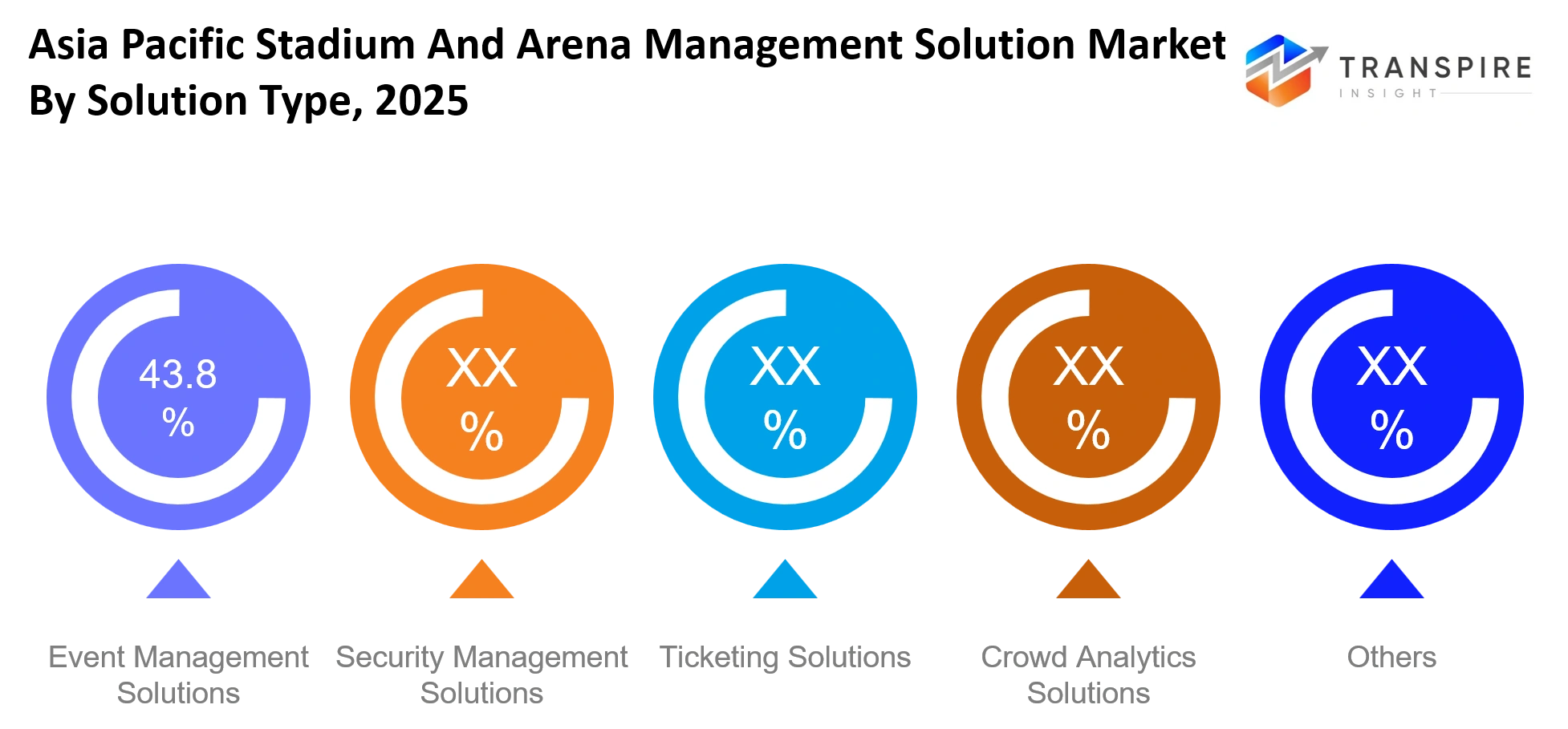
- Event operations management has captured the largest segment with around 42% of the Asia Pacific Stadium And Arena Management Solution Market share in 2025, fueled by high frequency of sports and entertainment events.
- Crowd analytics and real time occupancy monitoring emerged as the fastest growing application segment across the smart stadium deployment through 2030.
- Ticketing and digital engagement platform is expected to gain market traction, contributing towards fan monetization and operational efficiencies.
- Sports stadium operators led end-user demand, comprising almost 50% share in the Asia Pacific Stadium And Arena Management Solution Market share.
What are the Key Drivers, Restraints, and Opportunities in the Asia Pacific Stadium And Arena Management Solution Market?
The major growth factor of Asia Pacific Stadium And Arena Management Solution Market is rapid integration into the unified digital venue ecosystem. The adoption is driven by accelerated adoption pace due to post-pandemic resurgence in live events and venue operator realization that segregated legacy systems cannot manage dynamic crowd flow, varying ticket demand and real-time security needs. Subsequently, a wider array of venue owners is moving towards centralized cloud-based venue management software integrated with access control systems, surveillance systems and fan engagement features to provide streamlined operations, and thereby driving vendor revenues via increase in subscription based SaaS services and longer term service contracts to a larger number of venues.
A structural limitation is high capital investment and complexity associated with modernization of existing venue infrastructure, which in the most Asian Pacific regions are legacy and highly integrated to procurement & security workflows. This requires capital expenditure and operational disruption thus hindering the purchase of these systems thereby restricting the pace of adoption and limiting the near term revenues due to disparity in adoption across Tier 2 & Tier 3 cities.
A significant growth opportunity comes from AI driven predictive crowd management technologies where countries like India & Indonesia plan a new generation of smart venues. In addition, venues like multiple venues sports complex in India integrating without sensors and real-time data analysis platforms to enhance entry flow and concession allocation/emergency response would fuel growth by transforming vendor offerings from management software to intelligence driven venue orchestrators resulting in high value contracts and recurring analytics based services.
What Has the Impact of Artificial Intelligence Been on the Asia Pacific Stadium And Arena Management Solution Market?
AI and other advanced digital technologies are revolutionizing the Asia Pacific Stadium And Arena Management Solution Market as stadiums transform from stand-alone structures into sophisticated, data-intensive complexes. AI-based automation is being adopted throughout stadium operations to optimize primary functionalities including ticketing and access, security, HVAC management, and crowd flow control. For example, computer vision systems are used to detect congestion at entry points while centralized management platforms dynamically modify security levels and ticket lane availability to increase operational efficiency at the most critical event times.
Machine learning algorithms are being applied to predictively schedule lighting and fixture, seating and safety equipment maintenance to minimize system failures, downtime and component lifetime while also enhancing overall equipment uptime. Power optimization models are being developed, with artificial intelligence being deployed by venue operators to increase operational efficiency and reduce utility expenses-often a large component of the stadium operation budget in large-scale venues.
The positive impacts of this technology on operation-entry wait times, power consumption and equipment downtime have improved venue profitability; nevertheless, current constraints for technology adoption and full implementation include high integration costs and compatibility concerns among older stadium equipment and new technology platforms; moreover, medium sized stadiums do not possess standardized operating data systems.
Key Market Trends
- During 2021-2026 venues began shifting from isolated on-premise system to unified cloud platforms in the Asia Pacific Stadium And Arena Management Market.
- From 2022 onward, the increasing adoption of AI-based crowd analytics tools at major stadium events by operators has helped to move away from human-based monitoring and improved congestion control at major sports events in real-time.
- The post 2021 sporting events' re-opening, fueled the demand for unified digital venue management system in handling fluctuations in attendee numbers and security compliances.
- From 2023 onward, Chinese and Japanese tightened security measures boosted the stadium operators' inclination towards integrated access control and surveillance systems.
- The adoption of cashless tickets accelerated in the region post 2022 with the adoption of solutions such as Oracle-based solutions being used for speedier entry and improved per-attendee monetization.
- Between 2023-2026 India's investment in smart stadium infrastructure increased due to the growth in the Indian Premier League (IPL) and multi-city sports complex developments.
- Competitive strategies witnessed the formation of alliances between players such as Cisco, Siemens, IBM, NEC and venue operators for full end-to-end digital integration.
- From 2024 onward, an increase in deployment of edge computing and IOT sensors in stadiums increased the operational accuracy for crowd density management systems and stadium facilities management systems.
Asia Pacific Stadium And Arena Management Solution Market Segmentation
By Solution Type :
Event Management Solutions assist in managing venue operations, scheduling, and the deployment of resources for large events. Security Management Solutions enhance monitoring capabilities, control over access to venues, and improve reaction systems to emergencies at stadiums. Ticketing Solutions streamline access into venues, facilitate paperless entry, and aid in tracking revenues.
Crowd Analytics Solutions facilitate comprehensive real-time monitoring of movements to ease congestion and improve safety within large venue environments. Solution types help in ensuring operational effectiveness, real-time control over the environment.
To learn more about this report, Download Free Sample Report
By Application :
Sports Stadiums continue to serve as dominant market segments as regular events necessitate advanced systems for traffic management, authentication, and operations coordination. Concert arenas, with their fast turnaround rates and dynamic seat allocation models, continue to deploy integrated solutions to improve overall venue performance and guest management.
Convention centers utilize a variety of solutions for better synchronization of scheduled activities and crowd movement and flow control. Solution adoption has gained traction in venues as organizers begin to embrace centralized systems that eliminate time-intensive manual methods.
By End User :
Sports Organizations leverage this solution for a seamless fan experience, effective usage of the stadium and elevated safety standards. Event companies employ this system for efficient logistical and ticketing operations and to manage on-ground activities at public places and mega-events.
Government Authorities also use integrated systems in public places for seamless compliance, security and emergency management. End user adoptions have continued to increase as operational complexities build-up and the demand for centralized management systems escalates across Asia Pacific venues.
What are the Key Use Cases Driving the Asia Pacific Stadium And Arena Management Solution Market?
The primary demand for the Asia Pacific Stadium And Arena Management Solution Market is driven by event operations control for major sporting stadiums. Venue operators employ the integrated system to ensure smooth management of Ticketing, Access Control, Security screening, crowd management for high capacity games. It drives significant demand due to direct positive impact on reducing congestion during games and revenue generation in the form of faster entry and improved visitor traffic.
Secondary demands are growing for large concert arenas and convention centers where event managers demand unified systems for quick venue reconfiguration, and management of multiple event schedules. Sports enterprises are implementing analytical features to boost fan engagement and optimal seat utilization in sports leagues that span a season.
Other use cases are emerging like AI-based predictive safety monitoring and automated energy management, as part of smart stadium projects. Government bodies are beginning to integrate such systems in public facilities to facilitate emergency response planning, and compliance monitoring for newly built multipurpose complexes throughout Asia Pacific.
|
Report Metrics |
Details |
|
Market size value in 2025 |
USD 1.88 Billion |
|
Market size value in 2026 |
USD 2.03 Billion |
|
Revenue forecast in 2033 |
USD 3.49 Billion |
|
Growth rate |
CAGR of 8.05% from 2026 to 2033 |
|
Base year |
2025 |
|
Historical data |
2021 - 2024 |
|
Forecast period |
2026 - 2033 |
|
Report coverage |
Revenue forecast, competitive landscape, growth factors, and trends |
|
Regional scope |
Asia Pacific (India, China, Japan, Australia,South Korea, Rest of Asia Pacific) |
|
Key company profiled |
IBM, Cisco Systems, Oracle, SAP, Honeywell, NEC Corporation, Johnson Controls, Tech Mahindra, Infosys, Fujitsu, Huawei, Ericsson, Telefonaktiebolaget LM Ericsson, Hitachi, Accenture |
|
Customization scope |
Free report customization (country, regional & segment scope). Avail customized purchase options to meet your exact research needs. |
|
Report Segmentation |
By Solution Type (Event Management Solutions, Security Management Solutions, Ticketing Solutions, Crowd Analytics Solutions, Others); By Application (Sports Stadiums, Concert Arenas, Convention Centers, Others); By End User (Sports Organizations, Event Companies, Government Authorities, Others) |
Which Regions are Driving the Asia Pacific Stadium And Arena Management Solution Market Growth?
China accounts for the leading position within the Asia Pacific Stadium And Arena Management Solution Market on account of significant smart city initiatives pushed forward by the government, and massive stadium infrastructure construction. National policies promoting digitalization across public venues have aided large-scale deployment of integrated venue management systems. Major cities in China make consistent investments in a sizable number of high-capacity sports venues, which demand robust operational and security control systems. Additionally, China benefits from its highly developed local technology industry in the constant implementation of AI-based crowd and facility management solutions across numerous stadia facilities.
Japan occupies the second spot with steady contributions driven by constant technology upgrades rather than widespread expansion projects. Stadium operators across the country are concerned with accuracy, efficiency, and safety standards, thus promoting the gradual implementation of sophisticated venue management systems. In terms of investment cycles, Japan boasts of long-term investments where facilities are gradually upgraded, and not completely rebuilt. This stable environment provides steady market demand particularly in cities which are popular venues for international sports and entertainment events.
The fastest growing market within Asia Pacific Stadium And Arena Management Solution is India due to intensive stadium construction and a wide host of sports leagues and international events. Recent infrastructure investments for developing multi-purpose arenas, and smart stadium concepts have propelled quick digital integration in major cities across the nation. Intensified deployment of large-scale events has accelerated the market's demand for real-time ticketing, analytics, and security systems at a more rapid rate. For the players as well as the investors interested in this domain, India offers an abundant expansion opportunity from the year 2026 to 2033.
Who are the Key Players in the Asia Pacific Stadium And Arena Management Solution Market and How Do They Compete?
Competition within the Asia Pacific Stadium And Arena Management Solution Market is relatively concentrated at the top while it's somewhat fragmented at regional vendors and niche platform provider level. Global technology enterprises and specialized venue software providers compete with one another for the long-term venue management contracts from stadium operators. The competitive factors are system integration capabilities, real time data analysis, cybersecurity capabilities and cloud based service offerings instead of price alone. Incumbents maintain market position through ecosystem lock-in, while new cloud-native platform providers adopt flexible deployment methods.
Cisco Systems is expanding its presence by its emphasis on edge enabled connectivity and IoT solutions which allow for high-density stadium networks via partnerships with venue operators throughout Asia Pacific. IBM utilizes its AI based analytics solution to advance prediction maintenance and crowd management. Hybrid cloud enables optimized stadium functionality with enhanced analytical capabilities. Oracle offers its fan engagement and ticketing integrated ecosystem that provides synchronized revenue management and data access points. Siemens offers its advanced smart infrastructure integration solution by bridging stadium energy control with building automation.
NEC Corporation is differentiating its service with the utilization of its bio metric access control and facial recognition system especially at the stadium in Japan for security related entry. Honeywell concentrates on safety critical building control and integrated security systems and it is expanding by retrofitting arenas all across Asia Pacific.
Company List
- IBM
- Cisco Systems
- Oracle
- SAP
- Honeywell
- NEC Corporation
- Johnson Controls
- Tech Mahindra
- Infosys
- Fujitsu
- Huawei
- Ericsson
- Telefonaktiebolaget LM Ericsson
- Hitachi
- Accenture
Recent Development News
In January 2026, NTT DOCOMO BUSINESS entered into an exclusive distribution agreement with 24/7 Software. The partnership will deploy a cloud-based smart stadium operations platform across Japan, South Korea, and Taiwan to improve incident management, maintenance workflows, and real-time venue efficiency in stadiums and arenas.
Source https://www.newswire.ca/
In April 2026, Listo announced expansion of its venue management platform across the United States with 15 new stadium and arena deployments. The rollout reflects growing adoption of labor optimization and customer experience solutions across sports and entertainment venues, reinforcing demand for integrated stadium operations software.
Source https://www.streetinsider.com/
What Strategic Insights Define the Future of the Asia Pacific Stadium And Arena Management Solution Market?
The Asia Pacific Stadium and Arena Management Solution Market is transitioning to a fully integrated AI-first venue ecosystem, merging the operational, fan and security domains within a single digital interface. The need to deliver instantaneous decision-making for high capacity venues and sustained investment in smart infrastructure across China, India, and Southeast Asia are compelling drivers. Platforms will depend more on edge processing and machine learning for the automation of crowd control, energy management and revenue maximization within 5-7 years.
A subtle threat in this trend is the increasing reliance on closely integrated proprietary systems, and therefore an increasing tendency toward lock-in that will limit the stadium operator's control. This element of concentration risk will likely reduce future innovation, as the growth of the platform space will continue without concurrent adoption of standard protocols enabling integration.
The biggest opportunity lies in AI-enabled dynamic pricing and demand orchestration in real time for tickets and concessions, as it's in the early stages of adoption, with significant interest being displayed across major sports leagues and networks. Market participants would do best to favor platforms with open architectures that are designed to integrate third party analytical tools and other IoT devices; that strategy enables scaling while minimizing future switching costs.
Asia Pacific Stadium And Arena Management Solution Market Report Segmentation
By Solution Type
- Event Management Solutions
- Security Management Solutions
- Ticketing Solutions
- Crowd Analytics Solutions
By Application
- Sports Stadiums
- Concert Arenas
- Convention Centers
By End User
- Sports Organizations
- Event Companies
- Government Authorities
Frequently Asked Questions
Find quick answers to common questions.
The Asia Pacific Stadium And Arena Management Solution Market size is USD 3.49 Billion in 2033.
Key segments for the Asia Pacific Stadium And Arena Management Solution Market are By Solution Type (Event Management Solutions, Security Management Solutions, Ticketing Solutions, Crowd Analytics Solutions, Others); By Application (Sports Stadiums, Concert Arenas, Convention Centers, Others); By End User (Sports Organizations, Event Companies, Government Authorities, Others).
Major Asia Pacific Stadium And Arena Management Solution Market players are IBM, Cisco Systems, Oracle, SAP, Honeywell, NEC Corporation, Johnson Controls, Tech Mahindra, Infosys, Fujitsu, Huawei, Ericsson, Telefonaktiebolaget LM Ericsson, Hitachi, Accenture.
The Asia Pacific Stadium And Arena Management Solution Market size is USD 1.88 Billion in 2025.
The Asia Pacific Stadium And Arena Management Solution Market CAGR is 8.05% from 2026 to 2033.
- IBM
- Cisco Systems
- Oracle
- SAP
- Honeywell
- NEC Corporation
- Johnson Controls
- Tech Mahindra
- Infosys
- Fujitsu
- Huawei
- Ericsson
- Telefonaktiebolaget LM Ericsson
- Hitachi
- Accenture
About the Authors

Mayur Shinde
I am Mayur Shinde, a Senior Research Analyst at Transpire Insight, specializing in the Automotive & Transportation and Information & Communication Technology (ICT) Industry. My work focuses on analyzing emerging market trends, technological advancements, competitive landscapes, and industry developments to deliver accurate, data-driven insights. I am passionate about transforming complex market information into clear, actionable content that helps businesses, professionals, and decision-makers stay informed and make confident strategic decisions.

Chakradhar Khansole
Chakradhar serves as the Research Director at Transpire Insight, bringing over 8 years of experience in technology, innovation, and strategic market intelligence. He specializes in transforming complex market data into actionable business insights that enable organizations to make informed, growth-oriented decisions. Recognized for his strategic vision and analytical expertise, Chakradhar leads high-impact research initiatives, delivering comprehensive market assessments, competitive intelligence, and forward-looking industry analysis.
Recently Published Reports
-
Apr 2026
3D Optical Profiler Market
3D Optical Profiler Market Size, Share & Analysis Report By Type (Desktop 3D Optical Profiler, and Portable 3D Optical Profiler), By Technology (Confocal Technology, and White Light Interference), By End-Use Industry (Manufacturing, Research Institutions, Automotive, Aerospace and Defense, Medical Devices, and Other), and Geography (North America, Europe, Asia-Pacific, Middle East and Africa, South and Central America), 2021 - 2031
-
Apr 2026
Depth Sensor Market
Depth Sensor Market Size, Share & Analysis Report By Type (Infrared Depth Sensors, Time-of-Flight (ToF) Sensors, Stereo Vision Sensors, Structured Light Sensors, Ultrasonic Depth Sensors), By Application (Automotive, Robotics, Gaming, Consumer Electronics, Industrial Automation, Healthcare, Security & Surveillance, Others), By End Users (Automotive Manufacturers, Consumer Electronics Companies, Healthcare Providers, Industrial Companies, Security Agencies, Gaming Companies, Robotics Companies, Others), and Geography (North America, Europe, Asia-Pacific, Middle East and Africa, South and Central America), 2021 – 2031
-
Apr 2026
Digital Manufacturing Market
Digital Manufacturing Market Size, Share & Analysis Report By Component (Hardware, Software, and Services), By Technology (Robotics, 3D Printing, Internet of Things (IoT), and Others), By Application (Automotive and Transportation, Aerospace and Defense, Consumer Electronics, Industrial Machinery, and Others), By Process Type (Computer-Based Designing, Computer-Based Simulation, Computer 3D Visualization, Analytics, and Others), and Geography (North America, Europe, Asia-Pacific, Middle East and Africa, South and Central America), 2021 – 2031
-
Apr 2026
Digital Visa Services Market
Digital Visa Services Market Size, Share & Analysis Report By Type (Individual Travelers, Group Travelers), By Application (Tourism, Business Travel, Others), and Geography (North America, Europe, Asia-Pacific, Middle East and Africa, South and Central America), 2021 – 2031