
United Kingdom Rail Track Monitoring System Market Size & Forecast:
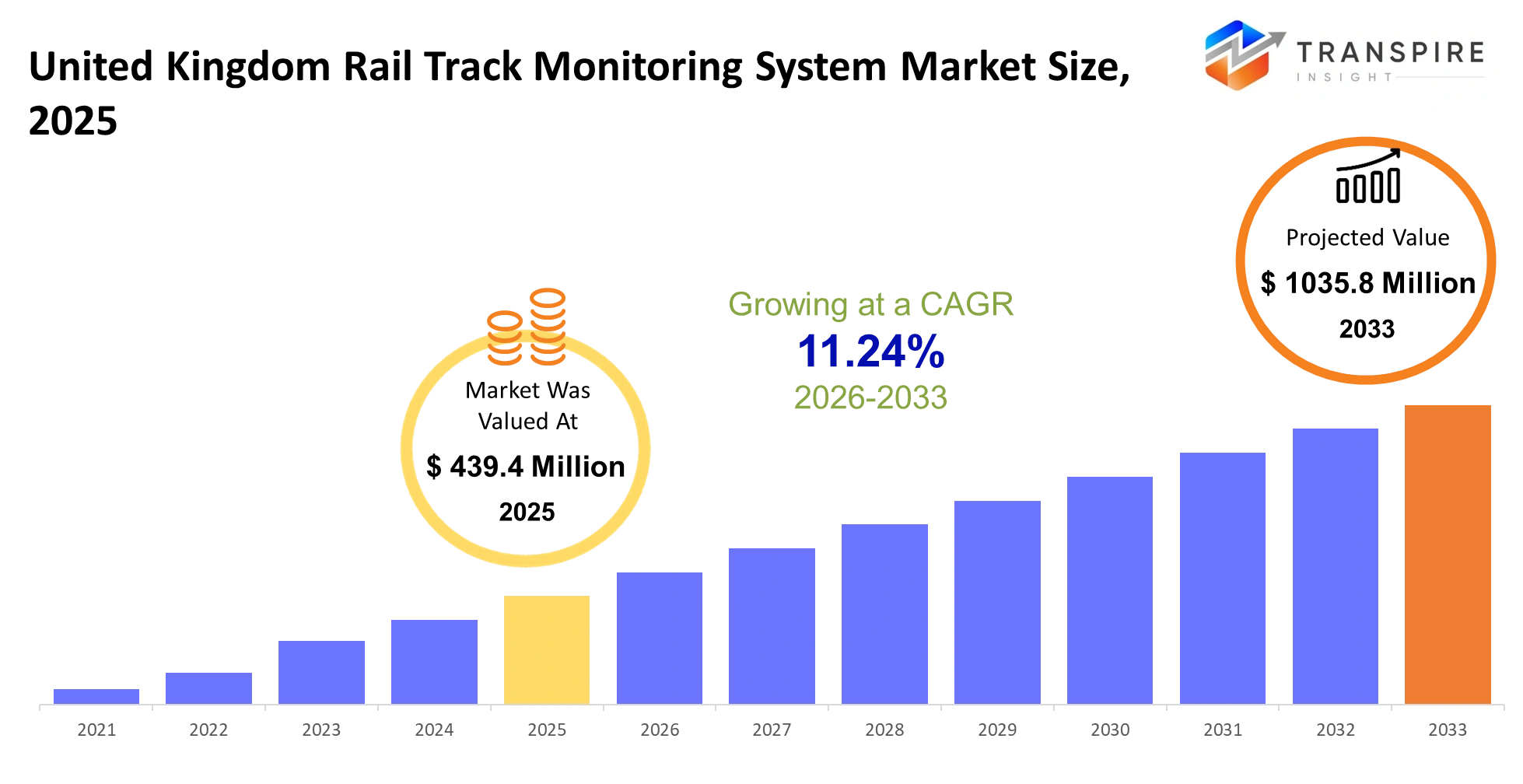
- United Kingdom Rail Track Monitoring System Market Size 2025: USD 439.4 Million
- United Kingdom Rail Track Monitoring System Market Size 2033: USD 1035.8 Million
- United Kingdom Rail Track Monitoring System Market CAGR: 11.24%
- United Kingdom Rail Track Monitoring System Market Segments: By Component (Sensors, Monitoring Software, Cameras & Imaging Systems, Communication Systems, Data Analytics Platforms, Edge Devices, Others); By Technology (IoT-based Monitoring, AI-based Monitoring, Fiber Optic Monitoring, Ultrasonic Inspection, LiDAR Monitoring, Drone-based Inspection, Others); By Application (Track Geometry Monitoring, Rail Defect Detection, Predictive Maintenance, Vibration Monitoring, Safety Monitoring, Asset Management, Others); By End User (Railway Operators, Metro Networks, Freight Rail Companies, Government Authorities, Infrastructure Providers, Others).
To learn more about this report,  Download Free Sample Report
United Kingdom Rail Track Monitoring System Market Summary
The United Kingdom Rail Track Monitoring System Market was valued at USD 439.4 Million in 2025. It is forecast to reach USD 1035.8 Million by 2033. That is a CAGR of 11.24% over the period.
In the United Kingdom, the rail track monitoring system market sort of keeps the rail network running day to day, by flagging track defects, structural fatigue, weird alignment issues, and vibration abnormalities, before any of it starts messing with operations. Rail operators depend on these kinds of solutions to dial down the unplanned maintenance stuff, avoid service hiccups , and lift passenger safety across busy commuter and freight routes. In the last few years, the market has clearly been drifting away from manual inspection calendars—more like checklists now and then, not a whole routine—toward always-on digital monitoring. That whole approach leans heavily on sensors, AI analytics, drones, and predictive maintenance software, pretty much nonstop.
This change really gathered momentum after pandemic-era labor shortages, and then the backlog of maintenance work showed where the inspection-heavy models were shaky. At the same time, the UK government keeps pushing rail modernization programs plus decarbonization targets, so operators are feeling the heat to pull more productive life out of their assets, but without messing up network efficiency. That’s why lately, when infrastructure managers talk condition-based maintenance, suppliers are also landing larger deals for real-time monitoring platforms, data integration services , and automated inspection technologies. And in turn that creates better long-term, repeatable revenue opportunities across most of the segment.
Key Market Insights
- The United Kingdom Rail Track Monitoring System Market seems to be moving, sort of quickly, toward real time condition monitoring, to keep maintenance costs down and make passenger safety a bit more reliable across those high traffic rail corridors.
- After 2021, digital twin integration plus AI powered analytics really started getting attention, and it now helps teams catch faults earlier, and even supports predictive infrastructure management across the broader national rail networks.
- In the meantime, England was leading the United Kingdom Rail Track Monitoring System Market, holding about 68% market share in 2025, mostly because there’s dense rail infrastructure there, and modernization spending is a higher priority.
- Scotland looks like the fastest-growing regional market through 2030, driven by freight rail upgrades, the growing use of remote monitoring, and smart transport investments that keep expanding.
- On the product side, hardware systems such as sensors , ultrasonic detectors, and track geometry measurement equipment represented roughly 46% of the industry share in 2025.
- Software and analytics platforms sort of showed up as the fastest-growing part between 2025 and 2030, while operators lean into predictive maintenance and cloud based monitoring solutions.
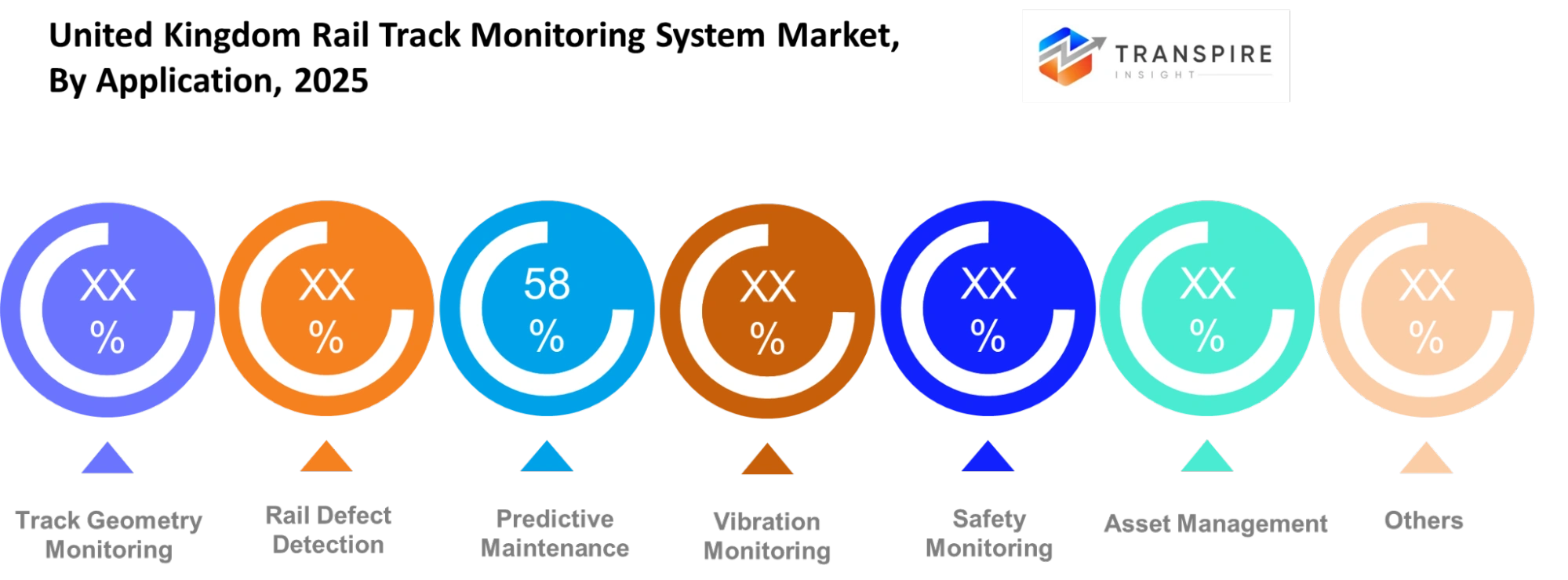
- Track geometry monitoring still stayed the main use case segment, with more than 38% market share in 2025, since operators need continuous alignment, and vibration assessment stuff.
- Meanwhile predictive maintenance applications are expected to grow the quickest over the forecast window, basically because the demand for automated fault prediction systems keeps climbing.
- Passenger rail operators held almost 57% share in the United Kingdom rail infrastructure monitoring industry during 2025, pushed by network congestion and punctuality targets.
What are the Key Drivers, Restraints, and Opportunities in the United Kingdom Rail Track Monitoring System Market?
The main thing driving the United Kingdom Rail Track Monitoring System Market is that it moves away from reactive upkeep and toward predictive infrastructure management across the whole rail network. This change really picked up after repeated service disruptions, older track assets, and the growing operational costs started showing the financial weak spots of doing only manual checks on a routine basis. Now, network operators increasingly depend on sensor-based watch systems, AI powered diagnostics, and even automated inspection vehicles, all to spot track issues before they turn into actual failures. So in the end you get less money burned on emergency repairs, reduced schedule disruptions, and better asset availability. And since rail operators are tying maintenance budgets to measurable performance outcomes and punctuality targets, spending on always-on monitoring platforms keeps climbing.
At the same time, the biggest restraint is the kind of structural tangle involved in fitting today’s monitoring tools into the rail infrastructure that was built decades ago. A lot of UK routes still run with split signaling arrangements, older maintenance software, and uneven digital connectivity. Rolling out upgrades means long procurement tracks, careful coordination for network shutdowns, and a large capital bill. Those obstacles slow down broad deployments, and they also make it harder for smaller regional operators to adopt advanced monitoring technologies as quickly as the bigger urban corridors can.
There is a big chance in expanding autonomous inspection technologies, especially drone- based monitoring and fiber optic sensing. Rail operators are now testing remote inspection tools along rural freight corridors and those hard to reach routes across Scotland and the north of England. In a sense, these tools cut down on inspection time, they make the data feel more accurate , and they also open up fresh long term service agreements for software analytics and infrastructure monitoring providers, too.
What Has the Impact of Artificial Intelligence Been on the United Kingdom Rail Track Monitoring System Market?
Artificial intelligence, and sort of advanced digital technologies are shifting the way rail operators think about track checks, upkeep planning, and overall network dependability across the United Kingdom. More and more, they are going with AI-enabled monitoring setups using onboard sensors, machine vision cameras, plus LiDAR scanners on dedicated inspection trains. The idea is to automate defect spotting, and reduce the whole dependence on manual inspections, which honestly takes time.
These systems can notice track misalignment, rail cracks, ballast weakening, and even vibration oddities in real time. Then maintenance teams get a clearer signal, before those issues grow into faults that mess up services. At the same time machine learning models help with predictive maintenance, by looking at past track records, weather swings, axle loads, and also train frequency routines, to guess how likely an asset is to fail. Infrastructure managers then use these hints to decide where to place maintenance efforts, pick maintenance windows, and stretch asset lifespan while keeping disruption to a smaller size.
Some rail operators have said they now see shorter inspection loops, and they’ve measured fewer emergency repairs after rolling out predictive analytics platforms. AI-driven scheduling can also lift network uptime by arranging maintenance work around low-traffic times, cutting down service delays and lowering operating expenses. So it sounds pretty beneficial, overall
Even so, integration is still a big sticking point. A lot of parts of the UK rail network still operate with scattered legacy signaling and maintenance systems, which were never meant for high volume real time data processing. This leads to interoperability headaches, increases deployment costs, and makes it harder for AI models to stay accurate when they’re trained on inconsistent historical infrastructure information
Key Market Trends
- Since 2021, Network Rail has been expanding condition-based maintenance programs , sort of to cut down on emergency repairs and make infrastructure more available across those packed commuter corridors, you know.
- Between 2022 and 2025, rail operators started swapping manual visual checks for AI-enabled cameras, LiDAR scanners and drone surveys, which are quicker and more consistent.
- Then, after the pandemic-era maintenance backlogs showed the operational hazards of inspection-heavy approaches, predictive maintenance software adoption really took off.
- Siemens Mobility and Hitachi Rail also put more money into cloud-connected rail analytics platforms, especially after 2023 modernization contracts came through.
- Freight operators, meanwhile, leaned harder into remote monitoring systems as heavier axle loads ramped up track fatigue and basically raised maintenance frequency on logistics routes.
- Fiber optic sensing technology gained real traction after 2022, because operators wanted nonstop vibration monitoring across tunnels, bridges, and high-speed rail sections.
- In Scotland and northern England, regional rail networks turned to drone-assisted inspections, to reduce maintenance delays in places where the terrain and operations get pretty difficult.
- From 2020 to 2025 operators started prioritizing integrated software platforms that can braid signaling, asset management, and track condition analytics into one dashboard, without too much fuss.
- Procurement behavior drifted toward longer-term service agreements too, since many operators outsourced predictive analytics and remote infrastructure monitoring capabilities.
- And over the past five years , regulatory pressure linked to punctuality targets and passenger safety metrics pushed rail operators to shrink the time to detect faults.
United Kingdom Rail Track Monitoring System Market Segmentation
By Component:
Sensors sort of play a big role in rail track monitoring, because nonstop data collection can help catch cracks, track alignment changes, and even pressure variations before the bigger kind of failures show up. The monitoring software then kind of helps with centralized control by shuffling inspection records, maintenance timelines, and these real-time alerts that railway authorities actually rely on. Meanwhile cameras and imaging systems can make the inspection work more precise, by grabbing track conditions across busy corridors and those hard operating situations where it’s not so easy.
For communication, the systems move the data between monitoring gear, control centers, and the field maintenance crews. Then data analytics platforms let railway operators study longer term infrastructure behavior patterns, and what maintenance will probably be needed next. Edge devices also help by processing the inspection data near where it’s collected, so there are fewer delays during those fault detection tasks.
By Technology:
IoT-based monitoring technology helps with a kind of ongoing track condition check, using connected sensors placed across the railway infrastructure, so it is kind of continuous. In that same mood, AI-based monitoring systems make inspection work faster, because they can pick out defects and also abnormal vibration patterns, with less manual involvement than before. Fiber optic monitoring technology also comes in handy, it enables long-distance track surveillance, and it tends to work well inside tunnels, along bridges, and on remote railway stretches where older inspection systems hit limitations more often.
Then there is ultrasonic inspection technology, which stays useful for catching internal rail defects that surface-level inspection simply cannot see. LiDAR monitoring systems support more accurate mapping and alignment analysis for rail corridors, plus the nearby infrastructure. Drone-based inspection technology reduces inspection time too, and it can reach areas across difficult terrain, without too much hassle. Other options you might see include thermal imaging, acoustic monitoring, and satellite-assisted rail inspection solutions, which are used for wider infrastructure assessment and broader situational awareness.
By Application:
Rail geometry monitoring is still a big deal in practice,mostly because railway operators need ongoing checks of alignment, bend radius, and elevation status across the running rail network. The rail defect detection side helps spot issues like cracking, corrosion, and general structural wear, before safety problems start creeping up. Then there is predictive maintenance, which supports timetabled repairs by looking at day to day operational data and pointing to which infrastructure sections will probably need care before anything breaks down.
On top of that, vibration monitoring systems give insight into how stable the rail is and how well the rolling stock and nearby equipment are performing along passenger lines and freight routes. Safety monitoring applications help prevent incidents by following operational hazards, surrounding conditions, and how much strain the infrastructure is taking. Asset management applications let railway authorities sort inspection notes, schedule upkeep, and set spending priorities for infrastructure upgrades. There are also related uses like bridge monitoring, tunnel assessment, and environmental condition tracking along railway corridors, sometimes in a more continuous manner than people expect.
To learn more about this report, Download Free Sample Report
By End User:
Railway operators count as a pretty major end-user group, because big passenger networks need continuous monitoring setups, so they can keep service reliability high and avoid operational delays that pile up. In recent years metro networks are starting to lean into automated track inspection technologies, not just because it sounds nice but because dense urban transport really benefits, and maintenance efficiency can go up too. At the same time freight rail companies tend to put money into monitoring platforms to handle heavy axle loads better, cut down infrastructure wear, and keep cargo movement more dependable.
Government authorities usually help things along via railway modernization projects, safety regulations, and infrastructure development programs that span across national transport systems. Infrastructure providers also lean on monitoring systems during rail construction, maintenance, and expansion work, to support long-term operational performance. Other end users still show up as well, like private rail contractors, maintenance service companies, and industrial transport operators—especially those working on specialized rail infrastructure management tasks, and you can see it in day to day operations where “inspection + feedback” matters.
What are the Key Use Cases Driving the United Kingdom Rail Track Monitoring System Market?
Rail geometry monitoring still feels like the big driver for adoption across the United Kingdom rail scene. Passenger rail operators depend on ongoing alignment and vibration assessment setups to limit service disruptions, push punctuality targets, and avoid track failures especially on busy commuter lines, and the intercity type corridors where the usage never really slows down.
Predictive maintenance plus rail defect detection is also getting more traction now, particularly with freight rail companies and metro networks. Freight teams use sensor based monitoring to handle track stress from heavy cargo loads, while metro systems lean on automated inspection tools so they can keep running at high frequency through the day, with less time lost for maintenance, even when schedules are tight.
Newer things coming up are drone assisted inspection and fiber optic sensing over harder to reach rail segments like remote stretches, tunnels, and bridge assets. Rail authorities are trying AI supported digital twin platforms too, putting live monitoring signals together with infrastructure models, to make long term maintenance choices feel more grounded and to trim surprise repair spending, across the forecast period.
|
Report Metrics |
Details |
|
Market size value in 2025 |
USD 439.4 Million |
|
Market size value in 2026 |
USD 491.5 Million |
|
Revenue forecast in 2033 |
USD 1035.8 Million |
|
Growth rate |
CAGR of 11.24% from 2026 to 2033 |
|
Base year |
2025 |
|
Historical data |
2021 - 2024 |
|
Forecast period |
2026 - 2033 |
|
Report coverage |
Revenue forecast, competitive landscape, growth factors, and trends |
|
Regional scope |
Middle East and Africa (Saudi Arabia, United Arab Emirates, South Africa, Rest of Middle East and Africa) |
|
Key company profiled |
Siemens Mobility, Hitachi Rail, Alstom, Thales Group, Nokia, Bentley Systems, Fugro, Hexagon AB, ENSCO Rail, MERMEC, IBM, Huawei, Balfour Beatty, Network Rail, SKF. |
|
Customization scope |
Free report customization (country, regional & segment scope). Avail customized purchase options to meet your exact research needs. |
|
Report Segmentation |
By Component (Sensors, Monitoring Software, Cameras & Imaging Systems, Communication Systems, Data Analytics Platforms, Edge Devices, Others); By Technology (IoT-based Monitoring, AI-based Monitoring, Fiber Optic Monitoring, Ultrasonic Inspection, LiDAR Monitoring, Drone-based Inspection, Others); By Application (Track Geometry Monitoring, Rail Defect Detection, Predictive Maintenance, Vibration Monitoring, Safety Monitoring, Asset Management, Others); By End User (Railway Operators, Metro Networks, Freight Rail Companies, Government Authorities, Infrastructure Providers, Others). |
Which Regions are Driving the United Kingdom Rail Track Monitoring System Market Growth?
England still comes out as the leading area in the United Kingdom Rail Track Monitoring System Market, mainly because the busiest passenger and cargo corridors run inside this network. In other words, big rail modernization moves, strong safety supervision, and constant groundwork improvements help the spread of predictive monitoring tools on the major between cities lines. Network Rail together with local transport authorities keep putting money into automated inspection tools to cut down timetable disruptions and handle aging assets in a more efficient manner. Also, a fairly solid ecosystem of rail technology suppliers, software providers, and engineering subcontractors backs up the long term market strength across the region.
Scotland, meanwhile, plays a more stable and steady role in market revenue, even if the growth rhythm is a bit different from England. Rail operators there tend to prioritize infrastructure resilience, remote corridor surveillance and weather driven track safeguards, largely because the terrain is tough and the surroundings can be harsh. Government supported rail investment schemes encourage a gradual roll out of fiber optic sensing systems, drone based inspections, and off site asset management approaches across regional routes. With consistent public infrastructure spending and long-range upkeep planning, demand for rail monitoring solutions stays dependable across the Scottish rail network.
Wales seems like its becoming the fastest growing regional market lately, mostly because there’s been more investment in metro modernization, and also in regional rail connectivity over the last few years. As urban transit networks grew, and as digital railway ideas moved along, operators started leaning into AI based inspection systems and real-time monitoring platforms, across commuter rail services. On top of that, the recent infrastructure upgrades tied to the South Wales Metro project generated even more need for integrated analytics and automated maintenance technologies, kinda everywhere. So yeah, this momentum is opening up solid opportunities for technology providers, software developers and infrastructure monitoring firms that want to expand between 2026 and 2033.
Who are the Key Players in the United Kingdom Rail Track Monitoring System Market and How Do They Compete?
The competitive landscape of the United Kingdom Rail Track Monitoring System Market is still kind of moderately consolidated, with big rail technology providers playing next to smaller specialized monitoring and analytics firms. At the moment, the fight seems to be less about just equipment pricing, and more about technology integration, predictive upkeep capability, and steady long-term service support , not only one-time sales. Big infrastructure companies keep defending their market share using multi-year rail modernization contracts while smaller tech firms often get more attention by pushing AI-driven analytics, wireless sensing systems and remote inspection platforms. Buyers also seem to lean more toward suppliers that can blend hardware, software, and maintenance support into one unified monitoring ecosystem, even if the word “ecosystem” is a bit overused.
Siemens Mobility competes with advanced automation and predictive maintenance platforms made for large passenger rail networks. It tends to stand out by linking signaling and infrastructure analytics systems so track monitoring data can flow into broader rail operations management , more or less end-to-end. Hitachi Rail, meanwhile, leans hard into digital rail infrastructure and cloud-based asset management solutions. Its active participation in UK rail modernization projects gives it a practical edge in rolling out real-time monitoring systems across both intercity and commuter networks.
Senceive does wireless condition monitoring in tough rail settings, like bridges and tunnels plus those remote track sections where it gets annoying fast. They use low-power wireless sensor tech, so installation is less complicated and maintenance costs stay lower compared with standard wired systems. Alstom meanwhile, pushes its market position via automated inspection solutions, and a more connected maintenance software platform, kinda supporting predictive asset management in a more organized way. Balfour Beatty expands too, through rail infrastructure maintenance contracts and partnerships that link to longer-term transport upgrade projects across England, Scotland and Wales.
Company List
- Siemens Mobility
- Hitachi Rail
- Alstom
- Thales Group
- Nokia
- Bentley Systems
- Fugro
- Hexagon AB
- ENSCO Rail
- MERMEC
- IBM
- Huawei
- Balfour Beatty
- Network Rail
- SKF
Recent Development News
In March 2026, Heavy Haul Rail announced operational expansion following its post-spinoff restructuring in the UK freight rail sector. The company began independent operations after the Freightliner intermodal division sale, strengthening its asset base for infrastructure and track monitoring-dependent freight operations.
Source: https://en.wikipedia.org/
In March 2026, Eversholt Rail Group was integrated into Beacon Rail following acquisition completion. The transaction consolidated one of the UK’s largest rolling stock leasing portfolios, impacting asset monitoring and digital condition-tracking systems across leased fleets.
Source: https://en.wikipedia.org/
What Strategic Insights Define the Future of the United Kingdom Rail Track Monitoring System Market?
The United Kingdom Rail Track Monitoring System Market is slowly moving toward fully connected, data-driven infrastructure management where nonstop monitoring kind of replaces the old periodic inspection rhythm across passenger as well as freight rail lines. This trend seems to be pulled less by fresh rail expansion and more by the ongoing pressure to boost network reliability, minimize maintenance disruption , and stretch the usable life of older rail assets. Over the next five to seven years, rail operators are likely to put more focus on integrated analytics platforms that can blend signaling data with asset health monitoring, plus predictive maintenance into one operational setup.
There’s also a quieter risk, not everyone talks about it, which has to do with relying on fragmented legacy infrastructure systems that can make interoperability slower between new monitoring technologies and day to day rail operations. If integration drags, project budgets can rise, and the efficiency gains operators expect from digital modernization programs may feel smaller than planned. Meanwhile, fiber optic sensing together with AI supported digital twin capabilities are also gaining momentum as longer-term opportunities, especially for tunnels bridges and far away freight corridors.
So, market participants should lean into collaborations with rail software providers and infrastructure operators, in order to form scalable monitoring ecosystems rather than just selling standalone hardware solutions.
United Kingdom Rail Track Monitoring System Market Report Segmentation
By Component
- Sensors
- Monitoring Software
- Cameras & Imaging Systems
- Communication Systems
- Data Analytics Platforms
- Edge Devices
By Technology
- IoT-based Monitoring
- AI-based Monitoring
- Fiber Optic Monitoring
- Ultrasonic Inspection
- LiDAR Monitoring
- Drone-based Inspection
By Application
- Track Geometry Monitoring
- Rail Defect Detection
- Predictive Maintenance
- Vibration Monitoring
- Safety Monitoring
- Asset Management
By End User
- Railway Operators
- Metro Networks
- Freight Rail Companies
- Government Authorities
- Infrastructure Providers
Frequently Asked Questions
Find quick answers to common questions.
The United Kingdom Rail Track Monitoring System Market size is USD 1035.8 Million in 2033.
Key segments for the United Kingdom Rail Track Monitoring System Market are By Component (Sensors, Monitoring Software, Cameras & Imaging Systems, Communication Systems, Data Analytics Platforms, Edge Devices, Others); By Technology (IoT-based Monitoring, AI-based Monitoring, Fiber Optic Monitoring, Ultrasonic Inspection, LiDAR Monitoring, Drone-based Inspection, Others); By Application (Track Geometry Monitoring, Rail Defect Detection, Predictive Maintenance, Vibration Monitoring, Safety Monitoring, Asset Management, Others); By End User (Railway Operators, Metro Networks, Freight Rail Companies, Government Authorities, Infrastructure Providers, Others).
Major United Kingdom Rail Track Monitoring System Market players are Siemens Mobility, Hitachi Rail, Alstom, Thales Group, Nokia, Bentley Systems, Fugro, Hexagon AB, ENSCO Rail, MERMEC, IBM, Huawei, Balfour Beatty, Network Rail, SKF.
The United Kingdom Rail Track Monitoring System Market size is USD 439.4 Million in 2025.
The United Kingdom Rail Track Monitoring System Market CAGR is 11.24% from 2026 to 2033.
- Siemens Mobility
- Hitachi Rail
- Alstom
- Thales Group
- Nokia
- Bentley Systems
- Fugro
- Hexagon AB
- ENSCO Rail
- MERMEC
- IBM
- Huawei
- Balfour Beatty
- Network Rail
- SKF
Recently Published Reports
-
Apr 2026
3D Optical Profiler Market
3D Optical Profiler Market Size, Share & Analysis Report By Type (Desktop 3D Optical Profiler, and Portable 3D Optical Profiler), By Technology (Confocal Technology, and White Light Interference), By End-Use Industry (Manufacturing, Research Institutions, Automotive, Aerospace and Defense, Medical Devices, and Other), and Geography (North America, Europe, Asia-Pacific, Middle East and Africa, South and Central America), 2021 - 2031
-
Apr 2026
Depth Sensor Market
Depth Sensor Market Size, Share & Analysis Report By Type (Infrared Depth Sensors, Time-of-Flight (ToF) Sensors, Stereo Vision Sensors, Structured Light Sensors, Ultrasonic Depth Sensors), By Application (Automotive, Robotics, Gaming, Consumer Electronics, Industrial Automation, Healthcare, Security & Surveillance, Others), By End Users (Automotive Manufacturers, Consumer Electronics Companies, Healthcare Providers, Industrial Companies, Security Agencies, Gaming Companies, Robotics Companies, Others), and Geography (North America, Europe, Asia-Pacific, Middle East and Africa, South and Central America), 2021 – 2031
-
Apr 2026
Digital Manufacturing Market
Digital Manufacturing Market Size, Share & Analysis Report By Component (Hardware, Software, and Services), By Technology (Robotics, 3D Printing, Internet of Things (IoT), and Others), By Application (Automotive and Transportation, Aerospace and Defense, Consumer Electronics, Industrial Machinery, and Others), By Process Type (Computer-Based Designing, Computer-Based Simulation, Computer 3D Visualization, Analytics, and Others), and Geography (North America, Europe, Asia-Pacific, Middle East and Africa, South and Central America), 2021 – 2031
-
Apr 2026
Digital Visa Services Market
Digital Visa Services Market Size, Share & Analysis Report By Type (Individual Travelers, Group Travelers), By Application (Tourism, Business Travel, Others), and Geography (North America, Europe, Asia-Pacific, Middle East and Africa, South and Central America), 2021 – 2031