

United Kingdom Sports Technology Market Size & Forecast:
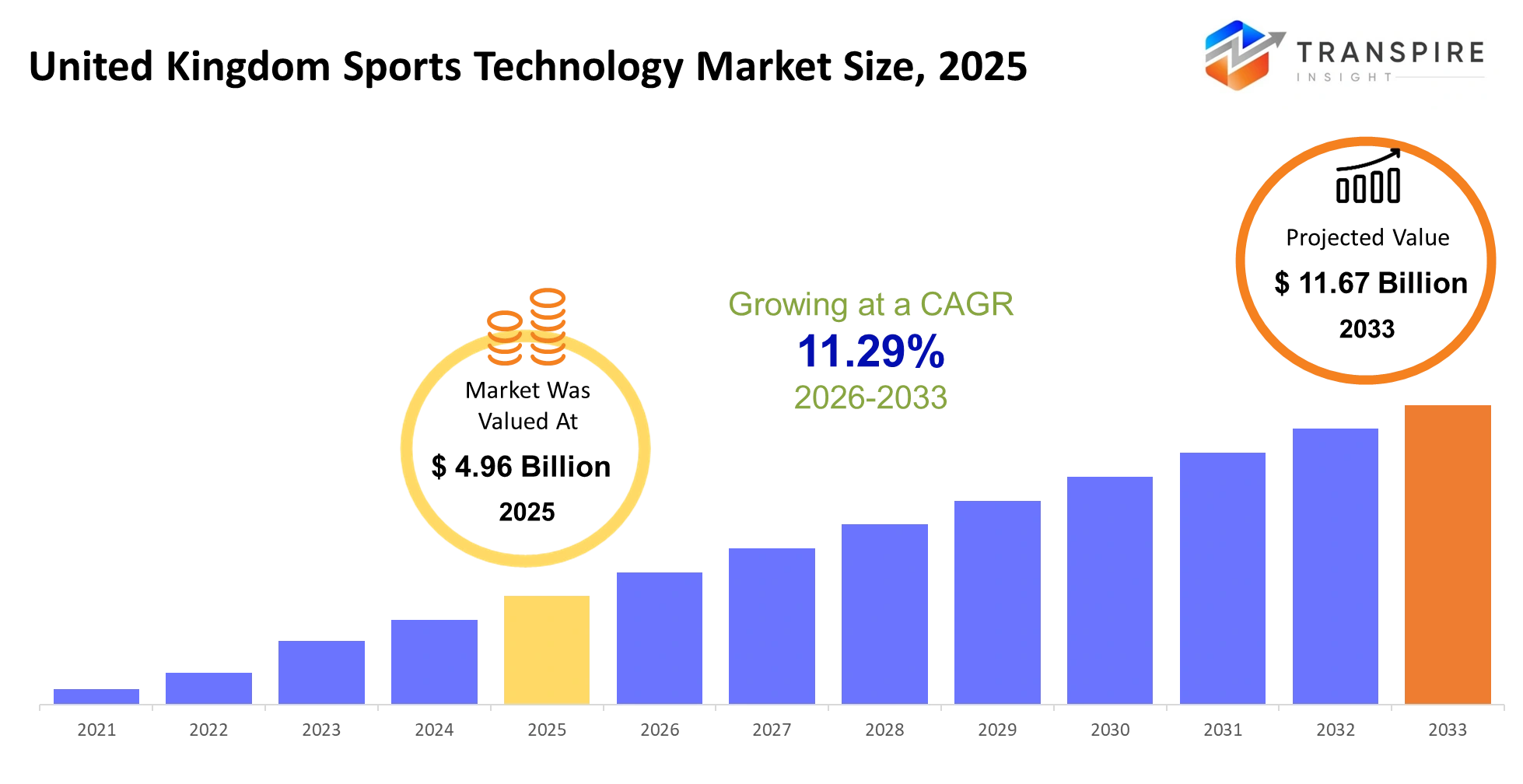
- United Kingdom Sports Technology Market Size 2025: USD 4.96 Billion
- United Kingdom Sports Technology Market Size 2033: USD 11.67 Billion
- United Kingdom Sports Technology Market CAGR: 11.29%
- United Kingdom Sports Technology Market Segments: By Technology (Wearable Technology, Smart Stadium Solutions, Sports Analytics, AR & VR Sports Tech, AI-based Coaching Systems, Athlete Monitoring Systems, Others); By Application (Player Performance Analysis, Fan Engagement, Sports Broadcasting, Injury Prevention, Fitness Tracking, Event Management, Others); By Deployment (Cloud-based Platforms, On-premise Systems, Mobile Applications, IoT-enabled Platforms, Others); By Sport Type (Football, Cricket, Tennis, Rugby, Esports, Others).
To learn more about this report,  Download Free Sample Report
United Kingdom Sports Technology Market Summary
The United Kingdom Sports Technology Market was valued at USD 4.96 Billion in 2025. It is forecast to reach USD 11.67 Billion by 2033. That is a CAGR of 11.29% over the period.
In the United Kingdom, sports technology kinda helps clubs, leagues, broadcasters, and stadium operators to improve performance analysis , boost fan interaction, and make event operations smoother via digital tools like wearable sensors, AI powered analytics systems, smart ticketing setups, and immersive broadcasting solutions, you know. Over the past five years, things moved from kinda patchy digital adoption to more connected, data focused ecosystems where real-time insights steer both what happens on the pitch, and also the commercial plans. One big structural change is that there has been a fast push toward AI enabled performance analytics and OTT streaming platforms, which in a sense replaced the older broadcast only approach that used to dominate.
Then COVID-19 showed up, and it basically acted like a major trigger, because the stadiums went empty, so teams had to accelerate spending on remote fan engagement and virtual viewing experiences. That shock rearranged revenue models, and stakeholders started to monetize digital audiences in a more intentional way . Because of that, uptake has intensified across pro and semi pro levels, not just the biggest clubs.
Key Market Insights
- London is kinda running the United Kingdom Sports Technology Market , with about 38% share in 2025, mostly because there’s a lot of clubs packed in close and tech investment really piles up there too.
- Northern England meanwhile is the fastest-moving area from 2025 to 2030, it is mainly propelled by stadium modernization efforts and the broader buildout of digital fan engagement infrastructure, you know, the usual upgrades but more coordinated.
- In terms of offerings , sports analytics software takes the top spot with roughly 42% share, and the push is tied to AI based performance optimization demand that keeps getting louder each year.
- Wearable technology comes in second, supported by athlete tracking systems and the adoption of biometric monitoring for performance across professional clubs.
- Cloud based sports platforms are the fastest-growing segment over 2025–2030, and that’s enabled by scalable data integration along with real time analytics delivery.
- When you look at categories , performance analytics is leading at around 45% share in the United Kingdom Sports Technology Market , improving tactical decision making across elite sports rather directly.
- For applications, fan engagement platforms are growing quickest, powered by OTT streaming, AR/VR experiences, and more individualized content distribution.
- On the end-user side, professional sports clubs hold the largest share at nearly 40%, drawing value from advanced analytics and injury prevention technologies.
- And for stadium operators, they’re the fastest-growing end-user group , investing in smart ticketing , IoT systems, and those connected venue experiences that feel slightly futuristic but are getting standard.
What are the Key Drivers, Restraints, and Opportunities in the United Kingdom Sports Technology Market?
The main driver is the rapid merging of AI enabled performance analytics with real time data systems into the way professional sports teams run things. This change sort of got momentum because sensor costs dropped, plus cloud computing is now more accessible, so continuous athlete tracking became commercially doable even for mid tier clubs. As a consequence, teams end up using predictive injury prevention models and tactical optimization tools more and more, which raises ongoing software subscriptions, and it also speeds up enterprise spending across the United Kingdom Sports Technology Market.
One big restraint is the ongoing fragmentation of older infrastructure across stadiums and also lower league institutions. A lot of venues still run on outdated ticketing, broadcast, and data setups that don't really connect cleanly with newer platforms. Because of that structural issue, full upgrades end up needing heavy capital expenditure, and that slows digital adoption. It can also delay the revenue uplift from advanced fan engagement and monetization technologies, even when the demand is there.
The key opportunity sits in the expansion of immersive fan engagement ecosystems, using AR and VR, along with 5G enabled streaming. Funding from broadcasters and sports tech firms is increasingly aiming at interactive viewing experiences. You can see it in pilot programs by Premier League clubs, where they add real time stats overlays and virtual stadium experiences, it kind of positions this area as the next real growth engine for the United Kingdom Sports Technology Market.
What Has the Impact of Artificial Intelligence Been on the United Kingdom Sports Technology Market?
The United Kingdom Sports Technology Market is getting more and more shaped by artificial intelligence and advanced digital systems, that kinda rework how clubs, leagues, and venues operate. Basically in real life, AI is now handling a big chunk of performance analysis and event operations , especially when it comes to computer vision platforms that label match footage live, cut down on a lot of the manual coding work for analysts, and back automated officiating systems such as goal-line and VAR decision support, used across top level football competitions. On the stadium side, operators are also leaning on AI driven monitoring tools for crowd flow management and more dynamic ticket scanning, which helps them run operations more smoothly during those packed, high-attendance matches.
Then there is prediction, which is becoming a core part of how decisions get made. Machine learning models process player tracking information to forecast injury risks, adjust training workloads more carefully, and even simulate tactical outcomes before a ball is kicked. At the infrastructure level, predictive maintenance tools are increasingly used too , spotting possible issues in lighting, pitch, or seating systems before they turn into disruptions.
Because of these uses, there are measurable gains. Teams and venues report quicker analytical turnaround, better match preparation efficiency, and less downtime caused by maintenance problems in major stadiums. Clubs also say they can allocate resources more efficiently through demand forecasting for ticket sales and staffing schedules.
Still, uptake has limits. Data is pretty fragmented across leagues and the integration costs are high, especially when trying to connect older stadium setups with newer AI platforms. Limited interoperability keeps holding back full-scale rollout, and it affects a lot of the lower-tier clubs across the United Kingdom Sports Technology Market, in a pretty noticeable way.
Key Market Trends
- AI performance analytics adoption kinda jumped after 2023, and it looks like it started swapping out those old manual video tagging workflows across Premier League and Championship outfits.
- Wearable technology usage also went further than the top teams, semi-pro clubs started using GPS tracking systems around 2022 , not just the elite organizations.
- At the stadium level, things moved from static ticketing setups to cloud-based smart entry platforms, which helped with crowd flow control between 2023 and 2025 , at least that’s what multiple reports suggest.
- Meanwhile, VAR and various automated officiating tools became the norm in higher tier competitions, cutting down human error rates and making regulatory decisions more consistent since 2022.
- After 2023, data-sharing partnerships between leagues and tech firms rose fast, and you could see that when companies like Stats Perform expanded AI-driven licensing models.
- Cloud-native sports platforms then replaced on-premise systems, so teams got real-time analytics access and also trimmed infrastructure costs, especially for mid-tier clubs.
- Fan engagement gradually pivoted toward OTT and second-screen kind of experiences, with broadcasters bringing in interactive streaming features starting 2024.
- Predictive injury analytics picked up momentum after 2023, clubs said they saw better player availability thanks to machine learning workload management systems .
- Finally, investment in immersive AR/VR match experiences kept increasing since 2024, partly because clubs have been trialing virtual stadium viewing environments.
United Kingdom Sports Technology Market Segmentation
By Technology :
Wearable tech, kind of a quiet assistant, helps athletes track movement in real time, also heart rate and overall workload control while training and during matches. Then there are smart stadium solutions that make entry systems smoother, they also help with crowd monitoring and digital ticketing , so event operations don’t feel like a mess. After that sports analytics steps in, it turns the data into coaching decisions, and helps clubs improve performance in a practical way across leagues.
On the more immersive side AR and VR sports tech gives fans a better view and athletes a training simulation, which boosts engagement and makes tactical practice feel more “in the moment” rather than abstract. AI based coaching systems look at how players behave over time and then they recommend strategy tweaks , even if it’s subtle. Athlete monitoring setups also follow long term fitness, and possible injury risks, so consistency stays higher and recovery planning becomes more organized.
By Application :
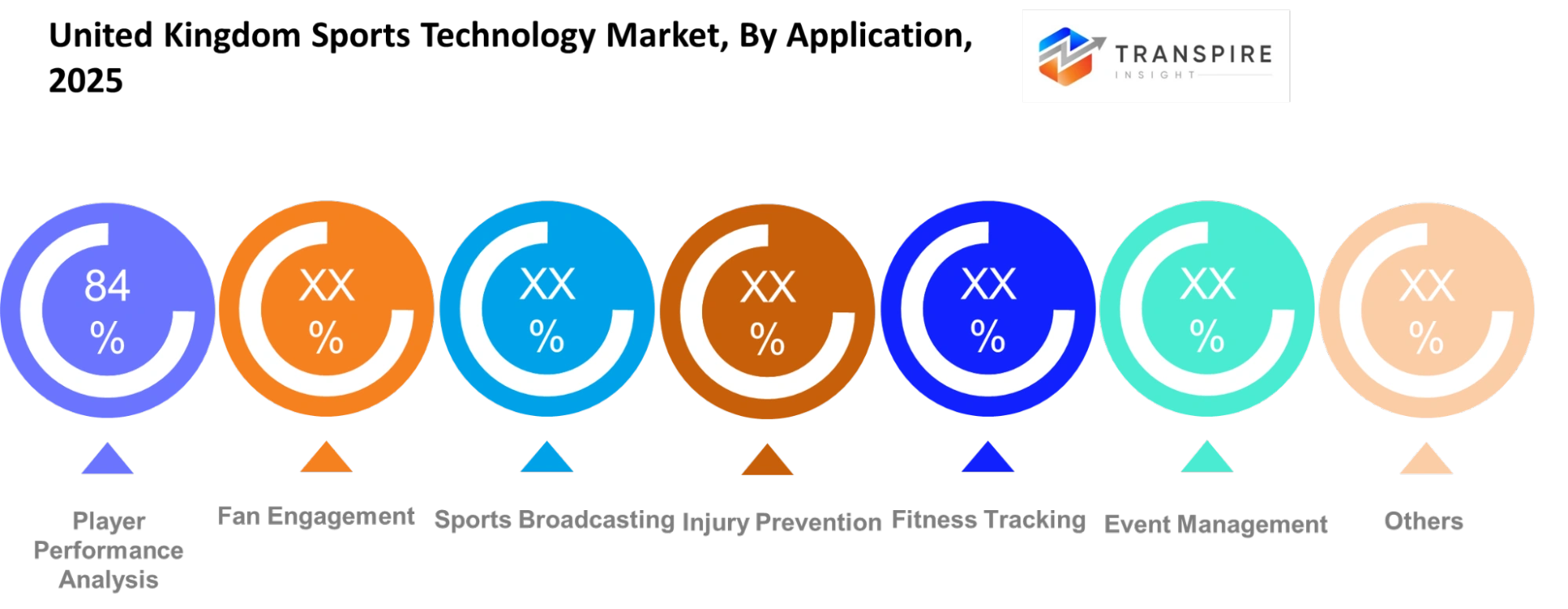
Player performance analysis is mostly about reading match data, checking movement efficiency, and judging tactical execution , to strengthen team results. Fan engagement tools do the everyday magic through mobile apps, live stats, and personalized content suggestions that actually fit people. Sports broadcasting uses digital overlays and real-time analytics to make viewing richer.
Injury prevention apps depend on predictive models to lower the time players miss, by managing workload earlier. Fitness tracking keeps an eye on physical condition during training sessions and competitive events. Finally event management systems handle scheduling, logistics, and stadium coordination, so the whole operation runs smoother with fewer awkward delays.
To learn more about this report, Download Free Sample Report
By Deployment :
Cloud based platforms let people tap into performance numbers and analytics tools in one place, which, in practice, helps teams and analysts work together better, even if sometimes it feels a bit fragmented. On premise systems are still around too, mostly when legacy infrastructure makes a full cloud move kinda hard. Mobile applications also matter, because they let users get match insights in real time, plus access training data and fan engagement services without waiting around.
IoT enabled platforms go a step further by tying together sensors around stadiums and training facilities, so they can keep collecting performance metrics and environmental conditions without pause. Taken together, these deployment approaches make adoption feel more flexible, depending on club size, budget, and how ready each organization is technologically, across the United Kingdom Sports Technology Market.
By Sport Type :
Football leads the technology uptake because it tends to pour high investment into analytics, broadcasting, and performance monitoring systems across professional leagues. Cricket meanwhile uses digital tools for match analysis, player tracking, and tactical decisions in high pressure formats. Tennis often leans into performance analytics and biomechanical tracking, to refine a player’s technique in a more methodical way.
Rugby leans on physical impact monitoring and injury prevention systems to protect player safety. Esports uses more advanced analytics alongside streaming technologies, for stronger viewer engagement and clearer competitive performance tracking. Other sports are slowly following the same direction, once digital infrastructure becomes easier to access across organizations.
What are the Key Use Cases Driving the United Kingdom Sports Technology Market?
In the United Kingdom Sports Technology Market , the main use case is pretty much about player performance optimization via advanced analytics along with tracking systems , you know the kind that watches everything. In practice , pro clubs lean on live information from sensors and video analysis tools , because that helps them adjust tactical choices, keep better control on player workload, and also lower the chance of injuries. So basically, the highest demand goes to integrated sports technology platforms, since they tie all of that together in one flow.
Beyond that, the applications are widening too, especially in fan engagement and sports broadcasting improvements. Stadium operators and media companies increasingly depend on OTT platforms , AR overlays, and interactive mobile apps . The whole point there is to push matchday revenue higher and keep audiences sticking around longer, and this is most visible across football and rugby ecosystems where the digital followings are large.
On the newer side, you can see emerging use cases like predictive injury prevention powered by AI models and automated stadium operations using IoT systems . These areas are still growing, but they’re starting to get attention from elite clubs and venue operators who want to trim operational costs, while also lifting athlete safety standards across the forecast period.
|
Report Metrics |
Details |
|
Market size value in 2025 |
USD 4.96 Billion |
|
Market size value in 2026 |
USD 5.52 Billion |
|
Revenue forecast in 2033 |
USD 11.67 Billion |
|
Growth rate |
CAGR of 11.29% from 2026 to 2033 |
|
Base year |
2025 |
|
Historical data |
2021 - 2024 |
|
Forecast period |
2026 - 2033 |
|
Report coverage |
Revenue forecast, competitive landscape, growth factors, and trends |
|
Regional scope |
Middle East and Africa (Saudi Arabia, United Arab Emirates, South Africa, Rest of Middle East and Africa) |
|
Key company profiled |
Cisco, IBM, SAP, Catapult Sports, Garmin, Fitbit, Sony, Hawk-Eye, Stats Perform, Hudl, Samsung Electronics, Apple, Polar Electro, Zebra Technologies, Oracle. |
|
Customization scope |
Free report customization (country, regional & segment scope). Avail customized purchase options to meet your exact research needs. |
|
Report Segmentation |
By Technology (Wearable Technology, Smart Stadium Solutions, Sports Analytics, AR & VR Sports Tech, AI-based Coaching Systems, Athlete Monitoring Systems, Others); By Application (Player Performance Analysis, Fan Engagement, Sports Broadcasting, Injury Prevention, Fitness Tracking, Event Management, Others); By Deployment (Cloud-based Platforms, On-premise Systems, Mobile Applications, IoT-enabled Platforms, Others); By Sport Type (Football, Cricket, Tennis, Rugby, Esports, Others). |
Which Regions are Driving the United Kingdom Sports Technology Market Growth?
London , and the South East of England. They kind of stand out as the main place in the United Kingdom Sports Technology Market. They win mostly because there’s a dense clustering of professional football clubs, top-notch training academies, and those big broadcasting headquarters all in relatively close proximity. And then you have digital policy backing for sports innovation , plus early take-up of performance analytics systems, which kind of locks in their edge. There’s also a pretty solid mix of technology vendors, media rights holders, and venture-backed startup teams, so innovation keeps moving and deployments tend to stay high value, at least comparatively.
The Midlands are seen as the steadier second contributor, with a strong base that includes football clubs, rugby institutions, and university-linked sports research centers. But it’s not quite the same as the London playbook. Instead of that high intensity commercial broadcasting pull, the region leans more on steady institutional investment. Many clubs there tend to favor analytics and injury prevention solutions that are cost efficient, rather than going all-in on premium platforms for fan engagement. Regulatory alignment stays fairly consistent, and stadiums modernize in a more gradual way, so growth is predictable but slower, in terms of tech deployment speed.
Northern England is growing the fastest, mainly due to newer stadium redevelopment programs , and also more money going into modernizing lower-league clubs. Since 2024, public-private funding initiatives have boosted the rollout of smart ticketing, IoT-based crowd systems, and cloud analytics platforms. On top of that, better connectivity infrastructure across places like Manchester and Leeds has made real-time data integration in sports operations much more practical. Altogether this shift implies strong entry chances for technology vendors and investors who want scalable deployments in the 2026 to 2033 window.
Who are the Key Players in the United Kingdom Sports Technology Market and How Do They Compete?
The United Kingdom Sports Technology Market looks like a fairly consolidated arena, where a small circle of established technology providers kinda dominate top-tier sports, but smaller startups still show up, especially via analytics and the whole fan engagement angle. The rivalry is mostly pushed by technical ability not by pricing, because clubs and broadcasters tend to care more about accuracy, real-time signals, and making everything fit with the performance systems they already use. The incumbents keep their grip through long-term deals with leagues and media rights holders. At the same time though, disruption is gaining momentum from data-first, cloud-native entrants, these groups usually build on scalable digital platforms.
Hawk-Eye Innovations plays a major role via high-precision tracking and officiating technology, mainly in football and tennis. What really sets it apart is its camera-based ball tracking systems, which help referees make calls with what feels like millimeter-level precision. The firm also keeps building strength by tying in deeply with global sports federations, plus it keeps rolling out upgrades for real-time decision systems that show up in big tournaments.
Catapult Sports concentrates on elite athlete monitoring systems, mixing wearable sensors with cloud analytics so training loads can be optimized. Its edge is tied to proprietary movement-tracking algorithms, and those are used to generate injury risk insights for professional clubs. It expands largely through partnerships with football and rugby teams across Europe, and those partnerships boost adoption inside high-performance training settings.
Company List
- Cisco
- IBM
- SAP
- Catapult Sports
- Garmin
- Fitbit
- Sony
- Hawk-Eye
- Stats Perform
- Hudl
- Samsung Electronics
- Apple
- Polar Electro
- Zebra Technologies
- Oracle
Recent Development News
In August 2025, Frasers Group acquired a minority stake in We Do Play. The investment marked Frasers’ entry into the UK leisure and sports-tech-driven experiential entertainment sector, strengthening its digital and physical sports engagement ecosystem through venues like Activate.
Source: https://www.reuters.com/
In December 2025, BKB Bare Knuckle Boxing announced the acquisition of Bad To The Bone (BTTB). The deal expanded BKB’s UK sports entertainment and technology-driven combat sports platform by increasing its fighter roster, digital content library, and event production capabilities ahead of a major 2026 UK event schedule.
Source: https://www.mmamania.com/
What Strategic Insights Define the Future of the United Kingdom Sports Technology Market?
The United Kingdom Sports Technology Market seems to be moving, kinda steadily, toward fully integrated AI-first sports ecosystems where performance data, fan engagement, and venue operations kinda all come together on one cloud type platform. And this isn’t just buzz, it is pushed forward by ongoing improvements in machine learning models plus real time data infrastructure, so there’s less delay between when data is captured and when decisions actually happen. In the next 5 to 7 years, the way value is created will depend more and more on platforms that link on-field performance analytics with commercial monetization systems like streaming, and digital ticketing too.
At the same time there’s a risk that’s less visible, which is that organizations are getting too dependent on a small group of data infrastructure providers. That can create concentration risk across analytics and broadcasting pipelines. If one of those core platforms goes down, or if data governance rules get tighter, then innovation cycles could slow down, and compliance costs might rise for clubs and media operators, also.
Meanwhile there’s an opportunity that’s starting to show up more clearly, specifically the integration of 5G-enabled immersive stadium experiences. In these setups, real time augmented analytics can be delivered straight to fan devices during live matches. It’s still early in deployment across a few venues only, but it is gaining momentum, largely because of pilot projects in major English football stadiums. Market participants should really focus on scalable, API driven platforms that can fit smoothly into league level data systems, so interoperability lasts longer and commercialization can move faster across several sports ecosystems.
United Kingdom Sports Technology Market Report Segmentation
By Technology
- Wearable Technology
- Smart Stadium Solutions
- Sports Analytics
- AR & VR Sports Tech
- AI-based Coaching Systems
- Athlete Monitoring Systems
By Application
- Player Performance Analysis
- Fan Engagement
- Sports Broadcasting
- Injury Prevention
- Fitness Tracking
- Event Management
By Deployment
- Cloud-based Platforms
- On-premise Systems
- Mobile Applications
- IoT-enabled Platforms
By Sport Type
- Football
- Cricket
- Tennis
- Rugby
- Esports
Frequently Asked Questions
Find quick answers to common questions.
The United Kingdom Sports Technology Market size is USD 11.67 Billion in 2033.
Key segments for the United Kingdom Sports Technology Market are By Technology (Wearable Technology, Smart Stadium Solutions, Sports Analytics, AR & VR Sports Tech, AI-based Coaching Systems, Athlete Monitoring Systems, Others); By Application (Player Performance Analysis, Fan Engagement, Sports Broadcasting, Injury Prevention, Fitness Tracking, Event Management, Others); By Deployment (Cloud-based Platforms, On-premise Systems, Mobile Applications, IoT-enabled Platforms, Others); By Sport Type (Football, Cricket, Tennis, Rugby, Esports, Others).
Major United Kingdom Sports Technology Market players are Cisco, IBM, SAP, Catapult Sports, Garmin, Fitbit, Sony, Hawk-Eye, Stats Perform, Hudl, Samsung Electronics, Apple, Polar Electro, Zebra Technologies, Oracle.
The United Kingdom Sports Technology Market size is USD 4.96 Billion in 2025.
The United Kingdom Sports Technology Market CAGR is 11.29% from 2026 to 2033.
- Cisco
- IBM
- SAP
- Catapult Sports
- Garmin
- Fitbit
- Sony
- Hawk-Eye
- Stats Perform
- Hudl
- Samsung Electronics
- Apple
- Polar Electro
- Zebra Technologies
- Oracle
About the Authors

Avinash Kumar
I’m Avinash Kumar, a Senior Research Analyst at Transpire Insight, with expertise in the Electronics and Semiconductor and Energy & Power industry. My work focuses on analyzing emerging technologies, market trends, industry developments, and innovation across these sectors. I specialize in transforming complex technical and market insights into clear, research-backed content that helps professionals, businesses, and decision-makers stay informed. Through continuous industry research and data-driven analysis, I strive to deliver accurate, reliable, and practical perspectives on the latest advancements shaping the semiconductor and energy landscape.

Chakradhar Khansole
Chakradhar serves as the Research Director at Transpire Insight, bringing over 8 years of experience in technology, innovation, and strategic market intelligence. He specializes in transforming complex market data into actionable business insights that enable organizations to make informed, growth-oriented decisions. Recognized for his strategic vision and analytical expertise, Chakradhar leads high-impact research initiatives, delivering comprehensive market assessments, competitive intelligence, and forward-looking industry analysis.
Recently Published Reports
-
Apr 2026
Fiber Optic Faceplates Market
Fiber Optic Faceplates Market Size, Share & Analysis Report By Type (< 300 mm2, 300-350 mm2, and > 350 mm2, By Application (Night Vision, Holographic Imaging, Medical, and Others), and Geography (North America, Europe, Asia-Pacific, Middle East and Africa, South and Central America), 2021 - 2031
-
Apr 2026
High Temperature Superconductors Market
High Temperature Superconductors Market Size, Share & Analysis Report By Type (1G HTS, and 2G HTS), By Application (Power Cable, Fault Current Limiter, and Transformer), and Geography (North America, Europe, Asia-Pacific, Middle East and Africa, South and Central America), 2021 - 2031
-
Apr 2026
Industrial Plugs and Socket Market
Industrial Plugs and Socket Market Size, Share & Analysis Report By Type (Industrial Plugs, Industrial Sockets), By Current (Up to 32 A, 32 to 125 A, Above 125 A), By Protection (Dustproof and Splash Proof, Waterproof, Explosion Proof), By End User (Heavy Industries, Oil and Gas, Chemicals and Pharmaceuticals, Power Generation, Others), and Geography (North America, Europe, Asia-Pacific, Middle East and Africa, South and Central America), 2021 - 2031
-
Apr 2026
InGaAs Avalanche Photodiodes Market
InGaAs Avalanche Photodiodes Market Size, Share & Analysis Report By Type (1100 - 1700 nm, and 1000 - 1600 nm), By Application (Missile Warning System, Muzzle Flash Detection, Wafer Defect Inspection, Laser Rangefinders, and Others), and Geography (North America, Europe, Asia-Pacific, Middle East and Africa, South and Central America), 2021 - 2031