

Europe Football Equipment Market Size & Forecast:
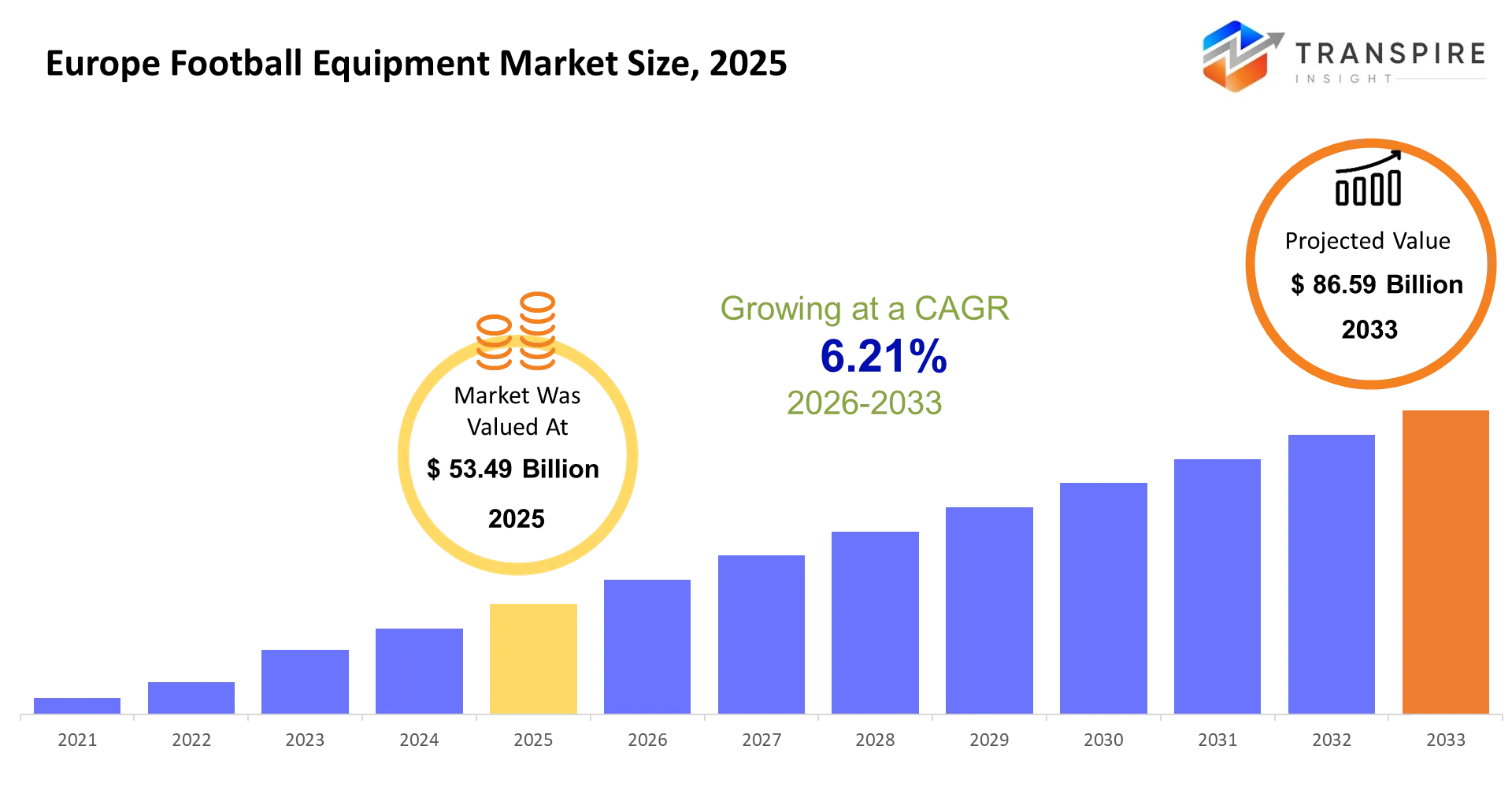
- Europe Football Equipment Market Size 2025: USD 53.49 Billion
- Europe Football Equipment Market Size 2033: USD 86.59 Billion
- Europe Football Equipment Market CAGR: 6.21%
- Europe Football Equipment Market Segments: By Type (Balls, Footwear, Protective Gear, Apparel, Training Equipment, Others), By Application (Professional Sports, Amateur Sports, Training, Others), By End-User (Men, Women, Kids, Clubs, Others), By Distribution (Online, Retail Stores, Sports Shops, Others).
To learn more about this report,  Download Free Sample Report
Europe Football Equipment Market Summary:
The Europe Football Equipment Market size is estimated at USD 53.49 Billion in 2025 and is anticipated to reach USD 86.59 Billion by 2033, growing at a CAGR of 6.21% from 2026 to 2033. The Europe Football Equipment Market provides essential equipment which professional teams and youth soccer academies, educational institutions, and community sports organizations use to compete in their respective activities. The market enables organizations to achieve better protection for their athletes while enhancing their training methods and athletic output and maintaining ongoing football activity throughout both competitive and grassroots soccer programs.
The market has evolved during the past three to five years from selling products based on their volume to focusing on technology-driven performance systems. The use of smart wearables and data-connected training equipment and eco-friendly material development has become the key factors which clubs and federations use to make their purchasing choices. The COVID-19 pandemic brought about a worldwide supply chain crisis which demonstrated that Europe relied on Asian manufacturing facilities for its supply needs.
This led brands and distributors to develop new sourcing strategies while creating local inventory operations. Clubs allocated more funds to specialized equipment and high-quality clothing and injury prevention equipment as women's soccer grew and player participation rates climbed. This development created new dependable income streams which manufacturers and sports retailers could use to enhance their businesses.
Key Market Insights
- The European Football Equipment Market for 2025 showed Western Europe as its main market force because the region held 46 percent of total market share which resulted from its established club infrastructure and consumer spending patterns.
- The European football gear market generates major revenue streams from Germany, the UK, and France because these countries have established league systems and secured sponsorship deals.
- The fastest regional market growth until 2030 occurs in Eastern Europe because youth participation rates increase and sports infrastructure development projects expand.
- Scandinavian countries show rising demand for environmentally friendly football uniforms and training equipment which can be recycled through institutional buying processes.
- The Europe Football Equipment Market for 2025 demonstrated football footwear as the leading product category which generated more than 34 percent of total market revenue through premium boot releases and athlete-oriented design options.
- European leagues have established their second biggest market segment through protective equipment because new player safety regulations and injury prevention initiatives have been introduced across the continent.
- The period between 2025 and 2030 will see smart training equipment become the industry segment with the highest growth rate because AI performance tracking and connected coaching systems drive its development.
- Major sports equipment makers in Europe are changing their product development approaches because they need to create environmentally sustainable footballs and products made from recycled polyester.
- Professional football clubs accounted for nearly 41% market share in 2025 because they established high-volume procurement contracts which facilitated ongoing equipment replacement.
- The application segment of grassroots football academies shows the highest growth rate because youth development programs supported by federations are expanding throughout Europe.
- Football clubs are using wearable sensors and biomechanics coaching systems to develop their training and conditioning programs.
What are the Key Drivers, Restraints, and Opportunities in the Europe Football Equipment Market?
The European Football Equipment Market experiences its most powerful growth through commercial activities which support both elite and semi-professional football events together with performance management systems that use data analytics for their development. The clubs in Germany and the UK and Spain and France now spend more money on wearable sensors and GPS training systems and injury prevention footwear because player availability directly impacts broadcasting revenue and tournament results. Sports analytics experienced rapid growth after the pandemic when athletic organizations began using measurable methods to enhance their athlete conditioning programs while decreasing their rehabilitation expenses. The equipment replacement cycle for high-end products has doubled while manufacturers of connected training systems now receive additional operational income through their equipment sales.
The European football equipment market faces a fundamental challenge from counterfeit sports merchandise which acts as an ongoing operational obstacle. Price-conscious customers in Eastern and Southern Europe continue to purchase fake shoes and clothing which online platforms and informal retail stores sell at lower prices. The problem continues because different areas enforce regulations at different levels while the counterfeit market develops new methods more quickly than authorities can track their activities. Premium brands face revenue losses which result in decreased consumer confidence and create a delay for amateur users who want to try new technology but refuse to buy it at expensive prices.
Women’s football infrastructure presents the clearest long-term growth opportunity. The UEFA-backed investment program which supports women’s leagues and academies and youth tournaments has created new demands for female-specific footwear and protective equipment and training clothing which follows female body movement patterns.
What Has the Impact of Artificial Intelligence Been on the Europe Football Equipment Market?
The Europe Football Equipment Market undergoes transformation through artificial intelligence and advanced digital technologies. These technologies enable clubs and academies and manufacturers to track athlete performance while they handle inventory and develop new products. The advanced training systems with AI-powered wearables now provide automatic real-time monitoring of sprint speed and fatigue levels and heart rate variability and injury risk assessment during training sessions. The professional clubs use these systems to connect with cloud-based analytics platforms which automate coaching decisions and decrease the need for coaches to assess player performance through manual methods.
Machine learning models are also improving predictive capabilities across football equipment operations. Manufacturers use AI-driven simulation tools to predict material stress, stud durability, and boot performance under different pitch conditions before large-scale production begins. The clubs use predictive analytics to detect overtraining patterns which help them reduce soft-tissue injuries that impact player availability during busy tournament times. The technologies deliver operational benefits through decreased rehabilitation expenses and expedited equipment replacement processes and enhanced athlete training results.
The current AI adoption process experiences barriers because amateur clubs and regional leagues lack complete digital systems. The smaller organizations need special sensor equipment and past performance data to develop accurate predictive models that work in actual football settings.
Key Market Trends
- European clubs increased their use of GPS-enabled wearables which help assess player fitness because they want to reduce player injuries since 2021. The pandemic disruptions
- Adidas and Nike changed their manufacturing processes after the pandemic showed their dependency on factories located in Asia.
- UEFA Women’s Euro 2022 raised investment in women’s football which led to the development of dedicated footwear and clothing based on female movement patterns.
- Football academies started using AI-based performance tracking systems which measure sprint load and fatigue and recovery metrics instead of standard training equipment.
- German and UK clubs began purchasing recyclable training gear since 2023 to meet their institutions new sustainability requirements.
- Manufacturers changed their product release schedule from seasonal cycles to permanent product availability which depends on partnerships with athletes and digital-first consumer marketing techniques.
- Eastern European distributors expanded their storage facilities across the region after 2022 which helped them deliver products faster while maintaining inventory levels during busy tournament times.
- Online platforms became the main distribution channel for counterfeit football boots and jerseys which forced high-end brands to spend large amounts on digital authentication solutions.
- Elite academies began using smart footballs that contain motion sensors to analyze passing and shooting performance through data analysis.
- After 2020 consumer buying patterns changed because customers started buying premium football equipment from direct-to-consumer online platforms instead of multi-brand stores.
Europe Football Equipment Market Segmentation
By Type
The price segment of football footwear stands as the most popular category because players need to replace their boots more often than they do other athletic equipment. The continuous development of new stud designs and new lightweight materials and new impact control technologies enables premium cleats to generate substantial financial returns. The market for protective equipment has grown in commercial value because European leagues now require teams to follow injury assessment protocols and concussion assessment guidelines. The market for training equipment which includes agility training tools and sensor-based systems shows rapid growth because clubs now use performance data to enhance their training sessions.
The patterns of demand show different characteristics based on the type of customer who makes purchases. Elite clubs require customized equipment which provides advanced performance capabilities but grassroots organizations need products which last long and cost less money. The market will expand for products which connect to the internet because they combine wearable sensors with digital monitoring features which will lead manufacturers to allocate more resources toward developing smart materials and unique ways to enhance product performance.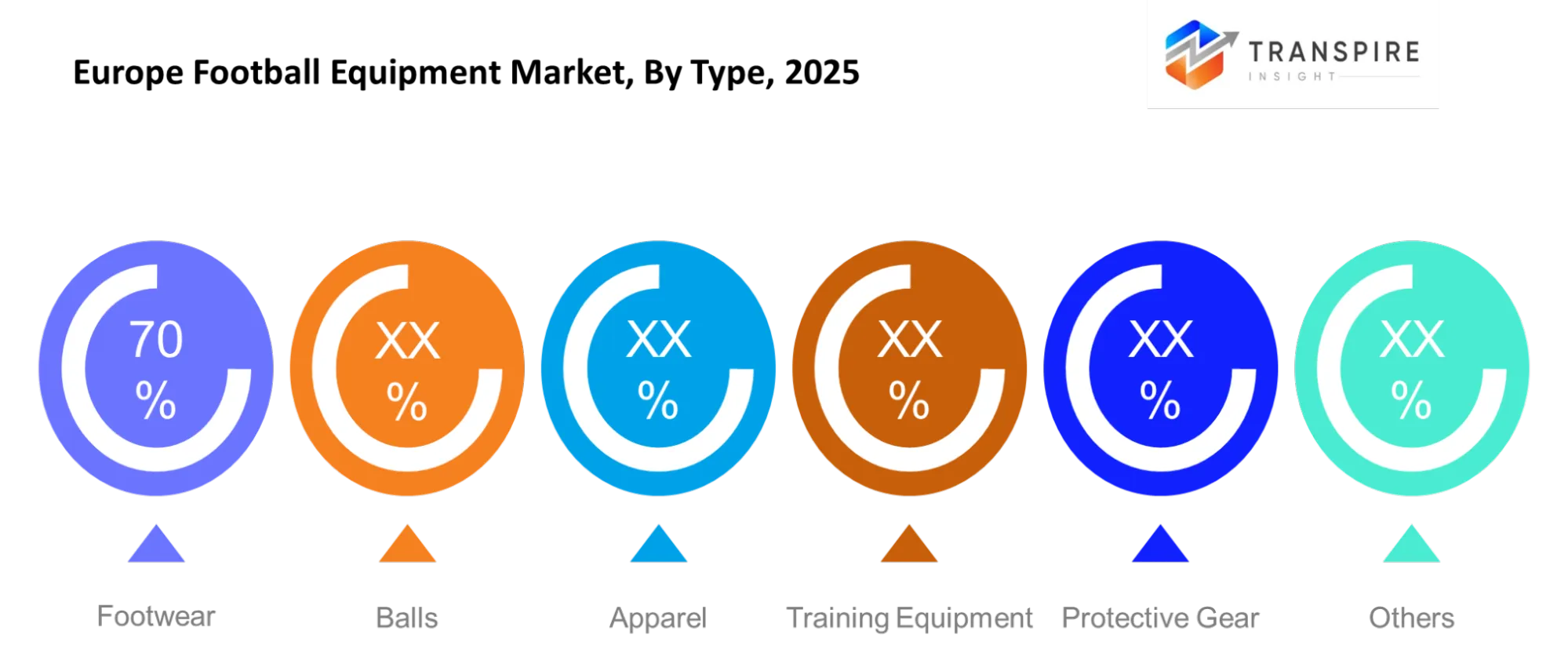
To learn more about this report, Download Free Sample Report
By Application
Professional sports applications dominate the application segment because top-tier football clubs maintain continuous spending on footwear, apparel, protective products, and data-assisted training systems. Professional organizations use broadcasting revenues and sponsorship contracts and tournament exposure to buy premium-grade equipment because these assets shorten equipment replacement cycles. Training applications are experiencing rapid growth because clubs and academies now use performance-driven conditioning programs which require tracking systems for wearable technology and biomechanics analysis.
Amateur sports also represent a substantial share because participation levels remain high across schools, universities, and local football associations throughout Europe. However, amateur buyers remain highly price sensitive which limits adoption of premium equipment categories in several regional markets. Youth development programs funded by football federations continue to influence purchasing behavior because their existence creates higher demand for durable and safety-focused products. Future application trends point toward training ecosystems which combine physical training equipment with digital coaching platforms as new business opportunities for manufacturers who provide connected performance solutions and subscription-based analytics services.
By End-User
The equipment market in Europe maintains its active sales because men represent the largest group of users who buy sports equipment through their ongoing participation in established professional leagues and their access to extensive sponsorship networks. Sports clubs operate as a key institutional buyer group because they purchase equipment through bulk contracts which include training equipment and protective gear and also training apparel and match balls. The UEFA-supported investments which enhanced league visibility and created commercial partnerships for women’s football have transformed it into the most rapidly expanding end-user segment of the market. Manufacturers now create specialized footwear and apparel products which match the specific body movements of women instead of using only unisex clothing options.
Football academies and grassroots programs now focus on developing kids and youth players because they understand the importance of teaching proper player development methods and safeguarding their health from injuries. Schools and parents now prefer protective gear which is lightweight and training equipment which lasts because these products enable students to train continuously over extended periods. The future development of end-user categories will benefit brands that successfully merge personalized customer experiences with athlete-focused product development and digital tools which build brand loyalty for both institutional and individual customer purchasing options.
By Distribution
The distribution segment maintains its leadership position through retail sports stores because customers want to try football boots and protective equipment and training accessories before making a purchase decision. Multi-brand sports retailers maintain strong influence through exclusive club partnerships, seasonal campaigns, and in-store customization services. The online distribution market has experienced rapid growth since 2020 because consumers started using direct-to-consumer purchasing models which mobile commerce and athlete-led digital marketing campaigns made possible. E-commerce platforms enable brands to gather consumer performance information which improves their ability to customize product recommendations beyond what traditional retail channels can achieve.
Specialty sports shops continue to serve both professional and semi-professional athletes who require expert advice on fit standards and playing surface needs and performance requirements. The independent retailers who operate as smaller businesses must compete against large digital platforms which use aggressive pricing methods to gain market share. The future distribution landscape will develop around brands that use omnichannel integration to create physical retail spaces which they connect to digital inventory management systems and virtual fitting software and subscription-based customer interaction methods.
What are the Key Use Cases Driving the Europe Football Equipment Market?
The primary purpose of professional football clubs requires them to obtain new football boots and training clothes and performance assessment tools because their matches occur on an ongoing basis. The elite leagues present in the UK and Germany and Spain create high demand for player performance programs which begin their purchasing process through sponsorships.
Grassroots academies and school football programs are expanding equipment adoption across training accessories, protective gear, and durable footballs. The growth of UEFA-supported participation programs in European domestic leagues has led women's football organizations to increase their demand for specialized footwear and lightweight clothing.
The field of artificial intelligence develops smart footballs and systems that track athlete performance through wearable technology to conduct biomechanics assessments and reduce injuries. Virtual fitting platforms and digitally customized footwear applications also show strong long-term potential as brands strengthen direct-to-consumer engagement strategies across online retail channels.
|
Report Metrics |
Details |
|
Market size value in 2025 |
USD 53.49 Billion |
|
Market size value in 2026 |
USD 56.81 Billion |
|
Revenue forecast in 2033 |
USD 86.59 Billion |
|
Growth rate |
CAGR of 6.21% from 2026 to 2033 |
|
Base year |
2025 |
|
Historical data |
2021 - 2024 |
|
Forecast period |
2026 - 2033 |
|
Report coverage |
Revenue forecast, competitive landscape, growth factors, and trends |
|
Regional scope |
Europe (Germany, United Kingdom, France, Italy, Spain and Rest of Europe) |
|
Key company profiled |
Nike, Adidas, Puma, Under Armour, Umbro, New Balance, Decathlon, Mizuno, Lotto, Kappa, Joma, Hummel, Diadora, Select Sport, Wilson |
|
Customization scope |
Free report customization (country, regional & segment scope). Avail customized purchase options to meet your exact research needs. |
|
Report Segmentation |
By Type (Balls, Footwear, Protective Gear, Apparel, Training Equipment, Others), By Application (Professional Sports, Amateur Sports, Training, Others), By End-User (Men, Women, Kids, Clubs, Others), By Distribution (Online, Retail Stores, Sports Shops, Others) |
Which Regions are Driving the Europe Football Equipment Market Growth?
Western Europe leads the market because it has elite football leagues and its advanced retail networks and professional sports infrastructure receives strong institutional investments. The countries of Germany the UK and France together with Spain spend high amounts on equipment because they receive broadcasting revenues and club sponsorships and they hold tournaments throughout the year. The region benefits from its existing manufacturing ecosystems and sports science research centers and enduring partnerships which exist between sports clubs and worldwide sportswear brands. The combination of high consumer spending ability and developed online shopping systems enables customers to choose premium products from footwear and wearable training systems and personalized apparel products.
Northern Europe acts as the second largest regional contributor although its growth patterns differ from Western Europe because people participate in sports through community programs and institutional sports initiatives instead of following commercial league activities. The Scandinavian nations maintain consistent equipment acquisition because their government programs support youth sports development and their school football programs and grassroots programs establish organized systems for sports development. The region's sustainability standards establish a stronger impact on purchasing decisions because they create demand for recyclable apparel materials and sustainable manufacturing methods. The combination of economic stability and predictable regulatory frameworks enables sports retailers and manufacturers to execute continuous investment plans which lasts through changing consumer spending patterns.
Eastern Europe demonstrates its strongest growth potential through the modernization efforts of football federations and private investors who are upgrading training centers and academy systems and domestic league facilities.
Who are the Key Players in the Europe Football Equipment Market and How Do They Compete?
The Europe Football Equipment Market currently operates with moderate market consolidation because international sportswear companies control high-end product segments while local companies and online-first shops battle for market share in affordable product categories. The current market competition employs performance technology and athlete collaborations and direct sales to customers and environmental protection standards as fundamental competition elements which have surpassed traditional price competition. Established companies defend their market position by using exclusive sponsor agreements with sports teams and developing new materials and creating digital training systems that work together. Emerging brands establish market presence through their focus on women’s football and youth development programs and creation of personalized online shopping experiences which larger companies have neglected.
Adidas establishes its unique identity through its complete participation in European football traditions which include permanent ties with top football clubs and UEFA tournaments and national soccer teams. The company develops lightweight soccer boots while creating recyclable materials which help it attract performance-driven customers who value sustainability.
Nike uses athlete-developed products together with data-driven performance design to compete in the premium footwear market and wearable training product sector. Nike uses direct online engagement methods and digital customization tools to attract high-margin customers while decreasing its dependence on third-party retail partners. PUMA has made its competitive position stronger by increasing its sponsorship activities in women’s football and establishing flexible commercial agreements with new European football clubs.
Company List
- Nike
- Adidas
- Puma
- Under Armour
- Umbro
- New Balance
- Decathlon
- Mizuno
- Lotto
- Kappa
- Joma
- Hummel
- Diadora
- Select Sport
- Wilson
Recent Development News
In April 2026, Adidas Reports Strong 2026 Growth Driven by Football Merchandise Demand: Adidas announced stronger-than-expected Q1 results, supported by rising demand for football equipment and World Cup-related merchandise across Europe. The company highlighted major growth in its soccer category and confirmed strong booking momentum ahead of global football tournaments.
Source: https://www.reuters.com
In April 2026, Puma Announces Leadership Changes and Improved Football Segment Performance: Puma reported improved quarterly profitability after reducing inventory levels and strengthening direct-to-consumer sales. The company stated that football kit demand and soccer-related products contributed positively to performance. Puma also announced executive leadership changes, including the appointment of Mark Langer as CFO.
Source: https://www.reuters.com
What Strategic Insights Define the Future of the Europe Football Equipment Market?
The Europe Football Equipment Market is changing its basic structure to develop a performance intelligence system which connects physical products with digital coaching and biomechanics tracking and athlete health analytics. The professional clubs and academies and women's football programs all use data-driven player management technology because it has become a commercially viable product that now exists in the market. Brand visibility will continue to lose its power as an advantage during the next five to seven-year period because businesses that want to succeed will need to develop complete performance platforms which include equipment and software and customized athlete data.
Advanced synthetic fabrics and smart sensors and lightweight polymers create a hidden hazard through their dependence on particular raw materials which are needed for production. The combination of current geopolitical trade disturbances and upcoming European sustainability regulations will result in higher production expenses which will reduce profit margins for manufacturers who rely on imported technical materials. Eastern Europe presents emerging opportunities because football infrastructure modernization projects and youth academy funding initiatives create demand for mid-priced performance equipment and digital training tools which remain unfulfilled. To achieve supply resilience, market participants need to make regional manufacturing partnerships their main focus while developing AI-enabled systems that allow for custom products in fast-developing football markets.
Europe Football Equipment Market Report Segmentation
By Type
- Balls
- Footwear
- Protective Gear
- Apparel
- Training Equipment
- Others
By Application
- Professional Sports
- Amateur Sports
- Training
- Others
By End-User
- Men
- Women
- Kids
- Clubs
- Others
By Distribution
- Online
- Retail Stores
- Sports Shops
- Others
Frequently Asked Questions
Find quick answers to common questions.
The Approximate Europe Football Equipment Market size for the Market will be USD 86.59 Billion in 2033.
The key Segments of the Europe Football Equipment Market are By Type (Balls, Footwear, Protective Gear, Apparel, Training Equipment, Others), By Application (Professional Sports, Amateur Sports, Training, Others), By End-User (Men, Women, Kids, Clubs, Others), By Distribution (Online, Retail Stores, Sports Shops, Others).
Major Players in the Europe Football Equipment Market are Nike, Adidas, Puma, Under Armour, Umbro, New Balance, Decathlon, Mizuno, Lotto, Kappa, Joma, Hummel, Diadora, Select Sport, Wilson.
The Current Market size of the Europe Football Equipment Market is USD 53.49 Billion in 2025.
The Europe Football Equipment Market CAGR is 6.21%.
- Nike
- Adidas
- Puma
- Under Armour
- Umbro
- New Balance
- Decathlon
- Mizuno
- Lotto
- Kappa
- Joma
- Hummel
- Diadora
- Select Sport
- Wilson
Recently Published Reports
-
Apr 2026
Bottled Water Market
Bottled Water Market Size, Share & Analysis Report By Product Type (Still Bottled Water, Carbonated Bottled Water, Functional Bottled Water, and Others), By Packaging (PET, Cans, and Others), By Sales Channel (Supermarkets/Hypermarkets, Convenience Stores/Drug Stores, Grocery Stores/Club Stores, Foodservice, and Others) and Geography (North America, Europe, Asia-Pacific, Middle East and Africa, South and Central America), 2021 - 2032
-
Apr 2026
Color Cosmetic Packaging Market
Color Cosmetic Packaging Market Size, Share & Analysis Report By Application (Mascara Packaging, Liquid Packaging, and Liquid Face), By Type (Tubes & Bottles, Pens & Markers, Compacts & Containers, and Droppers & Pumps), and Geography (North America, Europe, Asia-Pacific, Middle East and Africa, South and Central America), 2021 - 2031
-
Apr 2026
External Microphone For Camera Market
External Microphone For Camera Market Size, Share & Analysis Report By Type (Shotgun Microphone, Lavalier Microphone, and Others), By Application (Digital Camera, Professional Video Camera, and Others), and Geography (North America, Europe, Asia-Pacific, Middle East and Africa, South and Central America), 2021 - 2031
-
Apr 2026
Foot Orthotic Insoles Market
Foot Orthotic Insoles Market Size, Share & Analysis Report By Type (Pre-fabricated, and Custom-made), By Material (Thermoplastic, Composite Carbon Fiber, and Others), By Distribution Channel (Drug Stores, Hospitals & Clinics, and Others), and Geography (North America, Europe, Asia-Pacific, Middle East and Africa, South and Central America), 2021 - 2031