
Asia Pacific Industrial Workwear And Gear Market Size & Forecast:
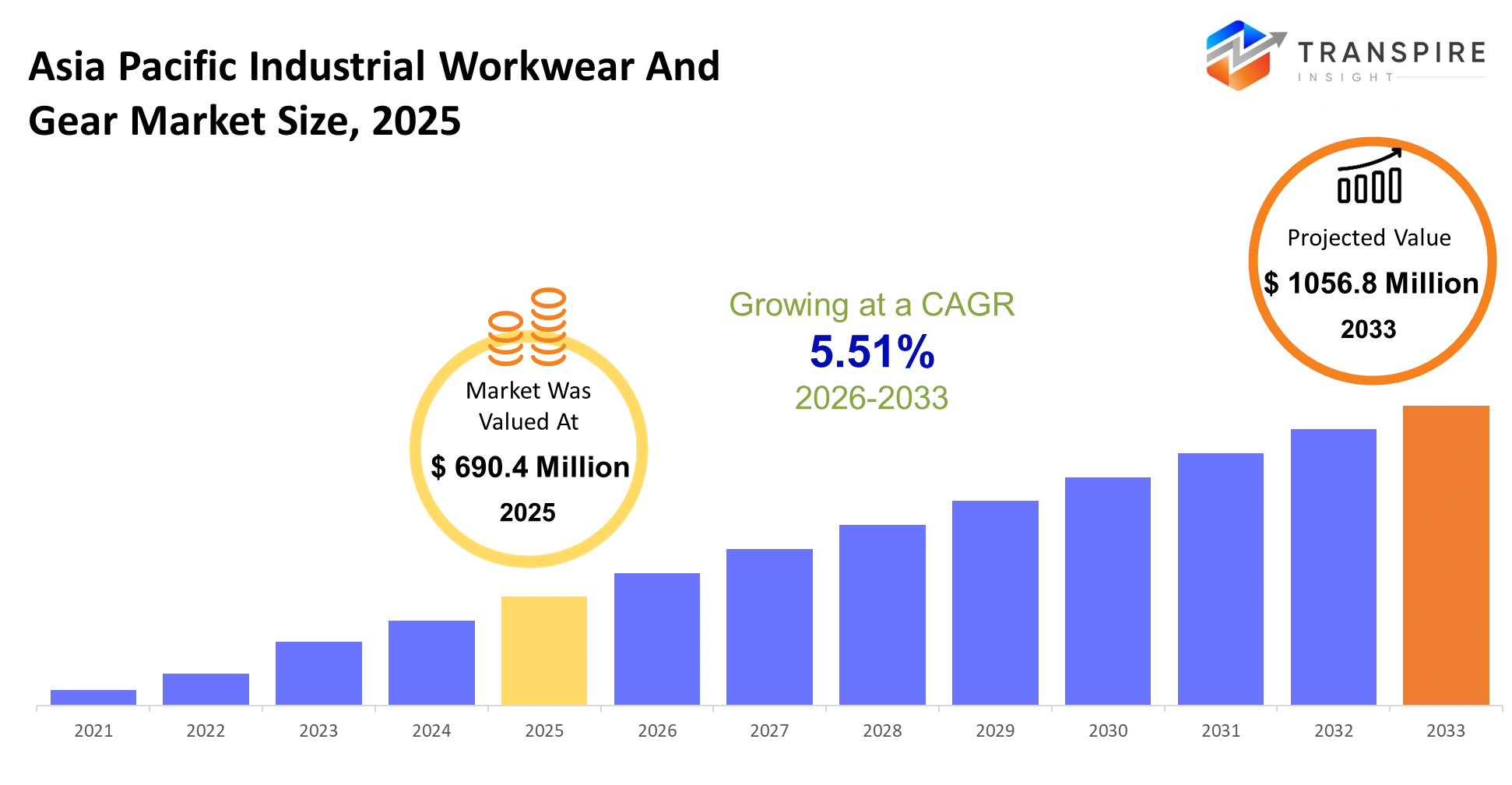
- Asia Pacific Industrial Workwear And Gear Market Size 2025: USD 690.4 Million
- Asia Pacific Industrial Workwear And Gear Market Size 2033: USD 1056.8 Million
- Asia Pacific Industrial Workwear And Gear Market CAGR: 5.51%
- Asia Pacific Industrial Workwear And Gear Market Segments: By Type (Protective Clothing, Safety Footwear, Gloves, Helmets, Others); By Application (Construction, Manufacturing, Oil & Gas, Mining, Healthcare, Others); By End-User (Industrial Workers, Construction Workers, Oil & Gas Employees, Healthcare Workers, Government Agencies, Others); By Material (Cotton, Polyester, Flame-resistant Fabrics, Others)
To learn more about this report,  Download Free Sample Report
Asia Pacific Industrial Workwear And Gear Market Summary
The Asia Pacific Industrial Workwear And Gear Market was valued at USD 690.4 Million in 2025. It is forecast to reach USD 1056.8 Million by 2033. That is a CAGR of 5.51% over the period.
The Asia Pacific Industrial Workwear and Gear Market supplies protective clothing and equipment that maintains worker safety in dangerous environments which include manufacturing plants, construction sites, shipyards, and logistics hubs. The system helps employers fulfill workplace safety requirements by decreasing chemical and thermal and electrical and mechanical dangers.
The market has evolved during the past three years from basic protective equipment toward performance-based certified products which feature flame-resistant materials and ergonomic designs and multiple layers of protection. The organization underwent a fundamental transformation which combined new material engineering techniques with enhanced procurement guidelines that emphasize durable products which provide comfort to workers and meet safety requirements. The COVID-19 pandemic disrupted global protective equipment supply chains which forced Asian Pacific companies to establish local manufacturing operations while developing multiple sourcing options. The development of regional manufacturing capabilities combined with faster procurement processes. High-risk industries now embrace safety measures because organizations link their safety expenditures to business operations and legal obligations.
Key Market Insights
- China controls more than 30% of the Asia Pacific Industrial Workwear And Gear Market because its manufacturing and export-driven industrial base creates its major market share in 2025.
- India emerges as the fastest-growing region during 2025–2030, driven by infrastructure expansion and increasing industrial workforce safety mandates.
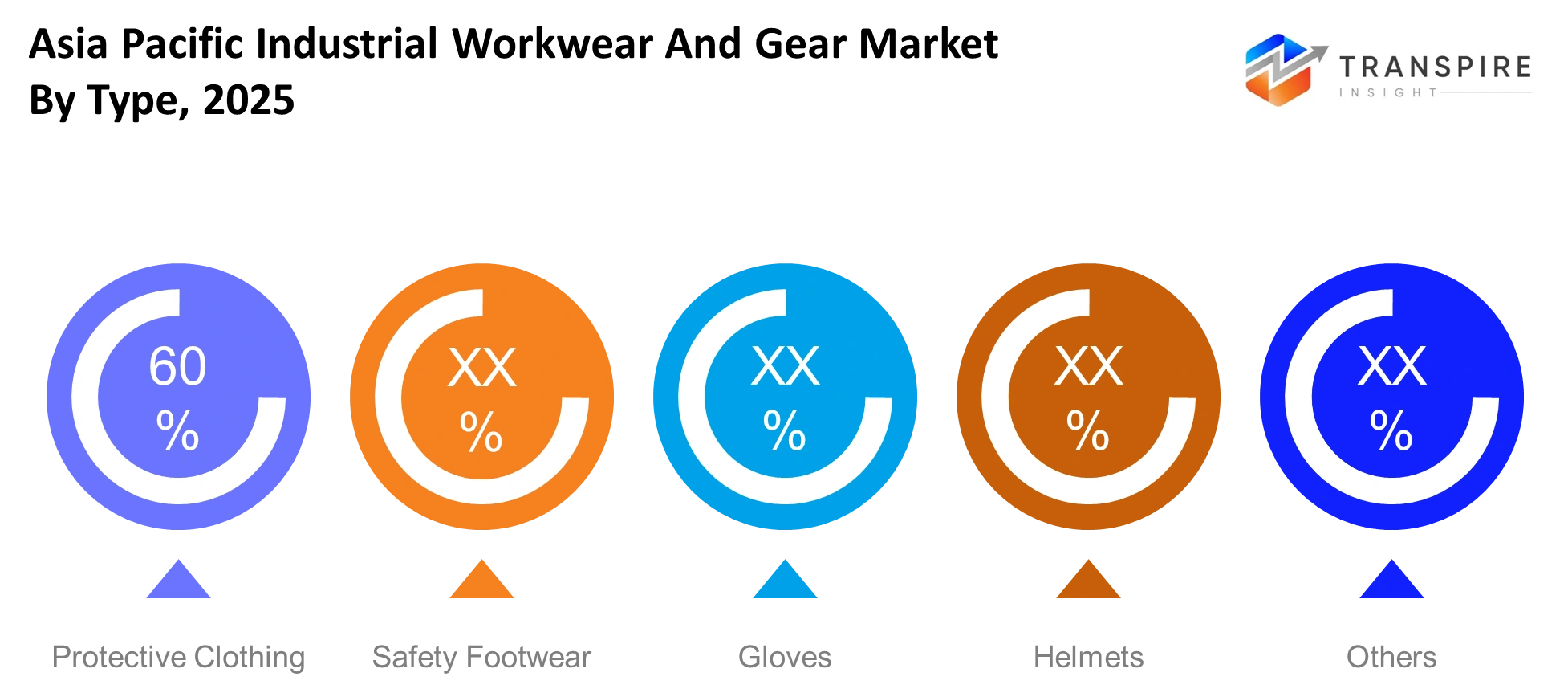
- The Asia Pacific Industrial Workwear And Gear Market receives its main market share from protective clothing, which accounts for more than one-third of market revenue because people need protection against chemical and thermal hazards.
- Manufacturing and logistics industries use gloves and hand protection equipment as their second most important equipment category.
- The period between 2025 and 2030 will see smart and high-performance protective fabrics become the fastest-growing market segment because of material innovation and their comfortable design.
- The Asia Pacific Industrial Workwear And Gear Market shows manufacturing applications as its leading segment which holds about 35 percent market share because of dangerous work conditions faced by industrial employees.
- Oil and gas and chemical sectors experience their highest application growth because of new safety rules and accident prevention requirements.
- The industrial workforce remains the leading end-user segment with the highest adoption share, supported by mandatory PPE compliance regulations.
- The construction sector has become the fastest-growing end-user category because urban infrastructure development and safety enforcement measures progress at a rapid pace.
What are the Key Drivers, Restraints, and Opportunities in the Asia Pacific Industrial Workwear And Gear Market?
Workplace safety regulations that manufacturing and construction and energy sectors must follow have become more stringent because of rising safety requirements in China and India and Southeast Asia. Governments have strengthened enforcement of occupational safety standards after repeated industrial accidents and chemical exposure incidents, pushing companies to adopt certified flame-resistant clothing, high-visibility apparel, and multi-hazard protective gear. The businesses must spend more money to buy work attire because they need to follow safety regulations about protective clothing now that safety equipment costs have increased.
The main barrier that small and mid-sized contractors face is advanced protective equipment which requires extended costs throughout its entire lifespan. Operating environments with harsh conditions force businesses to spend money on aramid fibers and multi-layer composite fabrics because these materials need expensive initial costs and require multiple replacements throughout their entire lifespan. Price-sensitive industries which need to purchase safety equipment to meet their operational costs will face challenges because of the structural affordability gap, which requires time to achieve complete market adoption.
Smart and connected workwear systems which use IoT sensors to monitor fatigue and heat stress and display worker locations present the biggest business opportunity. Pilot deployments in Japanese shipyards and Australian mining operations are demonstrating measurable productivity and safety gains. The Asian Pacific Industrial Workwear And Gear Market will create a new premium market segment because industrial digitalization will drive this segment, which will attract ongoing financial backing from international safety equipment companies.
What Has the Impact of Artificial Intelligence Been on the Asia Pacific Industrial Workwear And Gear Market?
Artificial intelligence together with advanced digital technologies transforms safety management processes and operational efficiency throughout equipment lifecycles in the Asia Pacific Industrial Workwear And Gear Market by providing operators with connected protective systems and data-based compliance solutions.
AI-powered computer vision technology now operates as an automated safety compliance system at manufacturing facilities which also includes construction sites and energy production sites. The systems monitor worker compliance with helmet use and flame-resistant clothing and high-visibility gear requirements while reducing correctional work through their capacity to enforce rules in real time. Companies utilize RFID and IoT-tagged protective equipment to monitor their inventory distribution and equipment operational patterns, which results in better asset management and decreased expenses from unnecessary equipment purchases.
Machine learning technology provides predictive capabilities, which companies use to plan their maintenance operations for protective equipment and industrial safety equipment. The models use wear-and-tear data and exposure data and environmental data to forecast equipment deterioration, which enables companies to determine optimal replacement schedules that maintain safety system uptime, while decreasing overall operational costs. The system has produced significant downtime decreases and improved compliance measurement results at multiple large industrial sites.
The adoption process encounters a foundational challenge because small and mid-sized industrial operators face difficulties with high integration expenses and their current data systems, which lack common standards. The absence of standardized datasets at many sites prevents accurate model development, which results in slow progress toward implementing AI-based safety systems throughout the entire region.
Key Market Trends
- The regulatory frameworks throughout the Asia Pacific region have transitioned from enforcing guideline-based safety standards to implementing strict regulations which now require industrial facilities to use certified workwear.
- Manufacturers have shifted their production methods away from traditional cotton-based workwear to new flame-resistant technical fabrics which include multiple protective layers because safety requirements now demand higher protection levels.
- Companies now purchase industrial safety apparel through compliance-certified suppliers instead of focusing first on their product prices.
- The pandemic disruptions revealed weaknesses in logistics systems which resulted in companies establishing regional manufacturing bases instead of depending on global supply chains.
- Smart wearable technology now includes sensors that manufacturers install in helmets and clothing to monitor worker safety on a continuous basis.
- Industrial buyers have switched from buying bulk uniforms to adopting lifecycle procurement systems which help them select products that last longer and need fewer replacements.
- Manufacturing facilities and construction sites now use digital systems for compliance monitoring instead of relying on manual inspection techniques.
- Companies use research and development to create unique competitive advantages through their investments in advanced textile engineering and ergonomic design solutions.
- Workforce safety culture has developed into a new stage which enables employers to monitor employee productivity through their usage of verified protective equipment.
Asia Pacific Industrial Workwear And Gear Market Segmentation
By Type:
Protective clothing continues to hold a major share in the Asia Pacific Industrial Workwear And Gear Market as safety standards across industrial sites become stricter. High demand exists in sectors where workers must work under conditions of heat exposure and chemical exposure and spark exposure and physical danger. Industries now concentrate their efforts on developing protective clothing which also provides workers with comfortable protection during extended work periods.
The need for safety footwear remains constant because workers sustain injuries through both slip hazards and impacts from heavy objects. Gloves and helmets continue to serve essential functions which protect employees in both factory environments and construction sites. The product category includes eye shields and reflective gear which serve to meet workplace safety standards while remaining vital across different industrial sectors.
To learn more about this report, Download Free Sample Report
By Application:
The construction industry drives demand for workwear which construction projects in Asia Pacific need to protect workers who work on these projects. The current demand for durable equipment which satisfies both local and international safety requirements exists because urban development and transportation projects and industrial facility construction continue to proceed. The manufacturing and oil and gas and mining and healthcare sectors generate a high demand for specialized industrial equipment.
Manufacturing sites require practical and durable clothing while oil and gas and mining environments need clothing which provides better protection against fire and extreme conditions. The healthcare sector requires protective clothing which helps maintain hygienic conditions while ensuring that workers can operate safely during their daily tasks.
By End-User:
The industrial workforce needs protective equipment because their workday involves handling machinery and working in hot environments and coming into contact with chemicals and performing repetitive tasks. The safety regulations that force organizations to improve their protection standards drive continuous equipment purchases by industrial operations which operate throughout their production plants and processing units.
The construction industry and the oil and gas sector both depend on workers who face physical dangers to their safety. Healthcare workers require gear focused on cleanliness and contamination control, while government agencies support procurement through public safety initiatives. The market expands because different user groups require workplace safety solutions which now exist in all business sectors.
By Material:
Industrial workers prefer cotton over other materials because it provides comfort and breathability together with simple maintenance which enables them to work for extended periods. People prefer polyester because it offers long-lasting durability and protection against damage. The two materials see widespread use because their practical performance and cost efficiency serve as the main reasons for customers to make purchases.
The demand for flame-resistant fabrics is increasing because oil and gas industries together with heavy manufacturing sectors need better protection against heat and fire hazards. Material innovation continues to create new materials which provide better flexibility and comfort while maintaining safety standards. The ongoing material development process for industrial workwear production depends on the need to achieve a balance between protection and usability.
What are the Key Use Cases Driving the Asia Pacific Industrial Workwear And Gear Market?
The primary application of industrial workwear and protective equipment exists in heavy manufacturing operations and large construction projects because workers need to stay protected from heat and sparks and mechanical hazards and chemical exposure. Safety compliance audits require organizations to perform ongoing equipment replacement which leads to higher procurement needs in these environments.
The use of secondary applications is growing in logistics centers and warehouse facilities and energy infrastructure development sites. High-visibility apparel and impact-resistant protective gear are seeing stronger adoption among transport operators, utility maintenance crews, and renewable energy installation teams as operational safety protocols become more rigorous.
New applications are emerging in semiconductor fabrication plants and advanced electronics manufacturing facilities which require anti-static and contamination-controlled protective garments. Smart connected safety apparel for mining and offshore operations functions as another developing area which enables real-time tracking of worker fatigue and location and environmental exposure through its embedded monitoring systems.
|
Report Metrics |
Details |
|
Market size value in 2025 |
USD 690.4 Million |
|
Market size value in 2026 |
USD 725.9 Million |
|
Revenue forecast in 2033 |
USD 1056.8 Million |
|
Growth rate |
CAGR of 5.51% from 2026 to 2033 |
|
Base year |
2025 |
|
Historical data |
2021 - 2024 |
|
Forecast period |
2026 - 2033 |
|
Report coverage |
Revenue forecast, competitive landscape, growth factors, and trends |
|
Regional scope |
Asia Pacific (China, India, Japan, South Korea, Australia, Rest of Asia Pacific) |
|
Key company profiled |
3M, Honeywell, DuPont, Lakeland Industries, Ansell, Kimberly-Clark, VF Corporation, Aramark, Cintas, Delta Plus, MSA Safety, Carhartt, Dickies, Portwest, Engelbert Strauss |
|
Customization scope |
Free report customization (country, regional & segment scope). Avail customized purchase options to meet your exact research needs. |
|
Report Segmentation |
By Type (Protective Clothing, Safety Footwear, Gloves, Helmets, Others); By Application (Construction, Manufacturing, Oil & Gas, Mining, Healthcare, Others); By End-User (Industrial Workers, Construction Workers, Oil & Gas Employees, Healthcare Workers, Government Agencies, Others); By Material (Cotton, Polyester, Flame-resistant Fabrics, Others) |
Which Regions are Driving the Asia Pacific Industrial Workwear And Gear Market Growth?
The Asia Pacific Industrial Workwear And Gear Market is dominated by East Asia which includes China and Japan and South Korea as the main driving forces through their established industrial systems and their strict enforcement of workplace safety regulations. China requires certified protective clothing and industrial safety equipment because its continuous manufacturing activities and infrastructure development work create ongoing demand for such products.Japan and South Korea strengthen their regional leadership position through their implementation of stringent workplace safety regulations which mandate the use of specialized protective equipment that includes flame-resistant materials and anti-static components and chemical protection systems. Manufacturing facilities which produce textiles and strict domestic safety regulations and industrial partnerships between employers and safety equipment providers all contribute to this leadership position.
Southeast Asia serves as the second most significant contributor but its strength comes from industrial diversification rather than sheer production scale. Stable foreign direct investment in electronics assembly and automotive production and export manufacturing facilities benefits Thailand and Vietnam and Malaysia. Southeast Asian workwear demand operates through industrial growth and multinational company safety measures because it differs from East Asia which needs strict procurement rules. The business generates steady income because the purchasing process operates according to the factory's permanent operational schedule and the local manufacturing industry's competitive advantages.
South Asia has become the fastest-growing region because India drives industrial modernization and infrastructure development. The construction and mining and manufacturing industries now adopt certified protective gear because new workplace safety regulations demand stricter compliance. The safety equipment market has expanded because industrial corridor development projects and renewable energy facility growth have created new demands. The period from 2026 to 2033 will bring strong growth opportunities for investors and new market entrants who want to develop local manufacturing and produce affordable premium products and digital safety monitoring systems.
Who are the Key Players in the Asia Pacific Industrial Workwear And Gear Market and How Do They Compete?
The Asia Pacific Industrial Workwear And Gear Market has reached a state of moderate competition because global safety equipment manufacturers face competition from regional suppliers which provide budget-friendly products. The current market environment does not experience fast changes because new market entrants face major difficulties which stem from the need for certification, the establishment of distribution networks, and the requirement for material engineering knowledge. The competitive landscape now revolves around various factors which include fabric technology, the extent of compliance certification, ergonomic product design, and the delivery capacity of customized industrial hazard solutions. The existing companies maintain their market position through two strategies, which involve increasing their production capacity across various regions while reducing their product delivery time, whereas local market experts attempt to win customers through their understanding of regional price levels and local safety regulations.
Honeywell establishes its unique market position through industrial safety systems that merge safety clothing with digital monitoring technology and software for workplace compliance. The system-based design approach enables the company to win major industrial contracts because customers value its capability to manage all safety operations from one location. The Asian market expansion plan of the company requires them to establish local partnerships while developing regional service networks that will help their industrial automation customers.
DuPont competes through its exclusive material science research which focuses on creating aramid-based protective fabrics that offer both thermal and chemical protection. Ansell targets two markets through its development of advanced hand and body protection products which it creates for healthcare and industrial crossover use. The company uvex safety expands its market presence through two strategies which include developing ergonomic products and using European certification to establish trust with customers in Asia through distributor partnerships that target the electronics manufacturing and precision engineering industries.
Company List
- 3M
- Honeywell
- DuPont
- Lakeland Industries
- Ansell
- Kimberly-Clark
- VF Corporation
- Aramark
- Cintas
- Delta Plus
- MSA Safety
- Carhartt
- Dickies
- Portwest
- Engelbert Strauss
Recent Development News
In May 2026, Vesta Workwear launched women-specific industrial safety apparel. The Australia-based company introduced patent-pending PPE designed for female trade workers, improving fit, mobility, and contamination control standards while addressing a growing underserved segment in Asia Pacific industrial workwear. Source https://www.couriermail.com
In December 2025, Ansell launched the industry’s first acetone-resistant disposable glove in Japan. The product rollout, targeted at semiconductor cleaning applications, reinforced Japan’s position as a priority innovation hub and expanded high-specification industrial PPE offerings across the Asia Pacific market. Source https://www.ansell.com/
What Strategic Insights Define the Future of the Asia Pacific Industrial Workwear And Gear Market?
The Asia Pacific Industrial Workwear and Gear Market currently needs time until the year 2030 to complete its shift toward protective systems that utilize intelligent performance-engineered technology. The workplace transition has three driving forces which include enhanced compliance requirements for workplace audits, the integration of digital safety monitoring systems, and industrial operators who face increasing demands to cut their operational downtime. Suppliers that develop advanced material science and safety systems with connectivity will receive market rewards according to market trends.
The dependency on specific synthetic fibers together with technical textile inputs which manufacturers obtain from limited global supply sources creates a hidden risk for businesses. Any disruption in these supply chains could sharply raise production costs and compress margins especially for manufacturers serving price-sensitive South and Southeast Asian markets.
India and Vietnam present a major opportunity since industrial automation demands smart protective gear with location tracking and exposure monitoring capabilities. Market participants should concentrate their resources on two objectives which involve building technical textile manufacturing plants in local areas and developing partnerships for research and development activities in specific regions. The establishment of production facilities in industrial corridors which experience high growth will improve operational resilience while reducing procurement lead times and enabling better compliance with emerging regulatory requirements.
Asia Pacific Industrial Workwear And Gear Market Report Segmentation
By Type
- Protective Clothing
- Safety Footwear
- Gloves
- Helmets
By Application
- Construction
- Manufacturing
- Oil & Gas
- Mining
- Healthcare
By End-User
- Industrial Workers
- Construction Workers
- Oil & Gas Employees
- Healthcare Workers
- Government Agencies
By Material
- Cotton
- Polyester
- Flame-resistant Fabrics
Frequently Asked Questions
Find quick answers to common questions.
The Asia Pacific Industrial Workwear And Gear Market size is USD 1056.8 Million in 2033.
Key segments for the Asia Pacific Industrial Workwear And Gear Market are By Type (Protective Clothing, Safety Footwear, Gloves, Helmets, Others); By Application (Construction, Manufacturing, Oil & Gas, Mining, Healthcare, Others); By End-User (Industrial Workers, Construction Workers, Oil & Gas Employees, Healthcare Workers, Government Agencies, Others); By Material (Cotton, Polyester, Flame-resistant Fabrics, Others).
Major Asia Pacific Industrial Workwear And Gear Market players are 3M, Honeywell, DuPont, Lakeland Industries, Ansell, Kimberly-Clark, VF Corporation, Aramark, Cintas, Delta Plus, MSA Safety, Carhartt, Dickies, Portwest, Engelbert Strauss.
The Asia Pacific Industrial Workwear And Gear Market size is USD 690.4 Million in 2025.
The Asia Pacific Industrial Workwear And Gear Market CAGR is 5.51% from 2026 to 2033.
- 3M
- Honeywell
- DuPont
- Lakeland Industries
- Ansell
- Kimberly-Clark
- VF Corporation
- Aramark
- Cintas
- Delta Plus
- MSA Safety
- Carhartt
- Dickies
- Portwest
- Engelbert Strauss
Recently Published Reports
-
Apr 2026
Bottled Water Market
Bottled Water Market Size, Share & Analysis Report By Product Type (Still Bottled Water, Carbonated Bottled Water, Functional Bottled Water, and Others), By Packaging (PET, Cans, and Others), By Sales Channel (Supermarkets/Hypermarkets, Convenience Stores/Drug Stores, Grocery Stores/Club Stores, Foodservice, and Others) and Geography (North America, Europe, Asia-Pacific, Middle East and Africa, South and Central America), 2021 - 2032
-
Apr 2026
Color Cosmetic Packaging Market
Color Cosmetic Packaging Market Size, Share & Analysis Report By Application (Mascara Packaging, Liquid Packaging, and Liquid Face), By Type (Tubes & Bottles, Pens & Markers, Compacts & Containers, and Droppers & Pumps), and Geography (North America, Europe, Asia-Pacific, Middle East and Africa, South and Central America), 2021 - 2031
-
Apr 2026
External Microphone For Camera Market
External Microphone For Camera Market Size, Share & Analysis Report By Type (Shotgun Microphone, Lavalier Microphone, and Others), By Application (Digital Camera, Professional Video Camera, and Others), and Geography (North America, Europe, Asia-Pacific, Middle East and Africa, South and Central America), 2021 - 2031
-
Apr 2026
Foot Orthotic Insoles Market
Foot Orthotic Insoles Market Size, Share & Analysis Report By Type (Pre-fabricated, and Custom-made), By Material (Thermoplastic, Composite Carbon Fiber, and Others), By Distribution Channel (Drug Stores, Hospitals & Clinics, and Others), and Geography (North America, Europe, Asia-Pacific, Middle East and Africa, South and Central America), 2021 - 2031