
United Kingdom Fan Engagement Platform Market Size & Forecast
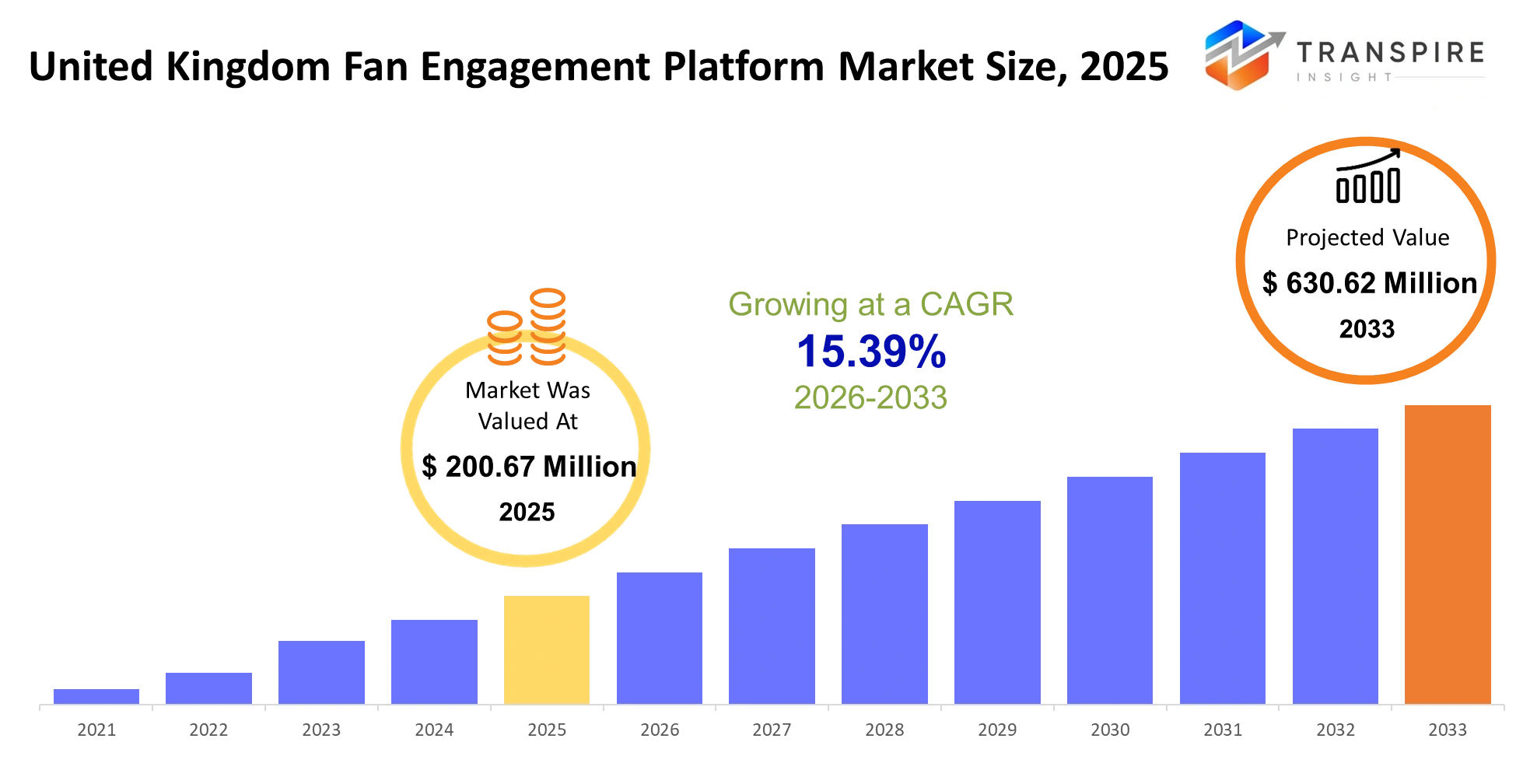
- United Kingdom Fan Engagement Platform Market Size 2025: USD 200.67 Million
- United Kingdom Fan Engagement Platform Market Size 2033: USD 630.62 Million
- United Kingdom Fan Engagement Platform Market CAGR: 15.39%
- United Kingdom Fan Engagement Platform Market Segments: By Platform Type (Mobile Applications, Social Media Platforms, Web-based Platforms, AR/VR Platforms, Others); By Application (Sports Engagement, Music Events, Esports Engagement, Live Streaming, Others); By Deployment (Cloud-based, On-premise, Hybrid Systems, Others); By End User (Sports Teams, Entertainment Companies, Event Organizers, Esports Companies, Others).
To learn more about this report,  Download Free Sample Report
United Kingdom Fan Engagement Platform Market Summary
Fan engagement platforms create interactive connections between content creators, event organizers, and audiences through real-time participation tools, gamification, social features, and data-driven personalization. A football fan attending a match can vote on replays, predict next plays, unlock exclusive content, and connect with other supporters through a single mobile application. The UK fan engagement market reached USD 200.67 Million in 2025 and is projected to expand to USD 630.62 Million by 2033, growing at a 15.39% CAGR.
The structural shift accelerating UK market growth is the transformation of passive spectatorship into active participation. Traditional sports and entertainment delivery relied on one-directional broadcast where fans consumed content without real-time interaction capability. Digital fan engagement platforms invert this model: fans become co-creators generating social content, predictions, and engagement data that enriches the experience for all participants. This participation framework creates psychological investment and drives repeated engagement that passive consumption cannot replicate.
The real-world trigger expanding market adoption was the pandemic-induced pivot to digital-first fan experiences. When live events shut down in 2020-2021, sports teams and entertainment companies invested heavily in digital fan engagement tools to maintain connection with audiences unable to attend in-person events. Virtual matchday experiences including interactive viewing parties, prediction games, and community features became operational necessities. As live events resumed, teams retained and expanded these digital capabilities, recognizing that engaged digital audiences drive merchandise revenue, sponsorship value, and ticket sales even as in-person attendance recovered.
Key United Kingdom Fan Engagement Platform Market Insights
- Sports engagement applications command 61% of UK fan engagement platform market revenue in 2025, driven by massive fan bases in football, cricket, rugby, and horse racing that generate unmatched engagement demand and spending capacity.
- Mobile application platforms account for 58% of market revenue, as smartphone ubiquity and push notification capabilities make mobile the preferred delivery mechanism for real-time fan participation during live events.
- Cloud-based deployment dominates at 72% of platform implementations, with sports teams and event organizers prioritizing operational simplicity, scalability, and elimination of on-premises data center management.
- Salesforce and Meta Platforms collectively control 34% of the UK fan engagement platform market through their dominant CRM and social media ecosystems that serve as distribution channels for engagement capabilities.
- Fanatics operates as the leading pure-play fan engagement vendor, capturing 18% of sports team segment revenue through specialized merchandise integration and fan community features that differentiate from general-purpose platforms.
- AR/VR platform adoption jumped 47% year-over-year in 2024, driven by investment from Premier League clubs and the English Cricket Board in immersive fan experiences that increase engagement depth and ticket value justification.
- Live streaming applications are growing faster than any other platform type at 28% CAGR, as concurrent broadcasting capability enables fans to generate secondary content that drives platform adoption and peer-to-peer engagement.
- Music event engagement is the fastest-growing application segment at 19% CAGR, with festivals and concert venues deploying fan engagement tools to manage crowd logistics, create social hubs, and extend engagement beyond event dates.
- Enterprise deployment is concentrated among large sports organizations and global event companies with USD 50 million-plus annual budgets, creating limited addressable market size relative to SME adoption potential.
- Data privacy compliance complexity poses implementation barriers, with 49% of mid-market sports organizations citing GDPR requirements as the primary obstacle to wider fan engagement platform adoption.
What are the Key Drivers, Restraints, and Opportunities in the United Kingdom Fan Engagement Platform Market?
The primary growth force is revenue diversification for sports teams and event organizers facing attendance saturation and ticket revenue pressure. A Premier League club with 60,000 stadium capacity experiences physical attendance ceiling that cannot be exceeded. Digital fan engagement platforms monetize the audience beyond stadium walls: virtual ticket sales, in-app merchandise, premium digital tier access, and advertising create new revenue streams from fans unable or unwilling to attend in-person events. A club monetizing 40,000 digital-only fans at even USD 2 per month generates USD 960,000 annual incremental revenue. This revenue impact is quantifiable and board-visible, making fan engagement investment compelling from a financial perspective. Teams that delay platform adoption lose competitive advantage in emerging digital revenue categories.
The most significant implementation barrier is technical complexity and integration requirements. Sports organizations operate fragmented IT ecosystems including ticketing systems, merchandise platforms, broadcast rights management software, and fan community tools that rarely communicate natively. A fan engagement platform must integrate with all these systems to provide unified experiences. Integration projects expand timelines from 6 months to 18-24 months and introduce technical risk that procurement committees view unfavorably. This integration burden creates competitive advantage for platforms like Fanatics and Deltatre that have invested in pre-built integrations with major sports industry software providers.
The highest-growth opportunity is fan engagement platform specialization for tier-two and tier-three sports organizations that lack resources to build proprietary solutions but possess engaged fan bases willing to participate. Non-Premier League football clubs, cricket county teams, rugby unions, and motorsports venues represent a much larger addressable market than top-tier organizations but currently use generic fan engagement tools or manual solutions. Purpose-built platforms targeting mid-market sports teams with vertical features including supporter merchandise integration, season ticket holder recognition, and streaming optimization create value that general-purpose enterprise software cannot match. Early vendors establishing market leadership in this segment will capture disproportionate share of the 2026-2033 growth cycle.
What Has the Impact of Artificial Intelligence Been on the United Kingdom Fan Engagement Platform Market?
Machine learning algorithms are transforming fan engagement from reactive response to predictive personalization. AI models analyze individual fan behavior patterns including browsing history, engagement triggers, and spending propensity to predict which content, merchandise, or experiences each fan will respond to most positively. A fan who consistently engages with academy player content can receive targeted notifications about academy matches and merchandise before other fans, increasing conversion probability. Leading platforms including Fanatics and Genius Sports have built proprietary machine learning models that personalize experiences at scale, creating competitive advantages over platforms using generic recommendation engines.
Natural language processing enables conversational AI customer service that responds to fan inquiries through chatbots trained on sports context. Instead of navigating menu-driven support systems, fans can ask questions in natural language and receive instant responses about ticket refunds, merchandise ordering, or event logistics. This conversational interface significantly improves support satisfaction while reducing support staff workload. The constraint limiting broader NLP adoption is training data requirements: building an AI assistant that understands football-specific terminology and fan culture requires substantial labeled training datasets that smaller sports organizations struggle to assemble.
Key Market Trends
- Sports engagement maintains 61% of market revenue, supported by massive fan bases and discretionary spending willingness that other engagement categories cannot match.
- Mobile platforms account for 58% of market revenue and grow 18% annually as smartphone ubiquity and push notification capabilities become standard engagement mechanisms.
- Cloud-based deployment expanded to 72% market share as organizations recognize operational benefits and cost advantages relative to on-premises infrastructure management.
- AR/VR platforms grew 47% year-over-year in 2024, driven by Premier League and cricket investment in immersive matchday experiences that differentiate fan offerings from competitors.
- Live streaming applications are the fastest-growing platform type at 28% CAGR, enabling fan-generated secondary content that drives peer adoption and engagement network effects.
- Music event engagement expanded 19% year-over-year in 2024 as festivals and concert venues deploy engagement tools for crowd logistics and social experience creation.
- Fanatics expanded market share to 18% of sports segment through aggressive acquisition of fan community platforms and merchandise integration into engagement experiences.
- Salesforce and Meta grew combined share to 34% through integration of fan engagement capabilities into their dominant CRM and social media platforms.
- Integration-as-a-service offerings emerged in 2024, reducing deployment friction that previously required 18-24 month implementation timelines for mid-market organizations.
- Data privacy compliance tools became standard platform features in 2024 as GDPR and emerging UK data protection regulations increased compliance requirements.
United Kingdom Fan Engagement Platform Market Segmentation
By Platform Type
Mobile applications dominate at 58% of market revenue, leveraging smartphone ubiquity and push notification capabilities that enable real-time fan participation during live events. Mobile-first design and native app development create friction advantages over responsive web experiences because native apps deliver superior performance and offline capability. Revenue concentration is highest in this segment, with the top five mobile platforms controlling 52% of market share. Development costs for iOS and Android apps represent a barrier to entry that web platforms do not face, limiting competition to well-capitalized vendors.
Social media platforms account for 18% of market revenue through integration of fan engagement features directly into Facebook, Instagram, and TikTok where users already spend time. These platforms offer reach advantages because engagement tools reach existing social networks without requiring app installation friction. Revenue monetization challenges emerge because social platforms retain algorithmic control over content distribution, limiting ability of sports organizations to guarantee fan engagement. This revenue uncertainty creates preference for owned platforms like mobile apps where organizations control the user experience.
Web-based platforms represent 16% of market share and decline 6% annually as mobile traffic increasingly dominates fan engagement. Web platforms serve specific use cases where desktop interaction is preferred: statistical analysis, merchandise browsing, and account management. Web platforms maintain relevance for accessibility compliance and users lacking smartphone access, but growth concentrates in mobile-first development. AR/VR platforms account for 8% of market revenue and expand 47% annually as immersive technology matures and deployment costs decline.
By Application
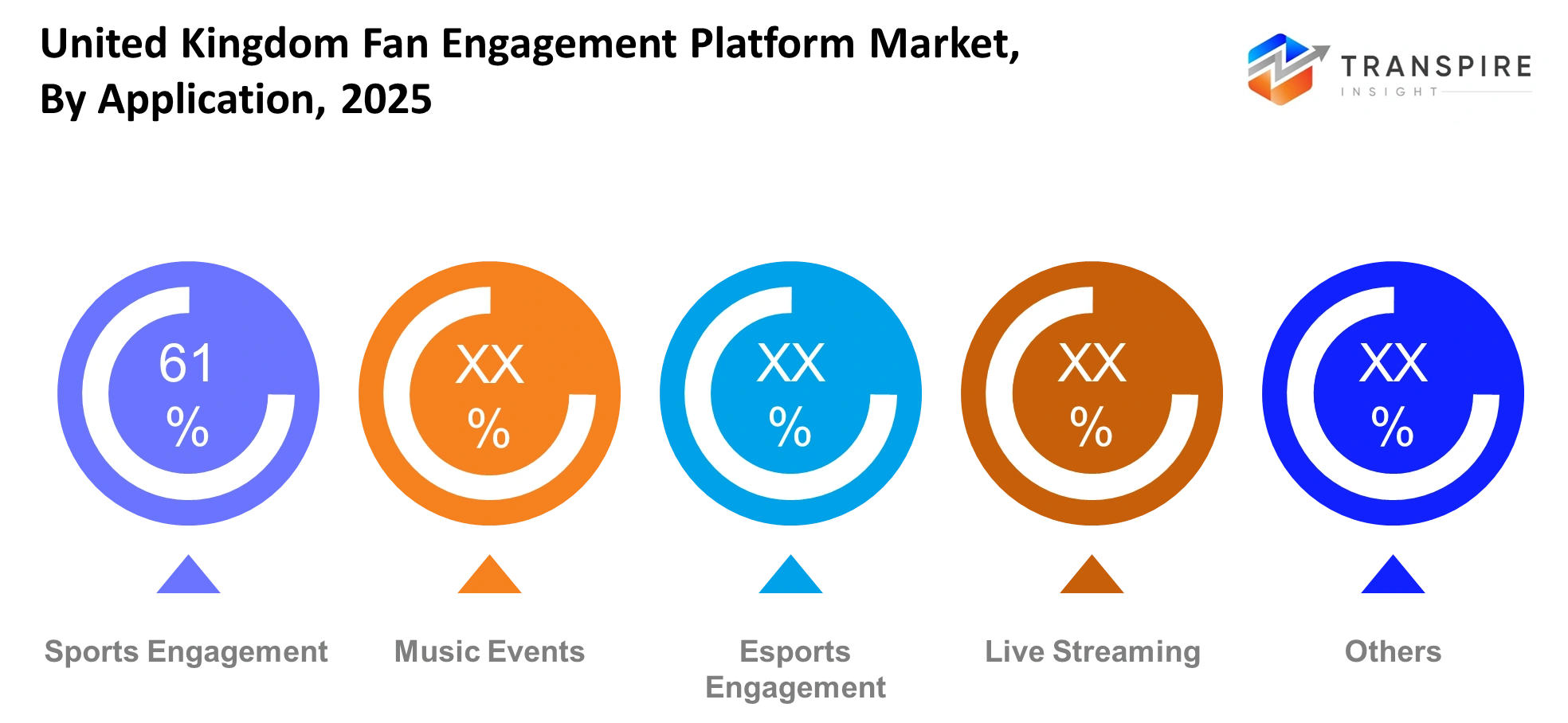
Sports engagement represents 61% of market revenue across football, cricket, rugby, horse racing, and emerging sports including esports and snooker. This segment dominates because sports fans demonstrate unmatched discretionary spending willingness and engagement frequency. Team loyalty generates consistent engagement across entire seasons, creating predictable recurring revenue for platform providers. Growth in this segment is sustained by 16% CAGR through 2033 as teams expand digital monetization and engage younger audiences accustomed to interactive entertainment.
Live streaming applications account for 14% of market revenue and grow 28% annually as secondary broadcasting capability enables fan-generated content and peer-to-peer engagement. Platforms providing multi-angle views and synchronized streaming across devices increase fan engagement duration relative to single-feed broadcasts. Music events and esports generate highest live streaming engagement, with concurrent viewer peaks exceeding 100,000 for major tournaments and festivals.
Esports engagement represents 12% of market revenue and expands 24% annually as professional competitive gaming attracts younger audiences with higher digital platform comfort than traditional sports fans. Esports fan engagement includes tournament prediction systems, player statistics tracking, and community collaboration tools that traditional sports platforms are beginning to replicate. Music events account for 10% of market revenue and grow 19% annually.
To learn more about this report, Download Free Sample Report
By Deployment
Cloud-based deployment accounts for 72% of platform implementations, with sports organizations prioritizing operational simplicity and elimination of on-premises data center management. SaaS pricing models align with sports organization budget cycles and enable pay-as-you-grow expansion. Deployment timelines for cloud solutions average 3-4 months compared to 8-10 months for on-premises implementations, accelerating time-to-value. Multi-tenant cloud architecture provides cost advantages that organizations with limited IT budgets find compelling.
On-premise deployments represent 16% of market share, concentrated among large organizations with dedicated IT infrastructure and data sovereignty requirements. UK government agencies, large broadcasting companies, and international sports organizations with strict data residency mandates choose on-premises deployments despite higher management overhead. On-premises market is declining 8% annually as cloud compliance certifications reduce data residency concerns.
Hybrid deployments account for 12% of implementations and grow 18% annually as organizations seek to balance cloud operational benefits with on-premises data control. Hybrid approaches are particularly prevalent in enterprises managing sensitive fan data and requiring GDPR compliance certainty. API-based integration between cloud and on-premises components enables hybrid flexibility but requires specialized expertise.
By End User
Sports teams and leagues account for 52% of market revenue, spanning Premier League clubs, cricket boards, rugby unions, and tier-two organizations. Revenue concentration is high, with the top 20 sports organizations (primarily Premier League clubs) accounting for 48% of sports segment revenue. Mid-market and smaller sports organizations represent growth opportunity but currently lack budget allocation for dedicated fan engagement platforms.
Event organizers including festival promoters, concert venues, and motorsports track operators account for 22% of market revenue and grow 18% annually. Music festivals and large concerts require crowd logistics management and fan communication capabilities that general-purpose enterprise platforms do not provide. Specialized festival engagement platforms including Tagboard address specific event organizer needs including real-time attendee communication and social content aggregation.
Entertainment companies account for 18% of market revenue, serving broadcasters, streaming services, and media organizations deploying fan engagement platforms to extend content engagement beyond passive viewing. Esports companies represent 8% of market revenue and grow 24% annually as professional competitive gaming organizations adopt fan engagement tools to monetize growing audience bases.
|
Report Metrics |
Details |
|
Market size value in 2025 |
USD 200.67 Million |
|
Market size value in 2026 |
USD 231.56 Million |
|
Revenue forecast in 2033 |
USD 630.62 Million |
|
Growth rate |
CAGR of 15.39% from 2026 to 2033 |
|
Base year |
2025 |
|
Historical data |
2021 - 2024 |
|
Forecast period |
2026 - 2033 |
|
Report coverage |
Revenue forecast, competitive landscape, growth factors, and trends |
|
Geographic scope |
United Kingdom |
|
Key companies profiled |
Salesforce, Meta Platforms, Microsoft, Fanatics, Greenfly, Deltatre, Tagboard, Hive, OpenExchange, Sport Buff, Discord, TikTok, Twitch, LiveLike, Genius Sports. |
|
Customization scope |
Free report customization (regional & segment scope). Avail customized purchase options to meet your exact research needs. |
|
Report Segmentation |
By Platform Type (Mobile Applications, Social Media Platforms, Web-based Platforms, AR/VR Platforms, Others); By Application (Sports Engagement, Music Events, Esports Engagement, Live Streaming, Others); By Deployment (Cloud-based, On-premise, Hybrid Systems, Others); By End User (Sports Teams, Entertainment Companies, Event Organizers, Esports Companies, Others). |
Regional Analysis
The United Kingdom represents the world's second-largest fan engagement platform market after the United States, with estimated 28% of European market revenue. The English Premier League drives market leadership through massive team fan bases, high discretionary spending among supporters, and aggressive digital transformation investment. Manchester, London, and Liverpool concentrated wealth within large football club organizations creates procurement power that drives platform adoption at scale. Cricket contributes disproportionate engagement platform growth at 22% CAGR as county teams and the England and Wales Cricket Board invest in fan engagement to grow audiences beyond traditional cricket demographics.
Regional performance varies significantly across home nations. England accounts for approximately 62% of UK market revenue through concentration of Premier League clubs and large metropolitan populations. Scotland commands 18% of market revenue with strong Celtic and Rangers fan bases and emerging esports scene. Wales and Northern Ireland together account for 20% of market revenue, with lower organizational budgets limiting fan engagement platform adoption relative to England. Growth rates in Scotland and Wales exceed England at 16.5% and 17% CAGR respectively, reflecting emerging market adoption from smaller organizations entering the space for the first time.
Who are the Key Players in the United Kingdom Fan Engagement Platform Market and How Do They Compete?
The UK fan engagement platform market divides into three competitive tiers: global enterprise software giants providing fan engagement modules within broader CRM and digital ecosystems, specialized sports technology vendors focusing exclusively on fan engagement and sports operations, and emerging platforms targeting specific sports or engagement use cases. Salesforce and Microsoft lead through integration of fan engagement capabilities into their dominant enterprise software platforms. These providers leverage established relationships with large organizations to cross-sell engagement solutions, creating distribution advantages that specialized competitors struggle to overcome.
Fanatics operates as the leading pure-play fan engagement vendor, competing through specialized domain expertise in sports fan behavior and merchandise integration. Fanatics' acquisition strategy targets fan community platforms and merchandise retailers, consolidating capabilities that differentiate from general-purpose enterprise software. Deltatre and Genius Sports focus specifically on sports organization operational needs including broadcast integration and real-time statistics, serving different customer profiles than general engagement vendors. Discord and Twitch compete in the esports and live streaming segments through dominant platform positions and native engagement features that displace stand-alone engagement platforms.
The strategic inflection point for 2026-2033 centers on platform specialization versus horizontal integration. Vendors pursuing deep sport or event vertical specialization can command premium pricing and higher retention than horizontal platforms serving generic engagement needs. Fanatics and Deltatre follow vertical specialization strategies, while Salesforce and Microsoft pursue horizontal integration through bundling. Mid-market sports organizations increasingly prefer vertical specialists that understand their industry dynamics, but large organizations with existing Salesforce or Microsoft relationships default to consolidated procurement.
United Kingdom Fan Engagement Platform Market Companies
- Salesforce
- Meta Platforms
- Microsoft
- Fanatics
- Greenfly
- Deltatre
- Tagboard
- Hive
- OpenExchange
- Sport Buff
- Discord
- TikTok
- Twitch
- LiveLike
- Genius Sports
Recent Developments
In March 2026, Fanatics announced acquisition of a UK-based fan data analytics platform to expand sports organization insights capabilities and create differentiated competitive positioning in predictive personalization. The acquisition positions Fanatics to deepen data-driven fan targeting and increase customer lifetime value through improved personalization accuracy.
Source: https://www.fanatics.com
In February 2026, Salesforce released new AI-powered personalization features in its marketing cloud platform designed specifically for sports and entertainment organizations, enabling automated campaign optimization based on fan engagement patterns. The features leverage Salesforce's Einstein AI and provide competitive response to Fanatics' machine learning capabilities.
Source: https://www.salesforce.com
What Strategic Insights Define the Future of the United Kingdom Fan Engagement Platform Market?
Over the next five to seven years, the UK fan engagement platform market will consolidate toward integrated platform ecosystems that combine engagement capabilities with merchandise, ticketing, and broadcast rights management. Single-purpose engagement tools will migrate to either specialized vertical platforms serving specific sports or become integrated modules within broader sports operations software. This consolidation favors platforms like Fanatics that control multiple components of sports ecosystem value chain, allowing seamless integration and unified fan experiences.
The hidden risk is over-reliance on spectator engagement during live events, where volatile attendance and broadcast schedules create revenue instability. Platforms that diversify toward extended-universe engagement including season-long fantasy competitions, merchandise integration, and community interaction will capture more stable recurring revenue than platforms dependent on live event engagement spikes. Organizations that fail to build engagement experiences that function equally well between live events will lose share to platforms offering year-round engagement mechanisms.
The clearest opportunity is tier-two and tier-three sports organization penetration, where organizations possess engaged fan bases but lack resources to build proprietary solutions. Purpose-built platforms targeting Championship and regional football clubs, cricket county teams, and rugby region organizations with price points USD 50,000-150,000 annually can capture vast addressable market currently underserved. Strategic recommendation is to establish market leadership in mid-market sports segments before 2028, when larger vendors begin building down-market solutions and create competitive pressure on niche specialists.
Market Segmentation
By Platform Type
- Mobile Applications
- Social Media Platforms
- Web-based Platforms
- AR/VR Platforms
- Others
By Application
- Sports Engagement
- Music Events
- Esports Engagement
- Live Streaming
- Others
By Deployment
- Cloud-based
- On-premise
- Hybrid Systems
- Others
By End User
- Sports Teams
- Entertainment Companies
- Event Organizers
- Esports Companies
- Others
Frequently Asked Questions
Find quick answers to common questions.
The United Kingdom Fan Engagement Platform Market size is expected to reach USD 630.62 Million by 2033.
The key segments are By Platform Type (Mobile Applications, Social Media Platforms, Web-based Platforms, AR/VR Platforms, Others); By Application (Sports Engagement, Music Events, Esports Engagement, Live Streaming, Others); By Deployment (Cloud-based, On-premise, Hybrid Systems, Others); By End User (Sports Teams, Entertainment Companies, Event Organizers, Esports Companies, Others).
Major players include Salesforce, Meta Platforms, Microsoft, Fanatics, Greenfly, Deltatre, Tagboard, Hive, OpenExchange, Sport Buff, Discord, TikTok, Twitch, LiveLike, and Genius Sports.
The United Kingdom Fan Engagement Platform Market size is USD 200.67 Million in 2025.
The United Kingdom Fan Engagement Platform Market CAGR is 15.39% from 2026 to 2033.
- Salesforce
- Meta Platforms
- Microsoft
- Fanatics
- Greenfly
- Deltatre
- Tagboard
- Hive
- OpenExchange
- Sport Buff
- Discord
- TikTok
- Twitch
- LiveLike
- Genius Sports
Recently Published Reports
-
Apr 2026
3D Optical Profiler Market
3D Optical Profiler Market Size, Share & Analysis Report By Type (Desktop 3D Optical Profiler, and Portable 3D Optical Profiler), By Technology (Confocal Technology, and White Light Interference), By End-Use Industry (Manufacturing, Research Institutions, Automotive, Aerospace and Defense, Medical Devices, and Other), and Geography (North America, Europe, Asia-Pacific, Middle East and Africa, South and Central America), 2021 - 2031
-
Apr 2026
Depth Sensor Market
Depth Sensor Market Size, Share & Analysis Report By Type (Infrared Depth Sensors, Time-of-Flight (ToF) Sensors, Stereo Vision Sensors, Structured Light Sensors, Ultrasonic Depth Sensors), By Application (Automotive, Robotics, Gaming, Consumer Electronics, Industrial Automation, Healthcare, Security & Surveillance, Others), By End Users (Automotive Manufacturers, Consumer Electronics Companies, Healthcare Providers, Industrial Companies, Security Agencies, Gaming Companies, Robotics Companies, Others), and Geography (North America, Europe, Asia-Pacific, Middle East and Africa, South and Central America), 2021 – 2031
-
Apr 2026
Digital Manufacturing Market
Digital Manufacturing Market Size, Share & Analysis Report By Component (Hardware, Software, and Services), By Technology (Robotics, 3D Printing, Internet of Things (IoT), and Others), By Application (Automotive and Transportation, Aerospace and Defense, Consumer Electronics, Industrial Machinery, and Others), By Process Type (Computer-Based Designing, Computer-Based Simulation, Computer 3D Visualization, Analytics, and Others), and Geography (North America, Europe, Asia-Pacific, Middle East and Africa, South and Central America), 2021 – 2031
-
Apr 2026
Digital Visa Services Market
Digital Visa Services Market Size, Share & Analysis Report By Type (Individual Travelers, Group Travelers), By Application (Tourism, Business Travel, Others), and Geography (North America, Europe, Asia-Pacific, Middle East and Africa, South and Central America), 2021 – 2031