
Asia Pacific Space Technology Market Size & Forecast:
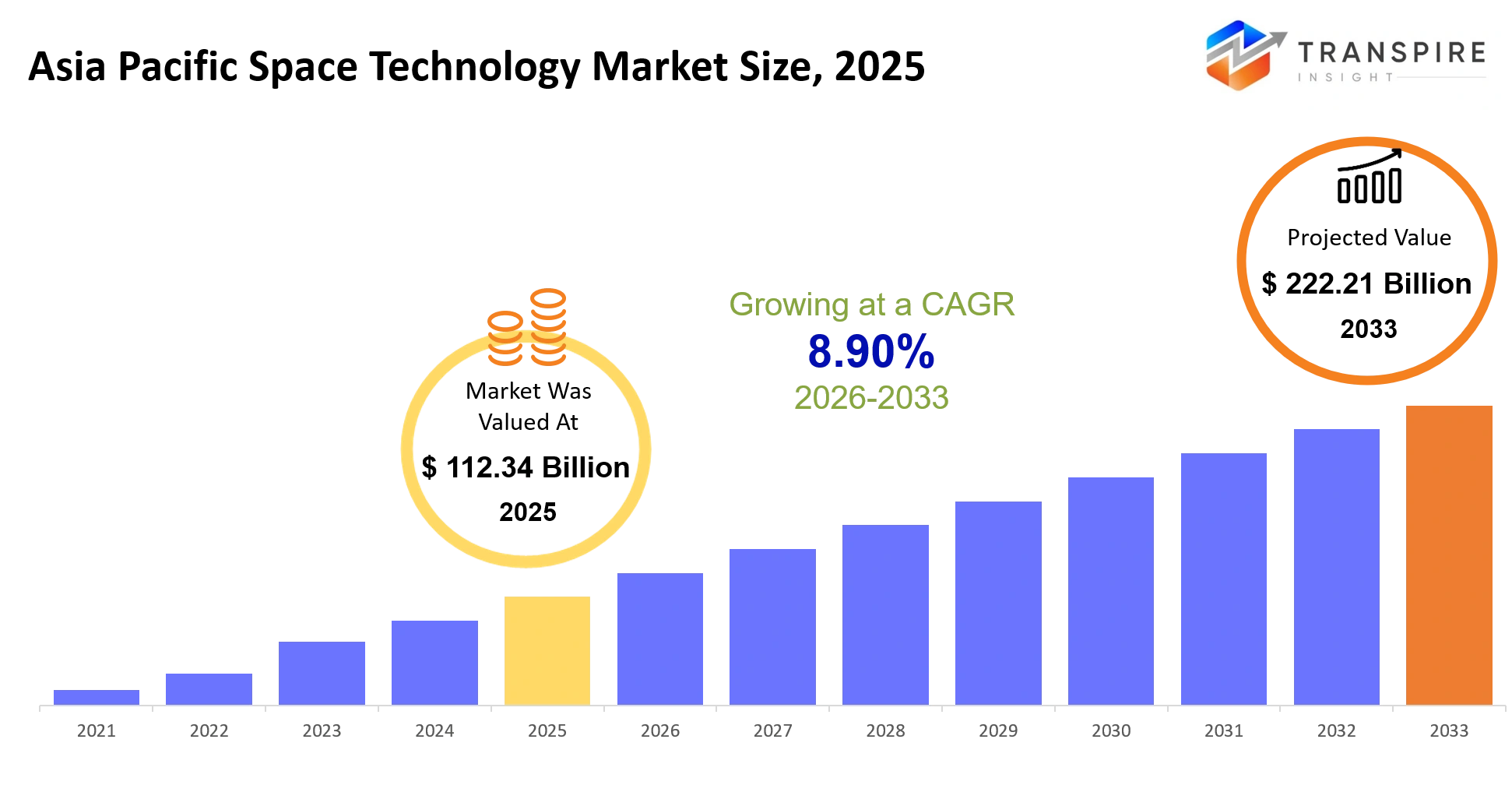
- Asia Pacific Space Technology Market Size 2025: USD 112.34 Billion
- Asia Pacific Space Technology Market Size 2033: USD 222.21 Billion
- Asia Pacific Space Technology Market CAGR: 8.90%
- Asia Pacific Space Technology Market Segments: By Technology (Satellite Technology, Launch Vehicles, Space Robotics, Space Exploration Systems, Earth Observation, Space Communications, Navigation Systems, Others); By Application (Defense, Commercial Space, Scientific Research, Telecommunications, Navigation, Earth Observation, Others); By Component (Hardware, Software, Services, Ground Systems, Payloads, Others); By End User (Government, Defense Agencies, Commercial Enterprises, Research Institutes, Others).
To learn more about this report,  Download Free Sample Report
Asia Pacific Space Technology Market Summary
The Asia Pacific Space Technology Market was valued at USD 112.34 Billion in 2025. It is forecast to reach USD 222.21 Billion by 2033. That is a CAGR of 8.90% over the period.
The Asia Pacific Space Technology Market helps governments, defense agencies, telecom operators, logistics companies, and environmental monitoring organizations grab critical data, keep communications going, guide and position assets, and bolster national security via satellites, launch systems, ground infrastructure, and related offerings. In day to day use, it lets industries keep an eye on shipments, tune into weather signals, respond to disasters, widen broadband access, and improve precision farming across widely spread locations, kind of messy but still effective.
Over the last five years, the market has quietly shifted, not just in one place, from government led space programs to commercially driven ecosystems that lean on private launch providers, satellite makers, and downstream data service firms. That change has been helped along by policy reforms in India, Japan, and Australia where officials are basically asking for more private-sector involvement. One big trigger is the intensifying strategic competition around space capabilities plus supply chain resilience, which has pushed governments to ramp up funding for sovereign satellite infrastructure. Also, as more organizations lean on space derived data for operational choices, demand is moving past the usual aerospace crowd, and that’s opening new revenue areas in communications, Earth observation, and defense applications.
Key Market Insights
- India, China, Japan, and Australia together sort of end up dominating the Asia Pacific Space Technology Market, taking in over 70% of the regional industry activity in 2025, it seems.
- Meanwhile Southeast Asia is showing up as a kind of strategic growth hub, mainly because satellite connectivity is expanding and the need for Earth observation keeps rising, too.
- In terms of what sells the most, satellite manufacturing pretty much leads the Asia Pacific Space Technology Market, grabbing around 35% market share in 2025.
- After that, launch services come in as the second-largest chunk, and it’s being backed by more commercial plus government satellite deployment programs, on the whole.
- Space data analytics, along with other downstream services, is the fastest moving segment over the forecast period, basically.
- Small satellite platforms keep getting more traction because the deployment costs are lower, and the development cycles are kinda shorter too, at least compared with older approaches.
- For now, satellite communication stays the main application, and it’s still close to 40% of the market revenue in 2025.
- Earth observation is moving the quickest, backed by disaster monitoring, agriculture initiatives and climate intelligence programs, all together in one bundle.
- Defense and national security uses hold a meaningful slice, mostly tied to sovereign space capability investments and related contracts.
- Navigation and positioning services are also expanding, especially across transportation plus logistics, where timing and awareness matter a lot .
What are the Key Drivers, Restraints, and Opportunities in the Asia Pacific Space Technology Market?
In the Asia Pacific Space Technology Market, the main thing pushing growth is the commercialization of national space initiatives, tied to expanding strategic spending on satellite infrastructure, or so it seems. Across India, China, Japan, South Korea, and Australia, governments have rolled out programs that make it easier for private players to join in with launch services, satellite building, and also the downstream data applications. When launch costs go down, and miniaturized satellite tech gets better, plus venture capital becomes more reachable, commercial missions are suddenly more “economically believable” than before. So companies in telecommunications, agriculture, logistics, and defense are buying more space-derived services, which then creates recurring income streams that don’t depend only on the usual government contracts.
Still, the biggest drag is the very high capital intensity linked with building satellites, running launch activities, and deploying ground infrastructure. This is kind of structural really, because space work comes with long development cycles, specialized engineering know-how, regulatory clearances, and a lot of upfront money. Even though launch costs are getting cheaper, quite a few emerging firms can’t line up enough financing for constellation rollouts and long-term operations. And then you end up with slower project execution, a slower path to commercialization, and fewer opportunities for smaller market entrants to join in at all.
A big future chance sits with low Earth orbit satellite constellations, sort of supporting broadband connectivity and real time data services. Lots of countries across Southeast Asia and some remote Pacific areas, still get hit with connectivity gaps that regular terrestrial networks cannot really fix at reasonable cost. If investment keeps growing into low Earth orbit infrastructure ,and if there are further improvements in satellite to device communication technologies, then new commercial markets could open up over the next decade. Think telecommunications, disaster response and management, maritime surveillance, and tracking of industrial assets all of that, tied together with the newer links.
What Has the Impact of Artificial Intelligence Been on the Asia Pacific Space Technology Market?
Artificial intelligence is kinda transforming the Asia Pacific space sector, mainly by making it better for satellite operators to collect and then process, and eventually monetize huge amounts of information. AI analytics platforms automatically spot patterns in Earth observation imagery, which allows quicker recognition of shifts in the environment, development of infrastructure, agricultural conditions, plus impacts from disasters. In practice this cuts down the need for a lot of manual sorting, and it speeds up decision making for government agencies , as well as commercial clients.
At the same time, machine learning models are getting really good at predictive maintenance for both satellites and ground infrastructure. If telemetry data keeps getting analyzed, operators can flag possible component failures ahead of time, before they ruin or interrupt missions. That tends to raise overall asset availability and also lowers maintenance expenses. Then there are AI driven mission planning tools that optimize satellite tasking, bandwidth distribution, and orbital operations, so operators can push utilization rates higher and improve service revenue.
Plus, newer digital technologies back these operational gains through automated image classification, near real time anomaly detection, and more careful management of communication networks. These approaches boost service dependability, shorten data processing turnarounds, and improve how efficiently satellite based applications work across telecommunications, defense, and environmental monitoring markets.
Even with these advantages , AI uptake is still kinda held back by whether there are enough high quality training datasets and by how hard it is to fold advanced analytics into older, legacy space infrastructure. A lot of operators keep running into the same stuff, like getting the data standardized the right way, the compute demands being too heavy, and the whole question of validating AI generated outputs when it actually matters in mission critical settings. So, large scale rollout across the regional space ecosystem stays limited and it’s not really taking off as quickly as people hope, mostly because all of those pieces are still complicated.
Key Market Trends
- Since 2020, India has opened up key space activities to private firms, and that somehow triggered a surge in startup involvement across launch, satellite, and data services.
- Satellite operators are leaning more often toward smaller satellite constellations , which tends to shorten the deployment timelines from several years to less than 24 months in many programs.
- Governments across China, Japan, India, and Australia have also expanded their sovereign space investments, mainly because geopolitical tensions rose and suddenly made strategic infrastructure feel more urgent.
- Earth observation buyers started shifting away from simply purchasing raw imagery, and moved toward subscribing to AI enabled analytics platforms that return actionable intelligence in near real time.
- Launch providers increasingly chase reusable technologies, following the same global cost-efficiency trend, and this has reshaped commercial launch economics since around 2021.
- Telecommunications companies expanded their satellite integration plans after rural broadband gaps made it obvious that extending terrestrial networks across remote regions has real limitations.
- Defense agencies have been moving toward multi satellite architectures , so they depend less on one single, high value asset, and overall they get better operational resilience against disruptions.
- Space startups pulled in significantly higher venture capital funding between 2021 and 2025, as investors focused on downstream use cases and data monetization approaches.
- Manufacturers began sourcing standardized satellite components more often, instead of highly customized designs, and that helps shorten production cycles while improving scalability.
- Strategic partnerships between commercial operators, government agencies, and research institutions became more frequent after 2022, which sped up tech transfer , and also mission development.
Asia Pacific Space Technology Market Segmentation
By Technology :
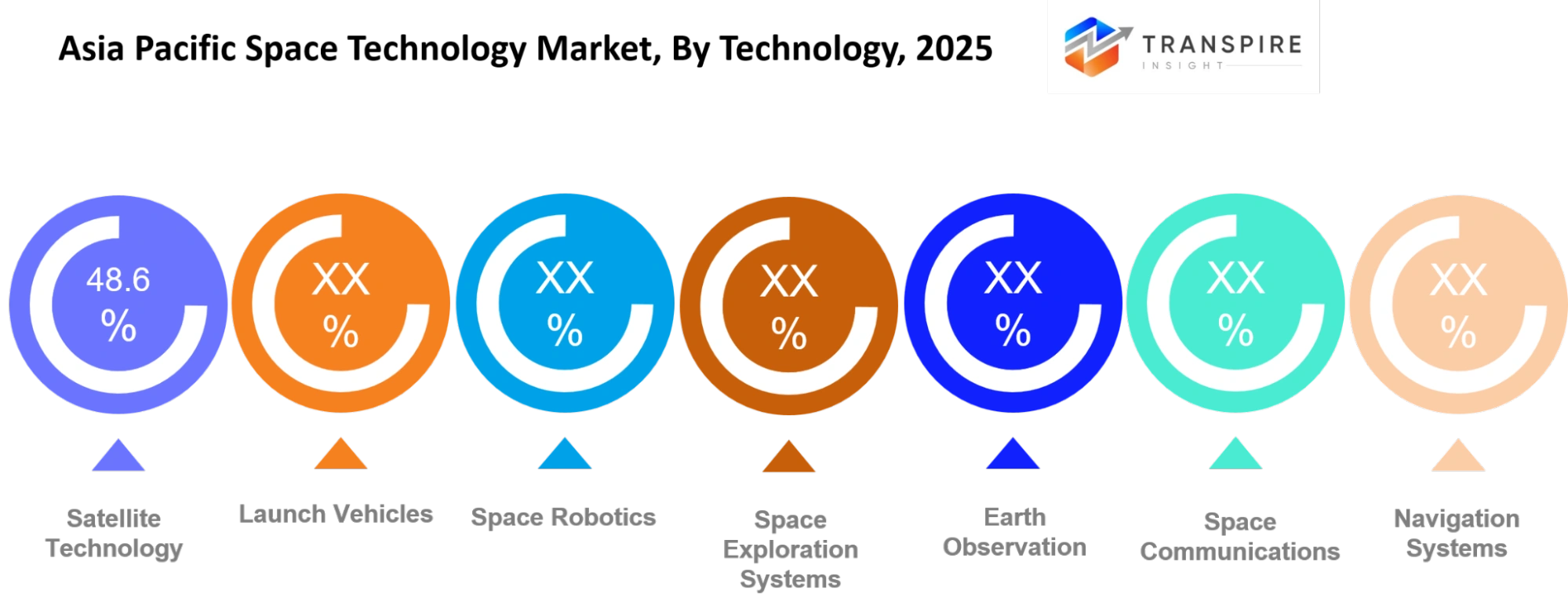
Satellite Technology kind of holds a central place in the Asia Pacific Space Technology Market, because satellites back communication, weather monitoring, navigation, and data gathering across many industries. Ongoing upgrades in satellite architecture, miniaturization, and day-to-day operational efficiency have allowed a much wider deployment. Quite often, organizations depend on satellite services for better connectivity, to watch over assets, and to help with the whole decision-making process, overall.
Launch Vehicles then take a big part too, they let both government and commercial missions reach space, and without that access a lot of programs simply stall. Meanwhile, Space Robotics and Space Exploration Systems help with mission execution, maintenance tasks, and scientific goals. Earth Observation technologies deliver useful environmental as well as geographic data. On top of that, Space Communications and Navigation Systems reinforce connectivity and improve positioning capabilities too. There are also other technology categories that end up being important for niche applications, they support the growing space ecosystem across the region, bit by bit.
To learn more about this report, Download Free Sample Report
By Application :
Defense is, kinda a big application area because satellite surveillance is strategic, and the intelligence collection plus secure comms networks are sort of the core. Governments keep funding new space capabilities to bolster national security and raise operational readiness. Space-based assets also help with real time information reach , and they increase overall mission efficiency.
Commercial Space keeps growing, since private companies join in not only satellite deployment, but also launch operations and business models that are driven by data. In the same way, Telecommunications along with Navigation cover connectivity and positioning services for both companies and everyday consumers. Meanwhile Scientific Research and Earth Observation help with climate work, environmental watch, disaster response, and even resource appraisal. There are also other applications that pop up to meet new demands across transport, agriculture, and infrastructure fields.
By Component :
Hardware plays a fairly big role in the Asia Pacific Space Technology Market, mostly because satellites, sensors, comms equipment, and launch-related systems need solid physical groundwork. There is continuous technical progress which keeps pushing performance, durability, and everyday operational abilities forward. So yeah, spending on hardware still stays important for brand new deployments as well as for modernization efforts.
Software, on the other hand, helps with mission planning, satellite commanding, data handling, and overall system management. Services then add operational assistance, upkeep, analytics, plus consulting style support. Ground systems help link space assets to terrestrial networks, while payloads bring the mission specific instruments in place, for communication, monitoring, observation, and even scientific use. Beyond that, other components exist too, to cover specialized operational needs and mission outcomes.
By End User :
Government organizations still show up as one of the biggest end users since public agencies… sort of oversee national space programs, satellite infrastructure build out, and strategic investments. There are long- range funding commitments that keep pushing technology progression, national connectivity targets, and several scientific initiatives. When it comes down to it, government-led programs tend to open doors for cross- industry teaming, even beyond the obvious partners.
Defense agencies depend on space capabilities for surveillance, encrypted or secure communications, intelligence missions, plus navigation support. Meanwhile commercial enterprises are leaning more and more into satellite based services, not only to boost operational efficiency, but also to reach high value data faster. Research institutes add value through scientific flights, research technology development, and innovation programs as well. There are also other end users like organizations that take space derived information, and turn it into applied services so they can satisfy sector specific operational requirements.
What are the Key Use Cases Driving the Asia Pacific Space Technology Market?
Satellite comms still feel like the main thing pushing adoption across the Asia Pacific Space Technology Market. Like, governments and defense groups, plus telecom providers, all end up leaning on satellite networks so they can get dependable connectivity across far off regions, islands, maritime routes, and other underserved pockets where terrestrial infrastructure is kinda thin. And yeah, that wide operational usefulness keeps pulling in real money, plus ongoing deployment work.
Then there’s earth observation and navigation services, which are starting to get picked up more by both commercial firms and public agencies. For example, agricultural operators use satellite imagery to keep an eye on crop conditions, and in turn better time resource allocation, while logistics and transportation companies count on positioning services to tighten route planning and asset tracking. Disaster management authorities also lean on satellite data to help with emergency response, plus environmental monitoring when things get messy.
New-ish uses are showing up too, especially low Earth orbit satellite constellations aimed at direct-to-device connectivity, and space based analytics that are powered by artificial intelligence. These types of solutions look promising for remote industrial operations, climate risk scoring, and real time infrastructure surveillance. As tech expenses keep sliding down, and satellite capacity keeps growing, it seems likely these efforts will shift from small pilots into more regular commercial rollouts during the forecast window.
|
Report Metrics |
Details |
|
Market size value in 2025 |
USD 112.34 Billion |
|
Market size value in 2026 |
USD 122.34 Billion |
|
Revenue forecast in 2033 |
USD 222.21 Billion |
|
Growth rate |
CAGR of 8.90% from 2026 to 2033 |
|
Base year |
2025 |
|
Historical data |
2021 - 2024 |
|
Forecast period |
2026 - 2033 |
|
Report coverage |
Revenue forecast, competitive landscape, growth factors, and trends |
|
Regional scope |
Asia Pacific (India, China, Japan, Australia, South Korea, Rest of Asia Pacific) |
|
Key company profiled |
SpaceX, Airbus Defence & Space, Boeing, Lockheed Martin, Northrop Grumman, ISRO, JAXA, Mitsubishi Electric, Thales Alenia Space, Rocket Lab, Maxar, Planet Labs, SES, Intelsat, Astroscale. |
|
Customization scope |
Free report customization (country, regional & segment scope). Avail customized purchase options to meet your exact research needs. |
|
Report Segmentation |
By Technology (Satellite Technology, Launch Vehicles, Space Robotics, Space Exploration Systems, Earth Observation, Space Communications, Navigation Systems, Others); By Application (Defense, Commercial Space, Scientific Research, Telecommunications, Navigation, Earth Observation, Others); By Component (Hardware, Software, Services, Ground Systems, Payloads, Others); By End User (Government, Defense Agencies, Commercial Enterprises, Research Institutes, Others). |
Which Regions are Driving the Asia Pacific Space Technology Market Growth?
East Asia kinda represents the biggest part of the Asia Pacific Space Technology Market, with China, Japan , and South Korea leading the way. There’s also strong government backing, pretty mature aerospace manufacturing capabilities, and those long-term national space plans that keep pushing for large-scale satellite rollout and frequent launch activity. China keeps putting serious money into launch facilities, satellite constellations, and Earth observation efforts. Japan, meanwhile, tends to lean more toward advanced satellite tech and also deep space missions. At the same time, the region has this solid web of research institutions, aerospace contractors, component suppliers and government agencies, which sort of helps maintain the lead and keeps new tech moving forward without a stop and start.
Then there are the developed Asia Pacific markets, especially Japan, South Korea, and Australia. They add more stability than huge volumes. When you compare them to East Asia’s heavy reliance on large, government-backed initiatives, these countries seem to prefer steadier investment, commercial partnerships, and dependable technology deployment. Their economic base is strong enough that spending on satellite communications, navigation services, and scientific missions can continue, even when the market feels uncertain. So overall, this calm but consistent environment results in more predictable income for manufacturers, service providers, and tech developers working across the whole regional space sector.
South and Southeast Asia right now show the most noticeable growth momentum, largely pushed by India and a few fast-rising Southeast Asian economies. Lately, regulatory reforms that try to encourage private-sector involvement have basically reshaped the whole competitive scene, and at the same time satellite connectivity initiatives keep rolling out. Because of this, investments into low Earth orbit satellite networks, digital infrastructure ,and commercial launch abilities are still pulling in fresh players and capital. From 2026 through 2033, this pace should translate into meaningful openings for satellite operators, launch service providers, data analytics companies, plus investors looking for more exposure to these expanding commercial space activities.
Who are the Key Players in the Asia Pacific Space Technology Market and How Do They Compete?
Competition across the Asia Pacific Space Technology Market looks like a real mix, with well known aerospace players, government-backed organizations, and newer commercial operators all rubbing shoulders. Overall the market is still somewhat concentrated, especially in launch services plus satellite manufacturing, but the downstream side is changing fast. Things like Earth observation analytics and satellite communications are drawing more and more niche participants, even if the entry paths aren’t the same. In practice, people care more about technology capability, mission reliability, launch efficiency, and even the quality of the data services, rather than only talking about size. Lately, new entrants are pushing the traditional firms by zeroing in on small satellites, software-driven offerings and deployment methods that cost less, not necessarily by competing on the biggest rockets or largest constellations.
Airbus Defence and Space tends to stand out thanks to advanced satellite platforms and bundled mission solutions. They effectively link manufacturing, communications, and Earth observation in one package, rather than treating each piece like separate puzzles. The firm is also extending its reach via cooperative projects with regional governments and commercial operators; those partners generally want high performance satellite infrastructure with less friction. Thales Alenia Space competes in a different lane. It focuses more on specialized satellite systems and payload technologies aimed at telecommunications, navigation, and scientific use cases. Ongoing investment in next generation satellite architectures is helping the company stay solid, especially for missions that are more demanding or complicated than the usual ones.
Mitsubishi Heavy Industries really focuses on launch reliability, plus building up the domestic space infrastructure, and that basically works because it has strong ties to Japan national space programs. Theres a kind of momentum there, in missions where you need high operational certainty and also that long-term program support. On a different angle, Sky Perfect JSAT stands out via satellite communication services and also by putting more resources into data-guided applications, not just the classic broadcasting stuff. And then China Aerospace Science and Technology Corporation, well, it leans on huge manufacturing capacity, integrated development know-how, and those broad government-backed programs, so it can back satellite production and launch services, plus space exploration across several mission categories.
Company List
- SpaceX
- Airbus Defence & Space
- Boeing
- Lockheed Martin
- Northrop Grumman
- ISRO
- JAXA
- Mitsubishi Electric
- Thales Alenia Space
- Rocket Lab
- Maxar
- Planet Labs
- SES
- Intelsat
- Astroscale
Recent Development News
In January 2026, Indian Space Research Organisation (ISRO) launched the PSLV-C62 mission carrying the EOS-N1 Earth observation satellite and multiple international payloads. The mission strengthened regional space surveillance capabilities and reinforced India's position as a commercial launch and satellite deployment hub in Asia Pacific.
Source https://timesofindia.indiatimes.com/
In May 2026, Bellatrix Aerospace entered a partnership with South Korean space company TelePIX to co-develop a next-generation Earth observation satellite for Very Low Earth Orbit operations. The collaboration combines advanced propulsion and AI-enabled imaging technologies, supporting future high-resolution observation and defense applications across the region. Source https://timesofindia.indiatimes.com/
What Strategic Insights Define the Future of the Asia Pacific Space Technology Market?
The Asia Pacific Space Technology Market seems to be drifting toward a more commercially woven, and data centric kind of setup, where the value is not just coming from putting satellites up, but from services that sit on top of that space infrastructure. Over the next five to seven years, the biggest push might be the meeting of low Earth orbit network constellations with artificial intelligence plus real time data analytics, so that both governments and enterprises can treat space-derived information like day to day operational support, not only as a stand alone asset. In practice this change should open up more money paths in connectivity, environmental intelligence, infrastructure monitoring, and also in defense uses.
There is a quieter worry as well, less talked about, about becoming too dependent on a small set of launch providers, a few critical component suppliers, and advanced semiconductor sources. If one part of those concentrated supply chains gets hit—like a disruption, a delay, or a capacity squeeze—then satellite deployment timelines across the region can slip and project costs may rise too
On the opportunity side, direct to device satellite connectivity is starting to look very interesting, especially in South Asia and Southeast Asia, where digital inclusion efforts and rural connectivity programs are getting policy backing. Market players should probably focus on partnerships that bring together satellite infrastructure, software analytics and application layers made for specific sectors. Integrated service ecosystems , not only hardware led approaches , could end up capturing a bigger part of whatever market value shows up later on
Asia Pacific Space Technology Market Report Segmentation
By Technology
- Satellite Technology
- Launch Vehicles
- Space Robotics
- Space Exploration Systems
- Earth Observation
- Space Communications
- Navigation Systems
By Application
- Defense
- Commercial Space
- Scientific Research
- Telecommunications
- Navigation
- Earth Observation
By Component
- Hardware
- Software
- Services
- Ground Systems
- Payloads
By End User
- Government
- Defense Agencies
- Commercial Enterprises
- Research Institutes
Frequently Asked Questions
Find quick answers to common questions.
The Asia Pacific Space Technology Market size is USD 222.21 Billion in 2033.
Key segments for the Asia Pacific Space Technology Market are By Technology (Satellite Technology, Launch Vehicles, Space Robotics, Space Exploration Systems, Earth Observation, Space Communications, Navigation Systems, Others); By Application (Defense, Commercial Space, Scientific Research, Telecommunications, Navigation, Earth Observation, Others); By Component (Hardware, Software, Services, Ground Systems, Payloads, Others); By End User (Government, Defense Agencies, Commercial Enterprises, Research Institutes, Others).
Major Asia Pacific Space Technology Market players are SpaceX, Airbus Defence & Space, Boeing, Lockheed Martin, Northrop Grumman, ISRO, JAXA, Mitsubishi Electric, Thales Alenia Space, Rocket Lab, Maxar, Planet Labs, SES, Intelsat, Astroscale.
The Asia Pacific Space Technology Market size is USD 112.34 Billion in 2025.
The Asia Pacific Space Technology Market CAGR is 8.90% from 2026 to 2033.
- SpaceX
- Airbus Defence & Space
- Boeing
- Lockheed Martin
- Northrop Grumman
- ISRO
- JAXA
- Mitsubishi Electric
- Thales Alenia Space
- Rocket Lab
- Maxar
- Planet Labs
- SES
- Intelsat
- Astroscale
About the Authors

Tejashri Dhatrak
I am Tejashri Dhatrak, a Senior Research Analyst at Transpire Insight, specializing in the Aerospace and Defence sector. My work focuses on analyzing industry trends, defence technologies, market developments, and emerging innovations that shape the global aerospace and security landscape. At Transpire Insight, I research complex topics, evaluate credible sources, and transform technical insights into accurate, well-structured, and easy-to-understand content for industry professionals and decision-makers. My goal is to provide reliable, research-backed information that helps readers stay informed about defence capabilities, aerospace advancements, strategic developments, and the evolving dynamics of the global defence ecosystem.

Chakradhar Khansole
Chakradhar serves as the Research Director at Transpire Insight, bringing over 8 years of experience in technology, innovation, and strategic market intelligence. He specializes in transforming complex market data into actionable business insights that enable organizations to make informed, growth-oriented decisions. Recognized for his strategic vision and analytical expertise, Chakradhar leads high-impact research initiatives, delivering comprehensive market assessments, competitive intelligence, and forward-looking industry analysis.
Recently Published Reports
-
Apr 2026
Aerospace Fluoropolymers Market
Aerospace Fluoropolymers Market Size, Share & Analysis Report By Type (PTFE, FEP, PFA, ETFE, and Others), By Application (Electrical Insulation, Seals & Gaskets, Coatings, and Others), By End User (Commercial Aviation, Military Aviation, General Aviation, and Others), and Geography (North America, Europe, Asia-Pacific, Middle East and Africa, South and Central America), 2021 - 2031
-
Apr 2026
Airborne SATCOM System Market
Airborne SATCOM System Market Size, Share & Analysis Report By Type (SATCOM Terminals, Transceivers, Airborne Radio, Modems and Routers, SATCOM Radomes, and Other), By Application (Government and Defense and Commercial), and Geography (North America, Europe, Asia-Pacific, Middle East and Africa, South and Central America), 2021 – 2031
-
Apr 2026
Ship Leasing Market
Ship Leasing Market Size, Share & Analysis Report By Vessel Type (Container Ships, Bulk Carriers, Tankers, and Specialized Vessels), By Lease Duration (Short-Term Lease (Less than 1 year), Medium-Term Lease (1-5 years), and Long-Term Lease (More than 5 years)), By Lease Type (Bareboat Charter, Time Charter, Financial Lease, and Others), By End-User Industry (Oil and Gas, Manufacturing and Industrial, Automotive, Agriculture and Food, Retail and Consumer Goods, and Others), and Geography (North America, Europe, Asia-Pacific, Middle East and Africa, South and Central America), 2021 – 2031
-
Apr 2026
Thread Rolling Dies Market
Thread Rolling Dies Market Size, Share & Analysis Report By Type (Flat Thread Rolling Dies, Circular (Cylindrical) Dies, Tangential Thread Rolling Dies, Planetary Thread Rolling Dies, and Other Types), By Material Type (High-Speed Steel (HSS), Carbide, Tool Steel, Alloy Steel, and Other Specialized Alloys), By Distribution Channel (Direct Sales, Distributors and Dealers, and Online Platforms), By Application (Automotive Industry, Aerospace and Defense, Construction and Infrastructure, Industrial Machinery, Electronics and Electrical Components, Medical Devices, and Fastener Production), and Geography (North America, Europe, Asia-Pacific, Middle East and Africa, South and Central America), 2021 – 2031
Our Clients