
Asia Pacific Spa Services Market Size & Forecast:
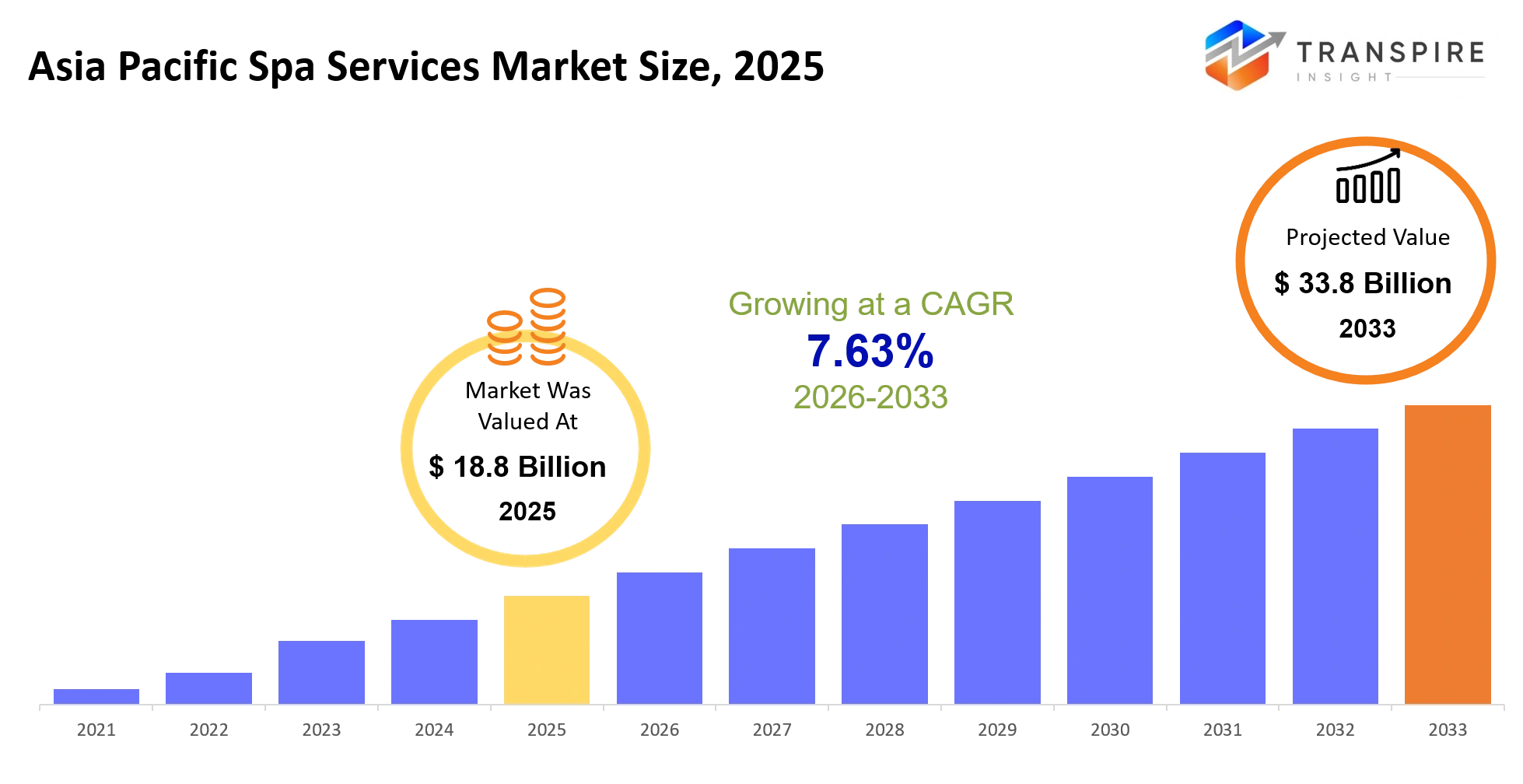
- Asia Pacific Spa Services Market Size 2025: USD 18.8 Billion
- Asia Pacific Spa Services Market Size 2033: USD 33.8 Billion
- Asia Pacific Spa Services Market CAGR: 7.63%
- Asia Pacific Spa Services Market Segments: By Service Type (Massage Therapy, Beauty Treatments, Wellness Therapies, Medical Spa Services, Aromatherapy, Others); By Application (Relaxation, Skin Care, Pain Relief, Stress Management, Others); By End User (Women, Men, Tourists, Corporate Clients, Others); By End User (Restaurants, Hotel Chains, Cafes, Catering Services, Others).
To learn more about this report,  Download Free Sample Report
Asia Pacific Spa Services Market Summary
The Asia Pacific Spa Services Market was valued at USD 18.8 Billion in 2025. It is forecast to reach USD 33.8 Billion by 2033. That is a CAGR of 7.63% over the period.
Spa services across Asia Pacific basically show up as customer-facing wellness and therapeutic options that are plugged into hotels, resorts, city wellness hubs, and even medical aesthetics clinics. They help people handle stress, recover better, and deal with lifestyle linked health goals, while also feeding into hospitality revenue streams, so it’s not just “extra.” Over the last 3–5 years, the whole market seems to have shifted in a more structural way, moving away from those occasional, high end splurges toward experience led preventive wellness. At the same time, many operators mix traditional bodywork with clinically inspired treatments and they’ve leaned hard into digital first booking and scheduling systems.
A big trigger, obviously, was the COVID-19 pandemic; it messed with travel, forced closures, and changed behavior. Then, after that downtime, there was a strong rebound in domestic and intra regional tourism, and that redirected demand toward spa spots that feel trusted, hygienic, and more “on purpose.” As a result, hotels and standalone brands have been repositioning spa services as core income engines, not something tacked on, which improves pricing leverage, and also speeds up investment in premium, tailored service models, both in dense city areas and resort style locations.
Key Market Insights
- Southeast Asia really dominates the Asia Pacific Spa Services Market, grabbing something like 30–35% share, mainly because resort spa penetration stays strong in Thailand and Indonesia, so it sort of keeps compounding.
- Northeast Asia is also expanding steadily, led by Japan and South Korea, with wellness tourism being woven in alongside an aging population that keeps asking for more.
- South Asia seems to be the quickest mover from 2025–2030, pushed by urban wellness centers and those rising disposable income currents that people talk about a lot.
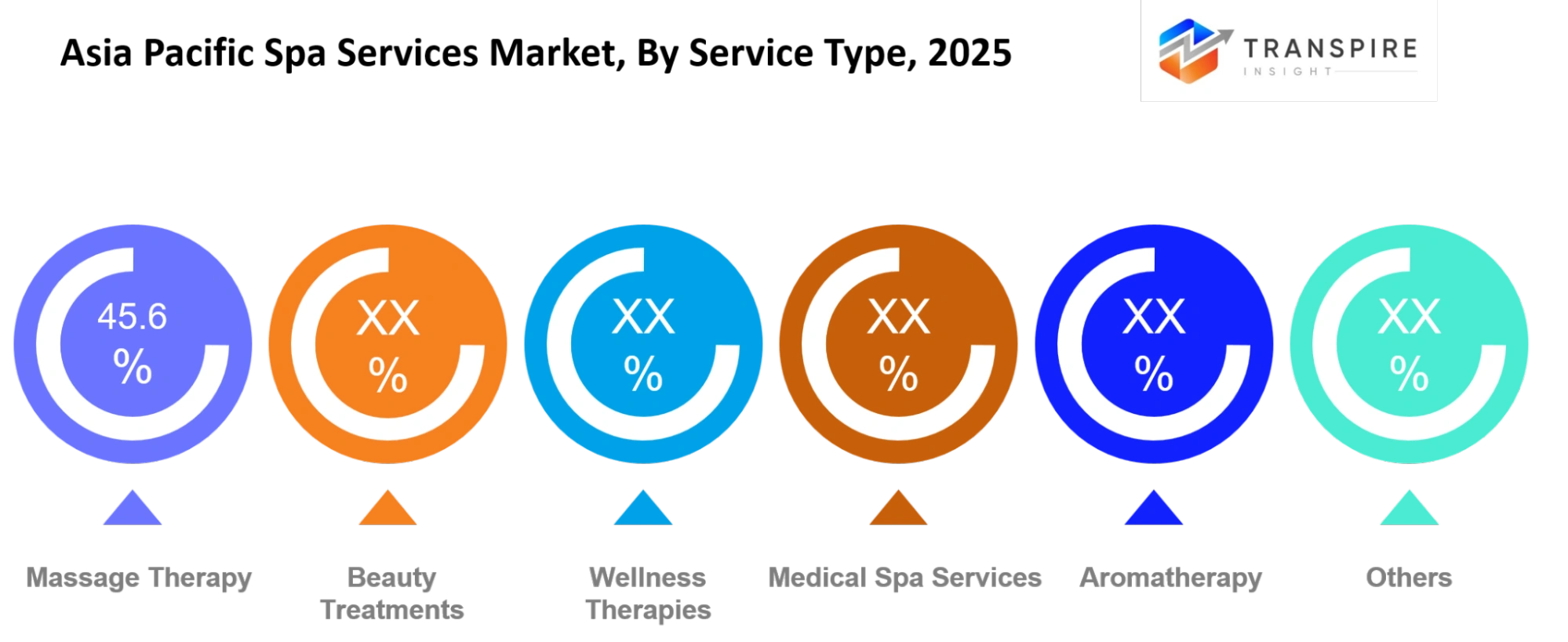
- Massage therapy services are still on top, around 28–32% share, because consumer demand stays consistent and customers come back often, like repeat visits.
- Skincare and facial treatments sit right behind, supported by cosmetic wellness convergence, plus medical spa adoption that continues to grow.
- Wellness and hydrotherapy services are the fastest-growing segment through 2030, mostly because they’re framed as holistic health, rather than only “spa” stuff.
- Luxury hotel spas account for roughly 35% share of Asia Pacific Spa Services Market revenue, driven by integrated hospitality wellness offerings that feel packaged.
- Urban standalone spa chains are the fastest-growing application angle, fueled by city-based stress management demand, and a lot of people seem to want that.
- Leisure tourists remain the main end-user group at about 40% share, due to strong regional tourism recovery.
- Corporate wellness clients are the fastest-growing category too, as employer-funded mental health and stress reduction programs keep getting traction.
What are the Key Drivers, Restraints, and Opportunities in the Asia Pacific Spa Services Market?
Primary driver is the inclusion of wellness in overall hospitality & tourism recovery process post the COVID-19 disruption. From 2022 onwards, with the resumption of both international and domestic travel, hotel groups and resort owners redefined spa services as essential part of offering rather than value added luxury service. This shift happened as guest is seeking to have recuperative holiday experience along with certified safety. So in the end, spa services now bring in a bigger slice of per-guest spending, mainly in premium resorts across Thailand, Indonesia, and Japan, and it directly lifts ancillary revenue margins.
The biggest constraint is still the reliance on skilled therapists and the uneven service standardization across countries. It feels structural really, because the training pipelines, certification systems and labor mobility are still pretty fragmented throughout the region. That situation then reduces scalability for big chains, and it also causes revenue leakage when service quality varies, especially for mid-tier spa operators that struggle to hit global benchmark standards consistently.
A major opportunity is the expansion of tech-enabled wellness personalization, mainly in urban China and Singapore, where AI-driven booking systems and biometric wellness assessments are being trialed. For instance, luxury spa networks in Singapore are linking data-driven treatment customization with guest preferences, and this supports stronger pricing power and more repeat visitation too, which should unlock the next stage of the Asia Pacific Spa Services Market growth.
What Has the Impact of Artificial Intelligence Been on the Asia Pacific Spa Services Market?
Artificial intelligence plus advanced digital systems are getting folded into scrubber performance setups and marine emission control activities across Asia Pacific shipping lanes, changing in practice how compliance and efficiency are handled, sort of on the fly.
In terms of automation, and operational tuning, AI enabled monitoring platforms are being rolled out to watch how the exhaust gas cleaning tech is performing, automatically handle sensor calibration, and help speed up compliance paperwork tied to sulfur cap rules. Shipping teams in major hubs like Singapore, and Shanghai are relying on central dashboards that pull together vessel level information, cutting down manual inspection routines and making regulatory submissions faster across entire fleets.
On the predictive side, machine learning approaches are now used to estimate scrubber fouling, forecast maintenance windows, and model emissions output when fuel quality or engine load changes. In many cases this supports voyage planning and smarter fuel switching approaches, which then boosts overall vessel efficiency while also lowering the odds of unexpected downtime on long-haul legs.
Operational results are showing up as better scrubber uptime, and some operators claim around 10–15% fewer maintenance related disruptions. They also mention improved fuel efficiency, largely because of more careful engine load balancing. Compliance quality is also said to be higher, since emissions tracking is continuous instead of periodic sampling.
Still, the main snag is inconsistent connectivity at sea. That limitation keeps real-time data from moving reliably, and it weakens the value of cloud based AI models in distant ocean zones, especially for older vessels that don’t have the same integrated digital backbone.
Key Market Trends
- Between 2021 and 2025, spa operators in Thailand and Indonesia sort of moved away from pure, standalone luxury treatments, and toward more stitched together resort wellness programs.
- In 2022, when tourism restarted after the pandemic, Asia Pacific hotels saw spa utilization jump roughly 20–30% across a bunch of premium hospitality brands.
- After 2020, digital booking platforms grew fast, and some operators like Marriott International even said direct-to-customer appointment conversions climbed.
- Starting around 2023, a medical spa kind of convergence really took hold, dermatology clinics began weaving in spa therapies, for cosmetic aims plus recovery- based sessions.
- In China and South Korea, city customers also shifted their spending habits. Instead of saving wellness for rare, high end retreats, they leaned into frequent shorter spa visits, kind of quick yet recurring.
- Then there were workforce issues too. Shortages of certified therapists got sharper after 2021, so many chains leaned on automation for scheduling and standardized training programs, across the region.
- Accor, for its part, expanded branded spa partnerships in 2024, which helped support premium pricing tactics at resort properties across Southeast Asia.
- Since 2022, wellness tourism packages have risen quite a lot as well, with Japan and Bali putting spa services in the spotlight, basically as key travel decision drivers.
- By 2023, AI driven personalization tools were rolled out, and those apparently improved customer retention by tailoring treatments based on earlier wellness history and booking behavior patterns,not just generic preferences.
Asia Pacific Spa Services Market Segmentation
By Service Type :
Massage therapy is still, like the most used service type because people keep coming back for relaxation and pain relief , pretty steady demand. Beauty treatments and skincare services have also grown , since more folks seem to care about appearance-focused care, while medical spa services are getting more attention in city clinics and premium wellness centers across a lot of Asia Pacific locations.
Wellness therapies, including aromatherapy, look stronger with younger consumers who want stress management answers. Service diversification across spas has picked up since 2021, operators added more specialized offerings to get repeat customers. When therapeutic and cosmetic services get mixed together , spending per visit tends to rise, and customer retention also stays stronger.
To learn more about this report, Download Free Sample Report
By Application :
For applications, relaxation is still the top one. Spa visits are widely used as short breaks from work pressure and travel fatigue, and it shows. Skin care applications are growing fast too, driven by awareness of routine dermatology-based wellness treatments among both men and women in urban areas.
Stress management applications expanded after 2020, mostly tied to more workplace pressure and lifestyle imbalance. Pain relief services keep a steady adoption, especially among older consumers and those who are physically active. Overall, the application pattern looks like a shift toward preventive wellness, not just occasional leisure breaks, especially across major cities.
By End User :
Women are still the largest end-user group, mostly because they’re more involved in skincare, beauty treatments, and general wellness habits. Men meanwhile are catching up, with more participation showing up in urban areas, where stress management, and grooming-oriented services, have been more openly accepted over the last few years, or so it seems.
Tourists also push demand hard in resort places like Thailand and Indonesia, because spa services tend to be woven into the trip itself. On the corporate side, that segment is growing fastest, as firms increasingly fund wellness programs aimed at reducing employee stress, and keeping productivity steady. Other users include older adults who are looking for recovery-minded and therapeutic sessions.
By End User :
Hotel chains are the main channel for spa services, since many premium as well as mid-scale properties now blend wellness spaces on-site. Meanwhile, restaurants and cafés are starting to team up with wellness brands too, adding relaxation add-ons in city lifestyle hubs which helps the overall experience.
Catering services, along with mixed hospitality providers, are adopting wellness packages more slowly for events and corporate meetings. Spa operations based inside hotels continue to expand across Asia Pacific, helped by tourism recovery and stronger premium travel demand. Other options are standalone wellness studios, usually in business districts or inside shopping complexes.
What are the Key Use Cases Driving the Asia Pacific Spa Services Market?
The core use case in the Asia Pacific spa services market kind of sits around relaxation focused massage therapy delivered via hotel and resort spas. As tourism sort of bounces back, and people start staying longer during travel, they tend to book again more often, plus that ends up lifting per guest spending for hospitality properties
Other expanding applications also show up, for example dermatology linked skincare treatments, and corporate wellness programs that get used by office employees in big cities. Meanwhile tourists are increasingly picking bundled spa packages in leisure locations, so the whole demand grows for integrated health and beauty services, across both hospitality setups and clinic partnerships
On the more emerging side you can see AI driven personalization, wellness subscriptions, and therapy selection that is guided by biometrics. These ideas are starting to take hold in premium urban spas and they are expected to grow as digital health tracking becomes more common across wellness centers in the Asia Pacific region
|
Report Metrics |
Details |
|
Market size value in 2025 |
USD 18.8 Billion |
|
Market size value in 2026 |
USD 20.2 Billion |
|
Revenue forecast in 2033 |
USD 33.8 Billion |
|
Growth rate |
CAGR of 7.63% from 2026 to 2033 |
|
Base year |
2025 |
|
Historical data |
2021 - 2024 |
|
Forecast period |
2026 - 2033 |
|
Report coverage |
Revenue forecast, competitive landscape, growth factors, and trends |
|
Regional scope |
Asia Pacific (India, China, Japan, Australia,South Korea, Rest of Asia Pacific) |
|
Key company profiled |
Marriott International, Hyatt Hotels, Four Seasons, Banyan Tree, Mandarin Oriental, Hilton Worldwide, Six Senses, Kempinski, Canyon Ranch, Lanserhof, Chiva-Som, Taj Hotels, Oberoi Hotels, Accor, Shangri-La. |
|
Customization scope |
Free report customization (country, regional & segment scope). Avail customized purchase options to meet your exact research needs. |
|
Report Segmentation |
By Service Type (Massage Therapy, Beauty Treatments, Wellness Therapies, Medical Spa Services, Aromatherapy, Others); By Application (Relaxation, Skin Care, Pain Relief, Stress Management, Others); By End User (Women, Men, Tourists, Corporate Clients, Others); By End User (Restaurants, Hotel Chains, Cafes, Catering Services, Others). |
Which Regions are Driving the Asia Pacific Spa Services Market Growth?
Southeast Asia still feels like the leading region in the Asia Pacific spa services market, mostly because it has a really strong tourism ecosystem and resort infrastructure that is already well built, in a practical way. Thailand and Indonesia seem to do especially well, not only because of their long-standing wellness tourism traditions but also because of travel promotion policies that governments keep backing. When you look at the steady stream of international tourists it helps keep demand on track for spa services that sit inside hotels, especially across beaches , coasts, and island type destinations. Also there’s a lot of luxury resorts around and many skilled traditional therapy providers which basically boosts service capacity and helps bring back repeat visitors again and again.
Northeast Asia is in the second spot, and it is not just by luck. There’s stable domestic consumption, plus high disposable income across much of the area. Japan, South Korea, and parts of China help sustain demand through a mix that includes medical spa integration together with corporate wellness programs. And honestly, this part of Asia feels different from tourism-heavy Southeast Asia, because here urban wellness spending is the main driver, plus the aging population angle creates a bigger need for preventive care. With healthcare infrastructure that is relatively strong, and regulatory alignment that is gradually tightening between wellness and medical aesthetics, it becomes easier to keep services being adopted over the long term.
South Asia is the fastest-growing region though, and India is usually the center of it, mainly due to the expanding urban middle class and quick hospitality development. More recently the momentum has come from new hotel launches, wellness centers inside shopping malls, and a rise in domestic travel after 2022. Digital booking platforms, along with affordable spa brands, have made access easier in Tier 1 as well as Tier 2 cities. So for investors and for new entrants, this region looks like a real expansion pathway through 2026–2033, mainly because wellness demand is moving away from premium-only options and toward broader mass-market adoption, which is kinda the whole shift people are watching.
Who are the Key Players in the Asia Pacific Spa Services Market and How Do They Compete?
In the Asia Pacific spa services market, competition stays moderately fragmented , with big global hotel chains , regional resort operators , and smaller boutique wellness brands all taking a shot at urban centers and tourist hubs. The existing players tend to hold on to share via integrated hospitality offerings, but newcomers often angle for more specialized “wellness moments” that feel distinct. Lately, the fight seems to revolve around service differentiation, where you are located , and the digital booking ecosystems that help keep customers coming back, and again, not just once.
Marriott International goes with a service integration approach, basically by weaving spa offerings into its loyalty driven hotel ecosystem, which boosts repeat guest monetization through bundled wellness packages. Hilton leans into urban hotel wellness centers plus localized partnerships with wellness operators , to tighten its grip on city based demand. Accor expands in Southeast Asia using franchised spa collaborations, and it leans on regional operators so it can widen service coverage without needing a huge amount of new assets.
Mandarin Oriental Hotel Group differentiates by emphasizing high end spa craftsmanship and therapist specialization across its flagship urban properties, this supports stronger premium pricing power. Banyan Tree Holdings builds its edge via destination spa resorts that are grounded in local wellness traditions across island markets. Six Senses Hotels Resorts Spas expands by rolling out science led wellness programs and personalized treatment models , those are placed right into the resort stay experience across Asia Pacific.
Company List
- Marriott International
- Hyatt Hotels
- Four Seasons
- Banyan Tree
- Mandarin Oriental
- Hilton Worldwide
- Six Senses
- Kempinski
- Canyon Ranch
- Lanserhof
- Chiva-Som
- Taj Hotels
- Oberoi Hotels
- Accor
- Shangri-La
Recent Development News
In April 2026, USANA Health Sciences announced the successful completion of its Celavive spa and wellness retreat in Phuket, Thailand in partnership with Club Med. The event brought together top Brand Partners from nine Asia-Pacific markets, strengthening USANA’s experiential wellness ecosystem and expanding its spa-linked skincare engagement strategy across the region’s growing wellness tourism segment.
Source: https://www.aap.com.au/
In May 2026, Asia Pacific Spa & Wellness Coalition (APSWC) hosted the APSWC Awards 2026 during its regional roundtable in Cambodia. The event recognized leading spa operators, wellness products, and service innovations across 13 countries, reinforcing cross-border collaboration and elevating competitive standards within the Asia Pacific spa services industry.”
Source: https://globalspaonline.com/
What Strategic Insights Define the Future of the Asia Pacific Spa Services Market?
The Asia Pacific spa services market is kinda moving toward a more structured wellness ecosystem where spa offerings get baked into hospitality, healthcare, and even day to day city life infrastructure. You can see it because tourism keeps recovering, people are spending more on prevention, and wellness is getting woven into travel plans in a more deliberate way. Over the next 5–7 years, money growth will hinge a lot more on experience personalization, plus hybrid medical-wellness formats, not just the old school, leisure style treatments.
There’s also a quieter risk, like over relying on hospitality linked demand, which makes operators wobbly when travel slows down and pricing gets squeezed, especially when macroeconomic pressure shows up. And another constraint is workforce fragility , meaning therapist shortages, and uneven certification expectations, which makes it hard to scale consistent service quality across different regions, without headaches.
The interesting opportunity that’s starting to show up involves AI enabled wellness personalization together with biometric health tracking in higher end urban spas, especially in Singapore and China’s top Tier 1 cities. That combo supports more dynamic pricing and tends to lift repeat visits. Operators should move first on integrated digital booking and customer data systems, because that’s how you strengthen retention, tune service customization, and keep margins safer while the competition gets louder.
Asia Pacific Spa Services Market Report Segmentation
By Service Type
- Massage Therapy
- Beauty Treatments
- Wellness Therapies
- Medical Spa Services
- Aromatherapy
By Application
- Relaxation
- Skin Care
- Pain Relief
- Stress Management
By End User
- Women
- Men
- Tourists
- Corporate Clients
Frequently Asked Questions
Find quick answers to common questions.
The expected Asia Pacific Spa Services Market size is USD 33.8 Billion in 2033.
Key segments for the Asia Pacific Spa Services Market are By Service Type (Massage Therapy, Beauty Treatments, Wellness Therapies, Medical Spa Services, Aromatherapy, Others); By Application (Relaxation, Skin Care, Pain Relief, Stress Management, Others); By End User (Women, Men, Tourists, Corporate Clients, Others); By End User (Restaurants, Hotel Chains, Cafes, Catering Services, Others).
Major Asia Pacific Spa Services Market players are Marriott International, Hyatt Hotels, Four Seasons, Banyan Tree, Mandarin Oriental, Hilton Worldwide, Six Senses, Kempinski, Canyon Ranch, Lanserhof, Chiva-Som, Taj Hotels, Oberoi Hotels, Accor, Shangri-La.
The Asia Pacific Spa Services Market size is USD 18.8 Billion in 2025.
The Asia Pacific Spa Services Market CAGR is 7.63% from 2026 to 2033.
- Marriott International
- Hyatt Hotels
- Four Seasons
- Banyan Tree
- Mandarin Oriental
- Hilton Worldwide
- Six Senses
- Kempinski
- Canyon Ranch
- Lanserhof
- Chiva-Som
- Taj Hotels
- Oberoi Hotels
- Accor
- Shangri-La
About the Authors

Chetan Dhatrak
I’m Chetan Dhatrak, a Senior Research Analyst at Transpire Insight, specializing in the Consumer Goods, Foods and Beverages industry. I focus on analyzing market trends, consumer behavior, competitive landscapes, and industry developments to deliver accurate, data-driven insights. My research at Transpire Insight is built on credible sources and in-depth analysis, helping businesses and readers better understand market dynamics, emerging opportunities, and evolving consumer preferences. I’m committed to creating reliable, well-researched content that supports informed decision-making and reflects the latest developments in the consumer goods and food & beverage sectors.

Chakradhar Khansole
Chakradhar serves as the Research Director at Transpire Insight, bringing over 8 years of experience in technology, innovation, and strategic market intelligence. He specializes in transforming complex market data into actionable business insights that enable organizations to make informed, growth-oriented decisions. Recognized for his strategic vision and analytical expertise, Chakradhar leads high-impact research initiatives, delivering comprehensive market assessments, competitive intelligence, and forward-looking industry analysis.
Recently Published Reports
-
Apr 2026
Bottled Water Market
Bottled Water Market Size, Share & Analysis Report By Product Type (Still Bottled Water, Carbonated Bottled Water, Functional Bottled Water, and Others), By Packaging (PET, Cans, and Others), By Sales Channel (Supermarkets/Hypermarkets, Convenience Stores/Drug Stores, Grocery Stores/Club Stores, Foodservice, and Others) and Geography (North America, Europe, Asia-Pacific, Middle East and Africa, South and Central America), 2021 - 2032
-
Apr 2026
Color Cosmetic Packaging Market
Color Cosmetic Packaging Market Size, Share & Analysis Report By Application (Mascara Packaging, Liquid Packaging, and Liquid Face), By Type (Tubes & Bottles, Pens & Markers, Compacts & Containers, and Droppers & Pumps), and Geography (North America, Europe, Asia-Pacific, Middle East and Africa, South and Central America), 2021 - 2031
-
Apr 2026
External Microphone For Camera Market
External Microphone For Camera Market Size, Share & Analysis Report By Type (Shotgun Microphone, Lavalier Microphone, and Others), By Application (Digital Camera, Professional Video Camera, and Others), and Geography (North America, Europe, Asia-Pacific, Middle East and Africa, South and Central America), 2021 - 2031
-
Apr 2026
Foot Orthotic Insoles Market
Foot Orthotic Insoles Market Size, Share & Analysis Report By Type (Pre-fabricated, and Custom-made), By Material (Thermoplastic, Composite Carbon Fiber, and Others), By Distribution Channel (Drug Stores, Hospitals & Clinics, and Others), and Geography (North America, Europe, Asia-Pacific, Middle East and Africa, South and Central America), 2021 - 2031