

Asia Pacific Solar PV Glass Market Size & Forecast:
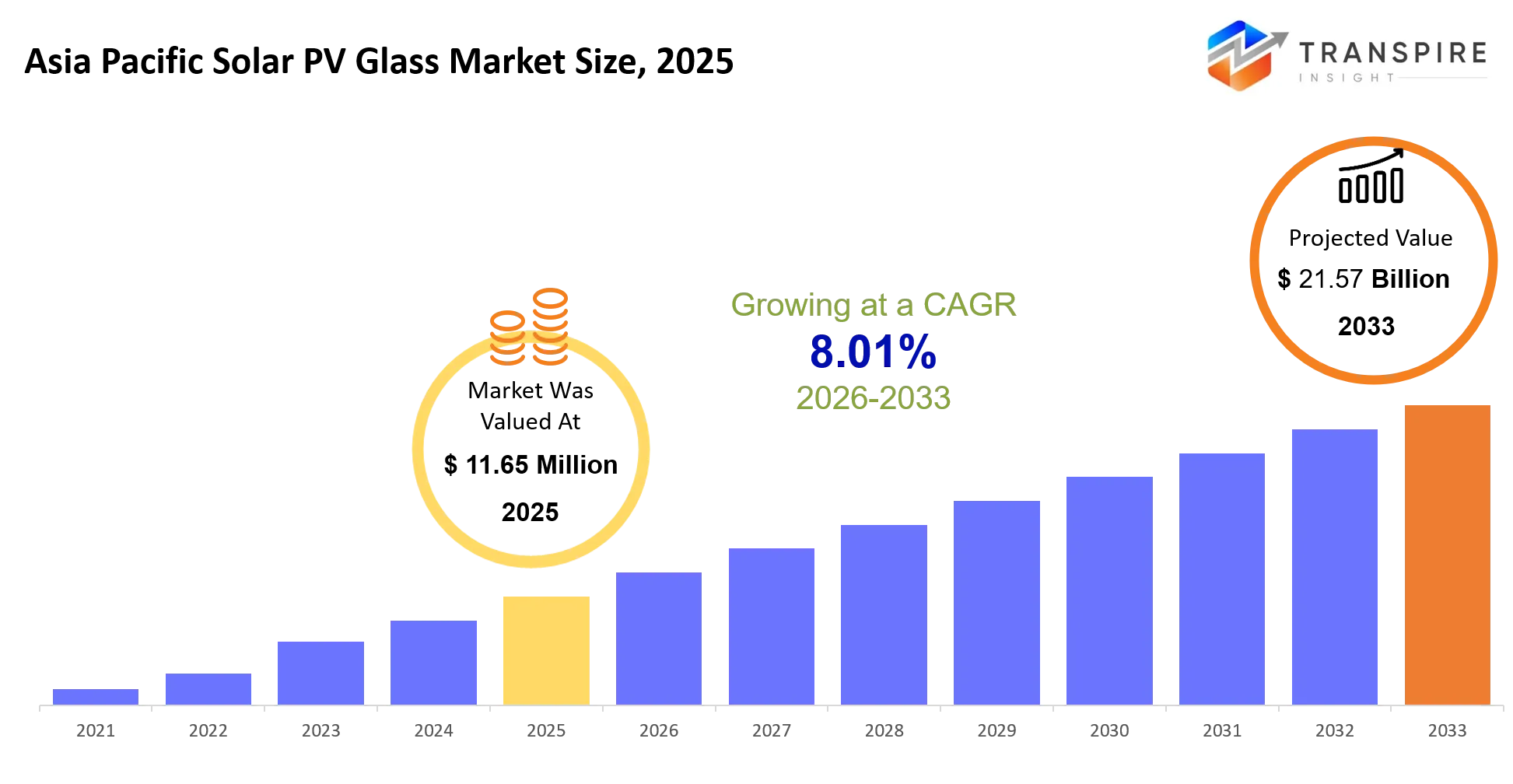
- Asia Pacific Solar PV Glass Market Size 2025: USD 11.65 Billion
- Asia Pacific Solar PV Glass Market Size 2033: USD 21.57 Billion
- Asia Pacific Solar PV Glass Market CAGR: 8.01%
- Asia Pacific Solar PV Glass Market Segments: By Type (AR Coated Glass, Tempered Glass, TCO Glass, Patterned Glass, Float Glass, Ultra-Clear Glass, Others); By Application (Utility Scale, Residential, Commercial, Industrial, BIPV, Others); By Thickness (2mm, 3.2mm, 4mm, 5mm, Above 5mm, Others); By End User (Solar Manufacturers, EPC Contractors, Utilities, Others)
To learn more about this report,  Download Free Sample Report
Asia Pacific Solar PV Glass Market Summary
The Asia Pacific Solar PV Glass Market was valued at USD 11.65 Billion in 2025. It is forecast to reach USD 21.57 Billion by 2033. That is a CAGR of 8.01% over the period.
Asia Pacific Solar PV glass is basically the protective, high-transmittance front sheet used on solar modules, it guards photovoltaic cells from moisture, dust, and mechanical harm, while still letting as much sunlight as possible pass through to the cell. In practice, it supports long term outdoor durability, so utility scale and rooftop solar rollouts stay more dependable and, yeah, cost effective too.
Over the last 5 years the market has been moving away from the older, conventional single glass setups, and leaning into thinner yet higher-transmittance and also bifacial glass, kind of aligning with newer cell formats like TOPCon and heterojunction. This structural step toward higher watt modules has lifted the need for glass that is lighter but still tougher. Then the polysilicon supply shock during 2021–2022, plus the price swings , accelerated the whole direction change, because manufacturers started choosing efficiency over simple production expansion. At the same time, renewable procurement efforts in China and India built steadier project pipelines and gave suppliers clearer visibility. Together these pressures are raising revenue per module and speeding up uptake of these advanced PV glass styles.
Key Market Insights
- China kinda dominates the Asia Pacific Solar PV Glass Market , with close to 65% share in 2025, mostly because of those integrated solar manufacturing ecosystems and also strong export capacity.
- India looks like the fastest-growing market through 2030, mainly backed by big solar parks and domestic manufacturing incentives tied to national energy programs.
- Meanwhile Southeast Asia is showing more adoption lately, as manufacturing relocation keeps happening and export oriented PV module assembly hubs keep expanding regional capacity.
- Low-iron tempered solar glass is taking the lead in the Asia Pacific Solar PV Glass Market , grabbing over 50% share since advanced modules really need high transmittance.
- Coated anti-reflective glass comes in second, because it helps with efficiency optimization, especially for utility scale installations.
- Ultra-thin bifacial glass seems to be the fastest growing piece going into 2030, sort of driven by TOPCon and heterojunction cell integration, that much is clear but not all at once.
- Utility scale solar plants still dominate , with roughly 70% share because of huge project pipelines in China and India, yes.
- On the other side rooftop solar systems are showing the quickest momentum as an application segment, mostly fueled by distributed energy adoption across urban Asia Pacific markets.
- Solar module manufacturers are holding the leading demand share in the Asia Pacific Solar PV Glass Market, and that is largely due to vertical integration trends, rather than random buying.
- Meanwhile independent power producers are the fastest-growing end user group , expanding procurement tied to long term renewable energy contracts, even when the timelines get delayed a bit.
What are the Key Drivers, Restraints, and Opportunities in the Asia Pacific Solar PV Glass Market?
The primary driver of the Asia Pacific Solar PV Glass Market is basically the rapid scaling of high-efficiency solar module manufacturing across China and India, like it’s going very fast. Government backed renewable capacity targets and the falling levelized cost of electricity have set off aggressive utility-scale solar deployment. So that then directly boosts the need for high transmittance durable PV glass, because manufacturers care about efficiency gains per module more than raw volume alone, and that ends up strengthening revenue per unit across the value chain too.
One key restraint though, is the structural reliance on upstream float glass plus energy intensive production processes. When natural gas and soda ash prices swing around, it keeps pressing manufacturing margins. This is especially noticeable in China, where big large scale furnaces still dominate production. As a result, there’s this persistent cost bottleneck that reduces pricing flexibility, and can slow down capacity expansion for smaller regional players, which suppresses short term profitability across the Asia Pacific Solar PV Glass Market.
The major opportunity is in bifacial and ultra thin glass being adopted alongside next generation TOPCon and heterojunction modules. Vietnam and India are starting to look like strategic expansion hubs where new gigawatt scale solar manufacturing clusters are being built. As those ecosystems grow and mature, they create long term procurement visibility for advanced PV glass suppliers. That kind of stability then unlocks a new revenue cycle linked to higher efficiency module architectures.
What Has the Impact of Artificial Intelligence Been on the Asia Pacific Solar PV Glass Market?
Artificial intelligence is getting more and more involved in reshaping operational efficiency and production quality across the Asia Pacific Solar PV Glass Market, enabling smarter manufacturing surroundings and predictive industrial control kind of systems. In big solar glass factories, AI based automation is now used to keep track of furnace conditions, help balance temperature consistency, and cut down micro defect formation during very precise tempering phases. That tends to push up yield levels and also lowers material wastage, so manufacturers that sell into solar module producers can push cost efficiency in a more direct way.
At the same time, machine learning models are being rolled out for predictive maintenance, and they spot equipment fatigue in rollers, coating systems, and cutting machinery, before any actual breakdowns begin. The result is better line availability in high-end facilities, with improvements estimated around 10–15% in plants that are already digitally connected. Also, AI assisted quality inspection systems that use computer vision can find tiny surface imperfections that manual checks sometimes overlook, which helps meet strict solar efficiency requirements and compliance expectations.
Still, the uptake is not entirely smooth, since integration costs can be high, and data quality can be uneven across older manufacturing lines. A lot of mid scale producers in Southeast Asia still don’t run fully digitized production environments, so advanced analytics don’t always deliver as expected. Even so, the longer term direction looks pretty clear: AI will likely stay central for scaling efficiency in the Asia Pacific Solar PV Glass Market, especially as production complexity rises with next generation solar technologies.
Key Market Trends
- After 2022 , China started taking up bifacial solar glass more and more, kind of moving away from the usual single-glass modules, toward designs that squeeze out extra rear-side power.
- Between 2021 and 2025 , manufacturers brought down the average glass thickness from about 3.2 mm to close to 2.0 mm. This tweak helped with module power density and also made shipping more efficient, less weight all that.
- In India, post-2023 PLI incentives spurred more domestic solar glass capacity, so import reliance eased up. That then changed the way Asia Pacific Solar PV Glass Market supply chains are arranged, from sourcing to distribution , sort of.
- TOPCon module take-up really jumped after 2024 . As a result, glass makers had to work on higher transmittance coatings, so they can support better cell efficiency gains.
- Vietnam also came up as a relocation manufacturing hub after 2022 , pulling in Chinese-backed investments in solar glass and module assembly.
- Meanwhile, utility-scale solar procurement shifted toward performance-based contract structures after 2023 , which boosted the call for sturdy anti-PID glass solutions , not just “good enough”.
- Xinyi Solar increased its production capacity in 2024 , aiming to lock in longer term contracts with global module manufacturers.
- Anti-reflective coating tech adoption jumped sharply after 2021 , improving how much light gets through by dialing down surface reflection losses at different installations .
- Supply chain consolidation sped up after 2022, with big names leaning into upstream float glass operations to keep raw material price swings from getting too wild.
- And in Southeast Asia, rooftop solar demand climbed faster after 2023, which pushed the need for customized lightweight glass types for distributed energy use cases.
Asia Pacific Solar PV Glass Market Segmentation
By Type:
AR Coated Glass, Tempered Glass, TCO Glass, Patterned Glass, Float Glass, Ultra-Clear Glass, Others: AR coated glass has gotten stronger adoption in the last few years, mainly because solar module makers are leaning toward higher efficiency output. This shift helps with better light transmission and at the same time reduces reflection losses, which sounds like a small thing but it adds up. Tempered glass still stays widely used due to its mechanical strength and general durability. It basically supports long-term outdoor operation for utility and rooftop solar, even when weather swings are pretty rough.
TCO glass along with ultra-clear glass segments have also expanded, as solar cell layouts get more advanced. Examples include bifacial setups and TOPCon technologies. Float glass demand seems to have eased a bit for premium module applications, while patterned glass keeps a stable role in cases where specific light diffusion is needed. That kind of diffusion helps with consistent energy generation, it’s kinda important for certain system designs.
By Application:
Utility Scale, Residential, Commercial, Industrial, BIPV, Others: Utility scale solar applications lead the market, mostly tied to big solar park developments across China and India. Project pipelines there have expanded noticeably after 2022, helped by policy support. Residential usage has grown at a steady pace too, because distributed solar is spreading more in city areas, and subsidy-linked rooftop installations keep increasing.
Commercial and industrial uses have strengthened as companies look to self-generation, so they can manage energy costs more directly. BIPV is gaining traction in newer building projects too, where solar is getting integrated into building materials, rather than treated as a separate add-on. In modern infrastructure development across Asia Pacific, this integration has become more common, so BIPV is showing a smoother path to adoption.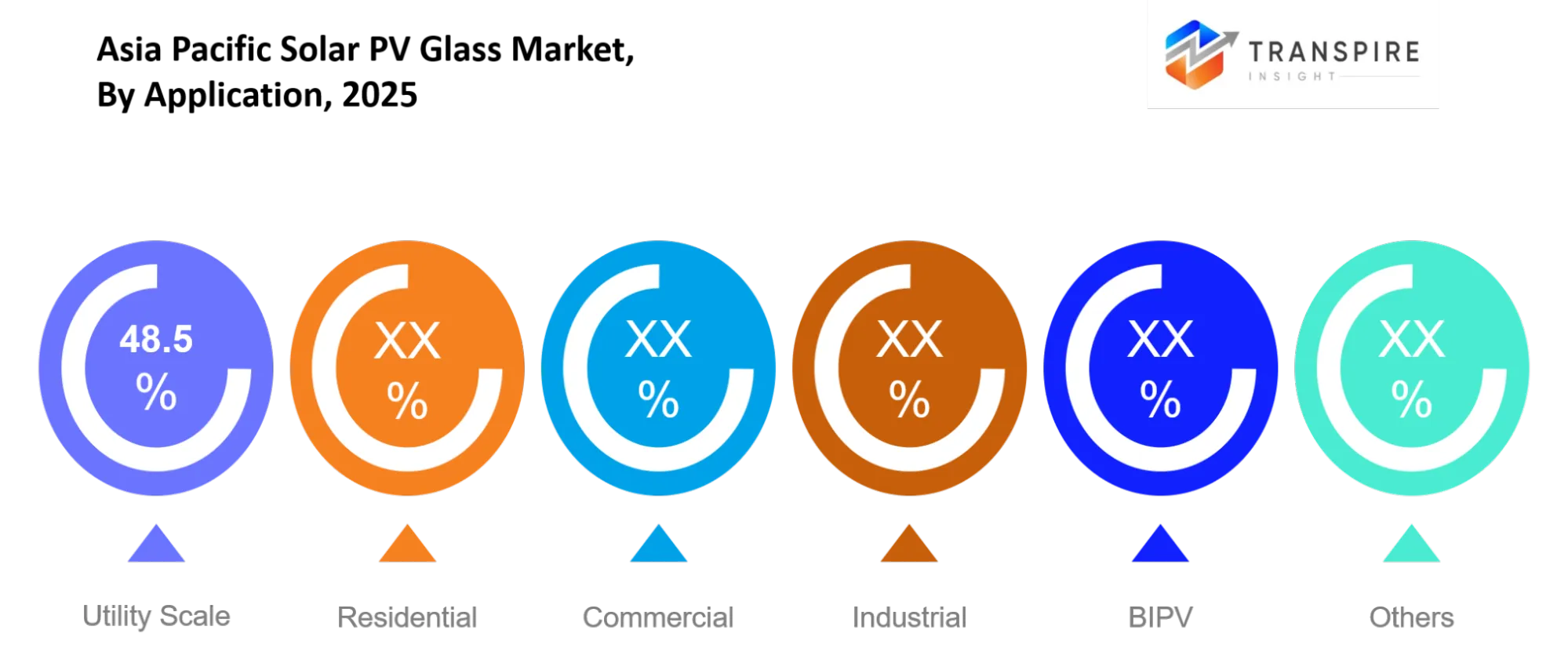
To learn more about this report, Download Free Sample Report
By Thickness:
2mm , 3.2mm, 4mm, 5mm, Above 5mm, Others: It seems like 2mm and thinner glass formats have been in higher demand, because solar module manufacturers are really pushing lightweight designs. That helps lower transport costs, and yeah it also makes installation faster, more practical . This change has been backed by the broader adoption of high-efficiency modules, which in turn needs structural materials that are lighter in weight .
3.2mm glass still feels like a standard pick for a lot of utility projects, yet 4mm and above thickness levels keep showing up in places where higher mechanical strength is required . Also, demand for ultra-thin variants has grown since 2021, mainly because module power density improvements have turned into one of the big industry priorities.
By End User:
Solar Manufacturers, EPC Contractors, Utilities, Others: Solar manufacturers are basically the largest end-user group, since integrated production of modules and components has grown a lot across China and Southeast Asia . And when vertically integrated manufacturing expands , it sort of locks in the need for a stable supply, with consistent high-quality solar glass .
EPC contractors have ramped up procurement too, as large scale solar project installations are increasing across India and Vietnam. Utilities keep expanding procurement for long-term renewable capacity additions, while other end users include independent developers who support distributed and hybrid solar project deployment across the region.
What are the Key Use Cases Driving the Asia Pacific Solar PV Glass Market?
Utility scale solar power plant setups still sit at the center of how the Asia Pacific Solar PV Glass Market gets adopted, mostly because of huge solar parks across China , and India. In practice these sites keep asking for tough glass with higher transparency so it can handle long service lives outdoors, even when conditions are really rough. That need then spills over into greater bulk ordering from module producers as well as EPC contractors , not just smaller buyers.
At the same time commercial roofs and industrial self generation are growing fast, you know how factories and corporate campuses want to cut grid reliance and also make energy spending more predictable. Independent power producers and industrial energy users are therefore pushing for glass that feels lighter but still performs better , since it helps with quicker mounting and slightly improved power output.
And then there is building integrated photovoltaics that show up in city focused infrastructure jobs, where solar components get embedded into façades and skylights. Floating solar is also getting more attention on reservoirs and water treatment areas, largely because policy makers want land efficient renewables that can stretch long term capacity growth , without taking up extra space.
|
Report Metrics |
Details |
|
Market size value in 2025 |
USD 11.65 Billion |
|
Market size value in 2026 |
USD 12.58 Billion |
|
Revenue forecast in 2033 |
USD 21.57 Billion |
|
Growth rate |
CAGR of 8.01% from 2026 to 2033 |
|
Base year |
2025 |
|
Historical data |
2021 - 2024 |
|
Forecast period |
2026 - 2033 |
|
Report coverage |
Revenue forecast, competitive landscape, growth factors, and trends |
|
Regional scope |
Asia Pacific (India, China, Japan, Australia, South Korea, Rest of Asia Pacific) |
|
Key company profiled |
Xinyi Solar, Flat Glass Group, Saint-Gobain, AGC, NSG Group, Guardian Glass, Borosil, Sisecam, Jinjing Group, CSG Holding, Irico, Trulite, Vitro, Cardinal Glass, Taiwan Glass |
|
Customization scope |
Free report customization (country, regional & segment scope). Avail customized purchase options to meet your exact research needs. |
|
Report Segmentation |
By Type (AR Coated Glass, Tempered Glass, TCO Glass, Patterned Glass, Float Glass, Ultra-Clear Glass, Others); By Application (Utility Scale, Residential, Commercial, Industrial, BIPV, Others); By Thickness (2mm, 3.2mm, 4mm, 5mm, Above 5mm, Others); By End User (Solar Manufacturers, EPC Contractors, Utilities, Others) |
Which Regions are Driving the Asia Pacific Solar PV Glass Market Growth?
China still looks like the top region in the Asia Pacific Solar PV Glass Market, mostly because it has this kind of fully integrated solar manufacturing ecosystem, plus really strong state-backed renewable energy targets. You know, the industrial clusters around Jiangsu and Zhejiang keep glass flowing, and modules getting assembled fast. There is also that solid export infrastructure via big ports, so finished solar modules can move to overseas markets without too much friction. In the end, this close linkage between glass suppliers , cell makers, and module assemblers keeps China in the dominant position, even when demand shifts a bit.
India kind of plays a more stability-focused role rather than chasing the same export momentum. It leans on long-term energy security objectives and a policy schedule that feels more predictable under national solar programs. Compared with China’s export-led growth, India’s demand is more internal, mostly aimed at utility-scale solar parks and government procurement. Steady funding from independent power producers also helps lock in consistent offtake for solar glass suppliers. Meanwhile gradual expansion of local manufacturing—more than just substitution cuts back import reliance and keeps supply steady.
Southeast Asia is maybe the fastest-growing piece of the market right now. This is tied to recent manufacturing relocation out of China, along with fresh foreign direct investments in Vietnam and Malaysia. After 2023, several policy shifts seemed to push solar assembly hubs to ramp up export-tilted production. Plus new industrial parks, and port upgrades, improved logistics efficiency for module shipments. That quick build-out basically creates strong entry potential for suppliers looking for cost-competitive production bases during 2026–2033, not just somewhere else later on.
Who are the Key Players in the Asia Pacific Solar PV Glass Market and How Do They Compete?
Competition in the Asia Pacific Solar PV Glass Market is sort of moderately consolidated, with a handful of big manufacturers running most of the high volume supply, while the mid sized regional players mostly go head to head on price, and also on more localized supply lines. Overall, the demand is pretty strongly pushed by ongoing tech upgrades, like improving glass transmittance, reducing thickness, and meeting tighter durability standards that come with next generation solar modules. Pricing pressure still feels very intense, but the way companies stand out is changing—now it depends more on manufacturing efficiency, plus longer term supply agreements with module manufacturers.
Xinyi Solar plays it with large scale integrated production, and with cost leadership, backed by huge furnace capacity in China. What really helps them is that they manage both upstream raw materials and the downstream module supply relationships, so their production swings are less dramatic. Their expansion toward Southeast Asia, also supports supply diversification and makes export reliability stronger for international buyers.
Flat Glass Group, meanwhile, is leaning into high efficiency production lines, built for ultra clear and bifacial glass that advanced solar module designs need. Their differentiation is tied to precision coating technology, which tends to boost module energy yield. They are also expanding capacity in China to lock in longer term contracts with Tier 1 module makers.
AGC Inc. and Nippon Sheet Glass compete a lot via tech innovation and high quality specialty glass production. Both firms use deep material science and know how to deliver premium solar glass for higher performance projects. They also keep partnering with module manufacturers in Japan and Southeast Asia, trying to secure those smaller, niche segments that usually bring higher margins.
Company List
- Xinyi Solar
- Flat Glass Group
- Saint-Gobain
- AGC
- NSG Group
- Guardian Glass
- Borosil
- Sisecam
- Jinjing Group
- CSG Holding
- Irico
- Trulite
- Vitro
- Cardinal Glass
- Taiwan Glass
Recent Development News
In November 2025, Flat Glass Group completed a capacity expansion phase at its Zhejiang facility to support rising demand for bifacial solar glass. The upgrade increased high-transmittance glass output and improved compatibility with TOPCon module designs. The company noted the investment will improve order visibility with Tier-1 solar module producers.
Source https://www.bloomberg.com/
In January 2026, Xinyi Solar announced expansion of its Southeast Asia production footprint to strengthen supply chain resilience for photovoltaic glass. The company stated the move will reduce export bottlenecks and stabilize delivery timelines for global module manufacturers. This development reflects growing industry efforts to diversify manufacturing bases outside mainland China. Source https://www.reuters.com/
What Strategic Insights Define the Future of the Asia Pacific Solar PV Glass Market?
The Asia Pacific Solar PV Glass Market is kind of moving into a more structurally higher-efficiency, technology-led growth stage, where ultra-clear, bifacial and thinner glass formats become kind of normal across fresh solar setups. At the same time, this change is being pushed by fast adoption of next generation module tech like TOPCon and heterojunction cells, and those need higher light transmittance plus tighter quality tolerances, in order to really pull up energy yield. Over the next 5 to 7 years, the demand feels like it will show up more and more with vertically integrated manufacturers who can line up glass innovation with the module design cycles.
A less obvious risk is also in the overconcentration of supply among just a few big Chinese producers, which can trigger pricing stress and policy-driven export limits that may disturb regional stability. But also, a more emerging opportunity is forming at the same time in Southeast Asia, where localized solar manufacturing clusters are scaling, helped by foreign investment and trade diversification approaches.
Market players should try to put early capital into regionally diversified production , and also build co-development alliances with module manufacturers , so they can lock in long-term contracts and cut down exposure to depending on one single market too much.
Asia Pacific Solar PV Glass Market Report Segmentation
By Type
- AR Coated Glass
- Tempered Glass
- TCO Glass
- Patterned Glass
- Float Glass
- Ultra-Clear Glass
By Application
- Utility Scale
- Residential
- Commercial
- Industrial
- BIPV
By Thickness
- 2mm
- 3.2mm
- 4mm
- 5mm
- Above 5mm
By End User
- Solar Manufacturers
- EPC Contractors
- Utilities
Frequently Asked Questions
Find quick answers to common questions.
The Asia Pacific Solar PV Glass Market size is USD 21.57 Billion in 2033.
Key Segments for the Asia Pacific Solar PV Glass Market are By Type (AR Coated Glass, Tempered Glass, TCO Glass, Patterned Glass, Float Glass, Ultra-Clear Glass, Others); By Application (Utility Scale, Residential, Commercial, Industrial, BIPV, Others); By Thickness (2mm, 3.2mm, 4mm, 5mm, Above 5mm, Others); By End User (Solar Manufacturers, EPC Contractors, Utilities, Others).
Major Asia Pacific Solar PV Glass Market Players are Xinyi Solar, Flat Glass Group, Saint-Gobain, AGC, NSG Group, Guardian Glass, Borosil, Sisecam, Jinjing Group, CSG Holding, Irico, Trulite, Vitro, Cardinal Glass, Taiwan Glass.
The Current Asia Pacific Solar PV Glass Market size is USD 11.65 Billion in 2025.
The Asia Pacific Solar PV Glass Market CAGR is 8.01% from 2026 to 2033.
- Xinyi Solar
- Flat Glass Group
- Saint-Gobain
- AGC
- NSG Group
- Guardian Glass
- Borosil
- Sisecam
- Jinjing Group
- CSG Holding
- Irico
- Trulite
- Vitro
- Cardinal Glass
- Taiwan Glass
About the Authors

Avinash Kumar
I’m Avinash Kumar, a Senior Research Analyst at Transpire Insight, with expertise in the Electronics and Semiconductor and Energy & Power industry. My work focuses on analyzing emerging technologies, market trends, industry developments, and innovation across these sectors. I specialize in transforming complex technical and market insights into clear, research-backed content that helps professionals, businesses, and decision-makers stay informed. Through continuous industry research and data-driven analysis, I strive to deliver accurate, reliable, and practical perspectives on the latest advancements shaping the semiconductor and energy landscape.

Chakradhar Khansole
Chakradhar serves as the Research Director at Transpire Insight, bringing over 8 years of experience in technology, innovation, and strategic market intelligence. He specializes in transforming complex market data into actionable business insights that enable organizations to make informed, growth-oriented decisions. Recognized for his strategic vision and analytical expertise, Chakradhar leads high-impact research initiatives, delivering comprehensive market assessments, competitive intelligence, and forward-looking industry analysis.
Recently Published Reports
-
Apr 2026
Active Power Filter Market
Active Power Filter Market Size, Share & Analysis Report By Type (Shunt Active Power Filters, Series Active Power Filter, Hybrid Active Power Filter), By Application (Harmonics Mitigation, Reactive Power Compensation, Voltage Regulation, Power Factor Correction), By Phase (Single Phase, Three Phase), By End-User Industry (Manufacturing, Healthcare, Commercial, Automotive, Oil and Gas, Others), and Geography (North America, Europe, Asia-Pacific, Middle East and Africa, South and Central America), 2021 - 2031
-
Apr 2026
Electrical Transformer Market
Electrical Transformer Market Size, Share & Analysis Report By Core (Closed, Shell, and Berry), By Insulation (Gas, Oil, Solid, Air, and Other), By Phase (Single, and Three), By Rating (100 MVA to 500 MVA, 501 MVA to 800 MVA, and 801 MVA to 1200 MVA), and Geography (North America, Europe, Asia-Pacific, Middle East and Africa, South and Central America), 2021 – 2031
-
Apr 2026
Hydraulic Piston Pumps Market
Hydraulic Piston Pumps Market Size, Share & Analysis Report By Type (Axial Piston Pumps, Radial Piston Pumps), By Operating Pressure (Low Pressure, Medium Pressure, High Pressure), By Application (Construction, Mining, Agriculture, Automotive, Oil & Gas, Industrial Machinery, Others), By End-User (OEMs, Aftermarket), and Geography (North America, Europe, Asia-Pacific, Middle East and Africa, South and Central America), 2021 – 2031
-
Apr 2026
Laboratory Gas Generators Market
Laboratory Gas Generators Market Size, Share & Analysis Report By Product (Nitrogen Gas Generator, Hydrogen Gas Generator, Zero Air Gas Generator, Purge Gas Generator, TOC Gas Generators, Others), By Application (Gas Chromatography, Liquid Chromatography-mass Spectrometry (LC-MS), Gas Analyzers, Others), By End-user (Life Science, Chemical & Petrochemical, Food & Beverage, Others), and Geography (North America, Europe, Asia-Pacific, Middle East and Africa, South and Central America), 2021 – 2031