
Asia Pacific Silk Textiles Market Size & Forecast:
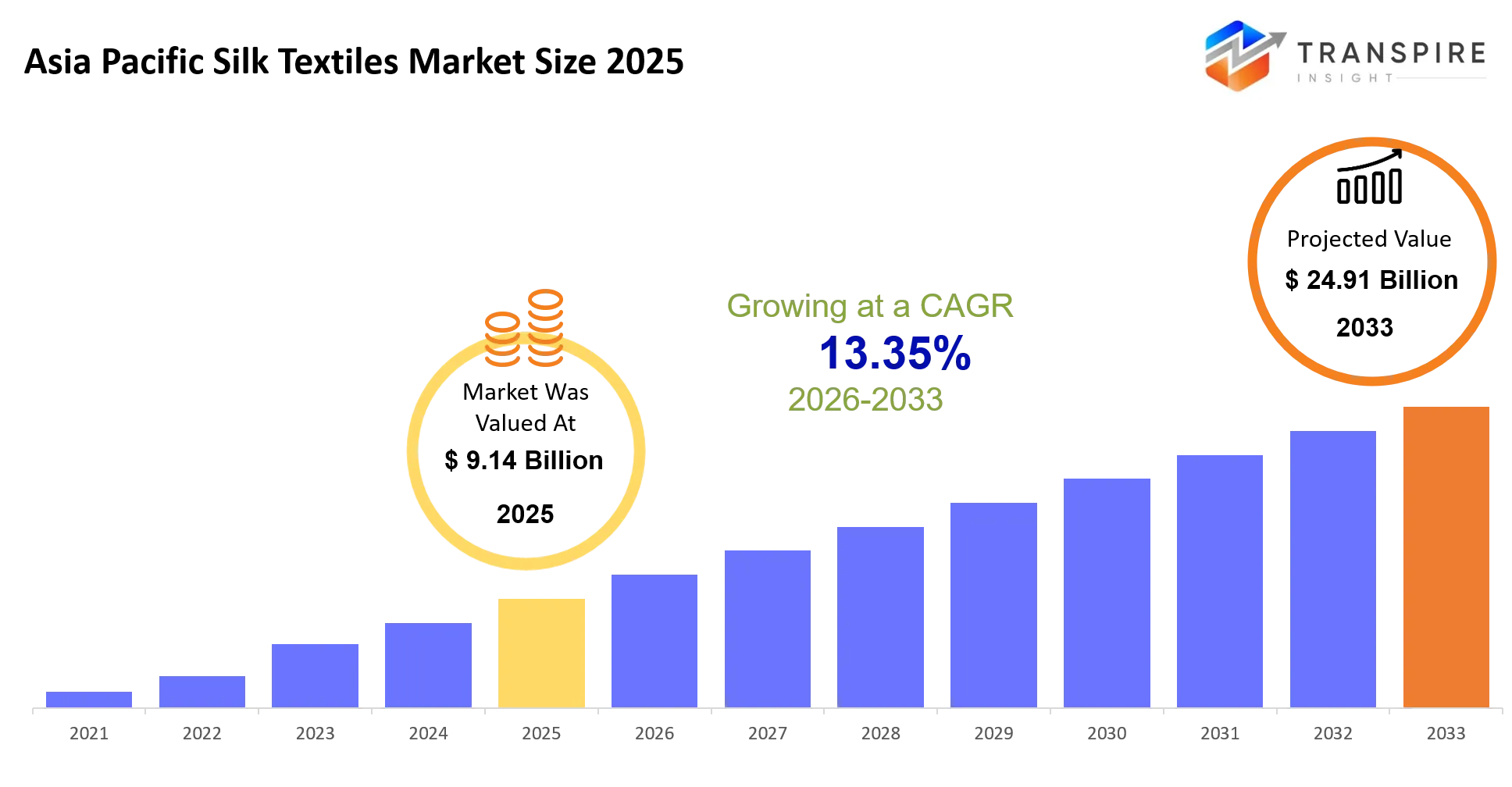
- Asia Pacific Silk Textiles Market Size 2025: USD 9.14 Billion
- Asia Pacific Silk Textiles Market Size 2033: USD 24.91 Billion
- Asia Pacific Silk Textiles Market CAGR: 13.35%
- Asia Pacific Silk Textiles Market Segments: By Product Type (Mulberry Silk, Tussar Silk, Eri Silk, Muga Silk, Silk Blends, Dyed Silk, Printed Silk, Others); By Application (Apparel, Home Furnishings, Fashion Accessories, Upholstery, Industrial Textiles, Luxury Textiles, Decorative Textiles, Others); By Distribution Channel (Offline Retail, Online Retail, Specialty Stores, Direct Sales, Department Stores, Export Channels, Brand Outlets, Others); By End User (Women, Men, Fashion Designers, Textile Manufacturers, Home Décor Companies, Retail Brands, Export Houses, Others)
Asia Pacific Silk Textiles Market Summary
The Asia Pacific Silk Textiles Market was valued at USD USD 9.14 billion in 2025. It is forecast to reach USD 24.91 billion by 2033. That is a CAGR of 13.35% over the period.
The Asia Pacific Silk Textiles Market is a place where people buy nice natural fiber fabrics. These fabrics are used to make clothes, luxury fashion items, things for the home, accessories and special textiles. Silk fabrics are great because they are soft, strong and breathable. They look really nice too. This is something that synthetic fabrics often cannot do.For people who make textiles, fashion companies and stores silk is still an important material. It helps them make products that're high in value and look really nice.In the five years the market has changed a lot. Now people want to know where their silk comes from and that it is made in a way that's good for the environment. Fashion companies want to know everything about how their silk's made. This is why producers are using computers to track their silk and making sure they are not hurting the environment.
One big reason for this change was what happened during the pandemic. There were problems with getting silk. This showed that the system was not working well. So manufacturers had to find ways to get silk and work with people closer to them.Now the market is growing because people are buying expensive clothes and luxury fashion items. There is also money being spent on textiles that are really nice and have a lot of value. As producers get better, at making textiles their products become more consistent. They can sell them to other countries more easily. This means they can make money and sell more products.
Key Market Insights
- The Asia Pacific Silk Textiles Market keeps growing because people want high-quality clothes companies focus on sourcing and new textile technologies are being developed.
- The market is expected to keep expanding until 2033 as manufacturers focus on tracing the origin of their materials, improving product quality and making high-value textiles.
- East Asia was the part of the Asia Pacific Silk Textiles Market in 2025 with more than 55% of the market because it has a complete system for producing silk and textiles.
- South Asia is going to grow the fastest in the Asia Pacific Silk Textiles Market until 2033 because it is exporting textiles and making high-quality fabrics.
- Mulberry silk was the popular type of silk in 2025 making up more than 60% of all silk textiles consumed.
- Woven silk fabrics were the most popular type of silk product because luxury clothing and home furnishing companies want them.
- Silk products that are sustainable and have an origin are going to be the fastest-growing type of silk product from 2026 to 2033 in the fashion industry.
- Clothing made up than 65% of the market in 2025 as luxury brands started using more natural fibers like silk.
- Home décor and furniture applications are becoming more popular, driven by end interior design and hotel projects.
- Companies like Luthai, Raymond, Arvind, Toray, Teijin and Reliance are investing in weaving technologies, product innovation and strategic expansion.
What are the Key Drivers, Restraints, and Opportunities in the Asia Pacific Silk Textiles Market?
Driver
The main thing that is helping the Asia Pacific Silk Textiles Market grow is that people are making high end clothes and fancy clothes. Big fashion companies are buying good quality natural fibers because people want clothes that feel and look nice and last a long time. This means that the people who make textiles are putting money into machines that make the clothes better and more consistent. When people want silk clothes and things for the home it helps the people who make silk and the people who make clothes and textiles to make more money.
Restraint
The biggest problem is that it is hard to get silk and the price can change a lot. Making silk depends on the weather. If people can grow mulberry trees and if they have people to work on the farms. These things cannot be changed quickly when people want silk. This means that sometimes there is no silk and it costs more for the people who make textiles to buy it. So some buyers wait to buy silk. They use a different kind of fabric instead which means the market does not make as much money.
Opportunity
There is a chance for the silk market to get better by using technology to track where the silk comes from. Luxury brands want to know where their materials come from and how they are made. If silk producers use computers to track their silk and get certificates for being sustainable they can sell to countries and get more money. The companies that can show where their silk comes from will be able to sell silk to big fashion companies in the future.
What Has the Impact of Artificial Intelligence Been on the Asia Pacific Silk Textiles Market?
Silk textile production is changing because of intelligence and new digital technologies. These things are making production better and more efficient. They are also helping with quality control. Managing the supply chain. Textile mills are using intelligence to check fabrics and find problems. This helps them make sure the fabrics are quality. It helps them fix problems quickly.Artificial intelligence is also helping with spinning, weaving and dyeing. It makes sure that everything is done consistently and it reduces waste. This means that people do not have to do much work and the factories can produce more. Silk textile production is getting better because of these technologies.
Machine learning is also very useful. It helps predict when machines might break down. This means that factories can fix problems before they happen. Digital analytics platforms are also helpful. They help factories know how raw silk they need and when they need it. This helps them plan production and reduce waste.Artificial intelligence and digital technologies are good for silk textile production. They help factories work better and make products.. Some factories are having trouble using these new technologies. They are too expensive. Some factories do not have the right equipment or training. This is a problem for factories.
Blockchain is also important for silk production. It helps people know where the silk comes from and it makes the supply chain more transparent. Luxury fashion brands like this because they want to know where their silk is coming from. Artificial intelligence and digital technologies are changing silk textile production. They are making it better and more efficient. Silk textile production and artificial intelligence are a combination.
Key Market Trends
- Since 2021 luxury fashion brands have been buying silk that they can track. This means producers have to use systems to keep track of everything and get certified.
- The people who make textiles started using machines to weave and computers to check for quality. This helped reduce mistakes and make things more consistent.
- After 2022 people started spending money on clothes. So the companies that make these clothes got more popular.
- Between 2021 and 2025 silk producers started doing things in a friendly way. This is because the people they sell to wanted to make sure they were buying from suppliers.
- Companies like Luthai, Toray, Teijin, Raymond and Arvind put money into making fabrics. They also use technology to finish textiles.
- Because of problems caused by the pandemic the way people get raw silk changed. Manufacturers started working with suppliers so they could get what they needed.
- Using platforms to manage the supply chain became an advantage. It helped producers be more transparent and meet standards.
- The market for home textiles and interior design fabrics kept growing. This is because more hotels and luxury homes were built and needed these fabrics.
- Since 2023 some silk producers have started using blockchain technology to track their silk products. This is now being used in a commercial way.
- The people who export textiles are now focusing on making batches of high-quality silk products. They want to sell these products for a lot of money rather than just trying to make as much as possible.
Asia Pacific Silk Textiles Market Segmentation
By Product Type
Mulberry Silk is still the widely used product type in the Asia Pacific Silk Textiles Market. There is demand from luxury clothing and high-end fashion brands, which helps steady production growth. Mulberry Silk has fiber quality and a consistent texture making it a preferred choice for large textile manufacturing. Production will keep growing as manufacturers invest in sericulture practices and processing efficiency. Tussar Silk and Eri Silk are strong in niche and traditional textile applications. These silk types support craftsmanship and handmade textile production. Demand stays stable due to heritage-based clothing preferences. Growth will continue as designers use these silk types in fashion collections.
Silk blends, colored silk and printed silk are becoming more popular in value-added textile production. These categories help product diversification and design innovation in fashion and home furnishing markets. Manufacturers focus on improving color consistency and fabric durability. The Asia Pacific Silk Textiles Market will see use of processed silk formats driven by changing consumer design preferences.
By Application
Clothing represents the application area in the Asia Pacific Silk Textiles Market. Strong demand from high-end fashion brands and seasonal collections supports consumption. Silk fabrics are widely used in dresses and high-end clothing lines. Clothing demand will keep expanding with rising preference for premium fabrics. Home furnishings and decorative textiles are emerging as application segments. Silk is increasingly used in curtains, cushions and interior design applications. Growth is supported by rising luxury housing and hospitality projects. Manufacturers focus on improving fabric durability and design versatility.
Luxury textiles and fashion accessories are gaining value. Silk is used in scarves, handbags and premium lifestyle products. Industrial textile usage remains limited but stable in applications. The Asia Pacific Silk Textiles Market will expand as designers explore functional and aesthetic applications of Mulberry Silk, Tussar Silk and Eri Silk.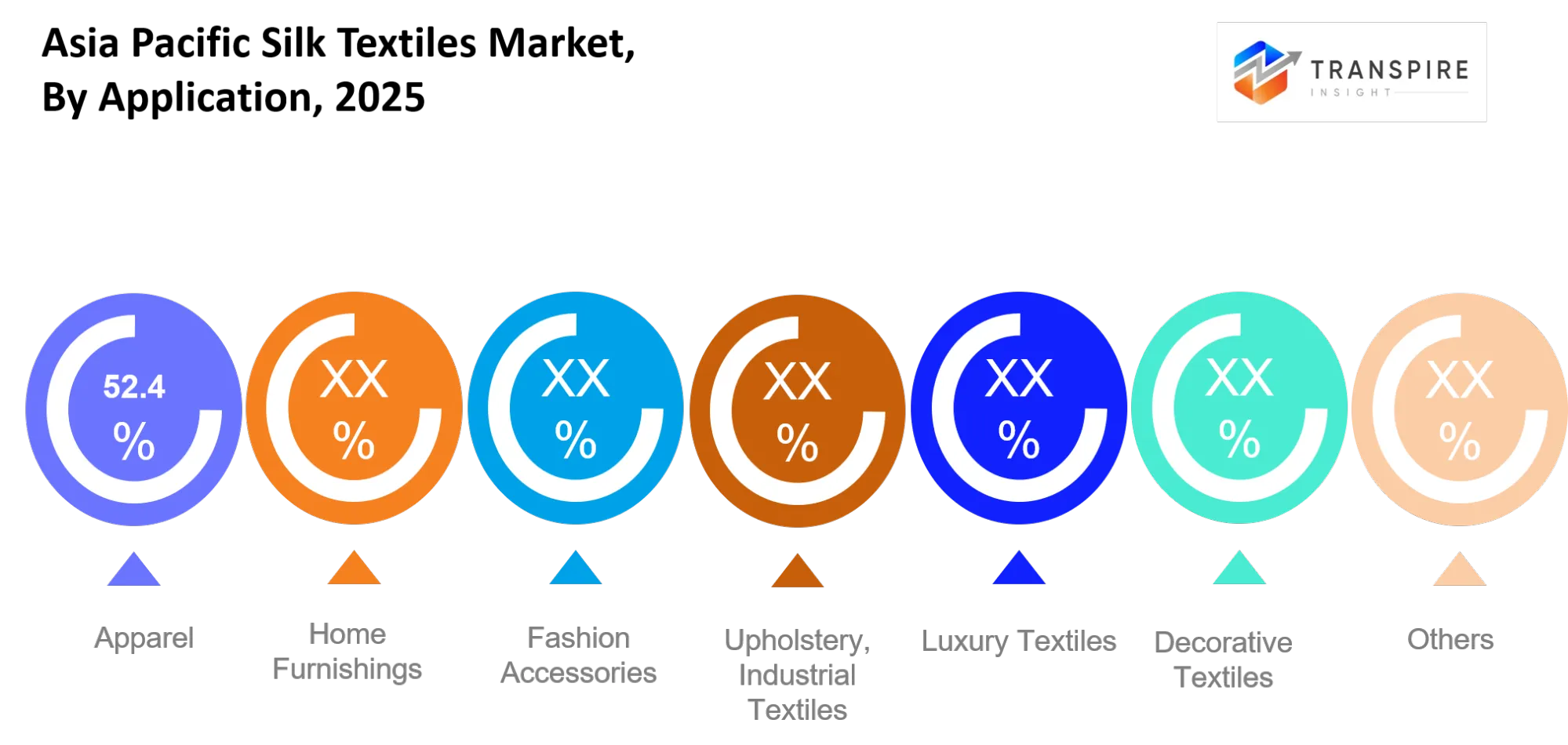
By Distribution Channel
Offline retail continues to dominate distribution in the Asia Pacific Silk Textiles Market. Physical stores remain important for fabric evaluation, texture assessment and bulk purchasing decisions. Textile buyers and designers prefer inspection before purchase. Offline channels will remain strong due to trust and quality verification needs. Export channels and direct sales play a role in international trade flows.Online retail and specialty stores are gaining importance in fabric distribution. Digital platforms support product discovery and wider market access for smaller buyers. Specialty stores focus on curated premium Mulberry Silk, Tussar Silk and Eri Silk collections. The Asia Pacific Silk Textiles Market will see rising adoption as procurement becomes more structured and efficient.
By End User
Women represent the end-user segment in the Asia Pacific Silk Textiles Market due to strong demand for silk-based clothing and accessories. Premium fashion consumption and seasonal clothing trends support purchasing. Mulberry Silk, Tussar Silk and Eri Silk remain fabrics for comfort and elegance. Demand will continue to rise with expanding fashion penetration. Fashion designers and retail brands play a role in driving innovation and product demand. Designers actively integrate Mulberry Silk, Tussar Silk and Eri Silk into collections for luxury and seasonal wear. Retail brands focus on expanding premium product lines to attract high-value consumers. The market will grow as design-led demand increases, across fashion segments.
Textile manufacturers, home décor companies and export houses form the production and supply backbone. These end users support large-scale processing, finishing and global distribution of Mulberry Silk, Tussar Silk and Eri Silk. Rising export activity strengthens revenue generation across the value chain. The Asia Pacific Silk Textiles Market will continue expanding as institutional buyers invest in value-added silk products.
What are the Key Use Cases Driving the Asia Pacific Silk Textiles Market?
The Asia Pacific Silk Textiles Market is driven by people making clothes. This is because famous fashion brands and stores really like silk. People use silk to make clothes because it is soft and shiny and feels nice on the skin. People always want to buy clothes made of silk at certain times of the year and designers are always thinking of new things. This means that people keep buying silk clothes both where they live and in other countries.
The Asia Pacific Silk Textiles Market and silk are also being used in home things like curtains and cushions and in things people carry like scarves and handbags. This is happening because companies that design homes and lifestyle brands are starting to use silk a lot. They like to use silk in homes and hotels because it looks nice. Fashion designers also like to use silk when they make clothes for people like the Asia Pacific Silk Textiles Market. The Asia Pacific Silk Textiles Market is important for silk and people, like silk.
There are some ways that silk is being used, like in cars and in special textiles, for fancy offices and stores. Some companies are even trying to use silk to make coatings and materials. These are not very common yet. They might become more popular as people start to want more unique and high-quality things. The Asia Pacific Silk Textiles Market is going to keep growing as people find ways to use silk. Silk textiles are going to be used in different ways, including apparel production, home furnishings and fashion accessories. Silk is a useful material and it is going to be used more and more in the future.
|
Report Metrics |
Details |
|
Market size value in 2025 |
USD 9.14 Billion |
|
Market size value in 2026 |
USD 10.36 Billion |
|
Revenue forecast in 2033 |
USD 24.91 Billion |
|
Growth rate |
CAGR of 13.35% from 2026 to 2033 |
|
Base year |
2025 |
|
Historical data |
2021 - 2024 |
|
Forecast period |
2026 - 2033 |
|
Report coverage |
Revenue forecast, competitive landscape, growth factors, and trends |
|
Regional scope |
Asia Pacific |
|
Key company profiled |
Luthai, Jiangsu Soho, Raymond, Arvind, Welspun, Toray, Teijin, Reliance, Wujiang Silk, China Silk, Anhui Silk, Shandong Silk, Vardhman, Jiaxin Silk, Silk Route |
|
Customization scope |
Free report customization (country, regional & segment scope). Avail customized purchase options to meet your exact research needs. |
|
Report Segmentation |
By Product Type (Mulberry Silk, Tussar Silk, Eri Silk, Muga Silk, Silk Blends, Dyed Silk, Printed Silk, Others); By Application (Apparel, Home Furnishings, Fashion Accessories, Upholstery, Industrial Textiles, Luxury Textiles, Decorative Textiles, Others); By Distribution Channel (Offline Retail, Online Retail, Specialty Stores, Direct Sales, Department Stores, Export Channels, Brand Outlets, Others); By End User (Women, Men, Fashion Designers, Textile Manufacturers, Home Décor Companies, Retail Brands, Export Houses, Others) |
Which Regions are Driving the Asia Pacific Silk Textiles Market Growth?
East Asia is leading the Asia Pacific Silk Textiles Market because it has a base in sericulture good infrastructure for making textiles and established networks for exporting.The region has production facilities and supply chains that help in efficiently processing mulberry silk and making silk products that have extra value.The government supports textile innovation and quality standards which makes East Asia the top region.The region keeps investing in technologies for weaving, dyeing and finishing making it very competitive in exporting luxury textilesSouth Asia comes next as a contributor to the market.The region has systems for producing silk and its domestic consumption is growing. Unlike East Asia, South Asia's growth depends more on the demand for textiles and slowly modernizing industries, rather than dominating exports on a large scale.The region keeps investing in textile parks and manufacturing practices which helps it to have a steady output.
This steady output helps South Asia to be a supplier of silk globally without sudden changes in production.Southeast Asia is growing the fastest in the market.The region is getting investments in making textiles and its ability to export fashion products is growing.Upgrades in infrastructure in textile clusters and better trade connections have increased production capacity.Global companies are now looking for suppliers, which has also helped Southeast Asia to grow.Between 2026 and 2033 this growth will create opportunities, for manufacturers and investors who want to produce silk textiles in a cost-efficient and scalable way.
Who are the Key Players in the Asia Pacific Silk Textiles Market and How Do They Compete?
The Asia Pacific Silk Textiles Market is made up of a lot of companies, including big textile makers and smaller silk producers. They all compete with each other to make the products. The companies that do well are the ones that make quality products that can get good raw silk, make things efficiently and meet the strict rules for exporting and getting certified. The big companies try to keep their connections with fashion brands while the smaller companies try to stand out by making special kinds of silk and designing nice products. Using technology for weaving, dyeing and tracking products has become a big way for companies to be different from each other.
Luthai Textile is a company that uses a lot of technology to make its products. It has machines that can weave and finish fabric automatically which helps make a lot of silk textiles that're all the same quality. The company sells its products to countries and works with big clothing brands. Raymond is another company that focuses on making end textiles. It uses designs and makes different kinds of fabric to sell to luxury clothing brands. The company is trying to sell its products in stores and make more special textiles.
Arvind Limited is a company that cares about making textiles in a way that's good for the environment. It also tries to make innovative fabrics, especially ones that are made from a mix of silk and other materials. The company is good at making things from start to finish. Has strong connections with other companies that make clothing. Toray Industries is a company that's really good at making new materials, including ones that are made from silk and other synthetic materials. It is trying to work with companies in the region and is always investing in research and development to make new and better textiles.
Company List
- Welspun Living
- Toray Industries
- Teijin
- Reliance Industries
- Wujiang Silk
- China Silk Corporation
- Anhui Silk
- Shandong Silk Corporation
- Vardhman Textiles
- Jiaxin Silk
- Silk Route
Recent Development News
In July 2025, Toray Industries expanded its advanced textile innovation program focused on high-performance silk blend materials used in luxury apparel and technical fabric applications. The expansion enhances material engineering capabilities and supports stronger integration of silk-based composites in diversified textile segments.https://www.toray.com
What Strategic Insights Define the Future of the Asia Pacific Silk Textiles Market?
The Asia Pacific Silk Textiles Market is expected to move toward higher-value, technology-integrated production systems over the next five to seven years. Demand will increasingly concentrate around traceable, certified, and design-driven silk products as global fashion brands tighten sourcing standards and prioritize supply chain transparency. This shift is mainly driven by premiumization in apparel and rising expectations for verifiable material origin, which will push manufacturers to invest more in digital traceability and advanced textile processing.
A less visible risk is overdependence on a limited base of sericulture output, which remains highly sensitive to climate variability and agricultural input availability. This can create supply instability even when downstream demand remains strong, leading to pricing pressure and production delays across textile supply chains. Such constraints may not be immediately visible in demand-driven forecasts but can significantly impact revenue consistency for manufacturers.
A key emerging opportunity lies in digitally certified silk ecosystems integrated with blockchain-based verification and AI-assisted quality grading. Regions strengthening textile digitization infrastructure will likely become preferred sourcing hubs for global luxury brands. Market participants should prioritize investments in traceability systems, product innovation in silk blends, and strategic partnerships with fashion brands to secure long-term contracts and improve pricing power in high-margin segments.
Asia Pacific Silk Textiles Market Report Segmentation
By Product Type
- Mulberry Silk
- Tussar Silk
- Eri Silk
- Muga Silk
- Silk Blends
- Dyed Silk
- Printed Silk
- Others
By Application
- Apparel
- Home Furnishings
- Fashion Accessories
- Upholstery
- Industrial Textiles
- Luxury Textiles
- Decorative Textiles
- Others
By Distribution Channel
- Offline Retail
- Online Retail
- Specialty Stores
- Direct Sales
- Department Stores
- Export Channels
- Brand Outlets
- Others
By End User
- Women
- Men
- Fashion Designers
- Textile Manufacturers
- Home Décor Companies
- Retail Brands
- Export Houses
- Others
Frequently Asked Questions
Find quick answers to common questions.
The Expected Asia Pacific Silk Textiles Market size for the Market will be USD 24.91 Billion in 2033.
Key Segments for the Asia Pacific Silk Textiles Market are By Product Type (Mulberry Silk, Tussar Silk, Eri Silk, Muga Silk, Silk Blends, Dyed Silk, Printed Silk, Others); By Application (Apparel, Home Furnishings, Fashion Accessories, Upholstery, Industrial Textiles, Luxury Textiles, Decorative Textiles, Others); By Distribution Channel (Offline Retail, Online Retail, Specialty Stores, Direct Sales, Department Stores, Export Channels, Brand Outlets, Others); By End User (Women, Men, Fashion Designers, Textile Manufacturers, Home Décor Companies, Retail Brands, Export Houses, Others).
Major Asia Pacific Silk Textiles Market players are Luthai, Jiangsu Soho, Raymond, Arvind, Welspun, Toray, Teijin, Reliance, Wujiang Silk, China Silk, Anhui Silk, Shandong Silk, Vardhman, Jiaxin Silk, Silk Route.
The Current Asia Pacific Silk Textiles Market size is USD 9.14 Billion in 2025.
The Asia Pacific Silk Textiles Market CAGR is 13.35% from 2026 to 2033.
- Luthai Textile
- Jiangsu SOHO Holdings Group
- Raymond
- Arvind Limited
- Welspun Living
- Toray Industries
- Teijin
- Reliance Industries
- Wujiang Silk
- China Silk Corporation
- Anhui Silk
- Shandong Silk Corporation
- Vardhman Textiles
- Jiaxin Silk
- Silk Route
About the Authors

Chetan Dhatrak
I’m Chetan Dhatrak, a Senior Research Analyst at Transpire Insight, specializing in the Consumer Goods, Foods and Beverages industry. I focus on analyzing market trends, consumer behavior, competitive landscapes, and industry developments to deliver accurate, data-driven insights. My research at Transpire Insight is built on credible sources and in-depth analysis, helping businesses and readers better understand market dynamics, emerging opportunities, and evolving consumer preferences. I’m committed to creating reliable, well-researched content that supports informed decision-making and reflects the latest developments in the consumer goods and food & beverage sectors.

Chakradhar Khansole
Chakradhar serves as the Research Director at Transpire Insight, bringing over 8 years of experience in technology, innovation, and strategic market intelligence. He specializes in transforming complex market data into actionable business insights that enable organizations to make informed, growth-oriented decisions. Recognized for his strategic vision and analytical expertise, Chakradhar leads high-impact research initiatives, delivering comprehensive market assessments, competitive intelligence, and forward-looking industry analysis.
Recently Published Reports
-
Apr 2026
Bottled Water Market
Bottled Water Market Size, Share & Analysis Report By Product Type (Still Bottled Water, Carbonated Bottled Water, Functional Bottled Water, and Others), By Packaging (PET, Cans, and Others), By Sales Channel (Supermarkets/Hypermarkets, Convenience Stores/Drug Stores, Grocery Stores/Club Stores, Foodservice, and Others) and Geography (North America, Europe, Asia-Pacific, Middle East and Africa, South and Central America), 2021 - 2032
-
Apr 2026
Color Cosmetic Packaging Market
Color Cosmetic Packaging Market Size, Share & Analysis Report By Application (Mascara Packaging, Liquid Packaging, and Liquid Face), By Type (Tubes & Bottles, Pens & Markers, Compacts & Containers, and Droppers & Pumps), and Geography (North America, Europe, Asia-Pacific, Middle East and Africa, South and Central America), 2021 - 2031
-
Apr 2026
External Microphone For Camera Market
External Microphone For Camera Market Size, Share & Analysis Report By Type (Shotgun Microphone, Lavalier Microphone, and Others), By Application (Digital Camera, Professional Video Camera, and Others), and Geography (North America, Europe, Asia-Pacific, Middle East and Africa, South and Central America), 2021 - 2031
-
Apr 2026
Foot Orthotic Insoles Market
Foot Orthotic Insoles Market Size, Share & Analysis Report By Type (Pre-fabricated, and Custom-made), By Material (Thermoplastic, Composite Carbon Fiber, and Others), By Distribution Channel (Drug Stores, Hospitals & Clinics, and Others), and Geography (North America, Europe, Asia-Pacific, Middle East and Africa, South and Central America), 2021 - 2031