

Asia Pacific Sex Toys Market Size & Forecast:
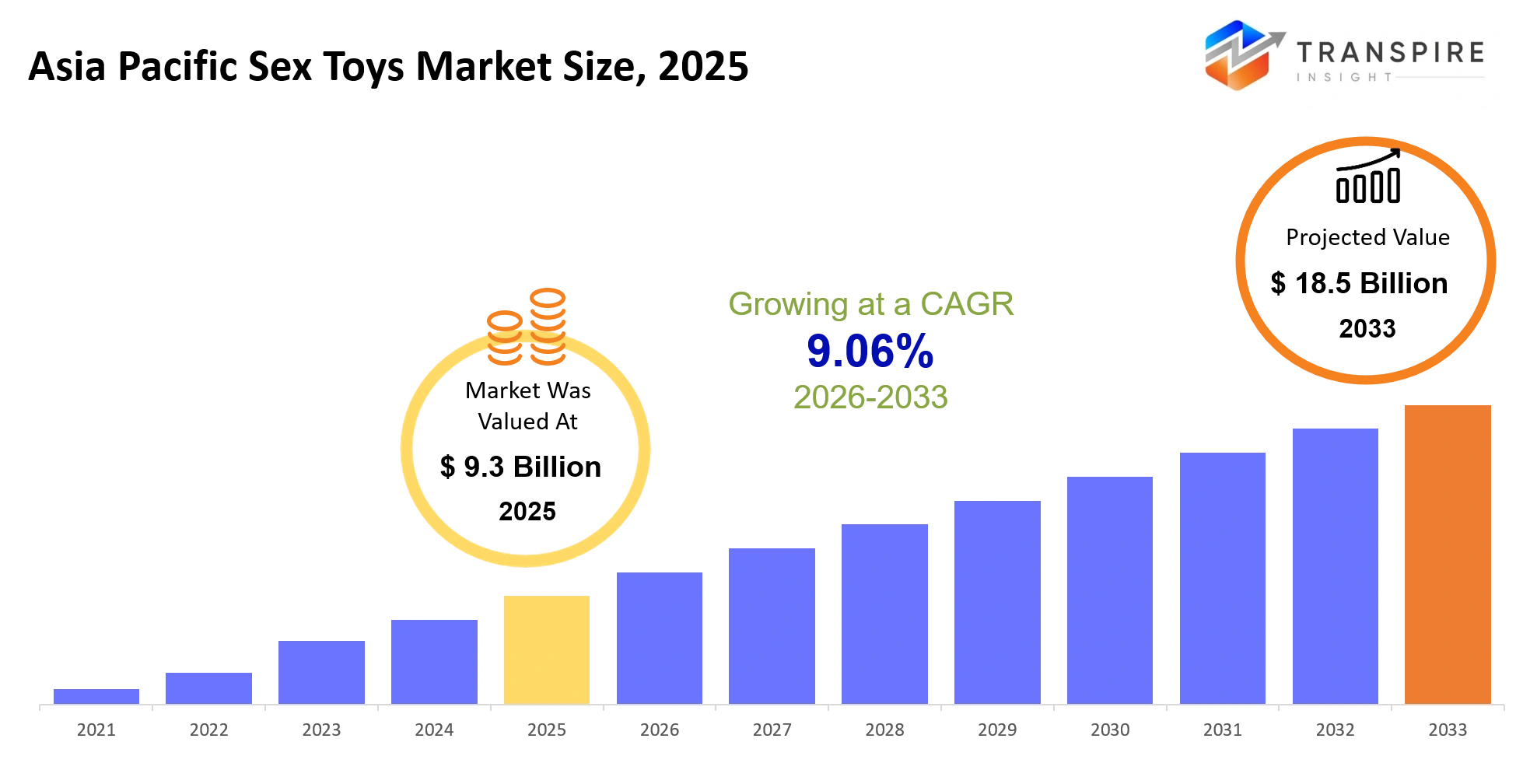
- Asia Pacific Sex Toys Market Size 2025: USD 9.3 Billion
- Asia Pacific Sex Toys Market Size 2033: USD 18.5 Billion
- Asia Pacific Sex Toys Market CAGR: 9.06%
- Asia Pacific Sex Toys Market Segments: By Product Type (Vibrators, Couples Products, Male Toys, Female Toys, Wearable Devices, Smart Intimacy Devices, Accessories, Others); By Distribution Channel (Online Retail, Specialty Stores, Pharmacies, Supermarkets, Direct Sales, Others); By Material (Silicone, ABS Plastic, Metal, Glass, TPE, Others); By End User (Women, Men, Couples, LGBTQ+ Consumers, Others).
To learn more about this report,  Download Free Sample Report
Asia Pacific Sex Toys Market Summary
The Asia Pacific Sex Toys Market was valued at USD 9.3 Billion in 2025. It is forecast to reach USD 18.5 Billion by 2033. That is a CAGR of 9.06% over the period.
The Asia Pacific sex toys market works like a wider sexual wellness retail ecosystem, giving consumers a kind of private door into products meant to boost intimacy, ease stress, and support personal wellbeing. In real life it tackles old obstacles like stigma, weak retail presence, and the lack of discreet buying lanes, especially in countries where cities keep expanding, and people end up closer to malls and online services.
Over the last 3–5 years , the market has been changing in a more structural way from scattered offline specialty shops toward more digital first, direct to consumer, and e-commerce platforms. This shift is pushed further by the growth of app-connected devices, plus product design updates that emphasize safety, skin-friendly materials and customization. A big moment was the COVID-19 pandemic, which disturbed physical retail supply routes and made more people order online across the region , basically faster than expected.
So, the momentum right now seems to come less from sheer novelty and more from convenience, privacy, and the normalization of sexual wellness as a regular part of mainstream health spending. That, in turn , encourages repeat buys and also helps diversify product categories across different income groups.
Key Market Insights
- Asia Pacific Sex Toys Market is moving fast, digitizing in a way that e-commerce platforms are taking more than half 50% of urban consumer buys by 2025 or so. You can see it in the way online storefronts are pulling customers , especially in big cities where people prefer discreet buying.
- Also, the rising take-up of discreet D2C brands is kind of remapping how the Asia Pacific Sex Toys Market is distributed across Tier-1 and Tier-2 areas, not just the usual channels.
- On the product side, innovation is getting more noticeable, with body-safe silicone and app-connected devices getting rolled out quicker.
- This is pushing premiumization, like, people are paying for better features, not only basics in the Asia Pacific Sex Toys Market.
- In terms of country , China is leading the Asia Pacific Sex Toys Market, with an estimated 35–40% share in 2025.
- That growth is tied to strong domestic manufacturing as well as online retail scale , and really large distribution networks.
- Meanwhile, India is emerging as the fastest-growing market through 2025–2030, and a big part of that is digital payment expansion plus changing urban consumer behavior, it’s a shift in habits overall.
- Vibrators and massagers kind of dominate, with almost 40% share, and seem to show strong repeat-buy behavior in the Asia Pacific Sex Toys Market.
- Male masturbators take the second-largest slice, mostly because of product diversification going up , and privacy-focused retail channels helping people stay discreet or something like that.
- App-controlled smart devices are the fastest-growing chunk through 2030, driven by personalization features and remote connectivity, plus the whole convenience angle.
- Personal wellness applications sit at over 60% share, so they become the main use case in the Asia Pacific Sex Toys Market, basically they lead it.For applications, couple intimacy enhancement is moving the quickest, supported by shifting lifestyle patterns across urban Asia, where people change habits faster I guess.
What are the Key Drivers, Restraints, and Opportunities in the Asia Pacific Sex Toys Market?
The main push behind the Asia Pacific Sex Toys Market growth is, well, the quick spread of online shopping ecosystems paired with changing consumer mindsets about sexual wellness as a form of self-care. When secure payment tools became more normal, plus shipping logistics that can stay discreet, and then mobile-first storefronts, it basically reduces the old purchase friction. So you see higher conversion rates, and people come back more often too. That structural change is starting to translate into stronger lifetime customer value, and more brand-led communities, not just one-time buys.
At the same time, the biggest drag is still regulatory ambiguity that doesn’t feel settled, plus cultural acceptance that varies a lot across multiple Asia Pacific economies. Together these issues can make distribution channels kind of fragmented. They also can reduce physical retail exposure, especially in more conservative places, where limits on advertising make mainstream brand building harder. Because of that, some of the likely demand sits there, not fully monetized, and it can slow market maturation even when overall interest is actually strong and pretty visible.
A meaningful opportunity is emerging through smart, app-connected devices that tie in to personalized wellness tracking routines. Japan and South Korea are already seeing early adoption of sensor based intimacy products that adjust vibration patterns using user feedback loops. This kind of setup can open the door to subscription driven digital ecosystems, and ongoing data-informed product upgrades, which could drive the next stage of monetization in the Asia Pacific Sex Toys Market.
What Has the Impact of Artificial Intelligence Been on the Asia Pacific Sex Toys Market?
Artificial intelligence is getting more and more embedded in next generation sexual wellness devices in the Asia Pacific Sex Toys Market, mainly via app connected systems that kind of personalize how the device gets used based on behavioral feedback. A lot of manufacturers are also pushing AI driven firmware optimization so it can nudge the vibration intensity, rhythm cycles, and interaction modes in real time, which tends to boost user satisfaction and gives the product a clearer point of difference.
On the operations side machine learning models are showing up in manufacturing quality control, to spot micro defects in silicone molding , and also motor calibration issues. This helps cut down product returns , and it improves overall production efficiency, at least in how companies describe it. Predictive analytics are likewise being used to anticipate demand shifts across consumer groups, so brands can tune their inventory allocation across e commerce channels in places like China, Japan, and India. Some manufacturers even say they see around 15–20% improvement in supply chain responsiveness, mostly from AI assisted forecasting and digital demand sensing, though it varies by operator.
That said , there is a major snag. The integration cost of AI enabled hardware components is pretty high, especially for mid tier manufacturers who don’t have the budget for full stack upgrades. Also there’s the issue with limited anonymized user data, because privacy concerns reduce the amount of large scale behavioral datasets that personalization algorithms really need. So the models can end up less accurate than they would be otherwise, even when the technology is there.
Key Market Trends
- Asia Pacific sex toys market sorta shifted from offline retail to e-commerce dominance, and by 2025 online channels are projected to go past 50% of urban sales.
- Between 2021 and 2025, D2C brands grew really fast, sort of displacing the older distributors, and this changed pricing transparency across Asia Pacific sexual wellness retail ecosystems.
- After 2022 app-connected devices started surging, with manufacturers like LELO adding Bluetooth-enabled personalization bits into their premium product lines.
- China also moved manufacturing bases toward Vietnam and Malaysia after 2020, which diversified supply chains and lowered tariff exposure risks across the region.
- Regulatory rules tightened, but in uneven ways across Asia, so compliance became fragmented, and that kinda slowed physical retail expansion in more conservative markets.
- And the share of female consumers rose to more than 55% after 2023, helped by stigma easing, plus wellness-focused marketing adjusted how people saw the products.
- Meanwhile, couple-oriented product demand accelerated after the pandemic, especially in urban Japan and South Korea, and that pushed shared wellness consumption patterns.
- Competition strategies evolved too: brands like Satisfyer and We-Vibe leaned into influencer-led marketing, plus subscription-based digital ecosystems.
Asia Pacific Sex Toys Market Segmentation
By Product Type :
Vibrators and related devices still seem to be the most used category, kinda, because product design shifted toward safer materials and quieter motors. Demand kinda moved away from plain basic products and more into connected devices with app based control and personalized settings too, y'know
Vibrators keep leading, mostly due to early adoption and the broad availability across online platforms. Manufacturers have been improving design comfort and also reducing noise levels, which helped pull in new users in cities and bigger urban markets. Right now, product upgrades are more about longer battery life and body safe materials
Smart intimacy devices are getting a stronger look after 2022, mainly because connectivity features are showing up more often. Companies like LELO and TENGA have added app-linked functions, so users can adjust settings remotely, this has widened interest among younger consumers as well
By Distribution Channel :
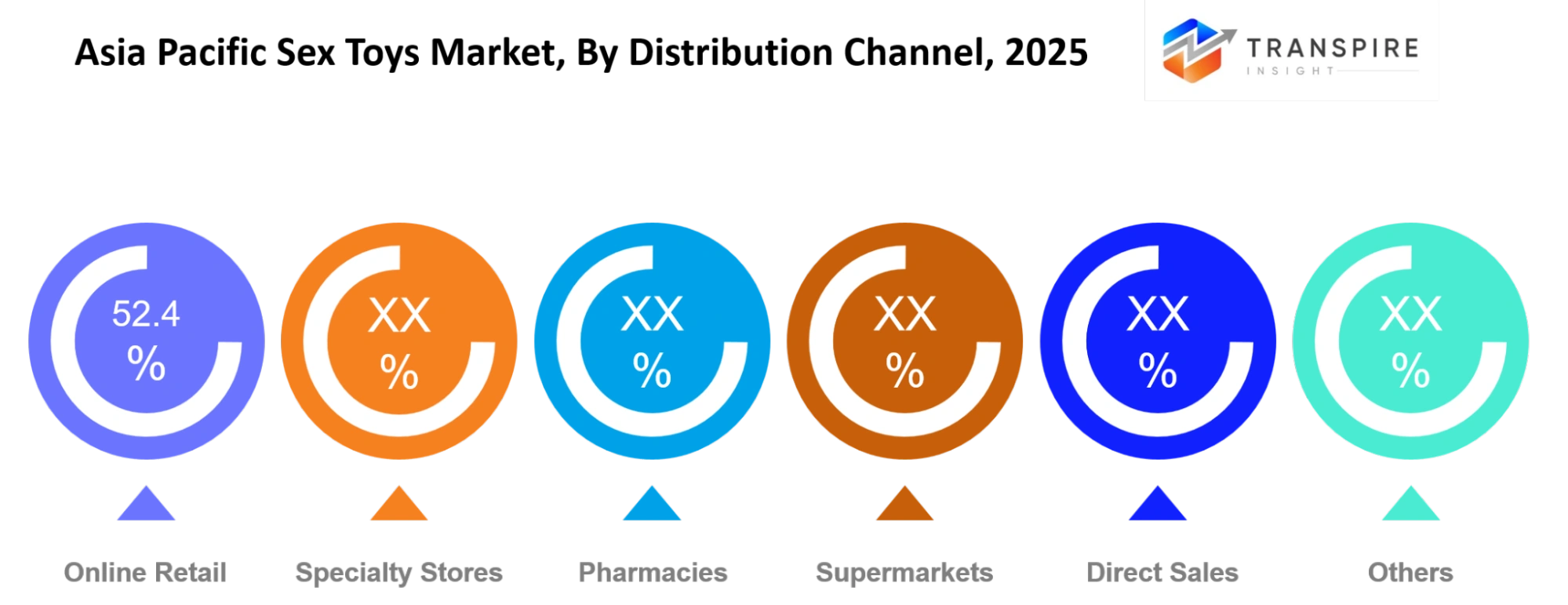
Online retail kinda moved past physical stores as privacy worries and easier access kinda changed how people buy in most major cities. Over time, the digital platforms became the go to entry point for first-time shoppers across quite a few Asia Pacific countries, you know.
After 2020 online retail grew pretty strongly , mainly because payment systems got better and discreet delivery turned into the usual thing. Because of that , stores that used to be heavy hitters—like specialty shops in major cities—now only keep a smaller piece of the sales pie.
At the same time direct-to-consumer brands got real momentum . Companies stripped away middle layers and they set up more private shopping experiences . That change helped brands keep pricing steady and build customer trust, especially where buying inside a store is still kinda sensitive.
To learn more about this report, Download Free Sample Report
By Material :
Silicone has basically become the leading material because it feels soft, it has a solid safety profile, and it holds up better than the older options. Over time, manufacturers kinda moved away from lower-quality compounds, due to safety expectations that started rising.
Medical-grade silicone usage went up after 2021, when regulators and consumers put more weight on body-safe standards. As a result, the demand for older, plastic-based designs dropped a bit and brands leaned into higher quality production methods, more or less.
ABS plastic still stays widely used for entry-level products, mostly because the production cost is lower. But growth in demand has slowed now, since buyers are shifting toward premium materials that give better comfort and a longer product life.
By End User :
Women are still the biggest end-user crew, and it feels like product marketing kind of slid toward personal wellbeing and self-care positioning over time. In the beginning it was more general, but later on, social acceptance in city areas basically gave a boost to stronger female participation in purchase behavior.
After 2022, female usage grew in a noticeable way, mainly because online platforms got better on privacy and also lowered those purchase hurdles . As a result, people felt more comfortable buying again and again , so repeat purchases picked up, especially in urban households where digital retail adoption is higher.
Meanwhile couples and LGBTQ+ consumers are showing faster growth , since product design is getting more inclusive , and brands have started tweaking both marketing language and product features. The idea is to support shared use, which then helps widen demand across different user groups , not just one lane.
What are the Key Use Cases Driving the Asia Pacific Sex Toys Market?
In the Asia Pacific sex toys market the big dominant use case seems to be more on personal wellness and intimacy enhancement, and it’s backed by these discreet online retail platforms that just feel easier. There’s strong demand from consumers who are kinda chasing privacy, convenience, and access to safe body-safe products without all the hassle
A secondary angle shows up too, like couple-focused products, and also LGBTQ+ consumer demand, and both of those are growing through D2C brands, plus subscription models that keep things steady and not too random. More and more urban users are adopting app-enabled devices that support shared experiences but still keep everything private, and with those guided usage features across different digital platforms, depending on the device
Then there are emerging use cases, such as AI-enabled personalization , remote intimacy features, and ways these products are being integrated into digital wellness ecosystems. These ideas are slowly shaping the next-generation products, the kind that adapt settings based on user behavior and they connect into health oriented platforms, so in practice it becomes more like a responsive wellness tool rather than only a standalone item
|
Report Metrics |
Details |
|
Market size value in 2025 |
USD 9.3 Billion |
|
Market size value in 2026 |
USD 10.08 Billion |
|
Revenue forecast in 2033 |
USD 18.5 Billion |
|
Growth rate |
CAGR of 9.06% from 2026 to 2033 |
|
Base year |
2025 |
|
Historical data |
2021 - 2024 |
|
Forecast period |
2026 - 2033 |
|
Report coverage |
Revenue forecast, competitive landscape, growth factors, and trends |
|
Regional scope |
Asia Pacific (India, China, Japan, Australia, South Korea, Rest of Asia Pacific) |
|
Key company profiled |
Lovehoney, LELO, We-Vibe, Womanizer, TENGA, Doc Johnson, BMS Factory, Fun Factory, Satisfyer, Lovense, Je Joue, Svakom, Kiiroo, OhMiBod, Durex. |
|
Customization scope |
Free report customization (country, regional & segment scope). Avail customized purchase options to meet your exact research needs. |
|
Report Segmentation |
By Product Type (Vibrators, Couples Products, Male Toys, Female Toys, Wearable Devices, Smart Intimacy Devices, Accessories, Others); By Distribution Channel (Online Retail, Specialty Stores, Pharmacies, Supermarkets, Direct Sales, Others); By Material (Silicone, ABS Plastic, Metal, Glass, TPE, Others); By End User (Women, Men, Couples, LGBTQ+ Consumers, Others). |
Which Regions are Driving the Asia Pacific Sex Toys Market Growth?
China still feels like the leading region in the Asia Pacific sex toys market, mostly because the manufacturing ecosystem is pretty strong and the e-commerce setup is already deeply embedded. You know, the big production clusters keep supply more or less steady and reliable , then the logistics networks help move goods quickly inside the country and for export as well. On top of that, regulatory oversight tends to be a lot more structured in urban areas so product quality and brand scaling become more standardized. And the digital retail environment is mature too, especially with cross-border e-commerce channels, which really helps keep the demand pipeline alive. So overall, the mix of supply strength and online reach keeps China right in the middle of regional market activity.
Japan, meanwhile, looks like a stable second contributor. This is tied to high consumer purchasing power, plus a long-standing acceptance of discreet adult wellness products. In contrast to China, the growth isn’t really built on manufacturing scale, it’s more about consistent domestic consumption patterns and a kind of strict retail discipline. There is also clearer regulation around product safety and advertising rules, so market operations can be more predictable. Retailers and brands basically get steady demand across urban populations, and especially in premium, compact product categories. Because of that, Japan feels like a dependable revenue source rather than some high-volatility growth market, even if it isn’t rushing ahead dramatically.
India seems to be coming up as the fastest-growing corner in the Asia Pacific sex toys market, mostly because digital payment adoption is speeding up and e-commerce penetration keeps widening. Lately, there are also these changes in what consumers expect about privacy, plus more people in the cities are using the internet more regularly, so it kind of opens new access channels that really werent around before. And unlike some other regions, the growth story is more about first-time buyers, who enter the category through discreet online platforms, kind of quietly. That momentum gets more fuel from logistics networks that are getting better and from social acceptance that is slowly shifting in metropolitan areas. For anyone planning to enter the market or investing, India looks like a strong high-growth opportunity window through 2026–2033, since penetration levels continue to rise.
Who are the Key Players in the Asia Pacific Sex Toys Market and How Do They Compete?
The competitive landscape of the Asia Pacific sex toys market is kinda moderately fragmented, like global brands are side by side with specialized niche players and these direct-to-consumer startups too. In practice, the rivalry isn’t just about price, not really—it's more about product innovation , discreet distribution patterns, and those digital engagement strategies that keep showing up everywhere. New entrants kind of shook up traditional retail by going online-first with their branding and leaning on subscription led sales methods. Meanwhile, established companies still try to defend their share, mostly via design quality, material safety standards , and pretty strong brand recognition especially when it comes to premium segments.
For example, LELO competes with high end product engineering and a premium stance, it leans into luxury-grade materials and app-enabled device innovation. TENGA, on the other hand, differentiates through minimalist design and a noticeable presence in compact male wellness products, backed by wide retail penetration across Asia. Lovehoney expands through e-commerce dominance and strategic partnerships that widen how their multi-brand portfolio reaches across international markets. We-Vibe builds advantage using couples-focused connected devices, really highlighting shared digital control functions. Satisfyer competes by mixing accessible pricing with quick product iteration cycles, while Fun Factory stays differentiated through ergonomic, German-engineered designs and a steady commitment to body-safe materials.
Company List
- Lovehoney
- LELO
- We-Vibe
- Womanizer
- TENGA
- Doc Johnson
- BMS Factory
- Fun Factory
- Satisfyer
- Lovense
- Je Joue
- Svakom
- Kiiroo
- OhMiBod
- Durex
Recent Development News
In January 2026, LELO announced expansion of its Asia-focused smart wellness product line targeting Bluetooth-enabled intimacy devices across major APAC e-commerce platforms. The launch strengthens app-connected product adoption and improves premium device penetration in urban markets.
Source: https://www.lelo.com
In February 2026, Lovehoney Group entered a strategic distribution partnership with a leading Southeast Asian e-commerce aggregator to expand discreet fulfillment networks. The collaboration improves last-mile privacy logistics and increases product availability in high-growth urban clusters.
Source: https://www.lovehoneygroup.com
What Strategic Insights Define the Future of the Asia Pacific Sex Toys Market?
The Asia Pacific sex toys market is moving, structurally, toward a more digitally integrated and wellness-oriented ecosystem where product usage is increasingly linked to connected devices and private online retail channels. Over the next 5 to 7 years , growth will be shaped by e-commerce penetration getting bigger, by the steady normalization of sexual wellness in urban consumer routines, and also by premiumization that keeps marching forward in smart, app-enabled products. Honestly this shift feels less about a novelty rush ,and more about longer-term changes in what consumers expect around privacy , plus the way people actually buy things online day after day.
There is also a risk that's a bit less visible, like tightening data privacy regulations. These rules could end up limiting the collection of user interaction data needed for those personalized device functions and app-based experiences. If that happens, the innovation cycles for smart products might slow down, and the market could see less differentiation between brands, which is not a small thing.
At the same time, there is a real opportunity starting to show up. For example, sexual wellness devices can be integrated with broader digital health platforms in places like Japan and South Korea, where wellness tracking ecosystems are already pretty mature. Firms that align product design with these ecosystems may get an early mover edge. Market participants should really focus on privacy-compliant AI features and build localized digital partnerships, so they can secure long term user trust and maintain platform access.
Asia Pacific Sex Toys Market Report Segmentation
By Product Type
- Vibrators
- Couples Products
- Male Toys
- Female Toys
- Wearable Devices
- Smart Intimacy Devices
- Accessories
By Distribution Channel
- Online Retail
- Specialty Stores
- Pharmacies
- Supermarkets
- Direct Sales
By Material
- Silicone
- ABS Plastic
- Metal
- Glass
- TPE
By End User
- Women
- Men
- Couples
- LGBTQ+ Consumers
Frequently Asked Questions
Find quick answers to common questions.
The Asia Pacific Sex Toys Market size is USD 18.5 Billion in 2033.
Key segments for the Asia Pacific Sex Toys Market are By Product Type (Vibrators, Couples Products, Male Toys, Female Toys, Wearable Devices, Smart Intimacy Devices, Accessories, Others); By Distribution Channel (Online Retail, Specialty Stores, Pharmacies, Supermarkets, Direct Sales, Others); By Material (Silicone, ABS Plastic, Metal, Glass, TPE, Others); By End User (Women, Men, Couples, LGBTQ+ Consumers, Others).
Major Asia Pacific Sex Toys Market players are Lovehoney, LELO, We-Vibe, Womanizer, TENGA, Doc Johnson, BMS Factory, Fun Factory, Satisfyer, Lovense, Je Joue, Svakom, Kiiroo, OhMiBod, Durex.
The Asia Pacific Sex Toys Market size is USD 9.3 Billion in 2025.
The Asia Pacific Sex Toys Market CAGR is 9.06% from 2026 to 2033.
- Lovehoney
- LELO
- We-Vibe
- Womanizer
- TENGA
- Doc Johnson
- BMS Factory
- Fun Factory
- Satisfyer
- Lovense
- Je Joue
- Svakom
- Kiiroo
- OhMiBod
- Durex
About the Authors

Chetan Dhatrak
I’m Chetan Dhatrak, a Senior Research Analyst at Transpire Insight, specializing in the Consumer Goods, Foods and Beverages industry. I focus on analyzing market trends, consumer behavior, competitive landscapes, and industry developments to deliver accurate, data-driven insights. My research at Transpire Insight is built on credible sources and in-depth analysis, helping businesses and readers better understand market dynamics, emerging opportunities, and evolving consumer preferences. I’m committed to creating reliable, well-researched content that supports informed decision-making and reflects the latest developments in the consumer goods and food & beverage sectors.

Chakradhar Khansole
Chakradhar serves as the Research Director at Transpire Insight, bringing over 8 years of experience in technology, innovation, and strategic market intelligence. He specializes in transforming complex market data into actionable business insights that enable organizations to make informed, growth-oriented decisions. Recognized for his strategic vision and analytical expertise, Chakradhar leads high-impact research initiatives, delivering comprehensive market assessments, competitive intelligence, and forward-looking industry analysis.
Recently Published Reports
-
Apr 2026
Bottled Water Market
Bottled Water Market Size, Share & Analysis Report By Product Type (Still Bottled Water, Carbonated Bottled Water, Functional Bottled Water, and Others), By Packaging (PET, Cans, and Others), By Sales Channel (Supermarkets/Hypermarkets, Convenience Stores/Drug Stores, Grocery Stores/Club Stores, Foodservice, and Others) and Geography (North America, Europe, Asia-Pacific, Middle East and Africa, South and Central America), 2021 - 2032
-
Apr 2026
Color Cosmetic Packaging Market
Color Cosmetic Packaging Market Size, Share & Analysis Report By Application (Mascara Packaging, Liquid Packaging, and Liquid Face), By Type (Tubes & Bottles, Pens & Markers, Compacts & Containers, and Droppers & Pumps), and Geography (North America, Europe, Asia-Pacific, Middle East and Africa, South and Central America), 2021 - 2031
-
Apr 2026
External Microphone For Camera Market
External Microphone For Camera Market Size, Share & Analysis Report By Type (Shotgun Microphone, Lavalier Microphone, and Others), By Application (Digital Camera, Professional Video Camera, and Others), and Geography (North America, Europe, Asia-Pacific, Middle East and Africa, South and Central America), 2021 - 2031
-
Apr 2026
Foot Orthotic Insoles Market
Foot Orthotic Insoles Market Size, Share & Analysis Report By Type (Pre-fabricated, and Custom-made), By Material (Thermoplastic, Composite Carbon Fiber, and Others), By Distribution Channel (Drug Stores, Hospitals & Clinics, and Others), and Geography (North America, Europe, Asia-Pacific, Middle East and Africa, South and Central America), 2021 - 2031