
Asia Pacific Semiconductor Memory Market Size & Forecast:
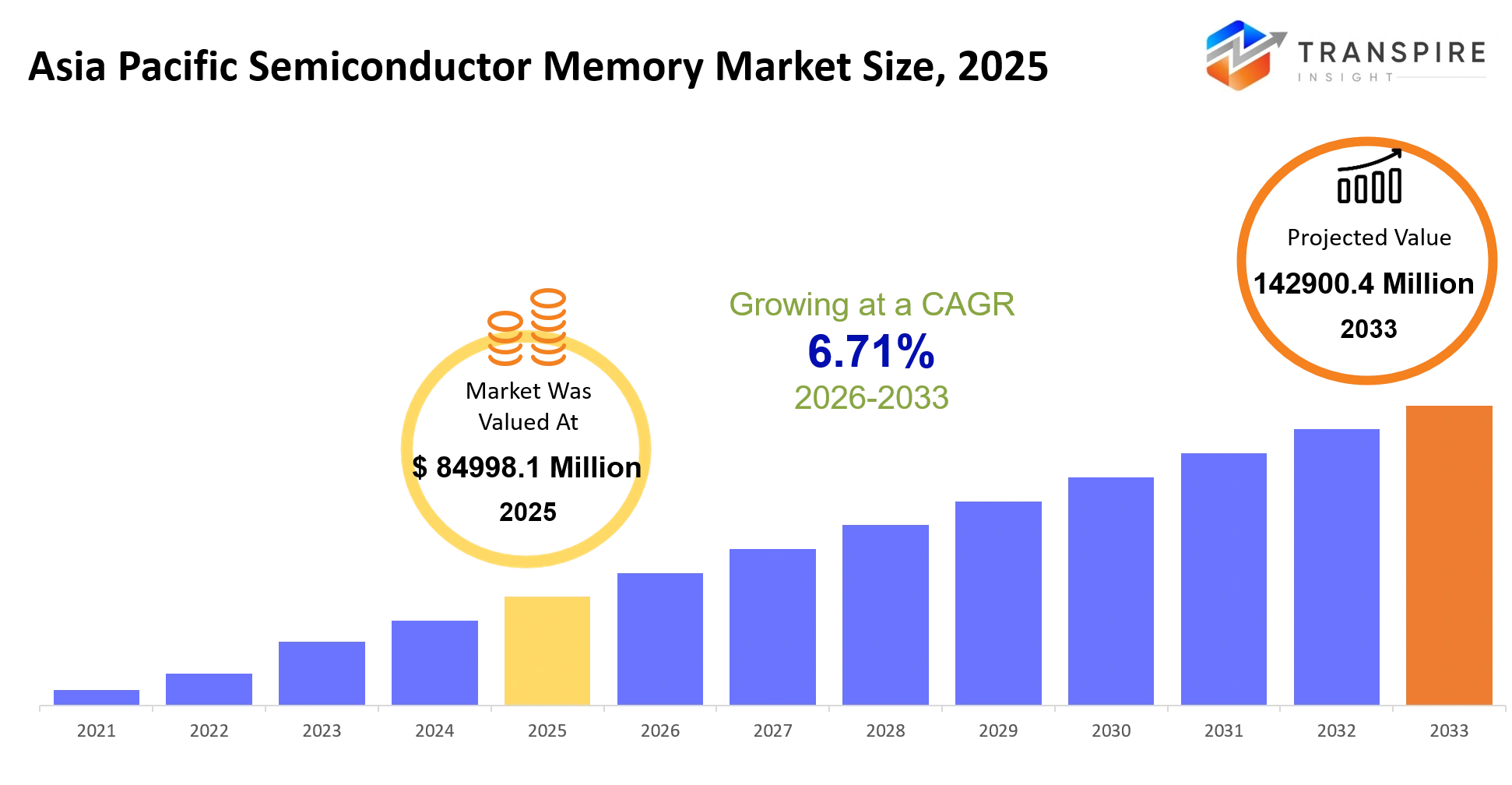
- Asia Pacific Semiconductor Memory Market Size 2025: USD 84998.1 Million
- Asia Pacific Semiconductor Memory Market Size 2033: USD 142900.4 Million
- Asia Pacific Semiconductor Memory Market CAGR: 6.71%
- Asia Pacific Semiconductor Memory Market Segments: By Memory Type (DRAM, SRAM, NAND Flash, NOR Flash, EEPROM, MRAM, HBM, Others); By Application (Consumer Electronics, Data Centers, Automotive Electronics, Industrial Systems, Telecommunications, Healthcare Devices, Aerospace & Defense, Others); By End User (Electronics Manufacturers, Automotive Industry, IT & Telecom, Industrial Sector, Healthcare Industry, Government, Others); By Technology (DDR Memory, LPDDR Memory, GDDR Memory, 3D NAND, HBM, AI Memory, Embedded Memory, Others).
Asia Pacific Semiconductor Memory Market Summary
The Asia Pacific Semiconductor Memory Market was valued at USD 84998.1 Million in 2025. It is forecast to reach USD 142900.4 Million by 2033. That is a CAGR of 6.71% over the period.
The Asia Pacific Semiconductor Memory Market is very important for hardware. It helps store. Get data from chips that power things like smartphones and big computers. The semiconductor memory decides how fast a device can process information and how much it can do at the time. It also decides if the device remembers things when it is turned off.
In the four years the Asia Pacific Semiconductor Memory Market has changed a lot. The need for intelligence has made high-bandwidth memory and advanced NAND Flash very important. These things used to be common. Now they are very valuable. This change happened quickly after 2023. Big data center operators in China, Japan, South Korea and India started to think about memory procurement as a security issue. They did not just think about it as a purchase.
The trade restrictions between the US and China made it harder to get these things. So companies in the region had to make their memories and find alternatives. Now the use of NAND and LPDDR5 memory is connected to the building of artificial intelligence servers, in the Asia Pacific Semiconductor Memory Market. The Asia Pacific Semiconductor Memory Market is still. The semiconductor memory is a big part of it.
Key Market Insights
- The Asia Pacific region makes most of the world's semiconductor memory with South Korea and Taiwan making a lot of it as of 2025.
- China is the place where people are buying the most semiconductor memory. They need more DRAM and NAND Flash from 2026 to 2033 because they are using more AI serve.
- NAND Flash is the type of memory that makes the money and this is because people are using solid-state drives in things like smartphones and computers.
- DRAM is the second most popular type of memory and people are using DDR5 and LPDDR5 in smartphones, laptops and AI computers.
- HBM is growing fast and this is because people need it to train AI models with demand growing over 30% every year until 2028.
- Most semiconductor memory is used in Consumer Electronics, which's about 34% of all the money made from it in 2025 and this is because people need memory for their smartphones and tablets.
- Data Centers are growing fast and this is because companies in Japan, South Korea, India and Singapore are using more AI and cloud computers.
- The companies that make electronics like the ones in China, South Korea and Taiwan are the buyers of semiconductor memory.
- The Automotive Industry is growing fast and this is because electric vehicles need a lot more memory, than regular cars, about 5 to 10 times more.
- Samsung Electronics, SK Hynix and Micron Technology make most of the DRAM in the world so they can decide how much it costs and how much is made, which affects the region.
What are the Key Drivers, Restraints, and Opportunities in the Asia Pacific Semiconductor Memory Market?
Drivers
A major factor that drives the development of the Asia Pacific semiconductor memory market can be considered to be the emergence of the AI infrastructure. As the number of companies that incorporate artificial intelligence in their products increases, the need for advanced computing devices that are able to handle huge amounts of data becomes higher. This means that new memory devices, featuring greater bandwidth and performance, as well as better data access time, are likely to appear on the market soon. Players in the data center and cloud sector and other technological firms have a strong interest in developing AI infrastructure, which is good news for semiconductor memory vendors from the region.
It is also worth paying special attention to the increasing popularity of AI servers because such devices are characterized by higher requirements to memory compared to ordinary computer systems. As a result, each of these servers is going to store a larger amount of data, which means increased memory capacity. The increasing presence of artificial intelligence means that the semiconductor memory market will experience stable demand for high-quality memory devices in the future.
Restraints
Another problem that the semiconductor memory market faces is the very high cost of production facilities due to capital investment needs. In order to set up a new factory to produce this product, a company needs a lot of money and advanced technologies. It takes quite some time from starting a construction facility until production begins. Thus, it becomes impossible for semiconductor memory producers to increase the volume of production in case of abrupt change in demand, as production cannot be organized quickly.
Therefore, this market experiences a certain cycle of shortage and oversupply of products, influencing prices and profits of enterprises on the whole. This issue is especially serious for small and medium-sized memory producers, who might have difficulties in entering a rapidly developing niche in case they need more funds for scaling production or establishing strategic relationships with other firms. Such conditions give an advantage to large-scale firms, having a huge amount of finances and well-established production network.
Opportunities
The emerging industry that is going to create an opportunity for the production of semiconductors would be automotive memory solutions. The trend of adopting more and more hybrid and fully electrical automobiles, along with advanced applications like driver-assistance software, means the emergence of a market that needs memory solutions that will guarantee flawless performance even in extreme operating conditions. Automotive electronics are constantly developing and integrating new elements that need computing power.
It would appear that creating opportunities for semiconductor technology companies that produce automotive memory solutions that conform to automotive standards might come by way of entering into partnerships and/or reaching out for long-term supply agreements. Such agreements could become a stable source of income for these businesses, even though it might take some time and effort to qualify.
What Has the Impact of Artificial Intelligence Been on the Asia Pacific Semiconductor Memory Market?
Artificial intelligence has really changed how people want semiconductor memory in the Asia Pacific region. Now memory controllers use machine learning to watch how people use them and make them last longer by moving things before they get too worn out. Companies like Samsung and SK Hynix use intelligence to find problems in their factories and make their products better. They can do this faster and more accurately than before which means they can make products that work properly.
Being able to predict what will happen is very important for managing supply chains. Models that use machine learning look at what people bought, what is happening in the world and how factories are being used to figure out what prices will be like in the future. This helps big electronics companies in Taiwan and South Korea get the amount of products at the right time. Some memory products are made to work well with artificial intelligence and people are willing to pay a lot more for them.
The main problem with using intelligence in this market is that it is expensive to set up and get all the information needed. Smaller companies do not have the money to build the systems they need to use intelligence so only a few big companies can use it to make their operations better.
Key Market Trends
- The use of HBM really took off after 2023. This is because companies like NVIDIA and chip makers needed HBM for their AI GPU shipments. Each accelerator unit required its high-bandwidth memory stack.
- In 2024, Samsung, Kioxia, and YMTC were producing NAND that had over 200 layers. It meant that companies were competing on how to stack the layers effectively rather than enlarging the chip size. The change led to companies' approach in investing in technology.
- Between 2024, and 2025, there would be a standardization of LPDDR5X memories in high-end smartphones. As a result, companies such as Apple, Samsung, and Xiaomi would adopt LPDDR5X memory in their smartphones. In addition, it became hard for companies to acquire memory for their phones.
- By 2024, Chinese memory corporations such as YMTC would be selling their memory products in Chinese markets. In turn, there would be no need for China to acquire memory chips from other regions.
- There would be increased demand for memory in vehicles from 2023, through 2025. There would be memory demand in terms of safety systems that include lane departure warning and automatic emergency braking system.
- During the period 2023 through 2025, there would be increased demand for memory in cars as compared to other fields since there were safety features. As a result, there was increased utilization of memory in cars. There were DDR5 memories among others in use by cars.
- There were instances where corporations in some countries like Japan, South Korea, and Taiwan began incorporating intelligence into their computers. This necessitated memory technology that consumed low amounts of energy. Some of these memories were MRAM memory types that did not depend on power supply since their contents were not lost during power failures.
- There was little variation in memory modules prices between 2024 and 2025, unlike what had been observed before. This is attributed to the fact that memory firms were signing contracts with their customers to sell memory at pre-agreed prices.
Asia Pacific Semiconductor Memory Market Segmentation
By Memory Type
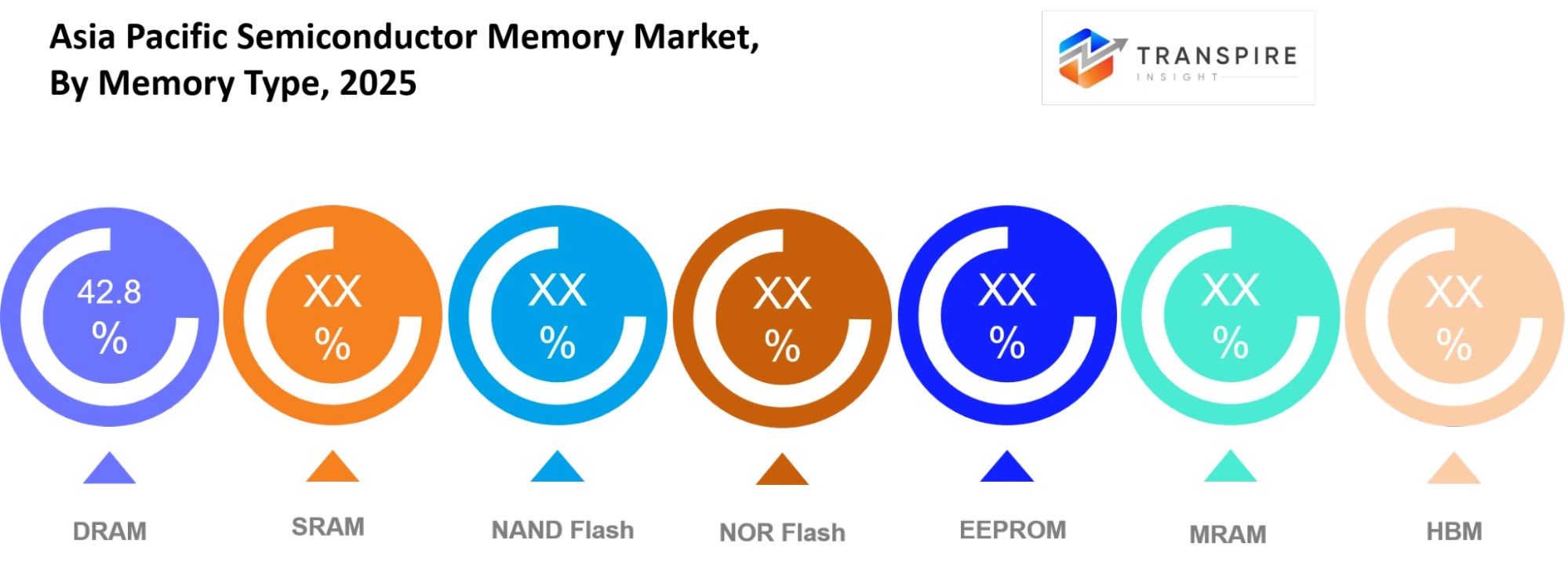
Semiconductor memory technologies form an integral part of electronic solutions and are necessary components of systems capable of processing data, storing information, and delivering superior performance levels. The use of dynamic memory technologies remains prevalent in consumer electronics, server solutions, networks, and computing systems owing to the high speeds and performance capacity they enable. Innovations related to memory architecture aim at achieving higher levels of performance, better energy efficiency, and improved bandwidth to meet the demands imposed by such technologies as artificial intelligence, cloud computing, and the Internet of Things.
However, there is also a need to provide premium memory solutions for the purposes of implementing various technologies that require low latency, non-volatility, increased durability, or the ability to operate in harsh environmental settings. Such industries as automotive, industrial automation, healthcare, aerospace engineering, or Internet of Things impose the demand for memory technologies that will facilitate high levels of performance, data integrity, and operational stability. In addition, innovative memory technologies also fuel innovations in artificial intelligence infrastructure and high-performance computing systems due to the bandwidth requirements these systems face.
By Application
One of the primary drivers for the development and utilization of semiconductor memory remains its use in consumer electronic products, especially with the proliferation of smartphones, laptops, tablets, wearables, and other gadgets that are becoming ever more popular among consumers. Indeed, the rising expectations regarding speed and performance, along with an increasing focus on storage capabilities of gadgets, are spurring the need for the implementation of improved memory technology in electronic devices. In addition to being used in consumer devices, semiconductors continue to play a major role in the functioning of data centers that are rapidly proliferating to support various cloud computing initiatives and AI applications.
Along with traditional applications, the use of semiconductor memory is expanding into a number of other industries, including automotive, industrial, telecommunications, health care, and aerospace engineering, each of which has specific requirements concerning the performance of memory chips. Automotive manufacturers utilize memory to ensure proper functioning of various ADAS applications, such as infotainment system and other connected applications, while the demands in the industrial market relate to automation, robotics, and smart manufacturing facilities. Telecommunications companies utilize semiconductors to provide fast internet access and perform data-intensive operations, while health care and aerospace industries are focused
By End User
It would not be an exaggeration to say that electronics manufacturing is one of the key consumers of semiconductor memory in the Asia Pacific market. Indeed, semiconductor memory is an integral part of the consumer electronics market – smartphones, PCs, tablets, gaming consoles, and even other electronics require this type of memory. In addition, as users' requirements increase in terms of performance and capacity, as well as user experience, electronics producers implement this memory technology in their devices. Additionally, the rise of artificial intelligence in electronic devices and gadgets may lead to the increase in semiconductor memory usage.
In any case, the automotive industry, telecommunications, and industrial sectors show growing demand for memory because of their digitalization. Cars need increasingly larger amounts of memory for implementing new technologies, from driver assistance and connectivity to infotainment and autonomous cars of the future. Telecommunications, as well as cloud services, invests a lot of money in data center infrastructure in order to integrate artificial intelligence. Lastly, memory technology powers many industrial automation projects, Internet of Things (IoT) devices, robotics and smart manufacturing projects.
By Technology
The Asia Pacific memory market in semiconductors is driven by an increasing need for memory solutions which are efficient, power-saving, and high performing in applications ranging from computing and mobile to storage and graphics. New developments in memory technology are driving improvements in data processing speeds, bandwidth, power saving, and system performance. The growth of AI computing, cloud computing, HPC, games, and connected devices is facilitating the move to next generation memory architectures. There is heavy investment being made by memory companies in the Asia Pacific market into research and development activities in order to meet the needs of these advanced applications.
There is a growing focus on innovations which can process large data loads while reducing energy consumption and spatial requirements. Memory technologies which support graphics processing, enterprise storage, data center operations, and applications such as AI are acquiring strategic importance due to the need for increased efficiencies in computing. The explosive growth in AI architecture, edge computing, and intelligent systems is fueling a rising demand for premium memory products that possess high performance capabilities. As a result, memory manufacturers are giving priority to technological advancements, manufacturing efficiencies, and product differentiation.
What are the Key Use Cases Driving the Asia Pacific Semiconductor Memory Market?
The Asia Pacific semiconductor memory market is changing a lot because of the growth of AI training infrastructure.To train AI models you need memory systems that can handle huge amounts of data very quickly and also manage billions of model details.This has made high-bandwidth memory (HBM) and high-capacity DDR5 setups very popular.Countries like China, Japan, South Korea, Singapore and India are investing heavily in AI infrastructure and cloud providers and tech companies are also joining in.As a result long-term supply deals are becoming more common.These deals help memory makers know what to expect in terms of demand in the future and make them produce high-end memory products.The Asia Pacific semiconductor memory market is seeing a lot of changes because of AI training infrastructure.High-bandwidth memory (HBM) and high-capacity DDR5 are in demand.Governments and tech companies are investing in AI infrastructure, in China, Japan, South Korea, Singapore and India.This investment is driving the growth of the Asia Pacific semiconductor memory market.
At the same time, growth in consumer electronics is extending beyond traditional smartphone applications. Advanced smartphones, AI-enabled devices, gaming systems, and high-refresh-rate tablets increasingly rely on LPDDR5X memory to deliver enhanced performance and energy efficiency. Strong manufacturing activity in China and India continues to generate substantial demand for advanced mobile memory solutions, supporting the expansion of the consumer electronics segment within the regional memory market.
The automotive sector is also emerging as an important driver of memory consumption. Modern vehicles equipped with advanced driver assistance systems (ADAS), electric vehicle battery management systems, infotainment platforms, and autonomous driving technologies require significantly greater memory capacity than conventional vehicles. Automotive manufacturing hubs in Japan, South Korea, and China are creating sustained demand for highly reliable and durable memory products that can operate under demanding environmental conditions.
Beyond AI data centers, edge computing and industrial automation are expected to become major sources of future memory demand. Smart factories across Japan and South Korea are increasingly deploying intelligent sensors, machine control systems, robotics, and edge AI platforms that depend on embedded and industrial-grade memory solutions. As industrial digitalization accelerates, these applications are likely to support long-term growth opportunities for memory manufacturers.
Additionally, the expansion of satellite broadband networks, private 5G deployments, and advanced telecommunications infrastructure is creating demand for memory products optimized for reliability, endurance, and long operational lifecycles. While these applications may not require the extreme performance levels associated with AI workloads, they represent a growing market segment with distinct technical requirements, further diversifying memory demand across the Asia Pacific region.
|
Report Metrics |
Details |
|
Market size value in 2025 |
USD 84998.1 million |
|
Market size value in 2026 |
USD 90701.2 Million |
|
Revenue forecast in 2033 |
USD 142900.4 Million |
|
Growth rate |
CAGR of 6.71% from 2026 to 2033 |
|
Base year |
2025 |
|
Historical data |
2021 - 2024 |
|
Forecast period |
2026 - 2033 |
|
Report coverage |
Revenue forecast, competitive landscape, growth factors, and trends |
|
Regional scope |
Asia Pacific |
|
Key company profiled |
Samsung Electronics, SK Hynix, Micron Technology, Kioxia, Western Digital, Intel, Nanya Technology, Winbond Electronics, Powerchip Semiconductor, YMTC, Macronix, Kingston Technology, Transcend Information, Toshiba, ADATA. |
|
Customization scope |
Free report customization (country, regional & segment scope). Avail customized purchase options to meet your exact research needs. |
|
Report Segmentation |
By Memory Type (DRAM, SRAM, NAND Flash, NOR Flash, EEPROM, MRAM, HBM, Others); By Application (Consumer Electronics, Data Centers, Automotive Electronics, Industrial Systems, Telecommunications, Healthcare Devices, Aerospace & Defense, Others); By End User (Electronics Manufacturers, Automotive Industry, IT & Telecom, Industrial Sector, Healthcare Industry, Government, Others); By Technology (DDR Memory, LPDDR Memory, GDDR Memory, 3D NAND, HBM, AI Memory, Embedded Memory, Others). |
Which Regions are Driving the Asia Pacific Semiconductor Memory Market Growth?
South Korea remains the leading country in the Asia Pacific semiconductor memory market due to its unmatched manufacturing scale, technological leadership, and strong government support for the semiconductor industry. The country is home to some of the world’s most advanced DRAM and High Bandwidth Memory (HBM) production facilities operated by major manufacturers such as Samsung Electronics and SK Hynix in key manufacturing hubs including Pyeongtaek, Icheon, and Cheongju. Continuous investments exceeding billions of dollars annually in fabrication facilities, research, and process technology have enabled South Korea to maintain its global leadership in advanced memory production. The country also benefits from a highly developed semiconductor ecosystem comprising equipment suppliers, specialty chemical producers, research institutions, and a skilled engineering workforce that has evolved over several decades. This integrated ecosystem provides a competitive advantage that is difficult for other countries to replicate and positions South Korea as a preferred manufacturing base for advanced memory technologies amid evolving global trade and export-control policies.
China occupies a unique position within the regional semiconductor memory market as both the largest consumer of memory products and an increasingly important producer. In response to supply-chain concerns and technology restrictions introduced after 2022, China has accelerated investments in domestic semiconductor manufacturing through state-backed funding and industrial policies. Companies such as Yangtze Memory Technologies Co., Ltd. (YMTC) have made significant progress in NAND flash production, while ChangXin Memory Technologies continues to expand domestic DRAM capabilities. Strong government support for semiconductor infrastructure, combined with substantial demand from major technology companies including Xiaomi, OPPO, Vivo, Huawei, Alibaba Group, and Tencent, creates a large domestic market that supports local memory manufacturers and reduces dependence on imported products. This combination of production expansion and strong internal demand makes China one of the most influential markets in the Asia Pacific memory industry.
India is emerging as one of the fastest-growing semiconductor memory markets in the region and is expected to experience substantial expansion between 2026 and 2033. Growth is being driven by rising smartphone adoption, increasing investments in cloud and data-center infrastructure, expanding electronics manufacturing activities, and supportive government initiatives such as Digital India and IndiaAI Mission. Historically dependent on imported memory products, India is beginning to establish a domestic semiconductor ecosystem through policy incentives and manufacturing support programs. A notable milestone is the establishment of a semiconductor assembly and test facility in Gujarat by Micron Technology, which marks an important step toward local semiconductor production capabilities. As memory demand continues to increase across consumer electronics, telecommunications, automotive, and AI applications, India presents significant long-term opportunities for manufacturers, suppliers, and investors. The country’s developing supply-chain infrastructure and expanding market demand create favorable conditions for early strategic partnerships in manufacturing, distribution, and technology development, potentially offering strong growth and profitability prospects over the coming decade.
Who are the Key Players in the Asia Pacific Semiconductor Memory Market and How Do They Compete?
The Asia Pacific Semiconductor Memory Market is a competitive place where a few big companies like Samsung Electronics, SK Hynix and Micron Technology control most of the market for DRAM and NAND Flash. These companies are always trying to be better than each other by making technology and working with big customers like NVIDIA, Apple and big cloud companies.
There are also some companies that specialize in certain areas like making memory for cars, factories and other devices that need to be very reliable. These companies can charge money for their products because they are very good at making things that last a long time.
Samsung Electronics is one of the companies in the market and it has a big advantage because it makes everything itself from designing the memory to testing the final product. This means Samsung can make new products faster and better than companies. Samsung also makes a lot of money from selling memory to companies that make intelligence hardware.
SK Hynix is another company that is very good at making a type of memory called HBM. It works closely with NVIDIA to make memory for their AI products, which makes a lot of money. YMTC is a company that sells memory to companies that want to buy from someone other than the big three companies.
Some other companies like Nanya Technology and Winbond Electronics specialize in making memory for cars and factories. They can charge money for their products because they are very reliable and last a long time. Macronix is a company that makes a type of memory called NOR Flash for cars and factories. It has certificates that show its products are very good which means it can charge more money.
Kingston Technology and Transcend Information are companies that buy memory from the companies and sell it to other customers under their own brand name. They are like middlemen that help get memory to people who cannot buy it directly from the companies.
The Asia Pacific Semiconductor Memory Market is a place with many different companies competing with each other. The big companies like Samsung Electronics, SK Hynix and Micron Technology control most of the market but the smaller companies can still make money by specializing in areas. The Asia Pacific Semiconductor Memory Market is very important for industries, including artificial intelligence, cars and factories. The Asia Pacific Semiconductor Memory Market will continue to be a place where companies will always be trying to make better products and sell them to more customers.
Company List
- Intel
- Nanya Technology
- Winbond Electronics
- Powerchip Semiconductor
- YMTC (Yangtze Memory Technologies)
- Macronix International
- Kingston Technology
- Transcend Information
- Toshiba
- ADATA Technology
Recent Development News
In May 2026, Samsung Electronicsbegan shipment of industry-first HBM4E samples. The company shipped 12-layer HBM4E samples to major global customers, strengthening its position in the AI memory market and accelerating next-generation high-bandwidth memory adoption for hyperscale infrastructure.
Source: https://news.samsung.com
In March 2026, Samsung Electronics and AMDentered a strategic partnership. The companies signed a Memorandum of Understanding (MOU) to collaborate on HBM4 supply for AMD Instinct MI455X GPUs and next-generation DDR5 memory solutions, reinforcing AI infrastructure development and expanding demand for advanced memory technologies across the Asia-Pacific semiconductor ecosystem.
Source: https://news.samsung.com
In June 2025, Micron Technologybegan sampling its 12-layer 36GB HBM4 memory to key customers. The launch supports next-generation AI platforms by delivering higher memory bandwidth and power efficiency, strengthening Micron’s presence in the rapidly growing AI and data-center memory segment.
Source: https://investors.micron.com
What Strategic Insights Define the Future of the Asia Pacific Semiconductor Memory Market?
The Asia Pacific Semiconductor Memory Market is structurally moving toward technology bifurcation: a small number of companies competing at the absolute frontier of HBM and advanced NAND will capture a growing share of total market revenue, while commodity DRAM and legacy NAND production migrates toward lower-cost regional producers in China and potentially India. The underlying force driving this direction is AI infrastructure investment, which has decoupled memory demand from the consumer electronics replacement cycles that previously governed market rhythm. A hidden risk within this picture is supply concentration: if geopolitical disruption, natural disaster, or regulatory action constrains output from the South Korean facilities where HBM production is currently concentrated, the entire global AI hardware supply chain faces a bottleneck with no near-term workaround. One emerging opportunity that is not yet mainstream is processing-in-memory architecture, where computational logic is embedded within memory arrays to reduce data movement energy and latency in AI inference workloads. This approach, being commercialized by Samsung and SK Hynix in limited production, could fundamentally alter the boundary between memory and compute — an architectural shift that rewards early patent holders and production-qualified suppliers with durable competitive moats. Market participants should prioritize securing long-term supply partnerships or equity positions in HBM-capable producers before the next AI hardware platform cycle locks in preferred supplier relationships.
Asia Pacific Semiconductor Memory Market Report Segmentation
By Memory Type:
- DRAM
- SRAM
- NAND Flash
- NOR Flash
- EEPROM
- MRAM
- HBM
- Others
By Application:
- Consumer Electronics
- Data Centers
- Automotive Electronics
- Industrial Systems
- Telecommunications
- Healthcare Devices
- Aerospace & Defense
- Others
By End User:
- Electronics Manufacturers
- Automotive Industry
- IT & Telecom
- Industrial Sector
- Healthcare Industry
- Government
- Others
By Technology:
- DDR Memory
- LPDDR Memory
- GDDR Memory
- 3D NAND
- HBM
- AI Memory
- Embedded Memory
- Others
Frequently Asked Questions
Find quick answers to common questions.
The expected Asia Pacific Semiconductor Memory Market size for the market will be USD 142900.4 Million in 2033.
Key segments for the Asia Pacific Semiconductor Memory Market are By Memory Type (DRAM, SRAM, NAND Flash, NOR Flash, EEPROM, MRAM, HBM, Others); By Application (Consumer Electronics, Data Centers, Automotive Electronics, Industrial Systems, Telecommunications, Healthcare Devices, Aerospace & Defense, Others); By End User (Electronics Manufacturers, Automotive Industry, IT & Telecom, Industrial Sector, Healthcare Industry, Government, Others); By Technology (DDR Memory, LPDDR Memory, GDDR Memory, 3D NAND, HBM, AI Memory, Embedded Memory, Others).
Major Asia Pacific Semiconductor Memory Market players are Samsung Electronics, SK Hynix, Micron Technology, Kioxia, Western Digital, Intel, Nanya Technology, Winbond Electronics, Powerchip Semiconductor, YMTC, Macronix, Kingston Technology, Transcend Information, Toshiba, ADATA.
The Asia Pacific Semiconductor Memory Market size is USD 84998.1 Million in 2025.
The Asia Pacific Semiconductor Memory Market CAGR is 6.71% from 2026 to 2033.
- Samsung Electronics
- SK Hynix
- Micron Technology
- Kioxia
- Western Digital
- Intel
- Nanya Technology
- Winbond Electronics
- Powerchip Semiconductor
- YMTC (Yangtze Memory Technologies)
- Macronix International
- Kingston Technology
- Transcend Information
- Toshiba
- ADATA Technology
About the Authors

Avinash Kumar
I’m Avinash Kumar, a Senior Research Analyst at Transpire Insight, with expertise in the Electronics and Semiconductor and Energy & Power industry. My work focuses on analyzing emerging technologies, market trends, industry developments, and innovation across these sectors. I specialize in transforming complex technical and market insights into clear, research-backed content that helps professionals, businesses, and decision-makers stay informed. Through continuous industry research and data-driven analysis, I strive to deliver accurate, reliable, and practical perspectives on the latest advancements shaping the semiconductor and energy landscape.

Chakradhar Khansole
Chakradhar serves as the Research Director at Transpire Insight, bringing over 8 years of experience in technology, innovation, and strategic market intelligence. He specializes in transforming complex market data into actionable business insights that enable organizations to make informed, growth-oriented decisions. Recognized for his strategic vision and analytical expertise, Chakradhar leads high-impact research initiatives, delivering comprehensive market assessments, competitive intelligence, and forward-looking industry analysis.
Recently Published Reports
-
Apr 2026
Fiber Optic Faceplates Market
Fiber Optic Faceplates Market Size, Share & Analysis Report By Type (< 300 mm2, 300-350 mm2, and > 350 mm2, By Application (Night Vision, Holographic Imaging, Medical, and Others), and Geography (North America, Europe, Asia-Pacific, Middle East and Africa, South and Central America), 2021 - 2031
-
Apr 2026
High Temperature Superconductors Market
High Temperature Superconductors Market Size, Share & Analysis Report By Type (1G HTS, and 2G HTS), By Application (Power Cable, Fault Current Limiter, and Transformer), and Geography (North America, Europe, Asia-Pacific, Middle East and Africa, South and Central America), 2021 - 2031
-
Apr 2026
Industrial Plugs and Socket Market
Industrial Plugs and Socket Market Size, Share & Analysis Report By Type (Industrial Plugs, Industrial Sockets), By Current (Up to 32 A, 32 to 125 A, Above 125 A), By Protection (Dustproof and Splash Proof, Waterproof, Explosion Proof), By End User (Heavy Industries, Oil and Gas, Chemicals and Pharmaceuticals, Power Generation, Others), and Geography (North America, Europe, Asia-Pacific, Middle East and Africa, South and Central America), 2021 - 2031
-
Apr 2026
InGaAs Avalanche Photodiodes Market
InGaAs Avalanche Photodiodes Market Size, Share & Analysis Report By Type (1100 - 1700 nm, and 1000 - 1600 nm), By Application (Missile Warning System, Muzzle Flash Detection, Wafer Defect Inspection, Laser Rangefinders, and Others), and Geography (North America, Europe, Asia-Pacific, Middle East and Africa, South and Central America), 2021 - 2031