
Asia Pacific Ride Hailing Services Market Size & Forecast:
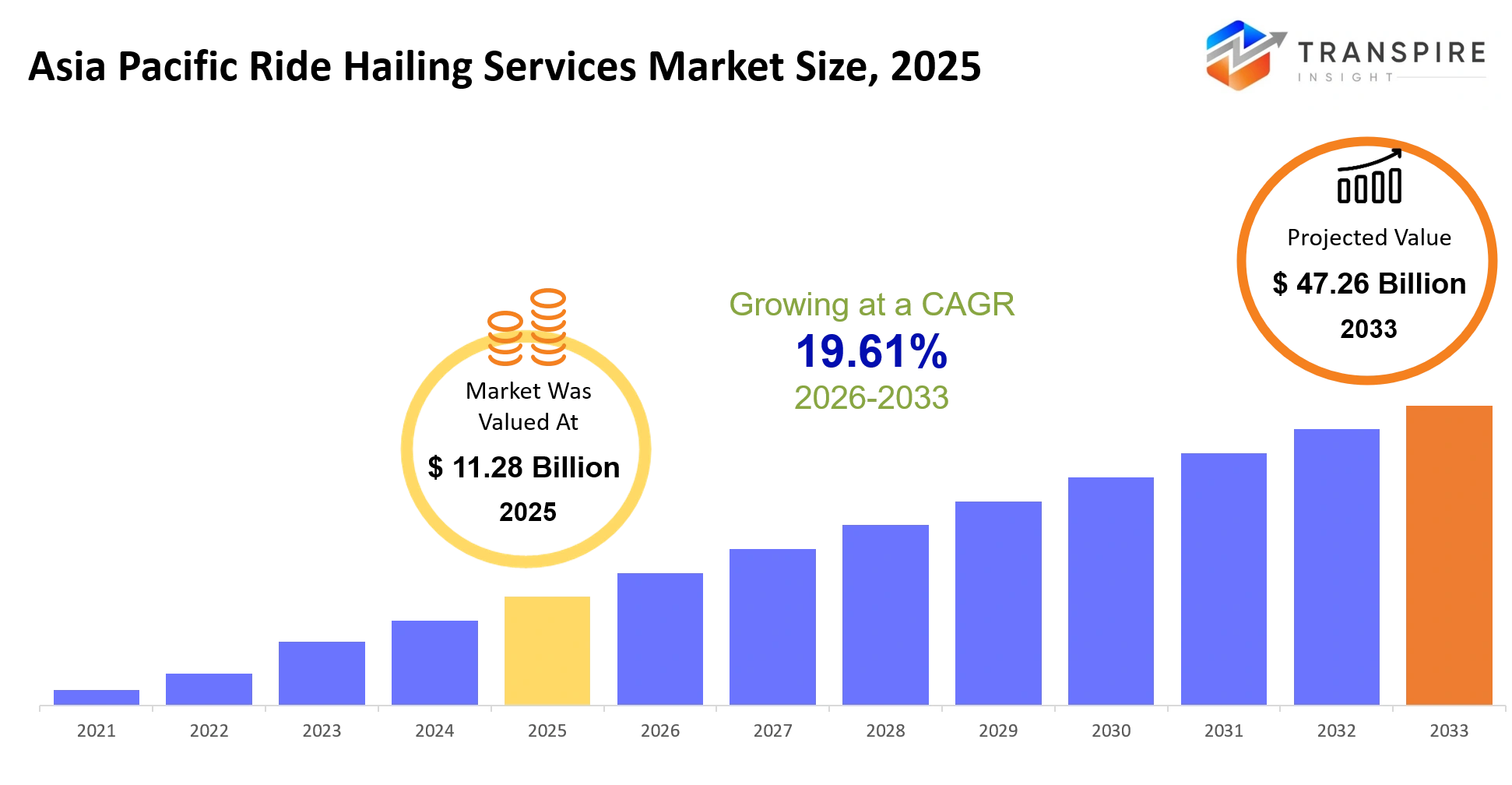
- Asia Pacific Ride Hailing Services Market Size 2025:USD 11.28 Billion
- Asia Pacific Ride Hailing Services Market Size 2033: USD 47.26 Billion
- Asia Pacific Ride Hailing Services Market CAGR: 19.61%
- Asia Pacific Ride Hailing Services Market Segments: By Vehicle Type (Cars, Motorcycles, EVs, Luxury Vehicles, Shared Rides, Vans, Others); By Service Type (On-Demand, Scheduled Rides, Carpooling, Corporate Mobility, Airport Transfers, Others); By Booking Platform (Mobile Apps, Web Platforms, Others); By End User (Individuals, Corporate Users, Tourists, Students, Others).
To learn more about this report,  Download Free Sample Report
Asia Pacific Ride Hailing Services Market Summary
The Asia Pacific Ride Hailing Services Market was valued at USD 11.28 Billion in 2025. It is forecast to reach USD 47.26 Billion by 2033. That is a CAGR of 19.61% over the period.
The Asia Pacific ride hailing services market helps people in cities get around easily by connecting them with drivers through digital platforms. These platforms solve the problem of not having public transport in busy cities. They also help reduce the need for people to own vehicles for daily commutes. Ride hailing services are now a part of how people move around in big cities helping both individuals and businesses.
In the 3 to 5 years ride hailing services have changed a lot. They are now part of platforms that offer many services. These services include food delivery, payments and logistics all in one app. The COVID-19 pandemic was a reason for this change. It made people stop using transport and start using private app-based services instead. When restrictions ended people in Southeast Asia and India started using ride hailing services often.
The market is growing because more people are using payments. The way prices are set is also getting more efficient. This helps drivers work more and wait less which means money for the platforms for each trip. Ride hailing services are becoming more popular. They are changing how people get around in cities.
Key Market Insights
- Asia Pacific Ride Hailing Services Market is led by Southeast Asia, which holds around 35% share in 2025. This is because people in Southeast Asia travel a lot within cities and there aren't public transport options.
- In the Asia Pacific Ride Hailing Services Market India is growing fast from 2025 to 2030. This growth is due to more people having smartphones and cities expanding quickly
- When it comes to services, intercity ride services are popular. This is because people want ways to travel long distances within cities.
- Carpooling and shared mobility services come in second. Many users choose these because they are cost-effective and cities are promoting them to reduce traffic.
- Electric ride hailing services are growing the fastest from 2025 to 2030. This is due to rules about emissions and policies that encourage fleets.
- Commuting services are used the most, making up 45% of applications. This is because many people travel to work in cities every day.
- Business travel mobility is growing rapidly. This growth is supported by companies partnering with ride hailing services and making it easy to manage travel expenses.
- Most users of ride hailing services are riders. However corporate users are increasing quickly because many companies offer subscription-based mobility programs.
- Companies like Uber, Grab and Ola are making their fleets electric and improving payments. This helps them keep a position in the market.
- Other companies, such as DiDi and inDrive are working on pricing and expanding into new areas. This helps them attract users, in smaller cities.
What are the Key Drivers, Restraints, and Opportunities in the Asia Pacific Ride Hailing Services Market?
Driver
It is now easier for people to book a ride because mobile internet is cheaper and we have real-time location technologies. Governments in countries like India and Southeast Asia are helping to make digital payments easier which means people can use ride hailing services easily. As a result people are using these services often and the companies that run them are making more money from all the trips and extra services they offer.
Another big reason for this growth is that younger people in cities are not buying cars like they used to. It is just too expensive to own a car and parking and traffic are such a hassle. So people are using ride hailing services to get there every day. This means that the companies that run these services are keeping their customers and making money from them. Some companies are even offering services like transportation, payments and delivery all in one app.
Restraint
The biggest problem for the Asia Pacific Ride Hailing Services Market is that there are many different rules and regulations in different countries and cities. Each place has its rules about licenses, driver rules, prices and how companies can operate. The problem is that transportation rules are closely tied to labor laws and urban planning. It is not easy to change them. In some cities there are rules that limit how much companies can charge for rides, which means they do not make much money. This can discourage companies from expanding their services to areas.
Opportunity
One of the opportunities for the Asia Pacific Ride Hailing Services Market is to switch to electric vehicles. Governments are offering incentives to companies that use vehicles and car manufacturers are making more affordable electric cars. This could really reduce the costs for drivers, which would mean they could earn money. When drivers earn money they are more likely to use the ride hailing services, which means the companies will do better.
Another opportunity is to expand ride hailing services to cities, where the digital infrastructure is getting better. Companies are using intelligence to make their services more efficient and to predict when people will need rides. As more people move to cities the companies that get there first will have an advantage and be able to grow their businesses over time. The Asia Pacific Ride Hailing Services Market is really going to take off in these cities.
What Has the Impact of Artificial Intelligence Been on the Asia Pacific Ride Hailing Services Market?
Ride hailing operations are getting better because of intelligence and new digital technologies. This helps to cut down on drivers just driving around with no one in the car. It helps to make sure that the right cars are being used for the right rides.
There are also tools that help to keep track of whether drivers have all the papers and if their cars are in good shape. This helps the companies that run the ride hailing services to make sure they are following all the rules in cities and states.
Machine learning is really important for figuring out what is going to happen in the future. The companies use machine learning to guess how many people will need rides at times and in certain places and they look at things like the weather and if there are any big events happening. They also use tools to help figure out if there are going to be any problems with the cars so they can fix them before they break down. And they use intelligence to find the best routes for the drivers to take so they can get to where they are going faster and use less gas.
All of these things are helping to make the ride hailing services better. People are not having to wait long for their rides and the cars are being used more. The companies are also able to save money and make the drivers happier. However it is still really expensive to get all of these systems working together especially when there are a lot of different cars and systems involved.. Sometimes the information that the companies have is not very good which can make it harder to guess what is going to happen in the future. Ride hailing operations and artificial intelligence are still getting better though. Artificial intelligence is helping ride hailing operations to improve utilization and trip matching accuracy.
Key Market Trends
- Ride hailing platforms have started to offer services, like payments, food delivery and logistics since 2021. This is to keep customers interested and make revenue.
- Electric cars gained popularity after 2022. Governments provided support to make it more affordable for drivers to use them and for companies to change to fleets.
- Between 2022 and 2025 AI systems that set prices based on demand got better which meant cars were used more and people didn't have to wait long.
- Younger people in cities started using ride hailing apps more because owning a car got too expensive with fuel, parking and maintenance costs.
- After 2021 governments started checking on ride hailing companies closely, making them improve how they check drivers, keep people safe and follow rules.
- Companies like Uber, Grab and Ola started working closely with electric car makers to change their fleets to electric cars over time.
- InDrive became popular by letting drivers and passengers agree on fares, which was different from the way of setting prices with an algorithm.
- After 2023 ride hailing companies started focusing on cities as more people in those areas started using smartphones.
- Using machine learning helped ride hailing companies predict demand better so they could use their cars efficiently during busy times and big events.
- After 2022 ride hailing companies stopped trying to get customers with fares and instead focused on making their service better offering subscriptions and engaging users with more features.
Asia Pacific Ride Hailing Services Market Segmentation
By Vehicle Type
Ride hailing platforms still use cars a lot for commuting and traveling around cities. People like using ride hailing platforms and cars because cars are convenient, comfortable and easy to find in cities.
Ride hailing platforms and luxury cars are used for occasions and business trips with ride hailing platforms and luxury cars.Some people like to share rides with others to save money and ride hailing platforms and vans are good, for groups of people who need to travel to the airport with ride hailing platforms and vans.
By Service Type
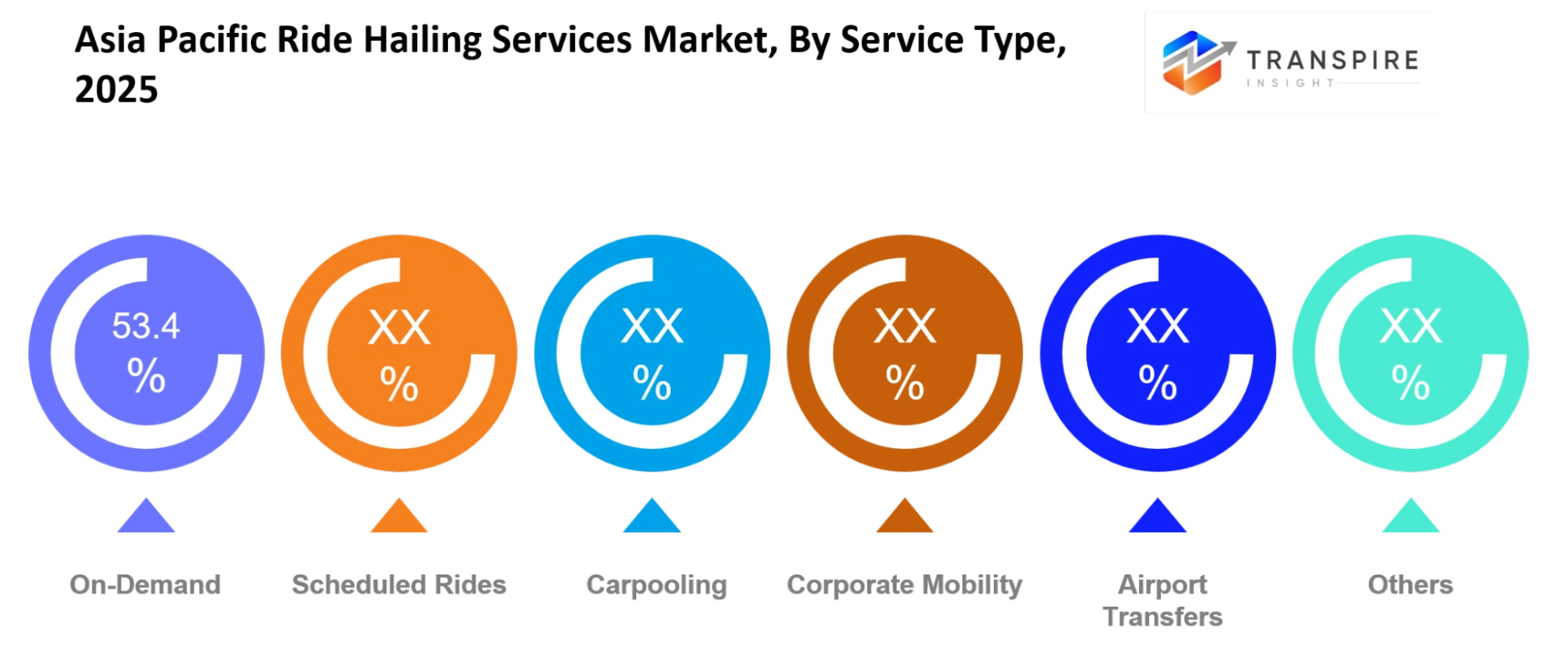
Most people use ride hailing services because they can get a car away. This is especially true for people who live in cities and need to get there every day. The services are easy to use. The prices are flexible so a lot of people use them. Some people like to schedule their rides of time like for business meetings or appointments. Carpooling is also a way for people to save money and reduce traffic in cities. Some companies even have their ride hailing programs for their employees.
To learn more about this report, Download Free Sample Report
By Booking Platform
People use their smartphones to book rides because it is easy to do. They like the apps and the apps are getting better. People like that they can see where their ride is and pay for the ride easily. The companies that make these ride apps are always trying to make them better. Ride apps are what people use to book rides. Some people still like to use their computers to book their rides. They do this when they are planning a trip or when they need to look at their ride accounts. Ride apps are used by people every day.
By End User
Most people who use ride hailing services are individuals who need to get around the city for work, school or other things. They like that the services are convenient and affordable. Some companies are also starting to use ride hailing services for their employees and clients. Tourists are another group of users especially with the rise of online travel planning. Students also use ride hailing services a lot in cities, with universities. All these different types of users help the companies that provide the services to keep improving and coming up with ideas.
What are the Key Use Cases Driving the Asia Pacific Ride Hailing Services Market?
Daily commuting in cities is the reason people use ride hailing services in the Asia Pacific region. People like professionals, students and city residents use these services because they do not want to deal with parking problems, the cost of owning a vehicle and traffic delays. They use these services a lot during peak working hours, which's when the companies make the most money.Some other reasons people use ride hailing services are for work trips. Going to the airport. Companies are using platforms to manage how their employees travel and to control how much they spend on transportation. More people are also using ride hailing services to get to the airport because travel is picking up again in big cities.
There are some ways that people are using ride hailing services like services that use electric vehicles and monthly subscription plans. Some cities are helping companies that use vehicles by giving them incentives and investing in charging stations. Ride hailing services are also becoming popular in cities and suburbs because internet access is getting better and transportation options are increasing. Ride hailing services are an option for people who live in these areas. The Asia Pacific Ride Hailing Services Market is growing because of these ways of using the services.
|
Report Metrics |
Details |
|
Market size value in 2025 |
USD 11.28 Billion |
|
Market size value in 2026 |
USD 13.49 Billion |
|
Revenue forecast in 2033 |
USD 47.26 Billion |
|
Growth rate |
CAGR of 19.61% from 2026 to 2033 |
|
Base year |
2025 |
|
Historical data |
2021 - 2024 |
|
Forecast period |
2026 - 2033 |
|
Report coverage |
Revenue forecast, competitive landscape, growth factors, and trends |
|
Regional scope |
United States; Canada; Mexico; United Kingdom; Germany; France; Italy; Spain; Denmark; Sweden; Norway; China; Japan; India; Australia; South Korea; Thailand; Brazil; Argentina; South Africa; Saudi Arabia; United Arab Emirates |
|
Key company profiled |
Uber, Grab, Ola, DiDi, Lyft, GoTo, inDrive, Kakao Mobility, Bolt, Ryde, Careem, Maxim, TADA, Rapido, Yandex Go. |
|
Customization scope |
Free report customization (country, regional & segment scope). Avail customized purchase options to meet your exact research needs. |
|
Report Segmentation |
By Vehicle Type (Cars, Motorcycles, EVs, Luxury Vehicles, Shared Rides, Vans, Others); By Service Type (On-Demand, Scheduled Rides, Carpooling, Corporate Mobility, Airport Transfers, Others); By Booking Platform (Mobile Apps, Web Platforms, Others); By End User (Individuals, Corporate Users, Tourists, Students, Others). |
Which Regions are Driving the Asia Pacific Ride Hailing Services Market Growth?
Southeast Asia is leading the ride hailing market in Asia Pacific. This is because many people who live in cities use smartphones and make payments. Many countries in the region have ride hailing apps that also offer food delivery, payments and logistics. These super-apps have made users more engaged. Take more rides. There are also drivers and good digital systems in place.India's ride hailing market is growing fast.More people are getting smartphones. Making digital payments.There is demand for urban transportation outside of big cities.
The government is supporting cashless transactions. Improving digital infrastructure.This has helped more people use ride hailing services.Investments in vehicles and mobility tech are also increasing.From 2026 to 2033 India will offer opportunities for companies and investors looking for long-term growth.
Who are the Key Players in the Asia Pacific Ride Hailing Services Market and How Do They Compete?
Competition in the Asia Pacific Ride Hailing Services Market remains intense but increasingly concentrated around large platform operators with strong regional networks and digital ecosystems. Incumbents continue to defend market share through technology investments, customer loyalty programs, and service diversification, while smaller entrants focus on niche pricing models or underserved geographic markets. The primary basis of competition has shifted from aggressive discounting toward platform efficiency, driver retention, digital payment integration, and multi-service offerings. Companies that can balance profitability with user growth are gaining a stronger competitive position.
Grab differentiates itself through an integrated ecosystem that combines transportation, payments, food delivery, and financial services within a single platform. This approach increases customer engagement and creates multiple revenue streams beyond ride services. Uber focuses on advanced routing algorithms, enterprise mobility solutions, and strategic partnerships to improve operational efficiency and strengthen its position in key urban markets. Expansion of electric vehicle partnerships also supports long-term cost optimization goals.
Ola leverages strong domestic market knowledge and investment in electric mobility infrastructure to differentiate its service portfolio. DiDi uses large-scale data analytics and artificial intelligence to optimize fleet utilization and demand forecasting across high-volume urban networks. inDrive stands apart through a fare negotiation model that allows passengers and drivers to agree on pricing directly, creating flexibility and attracting users in cost-sensitive markets.
Company List
Recent Development News
"In April 2026, Grab launched 13 AI-powered features at GrabX 2026. The new tools, including Group Ride and AI Assistant capabilities, strengthened platform engagement and expanded mobility service functionality across Southeast Asia.
Source: https://www.bernama.com
"In March 2026, Grab announced acquisition of Delivery Hero's Foodpanda Taiwan business for US$600 million. The transaction marked Grab's first expansion outside Southeast Asia and strengthened its regional mobility and delivery ecosystem strategy.
Source: https://www.reuters.com
"In July 2025, Baidu and Uber entered a multi-year strategic partnership to deploy Apollo Go autonomous vehicles on the Uber platform. The collaboration accelerated autonomous ride-hailing deployment in Asia and other international markets, supporting the next phase of mobility platform innovation.
Source: https://investor.uber.com
What Strategic Insights Define the Future of the Asia Pacific Ride Hailing Services Market?
The Asia Pacific Ride Hailing Services Market is moving toward an integrated mobility ecosystem where transportation, payments, delivery services, and artificial intelligence-driven personalization operate through unified digital platforms. Over the next 5–7 years, competitive advantage will depend less on ride volume and more on platform efficiency, customer retention, and the ability to monetize multiple services within a single application. The underlying force driving this shift is the maturation of digital infrastructure combined with growing consumer preference for app-based convenience and seamless mobility experiences.
A hidden risk lies in increasing market concentration among a small number of large platform operators. While scale improves efficiency, excessive concentration may attract stronger regulatory scrutiny, pricing controls, or competition policy interventions that could limit profitability and expansion flexibility. This risk is often overlooked because current growth indicators remain strong.
A significant emerging opportunity is the deployment of autonomous and AI-assisted mobility services in technologically advanced urban centers. Partnerships between ride hailing companies and autonomous vehicle developers are creating the foundation for future commercial adoption. Market participants should prioritize investments in artificial intelligence, electric vehicle ecosystems, and secondary-city expansion strategies, as these areas are likely to generate stronger long-term returns than traditional customer acquisition campaigns.
Asia Pacific Ride Hailing Services Market Report Segmentation
By Vehicle Type
- Cars
- Motorcycles
- EVs
- Luxury Vehicles
- Shared Rides
- Vans
- Others
By Service Type
- On-Demand
- Scheduled Rides
- Carpooling
- Corporate Mobility
- Airport Transfers
- Others
By Booking Platform
- Mobile Apps
- Web Platforms
- Others
By End User
- Individuals
- Corporate Users
- Tourists
- Students
- Others
Frequently Asked Questions
Find quick answers to common questions.
The expected Asia Pacific Ride Hailing Services Market size for the market will be USD 47.26 Billion in 2033.
Key segments for the Asia Pacific Ride Hailing Services Market are By Vehicle Type (Cars, Motorcycles, EVs, Luxury Vehicles, Shared Rides, Vans, Others); By Service Type (On-Demand, Scheduled Rides, Carpooling, Corporate Mobility, Airport Transfers, Others); By Booking Platform (Mobile Apps, Web Platforms, Others); By End User (Individuals, Corporate Users, Tourists, Students, Others).
Major Asia Pacific Ride Hailing Services Market players are Uber, Grab, Ola, DiDi, Lyft, GoTo, inDrive, Kakao Mobility, Bolt, Ryde, Careem, Maxim, TADA, Rapido, Yandex Go.
The Asia Pacific Ride Hailing Services Market size is USD 11.28 Billion in 2025.
The Asia Pacific Ride Hailing Services Market CAGR is 19.61% from 2026 to 2033.
-
Uber
-
Grab
-
Ola
-
DiDi
-
Lyft
-
GoTo
-
inDrive
-
Kakao Mobility
-
Bolt
-
Ryde
-
Careem
-
Maxim
-
TADA
-
Rapido
-
Yandex Go
About the Authors

Mayur Shinde
I am Mayur Shinde, a Senior Research Analyst at Transpire Insight, specializing in the Automotive & Transportation and Information & Communication Technology (ICT) Industry. My work focuses on analyzing emerging market trends, technological advancements, competitive landscapes, and industry developments to deliver accurate, data-driven insights. I am passionate about transforming complex market information into clear, actionable content that helps businesses, professionals, and decision-makers stay informed and make confident strategic decisions.

Chakradhar Khansole
Chakradhar serves as the Research Director at Transpire Insight, bringing over 8 years of experience in technology, innovation, and strategic market intelligence. He specializes in transforming complex market data into actionable business insights that enable organizations to make informed, growth-oriented decisions. Recognized for his strategic vision and analytical expertise, Chakradhar leads high-impact research initiatives, delivering comprehensive market assessments, competitive intelligence, and forward-looking industry analysis.
Recently Published Reports
-
Apr 2026
ATV & UTV Market
ATV & UTV Market Size, Share & Analysis Report By Type (ATV, and UTV), By Variants (Less Than 400 CC, 400 CC To 800 CC, and More Than 800 CC), and Geography (North America, Europe, Asia-Pacific, Middle East and Africa, South and Central America), 2021 - 2031
-
Apr 2026
Automotive Central Gateway Module Market
Automotive Central Gateway Module Market Size, Share & Analysis Report By Type (Ethernet Central Gateway Module, CAN Central Gateway Module, LIN Central Gateway Module, and FlexRay), By Application (Powertrain Control, Body Control, Infotainment System, Advanced Driver Assistance Systems (ADAS), and Others), By End User (Passenger Vehicles, and Commercial Vehicles), and Geography (North America, Europe, Asia-Pacific, Middle East and Africa, South and Central America), 2021 - 2031
-
Apr 2026
Automotive Engine Oil Filter Market
Automotive Engine Oil Filter Market Size, Share & Analysis Report By Filter Type (Fuel Filter, Engine Oil Filter, Hydraulic Oil Filter, and Others), By Filter Media (Cellulose, Synthetic, and Micro), By Sales Channel (OEMs, and Aftermarket), By Vehicle Type (Passenger Cars, Light Commercial Vehicles, Heavy Duty Trucks, Buses and Coaches, and Off-road Vehicles), and Geography (North America, Europe, Asia-Pacific, Middle East and Africa, South and Central America), 2021 - 2031
-
Apr 2026
Automotive Parts Aluminium Die Casting Market
Automotive Parts Aluminium Die Casting Market Size, Share & Analysis Report By Production Process (Pressure Die Casting, Vacuum Die Casting, Squeeze Die Casting, Gravity Die Casting), By Application (Body Parts, Engine Parts, Transmission Parts, Battery And Related Components, Other Application Types), and Geography (North America, Europe, Asia-Pacific, Middle East and Africa, South and Central America), 2021 - 2031
Our Clients



