

Asia Pacific RegTech Market Size & Forecast:
- Asia Pacific RegTech Market Size 2025: USD 4.87 Billion
- Asia Pacific RegTech Market Size 2033: USD 22.29 Billion
- Asia Pacific RegTech Market CAGR: 20.94%
- Asia Pacific RegTech Market Segments: By Component (Software, Services, Consulting, Risk Management Tools, Compliance Tools, Reporting Solutions, Analytics Platforms, Others); By Deployment (Cloud, On-Premise, Hybrid, SaaS, Private Cloud, Others); By Application (AML, KYC, Fraud Detection, Regulatory Reporting, Risk Management, Compliance Monitoring, Others); By End User (BFSI, Insurance, FinTech, Government, Healthcare, Others)
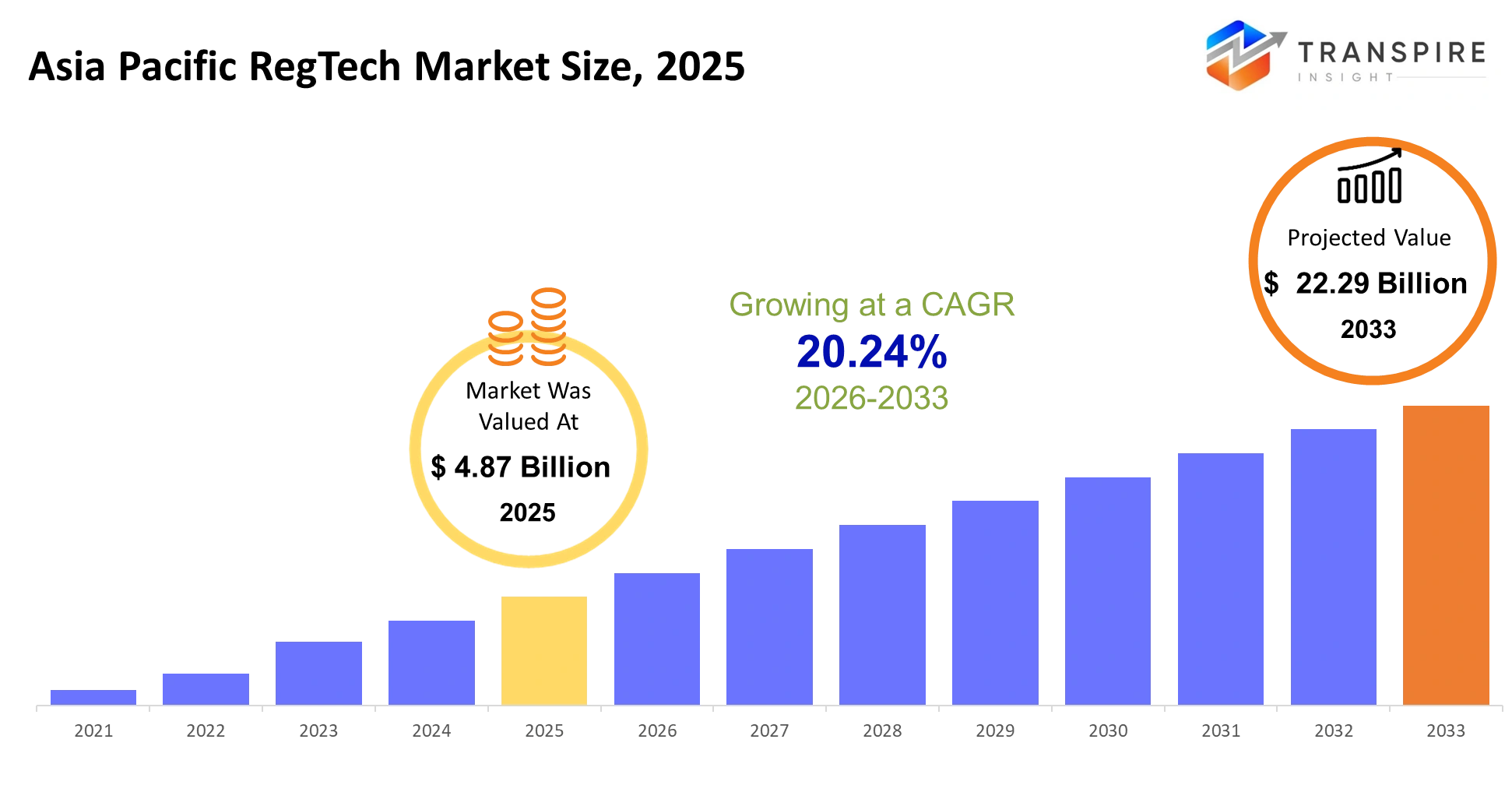
Asia Pacific RegTech Market Summary
The Asia Pacific RegTech Market was valued at USD 4.87 Billion in 2025. It is forecast to reach USD 22.29 Billion by 2033. That is a CAGR of 20.94% over the period.
The Asia Pacific RegTech market facilitates financial institutions, insurance providers, fintech firms, and regulated entities to improve regulatory compliance by automating operational activities that include KYC, transaction monitoring, regulatory reporting, risk evaluation, and fraud detection. From a practical point of view, RegTech alleviates operational burdens and difficulty to manage strict and fast-changing regulatory requirements and its associated non-compliance costs.
The past five years has been characterized by the shift of the RegTech market from a model focused on rule-based compliance workflows to the adoption of AI-based and data-driven compliance platforms, providing for continuous monitoring and real-time risk intelligence. One catalyst contributing to the accelerated shift has been the growth of digital banking, cross-border digital payments and digital remote onboarding due to the pandemic which highlighted the challenges of manual compliance. Increased expectations from regulators in Asia Pacific with regard to anti-money laundering controls, data management and digital identity checks caused more organizations to spend on automated compliance systems. As the adoption rate extended beyond large banks to service mid-market financial institutions and the new digital finance ecosystem, new revenue opportunities have been opened for technology companies.
Key Market Insights
- China holds the major share in Asia Pacific RegTech Market in 2025 with market share almost around 34 percent, on account of its massive investment into fintech and banking compliances.
- Australia holds significant market share, thanks to widespread RegTech implementation across banking, wealth management and insurance sectors.
- Regulatory Reporting solution captured the largest market share in 2025 with almost 30 percent, owing to complicated reporting requirements for financial institutions.
- The second largest segment is the risk & compliance management platform, attributed to enterprise wide governance and compliances.
- AI powered financial crime monitoring solutions are the fast-growing segment expected between 2025 and 2030.
- Cloud based RegTech platforms are gaining market share due to its benefits to organizations (scalability of compliance infrastructure and reducing implementation costs).
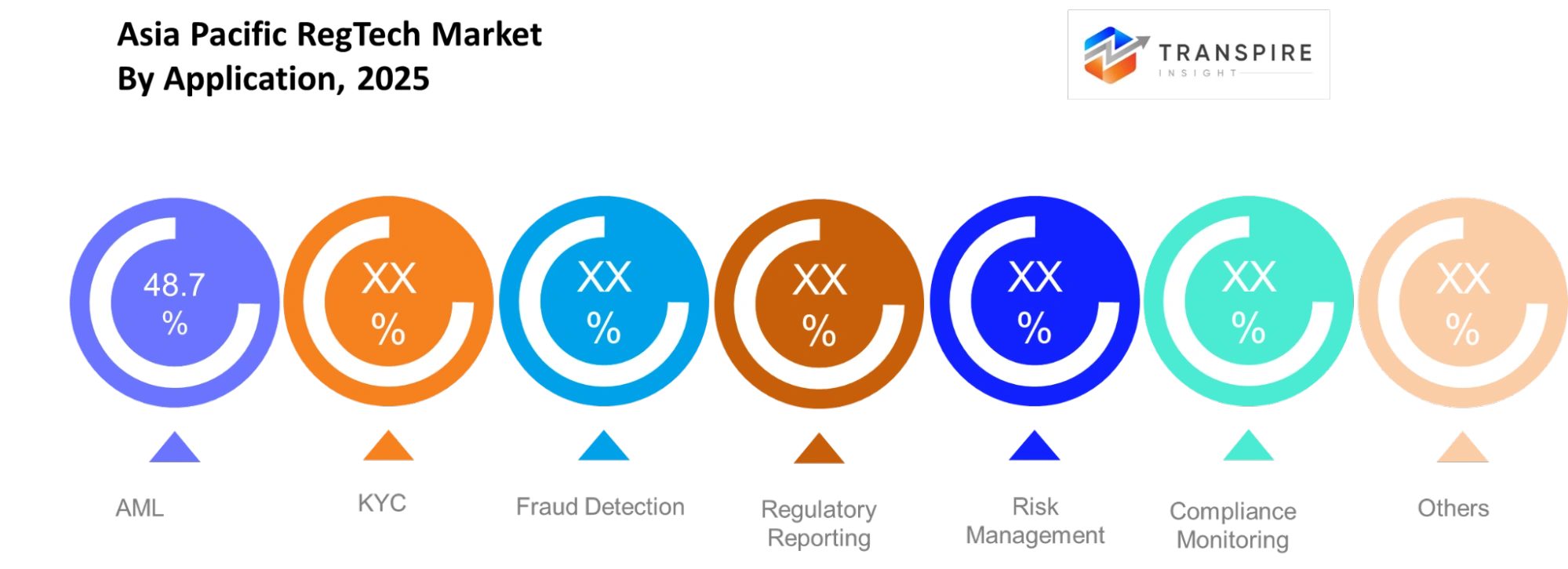
- AML and Fraud Detection application dominated with almost 35% share in 2025 market.
- Digital identity and customer onboarding application has the most fastest growing category.
- The significance of real time transaction monitoring is increasing owing to increasing regulatory focus on the digital payments ecosystem.
- Automated regulatory reporting solutions are expanding across the Banking and insurance sector.
What are the Key Drivers, Restraints, and Opportunities in the Asia Pacific RegTech Market?
Regulatory enforcement is the main driver in the Asia Pacific RegTech market. Regulators are increasingly enhancing the anti-money laundering, customer due diligence, transaction monitoring, and data governance requirements of digital banking, payments, insurance, and capital markets segments across the region. In parallel, a rise in the uptake of digital banking, alongside the increased volume of cross-border payment transactions, creates the high volume of compliance work that manual efforts simply cannot keep pace with. This leads the financial sector to shift toward automated compliance platforms that improve error reduction in reporting, speed up the process of conducting investigations and provide faster responses to regulatory requirements. Thus, expenditure in the segment gradually shifts from reactive compliance management to continuous monitoring systems in order to achieve a rise in subscription-based software revenues and broader enterprise application.
The greatest challenge lies with the heterogeneity in regulatory landscapes across various geographies in Asia Pacific. If a financial institution is operating across different countries, it is responsible for reporting in different formats, following diverse privacy policies, varying risk approaches and regulatory authority expectations. This complex regulatory environment complicates implementation of compliance solutions and extends delivery timelines. Unlike functional or operational short-term challenges, the fragmentations in regulations derive from sovereign policy distinctions which cannot be made to follow an identical standard rapidly. The consequence is delay in the decision-making process for procurement, longer implementation times, and slow adoption rate among middle-sized financial firms, given limited budgets in compliance.
A significant opportunity area would be the rise of AI-powered regulatory intelligence and the proliferation of digital identity ecosystems. The need for automated systems to decipher the evolving regulatory guidelines, modify policies and conduct real-time monitoring of the risks involved is of increasing importance to financial institutions. India, Singapore, and various other markets in Southeast Asia are significant investors in digital identity infrastructure and open financial ecosystems, establishing a fertile ground for modern compliance solutions. The combination of artificial intelligence, real-time data analytics and digital identity verification in integrated platforms could serve as new opportunities for new revenue streams, aligned with the digital transformation trend of the Asia Pacific.
What Has the Impact of Artificial Intelligence Been on the Asia Pacific RegTech Market?
RegTech Market in the Asia Pacific region is being transformed by Artificial intelligence by eliminating manual reviews needed for certain compliance processes. Banks and financial organizations widely implement machine learning algorithms to track transactions, trace out suspicious trends in transaction data, screen for sanctions, and streamline Know Your Customer (KYC) processes. With these automated systems processing millions of transactions per second, compliance officers are better able to focus on those high-risk cases which would normally require detailed manual investigation.
The adoption of predictive capabilities is one of the most significant advances in Risk Management technology. Using sophisticated analytics platforms, machine learning models analyze various factors such as past transactional behavior of customers, profile of the customers, and emergent trends to predict potential compliance breaches or financial crimes. With such analysis being performed regularly and before incidents occur, organizations are more likely to be compliant and internal control mechanisms strengthened. Businesses have witnessed lower turnaround time for investigation cases, reduction in false positives, better audit preparedness, and efficient allocation of compliance resources after implementing AI-powered solutions.
NLP solutions improve operational efficiency by reviewing regulatory information and updating policy and controls automatically. They enable users to interpret the new regulations and incorporate them into existing compliance controls efficiently.
Despite the increased use of AI, one significant barrier remains. Organizations struggle to overcome difficulties in data integration due to the heterogeneity of their data sources, inconsistencies within data quality, and legacy infrastructure. These problems ultimately degrade model accuracy, hike the cost of implementation, and impair the capability of predictive compliance systems in organizations that have diverse international jurisdictions.
Key Market Trends
- Post 2020, banks fast tracked their move from manual compliance reviews towards automated AI compliance monitoring tools to shorten investigative timelines and improve response to regulatory queries.
- Digital payments saw greater regulatory scrutiny post rapid fintech growth and the banks invested in automating money laundering and transaction surveillance systems.
- Cloud native RegTech adoption accelerated between 2021-2025 on the basis of reducing implementation timelines and infrastructure overheads.
- Digital identity verification shifted from being a competitive advantage to a critical requirement for compliance, especially in the Indian, Singapore and emerging Southeast Asian markets.
- Financial institutions have increased their appetite for integrated compliance ecosystems instead of point solutions and consolidated reporting, risk, and fraud into a single platform.
- Machine learning expanded beyond its initial use case in fraud detection and predictive analysis began being used for proactive identification of compliance risks before they resulted in breaches.
- Supervision has moved towards data-driven regulatory compliance across Asia Pacific, advocating for real-time reporting systems over period submissions.
- Strategic collaborations between fintech vendors and large vendors like Oracle,SAS institute,and Fenergo boomed post 2022.
- Cross-border compliance requirements are taking up higher procurement priority due to growth of regional payment networks and increased transactions across geographies.
- Natural language processing tools gained traction among compliance departments for the interpretation of regulatory changes to reduce manual effort and shorten policy implementation timelines.
Asia Pacific RegTech Market Segmentation
By Component :
Software forms the cornerstone of compliance activities as it supports the transaction monitoring, customer verification, regulatory reporting and risk analysis functions. The software is used by financial institutions for handling a multitude of regulatory data without causing inconsistencies throughout the different compliance activities and it receives automatic updates as needed, hence allowing the organization to be flexible about changing regulatory guidelines.
Services help in installation, integration, maintenance, and on-going support of regulatory technology systems. Consulting provides high-level advice on transformation, regulatory readiness and process optimization. The tools facilitate the measurement and mitigation of operational, financial and regulatory risks.
The components allow organizations to address the legal and regulatory mandates through use of automated controls and workflow management. The reporting tools allow automatic report generation and submission while decreasing manual processing. The analysis tools can process large amounts of data to give clear insights. Other categories of components are designed as specific applications to meet the industry specific compliance needs and emerging issues in the regulatory world.
By Deployment :
Cloud-based deployment allows regulatory operations to scale flexibly through remote facilities and integrated data. Companies save on setup times, upgrade processes and flexibility to adapt to regulations. It is also beneficial because it offers real-time access to compliance information remotely.
On-premise deployment is still relevant for companies that need to retain their own data and its storage and security management facilities. Hybrid deployment allows for a blend of both cloud and on-premise facilities, giving them more room for operational requirements and governance policies, and phased migration to digital transformation without interruption.
SaaS gives you access to reg tech on a subscription basis without costly infrastructure investments. Other methods of deployment are private cloud (reserved environment) and custom hosted services to meet certain operational and regulatory requirements.
By Application :
Anti-Money Laundering (AML) applications assist in flagging suspect financial activity, monitoring transactions, and aiding investigations. Know Your Customer (KYC) applications assist with customer identity verification and the upkeep of up-to-date customer records. Both of these are vital for financial integrity and meeting obligations to the authorities.
Fraud detection applications provide analyses of transaction patterns and behavioural activity for suspect activities. Regulatory reporting applications automate the collection and reporting of information, enabling efficient processing of reporting requirements. Risk management applications measure exposures across a range of business functions and facilitate smart decision making.
Compliance monitoring applications monitor internal controls, policies, and relevant regulations, offering automated alerts and tracking mechanisms for visibility and responsibility. Applications also exist to handle other niche compliance operations, newly developing regulations, and sector-specific work practices.
By End User :
Financial Institutions, banks, regulatory technology solutions, huge reporting, and large volume of transactions in BFSI makes the sector a large consumer of regulatory technology solutions. Automated systems and solutions in banks and financial institutions are being used for enhancing customer authentication, risk management, regulatory reporting while enhancing operational productivity. The reporting requirements, underwriting activities and policy supervision is handled with the help of the compliance platform in insurance organizations.
FinTech companies are relying on regulatory technology to facilitate their digital financial services along with their ever-changing reporting demands and regulatory standards. The accelerated progress and innovation in financial technology would continue to spur new investments in superior compliance solutions. The public sector and government organizations use regulatory technology for performing various supervisory activities and other related regulatory enforcement and overseeing functions.
Healthcare organizations are implementing compliance solutions that will help them to establish data governance and abide by the various regulatory standards. Other major end user industry segments include the telecom sector, retail and other various enterprises, which are finding ways to improve the risk management activities and also seeking for more transparency in operations in Asia Pacific RegTech Market.
What are the Key Use Cases Driving the Asia Pacific RegTech Market?
The primary use case within the Asia Pacific RegTech Market is Regulatory Reporting and AML within Banks. Since Banks process large amounts of data (transactional, across digital payments, lending and international transfers), they are heavily dependent on automated monitoring and efficient regulatory reporting. This use case has strong traction due to increasingly shorter submission cycles required by regulators across Asia Pacific as well as the greater transparency required across activities.
Secondary use cases are KYC automation and fraud detection in particular amongst Fintech companies and Insurance firms. Fintechs (e.g. In India and Southeast Asia) can leverage real-time identification verification, thus streamlining their customer on boarding processes, while insurance providers leverage automated fraud detection to manage claims leakages and audit requirements more efficiently. These are driven by the fast growth of digital financial services and mobile-centric banking frameworks.
The nascent use cases include AI based regulatory change management and predictive compliance risk scoring. Firms are now trialing automated systems that interpret new regulations and link them to internal procedures. Orchestration of cross border compliance also represents a nascent use case, as cross border payments frameworks expand into new geographies.
|
Report Metrics |
Details |
|
Market size value in 2025 |
USD 4.87 Billion |
|
Market size value in 2026 |
USD 5.89 Billion |
|
Revenue forecast in 2033 |
USD 22.29 Billion |
|
Growth rate |
CAGR of 20.94% from 2026 to 2033 |
|
Base year |
2025 |
|
Historical data |
2021 - 2024 |
|
Forecast period |
2026 - 2033 |
|
Report coverage |
Revenue forecast, competitive landscape, growth factors, and trends |
|
Regional scope |
Asia Pacific (India, China, Japan, Australia, South Korea, Rest of Asia Pacific) |
|
Key company profiled |
NICE Actimize, Fenergo, ComplyAdvantage, LexisNexis Risk Solutions, Oracle, IBM, SAS, Thomson Reuters, Wolters Kluwer, MetricStream, ACI Worldwide, Broadridge, Trulioo, Refinitiv, Deloitte |
|
Customization scope |
Free report customization (country, regional & segment scope). Avail customized purchase options to meet your exact research needs. |
|
Report Segmentation |
By Component (Software, Services, Consulting, Risk Management Tools, Compliance Tools, Reporting Solutions, Analytics Platforms, Others); By Deployment (Cloud, On-Premise, Hybrid, SaaS, Private Cloud, Others); By Application (AML, KYC, Fraud Detection, Regulatory Reporting, Risk Management, Compliance Monitoring, Others); By End User (BFSI, Insurance, FinTech, Government, Healthcare, Others) |
Which Regions are Driving the Asia Pacific RegTech Market Growth?
China leads the Asia Pacific RegTech Market, driven by the high level of financial regulation and immense volume of digital banking operations, while the authorities demand intricate details on compliance with respect to payments, lending and fintech operations, thereby pushing demand for automated compliance solutions. In addition, it possesses both technologically advanced local technology players and the scale for execution provided by large state-owned banking networks. Digital financial infrastructure continues to grow, driving persistent demand for compliance automation technologies.
Japan is the only stable, mature participant, owing to the conservative approach to financial regulation and established banking infrastructure. Growth has primarily been in the modernization of legacy compliance systems, and less in the exponential growth observed in other Asian markets. Corporations and insurance companies are investing in robust risk management platforms to keep abreast of well-established, predictable regulatory changes, resulting in sustained, low-volatility demand.
India remains the fastest growing participant in this space due to its expansive and burgeoning digital payments networks and fintech operations. Its regulatory environment for payments (UPI), lending and identification is tightening rapidly and has experienced substantial expansion in recent times. Banks have been upgrading their compliance technology platforms very quickly in response to this growing scale and pace of operations. All these developments point to a strong long-term market opportunity for technology suppliers from 2026 onwards through 2033.
Who are the Key Players in the Asia Pacific RegTech Market and How Do They Compete?
The Asia Pacific RegTech Market is somewhat fragmented with global vendors, specialized compliance tech vendors and cloud software providers in competition. Tech capability, rapid integration speed and capacity to process real-time data are the deciding factors, not just cost. Incumbent vendors hold ground through long-term contracts with enterprise firms, while new challengers leverage AI based automation and targeted compliance workflows suitable for fintech and banks.
NICE Actimize, for example, gains the edge on others with sophisticated financial crime detection systems that emphasize real-time transaction monitoring and behavior analysis. They gain advantage through in-depth AI integration that reduces false positives in detection of money laundering and strengthens investigation processes. Its growth primarily comes through long term relationships with global banks and continuous improvements of the analytics engine.
Fenergo specializes through sophisticated client lifecycle management and automatic onboarding workflows. By integrating compliance checks within these processes and eliminating much manual intervention for both banks and fintech companies it gains a strong position in the market. Cloud deployment across major Asia Pacific financial centers are a key growth driver.
LexisNexis Risk Solutions relies on risk intelligence delivered through the power of data and its identity verification technology. It leverages deep global data networks to improve accuracy in screening and the quality of reports it generates. The company expands through partnerships with regional financial institutions and integrates its capabilities in emerging markets' digital identity systems across Asia.
Company List
- NICE Actimize
- Fenergo
- ComplyAdvantage
- LexisNexis Risk Solutions
- Oracle
- IBM
- SAS
- Thomson Reuters
- Wolters Kluwer
- MetricStream
- ACI Worldwide
- Broadridge
- Trulioo
- Refinitiv
- Deloitte
Recent Development News
In June 2026, Fenergo was selected by Union Investment for an AMLR-ready KYC transformation initiative. The deployment modernizes client lifecycle operations and improves regulatory compliance efficiency across large-scale asset management workflows in Europe and Asia-linked operations. Source https://resources.fenergo.com/
In January 2026, NICE Actimize announced the launch of its Actimize Insights Network. The platform introduced real-time counterparty risk intelligence to strengthen fraud prevention and reduce payment scam losses across Asia Pacific financial institutions.
Source https://www.niceactimize.com/
What Strategic Insights Define the Future of the Asia Pacific RegTech Market?
RegTech will continue its transition towards AI driven compliance systems. We will see compliance ecosystems that automate regulatory monitoring, reporting and fraud detection on an ongoing rather than an ad hoc basis, supported by ever-growing digital banking ecosystems, ever increasing volumes of cross-border payments, and regulator pressure to develop near real-time oversight. We expect to see this become deeply embedded into the fabric of transactions over the next 5-7 years, rather than operating as an independent back office function.
A less apparent but important risk is the possible increasing fragmentation of regulation across markets as different regions develop different data sovereignty or digital identity requirements. This can reduce the ease with which compliance platforms will interoperate, while increasing vendor lock in and limiting the scalability for global vendors. Similarly, models relying on AI trained on localized or limited datasets may have a greater capacity to miss localized instances of fraud.
One exciting opportunity we anticipate is the development of near-real time regulatory intelligence systems tightly linked to national digital ID systems (especially in India and South East Asia). This will allow instantaneous verification at the point of transaction. The primary opportunity, for market participants, will be to focus on building API-driven, interoperable architectures that can quickly adapt to the complex, dynamic, cross-jurisdictional regulatory environments of the future.
Asia Pacific RegTech Market Report Segmentation
By Component
- Software
- Services
- Consulting
- Risk Management Tools
- Compliance Tools
- Reporting Solutions
- Analytics Platforms
By Deployment
- Cloud
- On-Premise
- Hybrid
- SaaS
- Private Cloud
By Application
- AML
- KYC
- Fraud Detection
- Regulatory Reporting
- Risk Management
- Compliance Monitoring
By End User
- BFSI
- Insurance
- FinTech
- Government
- Healthcare
Frequently Asked Questions
Find quick answers to common questions.
The Asia Pacific RegTech Market size is USD 22.29 Billion in 2033.
Key segments for the Asia Pacific RegTech Market are By Component (Software, Services, Consulting, Risk Management Tools, Compliance Tools, Reporting Solutions, Analytics Platforms, Others); By Deployment (Cloud, On-Premise, Hybrid, SaaS, Private Cloud, Others); By Application (AML, KYC, Fraud Detection, Regulatory Reporting, Risk Management, Compliance Monitoring, Others); By End User (BFSI, Insurance, FinTech, Government, Healthcare, Others).
Major Asia Pacific RegTech Market players are NICE Actimize, Fenergo, ComplyAdvantage, LexisNexis Risk Solutions, Oracle, IBM, SAS, Thomson Reuters, Wolters Kluwer, MetricStream, ACI Worldwide, Broadridge, Trulioo, Refinitiv, Deloitte.
The Asia Pacific RegTech Market size is USD 4.87 Billion in 2025.
The Asia Pacific RegTech Market CAGR is 20.94% from 2026 to 2033.
- NICE Actimize
- Fenergo
- ComplyAdvantage
- LexisNexis Risk Solutions
- Oracle
- IBM
- SAS
- Thomson Reuters
- Wolters Kluwer
- MetricStream
- ACI Worldwide
- Broadridge
- Trulioo
- Refinitiv
- Deloitte
About the Authors

Mayur Shinde
I am Mayur Shinde, a Senior Research Analyst at Transpire Insight, specializing in the Automotive & Transportation and Information & Communication Technology (ICT) Industry. My work focuses on analyzing emerging market trends, technological advancements, competitive landscapes, and industry developments to deliver accurate, data-driven insights. I am passionate about transforming complex market information into clear, actionable content that helps businesses, professionals, and decision-makers stay informed and make confident strategic decisions.

Chakradhar Khansole
Chakradhar serves as the Research Director at Transpire Insight, bringing over 8 years of experience in technology, innovation, and strategic market intelligence. He specializes in transforming complex market data into actionable business insights that enable organizations to make informed, growth-oriented decisions. Recognized for his strategic vision and analytical expertise, Chakradhar leads high-impact research initiatives, delivering comprehensive market assessments, competitive intelligence, and forward-looking industry analysis.
Recently Published Reports
-
Apr 2026
3D Optical Profiler Market
3D Optical Profiler Market Size, Share & Analysis Report By Type (Desktop 3D Optical Profiler, and Portable 3D Optical Profiler), By Technology (Confocal Technology, and White Light Interference), By End-Use Industry (Manufacturing, Research Institutions, Automotive, Aerospace and Defense, Medical Devices, and Other), and Geography (North America, Europe, Asia-Pacific, Middle East and Africa, South and Central America), 2021 - 2031
-
Apr 2026
Depth Sensor Market
Depth Sensor Market Size, Share & Analysis Report By Type (Infrared Depth Sensors, Time-of-Flight (ToF) Sensors, Stereo Vision Sensors, Structured Light Sensors, Ultrasonic Depth Sensors), By Application (Automotive, Robotics, Gaming, Consumer Electronics, Industrial Automation, Healthcare, Security & Surveillance, Others), By End Users (Automotive Manufacturers, Consumer Electronics Companies, Healthcare Providers, Industrial Companies, Security Agencies, Gaming Companies, Robotics Companies, Others), and Geography (North America, Europe, Asia-Pacific, Middle East and Africa, South and Central America), 2021 – 2031
-
Apr 2026
Digital Manufacturing Market
Digital Manufacturing Market Size, Share & Analysis Report By Component (Hardware, Software, and Services), By Technology (Robotics, 3D Printing, Internet of Things (IoT), and Others), By Application (Automotive and Transportation, Aerospace and Defense, Consumer Electronics, Industrial Machinery, and Others), By Process Type (Computer-Based Designing, Computer-Based Simulation, Computer 3D Visualization, Analytics, and Others), and Geography (North America, Europe, Asia-Pacific, Middle East and Africa, South and Central America), 2021 – 2031
-
Apr 2026
Digital Visa Services Market
Digital Visa Services Market Size, Share & Analysis Report By Type (Individual Travelers, Group Travelers), By Application (Tourism, Business Travel, Others), and Geography (North America, Europe, Asia-Pacific, Middle East and Africa, South and Central America), 2021 – 2031