

Asia Pacific Radio Frequency Duplexer Market Summary
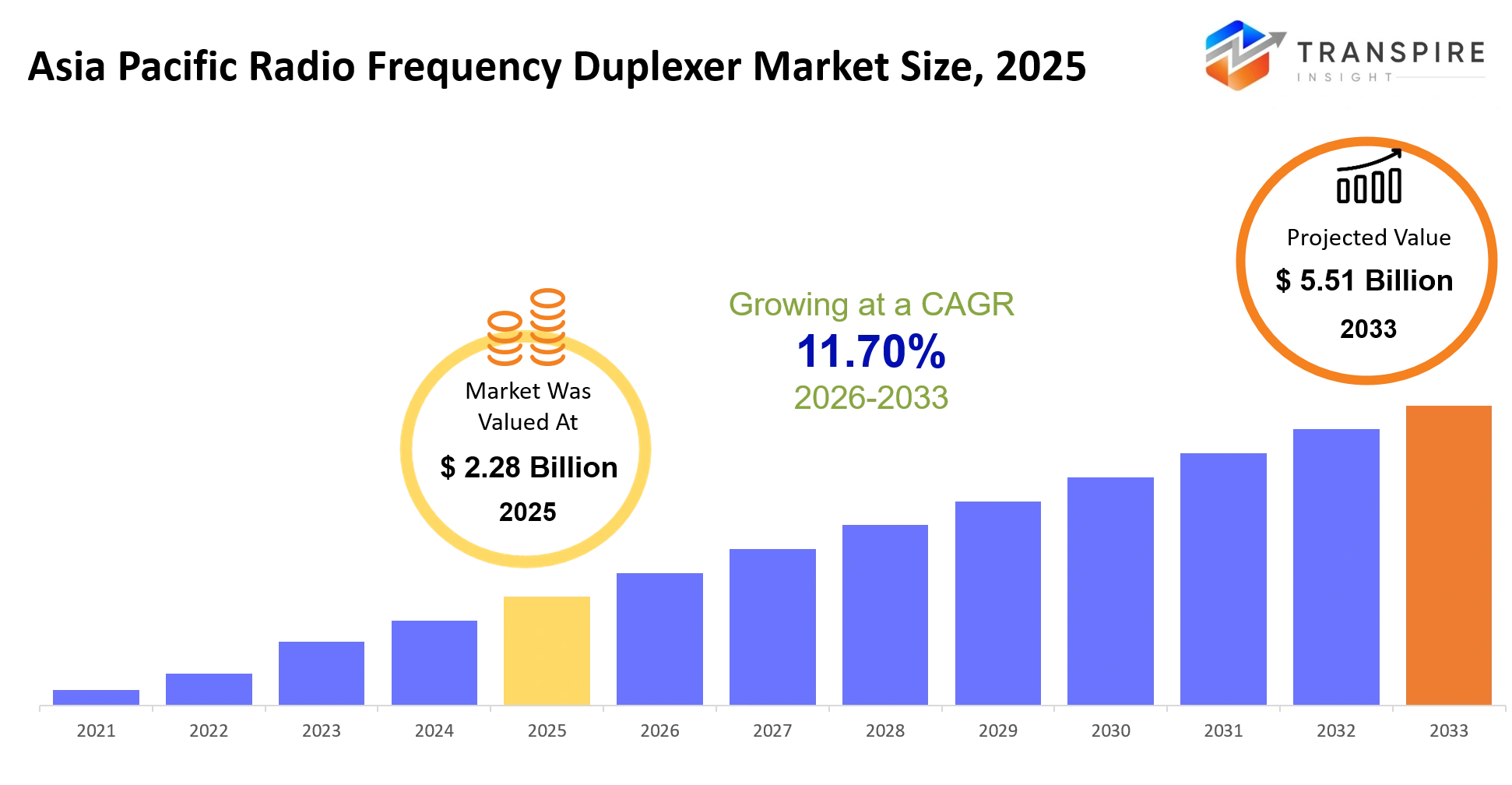
As per Transpire Insight Analysis the Asia Pacific Radio Frequency Duplexer Market size is estimated at USD 2.28 Billion in 2025 and is anticipated to reach USD 5.51 Billion by 2033, growing at a CAGR of 11.70% from 2026 to 2033.
The Asia Pacific Radio Frequency Duplexer Market helps keep wireless communication fairly smooth by letting mobile devices, base stations, and various connected systems send and receive at the same time, even when they are sharing antenna resources. In practice this approach boosts network efficiency , lowers hardware complexity a bit, and keeps connectivity more steady across smartphones, industrial automation setups, public safety communications, and the newer Internet of Things projects that keep popping up.
In the last five years, the market has gradually moved away from more standard duplexers toward super integrated, miniaturised building blocks. These are meant for newer 5G radio layouts, and also for higher frequency bands, so the design logic is kinda different now. Then during the pandemic there were semiconductor supply chain disturbances, which made component sourcing feel risky for a while, and it pushed manufacturers as well as telecom equipment providers to spread production across multiple places and to strengthen regional supply networks.
Now, as telecom operators roll out denser 5G infrastructure, and as industries push forward connected digital systems, the demand has shifted toward high performance filtering solutions. The goal is to minimize signal interference , which in turn opens up stronger opportunities for premium component suppliers, and supports long term revenue growth through technology based product differentiation.
Asia Pacific Radio Frequency Duplexer Market Size & Forecast:
- Asia Pacific Radio Frequency Duplexer Market Size 2025: USD 2.28 Billion
- Expected Market Value 2033: USD 5.51 Billion
- Forecast CAGR: 11.70%
- Leading region in 2025: China
- Fastest Growing region: India
- Key Profile: Murata Manufacturing, Qorvo, Skyworks Solutions, Broadcom, TDK Corporation, Taiyo Yuden, Qualcomm, Samsung Electro-Mechanics, Kyocera AVX, Qualcomm RF360, Knowles Precision Devices, Nokia, Ericsson, Infineon Technologies, Huawei.
Key Market Insights
- China basically took over the Asia Pacific Radio Frequency Duplexer Market, with around 46% share in 2025, kinda backed by lots of 5G base station rollouts and domestic semiconductor making.
- India meanwhile is set up to become the fastest growing regional market in 2025–2033, mainly because nationwide 5G expansion is happening, telecom spending is rising, and electronics manufacturing is speeding up too.
- For the product side, SAW duplexers led the segment, with close to 58% market share in 2025, cost efficient solutions were still the main thing, especially for everyday smartphone manufacturing.
- BAW duplexers stayed in the second spot since high end smartphones, plus higher frequency communication gear, are increasingly leaning on stronger filtering capability.
- Looking ahead, advanced BAW and hybrid duplexers are expected to grow the quickest through 2033 , pushed by broader use across 5G setups and infrastructure that’s basically ready for future 6G.
- As for applications, smartphones and mobile devices contributed about 62% of revenue in 2025, which makes sense considering ongoing replacement cycles, and the need for multi band connectivity.
- 5G base stations and industrial IoT infrastructure will likely be the fastest moving application areas during the forecast period, as enterprise digitalisation ramps up across Asia Pacific, without much pause.
- Telecommunication equipment manufacturers held roughly 54% market share in 2025, supported by steady investments into next generation wireless infrastructure, and related upgrades.
- On the end user side, industrial automation and connected manufacturing should become the fastest growing category, because factories are slowly, or quickly, integrating private wireless networks and smart production systems.
What are the Key Drivers, Restraints, and Opportunities in the Asia Pacific Radio Frequency Duplexer Market?
The Asia Pacific Radio Frequency Duplexer Market is mainly being pulled by the sped-up 5G spectrum rollout and the shift toward higher-frequency mobile links. In places like China, India, Japan, and South Korea, governments broadened spectrum authorizations, while telecom operators kept putting money into more dense network fabric. With this technology shift, each device can handle a wider set of RF bands, so it is not just one or two anymore. And that means more frequency bands need duplexing parts that are a bit more sophisticated, and also more “expensive” in a practical sense. So overall you see higher component pricing per smartphone, per base station, and for industrial wireless equipment, and it helps revenue generation move along the regional supply chain.
Still, there is a big restraint that does not go away easily, namely semiconductor fabrication concentration and the overall complexity of advanced RF manufacturing. The high-performance duplexers lean on specialised materials, tight precision fabrication, plus long qualification cycles. Those steps are not something that can be copied quickly elsewhere. From a Transpire Insight look at regional buying announcements and product launch timing, this concentration issue stays the main execution risk. If wafer production or packaging capacity gets delayed, the product qualification timelines stretch out by several months. That then suppresses equipment launches, and postpones network deployment schedules across several Asia Pacific markets, sometimes more than people expect, at least at first glance.
In my view the strongest opportunity is still about RF front end innovation for emerging 5G Advanced and that early 6G kind of ecosystem. With AI enabled edge devices , connected factories , autonomous mobility, and satellite communications all showing up at the same time, you really need filtering at higher frequencies but with lower power consumption. At the same time there’s this regional shift in semiconductor investments across India and Southeast Asia which is adding extra manufacturing capacity while also easing the supply concentration issue. So, the firms that can actually commercialize compact multi band duplexers, and do it with better thermal behavior, will likely grab a more durable competitive edge over the long run.
What Has the Impact of Artificial Intelligence Been on the Asia Pacific Radio Frequency Duplexer Market?
Artificial intelligence along with digital engineering are kinda reshaping the regional radio frequency duplexer market, improving manufacturing precision plus how products are managed across their whole lifecycle, a bit more smoothly. Semiconductor manufacturers are more and more adopting AI driven inspection systems that catch microscopic defects while wafers are being processed, so there is less manual interference and the output becomes more steady. On top of that, digital twin setups and automated process control platforms nudge optimization of deposition, packaging, and calibration parameters, especially for the more complex RF components. Then there are machine learning models that estimate component demand by looking at smartphone production calendars, telecom infrastructure spending, and procurement habits. This helps manufacturers balance inventories, with fewer surprises, in general.
Predictive analytics also pinpoints equipment wear ahead of production stoppages, so factory uptime improves, and maintenance costs take a smaller hit. AI assisted electromagnetic simulation speeds up development timelines too, because it can quickly test filter designs across several frequency bands without waiting forever. Altogether, these things lift manufacturing yields, reduce qualification delays, and enable quicker commercial releases for advanced wireless devices. Still though, the broad roll out of AI is limited by integration expenses and by the scarcity of high quality manufacturing datasets. RF behaviour in the real world, under actual operating conditions, stays complicated, so physical verification is still needed, which means AI cannot completely replace engineering checking and it also slows down a full digital transformation for advanced RF component manufacturing.
Key Market Trends
- Starting 2022, smartphone makers have been sliding toward integrated RF front-end modules, kind of reducing board footprint while also boosting multi-band wireless results, you know.
- From 2023 to 2025 telecom operators pushed harder into 5G standalone rollouts, so the appetite for advanced duplexers went up because wider spectrum allocations need them.
- On the manufacturing side, there’s more focus on BAW technology lately as high-frequency use cases move past only premium smartphones and into industrial communication systems, quietly expanding everywhere.
- Meanwhile, regional semiconductor localisation programmes that kicked off after 2021 are nudging fresh RF component investments across India and Southeast Asia, mostly.
- A lot of companies are pairing AI assisted electromagnetic simulation with digital twins, which helps shave off RF filter design validation time, in hours that engineering teams can actually point at.
- Murata Manufacturing, Qorvo, and Skyworks Solutions keep widening their high-frequency RF lineups by putting money into technology that supports upcoming wireless platforms.
- Since 2023, miniaturised RF front-end modules have been adopted more broadly, meaning thinner consumer devices are now possible without really hurting signal quality.
- After the pandemic disruptions, supply chain diversification sped up, and manufacturers have been adding packaging and testing capacity across several Asia Pacific countries.
- Finally, research into 5G Advanced and early 6G is driving duplexer development toward higher performance, covering more frequencies while aiming for lower signal loss, all at once.
Asia Pacific Radio Frequency Duplexer Market Segmentation
By Duplexer Type :
SAW duplexers hold a really big position, since smartphone manufacturers keep choosing compact and cost efficient filtering solutions for mass production volumes. Mobile device shipments stay strong and broader 5G deployment also helps keep adoption steady across consumer electronics. Ceramic duplexers keep a stable demand too, mainly because consistent performance and moderate production costs fit the communication gear used in commercial applications. Hybrid duplexers are still getting attention for advanced wireless systems, where you need coverage for multiple frequency bands but still want compact form factors.
BAW duplexers will, in a sense, expand faster, because higher frequency networks call for stronger signal isolation and better filtering accuracy. Cavity duplexers remain important for base stations and high-power communication infrastructure, where durability and low signal loss have to be reliable. Product development will keep leaning toward miniaturisation, thermal stability, and higher integration, as communication equipment keeps shrinking and becoming more capable. Technology investment across regional manufacturing sites will also push product quality further, and support future rollout needs.
By Frequency Band :
Mid band frequencies take the largest share , mostly because telecom operators keep expanding 5G services on spectrum that sort of sits between coverage and usable network capacity. The low band plans still matter a lot too, they help with wide geographic reach and dependable in-building access, in cities as well as remote areas. Meanwhile high band solutions keep getting more traction because operators are getting better at moving data faster, especially for crowded downtown zones. If investment keeps happening across several spectrum layers, it can support stronger network performance and also wider service availability.
mmWave technology will likely move ahead quicker , since advanced enterprise applications and next-gen communication services lean on extremely high data throughput. Infrastructure build outs and spectrum allocation programmes across multiple Asia Pacific economies should push more real commercial rollouts. Equipment manufacturers keep bringing out components that can support multiple frequency bands, inside one single device, in practice. Product innovation should also raise spectrum efficiency , and at the same time reduce interference across today’s wireless networks.
By Application :
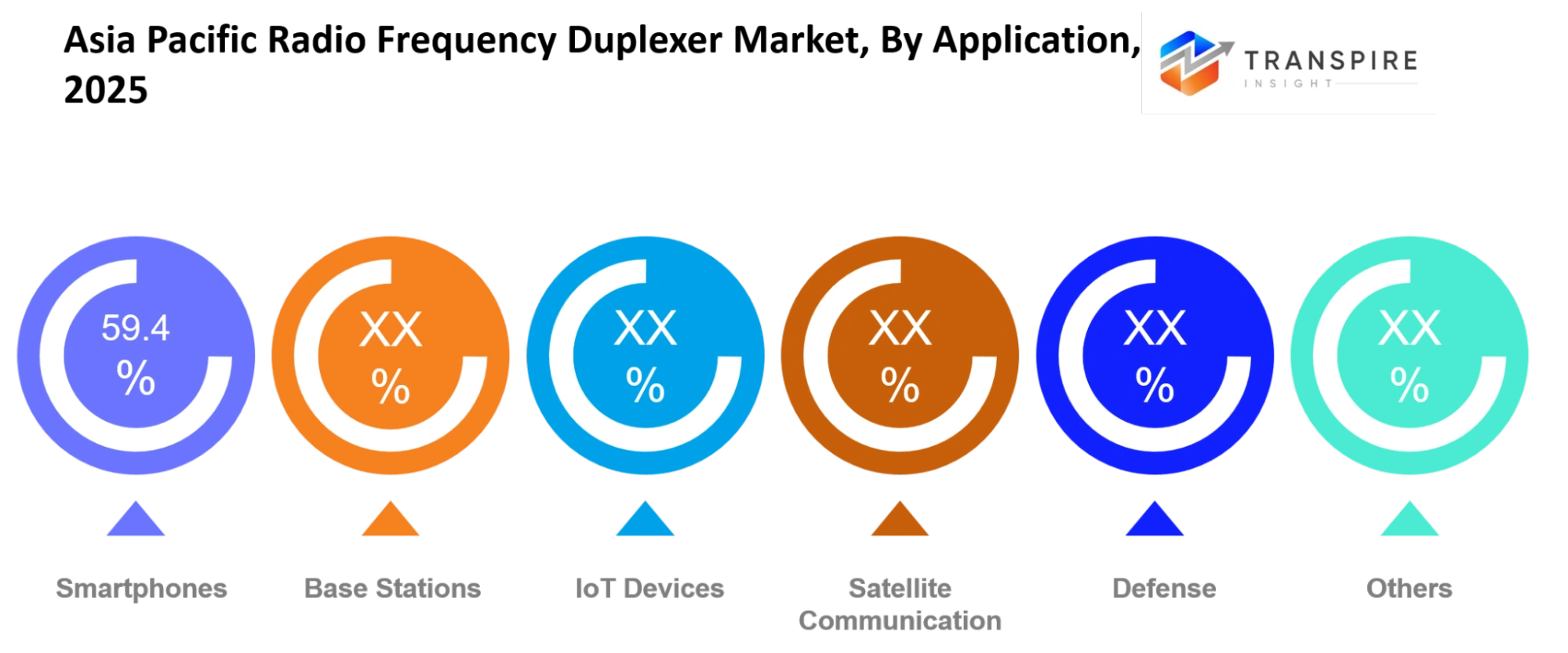
Smartphones account for the leading application, because each advanced mobile unit needs multiple filtering components to handle a lot of wireless bands. There are continuous product releases, and also shorter replacement cycles, which keeps production volumes looking healthy across different regional manufacturing hubs. Base stations too feel like a big application area as telecom operators extend coverage and try to enhance communication quality. With stable infrastructure spending in place, long term equipment buying tends to keep going across both developed and developing economies.
IoT devices will show the fastest expansion, since connected factories, healthcare systems, logistics networks, and smart city deployments need dependable wireless links. At the same time, satellite communication applications keep growing thanks to wider commercial connectivity efforts and the remote network reach programs. Defence communication systems continue with steady procurement, because secure and reliable signal transfer is still required for mission critical activities. And yeah, broader digital transformation throughout industries will open extra opportunities for advanced filtering technologies too.
By End User :
Telecom operators stay the biggest end-user group, since network expansion programmes need nonstop rollouts of wireless communication infrastructure. There is steady investment in 5G base stations and network modernisation, which keeps the procurement of advanced RF components fairly consistent. Consumer electronics manufacturers also add a lot of revenue via making smartphones, tablets, wearable devices, and various connected consumer products. Product innovation keeps pushing demand for compact yet efficient communication hardware, even when timelines get tight.
Automotive manufacturers will likely show up as one of the fastest-growing end-user categories, because connected vehicles rely on dependable wireless communication across several use cases at once. Aerospace and defence organisations keep purchasing activity rather stable through secure communication upgrades, and advanced surveillance systems too. At the same time, industrial digitalisation and intelligent transportation projects go on creating fresh commercial chances across regional markets. Overall, long-term infrastructure investment should help wider technology adoption, across multiple industries, over time.
By Technology :
5G techs kind of end up leading the technology segment, simply because the higher network capacity and wider spectrum utilisation call for more advanced duplexing methods with better filtering performance. The 4G LTE infrastructure that already exists is still doing its job too, it keeps supporting real equipment demand across multiple countries where network upgrades remain underway, more or less. And then Wi‑Fi technologies help push market expansion as deployment grows for connected consumer and enterprise devices, not just one side. Meanwhile, the ongoing communication improvements keep pushing continuous product development, plus more manufacturing investment, which is pretty typical.
Satellite communication technology should see even stronger growth though, especially as governments and private organisations roll out regional connectivity programmes. Research into future wireless standards keeps motivating work on compact, highly efficient RF components that can handle additional frequency bands. At the same time, manufacturers keep spending on upgraded materials, better production methods, and improved integration techniques, so they can meet what future communication demands will look like. Strong collaboration between semiconductor suppliers and equipment manufacturers will also likely back long term technological progress.
What are the Key Use Cases Driving the Asia Pacific Radio Frequency Duplexer Market?
Smartphones basically stay as the main use case, since every multi-band device kinda needs solid signal separation so voice and data keep running without interruptions. Consumer electronics makers tend to buy huge batches of radio frequency duplexers, partly because it helps keep the design compact, improves network quality, and also keeps things working across several 4G and 5G frequency bands. Because of that, this particular application keeps showing up as the biggest procurement driver across the main regional production hubs, pretty consistently.
At the same time, base stations and industrial IoT setups are moving more deeply into key application areas. Telecom operators are looking for more advanced duplexers, to squeeze better spectrum efficiency as 5G coverage keeps growing, and in parallel manufacturing plants are rolling out private wireless networks to back automated production, connected machinery, and real-time monitoring , without stepping on each other's signals, if that makes sense.
And then there are newer directions that are starting to take shape in satellite communication, plus connected vehicle platforms. In satellite, commercial operators need compact, high-performance filtering components so broadband service stays dependable. Meanwhile, automotive companies are also embedding more capable wireless communication systems for connected mobility initiatives and intelligent transportation projects, which are expected to keep expanding during the whole forecast period.
|
Report Metrics |
Details |
|
Market size value in 2025 |
USD 2.28 Billion |
|
Market size value in 2026 |
USD 2.54 Billion |
|
Revenue forecast in 2033 |
USD 5.51 Billion |
|
Growth rate |
CAGR of 11.70% from 2026 to 2033 |
|
Base year |
2025 |
|
Historical data |
2021 - 2024 |
|
Forecast period |
2026 - 2033 |
|
Report coverage |
Revenue forecast, competitive landscape, growth factors, and trends |
|
Regional scope |
Asia Pacific (India, China, Japan, Australia, South Korea, Rest of Asia Pacific) |
|
Key company profiled |
Murata Manufacturing, Qorvo, Skyworks Solutions, Broadcom, TDK Corporation, Taiyo Yuden, Qualcomm, Samsung Electro-Mechanics, Kyocera AVX, Qualcomm RF360, Knowles Precision Devices, Nokia, Ericsson, Infineon Technologies, Huawei. |
|
Customization scope |
Free report customization (country, regional & segment scope). Avail customized purchase options to meet your exact research needs. |
|
Report Segmentation |
By Duplexer Type (Cavity Duplexers, Ceramic Duplexers, SAW Duplexers, BAW Duplexers, Hybrid Duplexers, Others); By Frequency Band (Low Band, Mid Band, High Band, mmWave, Others); By Application (Smartphones, Base Stations, IoT Devices, Satellite Communication, Defense, Others); By End User (Telecom Operators, Consumer Electronics Manufacturers, Aerospace & Defense, Automotive, Others); By Technology (4G LTE, 5G, Wi-Fi, Satellite Communication, Others). |
Which Regions are Driving the Asia Pacific Radio Frequency Duplexer Market Growth?
China takes the biggest slice of regional revenue, about 46% of the market . With steady government support for semiconductor manufacturing, plus big scale 5G rollout, and ongoing spectrum allocation, the conditions for RF component production look pretty favourable . There’s also that mature ecosystem around device manufacturers, telecom equipment suppliers, and domestic component producers that kind of reinforces local sourcing and speeds up product development. Ongoing money into advanced wireless infrastructure and semiconductor capacity should keep the regional edge alive across the forecast timeline .
Japan still shows up as a solid revenue contributor, mostly because research investment stays consistent and industrial policies remain relatively stable . That means long-term technology development keeps moving forward rather than doing frantic, rapid capacity expansion . Consumer electronics output, automotive electronics, and higher-value communication equipment bring dependable pull for precision RF components. Strict quality standards then push continuous improvement and back those premium manufacturing capabilities. And the relationships between component suppliers and equipment manufacturers stay strong so procurement is steadier across multiple industries.
India is becoming the fastest-growing regional market because recent telecom infrastructure expansion, production linked incentive programmes, and domestic electronics manufacturing investments have really sped up component demand in the last while. More broad 5G network rollout, plus new semiconductor initiatives , have also boosted confidence among global manufacturers who are looking for alternative production locations. Meanwhile, expanding smartphone manufacturing and industrial digitalisation are still paving the way for fresh commercial openings for RF component suppliers.Overall, growth from 2026 to 2033 should bring solid chances for manufacturers and investors who want long-term expansion, especially through local production and strategic partnerships.
Who are the Key Players in the Asia Pacific Radio Frequency Duplexer Market and How Do They Compete?
Competition is still somewhat consolidated, mainly because only a relatively small set of specialised RF component manufacturers have the advanced design know how and the production know what it takes to deliver high performance duplexers. In general, technology innovation stays as the core reason companies can compete, then comes manufacturing scale, plus those long term supply ties with smartphone and telecom equipment producers. The well established players keep trying to hold market share via nonstop research spending, whereas the smaller technology firms show up with specialised solutions that match new wireless use cases.
Murata Manufacturing leans into miniaturised RF filtering technologies, it helps sharpen signal quality while also making the component size smaller, which matters a lot for advanced smartphones and connected devices. Qorvo on the other hand differentiates through high performance bulk acoustic wave technology, this supports higher frequency applications in premium mobile devices, as well as advanced wireless infrastructure. Skyworks Solutions strengthens its stance by building integrated RF front end modules , so device designers get it easier, and the overall communication performance improves too.
Broadcom pushes forward with advanced filtering technologies meant for complicated multi band communication systems, this gives equipment manufacturers higher integration levels and better spectrum efficiency. TDK invests in materials innovation as well as manufacturing upgrades, those two things improve product reliability, especially in harsh communication settings. Regional expansion, continuous product development, and staying close with telecom equipment manufacturers , helps these firms secure long term supply agreements while still adapting quickly when wireless requirements shift.
Company List
- Murata Manufacturing
- Qorvo
- Skyworks Solutions
- Broadcom
- TDK Corporation
- Taiyo Yuden
- Qualcomm
- Samsung Electro-Mechanics
- Kyocera AVX
- Qualcomm RF360
- Knowles Precision Devices
- Nokia
- Ericsson
- Infineon Technologies
- Huawei
Recent Development News
In May 2026, Qorvo announced new RF product launches and live technology demonstrations at IMS 2026. The expanded portfolio highlighted advanced RF solutions for wireless infrastructure, satellite communications, IoT, and next-generation networks, strengthening technology options for high-frequency duplexer applications across Asia Pacific.
Source: https://www.everythingrf.com/
In March 2026, Forefront RF unveiled the industry's first commercial low-band tunable duplexer at Mobile World Congress 2026. The launch introduced a software-tunable duplexer architecture designed to improve spectrum flexibility and reduce RF front-end complexity, supporting future multi-band wireless devices.
Source: https://www.forefrontrf.com/
What Strategic Insights Define the Future of the Asia Pacific Radio Frequency Duplexer Market?
In the Asia Pacific Radio Frequency Duplexer Market, things are drifting toward a more specialised, kind of performance led setup, with expanding 5G standalone deployments doing a lot of the heavy lifting, plus early 6G research and this growing weaving together of connected devices across industrial and everyday consumer uses. Going forward, competition should lean less on sheer production scale and more on advanced filter performance , better power efficiency, and solid compatibility with those higher frequency spectrum ranges.
There is also a risk that isn’t always obvious, the kind you only notice after, with the rising concentration of essential material supplies and specialised semiconductor manufacturing. That situation can end up making manufacturers face pricing volatility and potential supply disruptions, even if demand looks favourable.
At the same time, an opportunity is starting to show itself, mainly through customised duplexers for private 5G networks, aimed at smart manufacturing, ports, and logistics sites across Southeast Asia. There, the money for digital infrastructure keeps moving up, and that momentum matters.
Market players should probably tighten their collaborations with regional semiconductor foundries, and also invest in application specific product development, not just for the performance side, but to boost supply resilience while keeping pace with changing wireless communication requirements.
Asia Pacific Radio Frequency Duplexer Market Report Segmentation
By Duplexer Type
- Cavity Duplexers
- Ceramic Duplexers
- SAW Duplexers
- BAW Duplexers
- Hybrid Duplexers
By Frequency Band
- Low Band
- Mid Band
- High Band
- mmWave
By Application
- Smartphones
- Base Stations
- IoT Devices
- Satellite Communication
- Defense
By End User
- Telecom Operators
- Consumer Electronics Manufacturers
- Aerospace & Defense
- Automotive
By Technology
- 4G LTE
- 5G
- Wi-Fi
- Satellite Communication
Frequently Asked Questions
Find quick answers to common questions.
The expected Asia Pacific Radio Frequency Duplexer Market size for the market will be USD 5.51 Billion in 2033.
Key segments for the Asia Pacific Radio Frequency Duplexer Market are By Duplexer Type (Cavity Duplexers, Ceramic Duplexers, SAW Duplexers, BAW Duplexers, Hybrid Duplexers, Others); By Frequency Band (Low Band, Mid Band, High Band, mmWave, Others); By Application (Smartphones, Base Stations, IoT Devices, Satellite Communication, Defense, Others); By End User (Telecom Operators, Consumer Electronics Manufacturers, Aerospace & Defense, Automotive, Others); By Technology (4G LTE, 5G, Wi-Fi, Satellite Communication, Others).
Major Asia Pacific Radio Frequency Duplexer Market players are Murata Manufacturing, Qorvo, Skyworks Solutions, Broadcom, TDK Corporation, Taiyo Yuden, Qualcomm, Samsung Electro-Mechanics, Kyocera AVX, Qualcomm RF360, Knowles Precision Devices, Nokia, Ericsson, Infineon Technologies, Huawei.
The Asia Pacific Radio Frequency Duplexer Market size is USD 2.28 Billion in 2025.
The Asia Pacific Radio Frequency Duplexer Market CAGR is 11.70% from 2026 to 2033.
- Murata Manufacturing
- Qorvo
- Skyworks Solutions
- Broadcom
- TDK Corporation
- Taiyo Yuden
- Qualcomm
- Samsung Electro-Mechanics
- Kyocera AVX
- Qualcomm RF360
- Knowles Precision Devices
- Nokia
- Ericsson
- Infineon Technologies
- Huawei
About the Authors

Avinash Kumar
I’m Avinash Kumar, a Senior Research Analyst at Transpire Insight, with expertise in the Electronics and Semiconductor and Energy & Power industry. My work focuses on analyzing emerging technologies, market trends, industry developments, and innovation across these sectors. I specialize in transforming complex technical and market insights into clear, research-backed content that helps professionals, businesses, and decision-makers stay informed. Through continuous industry research and data-driven analysis, I strive to deliver accurate, reliable, and practical perspectives on the latest advancements shaping the semiconductor and energy landscape.

Chakradhar Khansole
Chakradhar serves as the Research Director at Transpire Insight, bringing over 8 years of experience in technology, innovation, and strategic market intelligence. He specializes in transforming complex market data into actionable business insights that enable organizations to make informed, growth-oriented decisions. Recognized for his strategic vision and analytical expertise, Chakradhar leads high-impact research initiatives, delivering comprehensive market assessments, competitive intelligence, and forward-looking industry analysis.
Recently Published Reports
-
Apr 2026
Fiber Optic Faceplates Market
Fiber Optic Faceplates Market Size, Share & Analysis Report By Type (< 300 mm2, 300-350 mm2, and > 350 mm2, By Application (Night Vision, Holographic Imaging, Medical, and Others), and Geography (North America, Europe, Asia-Pacific, Middle East and Africa, South and Central America), 2021 - 2031
-
Apr 2026
High Temperature Superconductors Market
High Temperature Superconductors Market Size, Share & Analysis Report By Type (1G HTS, and 2G HTS), By Application (Power Cable, Fault Current Limiter, and Transformer), and Geography (North America, Europe, Asia-Pacific, Middle East and Africa, South and Central America), 2021 - 2031
-
Apr 2026
Industrial Plugs and Socket Market
Industrial Plugs and Socket Market Size, Share & Analysis Report By Type (Industrial Plugs, Industrial Sockets), By Current (Up to 32 A, 32 to 125 A, Above 125 A), By Protection (Dustproof and Splash Proof, Waterproof, Explosion Proof), By End User (Heavy Industries, Oil and Gas, Chemicals and Pharmaceuticals, Power Generation, Others), and Geography (North America, Europe, Asia-Pacific, Middle East and Africa, South and Central America), 2021 - 2031
-
Apr 2026
InGaAs Avalanche Photodiodes Market
InGaAs Avalanche Photodiodes Market Size, Share & Analysis Report By Type (1100 - 1700 nm, and 1000 - 1600 nm), By Application (Missile Warning System, Muzzle Flash Detection, Wafer Defect Inspection, Laser Rangefinders, and Others), and Geography (North America, Europe, Asia-Pacific, Middle East and Africa, South and Central America), 2021 - 2031