

United States Industrial Automation Market Size & Forecast:
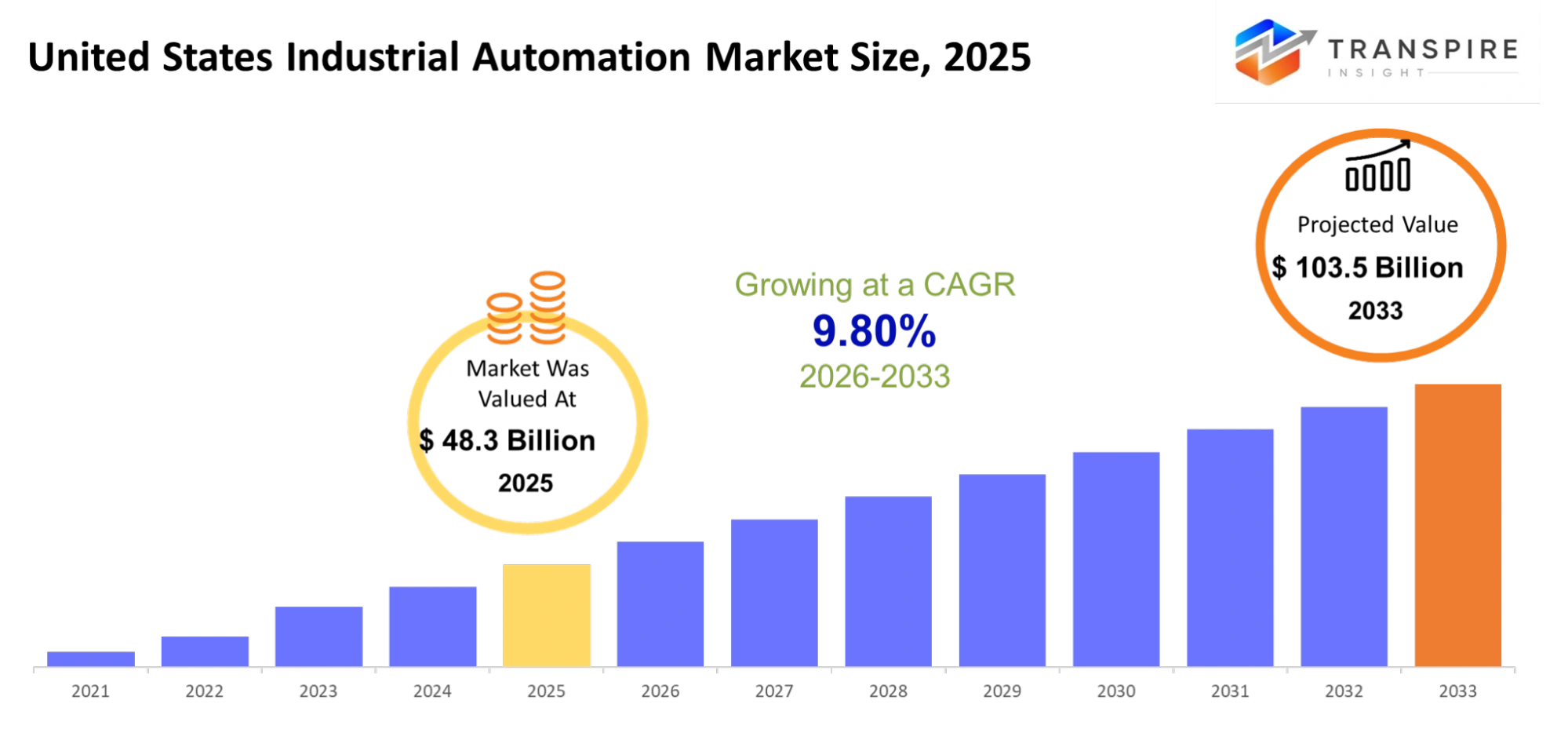
- United States Industrial Automation Market Size 2025: USD 48.3 Billion
- United States Industrial Automation Market Size 2033: USD 103.5 Billion
- United States Industrial Automation Market CAGR: 9.80%
- United States Industrial Automation Market Segments:By Type (PLC, DCS, SCADA, Robotics, Sensors, Drives, HMI), By Application (Manufacturing, Oil & Gas, Power, Automotive, Food & Beverage, Pharma, Chemicals), By Technology (AI, IoT, Robotics, Machine Vision, Digital Twin, Edge, Cloud), By End-User (Industrial, Automotive, Energy, Electronics, Pharma, Food, Utilities), By Component (Hardware, Software, Services, Platforms, Controllers, Interfaces, Systems).
To learn more about this report,  Download Free Sample Report
United States Industrial Automation Market Summary:
The United States industrial automation market shows continuous expansion because manufacturing industries require better efficiency and precision and cost savings solutions. Businesses now implement cutting-edge technologies which include robotics and artificial intelligence and IoT systems to improve their workflows and boost their operational efficiency. The demand for intelligent manufacturing facilities and digital transformation initiatives continues to grow. The combination of labor shortages and increased operational expenses drives businesses to invest in automation systems which have become essential for industrial progress in the nation.
Key Market Trends & Insights:
- Organizations are starting to adopt smart factories which operate with connected devices and use real-time data. The new operational methods enable businesses to enhance their decision-making processes while decreasing equipment failures and developing adaptable manufacturing operations.
- Robots have expanded beyond their traditional role in automotive manufacturing plants. They now operate in various industries which include electronics and food processing. The technology enables robots to execute repetitive tasks with accuracy which leads to increased productivity and steady performance.
- The shortage of skilled workers has caused companies to increase their investments in robotics technology. Automation systems enable businesses to solve their labour shortages while they maintain 24-hour production schedules which deliver high-quality outcomes.
- Manufacturers are selecting energy-efficient automation technologies because they help decrease operational expenses while supporting sustainability objectives. The current trend leads to the creation of advanced systems which protect the environment.
- The industrial sector needs cloud platforms as fundamental tools for processing and organising its extensive data resources. The platforms provide businesses with two essential features which enable their automation systems to achieve both better operational capacity and system control.
- Businesses are adopting flexible automation systems which allow them to modify their operations according to their current product requirements. Customisation has become a critical factor for companies that want to maintain their competitive position in their respective markets.
United States Industrial Automation Market Segmentation
By Type
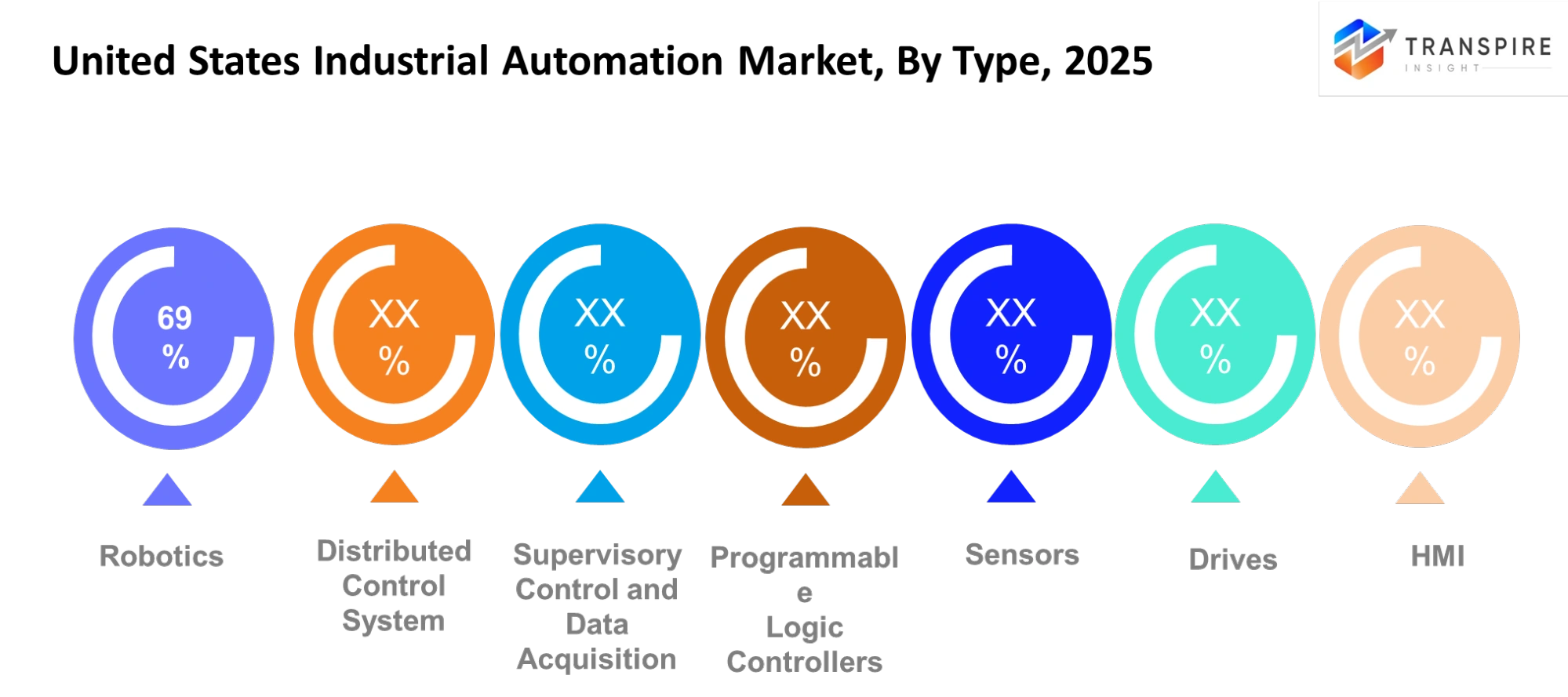
- Programmable Logic Controllers (PLC): Industrial automation depends on PLC systems as essential components which provide dependable equipment and process control capabilities. The system offers manufacturers who need to maintain production output through immediate equipment changes and brief operational interruptions the ability to drive their operations.
- Distributed Control System (DCS): The power and chemical industries currently implement DCS systems which serve as standard solutions to manage their industrial operations. The system provides a central point for monitoring while allowing multiple facilities to operate their processes which results in improved safety and better operational performance.
- Supervisory Control and Data Acquisition (SCADA): SCADA systems provide operators with live system performance information and the ability to control industrial operations from remote locations. The systems enable operators to manage extensive industrial setups while they monitor system performance and detect faults which allows them to manage utilities and infrastructure operations effectively.
- Robotics: Industrial robots create advantages for production facilities because they deliver faster results with greater precision and more dependable performance. The use of robotics technology from assembly processes to packaging work enables manufacturing facilities to achieve higher production levels while decreasing operational mistakes.
- Sensors: Sensors serve an essential function because they collect current information about machinery and their surrounding environment. The system enables better decision-making through temperature and pressure and motion detection, which helps organisations to implement predictive maintenance and process optimisation strategies.
- Drives: Drives function as fundamental components which enable automated systems to regulate their motor operations through various speed control methods and energy usage management techniques. The system enables organisations to achieve operational excellence while decreasing their energy expenses, which leads to greater value for companies that pursue eco-friendly practices and operational efficiency.
- HMI (Human Machine Interface) : HMI provide operators with an easy method to control machines while viewing machine status. The system uses clear real-time data presentation to make complex processes easier to operate, which results in better user experience and operational performance.
To learn more about this report, Download Free Sample Report
By Application
- Manufacturing: Automation in manufacturing improves productivity while it decreases operational mistakes. Smart systems create efficient workflows which enhance product quality and enable businesses to provide tailored products for their needs.
- Oil & Gas: Automation protects workers while it makes extraction operations safer in oil and gas production areas. The system enables operators to monitor activities in real-time while it minimizes their need for manual work and allows them to perform preventive maintenance on essential systems.
- Power: Automation in the power industry controls all aspects of electricity generation and transmission and distribution operations. The system enhances grid stability because it manages electricity distribution and enables the use of renewable power resources.
- Automotive: The automotive industry depends on automation to perform all steps of assembly and painting and inspection work. The system delivers exact results and keeps production processes uniform while it accelerates output to meet vehicle quality needs of increasing customer demand.
- Food & Beverage: Automation enables food production to achieve hygienic operations and maintain product uniformity while operating at maximum efficiency. The system enables organisations to maintain their quality requirements while processing and packaging products at higher speeds to satisfy customer needs.
- Pharma: The pharmaceutical industry uses automation technology to ensure it meets all required regulatory compliance standards. The system improves production accuracy while it decreases contamination chances and provides complete manufacturing process traceability.
- Chemicals: Automation technology in chemical production facilities enhances worker protection and improves operational efficiency. The system enables operators to control dangerous chemical reactions while they establish stable operating conditions and decrease dangerous material handling hazards.
By Technology
- AI (Artificial Intelligence) : The AI system uses its ability to analyze extensive data sets for building automated systems which can forecast future events. The system delivers three main industrial functions through its predictive maintenance and quality control and process optimization capabilities which enable businesses to enhance their operations.
- IoT (Internet of Things): The Internet of Things system establishes links between machines and devices to create a system which enables immediate data transmission. The system provides industrial operations with enhanced visibility and better decision-making abilities and complete operational integration through its connectivity features.
- Robotics : The field of robotics has developed new technologies which allow machines to operate with improved accuracy and flexible control. The system enables businesses to use automation for complex work while decreasing their need for human resources and increasing their production output.
- Machine Vision: Machine vision systems enable automated inspection and quality control. The systems achieve high detection accuracy for defects, which helps maintain product quality standards and decreases waste during manufacturing operations.
- Digital Twin : The digital twin technology creates digital copies of physical systems which exist in real life. The system enables businesses to test their operations and forecast results and enhance their processes without interrupting actual production activities.
- Edge Computing: Edge computing brings data computation closer to its original location, which results in reduced waiting times and enhanced system performance. The system enables industries to make instant decisions during their most critical operational times.
- Cloud Computing: Cloud platforms offer businesses the ability to expand their storage capacity through cloud-based data solutions and data analysis tools. The system enables users to monitor systems from a distance while working together with others to manage complex automated systems effectively.
By End-User
- Industrial: The complete industrial sector utilizes automation systems to achieve higher productivity levels while decreasing operational expenses. The system delivers operational success through its capability to handle different manufacturing and processing tasks.
- Automotive: Automotive companies utilize automation systems to achieve production processes which operate at higher accuracy and faster processing speeds. The system maintains product quality during manufacturing operations which require extensive output to be produced.
- Energy: Automation systems assist the energy sector because they help control resources while they enhance operation efficiency. The system maintains electrical grid stability while establishing improved methods for incorporating renewable energy resources.
- Electronics: Electronics manufacturing uses automation systems to achieve exactness and stable performance throughout its sensitive manufacturing procedures. The system enables manufacturers to produce high-quality small-sized advanced electronic devices which fulfill market needs.
- Pharma: Pharmaceutical companies depend on automation systems to achieve precise results which enable them to follow industry regulations. The system guarantees safe production operations while enforcing strict quality control procedures.
- Food: The food industry uses automation systems to achieve better operational performance and maintain sanitary conditions. The system enables factories to produce goods at a steady rate which meets both safety standards and customer requirements.
- Utilities: Utilities implement automation systems to handle their operations for water distribution and power supply and waste management systems. The system improves operational dependability while decreasing system outages and maintaining uninterrupted service operations.
By Component
- Hardware: Serving as an underlying physical requirement of automation systems, the hardware includes all the necessary machinery and devices that support the automation and automation process' functioning.
- Software: This software enables the control, monitoring, and management of automation systems. It provides data collection, which enhances the decision-making capabilities and the efficiency of the entire system.
- Service: What services bring us maintenance and support to automation systems. These steps ensure smooth installations and a lasting industrial solution.
- Platform: Various assets for automation are now being combined for seamless operation through a single platform. Hence, the platform improves coordination between different processes.
- Controllers: Controllers exercise control over industrial processes in a precise manner. They assure task completion flawlessly while keeping the system stable.
- Interfaces: Interfaces act as a connecting piece between human and machine. They render decision-makers operational insights in real time and make control operations considerably easier.
- System: Integrated systems clarify the interplay of various components in a system for operational enhancement, workflow simplification, and sophisticated automation functions across industries.
Country Insights
The United States industrial automation market demonstrates a developed market which experiences fast technological progress through its innovative research capacity. The country benefits from a well-established manufacturing base which industrial companies use to adopt automated systems that drive productivity improvements and help them compete in international markets. Industries apply advanced robotics together with AI-based systems to execute contemporary technological solutions which enhance their operational efficiency and increase their productivity levels.
The market experiences growth because the government provides financial support for digital transformation projects and smart manufacturing programs. The market makes continuous progress because major technology companies operate in the area and maintain their research development programs through their investments. The combination of labor shortages and increasing operational expenses drives companies to implement automation solutions at an accelerated rate. The U.S. market functions as a vital center for industrial automation which combines new technologies with real-world applications that serve multiple industries.
Recent Development News
In April 2026, the U.S. Navy invests $900M in automated submarine production: Facing labour shortages, the U.S. Navy is investing heavily in automated factories to speed up submarine production and reduce dependency on manual work.
In April 2026, AI and robots reshape U.S. shipbuilding operations: U.S. shipbuilding is entering a new era with AI-driven automation improving efficiency and reducing manual labour. This reflects growing reliance on robotics in heavy industries.
|
Report Metrics |
Details |
|
Market size value in 2025 |
USD 48.3 Billion |
|
Market size value in 2026 |
USD 53.8 Billion |
|
Revenue forecast in 2033 |
USD 103.5 Billion |
|
Growth rate |
CAGR of 9.80% from 2026 to 2033 |
|
Base year |
2025 |
|
Historical data |
2021 – 2024 |
|
Forecast period |
2026 – 2033 |
|
Report coverage |
Revenue forecast, competitive landscape, growth factors, and trends |
|
Country scope |
United States |
|
Key company profiled |
Siemens, ABB, Rockwell Automation, Schneider Electric, Honeywell, Emerson, Mitsubishi Electric, Omron, Bosch Rexroth, Yokogawa, GE, Fanuc, KUKA, Hitachi, Danaher |
|
Customization scope |
Free report customization (country, regional & segment scope). Avail customized purchase options to meet your exact research needs. |
|
Report Segmentation |
By Type (PLC, DCS, SCADA, Robotics, Sensors, Drives, HMI), By Application (Manufacturing, Oil & Gas, Power, Automotive, Food & Beverage, Pharma, Chemicals), By Technology (AI, IoT, Robotics, Machine Vision, Digital Twin, Edge, Cloud), By End-User (Industrial, Automotive, Energy, Electronics, Pharma, Food, Utilities), By Component (Hardware, Software, Services, Platforms, Controllers, Interfaces, Systems). |
Key United States Industrial Automation Company Insights
The United States industrial automation market is shaped by a mix of global leaders and innovative domestic companies which develop advanced smart manufacturing technologies. The companies maintain ongoing research and development initiatives to create automation systems that operate with greater efficiency and scalability and enhanced intelligent capabilities. Companies use strategic collaborations and product innovations through mergers to build their market presence. The industry players are now focusing their efforts on developing customized solutions which address the particular requirements of different industries. The competitive environment drives organizations to enhance their performance through ongoing research which leads to technological advancements while meeting the increasing demand for automation across various fields.
Company List
- Siemens
- ABB
- Rockwell Automation
- Schneider Electric
- Honeywell
- Emerson
- Mitsubishi Electric
- Omron
- Bosch Rexroth
- Yokogawa
- GE
- Fanuc
- KUKA
- Hitachi
- Danaher
United States Industrial Automation Market Report Segmentation
By Type
- PLC
- DCS
- SCADA
- Robotics
- Sensors
- Drives
- HMI
By Application
- Manufacturing
- Oil & Gas
- Power
- Automotive
- Food & Beverage
- Pharma
- Chemicals
By Technology
- AI
- IoT
- Robotics
- Machine Vision
- Digital Twin
- Edge
- Cloud
By End-User
- Industrial
- Automotive
- Energy
- Electronics
- Pharma
- Food
- Utilities
By Component
- Hardware
- Software
- Services
- Platforms
- Controller
- Interfaces
- Systems
Frequently Asked Questions
Find quick answers to common questions.
The approximate United States Industrial Automation Market size for the market will be USD 103.5 Billion in 2033.
The key segments of the United States Industrial Automation Market are By Type (PLC, DCS, SCADA, Robotics, Sensors, Drives, HMI), By Application (Manufacturing, Oil & Gas, Power, Automotive, Food & Beverage, Pharma, Chemicals), By Technology (AI, IoT, Robotics, Machine Vision, Digital Twin, Edge, Cloud), By End-User (Industrial, Automotive, Energy, Electronics, Pharma, Food, Utilities), By Component (Hardware, Software, Services, Platforms, Controllers, Interfaces, Systems).
Major players in the United States Industrial Automation Market are Siemens, ABB, Rockwell Automation, Schneider Electric, Honeywell, Emerson, Mitsubishi Electric, Omron, Bosch Rexroth, Yokogawa, GE, Fanuc, KUKA, Hitachi, Danaher.
The current market size of the United States Industrial Automation Market is USD 48.3 Billion in 2025.
The United States Industrial Automation Market CAGR is 9.80%.
- Siemens
- ABB
- Rockwell Automation
- Schneider Electric
- Honeywell
- Emerson
- Mitsubishi Electric
- Omron
- Bosch Rexroth
- Yokogawa
- GE
- Fanuc
- KUKA
- Hitachi
- Danaher
Recently Published Reports
-
Apr 2026
3D Optical Profiler Market
3D Optical Profiler Market Size, Share & Analysis Report By Type (Desktop 3D Optical Profiler, and Portable 3D Optical Profiler), By Technology (Confocal Technology, and White Light Interference), By End-Use Industry (Manufacturing, Research Institutions, Automotive, Aerospace and Defense, Medical Devices, and Other), and Geography (North America, Europe, Asia-Pacific, Middle East and Africa, South and Central America), 2021 - 2031
-
Apr 2026
Depth Sensor Market
Depth Sensor Market Size, Share & Analysis Report By Type (Infrared Depth Sensors, Time-of-Flight (ToF) Sensors, Stereo Vision Sensors, Structured Light Sensors, Ultrasonic Depth Sensors), By Application (Automotive, Robotics, Gaming, Consumer Electronics, Industrial Automation, Healthcare, Security & Surveillance, Others), By End Users (Automotive Manufacturers, Consumer Electronics Companies, Healthcare Providers, Industrial Companies, Security Agencies, Gaming Companies, Robotics Companies, Others), and Geography (North America, Europe, Asia-Pacific, Middle East and Africa, South and Central America), 2021 – 2031
-
Apr 2026
Digital Manufacturing Market
Digital Manufacturing Market Size, Share & Analysis Report By Component (Hardware, Software, and Services), By Technology (Robotics, 3D Printing, Internet of Things (IoT), and Others), By Application (Automotive and Transportation, Aerospace and Defense, Consumer Electronics, Industrial Machinery, and Others), By Process Type (Computer-Based Designing, Computer-Based Simulation, Computer 3D Visualization, Analytics, and Others), and Geography (North America, Europe, Asia-Pacific, Middle East and Africa, South and Central America), 2021 – 2031
-
Apr 2026
Digital Visa Services Market
Digital Visa Services Market Size, Share & Analysis Report By Type (Individual Travelers, Group Travelers), By Application (Tourism, Business Travel, Others), and Geography (North America, Europe, Asia-Pacific, Middle East and Africa, South and Central America), 2021 – 2031