

Asia Pacific Product Engineering Services Market Size & Forecast:
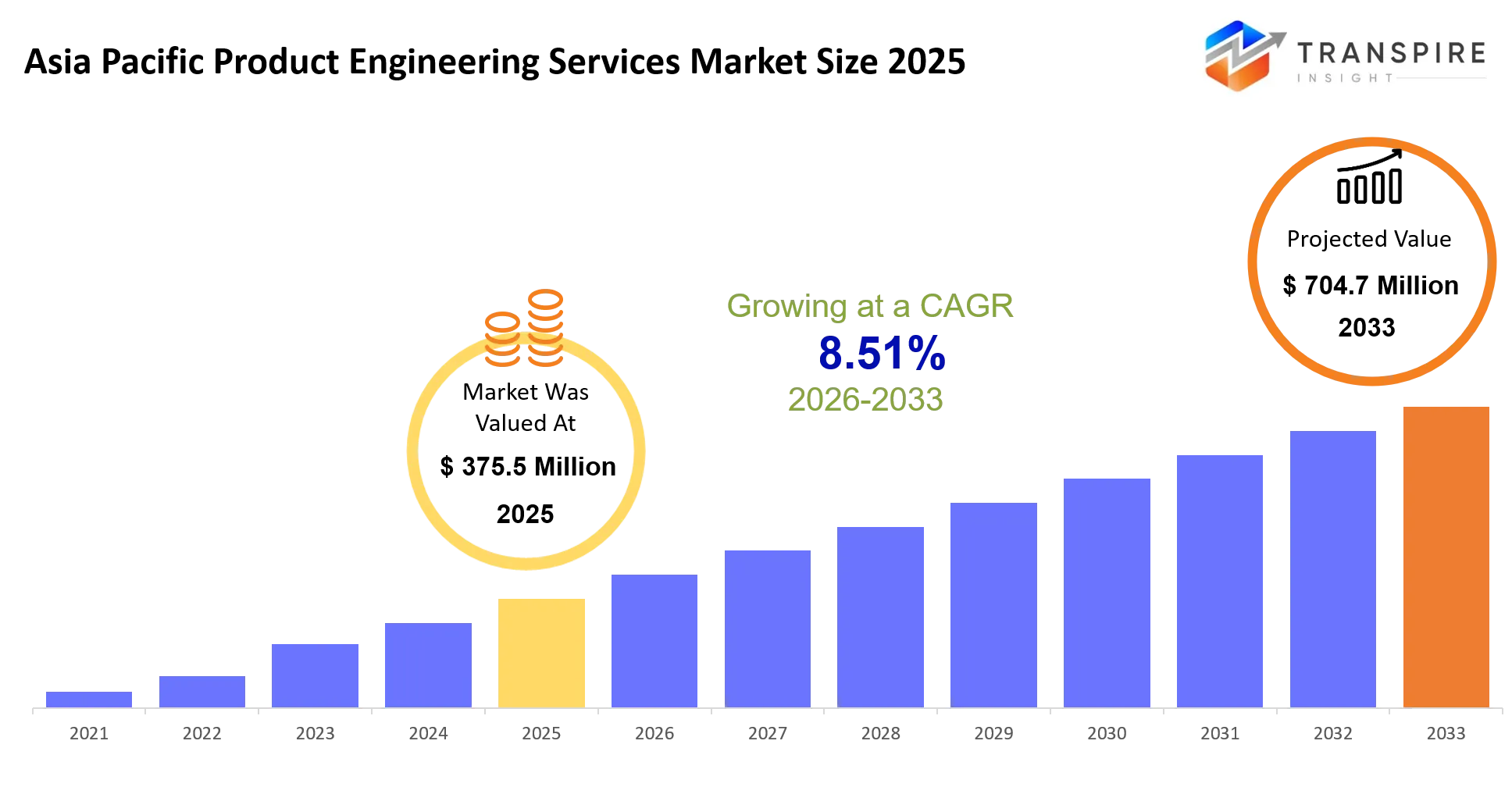
- Asia Pacific Product Engineering Services Market Size 2025: USD 375.5 Million
- Asia Pacific Product Engineering Services Market Size 2033: USD 704.7 Million
- Asia Pacific Product Engineering Services Market CAGR: 8.51%
- Asia Pacific Product Engineering Services Market Segments: By Service Type (Product Design, Prototyping, Testing Services, Embedded Engineering, Mechanical Engineering, Software Engineering, IoT Engineering, Others); By Deployment (Onshore, Offshore, Hybrid Delivery, Dedicated Teams, Cloud Engineering, Agile Engineering, Managed Services, Others); By Application (Automotive, Healthcare, Industrial Equipment, Consumer Electronics, Aerospace, Telecom, Energy, Others); By End User (OEMs, Startups, Enterprises, Manufacturing Companies, Healthcare Firms, Automotive Companies, Technology Providers, Others)
Asia Pacific Product Engineering Services Market Summary
The Asia Pacific Product Engineering Services Market was valued at USD 375.5 Million in 2025. It is forecast to reach USD 704.7 Million by 2033. That is a CAGR of 8.51% over the period.
The Asia Pacific Product Engineering Services Market helps companies turn ideas into commercially viable products faster by combining product design, embedded systems, software development, testing, digital engineering, and lifecycle management services. Manufacturers, automotive firms, telecom providers, industrial equipment companies, and medical device producers rely on these services to shorten development timelines while controlling engineering costs and improving product performance. Over the last five years, the market has shifted from labor-based outsourcing toward platform-driven, software-centric engineering, where AI, cloud technologies, and connected products are integrated from the earliest design stages. The pandemic-era supply chain disruptions also reshaped engineering priorities by exposing vulnerabilities in globally distributed product development models and accelerating digital collaboration investments. This transition is driving growth because companies are redesigning products to be smarter, connected, and continuously upgradable rather than static assets. As a result, engineering partners are becoming long-term innovation collaborators, creating recurring revenue opportunities through product lifecycle support, analytics, and continuous software enhancements.
Key Market Insights
- India dominates the Asia Pacific Product Engineering Services Market with approximately 30-35% market share in 2025 due to its large engineering workforce and established delivery ecosystem.
- Southeast Asia is projected to be the fastest-growing regional market through 2030, supported by manufacturing relocation and foreign direct investments.
- China maintains a significant share because of its strong automotive, industrial automation, and consumer electronics manufacturing capabilities.
- Software engineering leads the market with nearly 28-30% share in 2025, driven by software-defined products and cloud-native development models.
- Embedded engineering represents the second-largest segment as intelligent devices and connected industrial systems become mainstream.
- IoT engineering is expected to be the fastest-growing segment between 2025 and 2030 due to expanding edge computing and sensor integration projects.
- Automotive applications dominate with approximately 25-28% market share, supported by electric vehicle and connected mobility development programs.
- Healthcare and medical device engineering is emerging as the fastest-growing application segment due to digital diagnostics adoption.
- Industrial manufacturing continues expanding engineering investments to modernize legacy products and improve operational efficiency.
- Manufacturing enterprises lead with nearly 32-35% share in 2025 as companies accelerate product digitization initiatives.
What are the Key Drivers, Restraints, and Opportunities in the Asia Pacific Product Engineering Services Market?
The transition toward software-defined products across automotive, industrial manufacturing, telecommunications, and healthcare sectors. This shift was triggered by the rapid adoption of AI, cloud computing, IoT, and connected devices that require continuous software updates throughout a product's lifecycle. Companies can no longer rely on one-time product launches because customers now expect regular feature enhancements, predictive maintenance capabilities, and seamless digital experiences. As a result, enterprises increasingly outsource engineering functions to specialized partners, creating recurring revenue streams that extend beyond initial product development.
The most significant structural barrier is the shortage of highly specialized engineering talent capable of integrating software, hardware, AI, cybersecurity, and cloud technologies into a single development ecosystem. This challenge cannot be resolved quickly because building multidisciplinary expertise requires years of training and practical experience. The talent gap delays project execution, raises labor costs, and limits the ability of service providers to scale large, complex engineering programs, ultimately suppressing revenue potential across the market.
A major future opportunity lies in digital twin adoption across Southeast Asia's expanding manufacturing sector. Countries such as Vietnam, Indonesia, and Thailand are attracting global manufacturers seeking supply chain diversification. Digital twin technologies enable companies to simulate product performance before physical production begins, reducing development costs and shortening time-to-market. Engineering service providers that combine AI, cloud platforms, and digital twin capabilities will be well positioned to capture the next phase of regional growth.
What Has the Impact of Artificial Intelligence Been on the Asia Pacific Product Engineering Services Market?
Artificial intelligence and advanced digital technologies are transforming the Asia Pacific Product Engineering Services Market by changing how companies design, test, monitor, and optimize products throughout their lifecycle. Engineering service providers increasingly deploy AI-powered automation to manage software testing, embedded control systems, digital twins, and product performance monitoring across automotive, industrial equipment, telecommunications, and healthcare applications. Automated engineering platforms can identify design flaws, generate code suggestions, and continuously monitor connected products, reducing development cycles and improving operational efficiency.
Machine learning models are also strengthening predictive capabilities. Companies use AI algorithms to forecast equipment failures, optimize product performance, and analyze real-time operational data collected from IoT-enabled devices. In manufacturing environments, predictive maintenance solutions can reduce unplanned downtime by 20% to 30%, while AI-assisted quality inspection systems improve defect detection accuracy and minimize production losses. Digital twin technology further enables engineers to simulate product behavior before physical deployment, reducing prototyping costs and accelerating time-to-market.
These technologies are generating measurable operational benefits, including lower maintenance costs, faster product releases, improved asset utilization, and stronger regulatory compliance for connected products. However, a major limitation remains the high cost of integrating AI into legacy engineering environments. Many organizations still operate fragmented data systems, making it difficult to train accurate machine learning models and scale AI deployments consistently across multiple product development teams.
Key Market Trends
- Since 2021, manufacturers have shifted from one-time product development projects to continuous engineering models that support regular software updates and feature enhancements.
- Automotive companies accelerated investments in software-defined vehicles between 2022 and 2026, increasing demand for embedded engineering and cybersecurity expertise.
- Global manufacturers expanded engineering operations in Vietnam, Malaysia, and India after pandemic disruptions exposed overdependence on single-country supply chains.
- Since 2023, buyers have increasingly preferred outcome-based contracts instead of fixed-cost engagements to improve product launch predictability.
- Generative AI adoption expanded across engineering workflows after 2023, reducing software coding, testing, and documentation timelines by 20% to 40%.
- Industrial manufacturers increasingly adopted digital twin technologies to simulate product performance before production and reduce expensive physical prototyping cycles.
- Telecom companies intensified engineering investments after regional 5G deployments accelerated demand for network virtualization and cloud-native infrastructure.
- Major providers including Accenture, Infosys, HCLTech, Capgemini, and TCS expanded AI engineering platforms to differentiate beyond traditional outsourcing services.
- Cross-functional engineering teams have become standard since 2022, combining software, hardware, cybersecurity, and cloud expertise under unified delivery models.
- Product lifecycle analytics emerged as a strategic priority as enterprises increasingly monetize post-launch services instead of relying solely on hardware sales.
Asia Pacific Product Engineering Services Market Segmentation
By Service Type:
Product engineering services support complete product development cycles across digital and physical products. Software engineering holds a strong position because modern products require continuous updates, cybersecurity integration, and cloud connectivity. Embedded engineering also attracts significant investment due to growth in connected devices, smart factories, and electric vehicles. Mechanical engineering, prototyping, and testing services continue supporting faster product validation and improved quality control.
IoT engineering gains momentum as manufacturers connect sensors, analytics platforms, and edge computing capabilities into products. Cloud engineering and integrated software architectures create additional value by allowing remote monitoring and easier product management. Dedicated engineering teams also help enterprises reduce development timelines and improve resource utilization. Strong demand for multidisciplinary capabilities encourages service providers to combine software, hardware, analytics, and design expertise under unified delivery models.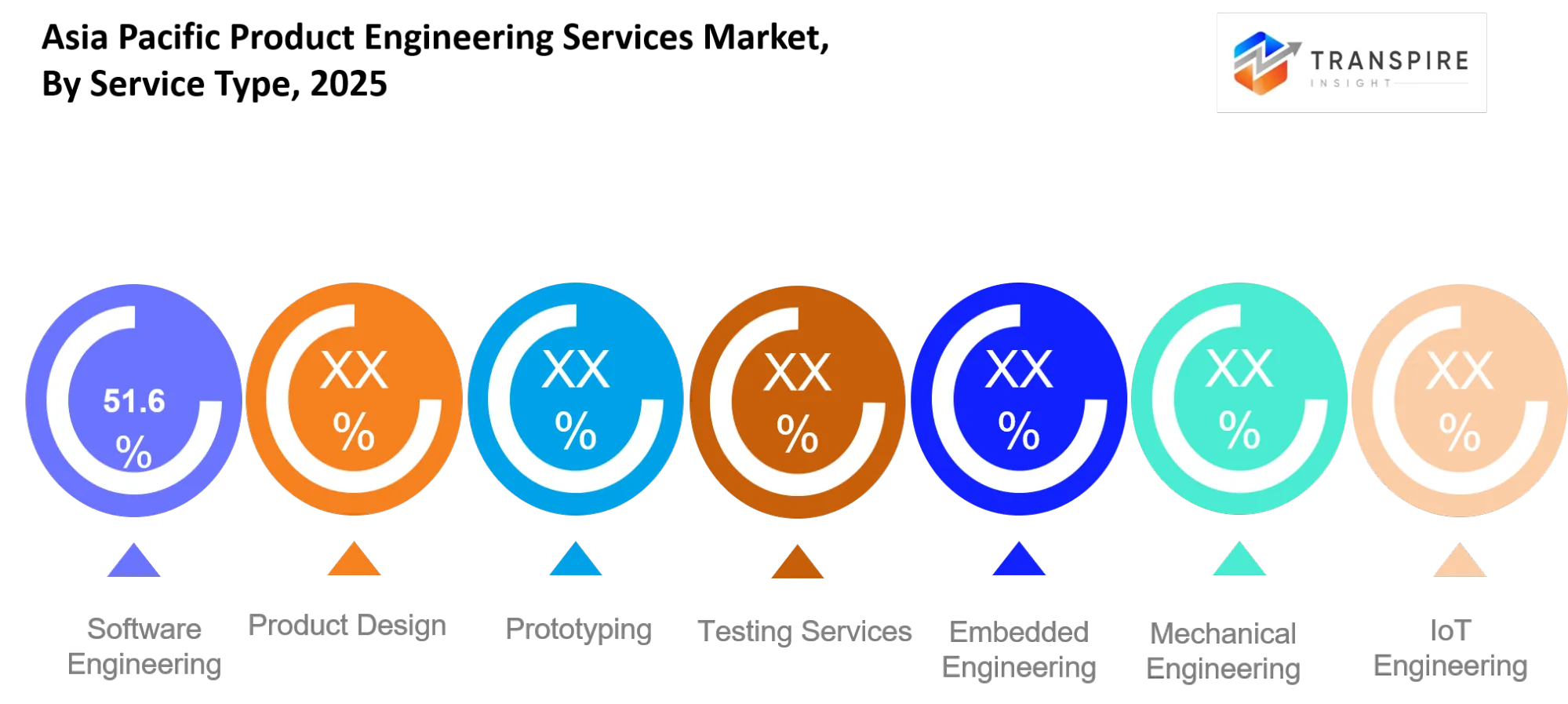
By Deployment:
Onshore deployment remains important for projects involving strict regulatory requirements, intellectual property protection, and close collaboration with internal engineering teams. Industries such as healthcare, aerospace, and telecommunications often prefer local engineering support for sensitive projects. Offshore deployment continues attracting organizations seeking cost optimization and access to large engineering talent pools. India maintains a leading position because of established engineering ecosystems and technical expertise.
Hybrid delivery models gain wider acceptance because hybrid structures balance operational efficiency with direct customer collaboration. Agile engineering frameworks strengthen project visibility and shorten product release cycles. Managed services also expand across long-term product lifecycle management projects because enterprises require continuous support after commercial launches. Dedicated engineering centers create stronger customer relationships and provide stable recurring revenue opportunities for service providers.
By Application:
Automotive applications occupy a leading position because software-defined vehicles, battery management systems, and connected mobility platforms require complex engineering support. Healthcare applications also expand steadily through digital diagnostics, wearable devices, and remote monitoring technologies. Industrial manufacturing organizations invest heavily in smart product development to improve operational efficiency. Telecommunications companies strengthen engineering investments through 5G infrastructure and network virtualization projects.
Consumer electronics manufacturers accelerate product launches to match shorter innovation cycles and changing customer expectations. Product lifecycle analytics also gain importance across multiple industries because performance data supports future upgrades and service improvements. Cloud-native architectures simplify product maintenance and feature deployment. Strong application diversity creates long-term opportunities across both mature and emerging industrial sectors.
By End User:
Manufacturing enterprises remain major contributors because smart factories depend on connected equipment, automation systems, and digital monitoring capabilities. Automotive companies also generate substantial engineering expenditure through electric vehicle programs and autonomous driving technologies. Telecommunications providers continue expanding engineering budgets because digital infrastructure modernization requires advanced technical support. Healthcare organizations increasingly depend on engineering expertise for connected medical devices and digital platforms.
Consumer electronics brands focus on faster innovation and shorter commercialization timelines. Energy and industrial infrastructure operators also adopt advanced engineering support to modernize aging assets. Long-term partnerships replace transactional project relationships because continuous product enhancement generates stronger business value. Greater emphasis on lifecycle management encourages sustained engagement between enterprises and engineering service providers.
What are the Key Use Cases Driving the Asia Pacific Product Engineering Services Market?
The primary use case centers on software-defined product development in the automotive industry. Vehicle manufacturers increasingly depend on engineering service providers to build embedded software, battery management systems, digital dashboards, and connected mobility platforms. This application generates the highest demand because vehicles now require continuous software upgrades throughout their lifecycle.
Healthcare and industrial manufacturing represent important expanding applications. Medical device companies use engineering expertise to develop connected diagnostic equipment and remote monitoring systems, while manufacturers integrate IoT sensors and cloud platforms into factory equipment to improve operational visibility and maintenance planning.
Emerging use cases include digital twin development and generative AI-assisted engineering workflows. These applications remain at an early stage but show strong potential as enterprises seek faster product simulations, automated testing, and intelligent product optimization. Telecommunications companies are also exploring AI-enabled network engineering solutions to support future 5G and advanced connectivity deployments.
|
Report Metrics |
Details |
|
Market size value in 2025 |
USD 375.5 Million |
|
Market size value in 2026 |
USD 375.5 Million |
|
Revenue forecast in 2033 |
USD 704.7 Million |
|
Growth rate |
CAGR of 8.51% from 2026 to 2033 |
|
Base year |
2025 |
|
Historical data |
2021 - 2024 |
|
Forecast period |
2026 - 2033 |
|
Report coverage |
Revenue forecast, competitive landscape, growth factors, and trends |
|
Regional scope |
Asia Pacific |
|
Key company profiled |
Accenture, Capgemini, HCLTech, Infosys, TCS, Wipro, Cognizant, LTTS, Cyient, Quest Global, Alten, EPAM, IBM, Tech Mahindra, AVL |
|
Customization scope |
Free report customization (country, regional & segment scope). Avail customized purchase options to meet your exact research needs. |
|
Report Segmentation |
By Service Type (Product Design, Prototyping, Testing Services, Embedded Engineering, Mechanical Engineering, Software Engineering, IoT Engineering, Others); By Deployment (Onshore, Offshore, Hybrid Delivery, Dedicated Teams, Cloud Engineering, Agile Engineering, Managed Services, Others); By Application (Automotive, Healthcare, Industrial Equipment, Consumer Electronics, Aerospace, Telecom, Energy, Others); By End User (OEMs, Startups, Enterprises, Manufacturing Companies, Healthcare Firms, Automotive Companies, Technology Providers, Others) |
Which Regions are Driving the Asia Pacific Product Engineering Services Market Growth?
India leads the Asia Pacific Product Engineering Services Market because of a mature engineering talent ecosystem, strong digital infrastructure, and long-standing government support for technology investments. Programs such as Digital India and Production Linked Incentive schemes have encouraged domestic innovation and attracted multinational engineering projects. Large delivery centers, research facilities, and startup ecosystems allow companies to access multidisciplinary expertise at scale. This established ecosystem enables service providers to support entire product lifecycles, from design and prototyping to software development and long-term maintenance.
China represents the second-largest contributor, but growth dynamics differ from India's service-led model. Strong manufacturing capabilities, industrial automation investments, and domestic technology development create a stable foundation for engineering services demand. Large automotive, electronics, and industrial equipment manufacturers consistently invest in product modernization despite economic fluctuations. This reliability makes China an important revenue contributor because engineering requirements remain closely integrated with local production activities.
Southeast Asia is emerging as the fastest-growing region as global manufacturers diversify supply chains beyond traditional production hubs. Vietnam, Thailand, Indonesia, and Malaysia have expanded industrial infrastructure and attracted foreign investments over the past few years. Governments have also accelerated digital transformation initiatives to strengthen competitiveness in advanced manufacturing sectors. Growth across 2026 to 2033 will create significant opportunities for engineering service providers that establish regional partnerships, local talent networks, and specialized capabilities in smart manufacturing and connected product development.
Who are the Key Players in the Asia Pacific Product Engineering Services Market and How Do They Compete?
Competition in the Asia Pacific Product Engineering Services Market remains moderately fragmented because global consulting firms compete alongside specialized engineering providers and regional technology companies. Cost advantages alone no longer determine market position because enterprises increasingly prioritize domain expertise, AI capabilities, and end-to-end product lifecycle support. Incumbents are actively defending market share by investing in digital engineering platforms, while smaller firms differentiate through niche expertise in embedded systems, cloud engineering, and industrial automation. The primary basis of competition has shifted toward technology integration, speed of delivery, and the ability to manage complex multidisciplinary projects.
Accenture focuses on technology innovation by combining product engineering with cloud, data, and generative AI capabilities. This integrated approach allows clients to move from product design to commercialization within a single ecosystem. Capgemini differentiates itself through engineering and research capabilities that connect software, hardware, and intelligent industry solutions. Both companies continue expanding through strategic partnerships with cloud providers and investments in AI-driven engineering platforms across Asia Pacific delivery centers.
HCLTech, Tata Consultancy Services (TCS), and LTTS emphasize large-scale engineering execution supported by strong engineering talent networks in India. HCLTech integrates digital engineering with cybersecurity expertise, which creates an advantage for connected products. TCS leverages industry-specific platforms for automotive, telecommunications, and manufacturing clients to accelerate development timelines. LTTS differentiates itself through industrial engineering specialization and digital twin capabilities while expanding collaborations in smart manufacturing and Industry 4.0 projects throughout Southeast Asia.
Company List
- Accenture
- Capgemini
- HCLTech
- Infosys
- TCS (Tata Consultancy Services)
- Wipro
- Cognizant
- LTTS (L&T Technology Services)
- Cyient
- Quest Global
- Alten
- EPAM
- IBM
- Tech Mahindra
- AVL
Recent Development News
"In March 2026, L&T Technology Services (LTTS) announced the sale of its Smart World and Communication (SWC) business to AMI Paradigm Solutions for ₹452 crore. The divestment is part of LTTS' five-year strategy to concentrate investments on AI-led digital and product engineering capabilities, strengthening competitiveness in advanced engineering services. [https://economictimes.indiatimes.com
What Strategic Insights Define the Future of the Asia Pacific Product Engineering Services Market?
Over the next five to seven years, the Asia Pacific Product Engineering Services Market will move toward continuous engineering ecosystems rather than project-based service delivery models. The underlying force behind this transition will be the rapid expansion of software-defined products, where automotive, industrial equipment, healthcare devices, and telecommunications infrastructure require ongoing updates instead of one-time development cycles. Engineering providers that successfully integrate AI, cybersecurity, cloud platforms, and domain expertise will gradually replace vendors that rely primarily on labor arbitrage.
A hidden risk lies in market concentration around a small group of large engineering service providers and cloud technology partners. Excessive dependence on a limited number of digital platforms could increase pricing pressure for customers and reduce flexibility during technology transitions. At the same time, tighter data sovereignty regulations across several Asian countries may create operational complexity for cross-border engineering projects.
An emerging opportunity is the development of sovereign AI engineering ecosystems in Southeast Asia, particularly in Vietnam, Malaysia, and Indonesia, as governments accelerate advanced manufacturing investments. Market participants should establish localized engineering centers that combine AI capabilities with industry specialization instead of competing solely on cost, because regional proximity and domain expertise will become stronger competitive differentiators than workforce scale alone.
Asia Pacific Product Engineering Services Market Report Segmentation
By Service Type
- Product Design
- Prototyping
- Testing Services
- Embedded Engineering
- Mechanical Engineering
- Software Engineering
- IoT Engineering
- Others
By Deployment
- Onshore
- Offshore
- Hybrid Delivery
- Dedicated Teams
- Cloud Engineering
- Agile Engineering
- Managed Services
- Others
By Application
- Automotive
- Healthcare
- Industrial Equipment
- Consumer Electronics
- Aerospace
- Telecom
- Energy
- Others
By End User
- OEMs (Original Equipment Manufacturers)
- Startups
- Enterprises
- Manufacturing Companies
- Healthcare Firms
- Automotive Companies
- Technology Providers
- Others
Frequently Asked Questions
Find quick answers to common questions.
The Expected Asia Pacific Product Engineering Services Market size for the Market will be USD 704.7 Million in 2033.
Key Segments for the Asia Pacific Product Engineering Services Market are By Service Type (Product Design, Prototyping, Testing Services, Embedded Engineering, Mechanical Engineering, Software Engineering, IoT Engineering, Others); By Deployment (Onshore, Offshore, Hybrid Delivery, Dedicated Teams, Cloud Engineering, Agile Engineering, Managed Services, Others); By Application (Automotive, Healthcare, Industrial Equipment, Consumer Electronics, Aerospace, Telecom, Energy, Others); By End User (OEMs, Startups, Enterprises, Manufacturing Companies, Healthcare Firms, Automotive Companies, Technology Providers, Others).
Major Asia Pacific Product Engineering Services Market Players are Accenture, Capgemini, HCLTech, Infosys, TCS, Wipro, Cognizant, LTTS, Cyient, Quest Global, Alten, EPAM, IBM, Tech Mahindra, AVL.
The Current Asia Pacific Product Engineering Services Market size is USD 375.5 Million in 2025.
The Asia Pacific Product Engineering Services Market CAGR is 8.51% from 2026 to 2033.
- Accenture
- Capgemini
- HCLTech
- Infosys
- TCS (Tata Consultancy Services)
- Wipro
- Cognizant
- LTTS (L&T Technology Services)
- Cyient
- Quest Global
- Alten
- EPAM
- IBM
- Tech Mahindra
- AVL
About the Authors

Mayur Shinde
I am Mayur Shinde, a Senior Research Analyst at Transpire Insight, specializing in the Automotive & Transportation and Information & Communication Technology (ICT) Industry. My work focuses on analyzing emerging market trends, technological advancements, competitive landscapes, and industry developments to deliver accurate, data-driven insights. I am passionate about transforming complex market information into clear, actionable content that helps businesses, professionals, and decision-makers stay informed and make confident strategic decisions.

Chakradhar Khansole
Chakradhar serves as the Research Director at Transpire Insight, bringing over 8 years of experience in technology, innovation, and strategic market intelligence. He specializes in transforming complex market data into actionable business insights that enable organizations to make informed, growth-oriented decisions. Recognized for his strategic vision and analytical expertise, Chakradhar leads high-impact research initiatives, delivering comprehensive market assessments, competitive intelligence, and forward-looking industry analysis.
Recently Published Reports
-
Apr 2026
3D Optical Profiler Market
3D Optical Profiler Market Size, Share & Analysis Report By Type (Desktop 3D Optical Profiler, and Portable 3D Optical Profiler), By Technology (Confocal Technology, and White Light Interference), By End-Use Industry (Manufacturing, Research Institutions, Automotive, Aerospace and Defense, Medical Devices, and Other), and Geography (North America, Europe, Asia-Pacific, Middle East and Africa, South and Central America), 2021 - 2031
-
Apr 2026
Depth Sensor Market
Depth Sensor Market Size, Share & Analysis Report By Type (Infrared Depth Sensors, Time-of-Flight (ToF) Sensors, Stereo Vision Sensors, Structured Light Sensors, Ultrasonic Depth Sensors), By Application (Automotive, Robotics, Gaming, Consumer Electronics, Industrial Automation, Healthcare, Security & Surveillance, Others), By End Users (Automotive Manufacturers, Consumer Electronics Companies, Healthcare Providers, Industrial Companies, Security Agencies, Gaming Companies, Robotics Companies, Others), and Geography (North America, Europe, Asia-Pacific, Middle East and Africa, South and Central America), 2021 – 2031
-
Apr 2026
Digital Manufacturing Market
Digital Manufacturing Market Size, Share & Analysis Report By Component (Hardware, Software, and Services), By Technology (Robotics, 3D Printing, Internet of Things (IoT), and Others), By Application (Automotive and Transportation, Aerospace and Defense, Consumer Electronics, Industrial Machinery, and Others), By Process Type (Computer-Based Designing, Computer-Based Simulation, Computer 3D Visualization, Analytics, and Others), and Geography (North America, Europe, Asia-Pacific, Middle East and Africa, South and Central America), 2021 – 2031
-
Apr 2026
Digital Visa Services Market
Digital Visa Services Market Size, Share & Analysis Report By Type (Individual Travelers, Group Travelers), By Application (Tourism, Business Travel, Others), and Geography (North America, Europe, Asia-Pacific, Middle East and Africa, South and Central America), 2021 – 2031