

Global Product Engineering Services Market Size & Forecast:
- Global Product Engineering Services Market Size 2025: USD 1253.7 Billion
- Global Product Engineering Services Market Size 2033: USD 2106.3 Million
- Global Product Engineering Services Market CAGR: 6.66%
- Global Product Engineering Services Market Segments: By Service (Design, Development, Testing, Maintenance), By Deployment (Cloud, On-Premise, Hybrid), By Application (Automotive, IT, Healthcare, Manufacturing), By End-User (Enterprises, OEMs, Startups, SMEs)

To learn more about this report,  Download Free Sample Report
Global Product Engineering Services Market Summary:
The global product engineering services market size is estimated at USD 1,253.7 billion in 2025 and is anticipated to reach USD 2,106.3 million by 2033, growing at a CAGR of 6.66% from 2026 to 2033.
By providing design, prototype, software and hardware integration, testing and support, companies can avoid the need to create large teams of engineers to bring their ideas to market. In the last 3-5 yrs, the sector shifted from CAD/firmware silo working to data-driven, cloud-based working: digital twins, AI-assisted design and collaborative working from a distance are used to shorten iterations. The need for faster growth of smarter connected products from OEMs and start-ups is rising, while the adoption of AI/ML and IoT gives engineers the ability to optimise product performance early on, which minimises recalls and time-to-revenue, forcing companies to outsource product engineering services for speed, expertise, and predictable quality. The real-world catalyst for this shift was the pandemic, which disrupted supply chains, prompting companies to review resilience and remote manufacturing.
Key Global Product Engineering Services Market Insights:
- The push toward faster, smarter, and more sustainable product lifecycles is driving the global product engineering services market to evolve from general outsourcing to targeted and AI-driven innovation. The change is most noticeable in the automotive industry, large enterprises, and design‑led services that are powered by cloud computing.
- Product engineering accounted for more than 47% of the revenue, with the growth of cloud native design and simulation suites from companies such as Tata Elxsi and Altair for complex EV and IoT platforms.
- In 2024, the biggest market share went to large enterprises, whose examples include outsourcing full lifecycle engineering and testing to TCS and Capgemini by Ford. Indian startups will scale their smart hardware using Infosys and Wipro's modular cloud platforms, thereby growing at the highest CAGR in the SME space.
- In 2024, automotive reported the highest revenue share, with automotive OEMs such as BMW outsourcing embedded-software stacks for ADAS and EVs to HCL and Accenture.
- The fastest growth is expected in retail and consumer goods, with Amazon and Unilever leveraging AI‑based design and packaging optimisation from PES partners.
- North America kept over 38–40% share, with U.S. cloud and EV firms adopting AI‑driven product‑engineering platforms from Accenture and Cognizant.
- Sustainability and AI‑informed design accounted for 47% share and have become key differentiators, with Wipro and TCS equipping OEMs worldwide with eco‑material and low emissions simulation workflows.
What are the Key Drivers, Restraints, and Opportunities in the Global Product Engineering Services Market?
Drivers: The push to develop software-rich and connected products is accelerating and is being fueled by customer demands for smarter and more updatable products. Today, companies are outstanding in systems engineering and embedded software, moving PES from one-off design to multilayer contracts, thus removing recurrent revenues and client stickiness. An automotive OEM (original equipment manufacturer) in Germany, working with an Indian PES partner, develops SDV (software-defined vehicle) software stacks to support OTA updates and remote diagnostics, rather than complete model redesigns. In May 2025, Tata Elxsi partnered with Mercedes-Benz Research and Development India (MBRDI). This supported vehicle software engineering and software-defined vehicle development, showing how German OEMs are shifting toward OTA-ready and remote-diagnostic SDV stacks with Indian PES partners.
Restraints: A lack of structural talent in AI-ready and embedded-system engineers hampers growth, and this is ongoing since training lags behind real-world requirements, and companies are forced to offer top salaries and split terms. The other factors that prevent adoption are bloat in the toolchain and licensing fees for integrated DevOps and simulation tools for mid-sized companies. A Japanese industrial equipment company pushes back the launch of a new controller by 9 months because of unfilled embedded software positions, limiting its PES engagement to non-core work.
Opportunities: The Transition to software-defined platforms and sustainable design can create growth opportunities, with the energy-optimised designs and AI-based validation of EVs and smart factories all requiring embedded firmware. The Skilled, affordable talent pool in emerging markets, like Europe, India and Vietnam, enables PES companies to gain original equipment manufacturer and export business from the region. A European fridge manufacturer signs a PES (product engineering service) long-term optimisation contract with a PES partner to redesign their fridge using AI-based load- balancing, reducing its energy consumption. In January 2026, S&P Global highlighted the scaling of software-defined vehicles across the automotive sector. This reflected growing OEM demand for embedded software, systems engineering, and multi-layer engineering contracts instead of one-off design work.
What has the Impact of Artificial Intelligence been on the Global Product Engineering Services Market?
In today’s world, AI has revolutionized product engineering services, transforming design, simulation and testing into a data-driven and automated process. These AI-powered tools generate code automatically, propose design variations, and perform design-space exploration, reducing concept-to-prototype development time and enabling engineers to concentrate on architecture and safety-critical aspects. For optimisation, AI-driven digital twins and generative design automatically optimise the weight, stiffness and energy consumption of energy-efficient products.
AI models use test, sensor and field failure data to identify areas of weakness, calculate remaining life and prioritise redesigns to increase reliability and minimise review in late project stages. PES firms are using AI-assisted requirements analysis and smart-test suite organisation to reduce the length of validation cycles and improve the quality of the first release.
One of the major challenges is the integration and accuracy gap, in which many legacy CAD tools are not designed for the use of AI, requiring complex data pipelines, API wrapping, and model tuning to integrate AI workflows, and under-trained models can generate unmanufacturable or unsafe designs that must still be carefully reviewed by humans.
In May 2026, AI has become a practical engine for product engineering services, turning design, simulation, and testing into a faster, data-led process.
Key Global Product Engineering Services Market Trends:
- Product Engineering Services are no longer just about the design; they are innovation partners for firms that are running to create smarter, connected and sustainable products. This change is pushing firms to outsource more complex, software-heavy engineering work instead of keeping everything in-house.
- Companies are shifting from hardware to software, to connected products (e.g. EVs and smart appliances), and thus are being forced to outsource embedded software, connectivity, and AI initial development.
- There is a growing shift toward full-lifecycle engineering partnerships(design, testing, updates, and support) instead of one-time projects, as OEMs want long-term product evolution, not just initial development.
- The Focus of design processes is shifting from physical prototypes to digital-first processes via simulation, virtual reality, AR, and digital twins to drive faster iteration and eliminate expensive trial-and-error builds.
- In Engineering workflows, AI is increasingly playing a role in creating design possibilities, optimising performance, and automating repetitive tasks, allowing engineers to focus on more creative aspects of their work.
- Engineering support is outsourced as businesses increasingly prioritise energy efficiency, reusable materials and reduced emission products in their designs.
- OEMs are moving some of their R&D into emerging engineering centres, where cost-effective but capable teams can help expand design with low fixed-cost centres.
- Today, customers demand customisable products, and companies rely on PES providers to develop software-driven platforms that can be modified as needed and introduced with new features.
Global Product Engineering Services Market Segmentation
By Service:
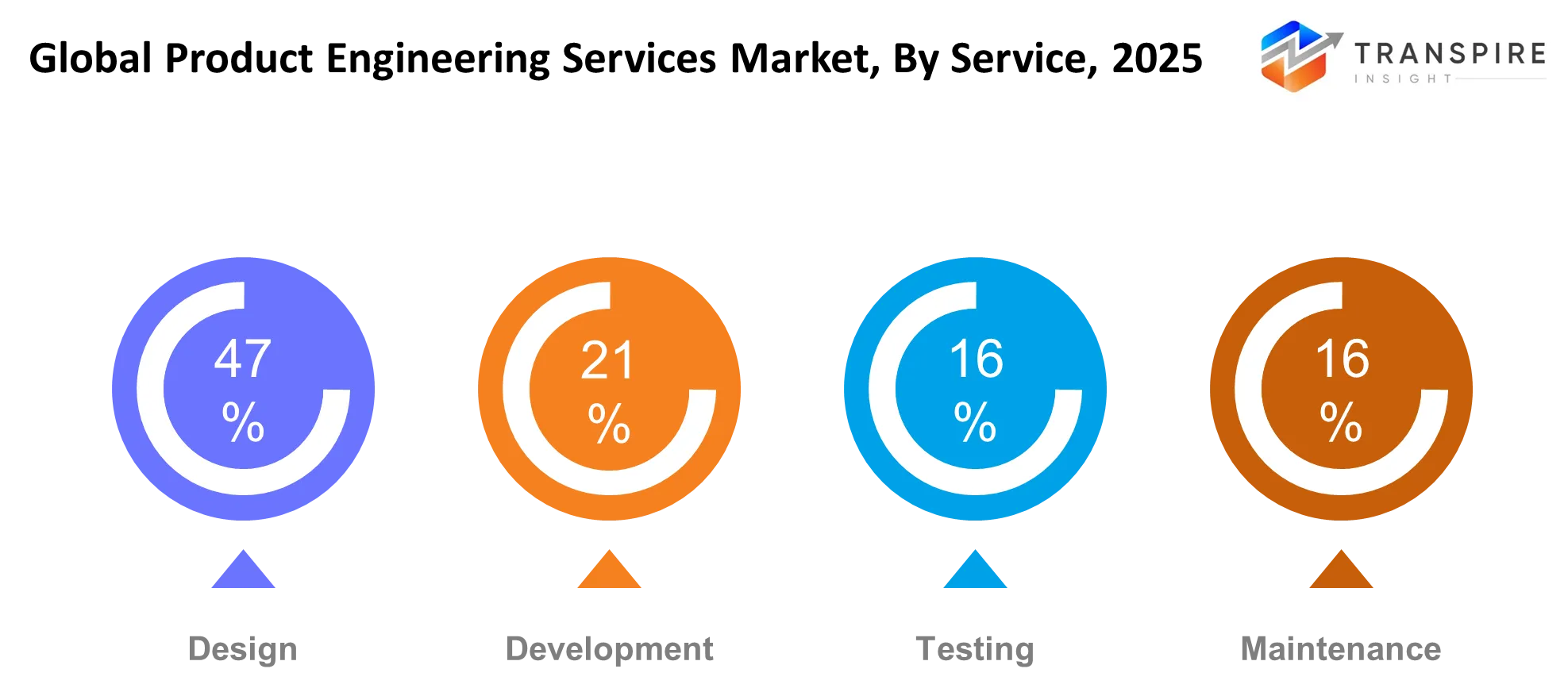
Product engineering services are divided as design (47%), development (21%), testing (16%) and maintenance (16%), with the dominating segment being design. Further, development is divided into sub-segments, with 66�ing core development. The two leading services are design and development, with the latter seeing a CAGR of 8.5% due to the demand for the more mature and software-rich product builds. Testing and quality assurance are also growing, given that companies now focus on safety, performance, and compliance, while maintenance ensures product updates and life cycle management.
To learn more about this report, Download Free Sample Report
By Deployment:
Cloud is the main delivery, allowing scalable and flexible access to product engineering resources, particularly for SMEs and startups. Hybrid deployments, which offer a mix of cloud agility and on-premise security, and on-premise deployments are still being deployed in regulated industries that demand data control. Cloud- and AI-based engineering tools are lowering barriers to entry and accelerating time to market across all segments.
By Application:
Automotive is progressing in electrification, autonomy, and connectivity, requiring complex embedded and software-defined systems. Product engineering companies provide high-reliability design and regulatory-grade testing, as high precision and compliant solutions are needed in IT, healthcare, and manufacturing applications. Cloud-based platforms are becoming more popular in all these industries for design, simulation and testing integration.
By End-User:
Enterprises and OEMs are the largest current end‑users, outsourcing design and development to speed innovation. SMEs and startups are expected to grow at a faster pace, with the help of cloud-based engineering platforms and AI-assisted design, which lowers the cost of accessing advanced product-engineering support.
What are the key use cases driving the Global Product Engineering Services Market?
In the embedded software, battery systems and in-vehicle networks design and integration, PES companies are closely tied to the automotive sector and directly involved in the core use cases of connected mobility and electrification. This allows OEMs to introduce new models more quickly in a way that complies with safety and efficiency requirements.
In addition to auto, the services now include on behalf of smart devices, robots and connected machinery in other sectors such as healthcare, aerospace and industrial automation, that rely on reliable, software-driven architecture and lifecycle support.
The Use cases are just starting to take shape in AI-directed rapid prototyping, products using digital twins for virtual validation, and edge-driven products that process data on the edge, particularly in consumer electronics and smart infrastructure, which reduce physical trials, accelerate iteration, and enable more adaptive, upgradable products.
|
Report Metrics |
Details |
|
Market size value in 2025 |
USD 1253.7 Billion |
|
Market size value in 2026 |
USD 1341.5 Billion |
|
Revenue forecast in 2033 |
USD 2106.3 Million |
|
Growth rate |
CAGR of 6.66% from 2026 to 2033 |
|
Base year |
2025 |
|
Historical data |
2021 - 2024 |
|
Forecast period |
2026 - 2033 |
|
Report coverage |
Revenue forecast, competitive landscape, growth factors, and trends |
|
Regional scope |
United States; Canada; Mexico; United Kingdom; Germany; France; Italy; Spain; Denmark; Sweden; Norway; China; Japan; India; Australia; South Korea; Thailand; Brazil; Argentina; South Africa; Saudi Arabia; United Arab Emirates |
|
Key company profiled |
Accenture, Capgemini, Infosys, TCS, Wipro, Cognizant, HCLTech, IBM, Tech Mahindra, LTTS, EPAM Systems, Globant, Cyient, Alten, Altran |
|
Customization scope |
Free report customization (country, regional & segment scope). Avail customized purchase options to meet your exact research needs. |
|
Report Segmentation |
By Service (Design, Development, Testing, Maintenance), By Deployment (Cloud, On-Premise, Hybrid), By Application (Automotive, IT, Healthcare, Manufacturing), By End-User (Enterprises, OEMs, Startups, SMEs) |
Which Regions Are Driving Growth in the Global Product Engineering Services Market?
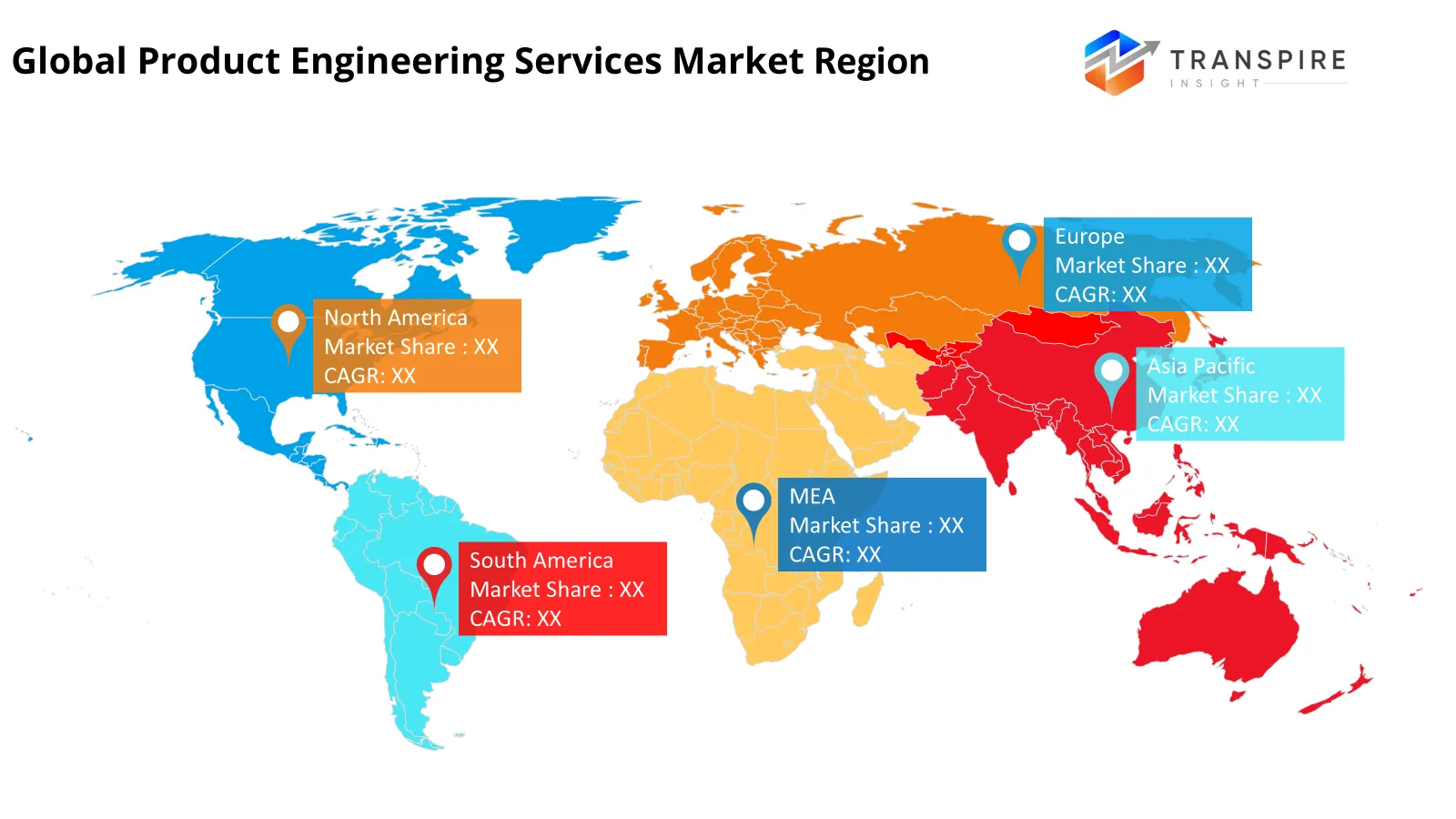
North America leads the Product Engineering Services (PES) market, with 39% of global revenue, due to its robust R&D capabilities, extensive cloud and AI ecosystem, and dense presence of technology-driven OEMs in automotive and healthcare. The region also has a natural advantage in executing high-value engineering work because of its early adoption of Industry, supportive innovation policies, and high public and private R&D spending.
Instance: In January 2026, North America saw continued growth in AI spending, data-centre expansion, and R&D-led engineering activity, with U.S. firms and technology vendors driving demand for connected, upgradeable platforms and advanced product engineering services.
Asia Pacific is the second-largest region, with 18% of the market, supported by digital SMEs, local EV initiatives, and 5G infrastructure growth in India, China, and Southeast Asia. The rise of policy initiatives such as India’s PLI programmes and China’s domestic chip-design push is driving growth in embedded systems and AI-enhanced design services. Advanced semiconductor and IoT-module work that was previously concentrated in the West has increasingly shifted to Vietnam and Malaysia, making the Asia Pacific a preferred destination for scalable, cost-effective product engineering with AI assistance over the next decade.
Instance: In January 2026, Asia Pacific product engineering services expanded as semiconductor, embedded systems, and AI-enabled design work moved increasingly toward Vietnam and Malaysia, while regional demand was supported by digital SMEs, EV initiatives, and 5G growth across India, China, and Southeast Asia
Europe is the fastest-growing region, accounting for 22% of the market, and remains one of the most stable due to strong automotive, aerospace, and industrial manufacturing demand. Compliance is deeply embedded in engineering, with German auto OEMs introducing low-emission, AI-driven vehicles. Manufactured goods have a higher share than in North America, particularly in developed European markets, which are expected to expand at a CAGR of approximately 9.5% in the sub-market despite the lower share. The remainder of the world accounts for 21%, comprising a mix of emerging and still underpenetrated markets.
Instance: In January 2026, Europe’s product engineering services market expanded as companies increased use of simulation, virtual prototyping, AI-enabled testing, and connected design platforms, with Germany remaining a key hub for automotive and industrial engineering demand.
To learn more about this report, Download Free Sample Report
Who are the Key Players in the Global Product Engineering Services Marketand how do they Compete?
The market for Product Engineering Services is highly fragmented, with no single firm controlling a significant share of the market, and most of the growth is from firms establishing their niche rather than from size competition. The vendors need to overcome the broad category of engineering services, and clients are selecting specific strengths; AI-backed design, industry-ready stacks and pricing models are key.
Accenture sees the competition in innovation-driven engineering and is developing a significant AI, automation and digital-twin platform for regulated sectors such as automotive and healthcare. The reason for its expansion is to integrate consulting, cloud and product engineering into a single outcome-based package and by establishing ‘hubs' in North America, Europe and India, anchored by ‘fame' clients. TCS is cost-conscious, with large-scale delivery centres and consistent engineering platforms to ensure product prices remain stable and support the complexity of product programs involving multiple systems. It differentiates with deep industry‑specific blueprints, especially in EVs and telecom, and grows by co‑developing next‑gen platforms with OEMs instead of just resourcing them.
Wipro's embedded, end-to-end engineering and product-to-platform approach, which ties together embedded firmware, cloud integration and AI-driven simulations for industrial and medical-grade products. Its differentiation lies in its ability to combine AI, IoT and sustainability-conscious design in one "stack" and to expand its specialised delivery centres across India as well as in the NESA with new locations to create cost-effective models for global clients.
Key players are:
- Accenture
- Capgemini
- Infosys
- TCS
- Wipro
- Cognizant
- HCLTech
- IBM
- Tech Mahindra
- LTTS
- EPAM Systems
- Globant
- Cyient
- Alten
- Altran
Recent Development News
- In 2025, ipro acquired Harman International’s Digital Transformation unit. This enhanced its engineering and R&D capabilities across aerospace, industrial, automotive, and consumer technology use cases. Source: https://finance.yahoo.com
What Strategic Insights Define the Future of the Global Product Engineering Services Market?
The Product Engineering Services market is moving towards AI‑based, platformdependent product development in which software-defined vehicles, digital twins, and autonomous engineering systems will become the norm rather than the exception. Currently, OEMs and tech companies will increasingly be utilising PES providers as long-term innovation partners, not mere short-term vendors, and directly integrating AI, IoT, and cloud tools into their product lifecycles. The danger is relying too heavily on AI-driven design and testing: In regulated industries such as automotive, medical devices, and others, AI models may fail to capture the nuances of edge cases, resulting in potential quality and safety challenges that are only discovered in the field later.
A new opportunity is sustainability-as-a-service – engineering vendors offering energy-efficient design, circular material choices and carbon impact modelling as part of their core PES offering. Strategically, players should build AI‑augmented, data‑driven engineering platforms with strong validation safeguards, instead of just selling hours of design effort, to capture sticky, high‑margin partnerships.
Key Segmentations are:
By Service
- Design
- Development
- Testing
- Maintenance
By Deployment
- Cloud
- On-Premise
- Hybrid
By Application
- Automotive
- IT
- Healthcare
- Manufacturing
By End-User
- Enterprises
- OEMs
- Startups
- SMEs
Regional Outlook
North America
- United States
- Canada
- Mexico
Europe
- Germany
- United Kingdom
- France
- Spain
- Italy
- Rest of Europe
Asia Pacific
- Japan
- China
- Australia & New Zealand
- South Korea
- India
- Rest of Asia Pacific
South America
- Brazil
- Argentina
- Rest of South America
Middle East & Africa
- Saudi Arabia
- United Arab Emirates
- South Africa
- Rest of the Middle East & Africa
Frequently Asked Questions
Find quick answers to common questions.
The approximate global product engineering services market size for the market will be USD 2106.3 million in 2033.
Key segments are By Service (Design, Development, Testing, Maintenance), By Deployment (Cloud, On-Premise, Hybrid), By Application (Automotive, IT, Healthcare, Manufacturing), By End-User (Enterprises, OEMs, Startups, SMEs).
Major global product engineering services market players are Accenture, Capgemini, Infosys, TCS, Wipro, Cognizant, HCLTech, IBM, Tech Mahindra, LTTS, EPAM Systems, Globant, Cyient, Alten, and Altran.
The global product engineering services market size is USD 1253.7 Million in 2025.
The global product engineering services market CAGR is 6.66%.
- Accenture
- Capgemini
- Infosys
- TCS
- Wipro
- Cognizant
- HCLTech
- IBM
- Tech Mahindra
- LTTS
- EPAM Systems
- Globant
- Cyient
- Alten
- Altran
About the Authors

Mayur Shinde
I am Mayur Shinde, a Senior Research Analyst at Transpire Insight, specializing in the Automotive & Transportation and Information & Communication Technology (ICT) Industry. My work focuses on analyzing emerging market trends, technological advancements, competitive landscapes, and industry developments to deliver accurate, data-driven insights. I am passionate about transforming complex market information into clear, actionable content that helps businesses, professionals, and decision-makers stay informed and make confident strategic decisions.

Chakradhar Khansole
Chakradhar serves as the Research Director at Transpire Insight, bringing over 8 years of experience in technology, innovation, and strategic market intelligence. He specializes in transforming complex market data into actionable business insights that enable organizations to make informed, growth-oriented decisions. Recognized for his strategic vision and analytical expertise, Chakradhar leads high-impact research initiatives, delivering comprehensive market assessments, competitive intelligence, and forward-looking industry analysis.
Recently Published Reports
-
Apr 2026
3D Optical Profiler Market
3D Optical Profiler Market Size, Share & Analysis Report By Type (Desktop 3D Optical Profiler, and Portable 3D Optical Profiler), By Technology (Confocal Technology, and White Light Interference), By End-Use Industry (Manufacturing, Research Institutions, Automotive, Aerospace and Defense, Medical Devices, and Other), and Geography (North America, Europe, Asia-Pacific, Middle East and Africa, South and Central America), 2021 - 2031
-
Apr 2026
Depth Sensor Market
Depth Sensor Market Size, Share & Analysis Report By Type (Infrared Depth Sensors, Time-of-Flight (ToF) Sensors, Stereo Vision Sensors, Structured Light Sensors, Ultrasonic Depth Sensors), By Application (Automotive, Robotics, Gaming, Consumer Electronics, Industrial Automation, Healthcare, Security & Surveillance, Others), By End Users (Automotive Manufacturers, Consumer Electronics Companies, Healthcare Providers, Industrial Companies, Security Agencies, Gaming Companies, Robotics Companies, Others), and Geography (North America, Europe, Asia-Pacific, Middle East and Africa, South and Central America), 2021 – 2031
-
Apr 2026
Digital Manufacturing Market
Digital Manufacturing Market Size, Share & Analysis Report By Component (Hardware, Software, and Services), By Technology (Robotics, 3D Printing, Internet of Things (IoT), and Others), By Application (Automotive and Transportation, Aerospace and Defense, Consumer Electronics, Industrial Machinery, and Others), By Process Type (Computer-Based Designing, Computer-Based Simulation, Computer 3D Visualization, Analytics, and Others), and Geography (North America, Europe, Asia-Pacific, Middle East and Africa, South and Central America), 2021 – 2031
-
Apr 2026
Digital Visa Services Market
Digital Visa Services Market Size, Share & Analysis Report By Type (Individual Travelers, Group Travelers), By Application (Tourism, Business Travel, Others), and Geography (North America, Europe, Asia-Pacific, Middle East and Africa, South and Central America), 2021 – 2031