Middle East and Africa Dental CAD/CAM Market Size & Forecast:
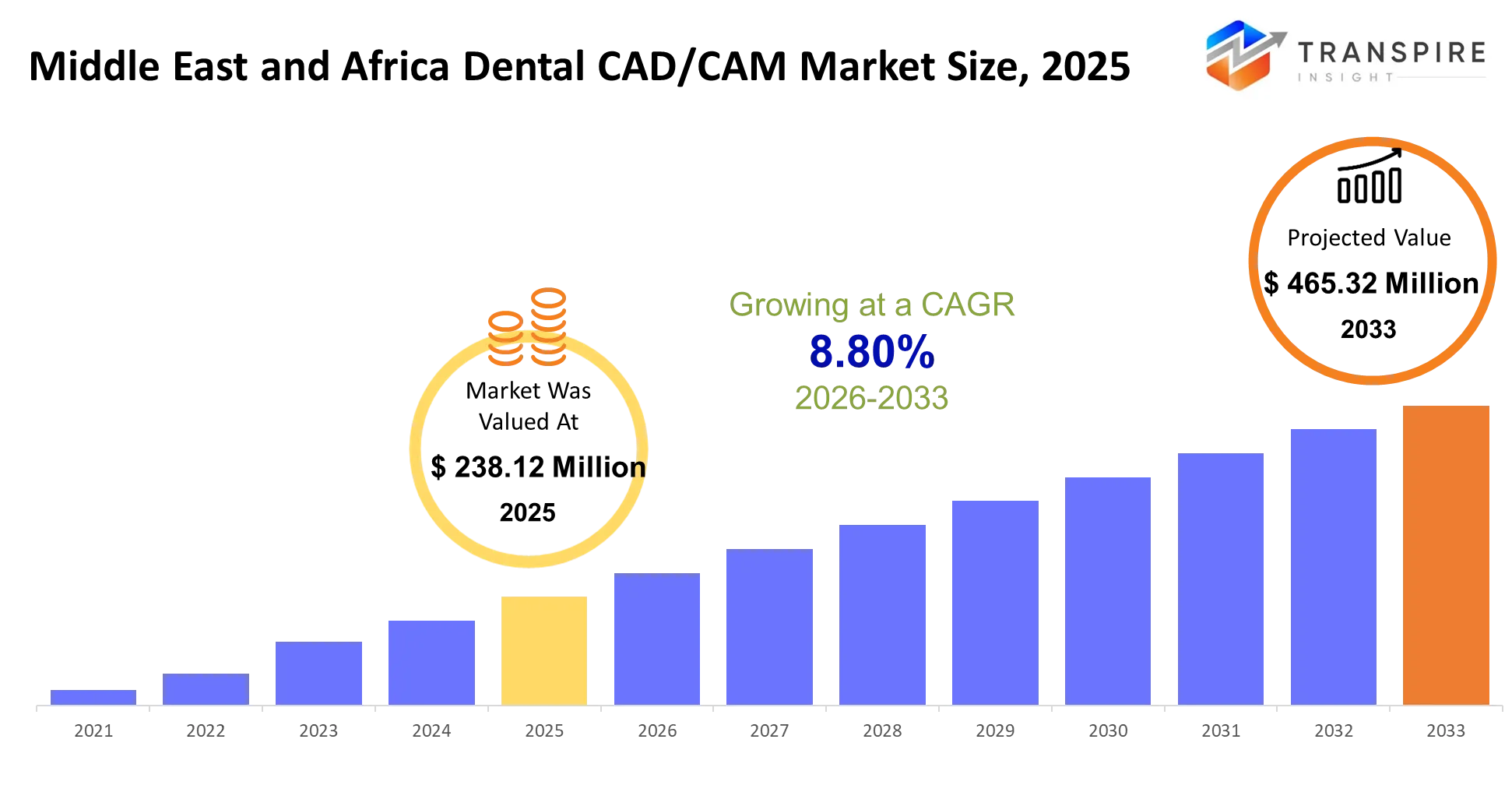
- Middle East and Africa Dental CAD/CAM Market Size 2025: USD 238.12 Million
- Middle East and Africa Dental CAD/CAM Market Size 2033: USD 465.32 Million
- Middle East and Africa Dental CAD/CAM Market CAGR: 8.80%
- Middle East and Africa Dental CAD/CAM Market Segments: By Type (Hardware, Software, Milling Machines, Scanners, Others); By Application (Dental Prosthetics, Orthodontics, Implants, Crowns & Bridges, Veneers, Others); By End-User (Dental Clinics, Hospitals, Dental Labs, Academic Institutes, Others); By Deployment (Chairside Systems, Lab Systems, Hybrid, Others)
To learn more about this report,  Download Free Sample Report
Middle East and Africa Dental CAD/CAM Market Summary
The Middle East and Africa Dental CAD/CAM Market was valued at USD 238.12 Million 2025. It is forecast to reach USD 465.32 Million by 2033. That is a CAGR of 8.80% over the period.
The Middle East and Africa Dental CAD/CAM Market helps dental clinics, hospitals, and laboratories drop manual impressions and outsourced prosthetic making in favor of digital scanning, design, and in-house milling routines. Basically it reduces treatment timelines and makes restoration work more precise, plus it supports same-day crowns, bridges, and implant restorations, most notably where high volume private dental networks are operating.
In the last 3 to 5 years, the market, has been moving more clearly from lab reliant production toward connected chairside ecosystems, driven by intraoral scanners, and CAD software platforms. One big spark, was the post-pandemic upswing in outpatient demand , paired with government health modernization programs in places like the UAE and Saudi Arabia. That combination made clinics digitize quicker so they can keep patient flow steady and also lessen reliance on dental labs across borders.
All of this has tweaked buying behavior too. Clinics now tend to prefer end-to-end solutions, not just standalone gear. So revenue momentum is getting more and more concentrated in packaged digital environments, where devices , software, and services are bundled together. That setup speeds up adoption, and it tends to lock users into ongoing platform based dental workflows , for a longer run.
Key Market Insights
- In 2025, the Middle East holds about 55% share of the Middle East and Africa Dental CAD/CAM market, this is largely driven by Saudi Arabia and UAE dental infrastructure modernization programs, more or less.
- Sub-Saharan Africa comes up as the fastest-growing region during 2026–2033, backed by growing private dental investment and also the spread of urban clinic expansion.
- North Africa looks steady in adoption, supported by gradual healthcare digitization and increasing dental tourism inflows.
- On the segment side, hardware is still the main chunk in the Middle East and Africa Dental CAD/CAM market with more than 45% share, mainly because demand for scanners and milling units stays high.
- Software solutions take the second place, pushed by deeper integration of AI-enabled CAD design platforms into clinical workflows and practices.
- Chairside CAD/CAM systems are the quickest mover segment from 2026–2033, basically due to the same-day restorative dentistry demand, patients want quick results.
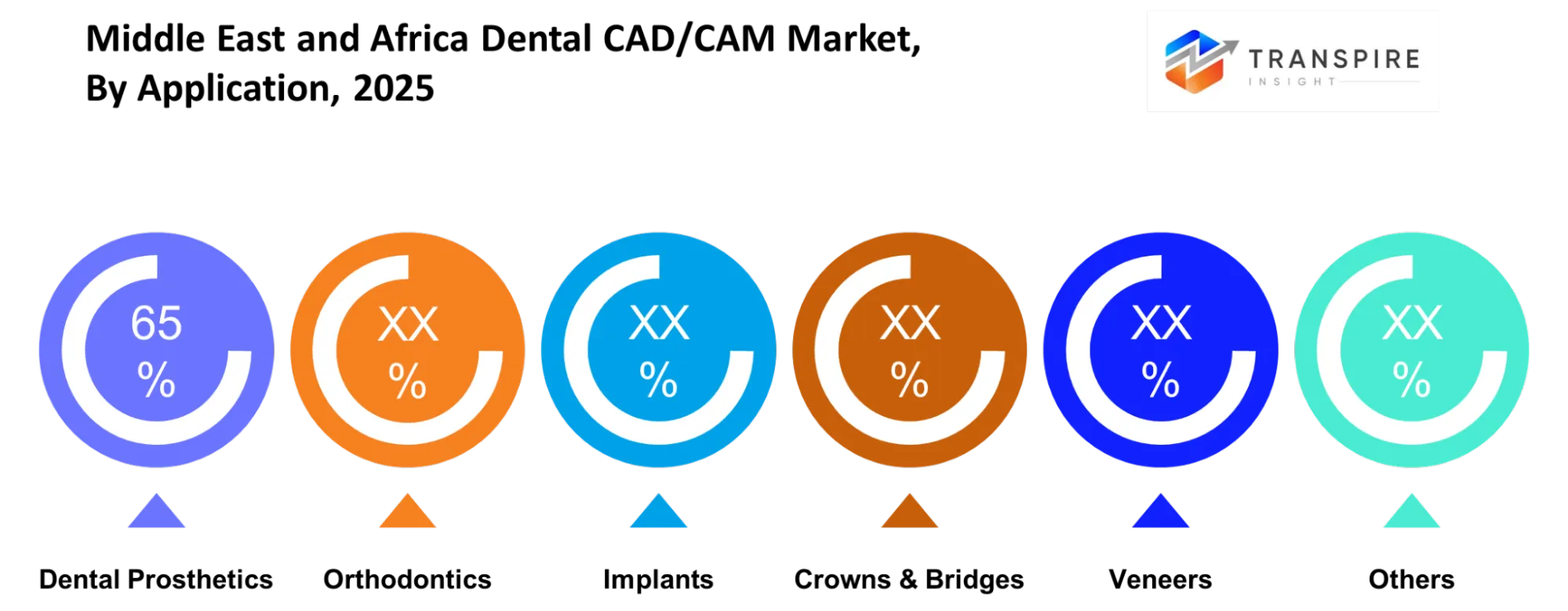
- For applications, crowns and bridges lead with nearly 40% share, which ties back to high restorative procedure volumes in private clinics.
- Orthodontics shows up as the fastest-growing application as clear aligner adoption keeps accelerating across urban dental networks.
- When it comes to end users, dental clinics dominate with over 60% share, driven by heavy outpatient treatment volumes.
- Meanwhile dental laboratories show a strong digital shift toward CAD-driven outsourcing plus 3D printing workflows, slowly but consistently.
What are the Key Drivers, Restraints, and Opportunities in the Middle East and Africa Dental CAD/CAM Market?
The main thing that is, like really speeding up adoption of dental CAD/CAM systems throughout Middle Eastern and African markets is the quick growth of private dental clinic networks, backed by healthcare modernization programs in Gulf economies. In Saudi Arabia and the UAE, governments have pushed incentives for high-end dental tourism and outpatient specialization, and so it sort of triggered a noticeable surge in demand for chairside scanning, milling, plus digital prosthetic workflows. When this happens, it directly lifts revenue for equipment providers, because clinics tend to favor same-day restorative care that needs complete digital integration, not the half way analog style workflows.
The biggest brake is still high capital intensity mixed with uneven technical infrastructure, outside the biggest urban centers. Full CAD/CAM setups depend on dependable broadband connectivity, continuous software licensing and trained technicians, and a lot of secondary towns, plus rural clinics, simply can’t hold that level. Because of that structural issue, adoption timelines get delayed, and demand ends up stuck inside premium urban networks, which in practice suppresses wider volume expansion and narrows market depth even if the headline growth signals look strong.
One real chance is now showing up via modular, cloud-enabled digital dentistry platforms along with lower-cost intraoral scanner devices made for mid-tier clinics. Firms like Straumann and Align Technology are growing ecosystem based solutions so clinics can adopt in phases, rather than buying an entire full system upfront. Also, as financing models get smoother through distributor-led leasing programs in places like the UAE and South Africa, adoption could reach smaller clinics more quickly. Then the “next wave” of scalable digital penetration across the region becomes more possible, overall.
What Has the Impact of Artificial Intelligence Been on the Middle East and Africa Dental CAD/CAM Market?
Artificial intelligence is kinda reshaping dental CAD/CAM workflows in the Middle East and Africa by automating design optimization, scan interpretation, and prosthetic modeling inside more integrated digital dentistry systems. AI driven software within intraoral scanners now cuts down manual margin tracing and it can automatically spot preparation boundaries, so crown and bridge fabrication ends up more consistent. On top of that, cloud based CAD platforms help with case planning by suggesting restoration geometries using historical treatment datasets, and this thing shortens the design cycles plus it lightens the technician workload across dental laboratories and clinic networks.
At the same time predictive analytics is increasingly supporting equipment uptime and workflow efficiency for chairside milling units and scanning devices. Machine learning models track usage patterns and they flag calibration drift or tool wear before anything fails, which reduces unplanned downtime in busy clinics. Early deployments show directional improvements in chairside throughput, and less material waste too as nesting algorithms optimize milling paths for ceramics, and resins—kind of a quiet win. Some hospital based dental centers also apply AI assisted imaging interpretation to improve implant positioning accuracy, and they mention lower revision rates afterward.
Still, AI adoption seems held back by limited high quality regional training data and uneven digital infrastructure across smaller clinics. A lot of systems depend on cloud connectivity for model updates, which creates operational friction in lower bandwidth settings, and that’s a recurring problem. Plus the integration cost for AI enabled CAD/CAM platforms is staying high, so adoption outside premium urban dental networks moves slower, even when people want it.
Key Market Trends
- Private dental clinics have been kind of replacing the old style impressions with intraoral scanning workflows, and this helped a lot with accuracy and honestly cut down the patient appointment cycles since 2023.
- Straumann and Align Technology pushed further into integrated ecosystems, so the competition moved away from hardware sales and more toward bundled digital treatment platforms across various EMEA regions.
- Dental laboratories slowly went from manual prosthetic making to centralized digital design hubs, using CAD software and 3D printing technologies since 2024, with less hassle overall.
- The adoption of chairside milling systems went up across Gulf countries, which lowered the need for outsourcing and made same-day restorative procedures happen faster in premium clinics, too.
- Orthodontic practices expanded clear aligner production by leaning on cloud-based CAD tools, and that replaced manual planning with more automated simulation style workflows in a bunch of urban centers.
- Hospitals shifted into hybrid digital workflows, basically mixing radiology imaging with CAD planning to boost implant accuracy and the surgical results, in general.
- Cheaper intraoral scanners from newer manufacturers increased the price fight, and that pressured the established brands to lean harder on software integration, plus ecosystem lock-in strategies.
- Dental education institutes started integrating CAD/CAM systems into their curricula, which speeds up workforce readiness for digital dentistry across regional healthcare systems.
- 3D printing adoption for prosthetics production grew pretty quickly, and it reduced reliance on outside labs, plus it shortened turnaround times for complicated restorations.
Middle East and Africa Dental CAD/CAM Market Segmentation
By Type
In digital dentistry adoption, Hardware is still in the lead position, mostly because scanners, milling units, and imaging systems have a high upfront value. Many clinics, and also dental chains, tend to focus on the physical infrastructure first, because this hardware really dictates how fast the workflow moves and how precise the treatment turns out to be. Software comes afterward, like a supporting layer, and it is often bundled with the devices so users get locked into certain ecosystems. Milling machines and scanners usually see the most active replacement cycles, since improvements in accuracy are what pushes the purchasing decisions.
This segment grows mostly from the rising need for integrated chairside systems, not so much from standalone parts. Clinics are increasingly choosing bundled hardware packages that cut down compatibility issues, and also reduce the training complexity. On the software side, demand is expanding too, through AI-assisted design tools that lower the need for manual intervention during prosthetic planning. Milling machines also pick up momentum, because in-house production becomes more cost efficient than relying on outsourcing to labs.
Looking ahead, development seems to point toward modular, interoperable hardware ecosystems, where upgrades can be done in phases. Manufacturers that pair open software compatibility with scalable device architectures will likely get stronger traction. Investors may lean toward companies that reduce switching barriers via ecosystem integration, while still leaving room for flexibility. Procurement strategies may shift away from buying a single device at a time, and move more toward adopting long term platforms.
By Application:
Dental prosthetics, like, holds the largest slice because private practices keep asking for crowns, bridges and full arch restorations. There’s also strong adoption of cosmetic dental work, and the aging population pretty much keeps pushing up volume, so the pace stays steady. Crowns and bridges are still the go to procedures, mostly because fabrication can be done quickly when digital workflows are used. Implants come next, as a high value but slightly more specialized application, you know, the kind that needs more targeted planning.
Orthodontics plus implant planning are growing segments, mainly from digital scanning and those treatment simulation tools. Clear aligner methods, in particular, raise the need for very accurate scanning systems, and also cloud based design options. Hospitals and specialty clinics are now folding digital planning into routine care, so surgical precision improves and treatment cycles can shorten. Veneers are also picking up in cosmetic oriented urban clinics, where people often prefer minimally invasive approaches.
In the future, demand will move toward fully digital treatment chains that link diagnosis, planning, and production together. Orthodontic uses should grow fastest since aligner adoption keeps spreading in newer urban markets. Implant workflows will lean more on guided surgery, supported by CAD/CAM imaging data. And developers who can tie together multi application platforms are likely to win more cross segment interest, instead of being stuck in just one corner.
To learn more about this report, Download Free Sample Report
By End-User
Dental clinics are probably the biggest end user group, since chairside systems are picked up pretty fast and the patient workflow is direct, almost like seamless. Private practices usually focus on rapid output, higher profitability, and a nicer patient experience, so CAD/CAM integration becomes kind of a must-have competitive angle. Dental labs, on the other hand, keep a solid role by handling outsourced design and fabrication work coming from smaller clinics. Hospitals add more stable demand but it tends to be lower volume , and it leans toward difficult procedures plus teaching responsibilities.
Clinic growth is pushed by more disposable income and by patient habits that lean toward same-day restorations. Dental labs are also moving, they start leaning toward digital service providers who can manage remote design and 3D printing, instead of the older manual fabrication approach. Academic institutes adopt the technology mainly for education and research , and this supports long-term skill building in digital dentistry. Hospitals are investing in mixed workflows that combine clinical care with specialist prosthetic services, so it’s not just one lane.
In the future, the structure should tilt toward clinics that produce in-house, which means less reliance on outside labs. Labs will gradually transform into digital manufacturing hubs, providing centralized production services. Investors may end up seeing the best returns in service setups that connect clinics and labs through cloud based platforms. And the end user borders might blur, because digital workflows start unifying the treatment side with the production ecosystem , so it all feels more connected than before.
By Deployment
Chairside systems kinda hold the leading position because of solid demand for same-day dental treatments, plus patient convenience. Clinics use these setups to cut down outsourcing expenses and also push higher treatment throughput. Lab systems stay vital for high-volume prosthetic output, and for tougher restorative situations. Hybrid systems are now showing up more, as flexible arrangements that mix in-clinic scanning with external fabrication, so it feels less rigid.
The momentum for chairside rollout is mostly pulled by patients wanting faster procedures and by stronger competition among private clinics. Lab systems keep their footing through bigger contracts with dental chains, and also with hospitals. Hybrid approaches get more attention in mid-sized clinics where a full in-house production investment just isn’t really practical. Improvements in compact milling units help widen the chairside reach, and honestly it makes the whole process feel smoother.
Looking ahead, adoption will lean more toward hybrid and chairside setups as the equipment keeps shrinking in size and getting more affordable. Lab systems will likely move toward centralized production sites, powered by high-speed digital workflows. Manufacturers that build interoperable deployment models should gain better market access. Capital spending will tend to concentrate on adaptable systems that back gradual digital transformation, rather than forcing a full upfront replacement.
What are the Key Use Cases Driving the Middle East and Africa Dental CAD/CAM Market?
The main use case that really pushes dental CAD/CAM adoption across the Middle East and Africa is chairside restorative dentistry , especially same-day crowns, bridges, and veneers inside private dental clinics. The demand looks strongest in wealthier urban areas where people care a lot about quick delivery, polished aesthetics, and fewer appointment rounds. In practice this kind of flow cuts down the usual lab back-and-forth , and it also fits the overall trend of dental tourism plus more premium cosmetic work.
Then there are the more supporting use cases. Think about orthodontic aligner production and implant prosthetics planning , mainly in hospital-led dental departments and specialty clinics. Intraoral scanning paired with digital treatment rehearsal is getting stitched into orthodontic clinics more often now, especially across big private dental groups and teaching hospitals that handle higher patient throughput . You see the same pattern with teams that want reproducible workflows rather than manual steps.
More new or emerging applications are starting to appear too. Fully digital dental labs, for example, are using cloud-based design services and distributed 3D printing networks. There’s also early momentum around preventive dentistry , where AI-assisted diagnostics are derived from CAD/CAM imaging data. These directions are helped along by better digital infrastructure, plus a growing clinical willingness to trust data-driven treatment planning , even when staff are still learning the tools a bit.
|
Report Metrics |
Details |
|
Market size value in 2025 |
USD 238.12 Million |
|
Market size value in 2026 |
USD 257.88 Million |
|
Revenue forecast in 2033 |
USD 465.32 Million |
|
Growth rate |
CAGR of 8.80% from 2026 to 2033 |
|
Base year |
2025 |
|
Historical data |
2021 - 2024 |
|
Forecast period |
2026 - 2033 |
|
Report coverage |
Revenue forecast, competitive landscape, growth factors, and trends |
|
Regional scope |
Middle East and Africa (Saudi Arabia, United Arab Emirates, South Africa, Rest of Middle East and Africa) |
|
Key company profiled |
Dentsply Sirona, Straumann, 3Shape, Planmeca, Align Technology, Ivoclar Vivadent, Carestream Dental, Zimmer Biomet, Henry Schein, GC Corporation, Kuraray Noritake, Amann Girrbach, Vatech, Shofu, Medit |
|
Customization scope |
Free report customization (country, regional & segment scope). Avail customized purchase options to meet your exact research needs. |
|
Report Segmentation |
By Type (Hardware, Software, Milling Machines, Scanners, Others); By Application (Dental Prosthetics, Orthodontics, Implants, Crowns & Bridges, Veneers, Others); By End-User (Dental Clinics, Hospitals, Dental Labs, Academic Institutes, Others); By Deployment (Chairside Systems, Lab Systems, Hybrid, Others) |
Which Regions are Driving the Middle East and Africa Dental CAD/CAM Market Growth?
The Middle East is still, like pretty much the dominant region across the MEA dental CAD/CAM market, and it’s pushed by aggressive healthcare modernization efforts in the UAE and Saudi Arabia. At the same time there’s a private dental clinic network growing fast, almost like steadily, but then all at once. In these markets, governments really back digital dentistry uptake, via hospital upgrades , licensing reforms, and medical tourism strategies that basically push for high quality cosmetic and restorative work. All of that forms a solid ecosystem: premium dental chains, advanced training institutes and distributor networks, working together to speed up CAD/CAM penetration. So adoption isn’t only technology-led, it’s also reinforced by policy alignment and a high level of patient willingness to pay for same day dental solutions.
South Africa looks a bit more stable, but it grows slower, and the driver is more about a mature private healthcare space, plus consistent procurement patterns inside well established dental practices. Here, unlike the Middle East, you don’t see growth coming from huge new infrastructure rollouts so much. Instead it’s more about incremental replacement: moving from analog workflows into digital scanning and milling systems, step by step. Insurance linked patient care, and also the strong university hospital framework, keep demand steady, even when capital investment cycles get tighter. That ends up creating a predictable, but still moderate, kind of growth environment, where suppliers compete on service dependability and long term equipment support more than rapid scale expansion.
Sub Saharan Africa is starting to pull ahead as the fastest-growing area, mainly because more money is going into private healthcare infrastructure and awareness of digital dental solutions is rising across city hubs like Nairobi, and Lagos.Recent improvements in internet connectivity, financing models for medical devices and even the entry of lower cost CAD/CAM systems have let clinics sort of sidestep the old, traditional lab dependency. This whole change also seems to get pushed along by training programs that keep expanding, plus donor backed oral health initiatives, which, in practice, help build clinical capacity. For market entrants and investors, this region feels like high-risk, but still high upside type of place, over the 2026–2033 period since adoption should move from those isolated pilot clinics into wider commercial networks.
Who are the Key Players in the Middle East and Africa Dental CAD/CAM Market and How Do They Compete?
Competition in the Middle East and Africa dental CAD/CAM market is kinda moderately consolidated at the top, where global manufacturers keep pushing integrated digital ecosystems, and clinics labs mostly lean on scattered local distributors, plus service providers. Over time the competitive focus seems to move away from just device pricing, more toward end to end workflow integration, with big attention on scan precision, interoperability, and financing setups that lower upfront adoption costs a bit, you know.
Straumann Group builds its advantage via the Straumann AXS cloud platform, and also the MIDAS chairside 3D printing, basically connecting planning, scanning, and production in one flow across EMEA clinics. Align Technology counters with iTero Lumina scanners that are tied to Invisalign planning, which helps strengthen orthodontic–restorative integration in Gulf markets. Dentsply Sirona holds ground using CEREC systems, concentrating on same day chairside milling and a wide clinical training network, that supports adoption in private practices.
Planmeca folds imaging and CAD/CAM together in platforms like Planmeca FIT, aimed at clinics that really prefer radiology-led diagnostics, and it also expands through distributor partnerships across Gulf healthcare networks. Meanwhile 3Shape keeps leaning on open architecture TRIOS scanners and lab software, supporting compatibility with multiple milling systems, and that helps its standing among independent dental laboratories through partnerships with manufacturing and design service providers.
Company List
- Dentsply Sirona
- Straumann
- 3Shape
- Planmeca
- Align Technology
- Ivoclar Vivadent
- Carestream Dental
- Zimmer Biomet
- Henry Schein
- GC Corporation
- Kuraray Noritake
- Amann Girrbach
- Vatech
- Shofu
- Medit
Recent Development News
“In March 2025, Straumann Group launched its Straumann AXS digital dentistry platform across Europe, the Middle East and Africa. The cloud-based ecosystem integrates intraoral scanning, AI-driven planning, and chairside workflows, strengthening end-to-end CAD/CAM adoption in the region’s clinics and supporting faster restorative turnaround times.https://www.straumann.com
“In September 2025, Align Technology announced the regional availability of its iTero Lumina intraoral scanner portfolio across the Middle East, including UAE, Kuwait, Bahrain, Qatar, and Oman. The launch enhances high-precision digital impression capture for CAD/CAM restorative and orthodontic workflows, accelerating chairside digitization in emerging Gulf dental networks.https://www.zawya.com
What Strategic Insights Define the Future of the Middle East and Africa Dental CAD/CAM Market?
The Middle East and Africa dental CAD/CAM market is likely to shift , kinda like, from import dependent adoption toward more localized digital manufacturing ecosystems , pushed by rising dental tourism, growing private dental chains and government backed healthcare modernization. Over the next 5 to 7 years, the real structural force behind this transition will be cost compression along with higher, faster chairside workflow expectations, so clinics start integrating in house milling and 3D printing rather than outsourcing prosthetics, and you can see how that becomes the norm.
A not so obvious risk sits in the software–hardware ecosystem concentration, where the reliance on a few global CAD platforms could make regional providers feel pricing power , licensing restrictions , or even interoperability bottlenecks at the wrong time. At the same time, a kind of early but high potential opportunity is showing up, it’s a hybrid cloud based CAD design service model paired with distributed micro labs in secondary cities , enabled by improving broadband infrastructure and AI assisted design automation.
Strategically, market participants should lean into modular, vendor agnostic systems that let them integrate the digital stack step by step , keeping room for scalability without locking clinics into one single platform dependency while demand is still building.
Middle East and Africa Dental CAD/CAM Market Report Segmentation
By Type
- Hardware
- Software
- Milling Machines
- Scanners
- Others
By Application
- Dental Prosthetics
- Orthodontics
- Implants
- Crowns & Bridges
- Veneers
- Others
By End-User
- Dental Clinics
- Hospitals
- Dental Labs
- Academic Institutes
- Others
By Deployment
- Chairside Systems
- Lab Systems
- Hybrid
- Others
Frequently Asked Questions
Find quick answers to common questions.
The estimated Middle East and Africa Dental CAD/CAM Market size is USD 465.32 Million in 2033.
Key segments for the Middle East and Africa Dental CAD/CAM Market are By Type (Hardware, Software, Milling Machines, Scanners, Others); By Application (Dental Prosthetics, Orthodontics, Implants, Crowns & Bridges, Veneers, Others); By End-User (Dental Clinics, Hospitals, Dental Labs, Academic Institutes, Others); By Deployment (Chairside Systems, Lab Systems, Hybrid, Others).
Major Middle East and Africa Dental CAD/CAM Market players are Dentsply Sirona, Straumann, 3Shape, Planmeca, Align Technology, Ivoclar Vivadent, Carestream Dental, Zimmer Biomet, Henry Schein, GC Corporation, Kuraray Noritake, Amann Girrbach, Vatech, Shofu, Medit.
The Middle East and Africa Dental CAD/CAM Market size is USD 238.12 Million in 2025.
The Middle East and Africa Dental CAD/CAM Market CAGR is 8.80% from 2026 to 2033.
- Dentsply Sirona
- Straumann
- 3Shape
- Planmeca
- Align Technology
- Ivoclar Vivadent
- Carestream Dental
- Zimmer Biomet
- Henry Schein
- GC Corporation
- Kuraray Noritake
- Amann Girrbach
- Vatech
- Shofu
- Medit
Recently Published Reports
-
Apr 2026
AI in Diabetic Retinopathy Market
AI in Diabetic Retinopathy Market Size, Share & Analysis Report By Type (Screening AI Systems, Diagnostic AI Systems, and Predictive AI Models), By Application Segment (Hospitals, Ophthalmology Clinics, Diagnostic Centers, and Research and Development), and Geography (North America, Europe, Asia-Pacific, Middle East and Africa, South and Central America), 2021 - 2031
-
Apr 2026
Psychometric Tests Market
Psychometric Tests Market Size, Share & Analysis Report By Type (Personality Tests, Ability/Aptitude Tests, Skill/Knowledge Tests, and Others), By Application (Talent Acquisition and Talent Management), and Geography (North America, Europe, Asia-Pacific, Middle East and Africa, South and Central America), 2021 – 2031
-
Apr 2026
Rare Biological Sample Collection Market
Rare Biological Sample Collection Market Size, Share & Analysis Report By Type (Isolation Kits & Reagent, Blood Collection Tubes, and Others), By Application (Oncology, Transcriptomics, Pharmacogenomics, and Others), and Geography (North America, Europe, Asia-Pacific, Middle East and Africa, South and Central America), 2021 – 2031
-
Apr 2026
Patient Lift Pendant Market
Patient Lift Pendant Market By Product Type (Wired Pendants, Wireless, Programmable), By Operation Type(Manual, Electric), By End-Users (Healthcare Professionals, Patients), By Application (Hospitals, Homecare, Rehabilitation Centers, Others), By Industry Analysis, Size, Share, Growth, Trends, and Forecasts 2021-2033
Our Clients
.jpg)